Diversity of Endophytic Fungal Strains from Jeju Aquatic Plants
Yoosun Oh, Hye Yeon Mun, Jaeduk Goh and Namil Chung*
Fungal Resources Research Division, Freshwater Bioresources Research Bureau, Nakdonggang National Institute of Biological Resources, Sangju-si, Gyeongsangbuk-do 37242, Korea
Received February 8, 2017 /Revised May 8, 2017 /Accepted May 23, 2017
Endophytic fungi are present in host plants and contribute to resistance to biotic and abiotic stress.
Aquatic plants are living in aquatic environment such as saltwater or freshwater and exposed more water stress than other land plants. In this study, we investigated 4 wetlands in Jeju and collected 11 aquatic plants. Exogenous microbes were removed by preprocessing of plants and endophytic fun- gal strains were isolated from the plants. We isolated 126 fungal strains from Namsaengi-pond, 22 fungal strains from Sujangdong-marsh, 44 fungal strains from Yongsu-reservoir and 32 fungal strains from Gangjeongcheon. The fungal strains were identified using internal transcribed spacer (ITS) region and analyzed the phylogeny and diversity. Endophytic fungi isolated from plants of Namsaengi-pond were classified to 30 genera, 19 families, 12 orders, 7 classes and 4 phyla. Endophytic fungi of Sujang- dong-marsh were classified to 11 genera, 11 families, 6 orders, 5 classes and 4 phyla. Endophytic fungi of Yongsu-reservoir were classified to 13 genera, 12 families, 7 orders, 5 classes and 4 phyla. Endo- phytic fungi isolated from Gangjeongcheon were classified to 9 genera, 7 families, 5 orders, 2 classes and 1 phyla. Overall, they were divided 40 genera and Alternaria, Colletotrichum and Fusarium were isolated from 4 sites in common. By investigating the endophytic fungi in aquatic plants, it is for base- line data that determination of diversity and the ecological distribution of endophytic fungi.
Key words : Aquatic plants, diversity, endophytic fungi, Jeju, phylogenetic analysis
*Corresponding author
*Tel : +82-54-530-0850, Fax : +82-530-0859
*E-mail : [email protected]
This is an Open-Access article distributed under the terms of the Creative Commons Attribution Non-Commercial License (http://creativecommons.org/licenses/by-nc/3.0) which permits unrestricted non-commercial use, distribution, and reproduction in any medium, provided the original work is properly cited.
Journal of Life Science 2017 Vol. 27. No. 6. 661~672 DOI : https://doi.org/10.5352/JLS.2017.27.6.661
서 론
식물체 내에 서식하는 내생균류는 식물의 뿌리, 줄기, 잎 내에 존재하며 식물과 공생을 이루며 살아간다. 숙주식물 내 에서 병원균이나 초식동물(herbivores)의 공격과 같은 생물학 적 스트레스나 열, 바람, 가뭄과 같은 비생물학적 스트레스로 부터 숙주식물이 저항성을 갖도록 도와준다. 내생균류가 없는 경우 식물은 영양획득이 부족해지고 생물적, 비생물적 스트레 스에 대한 낮은 저항성으로 잎에 백화현상이 일어나거나 광합 성 부족 등으로 병에 쉽게 걸리게 된다[8].
내생균류가 식물의 줄기부패에 대한 식물의 방어 호르몬 분비 시그널 네트워크에 관여하는 것에 대한 연구가 이루어 지고 있고, 생물학적 스트레스 정도를 알 수 있는 살리실산 (SA)과 자스몬산(JA)의 양이 줄어드는 것이 확인되었다[14].
또한 식물 내생균은 병원균에 대해서 숙주식물을 보호하는 물질을 분비하고[2], 내생균류의 이차대사산물은 항생과 항산 화 활성이 있으므로 생물활성화합물의 재료로서 이용가능성
또한 밝혀졌다[10]. 또한 내생균류는 고농도의 지질층을 가져 바이오연료로써 촉망된다[11]. 따라서 국내 내생균류에 대한 활발한 연구가 시급하다. 본 연구에서는 수생식물에서 내생균 류를 분리 및 동정하여 균류의 다양성을 분석함으로써 향후 내생균류 연구의 기초자료를 마련하였다.
재료 및 방법
시료 채집
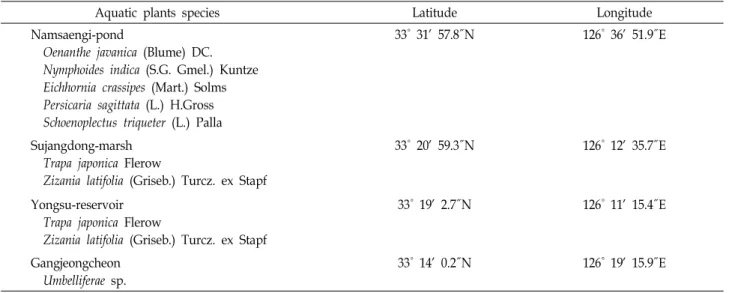
본 연구에서는 내생균류를 분리하기 위해 특이서식지인 제 주의 4개의 습지에서 시료 채집을 하였다. 남생이못에서 5개 체, 수장동습지에서 2개체, 용수저수지에서 2개체, 강정천에 서 1개체의 수생·수변식물을 채집하였다(Table 1).
내생균류 분리 및 동정
채집한 수생식물의 뿌리에서 내생균류를 분리하기 위해 뿌 리의 외부를 Tween 80과 1% 차아산염소나트륨(NaOCl)을 이 용하여 표면소독 하였다. 세척한 뿌리를 1 cm로 잘라 Hagem- Media (HM; H2O, KH2PO4, NH4Cl, MgSO4·7H2O, C6H12O6, maltextract, FeCl3)에 올려 25℃에서 일주일간 배양하였다. 자 른 뿌리 단면에 균사가 나타나면 순수분리를 위해 백금이를 이용하여 HM배지에 계대배양 하였다(25℃, 7일). 분리한 균의 균체 확보를 위해 Potato Dextrose Agar (PDA, Difco, USA)에 계대배양 하였다(25℃, 7일)[4].
Table 1. The scientific name of aquatic plants and sampling site
Aquatic plants species Latitude Longitude
Namsaengi-pond
Oenanthe javanica (Blume) DC.
Nymphoides indica (S.G. Gmel.) Kuntze Eichhornia crassipes (Mart.) Solms Persicaria sagittata (L.) H.Gross Schoenoplectus triqueter (L.) Palla
33˚ 31' 57.8˝N 126˚ 36' 51.9˝E
Sujangdong-marsh Trapa japonica Flerow
Zizania latifolia (Griseb.) Turcz. ex Stapf
33˚ 20' 59.3˝N 126˚ 12' 35.7˝E
Yongsu-reservoir Trapa japonica Flerow
Zizania latifolia (Griseb.) Turcz. ex Stapf
33˚ 19' 2.7˝N 126˚ 11' 15.4˝E
Gangjeongcheon Umbelliferae sp.
33˚ 14' 0.2˝N 126˚ 19' 15.9˝E
분리한 내생균류의 동정을 위해 DNA를 추출하여 분석하 였다. 플레이트에 배양하여 얻은 균체를 Nucleo PlantⅡ kit (MACHEREY-NAGEL, Germany)를 이용하여 genomic DNA 를 추출하였다. 추출된 genomic DNA는 ITS1과 ITS4 primer 를 이용하여 internal transcription region (ITS)영역을 증폭하 였다. PCR 조건은 predenaturation을 95℃에서 2분간 한 뒤 denaturation (95℃, 30 sec), annealing (55℃, 1min), extension (72℃, 1 min)을 35사이클 반복하였고 final extension은 72℃
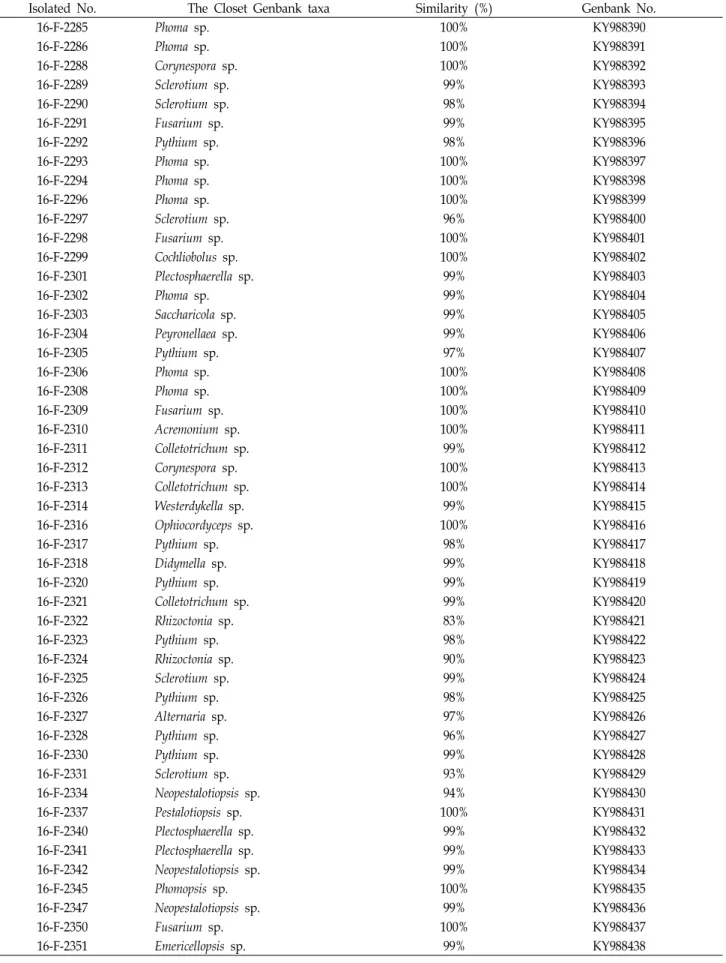
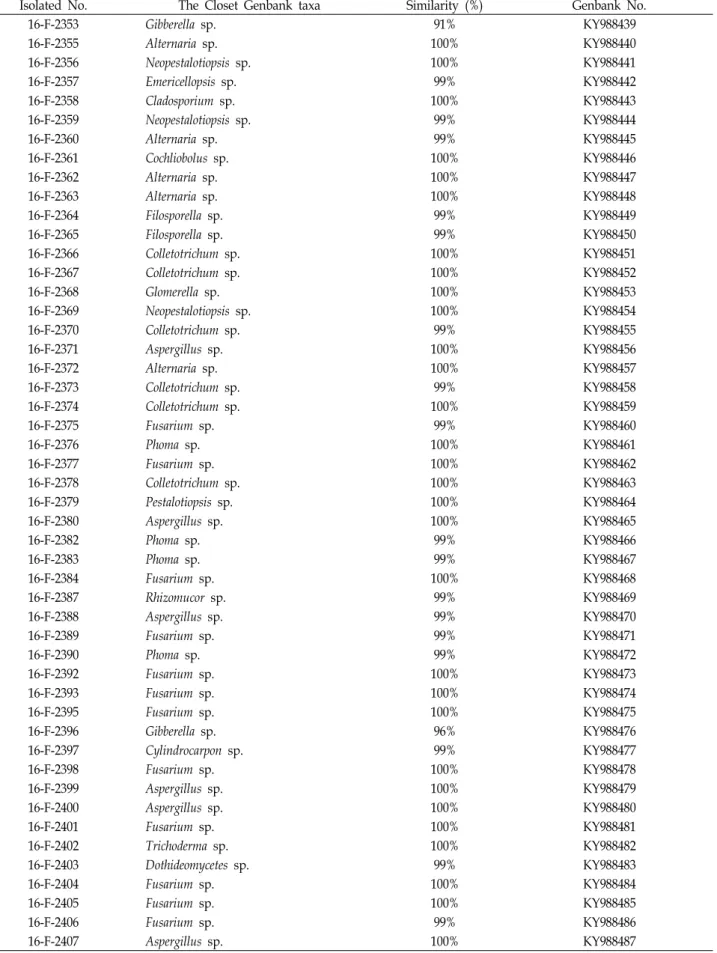
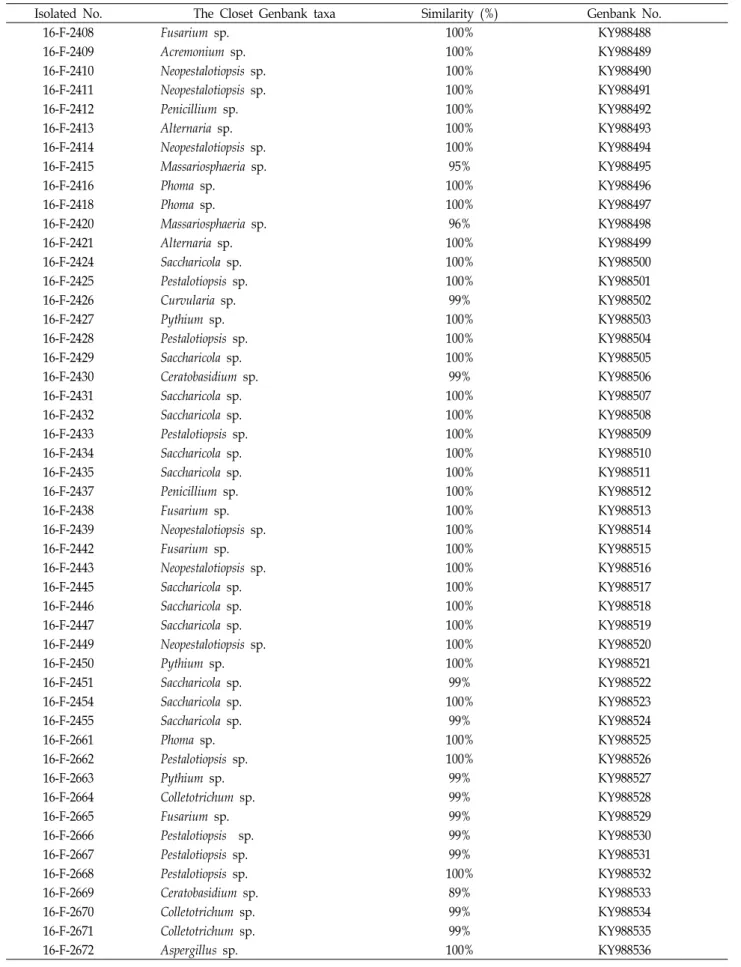
에서 7분간 수행하였다. PCR 산물은 Safe-Pinky DNA Gel Staining Solution (GenDEPOT)을 첨가한 1% agarose gel에서 전기영동하여 확인하였고 염기서열 분석을 의뢰하였다 (Macrogen, Daejeon, Korea). 염기서열을 NCBI blast tool을 이용하여 유사도가 가장 높은 종을 기준으로 분리한 균류를 분자생물학적 방법으로 동정하였다. 계통수 내 위상을 확인하 기 위해 계통관계 분석을 수행하였다. Bootstrap analysis는 1,000 replicates를 선택하였고, neighbor-joining method로 MEGA7을 이용하여 계통수를 완성하였다[5]. 분리된 내생균류 는 NCBI Genbank의 accession number를 부여받았다(Table 2).
분리한 내생균류의 다양성 분석
분리한 균의 다양성을 분석하기 위해 다양성 지수를 이용하 였다. Shannon’s diversity index (H')는 분리된 균의 다양성을 나타내고[12], Pielou evenness index (J')는 분리된 균이 시료 로부터 균등하게 분리된 정도를 의미한다[9]. 그리고 Menhi- nick’s richness index (Dmn)는 분리된 균의 풍부도를 의미하여 [15] 위 세 가지의 다양성 지수를 이용하여 다양성 분석을 진행 하였다[13].
결과 및 고찰
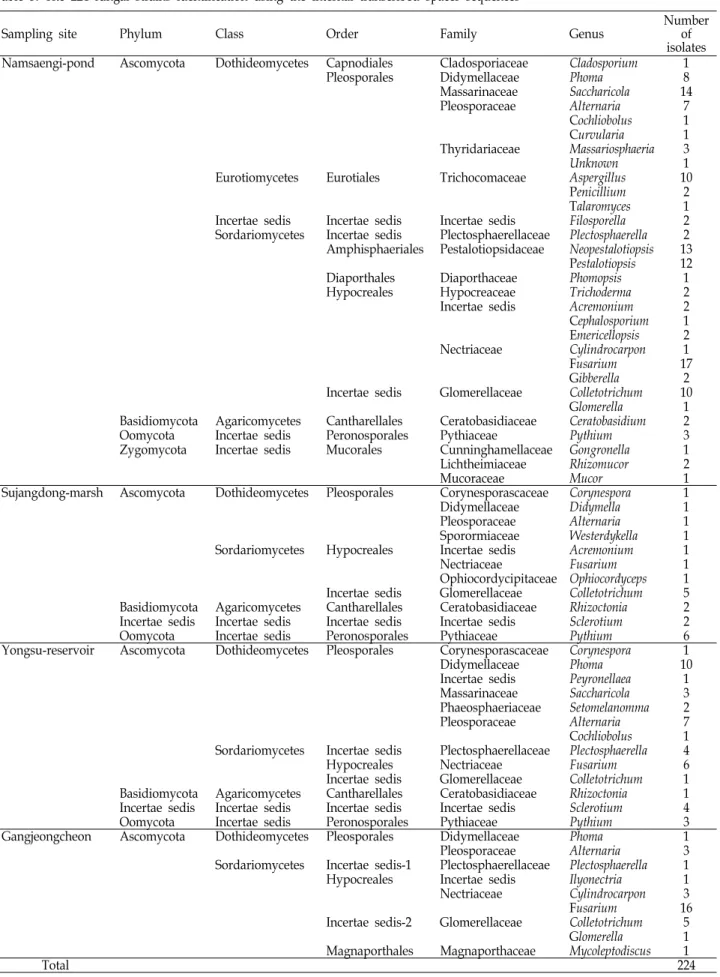
남생이못에서 125개 균주, 수장동습지에서 22개 균주, 용수 저수지에서 44개 균주, 강정천에서 32개 균주가 분리되었다 (Table 3).
남생이못에서 채집한 5종의 식물의 뿌리에서 분리된 균류 는 Ascomycota문, Basidiomycota문, Oomycota문, Zygomy- cota문에 속했다. Ascomycota문의 Dothideomycetes강의 Pleosporales목에 속하는 Didymellaceae과의 Phoma속, Mas- sarinaceae과의 saccharicola속, Pleosporaceae과의 Alternaria속, Cochliobolus속, Curvularia속, 그리고 Thyridariaceae과의 Mas- sariosphaeria속, Capnodiales목의 Cladosporiaceae과의 Clado- sporium속, Eurotiomycetes강의 Eurotiales목의 Trichocoma- ceae과에 속하는 Aspergillus속, Penicillium속, Talaromyces속으 로 확인되었다. 또한 Ascomycota문 이하의 분류체계가 정해 지지 않은 Incertae sedis의 Filosporella속이 확인되었다. Filo- sporella속은 수생균류로 수생식물의 경우 수생환경의 균과 공 생을 이루는 것을 알 수 있다[1]. 그리고 Sordariomycetes강의 Hypocreales목의 Hypocreaceae과의 Trichoderma속과 Nectri- aceae과의 Cylindrocarpon속, Fusarium속, Gibberella속, 그리고 과 수준의 분류체계가 정해지지 않은 Acremonium속, Cephalo- sporium속, Emericellopsis속이 확인되었고 Amphisphaeriales 목의 Pestalotiopsidaceae과의 Pestalotiopsis속과 Neopestalo- tiopsis속이 확인되었다. 또한 같은 강의 Diaporthales목의 Diaporthaceae과의 Phomopsis속과 목 수준의 분류체계가 정해 지지 않은 Plectospaerellaceae과의 Plectosphaerella속과 Glo- merellaceae과의 Colletotrichum속과 Glomerella속이 확인되었 다. Basidiomycota문의 Agaricomycetes강의 Cantharellales목 의 Ceratobasidiaceae과의 Ceratobasidium속이 확인되었고, Oomycota문의 강 수준의 분류체계가 정해지지 않은 Perono-
Table 2. Fungal strains isolated from aquatic plants in Jeju, Korea
Isolated No. The Closet Genbank taxa Similarity (%) Genbank No.
16-F-2220 Colletotrichum sp. 100% KY988341
16-F-2221 Plectosphaerella sp. 99% KY988342
16-F-2222 Fusarium sp. 99% KY988343
16-F-2223 Fusarium sp. 99% KY988344
16-F-2224 Fusarium sp. 100% KY988345
16-F-2225 Fusarium sp. 99% KY988346
16-F-2226 Colletotrichum sp. 100% KY988347
16-F-2227 Cylindrocarpon sp. 100% KY988348
16-F-2228 Fusarium sp. 100% KY988349
16-F-2231 Glomerella sp. 99% KY988350
16-F-2232 Alternaria sp. 100% KY988351
16-F-2233 Alternaria sp. 95% KY988352
16-F-2234 Fusarium sp. 100% KY988353
16-F-2235 Ilyonectria sp. 99% KY988354
16-F-2236 Fusarium sp. 100% KY988355
16-F-2237 Fusarium sp. 99% KY988356
16-F-2239 Cylindrocarpon sp. 99% KY988357
16-F-2240 Mycoleptodiscus sp. 99% KY988358
16-F-2241 Fusarium sp. 99% KY988359
16-F-2242 Colletotrichum sp. 100% KY988360
16-F-2243 Colletotrichum sp. 100% KY988361
16-F-2244 Fusarium sp. 99% KY988362
16-F-2245 Cylindrocarpon sp. 99% KY988363
16-F-2247 Fusarium sp. 100% KY988364
16-F-2248 Phoma sp. 100% KY988365
16-F-2249 Colletotrichum sp. 100% KY988366
16-F-2250 Fusarium sp. 100% KY988367
16-F-2251 Fusarium sp. 99% KY988368
16-F-2252 Alternaria sp. 100% KY988369
16-F-2253 Fusarium sp. 100% KY988370
16-F-2259 Saccharicola sp. 99% KY988371
16-F-2260 Plectosphaerella sp. 98% KY988372
16-F-2263 Plectosphaerella sp. 99% KY988373
16-F-2265 Colletotrichum sp. 100% KY988374
16-F-2266 Fusarium sp. 100% KY988375
16-F-2267 Setomelanomma sp. 94% KY988376
16-F-2268 Fusarium sp. 100% KY988377
16-F-2269 Saccharicola sp. 99% KY988378
16-F-2271 Alternaria sp. 100% KY988379
16-F-2272 Plectosphaerella sp. 99% KY988380
16-F-2273 Fusarium sp. 100% KY988381
16-F-2274 Alternaria sp. 100% KY988382
16-F-2275 Fusarium sp. 100% KY988383
16-F-2276 Phoma sp. 100% KY988384
16-F-2277 Setomelanomma sp. 94% KY988385
16-F-2279 Alternaria sp. 97% KY988386
16-F-2280 Phoma sp. 100% KY988387
16-F-2282 Sclerotium sp. 98% KY988388
16-F-2283 Rhizoctonia sp. 78% KY988389
Table 2. Continued
Isolated No. The Closet Genbank taxa Similarity (%) Genbank No.
16-F-2285 Phoma sp. 100% KY988390
16-F-2286 Phoma sp. 100% KY988391
16-F-2288 Corynespora sp. 100% KY988392
16-F-2289 Sclerotium sp. 99% KY988393
16-F-2290 Sclerotium sp. 98% KY988394
16-F-2291 Fusarium sp. 99% KY988395
16-F-2292 Pythium sp. 98% KY988396
16-F-2293 Phoma sp. 100% KY988397
16-F-2294 Phoma sp. 100% KY988398
16-F-2296 Phoma sp. 100% KY988399
16-F-2297 Sclerotium sp. 96% KY988400
16-F-2298 Fusarium sp. 100% KY988401
16-F-2299 Cochliobolus sp. 100% KY988402
16-F-2301 Plectosphaerella sp. 99% KY988403
16-F-2302 Phoma sp. 99% KY988404
16-F-2303 Saccharicola sp. 99% KY988405
16-F-2304 Peyronellaea sp. 99% KY988406
16-F-2305 Pythium sp. 97% KY988407
16-F-2306 Phoma sp. 100% KY988408
16-F-2308 Phoma sp. 100% KY988409
16-F-2309 Fusarium sp. 100% KY988410
16-F-2310 Acremonium sp. 100% KY988411
16-F-2311 Colletotrichum sp. 99% KY988412
16-F-2312 Corynespora sp. 100% KY988413
16-F-2313 Colletotrichum sp. 100% KY988414
16-F-2314 Westerdykella sp. 99% KY988415
16-F-2316 Ophiocordyceps sp. 100% KY988416
16-F-2317 Pythium sp. 98% KY988417
16-F-2318 Didymella sp. 99% KY988418
16-F-2320 Pythium sp. 99% KY988419
16-F-2321 Colletotrichum sp. 99% KY988420
16-F-2322 Rhizoctonia sp. 83% KY988421
16-F-2323 Pythium sp. 98% KY988422
16-F-2324 Rhizoctonia sp. 90% KY988423
16-F-2325 Sclerotium sp. 99% KY988424
16-F-2326 Pythium sp. 98% KY988425
16-F-2327 Alternaria sp. 97% KY988426
16-F-2328 Pythium sp. 96% KY988427
16-F-2330 Pythium sp. 99% KY988428
16-F-2331 Sclerotium sp. 93% KY988429
16-F-2334 Neopestalotiopsis sp. 94% KY988430
16-F-2337 Pestalotiopsis sp. 100% KY988431
16-F-2340 Plectosphaerella sp. 99% KY988432
16-F-2341 Plectosphaerella sp. 99% KY988433
16-F-2342 Neopestalotiopsis sp. 99% KY988434
16-F-2345 Phomopsis sp. 100% KY988435
16-F-2347 Neopestalotiopsis sp. 99% KY988436
16-F-2350 Fusarium sp. 100% KY988437
16-F-2351 Emericellopsis sp. 99% KY988438
Table 2. Continued
Isolated No. The Closet Genbank taxa Similarity (%) Genbank No.
16-F-2353 Gibberella sp. 91% KY988439
16-F-2355 Alternaria sp. 100% KY988440
16-F-2356 Neopestalotiopsis sp. 100% KY988441
16-F-2357 Emericellopsis sp. 99% KY988442
16-F-2358 Cladosporium sp. 100% KY988443
16-F-2359 Neopestalotiopsis sp. 99% KY988444
16-F-2360 Alternaria sp. 99% KY988445
16-F-2361 Cochliobolus sp. 100% KY988446
16-F-2362 Alternaria sp. 100% KY988447
16-F-2363 Alternaria sp. 100% KY988448
16-F-2364 Filosporella sp. 99% KY988449
16-F-2365 Filosporella sp. 99% KY988450
16-F-2366 Colletotrichum sp. 100% KY988451
16-F-2367 Colletotrichum sp. 100% KY988452
16-F-2368 Glomerella sp. 100% KY988453
16-F-2369 Neopestalotiopsis sp. 100% KY988454
16-F-2370 Colletotrichum sp. 99% KY988455
16-F-2371 Aspergillus sp. 100% KY988456
16-F-2372 Alternaria sp. 100% KY988457
16-F-2373 Colletotrichum sp. 99% KY988458
16-F-2374 Colletotrichum sp. 100% KY988459
16-F-2375 Fusarium sp. 99% KY988460
16-F-2376 Phoma sp. 100% KY988461
16-F-2377 Fusarium sp. 100% KY988462
16-F-2378 Colletotrichum sp. 100% KY988463
16-F-2379 Pestalotiopsis sp. 100% KY988464
16-F-2380 Aspergillus sp. 100% KY988465
16-F-2382 Phoma sp. 99% KY988466
16-F-2383 Phoma sp. 99% KY988467
16-F-2384 Fusarium sp. 100% KY988468
16-F-2387 Rhizomucor sp. 99% KY988469
16-F-2388 Aspergillus sp. 99% KY988470
16-F-2389 Fusarium sp. 99% KY988471
16-F-2390 Phoma sp. 99% KY988472
16-F-2392 Fusarium sp. 100% KY988473
16-F-2393 Fusarium sp. 100% KY988474
16-F-2395 Fusarium sp. 100% KY988475
16-F-2396 Gibberella sp. 96% KY988476
16-F-2397 Cylindrocarpon sp. 99% KY988477
16-F-2398 Fusarium sp. 100% KY988478
16-F-2399 Aspergillus sp. 100% KY988479
16-F-2400 Aspergillus sp. 100% KY988480
16-F-2401 Fusarium sp. 100% KY988481
16-F-2402 Trichoderma sp. 100% KY988482
16-F-2403 Dothideomycetes sp. 99% KY988483
16-F-2404 Fusarium sp. 100% KY988484
16-F-2405 Fusarium sp. 100% KY988485
16-F-2406 Fusarium sp. 99% KY988486
16-F-2407 Aspergillus sp. 100% KY988487
Table 2. Continued
Isolated No. The Closet Genbank taxa Similarity (%) Genbank No.
16-F-2408 Fusarium sp. 100% KY988488
16-F-2409 Acremonium sp. 100% KY988489
16-F-2410 Neopestalotiopsis sp. 100% KY988490
16-F-2411 Neopestalotiopsis sp. 100% KY988491
16-F-2412 Penicillium sp. 100% KY988492
16-F-2413 Alternaria sp. 100% KY988493
16-F-2414 Neopestalotiopsis sp. 100% KY988494
16-F-2415 Massariosphaeria sp. 95% KY988495
16-F-2416 Phoma sp. 100% KY988496
16-F-2418 Phoma sp. 100% KY988497
16-F-2420 Massariosphaeria sp. 96% KY988498
16-F-2421 Alternaria sp. 100% KY988499
16-F-2424 Saccharicola sp. 100% KY988500
16-F-2425 Pestalotiopsis sp. 100% KY988501
16-F-2426 Curvularia sp. 99% KY988502
16-F-2427 Pythium sp. 100% KY988503
16-F-2428 Pestalotiopsis sp. 100% KY988504
16-F-2429 Saccharicola sp. 100% KY988505
16-F-2430 Ceratobasidium sp. 99% KY988506
16-F-2431 Saccharicola sp. 100% KY988507
16-F-2432 Saccharicola sp. 100% KY988508
16-F-2433 Pestalotiopsis sp. 100% KY988509
16-F-2434 Saccharicola sp. 100% KY988510
16-F-2435 Saccharicola sp. 100% KY988511
16-F-2437 Penicillium sp. 100% KY988512
16-F-2438 Fusarium sp. 100% KY988513
16-F-2439 Neopestalotiopsis sp. 100% KY988514
16-F-2442 Fusarium sp. 100% KY988515
16-F-2443 Neopestalotiopsis sp. 100% KY988516
16-F-2445 Saccharicola sp. 100% KY988517
16-F-2446 Saccharicola sp. 100% KY988518
16-F-2447 Saccharicola sp. 100% KY988519
16-F-2449 Neopestalotiopsis sp. 100% KY988520
16-F-2450 Pythium sp. 100% KY988521
16-F-2451 Saccharicola sp. 99% KY988522
16-F-2454 Saccharicola sp. 100% KY988523
16-F-2455 Saccharicola sp. 99% KY988524
16-F-2661 Phoma sp. 100% KY988525
16-F-2662 Pestalotiopsis sp. 100% KY988526
16-F-2663 Pythium sp. 99% KY988527
16-F-2664 Colletotrichum sp. 99% KY988528
16-F-2665 Fusarium sp. 99% KY988529
16-F-2666 Pestalotiopsis sp. 99% KY988530
16-F-2667 Pestalotiopsis sp. 99% KY988531
16-F-2668 Pestalotiopsis sp. 100% KY988532
16-F-2669 Ceratobasidium sp. 89% KY988533
16-F-2670 Colletotrichum sp. 99% KY988534
16-F-2671 Colletotrichum sp. 99% KY988535
16-F-2672 Aspergillus sp. 100% KY988536
Table 2. Continued
Isolated No. The Closet Genbank taxa Similarity (%) Genbank No.
16-F-2673 Rhizomucor sp. 99% KY988537
16-F-2674 Aspergillus sp. 99% KY988538
16-F-2675 Gongronella sp. 100% KY988539
16-F-2676 Pestalotiopsis sp. 100% KY988540
16-F-2677 Talaromyces sp. 99% KY988541
16-F-2678 Phoma sp. 100% KY988542
16-F-2679 Trichoderma sp. 99% KY988543
16-F-2680 Aspergillus sp. 100% KY988544
16-F-2681 Aspergillus sp. 100% KY988545
16-F-2682 Mucor sp. 100% KY988546
16-F-2683 Massariosphaeria sp. 96% KY988547
16-F-2684 Cephalosporium sp. 99% KY988548
16-F-2685 Pestalotiopsis sp. 100% KY988549
16-F-2686 Neopestalotiopsis sp. 100% KY988550
16-F-2687 Saccharicola sp. 100% KY988551
16-F-2688 Acremonium sp. 99% KY988552
16-F-2689 Colletotrichum sp. 99% KY988553
16-F-2690 Saccharicola sp. 100% KY988554
16-F-2691 Pestalotiopsis sp. 100% KY988555
16-F-2692 Colletotrichum sp. 99% KY988556
16-F-2693 Colletotrichum sp. 99% KY988557
16-F-2694 Fusarium sp. 99% KY988558
16-F-2695 Fusarium sp. 99% KY988559
16-F-2696 Alternaria sp. 100% KY988560
16-F-2697 Alternaria sp. 100% KY988561
16-F-2698 Alternaria sp. 100% KY988562
16-F-2699 Alternaria sp. 98% KY988563
16-F-2700 Pythium sp. 99% KY988564
sporales목의 Pythiaceae과의 Pythium속이 확인되었다. 그리 고 Zygomycota문의 강 수준의 분류체계가 정해지지 않은 Mucorales목의 Cunninghamellaceae과의 Congronella속과 Li- chtheimiaceae과의 Rhizomucor속, Mucoraceae과의 Mucor속 이 확인되었다.
수장동습지에서 채집한 두 종의 식물에서 분리한 내생균류 는 Ascomycota문의 Dothideomycetes강의 Pleosporales목의 Corynesporascaceae과의 Corynespora속, Didymellaceae과의 Didymella속, Pleosporaceae과의 Alternaria속, Sporormiaceae 과의 Westerdykella속이 확인되었다. Sordariomycetes강의 Hy- pocreales목의 Nectriaceae과의 Fusarium속, Ophiocordyxipi- taceae과의 Ophiocordyceps속, 과 수준의 분류체계가 정해지지 않은 Acremonium속이 확인되었다. 같은 강의 목 수준의 분류 체계가 정해지지 않은 Glomerellaceae과의 Colletotrichum속이 확인 되었다. Basidiomycota문의 Agaricomycetes강의 Can- tharellales목의 Ceratobasidiaceae과의 Rhizotonia속이 확인되 었고 Oomycota문의 강수준의 분류체계가 정해지지 않은 Peronosporales목의 Pythiaceae과의 Pythium속이 확인되었
다. 그리고 과 이상의 분류체계가 정해지지 않은 Sclerotium속 이 확인 되었다.
용수저수지에서 채집한 두 종의 식물에서 분리한 내생균류 는 Ascomycota문의 Dothideomycetes강의 Pleosporales목의 Corynesporascaceae과의 Corynespora속, Didymellaceae과의 Phoma속, Massarinaceae과의 Saccharicola속, Phaeosphaeria- ceae과의 Setomelanomma속, Pleosporaceae과의 Alternaria속과 Cochliobolus속, 그리고 과 수준의 분류체계가 정해지지 않은 Peyronellaea속이 확인되었다. Sordariomycetes강의 Hypocre- ales목의 Nectriaceae과의 Fusarium속, 목 수준의 분류체계가 정해지지 않은 Plectosphaerellaceae과의 Plectosphaerella속과 Glomerellaceae과의 Colletotrichum속이 확인되었다. Basidio- mycota문의 Agaricomycetes강의 Cantharellales목의 Cerato- basidiaceae과의 Rhizoctonia속이 확인되었고 Oomycota문의 강 수준의 분류체계가 정해지지 않은 Peronosporales목의 Pythiaceae과의 Pythium속이 확인되었다. 또한 과 이상의 분 류체계가 정해지지 않은 Sclerotium속이 확인되었다. 수장동습 지와 용수저수지에서 채집한 식물은 같은 종으로 다른 채집지
Table 3. The 224 fungal strains identification using the internal transcribed spacer sequences
Sampling site Phylum Class Order Family Genus Number
of isolates Namsaengi-pond Ascomycota Dothideomycetes Capnodiales Cladosporiaceae Cladosporium 1
Pleosporales Didymellaceae Phoma 8
Massarinaceae Saccharicola 14
Pleosporaceae Alternaria 7
Cochliobolus 1
Curvularia 1
Thyridariaceae Massariosphaeria 3
Unknown 1
Eurotiomycetes Eurotiales Trichocomaceae Aspergillus 10
Penicillium 2
Talaromyces 1
Incertae sedis Incertae sedis Incertae sedis Filosporella 2 Sordariomycetes Incertae sedis Plectosphaerellaceae Plectosphaerella 2 Amphisphaeriales Pestalotiopsidaceae Neopestalotiopsis 13
Pestalotiopsis 12
Diaporthales Diaporthaceae Phomopsis 1
Hypocreales Hypocreaceae Trichoderma 2
Incertae sedis Acremonium 2
Cephalosporium 1 Emericellopsis 2
Nectriaceae Cylindrocarpon 1
Fusarium 17
Gibberella 2
Incertae sedis Glomerellaceae Colletotrichum 10
Glomerella 1
Basidiomycota Agaricomycetes Cantharellales Ceratobasidiaceae Ceratobasidium 2
Oomycota Incertae sedis Peronosporales Pythiaceae Pythium 3
Zygomycota Incertae sedis Mucorales Cunninghamellaceae Gongronella 1
Lichtheimiaceae Rhizomucor 2
Mucoraceae Mucor 1
Sujangdong-marsh Ascomycota Dothideomycetes Pleosporales Corynesporascaceae Corynespora 1
Didymellaceae Didymella 1
Pleosporaceae Alternaria 1
Sporormiaceae Westerdykella 1 Sordariomycetes Hypocreales Incertae sedis Acremonium 1
Nectriaceae Fusarium 1
Ophiocordycipitaceae Ophiocordyceps 1 Incertae sedis Glomerellaceae Colletotrichum 5 Basidiomycota Agaricomycetes Cantharellales Ceratobasidiaceae Rhizoctonia 2 Incertae sedis Incertae sedis Incertae sedis Incertae sedis Sclerotium 2
Oomycota Incertae sedis Peronosporales Pythiaceae Pythium 6
Yongsu-reservoir Ascomycota Dothideomycetes Pleosporales Corynesporascaceae Corynespora 1
Didymellaceae Phoma 10
Incertae sedis Peyronellaea 1
Massarinaceae Saccharicola 3
Phaeosphaeriaceae Setomelanomma 2
Pleosporaceae Alternaria 7
Cochliobolus 1 Sordariomycetes Incertae sedis Plectosphaerellaceae Plectosphaerella 4
Hypocreales Nectriaceae Fusarium 6
Incertae sedis Glomerellaceae Colletotrichum 1 Basidiomycota Agaricomycetes Cantharellales Ceratobasidiaceae Rhizoctonia 1 Incertae sedis Incertae sedis Incertae sedis Incertae sedis Sclerotium 4
Oomycota Incertae sedis Peronosporales Pythiaceae Pythium 3
Gangjeongcheon Ascomycota Dothideomycetes Pleosporales Didymellaceae Phoma 1
Pleosporaceae Alternaria 3
Sordariomycetes Incertae sedis-1 Plectosphaerellaceae Plectosphaerella 1
Hypocreales Incertae sedis Ilyonectria 1
Nectriaceae Cylindrocarpon 3
Fusarium 16
Incertae sedis-2 Glomerellaceae Colletotrichum 5
Glomerella 1
Magnaporthales Magnaporthaceae Mycoleptodiscus 1
Total 224
A B
Fig. 1. Phylogenetic analysis of endophytic fungal strains isolated from Jeju aquatic plants. The starins of Ascomycota at the phylum level (A), (B), Basidiomycota (C), Oomycota (D), Zygomycota (E). The treewas constructed using the neighbor-joining method with 1,000 replicates. Ceratobasidium sp. (A, B), Alternaria porri (C, E) and Pythium multisporum (D) were used as an outgroup.
C
D
E
Fig. 1. Continued
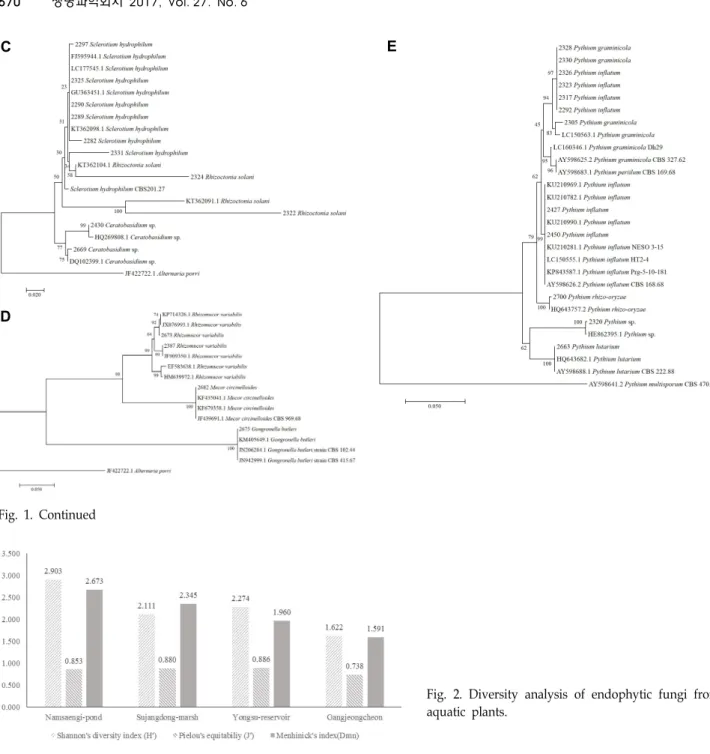
Fig. 2. Diversity analysis of endophytic fungi from aquatic plants.
의 식물에서는 분리되지 않았지만 두 지역의 식물에서만 분리 된 균류가 존재하였다. Corynespora cassiicola, Rhizoctonia sol- ani, Sclerotium hydrophilum으로 식물에 내생하며 식물에 병을 일으키는 균류이다[3, 7, 16].
강정천에서 채집한 한 종의 식물에서 분리한 내생균류는 모두 Ascomycota문으로 확인되었다. Dothideomycetes강의 Pleosporales목의 Didymellaceae과의 Phoma속, Pleospor- aceae과의 Alternaria속이 확인되었고 Sordariomycetes강의 Hypocreales목의 Nectriaceae과의 Cylindrocarpon속과 Fusa- rium속, 그리고 과 수준의 분류체계가 정해지지 않은 Ilyonec- tria속이 확인되었다. 같은 강의 Magnaporthales목의 Magna- porthaceae과의 Mycoleptodiscus속이 확인되었고 목 수준의 분
류체계가 정해지지 않은 Plectosphaerellaceae과의 Plectos- phaerella속, Glomerellaceae과의 Colletotrichum속과 Glomerella 속이 확인되었다.
속(genus) 수준에서 보면, 남생이못에서 30개 속, 수장동습 지에서 11개 속, 용수저수지에서 13개 속, 강정천에서 9개 속 이 분리되었다. 제주에서 분리된 전체 균주 224개의 균들의 50.4%가 Ascomycota문의 Sordariomycetes강이었고 30.8%가 Ascomycota문의 Dothideomycetes강이었다. 4개 지점에서 분 리된 균들에 Sodariomycetes강과 Dothideomycetes강이 높은 비율을 차지하였다. 강정천을 제외한 3개 습지에서는 Basidiomycota문과 Oomycota문에 속하는 균 또한 낮은 비율 로 분리 되었다. 이외 남생이못에서는 Zygomycota문에 속하
는 균도 분리되었다(Fig. 1).
분리된 균의 다양성의 경우 남생이못(H'=2.903), 용수저수 지(H'=2.274), 수장동습지(H'=2.111), 강정천(H' =1.622) 순이 었다. 분리된 균의 수가 많을수록 다양성 지수 또한 높아졌지 만 강정천과 수장동습지에서 분리된 균의 다양성을 비교해볼 때 분리한 균의 수와 H'의 값이 항상 비례하는 것은 아니므로 다양성 지수를 이용한 분리된 균의 다양성 비교는 필요하다.
분리된 균의 균등도는 Pielou evenness index를 이용하여 분 석하였다. 용수저수지(J'=0.886)에서 분리된 균이 가장 균등하 게 분리되었고 수장동습지(J'=0.880), 남생이못(J'=0.853), 강정 천(J'=0.738) 순이었다. 4 개의 습지에서 분리된 균의 풍부도는 남생이못(Dmn=2.673)이 가장 높은 값으로 다른 지점과 비교했 을 때 균이 풍부하게 분리되었고, 그 다음은 수장동습지(Dmn= 2.345), 용수저수지(Dmn=1.960), 강정천(Dmn=1.591) 순으로 나 타났다(Fig. 2). 남생이못과 강정천의 우점속(dominant genus) 은 Fusarium이었고 수장동습지는 Pythium, 용수저수지는 Phoma였다. 4개의 습지에서 모두 공통적으로 분리된 속은 Alternaria, Colletotrichum, Fusarium이었다. 전체 224개 균이 분 리된 가운데 4지점에서 공통적으로 분리된 균이 위의 3개속에 그치는 것으로 볼 때 다양한 지역에서의 시료확보와 내생균류 의 분리의 필요성이 보인다. 그리고 일반적으로 내생균류의 다양성은 숙주식물, 분포지, 주변 환경인자 등에 영향을 받으 며[2], 내생균류는 이차대사산물의 저장소로 생물학적 활성을 갖는다[10]. 또한, 식물체 내에서 영양분흡수, 질소고정의 역할 을 하고 수생환경에서 식물의 수분스트레스에 저항력을 갖는 것에도 기여한다[6]. 하지만 수생식물에 존재하는 내생균류에 대한 연구는 미비했다. 따라서 본 연구와 후속연구를 통해 다른 지역의 수생식물에서 내생균류를 분리함으로써 내생균류의 다 양한 생태학적 분포와 다양성 규명이 가능 할 것으로 본다.
감사의 글
This study was supported by a grant of the Nakdonggang National Institute of Biological Resources (project: the survey and discovery of freshwater bioresources; NNIBR, 2016) of the Republic of Korea.
References
1. Baschien, C., T sui, C. K.., Gulis, V., Szewzyk, U. and Marvanová, L. 2013. The molecular phylogeny of aquatic
hyphomycetes with affinity to the Leotiomycetes. Fungal Biol. 9, 660-672.
2. Brum, M. C., Araújo, W. L., Maki, C. S. and Azevedo, J.
L. 2012. Endophytic fungi from Vitis labrusca L. (‘Niagara Rosada’) and its potential for the biological control of Fusarium oxysporum. Genet. Mol. Res. 11, 4187-4197.
3. Dixon, L. J., Schlub, R. L., Pernezny, K. and Datnoff, L. E.
2009. Host Specialization and Phylogenetic Diversity of Corynespora cassiicola. Mycology 9, 1015-1027.
4. Kil, Y. J., Eo, J. K. and Eom, A. H. 2009. Molecular identi- fication and diversity of endophytic fungi isolated from Pinus densiflora in Boeun, Korea. Kor. J. Mycol. 37, 130-133.
5. Kumar, S., Stecher, G. and Tamura, K. 2016. MEGA7:
Molecular Evolutionary Genetics Analysis version 7.0 for bigger datasets. Mol. Biol. Evol. 33, 1870-1874.
6. Li, H. Y., Zhao, C. A., Liu, C. J. and Xu, X. F. 2010. Endophytic fungi diversity of aquatic/riparian plants and their anti- fungal activity in vitro. J. Microbiol. 48, pp1-6.
7. Parmeter, J. R. 1970. Rhizoctonia solani, biology and pathology.
London, UK: University of California.
8. Partida-Martínez, L. P. and Heil, M. 2011. The microbie-free plant: fact or artifact? Front. Plant. Sci. 2, 100.
9. Pielou, E. C. 1975. Ecological diversity. New York: John Wiley & Sons.
10. Sadrati, N., Duoud, H., Zerroug, A., Duhamna, S. and Bouharati, S. 2013. Screening of antimicrobial and anti- oxidant secondary metabolites from endophytic fungi iso- lated from wheat (Triticum durum). J. Plant. Prot. Res. 53, DOI:https://doi.org/10.2478/jppr-2013-0019.
11. Santos, F., Florisvaldo, C., Taicia, P. F., Joanita, N., Marcos, R. M. and Edson, R. F. 2011. Endophytic fungi as a source of biofuel precursors. J. Microbiol. Biotechnol. 21, 728-733.
12. Shannon, C. E. 1948. A mathematical theory of communica- tion. Bell. Syst. Tech. J. 24, 379-423.
13. Shirood, M. F., Ghorbani, R. and Montajami, S. 2013. A Comparative study of different biological indices sensitivity:
a case of study of macroinvertebrates of Gomishan wetland, Iran. World J. Fish Marine Sci. 5, 611-615.
14. Waqas, M., Khan, A. L., Muhammad, H., Shahzad, R., Kang, S. M., Kim, J. G. and Lee, I. J. 2015. Endophytic fungi pro- mote plant growth and mitigate the adverse effects of stem rot: an example of Penicillium citrinum and Aspergillus terreus. J. Plant Interact. 10, 280-287.
15. Whittaker, R. H. 1977. Evolution of species diversity in land communities. Evol. Biol. 10, 1-67.
16. Xu, Z., Harrington, T. C., Gleason, M. L. and Batzer, J. C.
2010. Phylogenetic placement of plant pathogenic Sclerotium species among teleomorph genera. Mycologia 102, 337-346.
초록:제주 수생식물에서 분리한 내생균류의 다양성
오유선․문혜연․고재덕․정남일*
(국립낙동강생물자원관 담수생물조사연구실 균류자원조사부)
내생균류는 숙주식물 내에서 생물학적 그리고 비생물학적 스트레스로부터 저항성을 갖는데 도움을 준다. 수생 식물은 수생환경에 서식하며 육상식물보다 수분스트레스에 더 많이 노출되어있다. 본 연구에서는 제주에 있는 남생이못, 수장동습지, 용수저수지, 강정천 4개의 습지에서 11개의 수생·수변식물을 채집하여 연구하였다. 전처리 를 통해 식물 외생균을 제거하고 뿌리에서 내생균류를 분리하였다. 남생이못에서 126균주, 수장동습지에서 22균 주, 용수저수지에서 44균주, 강정천에서 32균주가 분리되어 총 224개의 내생균류를 분리하였다. 분리된 균은 ITS 를 이용해 동정한 후, 다양성 분석을 하였다. 남생이못에서 분리된 내생균류는 4개 문(Phylum), 7개 강(class), 12 개 목(order), 19개 과(family), 30개 속(genus)로 구분되었다. 수장동습지에서 분리된 내생균류는 4개 문, 5개 강, 6개 목, 11개 과, 11개 속으로 구분되었으며, 용수저수지에서 분리된 내생균류는 4개 문, 5개 강, 7개 목, 12개 과, 13개 속으로 구분되었다. 강정천에서 분리된 내생균류는 1개 문, 2개 강, 5개 목, 7개 과, 9개 속으로 구분되었다.
4개의 습지에서 공통으로 분리된 속은 Alternaria속, Colletotrichum속, Fusarium속이었다. 향후 내생균류의 다양한 생태학적 분포와 다양성 규명에 대한 연구에 기초자료로 이용될 것이다.