Field Bioassay for Longhorn Pine Sawyer Beetle Monochamus alternatus (Coleoptera: Cerambycidae) in Korea Based on Aggregation Pheromone 2-(Undecyloxy)ethanol
Sung-Min Lee
1, Do Kyung Hong
2, Jongseong Park
3, Jinho Lee
3, Sei-Heon Jang
2and ChangWoo Lee
2*
1Gyeongsangbuk-do Forest Environment Research Institute, Gyeongju 38174, Korea
2Department of Biomedical Science and Center for Bio-Nanomaterials, Daegu University, Gyeongsan 38453, Korea
3Department of Chemistry, Keimyung University, Daegu 42601, Korea
Received September 18, 2015 /Revised October 20, 2015 /Accepted October 27, 2015
The pinewood nematode Bursaphelenchus xylophilus (Nematoda: Parasitaphelenchidae) poses a serious threat to pine forests in Europe and East Asia, leading to a debilitating pine wilt disease. Infected pine trees in Korea are generally fumigated or crushed to small wood chips after felling. Although pine wilt disease often recurs in pest management sites, there are no adequate means to monitor the effec- tiveness of pest control measures in those sites. Recently, a male-produced aggregation pheromone, 2-(undecyloxy)ethanol, was shown to be useful for attracting several Monochamus species, which are vectors for the pinewood nematodes. In this study, we investigated the abilities of 2-(undecyloxy)etha- nol at three different doses (175, 350, and 700 mg), as well as host plant volatiles (α-pinene and etha- nol), to attract M. alternatus (Coleoptera: Cerambycidae) at a pine forest in Pohang, Korea where in- fected pine trees had been cut down and fumigated. Twenty-seven M. alternatus were captured in cross-vane panel traps made of polyethylene terephthalate bottles and acrylic sheets. The results in- dicate that a high dose of 2-(undecyloxy)ethanol (700 mg per trap) is the most effective for attracting M. alternatus. The aggregation pheromone could be used to monitor the effectiveness of pest control measures as well as M. alternatus populations.
Key words :
Aggregation pheromone, cross-vane panel trap, Monochamus alternatus, pine wilt disease, pinewood nematode
*Corresponding author
*Tel : +82-53-850-6464 , Fax : +82-53-850-6469
*E-mail : [email protected]
This is an Open-Access article distributed under the terms of the Creative Commons Attribution Non-Commercial License (http://creativecommons.org/licenses/by-nc/3.0) which permits unrestricted non-commercial use, distribution, and reproduction in any medium, provided the original work is properly cited.
Journal of Life Science 2015 Vol. 25. No. 12. 1445~1449 DOI : http://dx.doi.org/10.5352/JLS.2015.25.12.1445
Introduction
Pine wilt disease, which blocks the circulation of water and nutrients in pine trees, is caused by the pinewood nem- atode Bursaphelenchus xylophilus (Nematoda: Parasitaphelen- chidae). Pinewood nematodes, native to North America, were accidentally introduced to Japan around 1905 [10], later spreading to China, Taiwan, and Korea. The nematodes were also detected in Europe (Portugal) in 1999 [16]. In Korea, where pine forest occupies approximately 23% of the land, pine wilt disease poses a serious threat to forest ecosys- tems ever since its first occurrence in 1988 [7, 14]. The Japanese red pine (Pinus densiflora), black pine (P. thunbergii
Parl.), and Korean white pine (P. koraiensis) are all affected by pine wilt disease [14]. Nationwide efforts have been made to suppress the spread of pine wilt disease including fumiga- tion or crushing of infected pine trees after cutting down, aerial spraying of insecticide, as well as injection of in- secticide into pine tree trunks [7, 14]. However, no adequate means of monitoring pine wilt disease at pest management sites have been devised instead of detection of newly in- fected pine trees.
In East Asia, longhorn pine sawyer beetles, M. alternatus
and M. saltuarius (Coleoptera: Cerambycidae), are primary
vectors of pinewood nematodes [1, 11]. Monochamus alter-
natus is found mainly in the southern part of Korea with
an annual mean temperature >13°C, whereas M. saltuarius
is found in the mid-to-northern part of the country with
an annual mean temperature <13°C [8]. Host plant volatiles
such as α-pinene and ethanol are known to attract
Monochamus species [4, 5]. Recently, 2-(undecyloxy)ethanol
was identified as a male-produced aggregation pheromone
of both M. galloprovincialis [13] and M. alternatus [15]. The
- Note -
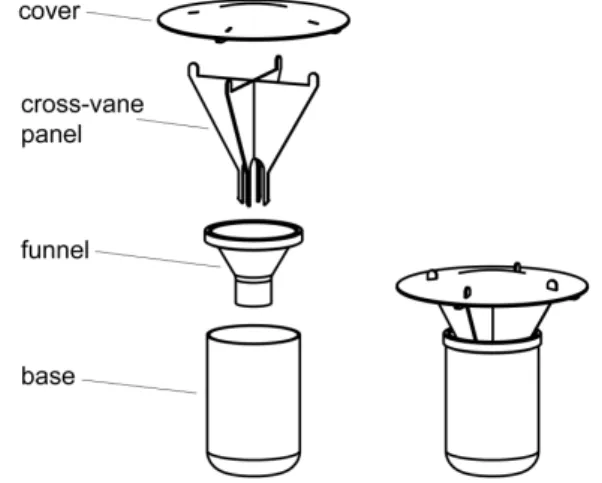
Fig. 1. Schematic diagram of cross-vane panel trap made of PET bottle and acrylic sheets. A 2-liter PET bottle was cut into three pieces. The upper part, which serves as a funnel in an upside-down position, was assembled to the base part. The capacity of the base part is 1.2 liters. The cross-vane panel and cover were made of acrylic sheets.
hydroxyether structural motif found in 2-(undecyloxy)etha- nol is considered to be conserved among many pheromones of Cerambycidae species [3] Attraction to aggregation pher- omones is strongly synergized by host plant volatiles [2, 12, 13, 15].
In this study, we investigated the abilities of 2-(undecy- loxy)ethanol along with the host plant volatiles α-pinene and ethanol to attract M. alternatus at a pine forest in Pohang, Korea. We used three different doses of 2- (undecyloxy)ethanol (175, 350, and 700 mg), whereas a sin- gle dose of 2-(undecyloxy)ethanol in the range of 25-95 mg per trap was used in other studies [9, 12, 13, 15]. To increase the surface area of the pheromone mixture, a super- absorbent polymer based on polyacrylic acids and water were added to the solution of 2-(undecyloxy)ethanol and host plant volatiles. As an alternative to commercial cross- vane panel traps or multi-funnel traps, we made cross-vane panel traps using polyethylene terephthalate (PET) bottles and acrylic sheets. Here, we report that a high dose of 2-(undecyloxy)ethanol (700 mg per trap) is the most effec- tive for attracting M. alternatus at a pest management site in Korea.
Materials and Methods
Synthesis of 2-(undecyloxy)ethanol
The aggregation pheromone 2-(undecyloxy)ethanol was synthesized using the microwave-assisted organic synthesis technique.
((2-(Undecyloxy)ethoxy)methyl) benzene : 2-(benzyloxy) ethanol (0.50 g, 3.3 mmol) in 2 ml of N,N-dimethylforma- mide was added to sodium hydride (0.16 g, 6.6 mmol), and the reaction mixture was stirred for 5 min at 25°C. A micro- wave tube filled with the above mixture and 1-bromounde- cane (0.85 g, 3.6 mmol) was heated in the microwave reactor at 100 W power and 80°C for 10 min. After removal of solvent in vacuo, the residue was treated with ethyl acetate and washed with water and saturated aqueous sodium chloride solution. The obtained organic layer was dried over anhydrous sodium sulfate and concentrated in vacuo. The residue was purified by flash column chromatography over silica gel using hexane:ethyl acetate (20:1 and then 9:1) mix- tures as eluents to obtain 0.72 g of product at 72% yield.
1
H NMR (CDCl
3, 400MHz) δ (ppm): 7.35-7.23(m, 5H), 4.57(s, 2H), 3.60(s, 4H), 3.45(t, J=6.8 Hz, 2H), 1.59(quint, J=6.9 Hz, 2H), 1.30-1.26(m, 16H), 0.88(t, J=6.6 Hz, 3H).
2-(undecyloxy)ethanol: ((2-(undecyloxy)ethoxy)methyl) ben- zene (0.72 g, 2.3 mmol) in 10 ml of ethanol was added to a catalytic amount of palladium on activated carbon (10%), and the resulting mixture was stirred for 5 hr under a hy- drogen gas atmosphere. After the reaction mixture was fil- tered with celite, the filtrate was concentrated in vacuo. The residue was purified by flash column chromatography over silica gel using hexane:ethyl acetate (5:1 and then 3:1) mix- tures as eluents to obtain 0.37 g of product at 73% yield.
1
H NMR (CDCl
3, 400M Hz) δ (ppm): 3.73 (q, J = 5.1 Hz, 2H), 3.53 (t, J = 4.6 Hz, 2H), 3.47 (t, J = 6.6 Hz, 2H), 2.28 (t, J = 6.0 Hz, 1H), 1.59 (quint, J = 7.0 Hz, 2H), 1.30-1.26 (m, 16H), 0.88 (t, J = 6.8 Hz, 3H).
13C NMR (CDCl
3, 100M Hz) δ (ppm): 70.86, 70.46, 60.76, 30.92, 28.63, 28.51, 28.35, 25.10, 21.69, 13.10.
Construction of cross-vane panel traps
Cross-vane panel traps were constructed using 2-liter clear PET bottles and acrylic sheets as shown in Fig. 1. A PET bottle was cut into three pieces. The upper part, which serves as a funnel in an upside-down position, was as- sembled to the base part (capacity 1.2 liters). The cover and cross-vane panel were constructed using acrylic sheets.
Superabsorbent polymer-based pheromone lure
(±)-α-Pinene, ethanol, and isopropanol were purchased
from Sigma (St. Louis, MO, USA). Superabsorbent polymer
based on polyacrylic acid was purchased from a local per-
Fig. 2. Arrangement of traps at the experiment site at a pine forest in Pohang, Korea. Twenty traps were allocated into four blocks of five treatments. Traps were randomly installed in each block, 50 m between traps, and 1.2 m high above the ground. Blocks 1 to 4 are denoted as I~IV.
fume store. To increase the surface area of the pheromone mixture, α-pinene, ethanol, and 2-(undecyloxy)ethanol were mixed in a 50 ml conical tube, followed by addition of poly- acrylic acid-based superabsorbent polymer (0.45 g) and wa- ter (approximately 27 ml). The volume of water was ad- justed to maintain a ratio of pheromone mixture to water of 1:4. The lure was kept at room temperature overnight before use.
Field bioassay
A field experiment was carried out at a pine forest in Pohang, Korea for 2 weeks from June 24, 2014 to July 7, 2014 within 36°08'87''N, 129°33'03''E and 36°09'37''N, 129°31'88''E (Fig. 2). Black pine (Pinus thunbergii Parl.), na- tive to Korea and Japan, was predominant at this site. The area was previously affected by pine wilt disease, wherein the infected pine trees had been cut down and fumigated using metham sodium [7, 14]. However, as control methods such as fumigation or crushing to small wood chips after felling of infected trees cannot remove all infected trees, including their branches, we speculate that there are still some living M. alternatus there. Daily monitoring of M. alter- natus in an outdoor netted cage at Pohang since 2008 showed that M. alternatus emerges from the logs of infected pine trees on average on May 27, and its cumulative emer- gence ratio reaches 50% on June 21 (Gyeongsangbuk-do Forest Environment Research Institute, unpublished data).
These data are consistent with the observations of Kim et al., who showed that the emergence of M. alternatus in Jinju,
Korea occurs on average on May 15, and a 50% cumulative emergence ratio is reached at mid-June [6]. As Jinju is lo- cated 160 km south of Pohang, the emergence of M. alter- natus in Jinju is 12 days earlier than Pohang.
Twenty traps were allocated in four blocks of five treat- ments (Fig. 2). Block 1 was located near the campus of Sunlin College while block 2 was close to a cemetery. Blocks 3 and 4 were close to a paddy field. As host plant volatiles α-pinene and ethanol (H) were reported to attract Monocha- mus species [4, 5], we used three different doses of 2-(undecyloxy)ethanol (P1, 175 mg; P2, 350 mg; and P3, 700 mg) along with α-pinene and ethanol for attracting M.
alternatus. Treatments included (i) Ctrl, untreated control;
(ii) H, α-pinene (3.78 g) and ethanol (1.26 g); (iii) H + P1;
(iv) H + P2; and (v): H + P3. In each block, traps were randomly installed 50 m between traps, approximately 1.2 m high above the ground using poles. The pesticide Vapor- tape II (2,2-dichlorovinyl dimethyl phosphate) (Hercon Environmental) was placed in the trap to prevent escape of the captured beetles.
Statistical analysis
The linear model for the experiment is x
ij= μ + b
i+ t
j+ e
ij,
whereby μ is overall mean, b
iis the effect of block (i = 1,
2, 3, and 4), t
jis the effect of treatment (j = 1, 2, 3, 4, and
5), and e
ijis random error. The data collected were analyzed
by two-way ANOVA. Data were transformed using the
square root of (x + 0.5) before analysis for normality [17].
Fig. 3. Two-week field bioassay results from June 24, 2014 to July 7, 2014. A total of 27 M. alternatus (10 males and 17 females) were captured. Ctrl, untreated control; H, α-pinene (3.78 g) and ethanol (1.26 g); P1, P2, and P3, 2-(undecyloxy)ethanol (175, 350, and 700 mg, respec- tively). Data represent mean ± S.E. of each treatment.
White bars represent males and black bars represent females.
Results and Discussion
A total of 27 M. alternatus (10 males and 17 females) were captured from 20 traps which were allocated into four blocks of five treatments (Fig. 2). Blocks 1, 2, 3, and 4 had on average 0.75, 1.25, 3.0, and 1.75 beetles per trap, respectively. The block 1 located near the campus of a local college contained the least M. alternatus captured, whereas blocks 3 and 4 located close to a paddy field contained slightly more M. alternatus. There was no significant differ- ence among the four blocks.
However, significant differences were detected among the five treatments (ANOVA: F=5.41; df=4, 12; p<0.01). On average, 0.5 beetles per trap were attracted to lure H con- taining α-pinene and ethanol, but the number was not sig- nificantly different from untreated control (Fig. 3). Lures H+P1 and H+P2 showed similar effectiveness with mean numbers of 1.75 and 1.0 beetles per trap, respectively, sug- gesting that the aggregation pheromone is more effective for attracting M. alternatus over α-pinene and ethanol (Fig.
3). Although lure P2 (350 mg) contained twice the amount of 2-(undecyloxy)ethanol per trap as compared with P1 (175 mg), less M. alternatus were captured in traps containing lure H+P2 than traps containing lure H+P1. These data sug-
gest that a minimum 175 mg of 2-(undecyloxy)ethanol per trap could be used for recruitment of M. alternatus using cross-vane panel traps made of PET bottles. The highest number of M. alternatus (n=14, 52% of all beetles captured) was captured in traps with lure H+P3 containing 700 mg of 2-(undecyloxy)ethanol, 3.5 beetles per trap, versus any other treatments (p<0.01) (Fig. 3). In each treatment, both sexes of M. alternatus were attracted to lures containing α- pinene and ethanol (H) and/or 2-(undecyloxy)ethanol (P), but the numbers of males and females captured in each treatment were not significantly different. Our results are consistent with those of Pajares et al. (2010), who reported that a high release rate of 41 mg of 2-(undecylxoy)ethanol per trap is more effective than a low release rate for attract- ing M. galloprovincialis. As the infected pine trees in the ex- periment site had been cut down and fumigated or crushed to small wood chips every year, not many M. alternatus were living there.
In conclusion, we demonstrated that a high dose of male-produced aggregation pheromone 2-(undecyloxy)etha- nol (700 mg per trap) is effective for attracting M. alternatus at a previously pine wilt disease-affected site in Korea using cross-vane panel traps made of PET bottles and acrylic sheets. Our results suggest that the aggregation pheromone could be used for monitoring of pest control measures for pine wilt disease as well as detection and population mon- itoring of pine sawyer beetles. Further study is needed to elucidate the effect of 2-(undecyloxy)ethanol along with host plant volatiles on recruitment of M. saltuarius.
Acknowledgements
The authors thank Byeong-Yoon Seo and Woong Jang for the construction of traps and Dr. Kwang-Soo Choi for statistical analysis. This work was supported by a Daegu University Research Grant (to C.L.).
References
1. Akbulut, S. and Stamps, W. T. 2012. Insect vectors of the pinewood nematode: a review of the biology and ecology of Monochamus species. Forest Pathol. 42, 89-99.
2. Allison, J. D., McKenney, J. L., Millar, J. G., McClfresh, J.
S., Mitchell, R. F. and Hanks, L. M. 2012. Response of the woodborers Monochamus carolinensis and Monochamus titil- lator (Coleoptera: Cerambycidae) to known cerambycid pheromones in the presence and absence of the host plant volatile alpha-pinene. Environ. Entomol. 41, 1587-1596.
초록:집합페로몬 2-(Undecyloxy)ethanol을 이용한 솔수염하늘소 유인 실험
이성민
1․홍도경
2․박종성
3․이진호
3․장세헌
2․이창우
2*
(1경상북도산림환경연구원, 2대구대학교 의생명과학과, 3계명대학교 화학과)
소나무재선충(Bursaphelenchus xylophilus)은 소나무재선충병을 유발하여 한국의 소나무 숲에 심각한 영향을 미 치고 있다. 소나무재선충에 감염된 소나무는 일반적으로 훈증 또는 파쇄처리되지만 소나무재선충병 피해지역의 방제효과를 검증할 수 있는 효과적인 방법은 아직 없다. 본 연구에서는 소나무재선충병 방제효과 검증에 적합한 솔수염하늘소 집합페로몬의 농도를 알아보기 위해 2-(Undecyloxy)ethanol, 알파-피넨, 에탄올을 이용하여 경상북 도 포항시의 소나무재선충병 피해지역에서 필드테스트를 시행하였다. 총 27마리의 솔수염하늘소가 유인되었으며 고농도(700 mg)의 집합페로몬을 사용한 트랩이 가장 효과적이었다. 집합페로몬 2-(Undecyloxy)ethanol은 솔수염 하늘소 개체수 조사와 소나무재선충병 방제효과 검증에 사용할 수 있을 것으로 사료된다.
3. Hanks, L. and Millar, J. 2013. Field bioassays of cerambycid pheromones reveal widespread parsimony of pheromone structures, enhancement by host plant volatiles, and antago- nism by components from heterospecifics. Chemoecology 23, 21-44.
4. Ikeda, T., Enda, N., Yamane, A., Oda, K. and Toyoda, T.
1980. Attractants for the Japanese pine sawyer, Monocha- mus alternatus Hope (Coleoptera: Cerambycidae). Appl.
Entomol. Zool. 15, 358-361.
5. Ikeda, T. and Oda, K. 1980. The occurrence of attractiveness for Monochamus alternatus Hope (Coleoptera: Cerambyci- dae) in nematode-infected pine trees. J. Jap. Forestry Soc.
62, 432-434.
6. Kim, D. S., Lee, S. M., Chung, Y. J., Moon, Y. S. and Park, C. G. 2003. Emergence ecology of Japanese pine sawyer, Monchamus alternatus, a vector of pinewood nematode, Bursaphelenchus xylophilus (in Korean). Kor. J. Appl. Entomol.
42, 307-313.
7. Kwon, T. S., Shin, J. H., Lim, J. H., Kim, Y. K. and Lee, E. J. 2011. Management of pine wilt disease in Korea through preventative silvicultural control. Forest Ecol.
Manag. 261, 562-569.
8. Kwon, T. S. et al. 2006. Distribution patterns of Monocha- mus alternatus and M saltuarius (Coleoptera: Cerambyci- dae) in Korea. J. Kor. For. Soc. 95, 543-550.
9. Macias-Samano, J. E., Wakarchuk, D., Millar, J. G. and Hanks, L. M. 2012. 2-Undecyloxy-1-ethanol in combination with other semiochemicals attracts three spe-cies
(Coleoptera: Cerambycidae) in British Columbia, Canada.
Can. Entomol. 144, 764-768.
10. Mamiya, Y. 1988. History of pine wilt disease in Japan.
J. Nematol. 20, 219-226.
11. Mamiya, Y. and Enda, N. 1972. Transmission of Bursaphelen- chus lignicolus (Nematoda: Aphelenchiodae) by Monocha- mus alternatus (Coleoptera: Cerambycidae). Nematologica 25, 252-261.
12. Pajares, J. A. et al. 2013. 2-(Undecyloxy)-ethanol is a major component of the male-produced aggregation pheromone of Monochamus sutor. Entomol. Exp. Appl. 149, 118-127.
13. Pajares, J. A., Alvarez, G., Ibeas, F., Gallego, D., Hall, D.
R. and Farman, D. I. 2010. Identification and field activity of a male-produced aggregation pheromone in the pine sawyer beetle, Monochamus galloprovincialis. J. Chem. Ecol.
36, 570-583.
14. Shin, S. C. 2008 Pine wilt disease in Korea. In Pine wilt disease (Zhao, B.G., ed.^eds), pp. 26-32. Springer, Tokyo.
15. Teale, S. A., Wickham, J. D., Zhang, F., Su, J., Chen, Y., Xiao, W., Hanks, L. M. and Millar, J. G. 2011. A male-pro- duced aggregation pheromone of Monochamus alternatus (Coleoptera: Cerambycidae), a major vector of pine wood nematode. J. Econ. Entomol. 104, 1592-1598.
16. Vicente, C., Espada, M., Vieira, P. and Mota, M. 2012. Pine wilt disease: a threat to European forestry. Eur. J. Plant Pathol. 133, 89-99.
17. Yamamura, K. 1999. Transformation using (x + 0.5) to stabi- lize the variance of populations. Res. Popul. Ecol. 41, 229-234.