Print ISSN: 2288-4637 / Online ISSN 2288-4645 doi:10.13106/jafeb.2020.vol7.no11.809
Empowering Leadership and Individual Creativity: The Mediation Role of Psychological Empowerment in Facing Covid-19 Pandemic
Yuni SISWANTI
1, Muafi MUAFI
2Received: August 01, 2020 Revised: October 05, 2020 Accepted: October 15, 2020
Abstract
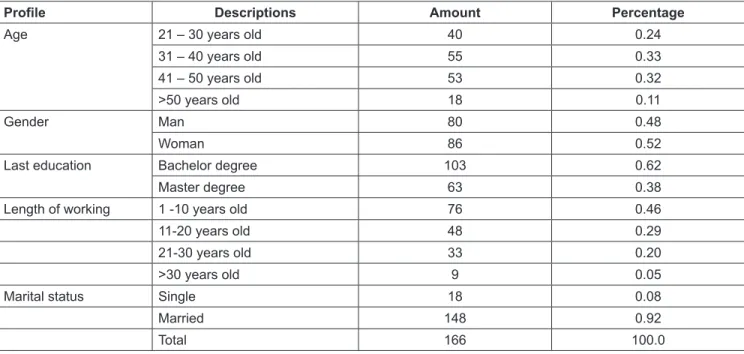
This study tests and analyzes the influence of empowering leadership on employee creativity which is mediated by psychological empowerment. Researchers conduct survey method on state-owned bank employees (ABC Bank) in Pacitan, East Java, Indonesia. Purposive sampling is selected with Likert scale as measurement. The population of this study is 166 respondents, who are permanent employees of the ABC Bank. The data analysis technique used is SPSS 24. The results of this study find that: (1) there is an influence of empowering leadership on psychological empowerment, (2) there is an influence of empowering leadership on individual creativity, (3) there is an influence of psychological empowerment on individual creativity, and (4) the influence of empowering leadership on individual creativity is mediated by psychological empowerment. This study ignores other types of leadership. Further study is needed to examine other types of leadership besides empowering leadership. The level of analysis of this study is individual, so further study could examine empowering leadership conceptualized at the group level because followers will be influenced not only by the dyadic relationship with the leader, but also by the dynamics of the members of the empowered group. This study provides theoretical enrichment from the aspect of empowering leadership, especially at the individual level. Leaders can increase employee creativity by empowering them to do their jobs. Additionally, by creating a work environment that ensures employees feel empowered psychologically.
Keywords: Empowering Leadership, Psychological Empowerment, Individual Creativity JEL Classification Code: L1, L2, L25, E24
1988; Shalley & Gilson, 2004; Dnishev & Alzhanova, 2016). Scientific evidence shows that employee creativity fundamentally contributes to innovation, effectiveness, and organizational survival (Shalley et al., 2004). Creativity refers to novelty products and useful ideas from a person or group of individuals working together (Amabile, 1988;
Madjar et al., 2002; Shalley et al., 2000; Zhou and Shalley, 2003). Managers need to support and promote creativity in organizations, because they are the most knowledgeable individuals and have a major influence on the group which brings forth creativity (Shalley and Gilson, 2004). Although a number of studies have examined the impact of leadership on creativity, this study mostly focuses on leader support issues (Amabile et al., 2004) and member-leader exchanges (Tran et al., 2020; Tierney et al., 1999).
Recently, researchers have begun investigating broader reciprocity based theory of membership behavior, such as transformational leadership theory and they obtain mixed results (Tierney, 2008). Research to explore creativity is scarce, so there is a suggestion that experts should have greater efforts on empowering leadership approaches that
1. Introduction
Lately, we have experienced turbulent environmental conditions, increased competition, and unpredictable technological changes, coupled with the COVID-19 pandemic that occurred suddenly on a world scale and its enormous consequences for the sustainability of all businesses. Those conditions require managers to realize that they must encourage employees to become creative (Amabile,
1
First Author. Department of Management, Business and Economic Faculty, Universitas Pembangunan Nasional “Veteran” Yogyakarta, Indonesia. Email: [email protected]
2
Corresponding Author. Professor, Department of Management, Business and Economics Faculty, Universitas Islam Indonesia [Postal Address: Jl. SWK Ringroad Utara Condong Catur, Yogyakarta, 55283, Indonesia] Email: [email protected]
© Copyright: The Author(s)
This is an Open Access article distributed under the terms of the Creative Commons Attribution Non-Commercial License (https://creativecommons.org/licenses/by-nc/4.0/) which permits unrestricted non-commercial use, distribution, and reproduction in any medium, provided the original work is properly cited.