Print ISSN: 2288-4637 / Online ISSN 2288-4645 doi:10.13106/jafeb.2021.vol8.no7.0469
The Impact of Capital Structure on Firm’s Profitability:
A Case Study of the Rubber Industry in Vietnam
Huong Thi Thanh CO
1, Trang Thi Mai UONG
2, Cong Van NGUYEN
3Received: March 30, 2021 Revised: June 07, 2021 Accepted: June 17, 2021
Abstract
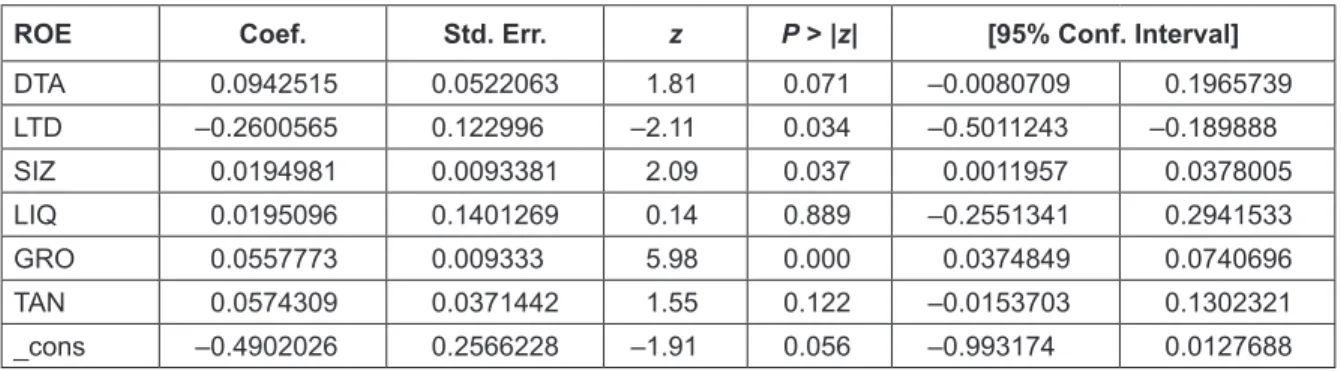
This study aims to examine and measure the impact of capital structure on the profitability of companies in emerging markets. The research sample includes eighteen rubber companies listed on the Vietnam stock exchange from 2015–2019. After collecting the research data, it was imported into excel to calculate the criteria for the research model. By using Stata 16 software, the study selected a data processing model and evaluated the relevance of the regression analysis model. The research results show that the profitability of listed rubber companies in Vietnam (measured by return on equity (ROE) has a positive relationship with the debt-to-asset ratio but has a negative relationship with the long-term debt-to-asset ratio. The results also show a positive impact of firm size and revenue growth on profitability while liquidity and the ratio of tangible fixed assets to total assets do not affect significantly. These results are consistent with most of the previously published studies. However, in contrast to many previous studies, our study shows that the long-term debt-to-assets ratio has a negative effect on profitability while the debt-to-asset ratio has a positive effect. This is entirely consistent with the characteristics of long-term debt use in emerging markets.
Keywords: Capital Structure, Debt to Asset, Long-term Debt to Assets, Profitability, Short-term Debt to Asset, Vietnam JEL Classification Code: G32, L25, L65
well as the maximization of the value and profitability of the enterprise. A sound capital structure protects a business enterprise from such financial risk through a judicious mix of debt and equity in the capital structure. Enterprises using different sources of capital will have different capital structures and the impact on the profitability of the business will be different.
With a rather long history of development (since 1907), Vietnam’s rubber product production and processing industry (Vietnam’s rubber industry) is currently one of the important agroforestry production industries of our country - in terms of economic, social, and environmental aspects. The country’s rubber area has reached nearly 1 million hectares, with nearly 70% of the area for latex collection with an output of about 1.1 million tons/year. Vietnam is the third-largest exporter of natural rubber in the world (Thuy Chung, 2021). Most rubber production enterprises are mainly state-owned enterprises (mostly belonging to the Vietnam Rubber Industry Group) and households (also known as smallholder rubber). Export is the focus of the rubber industry. The three main export product groups of the rubber industry include natural rubber materials (natural rubber), rubber products, and more recently rubberwood and furniture made from rubberwood.
1
First Author. Industrial University of Ho Chi Minh City (IUH), Vietnam.
Email: [email protected]; [email protected]
2
Office of the National Council for Education and Human Development, Ministry of Education and Training, Vietnam.
Email: [email protected]
3
Corresponding Author. Professor, Industrial University of Ho Chi Minh City (IUH), Ho Chi Minh City, Vietnam [Postal Address: 12 Nguyen Van Bao Street, Ward 4, Go Vap District, Ho Chi Minh City, 727900, Vietnam]
Email: [email protected]; [email protected]
© Copyright: The Author(s)
This is an Open Access article distributed under the terms of the Creative Commons Attribution Non-Commercial License (https://creativecommons.org/licenses/by-nc/4.0/) which permits unrestricted non-commercial use, distribution, and reproduction in any medium, provided the original work is properly cited.