요 약
월악산 국립공원에서 2009년 1월부터 2013년 12월까지 5년간 낙엽생산량과 낙엽을 통해 임상으로 이입되는 영양염류량을 조사하였다. 잎, 가지, 생식기관, 기타로 분류된 낙엽의 5년간 평균 생산량은 각각 1.940 ± 0.21, 0.505 ± 0.15, 0.259 ± 0.09, and 0.737 ± 0.14 t ㏊-1 yr-1 이었으며 낙엽구성원의 비율은 각각 56.4, 14.7, 7.5, 21.4%, 로 잎의 비율이 가장 높았다. 조사기간 동안 생산된 낙엽의 총량은 2009년부터 2013년까지 각각 2.810, 3.796, 3.268, 3.284, 4.045 ton ㏊-1 yr-1 으로, 5년간 평균 3.441 ± 0.49 ton ㏊-1 yr-1의 낙엽이 생산되었다. 조사기간 동안 조사된 낙엽을 통해 입상에 이입되는 질소, 인, 칼륨, 칼슘, 마그네슘의 평균 이입량은 각각 22.73 ± 4.92, 1.05 ± 0.42, 4.26 ± 1.69, 8.48 ± 4.62, 2.42 ± 1.01 ㎏ ㏊-1 yr-1 이었다.
Long Term Litter Production and Nutrient Input in Pinus densiflora Forest1a
Ho-Yeon Won2, YoungSang Lee2, Areum Han2, Deok-ki Kim3*
소나무 군락의 장기적 낙엽생산을 통한 영양염류 이입량1a 원호연2⋅이영상2⋅한아름2⋅김덕기3*
ABSTRACT
The litter production, the nutrient concentration of each component of litterfall, and the amounts of nutrient into the forest floor via litterfall were assessed for 5 years from January 2009 through December 2013 in a Pinus densiflora forest in Mt. Worak National Park. The average amounts of leaf litter, branch and bark, reproductive organs(flowers and cones), and miscellaneous categories for 5 years were 1.940 ± 0.21, 0.505 ± 0.15, 0.259 ± 0.09, and 0.737 ± 0.14 t ㏊-1 yr-1, respectively. The average percentage of leaf litter, branch and bark, reproductive organs and miscellaneous categories for 5 years were 56.4, 14.7, 7.5, and 21.4%, respectively. The amounts of total litterfall in 2009, 2010, 2011, 2012, and 2013 were 2.810, 3.796, 3.268, 3.284, and 4.045 ton ㏊-1 yr-1, respectively. The average amounts of litterfall for 5 years were 3.441 ± 0.49 ton ㏊-1 yr-1. The average amounts of N, P, K, Ca, and Mg returned to the forest floor via litterfall for 5 years in this Pinus densiflora forest were 22.73 ± 4.92, 1.05 ± 0.42, 4.26 ± 1.69, 8.48 ± 4.62, and 2.42 ± 1.01 ㎏ ㏊-1 yr-1, respectively.
KEY WORDS : LITTER COMPONENT, LITTERTRAP, FOREST ECOSYSTEM, PINE FOREST
1 접수 2017년 10월 27일, 수정 (1차: 2017년 12월 22일), 게재확정 2017년 12월 26일 Received 27 October 2017; Revised (1st: 22 December 2017); Accepted 26 December 2017 2 Division of basic Ecology, National Institute of Ecology, SeoCheon(33657), Korea
3 Division of Ecological Conservation, National Institute of Ecology, SeoCheon(33657), Korea
a This study was supported by Korea Ministry of En-vironment and National Institute of Ecology as National Long-Term Ecological Research Project.
* 교신저자 Corresponding author: [email protected]
주요어: 낙엽구성원, 낙엽수거기, 산림생태계, 소나무림
INTRODUCTION
Forest ecosystems are self-maintained via primary production and nutrient cycling(Barnes et al., 1998). Some of the primary production in forest ecosystems is returned to the forest floor via litterfall, and then nutrients in litter are reused by plants after mineralization by decomposition processes carried out by a hugely diverse array of organisms(Lavelle and Spain, 2001). Forest soil provides nutrients, water, and a medium for physical support for plant growth(Kimmins, 1987). Soil nutrients originate primarily from the weathering of soil minerals. However, nutrients released through the decomposition of soil organic matter are fundamental to the mainte-nance of mature forest ecosystems(Daubenmire, 1974, Barbour et al., 1987, Mun et al., 2007).
The litterfall of leaves, branches and other tree organs generally constitutes the principal pathway by which nu-trients and organic matter are transferred to soil(Bray and Gorham, 1964, Wiegert and Monk, 1972, Caritat et al., 2006, Blanco et al., 2008). Litter is the food source for decomposers and detritivores, and the means by which nutrients are returned to the cycling pool(Meentemeyer et al., 1982, Barbour et al., 1987, Baker et al., 2001, Blanco et al., 2008). Nutrient cycling describes the movement within and among various biotic or abiotic entities in which nutrients occur in the environment(Lavelle and Spain, 2001).
As a component of the Korean National Long-Term Ecological Research Program, we conducted a study of litter production and decomposition in Quercus mongolica, Quercus variabilis and Pinus densiflora forests in Mt.
Worak National Park. These species are known as the most common species in Korea. The principal objective of this study was to quantify the total amounts of nutrients returned to the forest floor via litterfall in a P. densiflora forest located in Mt. Worak National Park. For this study, seasonal litterfall and the nutrient concentration of litterfall were analyzed for 5 years from January 2009 through December 2013, and the total amounts of nutrient input to the forest floor via litterfall were calculated.
MATERIALS AND METHODS
1. Study area
The Mt. Worak National Park is located between Mt.
Soback and Mt. Sogni and stretches over both Gyeongsangbuk-do and Chungcheongbuk-do in Korea.
The highest peak in Mt. Worak National Park, Munsubong, is 1,162 m above sea level. The P. densiflora forest studied herein was located 380 m above sea level at Jaecheon-si, Hansu-myeon, Songgye-ri in a south-west direction(N 36°
51' 17", E 128° 64' 41"). Tree density was 1,300 trees
㏊-1 and average diameter at breast height (DBH) was 17.12±0.38㎝. In the shrub layer, Qurecus variabilis, Fraxinus sieboldiana and Indigofera kirilowii were distributed with low density. In the herb layer, Pteridium aquilinum and Miscanthus sinensis were distributed, It was examined in plot 20㎡. According to the Jecheon meteoro- logical station, about 20 ㎞ from the study area, annual average temperature and precipitation for thirty years from 1980 through 2010 were 10.2°C and 1,387.8 mm, respectively.
The annual average temperature and precipitation for four years from 2009 through 2013 were 10.1°C and 2,066.2 mm, respectively.
2. Litterfall collection and chemical analysis
Five circular litter traps, with opening areas of 0.5㎡, were randomly established in the P. densiflora forest in December 2008. Litter traps were leveled approximately 50㎝ above the ground to prevent the input of resuspended windblown materials from the forest floor. Litterfall collections began on January 2009 and continued for 5 years in every month. The litter collected from the litter traps was brought into the laboratory and separated into leaves, branches and bark, reproductive organs and mis- cellaneous(litterfall from shrubs). Each component weighed after drying in a drying oven at 80°C for 72 hour and ground with a mixer for chemical analysis.
Chemical analysis of each component of litterfall was carried out in 3 replicates. After the litter samples were digested on a block digestor, T-N and T-P were analyzed
with a flow injection analyzer(Lachat QuickChem 8000;
Zellweger Analytics, Milwaukee, WI, USA). K, Ca, and Mg in litter were determined using an atomic absorption spectrophotometer(Perkin-Elmer 3110; Perkin-Elmer, Waltham, MA, USA) after wet digestion(Allen et al., 1974). All calculations of the nutrient contents of sample materials were based on the means of three replicate analyses. The total amounts of each nutrient returned to the forest floor via litterfall for each year was calculated from each nutrient concentration and the dry weights of each component of litter. The measured values were converted into areas(㏊).
RESULTS AND DISCUSSION
1. Litter production
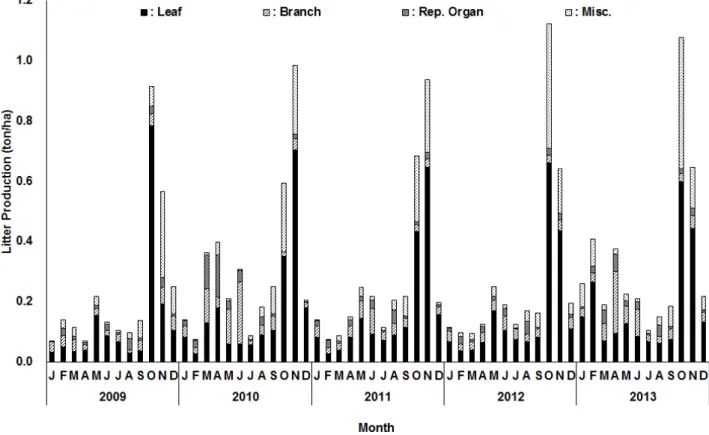
Litterfall in P. densiflora forest continued throughout the year, peaking in autumn(October in 2009, 2012 and 2013, November in 2010 and 2011)(Fig.1). In late winter and spring, from February to May, the proportion of
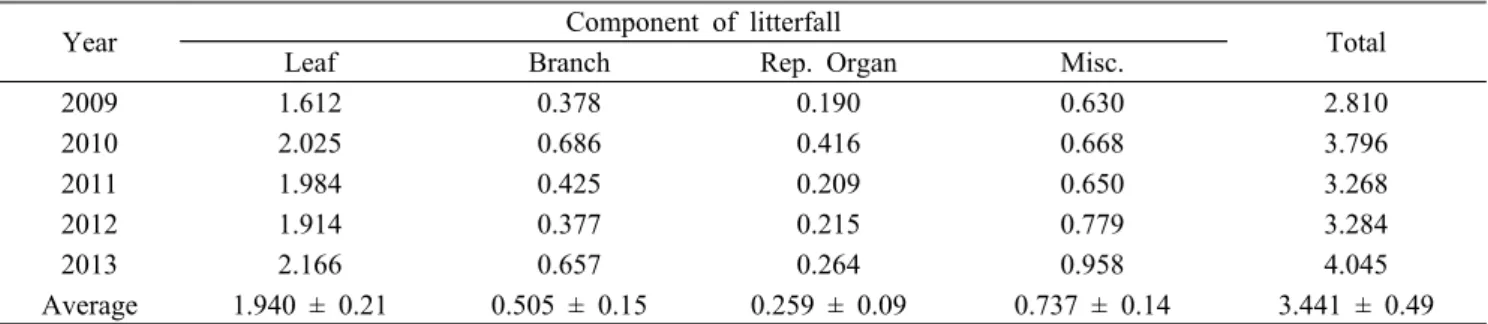
reproductive organ was relatively higher than the proportion of other litter components. The amounts of litterfall in 2009, 2010, 2011, 2012, and 2013 was 2.810, 3.796, 3.268, 3.284, and 4.045 ton ㏊-1 yr-1, respectively(Table 1). The yearly variation of litter production was not great. The average amounts of litterfall for 5 years was 3.441±0.49 ton ㏊-1 yr-1.
Lee(2013) reported the litter production of P. densiflora natural forest was 3.29±0.11 ton ㏊-1 yr-1. Berg and Laslowski(2006) reported that the litter production of Asian temperate coniferous forests ranged from 910~4,990
㎏ ㏊-1 yr-1. Litter production of P. densiflora forests in this study area fell within those ranges. Jeong et al.(2013) reported that the average amounts of litter production of P. densiflora forest in Mt. Nam was 7.07 ton ㏊-1 yr-1. The amounts of litter production in this P. densiflora forest was lower than that of Jeong et al.(2013). Gholz et al.(1985) reported that the differences in litter production might be related to tree density, age and canopy cover among forest(Mun et al., 2007, Namgung and Mun, 2009).
Fig 1. Seasonal changes of each component of litterfall in Pinus densiflora forest over 5 years at Mt. Worak National Park. Misc., miscellaneous; Rep. organ, reproductive organ.
The average proportion of leaf, branch, reproductive organ and miscellaneous of total litterfall for 5 years were 56.4, 14.7, 7.5, and 21.4%, respectively(Fig. 2). The yearly variation in the leaf category was highest among litter components. The proportion of the leaf category in 2009, 2010, 2011, 2012 and 2013 were 57.4, 53.4, 60.7, 58.3, and 53.5%, respectively.
Fig 2. Pie graph showing the average percentages of each component of litterfall for 5 years in a Pinus densiflora forest in Mt. Worak National Park. Misc., mis- cellaneous; Rep. organ, reproductive organ.
2. Nutrient concentration of litterfall
N concentration in leaf litterfall was low in the winter, and high in the summer and autumn season(Fig. 3A). N concentration in the reproductive organ was high in May through July when the debris of flowers of P. densiflora falls. N concentration in the branch and bark component showed no seasonal trend over five years. Unlike the N concentration, the P concentration in leaf litterfall was high in the spring. P concentration in branch and bark litterfall was lowest among the litterfall components(Fig. 3B). Like P concentration, the K concentration in branch and bark
litterfall was lowest among the litterfall components(Fig.
3C). In contrast, Ca concentration in branch and bark litterfall were the highest, and those in reproductive organ were the lowest among the litterfall components(Fig. 3D).
Mg concentrations in the leaf litterfall and miscellaneous fractions were higher than those in the branch and bark and reproductive organ fractions(Fig. 3E).
Year Component of litterfall
Total
Leaf Branch Rep. Organ Misc.
2009 1.612 0.378 0.190 0.630 2.810
2010 2.025 0.686 0.416 0.668 3.796
2011 1.984 0.425 0.209 0.650 3.268
2012 1.914 0.377 0.215 0.779 3.284
2013 2.166 0.657 0.264 0.958 4.045
Average 1.940 ± 0.21 0.505 ± 0.15 0.259 ± 0.09 0.737 ± 0.14 3.441 ± 0.49 Table 1. Amounts of litterfall(ton ha-1 yr-1) for 5 years from 2009 through 2013 in the Pinus densiflora forest at
Mt. Worak National park
Fig 3. Seasonal changes of N(A), P(B), K(C), Ca (D)and Mg(E) concentration(㎎/g) of each component of litterfall in Pinus densiflora forest at Mt. Worak National Park. Misc., miscell- aneous;, Rep. Organ, reproductive organ.
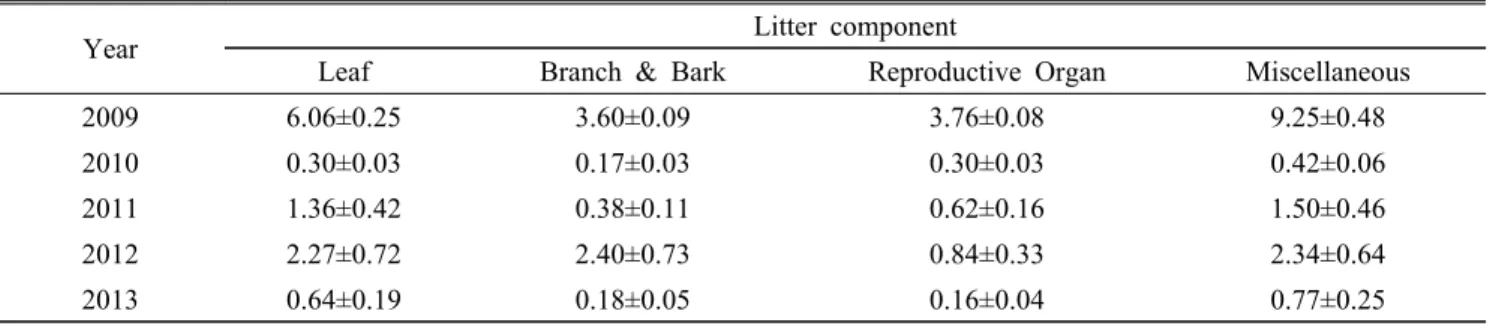
The average concentration of nutrients in each component of litterfall in the P. densiflora forest for 5 years was summarized in Table 2. With the exception of Ca, the nutrient concentration of leaf litterfall was higher than those in other litterfall components.
Lee(2013) reported that the average concentration of N, P, K, Ca and Mg in litterfall in the P. densiflora forest at Mt. Worak National Park over 4 years was 5.61, 0.31, 1.13, 2.27 and 0.51 ㎎/g, respectively. Namgung and Mun(2009) reported that the average concentrations of N, P, K, Ca, and Mg in a P. densiflora forest at the Mt. Worak site over 3 years were 6.34, 0.32, 1.45, 2.44, and 0.37
㎎/g, respectively; this was similar that those in this study.
Namgung(2010) reported that the average concentration of N, P, K, Ca, and Mg in leaf litterfall in the Q. variabilis forest at Mt. Worak over 4 years was 11.53, 0.67, 2.38, 3.15, and 2.14 ㎎/g, respectively. The average concen- trations of N, P, and K in leaf litterfall in P. densiflora were lower than those in Q. variabilis. The nutrient concentrations of litterfall in oak forests were higher than those in pine litterfall(Namgung et al., 2008, Namgung, 2010).
3. Nutrient returned to forest floor via litterfall
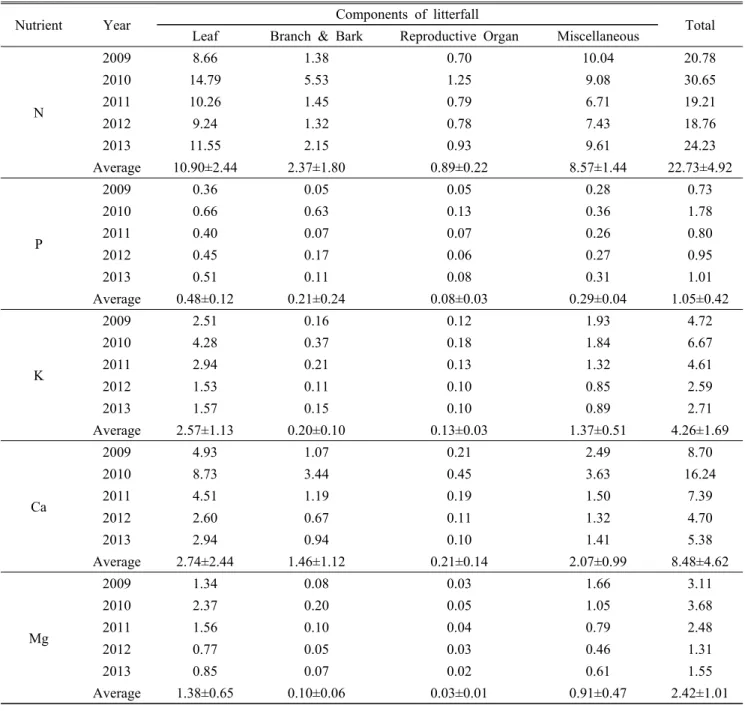
The amounts of each nutrient returned to the forest floor via litterfall in the P. densiflora forest was summarized in Table 3. As shown in Table 3, the amounts of annual input of N, P, K, Ca and Mg to the forest floor via litterfall in P. densiflora forests in 2009, 2010, 2011, 2012, and 2013 were 20.78, 30.65, 19.21, 18.38, and 24.23 ㎏ ㏊-1 yr-1 for N, 0.73, 1.78, 0.80, 0.95, and 1.01 ㎏ ㏊-1 yr-1 for P, 4.72, 6.67, 4.61, 2.59, and 2.71 ㎏ ㏊-1 yr-1 for K, 8.70, 16.24, 7.39, 4.70, and 5.38 ㎏ ㏊-1 yr-1 for Ca, 3.11, 3.68, 2.48, 1.31, and 1.55 ㎏ ㏊-1 yr-1 for Mg, respectively.
The average amounts of N, P, K, Ca, and Mg returned to the forest floor in this P. densiflora forest for 5 years was 22.73 ± 4.92, 1.05 ± 0.42, 4.26 ± 1.69, 8.48 ± 4.62, and 2.42 ± 1.01 ㎏ ㏊-1 yr-1, respectively(Table 3).
Generally, the amounts of nutrients returned to the forest floor via litterfall in pine forests was much lower than those in the oak forests(Vogt et al., 1983). This is because the annual input of litterfall and nutrient concentration of unit weight of litterfall in oak forests were greater than those in the pine forest(Kwak and Kim, 1992, Mun and Kim, 1992, Kim et al., 1997, Mun et al., 2007). Soil
Year Litter component
Leaf Branch & Bark Reproductive Organ Miscellaneous
2009 6.06±0.25 3.60±0.09 3.76±0.08 9.25±0.48
2010 0.30±0.03 0.17±0.03 0.30±0.03 0.42±0.06
2011 1.36±0.42 0.38±0.11 0.62±0.16 1.50±0.46
2012 2.27±0.72 2.40±0.73 0.84±0.33 2.34±0.64
2013 0.64±0.19 0.18±0.05 0.16±0.04 0.77±0.25
Table 2. Average nutrient concentration(㎎/g) of each component of litterfall for 5 years from January 2009 through December 2013 in Pinus densiflora forest at Mt. Worak National Park
nutrient concentrations in pine forests were much lower than those in the oak forest at Mt. Worak(Choi et al., 2006). This may be due to the greater litter production and higher nutrient concentrations of litter in the oak forest relative to those in the pine forest. Another reason for this is that the decay rates of oak litter are higher than the decay rates of pine needle litter(Mun and Joo, 1994, Mun et al., 2007, Namgung et al., 2008, Mun, 2009).
ACKNOWLEDGMENTS
This study was supported by Korea Ministry of Environment and National Institute of Ecology as National Long-Term Ecological Research Project.
Nutrient Year Components of litterfall
Total Leaf Branch & Bark Reproductive Organ Miscellaneous
N
2009 8.66 1.38 0.70 10.04 20.78
2010 14.79 5.53 1.25 9.08 30.65
2011 10.26 1.45 0.79 6.71 19.21
2012 9.24 1.32 0.78 7.43 18.76
2013 11.55 2.15 0.93 9.61 24.23
Average 10.90±2.44 2.37±1.80 0.89±0.22 8.57±1.44 22.73±4.92
P
2009 0.36 0.05 0.05 0.28 0.73
2010 0.66 0.63 0.13 0.36 1.78
2011 0.40 0.07 0.07 0.26 0.80
2012 0.45 0.17 0.06 0.27 0.95
2013 0.51 0.11 0.08 0.31 1.01
Average 0.48±0.12 0.21±0.24 0.08±0.03 0.29±0.04 1.05±0.42
K
2009 2.51 0.16 0.12 1.93 4.72
2010 4.28 0.37 0.18 1.84 6.67
2011 2.94 0.21 0.13 1.32 4.61
2012 1.53 0.11 0.10 0.85 2.59
2013 1.57 0.15 0.10 0.89 2.71
Average 2.57±1.13 0.20±0.10 0.13±0.03 1.37±0.51 4.26±1.69
Ca
2009 4.93 1.07 0.21 2.49 8.70
2010 8.73 3.44 0.45 3.63 16.24
2011 4.51 1.19 0.19 1.50 7.39
2012 2.60 0.67 0.11 1.32 4.70
2013 2.94 0.94 0.10 1.41 5.38
Average 2.74±2.44 1.46±1.12 0.21±0.14 2.07±0.99 8.48±4.62
Mg
2009 1.34 0.08 0.03 1.66 3.11
2010 2.37 0.20 0.05 1.05 3.68
2011 1.56 0.10 0.04 0.79 2.48
2012 0.77 0.05 0.03 0.46 1.31
2013 0.85 0.07 0.02 0.61 1.55
Average 1.38±0.65 0.10±0.06 0.03±0.01 0.91±0.47 2.42±1.01
Table 3. Amounts of nutrient(㎏ ㏊-1 y-1) input to forest floor via litterfall for 5 years from January 2009 through December 2013 in the Pinus densiflora forest at Mt. Worak National Park
REFERENCES
Allen, S.E., H.M. Grimshaw, J.A. Parkinson and C. Quarmby (1974) Chemical Analysis of Ecological Materials. Blackwell, Oxford.
Baker, T.T. III, B.G. Lockaby, W.H. Conner, C.E. Meier, J.A Stanturf and M.K. Burke(2001) Leaf litter decomposition and nutrient dynamics in four southern forested floodplain communities. Soil Sci. Soc. Amer. J. 65: 1334-1347.
Barbour, M.G., J.H. Burk and W.D. Pitts(1987) Terrestrial Plant Ecology. Benjamin/Cummings Pubs Co., Menlo Park, California.
Barnes, B.V., D.R. Zak, S.R. Denton and S.H. Spurr(1998) Forest Ecology. 4th ed. John Wiley & Sons Inc., NewYork.
Berg, B. and R. Laskowski(2006) Litter decomposition: A guide to carbon and nutrient turnover. Elsevier, NewYork.
Blanco, J.A., J.B. Imbert and F.J. Castillo(2008) Nutrient return via litterfall in two constrating Pinus sylvestris forests in the Pyrenees under different thinning intensities. For. Ecol.
Manag. 256: 1840-1852.
Bray, J.R. and E. Gorham(1964) Litter production in forests of the world. In: Graff, J. B. (ed.), Advances in Ecological Research.Vol.2. Academic Press, NewYork, pp. 101-157.
Caritat, A., E. Gracía-Berthu, R. Lapeña and L. Vilar(2006) Litter production in a Quercus suber forest of Montseny (NESpain) and its relationship to meteorological conditions. Ann. For. Sci.
63: 791-800.
Choi, H.J., I.Y. Jeon, C.H. Shin and H.T. Mun(2006) Soil properties of Quercus variabilis forest on Youngha valley in Mt. Worak National Park. J. Ecol. Field Biol. 29: 439-443. (in Korean with English abstract)
Daubenmire, R.F.(1974) Plant and Environment: a Textbook of Plant Autecology. 3rd ed. John Wiley and Sons Inc., New York.
Gholz, H.L., C.S. Perry, W.P. Cropper and L.C. Hendry(1985) Litterfall, decomposition, and nitrogen and phosphorus dy- namics in a chronosequence of Slash pine (Pinus elliot- tii)plantations. For. Sci. 31: 463-478.
Jeong, H.M., H.R. Kim, D.H. Shin, K.M. Lee, S.K. Lee, Y.S. Han, R.H. Jang, S.K. Lee, T.K. Kim and Y.H. You(2013) Litter Production and Soil Organic Carbon Dynamincs of Pinus den- siflora, Quercus mongolica and Robinia pseudo-acacia Forests in Mt. Nam. Korean J. Environ. Biol. 31(2): 87-95.
Kim, C.S., K.S. Koo, Y.K. Kim, W.K. Lee, J.H. Jeong and H.S.
Seo(1997) Dynamics of litterfall and nutrient inputs in Querces acutissima and Pinus koraiensis stands. FRI. J. For. Sci. 55:
13-18. (in Korean with English abstract)
Kimmins, J.P.(1987) Forest ecology. Macmillan Publishing Company, NewYork.
Kwak, Y.S. and J.H. Kim(1992) Secular changes of density, litter- fall, phytomass and primary productivity in mongolian oak (Quercus mongolica) forest. Kor. J. Ecol. 15: 19-33. (in Korean with English abstract)
Lavelle, P. and A.V. Spain(2001) Soil Ecology. Kluwer Scientific Publications, Amsterdam.
Lee, J.Y.(2013) Carbon Budget and Nutrient Cycling in the Pinus densiflora Forest at Mt. Worak. PhD Dissertation. Kongju National University, Gongju, Korea.
Meentemeyer, V., E.O. Box and R.T. Thompson(1982) World pat- terns and amounts of terrestrial litter production. Bio Science 32: 125-128.
Mun, H.T.(2009) Weight loss and nutrient dynamics during leaf lit- ter decomposition of Quercus mongolica in Mt. Worak National Park. J. Ecol. Field Biol. 32: 123-127.
Mun, H.T. and H.T. Joo(1994) Litter production and decomposition in the Quercus acutissima and Pinus rigida forests. Kor. J. Ecol.
173: 345-353. (in Korean with English abstract)
Mun, H.T. and J.H. Kim(1992) Litterfall, decomposition, and nu- trient dynamics of litter in red pine (Pinus densiflora) and Chines thuja (Thuja orientalis) stands in the limestone area.
Kor. J. Ecol. 15: 147-155. (in Korean with English abstract).
Mun, H.T., S.J. Kim and C.H. Shin(2007) Litter production and nu- trient contents of litterfall in oak and pine forests at Mt. Worak National Park. J. Ecol. Fiel. Biol. 30: 63-68. (in Korean with English abstract)
Namgung, J., A.R. Han and H.T. Mun(2008) Weight loss and nu- trient dynamics during leaf litter decomposition of Quercus variabilis and Pinus densiflora at Mt. Worak National Park. J.
Ecol. Fiel. Biol. 31: 291-295. (in Korean with English abstract) Namgung, J. and H.T. Mun(2009) Litterfall and nutrient input via
litterfall in Pinus densiflora forest at Mt. Worak National Park.
Kor. J. Env. Biol. 27: 261-265. (in Korean with English ab- stract)
Namgung, J.(2010) Production and nutrient cycling in the Quercus variabilis forest at Mt. Worak. PhD Dissertation. Kongju National University, Gongju, Korea..
Vogt, K.A., C.C. Grier, C.E. Meier and M.R. Keyes(1983) Organic matter and nutrient dynamics in forest floors of young and ma- ture Abies amabilis stands in Western Washington, as affected by fine-root input. Ecol. Monogr. 53: 139-157.
Wiegert, R.G. and C.D. Monk(1972) Litter production and energy accumulation in three plantations of longleaf pine (Pinus pal- ustris Mill.). Ecol. 53: 949-953.