월악산 굴참나무림의 낙엽생산과 낙엽을 통한 영양염류 이입량
1a원호연2․남궁정2․표재훈2․문형태2*
Litter Production and Nutrient Input via Litterfall in Quercus variabilis Forest at Mt. Worak National Park1a
Ho-Yeon Won2, Jeong Namgung2, Jae-Hoon Pyo2, Hyeong-Tae Mun2*
요 약
월악산 국립공원 내의 굴참나무림에서 2005년 5월부터 2009년 4월까지 4년 동안 월별 낙엽 생산량과 낙엽을 통해 임상에 이입되는 영양염류의 양을 조사하였다. 2005, 2006, 2007, 2008년의 낙엽생산량은 각각 5.181, 5.372, 5.314, 5.361 ton ha-1yr-1이었으며, 4년 동안의 평균 낙엽생산량은 5.307±0.09 ton ha-1yr-1이었다. 조사기간 동안 낙엽 구성원 중 잎, 가지, 생식기관 그리고 기타가 차지하는 비율은 각각 67.5±1.9, 13.3±0.8, 10.1±0.5, 9.1±1.2%로 잎이 차지하는 비율이 가장 높았다. 조사지소에서 4년 동안 낙엽을 통해 임상에 이입되는 질소, 인, 칼륨, 칼슘 그리고 마그네슘의 평균 이입량은 각각 44.47±6.70, 2.50±0.25, 12.26±0.30, 17.23±2.32, 9.56±0.54 kg ha-1yr-1이었다.
주요어: 낙엽구성원, 낙엽수거기, 삼림생태계, 참나무림
1 접수 2010년 12월 3일, 수정(1차: 2011년 7월 8일), 게재확정 2011년 7월 9일 Received 3 December 2010; Revised(1st: 8 July 2011); Accepted 9 July 2011
2 공주대학교 생명과학과 Dept. of Life Science, Kongju National University, Gongju(314-701), Korea a 이 논문은 환경부의 국가장기생태 연구사업의 지원에 의하여 수행되었음.
* 교신저자 Corresponding author([email protected])
ABSTRACT
Litter production, nutrient concentration of each component of litterfall and amount of nutrients input to forest floor via litterfall were investigated for four years from May 2005 through April 2009 in Quercus variabilis forest at Mt. Worak National Park. Amount of litterfall in 2005, 2006, 2007, 2008 were 5.181, 5.372, 5.314, 5.361 ton ha-1yr-1, respectively. Average amount of litterfall for four years was 5.307±0.09 ton ha-1yr-1. Average percentage of leaf litter, branch and bark, reproductive organ and the miscellaneous for four years were 67.5±1.9, 13.3±0.8, 10.1±0.5 and 9.1±1.2%, respectively. Average amount of N, P, K, Ca and Mg returned to forest floor via litterfall for four years in this Q. variabilis forest were 44.47±6.70, 2.50±0.25, 12.26±0.30, 17.23±2.32 and 9.56±0.54 kg ha-1yr-1, respectively.
KEY WORDS: LITTER COMPONENTS, LITTERTRAP, FOREST ECOSYSTEM, OAK FOREST
서 론
삼림생태계는 1차생산과 영양염류 순환을 통해 유지된
다. 1차생산 중 일부는 방목먹이사슬을 통해 상위 영양단계 로 이전되고, 대부분이 목질부의 형태로 축적되며, 나머지 는 낙엽의 형태로 임상에 이입된다(Barbour et al., 1987;
Barnes et al., 1998). 삼림토양은 식물생장에 필요한 영양염 류와 물을 제공하고, 식물 뿌리가 뻗을 수 있는 기질 역할을 하여 식물을 물리적으로 지지하는 기능도 가지고 있다 (Kimmins, 1987). 토양의 영양염류는 1차적으로 토양광물 의 풍화에서 비롯되지만 성숙한 삼림생태계의 경우에는 토 양 유기물의 분해를 통해 방출되는 영양염류가 생태계의 유지에 큰 비중을 차지하는 것으로 알려져 있다(Barbour et al., 1987; Daubenmire, 1974; Mun et al., 2007).
토양 유기물질은 낙엽의 분해를 통해 공급되기 때문에 낙엽생산은 삼림생태계 유지에 기본적인 과정이라고 할 수 있다. 또한 낙엽생산은 삼림생태계의 영양염류 순환이나 에 너지 흐름의 핵심적인 부분을 차지한다(Bray and Gorham, 1964; Wiegert and Monk, 1972). 삼림생태계 토양의 유기 물질은 지상부와 지하부의 죽은 생물량에서 비롯되며, 이들 은 다양한 부니질식자들과 분해자의 에너지원이 된다 (Baker et al., 2001; Barbour et al., 1987). 또한 낙엽의 분해를 통해 영양염류가 식물이 흡수할 수 있는 가용성 상 태로 전환되기 때문에 낙엽 분해율은 삼림의 1차생산을 조 절하는 중요한 요인이 된다(Blanco et al., 2006; Cole and Rapp., 1981; Meentemeyer et al., 1982).
환경부의 국가장기생태연구사업의 일환으로 국내 주요 삼림생태계의 1차생산과 영양염류 순환이 장기간에 걸쳐 조사되고 있으며, 본인 등은 월악산 국립공원에 발달되어 있는 소나무림, 굴참나무림 그리고 신갈나무림을 대상으로 1차생산과 영양염류 순환을 조사하고 있다. 본 연구의 목적 은 월악산 국립공원에 발달되어 있는 굴참나무림의 영양염 류 순환을 파악하기 위한 일환으로 조사대상 굴참나무림의 낙엽생산량과 낙엽생산을 통해 임상에 이입되는 영양염류 의 양을 파악하기 위한 것이다. 이를 위해 2005년 5월부터 2009년 4월까지 4년 동안의 낙엽생산량을 조사하고, 생산 된 낙엽의 영양염류 함량을 분석하여 연간 낙엽을 통해 임 상에 이입되는 영양염류의 양을 정량하였다.
재료 및 방법
1. 조사지 개황
월악산국립공원은 소백산과 속리산의 사이에 위치하며 (N 36°47'~ 36°55', E 128°4'~ 128°12'), 경상북도와 충청북 도에 걸쳐 있다. 조사지소인 굴참나무림은 월악산 용하계곡 의 남서사면에 위치하며(N 36° 53' 19″, E 128° 68' 55″), 해발고도는 약 330 m 이었다. 2005년 4월에 조사지소에 2개의 10 m × 20 m 영구방형구를 설치하고 흉고직경 2.5
㎝ 이상의 교목을 대상으로 매목조사를 실시하였다. 교목의 임목밀도는 2,550 그루/ha 이었으며, 평균 흉고직경은 2005,
2006, 2007, 2008년 4월에 각각 12.1±4.80, 12.4±4.95, 12.7±5.04, 13.1±5.10 ㎝, 평균수고는 9.8±3.16, 10.3±3.23, 10.8±3.29, 11.3±3.42 m이었다. 우점종인 굴참나무의 수령 은 약 35년으로 추정되었다. 관목층에는 생강나무(Lindera obtusiloba)와 누리장나무(Clerodendron trichotomum)가 매우 낮은 밀도로 분포하고 있었으며, 초본층은 매우 빈약 하였다. 조사지소로부터 약 30 km 떨어져 있는 제천측후소 의 자료에 의하면 1978년부터 2008년까지 30년 동안의 연 평균 기온과 강수량은 각각 10.1℃와 1,349.8 mm 이었다.
2. 낙엽생산량
낙엽생산량 조사를 위해 2005년 4월에 영구방형구 외부 에 입구의 넓이가 0.5 ㎡인 원형 낙엽수거기 5개를 임의로 설치하였다. 이미 떨어진 낙엽들이 바람에 날려 낙엽수거기 속으로 이입되는 것을 막기 위해 낙엽수거기의 입구의 높이 가 지표면에서 1 m 이상이 되도록 설치하였다. 2005년 5월 부터 2009년 4월까지 4년 동안 매월 낙엽수거기 속에 들어 있는 낙엽을 수거하여 실험실에서 잎, 가지 및 수피, 생식기 관, 기타 등으로 구분하여 80℃ 건조기에서 항량이 될 때까 지 건조시킨 후 평량하였다. 평량이 끝난 샘플은 마쇄하여 영양염류 분석에 이용하였다.
3. 영양염류 분석
낙엽 각 구성원의 영양염류 함량 분석은 3반복으로 실시 하였다. 전질소와 인은 낙엽샘플을 block digestor에서 분해 시킨 후(Allen et al., 1974), Flow Injection Analyzer (Lachat: QuickChem 8000)로 정량하였다. 칼륨, 칼슘, 마그 네슘은 Kjeldahl 플라스크를 이용하여 습식분해시킨 후 Atomic Absorption Spectrophotometer(Perkin-Elmer 3110) 로 정량하였다(Allen et al., 1974). 낙엽을 통해 연간 임상에 이입되는 각 영양염류의 총량은 매월 낙엽생산량에 각 낙엽 구성원의 영양염류 함량을 곱하여 계산하였다.
결과 및 고찰
1. 낙엽생산량
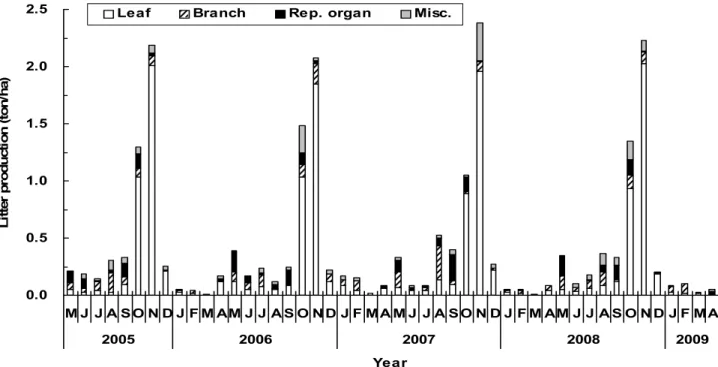
조사지역 굴참나무군락의 낙엽생산은 연 중 계속되었으 나 매년 가을인 10월과 11월에 낙엽생산량이 가장 많았다 (Figure 1). 낙엽생산량의 월별 패턴은 4년 동안에 걸쳐 큰 차이가 없었다. 4월과 5월에는 생식기관의 양이 상대적으로 증가하였다. 시작년도의 5월부터 다음 해 4월까지의 연간 낙엽생산량은 2005년, 2006년, 2007년, 2008년에 각각
0.0 0.5 1.0 1.5 2.0 2.5
M J J A S O N D J F M AM J J A S O N D J F MA M J J A S O N D J F M AM J J A S O N D J F MA
2005 2006 2007 2008 2009
Year
Litter production (ton/ha)
Leaf Branch Rep. organ Misc.
Figure 1. Monthly changes of each component of litterfall in Quercus variabilis forest for 4 years at Mt. Worak National Park. Misc. and Rep. organ indicate miscellaneous and reproductive organ, respectively.
Year Components of litterfall
Total Leaf Branch & Bark Rep. Organ Misc.
2005 3.645 0.632 0.497 0.406 5.181
2006 3.583 0.760 0.580 0.449 5.372
2007 3.541 0.707 0.539 0.527 5.314
2008 3.560 0.721 0.534 0.546 5.361
Ave. 3.582±0.045 0.705±0.053 0.537±0.034 0.482±0.066 5.307±0.088 Ave.: Average, Rep. organ: Reproductive organ, Misc.: Miscellaneous
Table 1. Amount of litterfall(kg ha-1yr-1) for four years from May 2005 through April 2009 in the Quercus variabilis forest at Mt. Worak National Park
Figure 2. Pie graph showing the average percentage of each component of litterfall for 4 years in Quercus variabilis forest at Mt. Worak National Park. Misc. and Rep. organ indicate miscellaneous and reproductive organ, respectively.
5.181, 5.372, 5.314, 5.361 ton ha-1yr-1로 큰 차이를 보이지 않았으며, 4년 동안의 평균 낙엽생산량은 5.307±0.09 ton ha-1yr-1이었다(Table 1).
낙엽수거기에서 수거된 낙엽 구성원 별 생산량의 범위는 낙엽이 3.541~3.645 ton ha-1yr-1으로 평균 3.582±0.045 ha-1yr-1(67.5%)이었으며, 가지와 수피가 0.632~0.760 ton ha-1yr-1로 평균 0.705±0.053 ha-1yr-1(13.3%)이었다. 그리고 생식기관이 0.497~0.580 ton ha-1yr-1로 평균 0.538±0.034 ha-1yr-1(10.1%),기타가 0.406~0.546 ton ha-1yr-1로 평균 0.482±0.066 ha-1yr-1(9.1%)이었다(Figure 2).
국내에서 발표된 참나무림의 연간 낙엽생산량은 공주지 역 상수리나무림(임목밀도 2,800그루/ha, 수령 30~40년)에 서 5.67 ton ha-1yr-1(Mun and Joo, 1994)로, 광릉 활엽수림
Nutrient Litter component
Leaf Branch & Bark Rep. organ Misc.
N 11.53±4.65 4.94±4.40 7.68±4.69 11.75±5.01
P 0.67±0.32 0.31±0.36 0.59±0.36 0.63±0.49
K 2.38±1.48 1.94±1.33 4.35±1.37 2.12±1.62
Ca 3.15±1.01 4.10±1.06 1.98±0.87 3.22±1.04
Mg 2.14±0.50 1.18±0.62 1.03±0.47 1.48±0.55
Ave.: Average, Rep. organ: Reproductive organ, Misc.: Miscellaneous
Table 2. Average nutrient concentration(mg/g) of each component of litterfall of the Quercus variabilis forest in the study area
에서 5.627 ton ha-1yr-1로(Kim et al. 2003), 광릉 지역의 고지대에 위치하고 있는 신갈나무림에서 5.43 ton ha-1yr-1 로 보고된 바 있는데(Kim, 2007), 이 값들은 본 조사지역에 서의 결과와 유사하였다. 그러나 무등산지역 굴참나무림의 6.137 ton ha-1yr-1(Kim et al., 2009), 포천지역 상수리나무 림의 7.333 ton ha-1yr-1(Kim et al., 1997), 석회암지역과 비석회암지역의 굴참나무림에서 각각 6.23 및 6.68 ton ha-1yr-1(Kim, 1992), 계방산 천연활엽수림의 6.593 ton ha-1yr-1(Lee et al., 2006)보다는 본 굴참나무림의 낙엽생산 량이 적었다. 하지만 본 굴참나무림의 낙엽생산량은 강원도 평창의 신갈나무림에서 보고된 4.97 ton ha-1yr-1(Kwak and Kim, 1992), 경기도 광주의 신갈나무림에서 보고된 3.49 ton ha-1yr-1(Lee and Park, 1987)보다는 높은 값이었다. 이 처럼 지소에 따른 낙엽 생산량의 차이는 각 조사지역의 임 목밀도, 수령, 수고 등의 차이에 기인한 것으로 판단된다 (Hennessey et al., 1992; Mun and Joo, 1994; Sharma and Ambasht, 1987).
우리나라 참나무림의 낙엽생산량은 극단적으로 높은 상 수리나무림의 10.77 ton ha-1yr-1(Chang and Kwon, 1987)을 제외하면 2.48~8.76 ton ha-1yr-1범위이며(Son et al., 2004), 온대 낙엽활엽수림에서는 2.3~7.1 ton ha-1yr-1(Raich and Nadelhoffer, 1989), 지중해지역의 참나무림에서는 1.9~6.9 ton ha-1yr-1(Caritat et al., 2006)의 범위로, 본 굴참나무림의 연간 낙엽생산량은 이들 범위 내에 포함되어 있다. 미국 중 남부 Oklahoma 지방의 참나무림의 낙엽생산량은 5.386 ton ha-1yr-1로 보고된 바 있는데(Johnson and Risser, 1974), 이 값은 본 조사지소와 매우 유사하였다. 연간 낙엽 생산량 이 4 ton/ha 이상이면 매우 높은 편이라고 보고한 바 있는데 (Olson, 1963), 본 굴참나무림은 이보다 많은 양이 생산되어 높은 편이라 할 수 있다.
낙엽생산량에 영향을 주는 요인으로는 기후요인, 국지적 으로 영향을 줄 수 있는 토양의 영양염류, 그리고 기저면적 이나 수관층 피도와 같은 임분의 특성 등으로 구분된다 (Berg and Laskowski, 2006). 토양의 영양염류는 지소 수준
에서 식물의 생장에 영향을 주어 낙엽 생산량에 차이를 유 발시킬 수 있으며, 임분 특성에 해당되는 기저면적, 수관층 피도, 수령 등은 지소의 발달과 관련이 있다(Barnes et al., 1998; Berg and Laskowski, 2006; Mun et al., 2007). 대부 분의 삼림군락에서 생산된 낙엽의 구성원 중 잎이 차지하는 비율이 가장 큰 것으로 보고되고 있다(Berg and Laskowski, 2006). 또한 낙엽은 그 구성원에 따라 영양염류의 함량과 분해율에 많은 차이가 있는 것으로 보고되어 있다(Mun et al, 2007).
2. 낙엽의 영양염류 함량
일반적으로 활엽수림의 낙엽이 침엽수림에 비하여 영양 염류 함량이 높은 것으로 보고되고 있다(Kim et al., 1997;
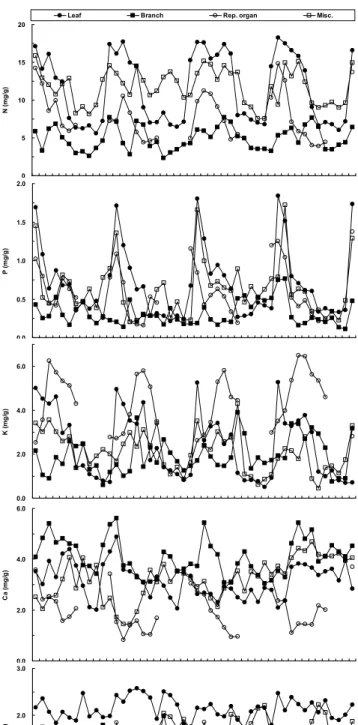
Mun and Joo, 1994; Vogt et al., 1983). 조사지소에서 낙엽 구성원의 영양염류 함량 월 변화를 Figure 3에 정리하였다.
낙엽수거기를 이용하여 4년 동안 수거한 낙엽의 평균 영양염 류 함량은 질소, 인, 칼륨, 칼슘, 마그네슘이 각각 11.53±4.65, 0.67±0.32, 2.38±1.48, 3.15±1.01, 2.14±0.50 mg/g, 생식기 관의 경우 질소, 인, 칼륨, 칼슘, 마그네슘이 각각 7.68±4.69, 0.59±0.36, 4.35±1.37, 1.98±0.87, 1.03±0.47mg/g 이었다 (Table 2).
낙엽구성원별 영양염류 함량은 질소, 인 및 칼륨의 경우 기타 > 낙엽 > 생식기관 > 가지의 순이었으며, 하절기(7∼
10월)에 그 값이 높았다. 칼슘은 가지 및 수피에서 가장 높 았고, 생식기관이 가장 낮았다. 마그네슘은 낙엽 > 기타 >
가지 > 생식기관 순이었으나 계절적 변동은 크지 않았다.
가지의 칼슘 함량이 높은 이유는 수피에 들어있는 칼슘 함 량이 높기 때문인 것으로 사료되며, 공주지역의 상수리나무 림에서 조사한 결과(Mun and Joo, 1994)와 유사하였다.
낙엽의 영양염류 함량은 식물의 생장기 동안 떨어진 낙엽 에서 높았는데, 이것은 일반적으로 삼림생태계에서 가을에 떨어지는 낙엽, 낙지는 고사한 상태로 떨어지지만 생장기에 는 태풍, 강우, 바람 등의 기상요인과 곤충 등에 의하여 떨어
0 5 10 15 20
N (mg/g)
Leaf Branch Rep. organ Misc.
0.0 0.5 1.0 1.5 2.0
P (mg/g)
0.0 2.0 4.0 6.0
K (mg/g)
0.0 2.0 4.0 6.0
Ca (mg/g)
0.0 1.0 2.0 3.0
M J J A S O N D J F M A M J J A S O N D J F M A M J J A S O N D J F M A M J J A S O N D J F M A
2005 2006 2007 2008 2009
Year
Mg (mg/g)
Figure 3. Monthly changes of N, P, K, Ca and Mg concentration of each component of litterfall in Quercus variabilis forest at Mt. Worak National Park. Misc. and Rep. organ indicate miscellaneous and reproductive organ, respectively.
지는 녹엽(green leaves)이 많아 영양염류 함량이 높으며, 또한 가을에는 낙엽이 지기 전에 잎에서 소지로 영양염류 재흡수가 일어나기 때문인 것으로 판단된다(Gholz et al., 1985; Kim et al., 1997; Lee and Son, 2004; Mun and Joo, 1994).
3. 낙엽을 통한 영양염류 이입량
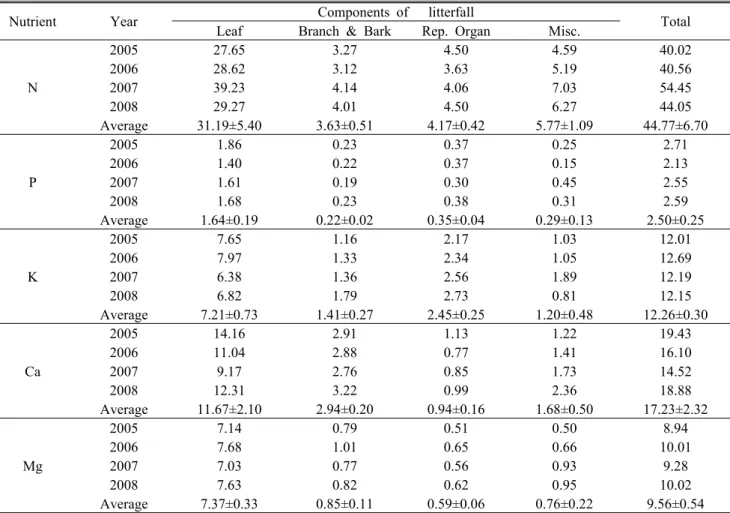
낙엽생산을 통해 연간 임상에 이입되는 각 영양염류의 총량은 질소, 인, 칼륨, 칼슘 및 마그네슘이 각각 44.47±6.70, 2.50±0.25, 12.26±0.30, 17.23±2.32, 9.56±0.54 kg ha-1yr-1 으로 질소 > 칼슘 > 칼륨 > 마그네슘 > 인의 순이었다(Table 3).
공주지역 참나무림의 연구 결과(Mun and Joo, 1994)를 보면 낙엽생산을 통해 연간 임상에 유입되는 영양염류의 양은 질소, 인, 칼륨, 칼슘 및 마그네슘이 각각 61, 0.6, 15, 32, 13 kg ha-1yr-1으로, 본 조사지역이 공주지역에 비해 인 의 이입량은 많으나 다른 원소들의 이입량은 적었다. 이것 은 임목밀도, 수령 등에 따른 낙엽생산량(공주지역 낙엽생 산량 5.671 ton/ha)과 기관별 영양염류 함량의 차이에 의한 것으로 판단된다.
미국의 참나무림에서 낙엽에 의하여 임상에 이입되는 영 양염류 이입량을 조사한 결과(Johnson and Risser, 1974)에 의하면 칼슘(97.9 kg ha-1yr-1) > 질소(65.5 kg ha-1yr-1) >
칼륨(45.9 kg ha-1yr-1) > 마그네슘(14.09 kg ha-1yr-1) > 인 (5.90 kg ha-1yr-1)의 순으로 질소와 칼슘의 순서가 본 조사 지소의 결과와 달랐다. 그러나 각 영양염류의 이입량은 본 조사지소보다 많았는데, 이것은 이 지소의 현존량(219.6 ton/ha)이 본 조사지소의 현존량(2008년에 178.5 ton/ha)에 비해 높아 낙엽생산량이 많기 때문인 것으로 판단된다. 계 방산 활엽수림에서 낙엽을 통한 영양염류 이입량은(Lee et al., 2006) 칼슘(43.4 kg ha-1yr-1) > 질소(26.9 kg ha-1yr-1)
> 칼륨(12.6 kg ha-1yr-1) > 마그네슘(9.7 kg ha-1yr-1) > 인 (0.9 kg ha-1yr-1)의 순으로 보고된 바 있으며, 광릉 천연활엽 수림에서 조사한 결과에서는(Kim et al., 2003) 칼슘(34.0 kg ha-1yr-1) > 질소(20.5 kg ha-1yr-1) > 칼륨(11.8 kg ha-1yr-1)
> 마그네슘(6.0 kg ha-1yr-1) > 인(1.0 kg ha-1yr-1)의 순으로 보고된 바 있어 본 조사결과와는 다소 상이하였다.
활엽수림이 아닌 소나무림과 측백나무림에서 낙엽생산 을 통해 임상에 이입되는 질소와 인이 소나무림에서 각각 29.02 및 2.81 kg/ha, 측백나무림에서 31.06 및 2.86 kg ha-1yr-1라고 보고된 바 있고(Mun and Kim, 1992), 월악산 의 소나무림에서 낙엽생산을 통해 임상에 이입되는 질소, 인, 칼륨, 칼슘, 마그네슘이 각각 18.014, 0.878, 4.240, 7.349, 2.172 kg ha-1yr-1으로 보고된 바 있는데(Namgung and Mun, 2009), 이들 침엽수림에 비해 본 조사지역의 굴참
Table 3. Amount of nutrient(kg ha-1yr-1) input to forest floor via litterfall for four years in the Quercus variabilis forest of the study area
Nutrient Year Components of litterfall
Total Leaf Branch & Bark Rep. Organ Misc.
N
2005 27.65 3.27 4.50 4.59 40.02
2006 28.62 3.12 3.63 5.19 40.56
2007 39.23 4.14 4.06 7.03 54.45
2008 29.27 4.01 4.50 6.27 44.05
Average 31.19±5.40 3.63±0.51 4.17±0.42 5.77±1.09 44.77±6.70
P
2005 1.86 0.23 0.37 0.25 2.71
2006 1.40 0.22 0.37 0.15 2.13
2007 1.61 0.19 0.30 0.45 2.55
2008 1.68 0.23 0.38 0.31 2.59
Average 1.64±0.19 0.22±0.02 0.35±0.04 0.29±0.13 2.50±0.25
K
2005 7.65 1.16 2.17 1.03 12.01
2006 7.97 1.33 2.34 1.05 12.69
2007 6.38 1.36 2.56 1.89 12.19
2008 6.82 1.79 2.73 0.81 12.15
Average 7.21±0.73 1.41±0.27 2.45±0.25 1.20±0.48 12.26±0.30
Ca
2005 14.16 2.91 1.13 1.22 19.43
2006 11.04 2.88 0.77 1.41 16.10
2007 9.17 2.76 0.85 1.73 14.52
2008 12.31 3.22 0.99 2.36 18.88
Average 11.67±2.10 2.94±0.20 0.94±0.16 1.68±0.50 17.23±2.32
Mg
2005 7.14 0.79 0.51 0.50 8.94
2006 7.68 1.01 0.65 0.66 10.01
2007 7.03 0.77 0.56 0.93 9.28
2008 7.63 0.82 0.62 0.95 10.02
Average 7.37±0.33 0.85±0.11 0.59±0.06 0.76±0.22 9.56±0.54 Rep. organ: Reproductive organ, Misc.: Miscellaneous
나무림에서 많은 영양염류가 낙엽을 통하여 임상으로 이입 되는 것을 알 수 있다. 이와 같이 낙엽을 통해 입상에 이입되 는 영양염류의 차이는 그 지소 토양의 영양염류 총량에 영 향을 준다(Choi et al., 2006). 열대지방 및 온대지방에서는 일반적으로 상록성 수종에 비해 낙엽성 수종의 낙엽 내 질 소함량이 높다고 보고된 바 있다(Vogt et al., 1983).
이처럼 조사지소 사이에 낙엽생산을 통해 임상에 이입되 는 영양염류의 양에 차이가 발생하는 것은 입지환경이나 수종, 수령 등에 따른 기관별 영양염류 함량의 차이에서 비 롯되기도 하지만, 임목밀도에 따른 각 지소간 낙엽 생산량 의 차이가 큰 요인으로 작용하는 것으로 판단된다.
삼림생태계의 낙엽분해와 분해과정에 따른 영양염류의 동태는 생태계의 기능을 파악하는데 매우 중요하다(Mun et al., 2007). 삼림생태계의 유형에 따라 생산되는 낙엽의 양이 다르고, 낙엽의 영양염류 함량에도 차이가 있으며, 이
들 낙엽의 종류에 따라 분해율이 다르다고 보고한 바 있다 (Namgung et al., 2008). 생산된 낙엽의 분해과정을 통해 영양염류가 삼림토양에 유입되어 다시 식물생장에 사용된 다. 따라서 삼림의 유형에 따라 토양의 영양염류 함량에 차 이가 있게 된다(Choi et al., 2006). 본 조사지소에서는 굴참 나무 낙엽의 분해과정과 분해에 따른 영양염류의 동태, 그 리고 토양의 영양염류에 관한 연구가 현재 진행되고 있으 며, 이들 연구결과를 종합하면 본 조사지소 굴참나무림의 영양염류 내부순환을 파악할 수 있을 것으로 사료된다.
감사의 글
본 연구는 환경부의 “국가장기생태연구사업”의 지원에 의해 수행되었음.
인용문헌
Allen, S.E., H.M. Grimshaw, J.A. Parkinson and C. Quarmby (1974) Chemical analysis of ecological materials. Blackwell.
Oxford.
Baker, T.T.III, B.G. Lockaby, W.H. Conner, C.E. Meier, J.A.
Stanturf and M.K. Burke (2001) Leaf litter decomposition and nutrient dynamics in four southern forested floodplain communities. Soil Sci. Soc. Amer. J. 65: 1334-1347.
Barbour, M.G., J.H. Burk and W.D. Pitts(1987) Terrestrial plant ecology. The Benjamin/Cummings, Menlo Park, California.
Barnes, B.V., D.R. Zak, S.R. Denton and S.H. Spurr(1998) Forest Ecology. John Wiley & Sons Inc., NewYork.
Berg, B. and R. Laskowski(2006) Litter decomposition: a guide to carbon and nutrient turnover. Elsevier, NewYork.
Blanco, J.A., J.B. Imbert and F.J. Castillo(2008) Nutrient return via litterfall in two constrating Pinus sylvestris forests in the Pyrenees under different thinning intensities. For. Ecol.
Manag. 256: 1840-1852.
Bray, J.R. and E. Gorham(1964) Litter production in forests of the world. In: Graff, J. B. (ed.), Advances in Ecological Research.
Vol.2. Academic Press, NewYork, pp. 101-157.
Caritat, A., E. Gracía-Berthu, R. Lapeña and L. Vilar(2006) Litter production in a Quercus suber forest of Montseny (NESpain) and its relationship to meteorological conditions. Ann. For. Sci.
63: 791-800.
Chang, N.K. and H.C. Kwon(1987) A study on the production and decomposition of litters related to altitude. Kor. J. Ecol. 10:
109-118. (in Korean with English abstract)
Choi, H.J., I.Y . Jeon, C.H. Shin and H.T . Mun(2006) Soil proper- ties of Quercus variabilis forest on Youngha valley in Mt.
Worak National Park. J. Ecol. Field Biol. 29: 439-443. (in Korean with English abstract)
Cole, D.W. and M. Rapp(1981) Elemental cycling in forest ecosystems. In: Reide, D. E. (ed.), Dynamic Properties of Forest Ecosystems. International Biological Programme 23.
Cambridge University Press, Cambridge, pp. 341-409.
Daubenmire, R.F.(1974) Plant and environment. 3rd eds., NewYork, Wiley.
Gholz, H.L., C.S. Perry, W.P. Cropper and L.C. Hendry(1985) Litterfall, decomposition, and nitrogen and phosphorus dy- namics in a chronosequence of Slash pine (Pinus elliottii) plantations. For. Sci. 31: 463-478.
Hennessey, T.C., P.M. Dougherty, B.M. Cregg and R.F. Wittwer (1992) Annual variation in needlefall of a loblolly pine stand in relation to climate and stand density. For. Ecol. Manag. 51:
329-338.
Johnson, F.L. and P.G. Risser(1974) Biomass, annual net primary
production and dynamics of six mineral elements in a post oak-blackjack oak forest. Ecol. 55: 1246-1258.
Kim, C.S., J.H. Lim and J.H. Shin(2003) Nutrient dynamics in litter- fall and decomposing leaf litter at the Kwangneung deciduous broad-leaved natural forest. Kor J. Agri For. Meteoro. 5: 87-93.
(in Korean with English abstract)
Kim, C.S., K.S. Koo, Y.K. Kim, W.K. Lee, J.H. Jeong and H.S.
Seo(1997) Dynamics of litterfall and nutrient inputs in Querces acutissima and Pinus koraiensis stands. FRI. J. For. Sci. 55:
13-18. (in Korean with English abstract)
Kim, J.S.(2007) Litter decomposition and nitrogen release in three Quercus species at temperate broad-leaved forest. For. Sci.
Tech. 3: 123-131. (in Korean with English abstract)
Kim, K.Y.(1992) Comparisons of litter decomposition of Chinese cork oak between the calcareous and noncalcareous areas. M.S.
Thesis, Kongju National University, Kongju, Korea. (in Korean with English abstract)
Kim, S.B., N.C. Jung and K.H. Lee(2009) Soil CO2 efflux and leaf-litter decomposition of Quercus variabilis and Pinus den- siflora stands in the southern region of Korean Peninsular. J.
Kor. For. Soc. 98: 183-188. (in Korean with English abstract) Kimmins, J.P.(1987) Forest ecology. Macmillan Publishing
Company, NewYork.
Kwak, Y.S. and J.H. Kim(1992) Secular changes of density, litter- fall, phytomass and primary productivity in mongolian oak (Quercus mongolica) forest. Kor. J. Ecol. 15: 19-33. (in Korean with English abstract)
Lee, I.K. and Y.W. Son(2004) Effects of nitrogen and phosphorus fertilization on seasonal changes and retranslocation of nu- trition in foliage and twig of Pinus rigida and Larix kaempferi.
Kor. J. Ecol. 27: 199-210. (in Korean with English abstract) Lee, I.K., J.W. Im, C. Kim and Y.K. Kim(2006) Nutrient dynamics
in decomposing leaf litter and litter production at the Long-Term Ecological Research Site in Mt. Gyebangsan. J.
Ecol. Field. Biol. 29: 585-591. (in Korean with English ab- stract)
Lee, K.J. and I.H Park(1987) Primary production and nutrients dis- tribution in 22-year-old Pinus koraiensis and Quercus mongol- ica stands in Kwangju District. J. Kor. For. Env. 7: 11-21. (in Korean with English abstract)
Meentemeyer, V., E.O. Box and R.T. Thompson(1982) World pat- terns and amounts of terrestrial litter production. Bio Science 32: 125-128.
Mun, H.T. and H.T. Joo(1994) Litter production and decomposition in the Querces acutissima and Pinus rigida forests. Kor. J. Ecol.
173: 345-353. (in Korean with English abstract)
Mun, H.T. and J.H. Kim(1992) Litterfall, decomposition, and nu- trient dynamics of litter in red pine (Pinus densiflora) and Chines thuja (Thuja orientalis) stands in the limestone area.
Kor. J. Ecol. 15: 147-155. (in Korean with English abstract) Mun, H.T., S.J. Kim and C.H. Shin(2007) Litter production and nu-
trient contents of litterfall in oak and pine forests at Mt. Worak National Park. J. Ecol. Fiel. Biol. 30: 63-68. (in Korean with English abstract)
Namgung, J. and H.T. Mun(2009) Litterfall and nutrient input via litterfall in Pinus densiflora forest at Mt. Worak National Park.
Kor. J. Env. Biol. 27: 261-265. (in Korean with English ab- stract)
Namgung, J., A.R. Han and H.T. Mun(2008) Weight loss and nu- trient dynamics during leaf litter decomposition of Quercus variabilis and Pinus densiflora at Mt. Worak National Park. J.
Ecol. Fiel. Biol. 31: 291-295. (in Korean with English abstract) Olson, J.S.(1963) Energy storage and the balance of producers and
decomposers in ecological systems. Ecol. 44: 321-331.
Raich, J.W. and K.J. Nadelhoffer(1989) Belowground carbon allo- cation in forest ecosystems: global trends. Ecol. 49: 471-483.
Sharma, E. and R.S. Ambasht(1987) Litterfall, decomposition and nutrient release in an age sequence of Alnus nepalensis planta- tion stands in the eastern Himalaya. Ecol. 75: 997-1010.
Son, Y.H., I.H. Park, H.O. Jin, M.J. Yi, D.Y. Kim, R.H. Kim and J.O. Hwang(2004) Biomass and nutrient cycling of natural oak forest in Korea. In: Hong, S.K., J. Lee, B.S. Ihm, A. Farina, Y.
Son, E.S. Kim, and J.C. Choe. (eds.), Ecological Issues in a Changing World-status, Responses and Strategy-. Kluwer Academic Publishers. pp 217-232. (in Korean)
Vogt, K.A., C.C. Grier, C.E. Meier and M.R. Keyes(1983) Organic matter and nutrient dynamics in forest floors of young and ma- ture Abies amabilis stands in Western Washington, as affected by fine-root input. Ecol. Monogr. 53: 139-157.
Wiegert, R.G. and C.D. Monk(1972) Litter production and energy accumulation in three plantations of longleaf pine (Pinus pal- ustris Mill.). Ecol. 53: 949-953.