Korean J. Environ. Biol. 35(3) : 227~239 (2017) https://doi.org/10.11626/KJEB.2017.35.3.227
INTRODUCTION
Coasts and estuaries, boundaries between seas and conti- nents, are ecosystem transition areas, with large geomorphic changes and diverse breeding grounds for living organisms (Elliott and Quintino 2007). Overall, species diversity of biological organisms is higher in coastal areas than in ocean or inland waters, and diatoms are no exception, as recent studies have revealed that diatom community structure and diversity are influenced by geographical factors indepen- dent of environmental conditions (Eichbaum et al. 1996;
Vanormelingen et al. 2008).
The estuary of the Nakdong River is a place where bio-
diversity is high due to diverse environmental factors and complicated topographical conditions as estuaries, and di- atoms are highly diverse in comparison with other regions (Du et al. 2009). More than 350 species of benthic diatoms were already reported in estuarine sediments of the river (Cho 1988).
As a deep and simple coastline, Yeongil Bay is rich in seagrass and is also a place where there are many diatoms related to seagrasses. A number of diatom species were listed in the Environmental Impact Assessment (EIA) con- ducted 1991-1993 at Yeongil Bay (Cho 1993). EIA was conducted when coastal area of the bay was reclaimed with burial of steel slag, produced by POSCO (Pohang Iron and Steel Corporation).
Previous studies on diatoms in the estuary of Nakdong River have been conducted on plankton in estuarine lakes,
* Corresponding author: Gyeongje Joh, Tel. 010-8320-3216, Fax. 055-320-4048, E-mail. [email protected]
ⓒ 2017. Korean Society of Environmental Biology.
Newly Recorded Species of Diatoms in Korea, from Estuarine Sandflats of the Nakdong River and
Seagrasses of Yeongil Bay
Gyeongje Joh*
Department of Environmental Science and Engineering, Inje University, Gimhae 50834, Republic of Korea
Abstract - To find unrecorded diatom species in the Nakdong River Estuary and Yeongil Bay, bottom sediments in the estuary, and seagrasses in the bay were collected from 12 sampling sites.
Eighteen species and four genera are added to the national flora of diatom as newly recorded one.
In the Nakdong River Estuary, twelve species are new records to Korea, Martyana atomus (Hustedt) Snoeijs, Pseudostaurosira perminuta (Grunow) Sabbe & Vyverman, Trachysphenia acuminata M. Peragallo, Trachysphenia australis Petit, Fallacia clipeiformis (König) D.G. Mann, Amphora graeffeana Hendey, Amphora jostesorum Witkowski, Metzeltin & Lange-Bertalot, Amphora ostrearia var. vitrea (Cleve) Cleve, Amphora wisei (Salah) Simonsen, Halamphora eunotia (Cleve) Levkov, Halamphora lineata (Gregory) Levkov, Nitzschia littorea Grunow. In Yeongil Bay, four species are added as new, Licmophora gracilis var. anglica (Kützing) H. Peragallo & M. Peragallo, Tabularia investiens (W. Smith) Williams & Round, Nitzschia composita Giffen, Nagumoea neritica Witkowski & Kociolek. Two species occurred simultaneously in both regions, Fragilaria cassubica Witkowski & Lange-Bertalot and Hyalinella lateripunctata Witkowski et al.
Key words : Bacillariophyta, coastal diatoms, new records, NIBR
<Original article>
and on benthic diatoms in sandy sediments. There were studies on distributions of planktonic diatoms in the estua- rine lake (Kim and Lee 1991; Cho et al. 1993). In intertidal sandflats, distribution of benthic diatom on the surface (Cho 1988; Du et al. 2009) and distribution along the depth of sediment layer (Du et al. 2010) were studied. On the other hand, taxonomic studies were conducted recently on diatom species belonging to genus Navicula and Hantzschia (Joh 2013, 2014).
This study extends the diatom species diversity and re- duces the number of unrecorded species in the local area.
It was conducted as part of a national task, “The Project on Survey and Excavation of Korean Indigenous Species”, supported by the National Institute of Biological Resources (NIBR) under the Ministry of Environment of Korea. The purpose of this study is to find unrecorded species of di-
atoms, not reported in Korea, at the Nakdong estuary and Yeongil Bay.
MATERIALS AND METHODS
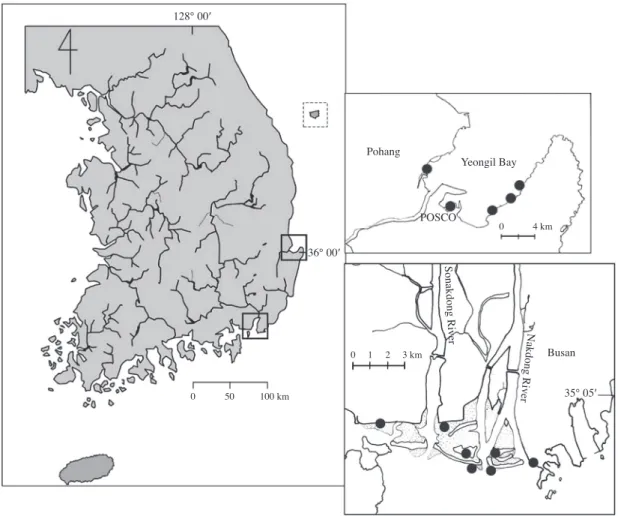
For the study of diatoms, materials were collected from sediments of intertidal sandflats in the Nakdong River Es- tuary in Busan, and from seagrass and rock in the Yeongil Bay in Pohang (Fig. 1). Benthic diatoms in the estuary were collected four times in the past in 1986, 1991, 2007 and 2013, and materials were taken from 7 sampling sites. In Yeongil Bay, periphytic diatoms were collected from sea- grasses and rock in the process of the EIA 1991-1993.
Materials containing diatoms were oxidized using nitric acid and potassium dichromate in hot sand-bath, followed
Fig. 1. Map of the Nakdong River Estuary, sand bars and sandflats (dotted areas) are developed parallel along the coast. Map of Yeongil Bay of Pohang, POSCO is the locality of Pohang Iron and Steel Company. Large black circles are sampling sites for benthic and periphytic diatoms in the coastal area.
128° 00ʹ
36° 00ʹ
35° 05ʹ Pohang
Yeongil Bay
POSCO
Busan Sonakdong River
Nakdong River
0 50 100 km
0 1 2 3 km
0 4 km