*Corresponding author. Tel : +82-41-550-3631 E-mail : [email protected]
Received : Sep., 22, 2009, Revised : Nov., 7, 2009, Accepted : Nov., 20, 2009
Growth of Creeping Bentgrass on Bottom Ash and Dredged up Sand with Four Organic Matter Amendment Rates Under Saline Irrigation Condition
Rahayu1, Geun-Mo Yang2 and Joon-Soo Choi2
1Dept. of Agrotechnology, Sebelas Maret National University, Surakarta, Indonesia,
2Dept. of Green Landscape Science, Dankook University, Cheonan, 330-714, Korea
염해 조건에서 유기물이 첨가된 준설모래와 석탄회 토양이 크리핑 벤트그래스의 생육에 미치는 영향
라하유1․양근모2․최준수2*
1세블라스마렛국립대학 농업과학과, 2단국대학교 녹지조경학과
ABSTRACT
This study was carried out to check the possibility of substituting bottom ash from the Seosan power plant for sand as growing media for creeping bentgrass (Agrostis stolonifera L.) under saline irrigation condition. Characteristics of growing media were evaluated by using column and leaching method. Creeping bentgrass cv. Pen-A1 was grown in pots with dredged up sand (DS) and bottom ash (BA) media those were amended using 1%, 2%, and 3 % OM rates in a green house. The plants were irrigated with 1.5 dSm-1 saline water. Results showed that visual quality, plant height and shoot dry weight from DS treatment were higher than those of BA treatment. Even though BA contained more salts, repeated leaching could decrease ECe efficiently. In case of no OM amendment, the visual quality, plant height and shoot dry weight were similar between in BA and DS.
Amendment of 2% OM increased the height of creeping bentgrass in DS, while decreased the plant growth in BA.
Key words: bottom ash, creeping bentgrass, organic matter, dredged up sand, saline irrigation.
INTRODUCTION
Construction of golf course using sand base growth media has become a part of modern golf course, but sand require amendment to provide adequate water holding capacity and nutrient retentions. Constructing largegolf course area using sand is expensive when the sand is moved from other places (Waltz and McCarty, 2000). The principal motivationsfor high sand content root zone are to resist soil compaction from frequent foot traffic, to induce deep rooting, to minimize pathogenic factors and to protect against salt problem (McCoy, 2006). Even though it provided rapid drainage, promotion of aeration for root growth, inefficiency in retaining moisture and nutrient is expected (Freddie et al., 2003). The possibility for substituting the sand with other material which can hold water and nutrients better with less expense may be obtained by using bottom ash (BA). Bottom ash is the waste of coal bed in many industries, and it can improve the quality of soil and increase plant growth (Buck and LaBuz, 2005). Physical characteristics of the material are near similar to soils, representing 13 – 20 % of the total ash remaining in the bottom of a coal-fired boiler after combustion, relatively coarse, gritty material, with particle sizesgenerally within the range 0.1 – 10 mm (Mukhtar et al., 2003).
Organic and inorganic amendment had significant effect on establishment and turf quality of creeping bentgrass (Agrostis stolonifera L.) in a puttinggreen (Bigelow et al., 2001). Tejada et al. (2006) reported five years investigation of organic amendment in saline soil using cotton gin crushed compost and poultry manure resultingboth organic wastes had a positive effect on the physical, chemical and biological properties of the soil, but the exchangeable sodium percentage (ESP) decreased more significantly in the cotton gin crushed compost. Peat is the most frequently used amendment material in sand base construction, since peat can not only hold water more but also supply the nutrient through its decomposition (Bigelow et al., 1999). Peat also reduced soil bulk density, improved rootzone aeration, increased soil moisture retention, and allowed gradual release of plant available water (Freddie et al., 2003).
For maintaining high quality turf for golf,the quality and quantity of irrigation water are also limiting factor (Silverstooth, 2005). Irrigation water being used is often primary source of soluble salts, thus not only the quantity of available irrigation water is important, but also the quality of the water is crucial (Kjelgren et al., 2000 ; Marcum, 2005). Water containing salt (480 ppm) or ECw (0.75 dSm-1) can cause salt accumulation, physiological drought, element toxicity, nutrient imbalance, and sodium permeability hazard (Miyamoto et al., 2005), and it may result in high soil ECe over time (Carrow and Duncan, 1998). Duncan et al. (1999) reported that sea water is
feasible for turfgrass irrigation when the turf species is highly salt-tolerant, grown in sandy soil profile with the irrigation strategies of keepingsalts moving with regular leaching events and keeping the soil profile uniformly moist with good surface drainage design and careful nutrient management.
The objective of this research is to testthe possibility of susbstituting sand as growth media by bottom ash under saline water condition.
MATERIALS AND METHODS
Soil material analysis
Growing media used in this research are dredged up sand (DS) from Bhunam Lake, Tae- ahn South Korea and bottom ash (BA) of coal bed obtained from nuclear power plant in Seosan. Organic matter for soil amendment was peat that has 85.1 % water content and 91.9 % OM content. Saline water for irrigation was obtained from Tae-ahn stream at Tae-ahn region. The chemical and physical characteristics of DS and BA were summarized as Tables 1 and 2.
Soil Texture was measured by simplified method for soil particle size determination (Ketter et al., 2001). Water retention at field capacity was measured by column method. The growing media in dry condition was placed on the gravel with 4 cm depth in the column. Spread water up to 3 cm depth from the top of layer, covered column using aluminium foil to prevent evaporation for 48 hours.Soil moisture content of top 3 cm was measured using dry oven at 100oCfor 24 hour (Poerwowidodo, 1992).
Wilting point was calculated using soil particle content with equation of Middleton (1920); wiltingpoint = [0.063 (% sand) + 0.291(% silt) + 0.426 (% clay)]/1.84. Water availability was estimated by following equation; WA= FC-WP (field capacity minus wilting point).
Soil pH (1:5) and ECp were measured by using pH meter (pH-220L) and conductive meter (cond 720), respectively. ECe was calculated using texture class conversion factor from ECp data(Carrow and Duncan, 1998). Total porosity was calculated by equation (1- bulk density/particle density) x 100% (Klute. 1986; Kurnia et al., 2006), where bulk density was measured using column methods and the particle density be measured by pycnometer method (Klute, 1986). Cation exchange capacity (CEC) was measured using 1 M ammonium acetate (pH 7.0) to remove cations fromthe exchange complex of soil then the soil was leached using NaCl 10%, and NaOH was added in the ammonium solution followed by distillation (Tan, 1995). The ammonia was accommodated in 3% of boric acid solution and titrated using H2SO4 (Pengampu,
2006). Height of capillary raise was measured using transparent column. The column was covered by net at the bottom and then was kept in water. The height of upward water movement in the column was measured daily for10 days. Particle size distribution was measured by using dry sieving standard method (Klute, 1986).
Growing media Sand content
(%) Silt content
(%)
Clay content
(%)
Soil texture
Water retention at field capacity(%)
Wilting point
(%)
Water availability
(%)
Dredged up sand 98.1 1.8 0.2 Sand 11.7 3.7 8.0
Bottom ash 70.7 26.3 3.1 Loamy sand 18.8 7.3 11.5
Continued table 1.
Growing media pH (1:5)
ECe (dSm-1)
OM (%)
Total porosity (%)
CEC (me/100g)
High of capillary rise water after treatment 10
days(cm)
Dredged up sand 6.6 1.4 0.2 37.9 1.3 40.7
Bottom ash 7.8 8.4 0.3 29.3 - 54.5
Table 1. Chemical and physical characteristics of dredged up sand and bottom ash used in this study.
Growing media Particle size distribution (mm)
> 4 4-2 2-1 1-0.5 0.5-0.25 0.25-0.15 <0.15
Dredged up sand (%) 0.2 4.2 24.7 34.6 19.8 11.3 5.2
Bottom ash (%) 23.3 16.6 22.3 16.9 8.6 4.7 7.4
Table 2. Soil particle size distribution of dredged up sand and bottom ash.
To investigate the leachate, growing mediaamended by organic matter was put in the column with holes at the bottom. Vacant cup was attached at the bottom of the column to accommodate the leachate. The growing media in column were leached using 1.5 dSm-1 saline water with the same volume as soil for two times by 2 days interval. Electric conductivity and pH of leachate accommodatedin the cup were measured twice. Calcium and Mgwere removed from the soil complex by 1 M ammonium acetate at pH 7 with ratio 1:10 between soil: solution to get extract solution (Tan, 1995). Total hardness (Ca + Mg) was analyzed from 10ml extract solution and then was added by 5 ml ammoniac buffer (pH 10). The buffered solution was added by eriochrome black T solution indicator and followed by titration using EDTA. For Ca analysis, 2 ml of 3 M NaOH was used for 2 ml solution extract, addition of several drips of calcon indicator and then titrated by EDTA solution.
Magnesium concentration was calculatedby substracting Ca in ppm from total hardness, and then multipliedby the ratio of atomic masses to determine the concentration of Mg in meq/liter (Hach, 1996; Austin, 2005). Sodium concentration was
Growing media
Content of organic matter
(%, w/w)
Creeping bentgrass height (cm)
5 WATz 6 WAT 7 WAT 8 WAT 9 WAT
Dredged up sand
0 2.3 ± 0.4 y 3.3 ± 0.2 3.6 ± 0.4 3.9 ± 0.3 4.0 ± 0.4 1 3.6 ± 0.1 4.1 ± 0.1 4.1 ± 0.1 4.4 ± 0.1 4.7 ± 0.1 2 4.6 ± 0.2 4.9 ± 0.3 5.1 ± 0.4 5.6 ± 0.6 6.0 ± 0.6 3 4.8 ± 0.1 5.1 ± 0.2 5.1 ± 0.1 5.8 ± 0.1 6.1 ± 0.3 Mean 3.8 ± 0.2 4.4 ± 0.2 4.5 ± 0.3 4.9 ± 0.3 5.2 ± 0.4
Bottom ash
0 3.2 ± 0.1 3.4 ± 0.2 3.9 ± 0.1 4.1 ± 0.1 4.4 ± 0.1 1 3.4 ± 0.1 3.5 ± 0.1 3.5 ± 0.1 4.3 ± 0.3 4.3 ± 0.3 2 2.3 ± 0.2 2.3 ± 0.2 2.3 ± 0.2 2.5 ± 0.1 2.6 ± 0.2 3 2.0 ± 0.2 2.1 ± 0.2 2.1 ± 0.2 2.2 ± 0.2 2.2 ± 0.2 Mean 2.7 ± 0.2 2.8 ± 0.2 3.0 ± 0.2 3.3 ± 0.2 3.4 ± 0.4
Significance ** x ** ** ** **
z WAT = week after treatment.
y Mean ± standard deviation.
x Significantly different at P=0.01 between dredged up sand and bottom ash.
Table 3. Effects of growth media and organic matter on creeping bentgrass cv. Penn A1 height under saline irrigation condition.
calculated by soil conductivity (ECe) data in dSm-1multiplied by 10 and then substracted by Ca and Mg content (Hach, 1996).
Plant growth and root media analysis
Researchwas conducted from September to November in 2008 in a green house.
Oneliter pots were filled with DS and BA growth media up to 90 % in volume.
Dredged up sand and BA were mixed with OM : 0%, 1%, 2% and 3%, respectively.
Creeping bentgrass cv. Pen A1 was seeded by rate of 10 g.m-2, and irrigated using 1.5 dSm-1saline water. Irrigation rate was 12 mm with 2 days interval. Pots were arranged by completely randomized design. Plant height, visual quality, shoot dry weight, and root length were measured. After harvesting the grass, the growing media were obtained from root area and below root area for checking ECe, pH,Ca, Mg and SAR.
Statistical analysis
Data were analyzed by SAS to provide the statistical significance.
RESULTS AND DISCUSSION
Creeping bentgrass growth
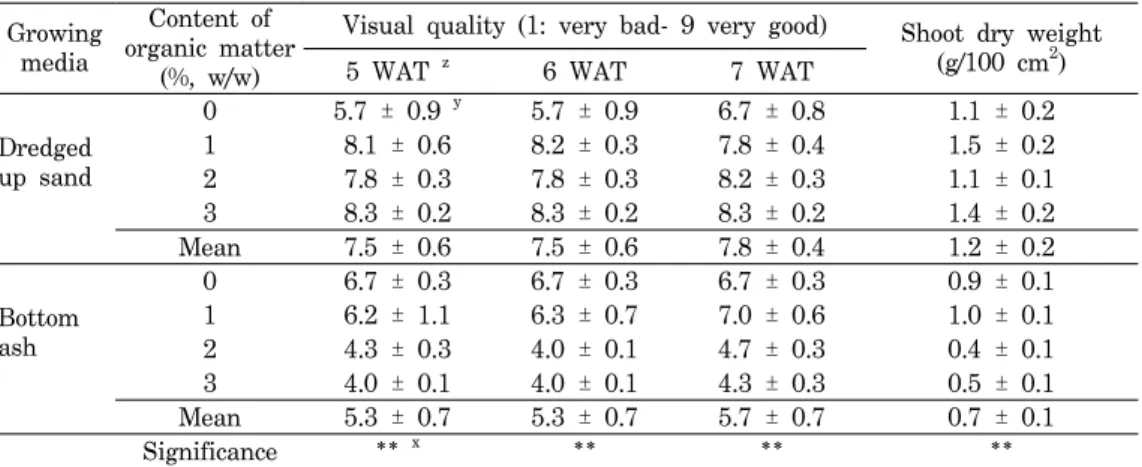
Growth of creeping bentgrass was generally better in DS than in BA growth media.
But when OM was not added, plant height, shoot dry weight and visual quality were
similar in DS and BA. Organic matter 1 % rate showedno significant effect in height, visual quality and shoot dry weight of creeping bentgrass compared with no amendment in DS and BA growth media. Amendments of 2 % and 3 % OM showed different effects in DS and BA, where OMincreased plant height in DS but decreased plant height, visual quality and shoot dry weight in BA. Factorial analysis data showed that visual quality, plant height and shoot dry weight were significantly different with higher OM in DS compared with in BA. This result showed that type of growing media as well as the organic matter rate affected plant growth differently.
Growth of creeping bentgrass was increased with increasing OM in DS, but tended to decrease in BA with increasing OM rate. In BA, increase of OM rate caused stagnancy ofplant growth (Table 4.). Bottom ash contain metals that is toxic to plants (Zang et al, 2002), and presence of dissolved organic matter, metal and OM form ligand complexes. Ligand complex formation may force desorption of metal, resulting in the total metal concentration increase in the leachate (Olsson et al., 2009). High concentration of metal in the leachate may be absorbed by plants.
Growing media
Content of organic matter
(%, w/w)
Visual quality (1: very bad- 9 very good) Shoot dry weight (g/100 cm2)
5 WAT z 6 WAT 7 WAT
Dredged up sand
0 5.7 ± 0.9 y 5.7 ± 0.9 6.7 ± 0.8 1.1 ± 0.2
1 8.1 ± 0.6 8.2 ± 0.3 7.8 ± 0.4 1.5 ± 0.2
2 7.8 ± 0.3 7.8 ± 0.3 8.2 ± 0.3 1.1 ± 0.1
3 8.3 ± 0.2 8.3 ± 0.2 8.3 ± 0.2 1.4 ± 0.2
Mean 7.5 ± 0.6 7.5 ± 0.6 7.8 ± 0.4 1.2 ± 0.2
Bottom ash
0 6.7 ± 0.3 6.7 ± 0.3 6.7 ± 0.3 0.9 ± 0.1
1 6.2 ± 1.1 6.3 ± 0.7 7.0 ± 0.6 1.0 ± 0.1
2 4.3 ± 0.3 4.0 ± 0.1 4.7 ± 0.3 0.4 ± 0.1
3 4.0 ± 0.1 4.0 ± 0.1 4.3 ± 0.3 0.5 ± 0.1
Mean 5.3 ± 0.7 5.3 ± 0.7 5.7 ± 0.7 0.7 ± 0.1
Significance ** x ** ** **
z WAT = week after treatment.
y Mean ± standard deviation.
x Significantly different at P=0.01 between dredged up sand and bottom ash.
Table 4. Effects of growing media and organic matter on visual quality and shoot dry weight of creeping bentgrass.
Growing media characteristics
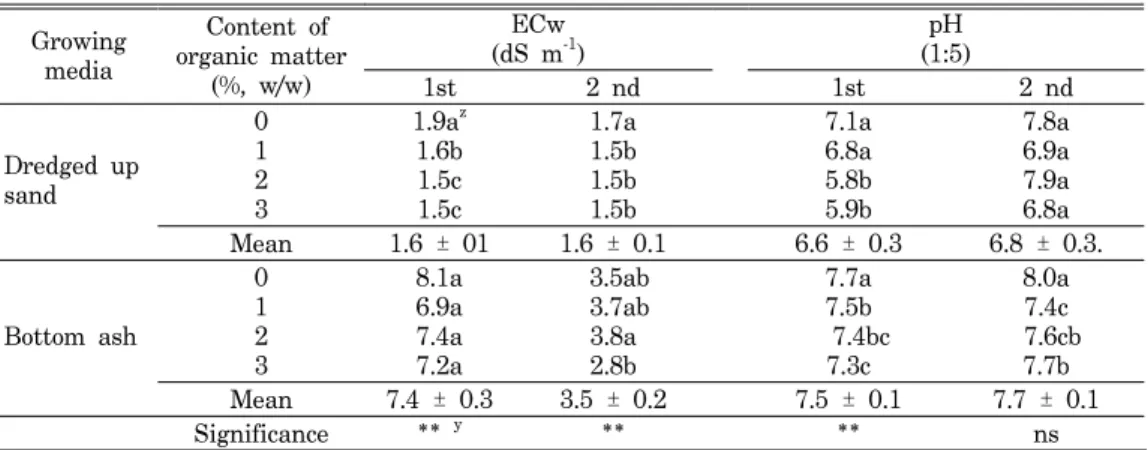
When growing media were leached by 1.5 dSm-1 saline water with the same volume of media, ECw of leachate was significantly higher in BA than in DS. In second leaching, the ECw of BA leachate was 41% lower than first leaching. This may indicate that BA contains more salts but easy to be leached resulting in lower
ECw. In second leaching of DS, ECw of second leachate was similar to first leaching, and the ECw was not different from ECw of control water leachate. High ECw at first leaching of BA agreed with Maima and Comans (1997), that BA may be weathered before or during column experiments, with carbonation by the absorption of CO2, leading to calcite formation (CaCO3) and decrease of pH values and the trace metal leachate concentration decreased with increasing liquid/solid ratio (Olsson et al., 2009). Thus in this study ECw of the second leaching was lower than first leaching, which may be caused by removing salts at first leaching or weathering during column experiment. In DS, addition of OM decreased ECw of leachate at first and second leaching. This result may due to the peat commonly containing humic substance, that is able to decrease the dissolution rate of metal oxides by forming bi or polynuclear surface complexes (Ochs, 1996). In the first leaching, pH of BA leachate was higher than DS, but there was no difference in pH in second leaching.
In DS, higher OM amendment decreased the pH of leachates only in first leaching, but not in second leaching. Organic matter increase significantly decreased the pH in BA at first and second leaching.
Growing media
Content of organic matter
(%, w/w)
ECw (dS m-1)
pH (1:5)
1st 2 nd 1st 2 nd
Dredged up sand
0 1 2 3
1.9az 1.6b 1.5c 1.5c
1.7a 1.5b 1.5b 1.5b
7.1a 6.8a 5.8b 5.9b
7.8a 6.9a 7.9a 6.8a
Mean 1.6 ± 01 1.6 ± 0.1 6.6 ± 0.3 6.8 ± 0.3.
Bottom ash
0 1 2 3
8.1a 6.9a 7.4a 7.2a
3.5ab 3.7ab 3.8a 2.8b
7.7a 7.5b 7.4bc
7.3c
8.0a 7.4c 7.6cb
7.7b
Mean 7.4 ± 0.3 3.5 ± 0.2 7.5 ± 0.1 7.7 ± 0.1
Significance ** y ** ** ns
z Mean with the same letter within column are not significantly different at P=0.05 with LSD test.
y ns,
** No significant and significantly different at P=0.01 between dredged up sand and bottom ash, respectively.
Table 5. ECw and pH of leachate after two irrigations with 1.5 dSm-1 saline water.
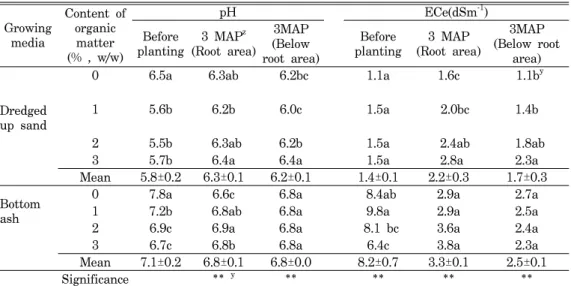
Bottom ash has higher ECe and pH than DS at before and after planting. The ECe of BA after planting was 40 % and 30 % lower than before planting in root area and below root area, respectively. However, in both growing media, the ECe of root area was higher than the deeper root zone. Organic amendment with higher rates resulted in the higher ECe of root area than below root area of DS and BA,
Growing media
Content of organic
matter (% , w/w)
pH ECe(dSm-1)
Before planting
3 MAPz (Root area)
3MAP (Below root area)
Before planting
3 MAP (Root area)
3MAP (Below root
area)
Dredged up sand
0 6.5a 6.3ab 6.2bc 1.1a 1.6c 1.1by
1 5.6b 6.2b 6.0c 1.5a 2.0bc 1.4b
2 5.5b 6.3ab 6.2b 1.5a 2.4ab 1.8ab
3 5.7b 6.4a 6.4a 1.5a 2.8a 2.3a
Mean 5.8±0.2 6.3±0.1 6.2±0.1 1.4±0.1 2.2±0.3 1.7±0.3
Bottom ash
0 7.8a 6.6c 6.8a 8.4ab 2.9a 2.7a
1 7.2b 6.8ab 6.8a 9.8a 2.9a 2.5a
2 6.9c 6.9a 6.8a 8.1 bc 3.6a 2.4a
3 6.7c 6.8b 6.8a 6.4c 3.8a 2.3a
Mean 7.1±0.2 6.8±0.1 6.8±0.0 8.2±0.7 3.3±0.1 2.5±0.1
Significance ** y ** ** ** **
Z MAP : months after planting.
y Mean with the same letter within column are not significantly different at P=0.05 with LSD test.
** Significantly different at P=0.01 between dredged up sand and bottom ash.
Table 6. Changes of soil pH and ECe of growing media before planting and after 3 months growing of creeping bentgrass under 1.5 dSm-1 saline water irrigation.
which may indicate salt holding role of OM. Lower ratesof OM have no significant effect to the ECe of DS and BA compared to no OM amendment.
Organic matter addition increased the pH of BA in root area but did not increase the pH in deeper root area. Before planting, addition of OM decreased pH of both BA and DS. Plants grow better with higher rates of OM in DS, because peat may hold the salt from the irrigation water. This result agreed with Brown et al. (2000) that peat has a polar characteristic, thus has quite high specific adsorption potential for dissolved solids such as metal and polar organic molecules. Higher OM amendment in DS may supply nutrient more as the OM solubility increase due to salinity. This was reported by Wong et al. (2006) that salinity can caused easy loss of soil OM due to OM solubility, decomposability and accessibility increase, resulting in the increase of dissolved organic carbon, providing additional substrates which can be easily decomposed by microbial population.
Different trend in BA with DS was due to the different characteristics of the rootzone, where the ECe of BA before planting was higher than after planting. This opposite trend between DS and BA was also shown with plant growth (Table 3), where the plant growth decreased as the OM rate increased. Bottom ash with higher OM amendment may release more metals to the solution and absorption by plant causing decreased plant growth. Decomposition of OM produce acid, thus make the solution more acidic, and acidity of solution can increase the solubility of trace metals
Growing media
Content of organic matter(%)
Ca (ppm)
Mg (ppm)
Na
(ppm) SAR
Water retention at field capacity
(%)
Dredged up sand
0 103.4b 35.7b 176.8b 3.8a 11.7cz
1 106.7b 73.9a 195.8b 3.5a 16.1b
2 126.2a 69.3a 297.0ab 5.3a 19.6a
3 125.6a 83.9a 348.8a 5.9a 20.8a
Mean 115.5 ± 6.1 65.7 ± 10.4 254.6 ± 41.0 4.6 ± 0.6 17.1 ± 2.0
Bottom ash
0 116.7ab 125.7a 284.2a 4.3a 18.8c
1 111.4ab 107.5a 340.6a 5.5a 24.0b
2 109.3b 126.1a 460.5a 7.2a 25.5ab
3 127.0a 99.3a 261.8a 4.2a 29.7a
Mean 116.1 ± 4.0 114.7 ± 6.7 336.8 ± 44.4 5.3 ± 0.7 24.5 ± 2.3
Significance ns ** ns ns **
z Mean with the same letter within column are not significantly different at P=0.05 with LSD test.
ns,* Non significant and significantly different at P=0.01 between dredged up sand and bottom ash, respectively.
Table 7. Three exchangeable bases and water retention of dredged up sand and bottom ash by organic matter content at 3 months after cultivated creeping bentgrass cultivation using saline water.
due to the pKa character of the metal ions (Sutanto, 1995). In root area, ECe was increased when the OM was 2 %. Amendment by 1% OM has no effect on increasing ECe in DS and also BA root area. However, all OM amendment increased the ECe of DS in root area. Organic matter amendment tended to reduce the ECe of BA in deeper root area.
Calcium content in root area was similar between BA and DS. In DS amendment with 2% OMincreased the Ca content. In BA the Ca content was not increased with the increase of organic matter. Magnesium content was significantly dependent on the type of growing media. Content of Mg in BA was higher than DS. Organic matter with 1 % rate increased the Mg content in DS but there was no effect in BA.
Sodium content of root area was not significantly different in both DS and BA. In DS amendment with 2% or more OM, Na content was increased, but in BA the OM had no significant effect on Na content. Sodium adsorption ratio (SAR) was not significantly different in both growth media, even though the SAR of BA was slightly higher than that of DS. Organic matter amendment has no significant effect to the SAR of BA and DS. Fard et al. (2007) reported that irrigation using saline water in sandy loam soil increased the soil salinity and SAR, and the increase in irrigation water salinity decreased the leaching efficiency of soils.
Water retention of BA at field capacity was significantly higher than that of DS.
Amendment with 1 % OMincreased the water retention in DS and BA. Increasing the OM rate could increase the water retention in both growth media, even though 2% was not significantly different from 3%.
CONCLUSION
Waste ashes can be used as growing media for turfgrass due to low expense and some desirable characteristics. This study was carried out to examine the characteristics of bottom ash compared to dredged-up sand. Generally sand was better as growing media when amended properly. However, when proper organic matter amendment is not available, BA could have potential for substitution with proper leaching procedure of salt and metal ions with benefits of low expense and waste reuse.
국문요약
본 실험은 서산 부남호 준설모래와 태안 화력 발전소에서 발생된 석탄회(Bottom ash) 토양 이 염해 조건에서 크리핑 벤트그래스의 생육배지로서의 활용 가능성에 대한 평가를 해보고자 수행되었다. 준설모래와 석탄회 토양의 물리, 화학적 특성을 실험실에서 조사하였으며, 각 토양 에 유기물(peat)을 0, 1, 2, 3% 비율(w/w)로 각각 혼합한 토양에서 크리핑 벤트그래스 Pen-A1 품종을 파종 후 염이 포함된 물(EC=1.5dSm-1)을 관수하며 생육을 평가하였다. 유기물 혼합전 준설 모래의 ECe가 1.4dSm-1로 나타나, 석탄회 8.4dSm-1에 비해 낮게 나타났다. 가시적 품질, 초장, 줄기 건물중 등은 준설모래 처리구에 비해 석탄회 처리구에서 낮게 나타났다. 석탄회 토 양은 염분을 보유하고 있었으나, 관수로 인한 세척시 염분이 용탈되는 것을 확인할 수 있었다.
유기물을 혼합하지 않은 경우는 준설모래와 석탄회 토양에서 가시적 품질, 초장, 건물중이 처리 간에 차이를 보이지 않았으나, 2% 유기물을 혼합한 경우 준설모래 처리구가 석탄회 처리구에 비해 초장이 높게 조사되었다.
주요어 : 석탄회, 염분 세척, 유기물, 준설모래, 크리핑 벤트그래스
REFERENCES
1. Austin, R.N. 2005. Chemical reactivity in the marine environment. CHEM 108b.
laboratory. USA.
2. Bigelow, C.A., D.C. Bowman, D.K. Cassel, and T.W. Jr. Rufty. 2001. Creeping bentgrass response to inorganic soil amendments and mechanically induced subsurface drainage and aeration. Crop Sci. 41(3):797-805.
3. Bigelow, C.A., D.C. Bowman, and K. Cassel. 1999. Germination and establishment with root-zone amendments. Golf Course Manage. 67(4):62–65.
4. Brown, P.A., S.A. Gill and S.J. Allen. 2000. Metal removal from waste water using peat. Wat. Res. Vol. 34. No.16 : 3907-3916.
5. Buck, J.K., and L.L. LaBuz. 2005. Bottom ash fines as a soil amendment for turfgrass and sute closure – laboratory and mesocosm studies at PPL Brunner Island and Montour steam electric station. Civil & Envi. Cons. Inc. p.333.
6. Carrow, R.N., and R.R. Duncan. 1998. Salt-affected turfgrass sites: assessment and management. Published by John Wiley and Sons, Inc. New Jersey.
7. Duncan, R.R., R.N. Carrow, and M. Huck. 1999. Effective use of seawater irrigation on turfgrass. USGA Green Section Rec. Feb.
8. Fard, B.M., M. Heidarpour, A. Aghakhani, and M. Feizi. 2007. Effect of irrigation water salinity and leaching properties in a arid region. Int. J. Agric. and Biology 30: 466-469. Iran.
9. Hach, C. 1996. Spectrophotometer soil and irrigation water portable laboratory manual. Js/cth 12-1-96.1ED. Printed in USA.
10. Ketter, T.A., J.W. Doran, and T.L.Gilbert. 2001. Rapid method of texture analysis. USDA-ARS. J. Soil Sci. AM. J. 65:849-852.
11. Kjelgren, R., L. Rupp, and D. Kilgren. 2000. Water conservation in urban landscapes. Hort. Science 35:1037-1040.
12. Klute, A. 1986. Methods of soil analysis. Physical and mineralogical method.
American Society of Agronomy, Inc. Madison, Wisconsin USA. p.701-702.
13. Kurnia, U., A. Fahmudin, A. Adimihardja, and A. Dairah. 2006. Physical soil properties and their analysis. BB Litbang SDL Pertanian. Deptan Jakarta.
Indonesia.
14. McCoy. 2006. Golf course soils and water science. 215A Williams hall 1680 Madison avenue. Ohio State Univ. USA.
15. Maima, J.A., and R.N.J. Comans. 1997. Geochemical modeling of weathering reaction in municipal solid waste incinerator bottom ash. J. Environ. Sci. Tech. 31:
1269-1276.
16. Marcum, K.B. 2005. Use of saline and non-potable water in the turfgrass industry;
constraints and developments. J. Agriculture Water Management 80: 132-146.
17. Middleton, H.E. 1920. The moisture equivalency in relation to the mechanical analysis of soil. J. Soil Sci. 9:159-167.
18. Miyamoto, S., A. Chacon, M. Hossain, and I. Martinez. 2005. Soil salinity of urban turf irrigated with saline water I. Spatial Variability. ARC, Texas. El Paso.USA.
19. Mukhtar, S., A.L. Kenmer, S.S. Sadaka, and L.G. Mathis.2003. Evaluation of bottom ash and composed manure blends as a soil amendment material. J.
Bioresource Technology 89 : 217-228.
20. Ochs, M. 1996. Influence of humified and non humified natural organic compounds on mineral dissolution. J. Chem. Geol. 132: 119-124.
21. Olsson, S., J.P. Gastafson, D. B. Kleja, D. Bendz, and I. Persson. 2009. Metal leaching from MSWI bottom ash as affected by salt or dissolved organic matter. J.
Waste Management 29: 506-512.
22. Pengampu, T. 2006. Procedure and technical analysis of soil. Dept. Soil Sci. UNS.
Surakarta. Indonesia.
23. Poerwowidodo. 1992. Soil investigation methods. Penerbit Usaha Nasional Surabaya Indonesia. p. 40-45.
24. Silverstooth, J.C. 2005. Saline and sodic soil management in irrigated crop production system. Dept. of Water and Envi. Sci. Univ.of Arizona.
25. Sutanto, R. 1995. Physical-chemical of soil; concept of soil developments and diagnostic horizon formation. Soil Sci. Dept. Gadjah Mada Univ. Indonesia.
26. Tan, K.H. 1995. Soil sampling, preparation and analysis. The Univ. Georgia.
Marcel Dekker, Inc. Hong Kong.
27. Tejada, M., M.T. Hernandez, and C. Garcia. 2006. Soil restoration using composed plant residues : effects on soil properties. Soil and Tillage Research. J.
102:109-117.
28. Waltz, C., and B. McCarty. 2000. Soil amendments affect turf establishment rate.
GCSAA/gcm/juli. Clemson Univ. South Caroline.
29. Wong, V.N.L., R.S.B. Greene, B.W. Murphy, R. Dalal, S. Mann, and G. Farquhar.
2006. The effects of salinity and sodicity on soil organic carbon stocks and fluxes;
an overview. J. Regolith. Australia Nat. Univ.
30. Zhang, F.S., S Yamasaki, and M. Nanzyo. 2002. Waste ashes for use in agricultural production: I. liming effect, contents of plant nutrients and chemical characteristics of some metals. The Sci. of Total Envir. 284: 215-225.