Res. Plant Dis. 16(3) : 326-330 (2010) © The Korean Society of Plant Pathology
국내에서 발생하는 배나무 바이러스병
조인숙*·김대현1·김현란1·정봉남·조점덕·최국선
농촌진흥청 국립원예특작과학원 원예특작환경과, 1농촌진흥청 국립원예특작과학원
Occurrence of Pome Fruit Viruses on Pear Trees (Pyrus pyrifolia) in Korea
In Sook Cho*, Dae Huyn Kim1, Hyun Ran Kim1, Bong Nam Chung, Jeom Doeg Cho and Gug Seoun Choi
Horticultural & Herbal Crop Environment Division, National Institute of Horticultural & Herbal Science, RDA Suwon 441-440, Korea
1National Institute of Horticultural & Herbal Science, RDA Suwon 440-706, Korea (Received on November 5, 2010; Accepted on November 12, 2010)
Three pome fruit viruses, Apple chlorotic leaf spot virus (ACLSV), Apple stem grooving virus (ASPV) and Apple stem pitting virus (ASGV) were detected in pear trees (Pyrus pyrifolia) using double antibody sandwich enzyme-linked immunosorbent assay (DAS-ELISA) in Ansung, Naju and Ulsan provinces of Korea. Infection rate of three viruses was 35.2% from 452 leaf samples of the three cultivars of pear trees. Also, each of three viruses was detected by reverse transcription polymerase chain reaction (RT-PCR) for a limited number of samples. Infection rate of three viruses was 86.3% from 233 leaf samples of the three pear cultivars. The virus infection rates by RT-PCR were much higher than ELISA. ASGV was prevailing on pear with 74.2%, whereas ASPV and ACLSV were found in 34.8% and 0.4% of tested samples, respectively. Symptoms caused by ASGV showed black spots of infected Niitaka cultivar leaves. The ACLSV, ASPV and ASGV isolates showed 83~94% sequence identity at a nucleotide level to other pome fruit virus isolates when analyzed by NCBI BLAST. Pome fruit viruses occurring in pear were ACLSV, ASPV and ASGV. This is the first report of pear trees infected ASPV in Korea.
Keywords : ACLSV, ASGV, ASPV, Nucleotide sequence, Pear (Pyrus pyrifolia)
국내에서 주로 재배되고 있는 배는 동양배(Pyrus pyrifolia) 로 재배면적은 16,239 ha이고 연간 358,000톤 정도 생산 되는 주요 과수작물 중 하나이다(2010 통계청, 농업관측).
사과, 배 등 인과류에서 가장 일반적으로 발생하는 바이 러스는 Apple chlorotic leaf spot virus (ACLSV), Apple mosaic virus (ApMV), Apple stem pitting virus (ASPV), Apple stem grooving virus (ASGV)이다(Nemeth, 1986). 이 들 바이러스는 주로 복합감염 형태로 고접병 등의 병을 일으키고 과실의 당도저하, 수량감소 등 경제적으로 적잖 은 피해를 준다(Posnett 등, 1963; Desvignes 등, 1999). 중 국과 대만에서는 동양배(Pyrus pyrifolia)에 ACLSV, ASGV
및 ASPV가 발생하고 있어 이들 바이러스를 제거하기 위 한 무독화 기술이 개발되고 있다(Wang 등, 1994, Yang 등, 2009). 한국식물병목록(2009)에 의하면 국내 발생하는 배 바이러스는 ACLSV와 ASGV 2종이 기록되어 있다.
특히, ASGV는 ‘신고’ 품종에서 발생이 심한데 잎에 검 은점의 증상이 나타나고 이병엽이 80% 이상이면 수량이 50%나 감소되어 경제적으로 큰 피해를 준다고 한다(Hong 등, 1985; Nam과 Kim, 1994). 본 연구에서는 국내 배 재 배단지에서 주로 발생하는 바이러스의 종류와 발생 정도 를 조사하여 배 바이러스병에 대한 연구뿐만 아니라 국 내 배 무독묘 생산과 보급을 위한 기초 자료로 제공하고 자 실시하였다.
시료 채집 및 바이러스 ELISA 검정. 2009년 가을에 배 주산단지인 나주, 울산, 안성 지역에서 재배 농가별로 배나무 10~20그루를 무작위 선발하고, 배나무 1그루당
*Corresponding author
Phone) +82-31-290-6237, Fax) +82-31-290-6259 Email) [email protected]
DOI: 10.5423/RPD.2010.16.3.326
3~5점의 잎을 채집하여 바이러스 ELISA 검정에 사용하 였다. 품종별 채집시료 수는 신고 350점, 원황 57점, 추 황 45점이었으며 전체 452점을 채집하였다. 바이러스 검 정은 스위스 Bioreba사의 ACLSV, ASPV 및 ASGV의 바 이러스 항혈청을 구입하여 DAS-ELISA 방법으로 수행하 였다. 배 주산단지인 나주, 울산, 안성의 각 지역에서 신 고, 원황, 추황 품종을 무작위로 선발하여 채집한 배나무 잎에 대한 바이러스 ELISA 검정 결과는 Table 2와 같다.
전체 검정 시료 452점 중 159점에서 ACLSV, ASPV, ASGV 3종 바이러스가 검출되어 35.2%의 발생률을 나타 냈다. 바이러스 종류별 발생률은 ACLSV 0.2%, ASPV 14.4%, ASGV 22.1%였고 ASGV가 3종 바이러스 중 가 장 높은 검출 빈도를 보였다. 복합감염은 1.5%로 ASPV 와 ASGV 2종 바이러스가 복합된 형태로 발생하였다. 지 역별 바이러스 발생률은 나주 35.9%, 울산 31.3%, 안성 38.6%로 거의 비슷했지만 검출된 바이러스 종류에는 차 이가 있었다. 나주에서는 ASGV 1종이 발생하였고 울산 에서는 ASGV, ASPV, ACLSV 3종 모두 발생하였으며 안 성에서는 ASGV, ASPV 2종이 발생하였다. 품종별 발생 률은 신고 37.7%, 원황 19.3%, 추황 35.6%였다.
바이러스 RT-PCR 검정. 바이러스 ELISA 검정에 사 용한 시료 452점 중에서 신고 175점, 원황 33점, 추황 25점의 총 233점 시료를 RT-PCR로 바이러스 검정을 수 행하였다. 시료 잎을 액체질소를 이용하여 마쇄한 후, 2%
polyvinylpyrrolidone가 첨가된 lysis buffer(Biomexieux Co.)에 시료를 넣고 20분 동안 실온에서 진탕하였다. 이 어서 13,000 rpm에서 5분 동안 원심분리를 통해 얻어진 상등액은 Nuclosens Extractor(Biomerieux Co)로 전체 RNA를 추출하였다. 추출한 RNA는 ACLSV, ASPV 및 ASGV 각각의 외피단백질 유전자 부분에 특이적으로 반 응하는 프라이머(Table 1)를 이용하여 RT-PCR을 실시하 였다. 유전자 증폭을 위한 조건은 48oC 50분; 94oC 4분;
[94oC 30초; 55oC 45초; 72oC 1분]35회; 72oC 10분이었다.
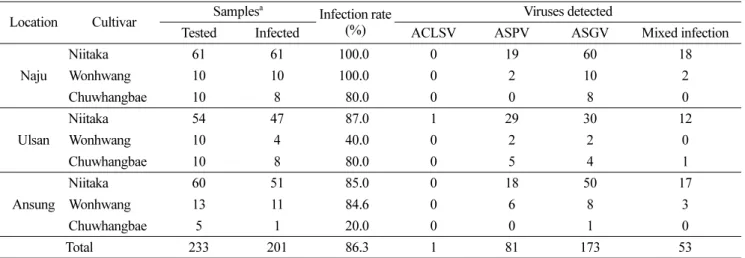
인과류 바이러스의 ELISA 검정은 계절적으로 제한된 시 기에 한해서만 결과를 신뢰할 수 있다는 보고(Candresse 등, 1995; Kirby 등, 2001)가 있어 RT-PCR로 바이러스 재 검정을 수행하였다. 이때 검정 시료는 전체 시료 452점 중 233점만을 RT-PCR 검정 시료로 사용하였으며 그 결 과는 Table 3과 같다. RT-PCR 검정결과 검정 시료 233점 중 201점에서 3종 바이러스가 검출되었고 86.3%의 높은 Table 1. Primer sequences and expected size for detection of ACLSV, ASPV and ASGV by RT-PCR
Virusesa Primer sequence (5'-3') Product size (bp) Reference ACLSV TTCATGGAAAGACAGGGGCAA
677 Menzel et al. (02) AAGTCTACAGGCTATTTATTATAAGTCTAA
ASPV ATGTCTGGAACCTCATGCTGCAA
370 Menzel et al. (02) TTGGGATCAACTTTACTAAAAAGCATAA
ASGV ATGAGTTTGGAAGACGTGCTTCAA
699 Shim et al. (06) CTAACCCTCCAGTTCCAAGTTACT
aACLSV: Apple chlorotic leaf spot virus; ASPV: Apple stem pitting virus; ASGV: Apple stem grooving virus.
Table 2. The incidence of ACLSV, ASPV and ASGV in pear trees surveyed different locations and three cultivars by ELISA Location Cultivar Samplesa Infection rate
(%)
Viruses detected
Tested Infected ACLSV ASPV ASGV Mixed infection
Naju
Niitaka 130 50 38.5 0 0 50 0
Wonhwang 20 1 9.0 0 0 1 0
Chuwhangbae 20 10 50.0 0 0 10 0
Ulsan
Niitaka 110 38 34.5 1 13 30 6
Wonhwang 20 7 35.0 0 2 6 1
Chuwhangbae 20 2 10.0 0 1 1 0
Ansung
Niitaka 110 44 40.0 0 42 2 0
Wonhwang 17 3 17.6 0 3 0 0
Chuwhangbae 5 4 80.0 0 4 0 0
Total 452 159 35.2 1 65 100 7
aNumber of plants.
발생률을 보였다. 바이러스 종류별 발생률도 ACLSV 0.4%, ASPV 34.8%, ASGV 74.2%였고 ASGV는 검정 시료의 다 수에서 검출되었다. 또한 복합감염도 22.7%로 ASPV와 ASGV 2종 복합과 ACLSV, ASPV, ASGV 3종 복합 형태 로 발생하였다. 지역별 바이러스 발생률은 나주 97.5%, 울산 86.3%, 안성 80.8%였고 검출된 바이러스 종류는 3개 지역에서 ASPV, ASGV가 모두 발생하였으며 울산에 서는 ACLSV가 하나의 시료에서 발생하여 3종 모두 발 생하였다. ACLSV는 ELISA 검정에서도 발생한 시료였다.
품종별 발생률은 신고 90.9%, 원황 75.8%, 추황 68.0%로 신고에서 바이러스 검출빈도가 높았으며 특히 ASGV의 발생률이 높은 것을 알 수 있었다. 이와 같은 결과로 국 내에서 발생하는 배 바이러스는 ACLSV, ASPV, ASGV 이고 ASGV가 가장 많이 발생하는 것을 알 수 있었다.
특히 신고품종에서의 ASGV 발생률이 높았으며 ASPV는 ASGV와 복합감염 형태로 주로 발생하였다. 국내에서 발 생하는 배 바이러스병 검정을 위한 방법으로 ELISA 보 다는 RT-PCR이 바이러스 검출에 있어서 효율이 높았으 므로, 앞으로의 배 바이러스병 검정을 위해서는 RT-PCR 방법이 적합하다고 본다.
바이러스병 증상. ASGV에 감염된 신고 잎에서는 부 정형의 검은점 증상이 보였으며(Fig. 1), Nam 등(2006)도 잎에 검은점을 형성하는 것은 ASGV의 전형적인 병징이 라고 보고한 것과 일치하였다. 하지만 ASGV가 감염된 원황과 추황의 잎에서는 검은점 증상이 보이지 않았다 (자료생략). 일본에서는 신고품종이 잎검은점병에 대한 감 수성 품종으로 보고되어 있다(家城 洋之, 2002). ASPV는 일본의 남수, 축수품종에 조피병을 일으키거나(Osaki 등, 2003) 유럽배 등에 엽맥황화 증상을 일으킨다고 보고되
어 있지만(Rossini, 2010) 이번 조사에서는 ASPV와 ACLSV 의 감염 이상증상을 발견하지 못했다. 하지만 이들 바이 러스가 단독 혹은 복합감염 형태로 배에 어떤 영향을 미 치는지에 대해서는 좀더 많은 연구가 필요하리라고 생각된다.
바이러스 유전자 염기서열 분석. RT-PCR 검정은 Table 1과 같이 예상된 크기의 유전자 증폭 밴드가 나타 나는 것만을 바이러스 감염으로 판단하였다(Fig. 2). RT- PCR로 증폭된 유전자를 pGEM-T easy vector에 클로닝하 Table 3. The incidence of ACLSV, ASPV and ASGV in pear trees surveyed different locations and three cultivars by RT-PCR
Location Cultivar Samplesa Infection rate (%)
Viruses detected
Tested Infected ACLSV ASPV ASGV Mixed infection
Naju
Niitaka 61 61 100.0 0 19 60 18
Wonhwang 10 10 100.0 0 2 10 2
Chuwhangbae 10 8 80.0 0 0 8 0
Ulsan
Niitaka 54 47 87.0 1 29 30 12
Wonhwang 10 4 40.0 0 2 2 0
Chuwhangbae 10 8 80.0 0 5 4 1
Ansung
Niitaka 60 51 85.0 0 18 50 17
Wonhwang 13 11 84.6 0 6 8 3
Chuwhangbae 5 1 20.0 0 0 1 0
Total 233 201 86.3 1 81 173 53
aNumber of plants, 233 samples of total 452 samples (Table 2) were used for RT-PCR.
Fig. 1. Typical black necrotic leaf spot symptoms caused by Apple stem grooving virus (ASGV) on pear tree (Niitaka cultivar).
Fig. 2. Agarose gel electrophoresis of RT-PCR products of ACLSV, ASGV and ASPV- infected pear trees (Niitaka cultivar).
RT-PCR was performed using the Promega Access Quick RT- PCR system with specific primer pairs (Table 1). M, 100 bp DNA marker; lane 1, ACLSV; lane 2, ASPV; lane 3, ASGV.
여 염기서열을 분석한 결과, ACLSV, ASPV, ASGV의 유 전자 증폭산물 크기는 각각 703 bp, 368 bp, 714 bp 크기
였다. ACLSV와 ASPV는 외피단백질 유전자의 일부분과 3'UTR 부분의 염기서열이 분석되었고 ASGV는 외피단백 질 유전자 전체의 염기서열이 분석되었다(Fig. 3). ACLSV 는 기존에 보고된 ACLSV와 94%의 상동(GeneBank accession AB060961)을 보였고 ASPV는 83%의 상동(AF345893)을 보였으며, ASGV는 92%의 상동(AB004063)을 보였다. 따 라서 본 연구에서 검출된 바이러스는 ACLSV, ASPV, ASGV 가 확실하였고 Table 1의 프라이머가 배 바이러스 검정 에 특이적으로 작동하고 있음을 알 수 있었다.
요 약
2009년 가을, 배 주산단지인 나주, 울산, 안성의 3개 지 역에서 신고, 원황, 추황 품종을 대상으로 배 바이러스병 발생률을 ELISA와 RT-PCR로 조사한 결과 ELISA 검정 은 ACLSV, ASPV, ASGV 3종 바이러스가 검출되어 35.2%
의 발생률을 보였다. RT-PCR 검정은 ELISA 검정 보다는 적은 시료로 검정을 수행하였지만 ACLSV, ASPV, ASGV 3종 바이러스가 검출되었고 86.3%의 높은 발생률을 보였 다. ELISA와 RT-PCR 진단 모두 ASGV > ASPV > ACLSV 순으로 ASGV의 발생률이 높게 나타났지만 발생률에는 ELISA 22.1%, RT-PCR 74.2%로 큰 차이가 있었다. 따라 서 배 바이러스 검정은 ELISA 방법 보다 RT-PCR 방법 이 바이러스 검출에 적합하다. ASGV가 감염된 신고 잎 에서는 부정형의 검은점 증상이 보였으며 ASPV와 ACLSV 가 감염된 식물체에서는 별다른 이상증상은 보이지 않았 다. RT-PCR로 증폭된 ACLSV, ASPV, ASGV 유전자는 기 존에 보고된 바이러스와 83~94%의 상동을 보였고, 특히, ASPV는 국내에서 처음으로 발생이 확인되었다.
참고문헌
Candresse, T., Lanneau, M., Revers, F., Macquaire, G., German, S., Dunez, J. Grasseau, N. and Malinovsky, T. 1995. An immunocapture PCR assay adapted to the detection and the analysis of the molecular variability of Apple chlorotic leaf spot virus. Acta Horticulturae 386: 136-147.
Desvignes, J. C. 1999. Virus diseases of fruit trees. Ctifl, Paris.
Hong, K. H., Kim, Y. S., Kim, W. C., Kim, J. B., Lee, U. J., Lee, E. J., Cho, W. D. and Cho, E. K. 1985. Studies on the abnormal spot disease in pear leaf. Res. Rept. RDA (Hort.). 27:
46-55.
Ismaeil, F., Al-Jabor, K., Myrta, A., Mando, M. J., Hassan, M. and Al-Chaabi, S. 2006. Viruses of pome fruit trees in Syria.
Bulletin OEPP/EPPO 36: 65-68.
家城 洋之. 2002. 原色 果樹のウイルス·ウイロイド病―診斷·
Fig. 3. The ACLSV, ASPV and ASGV nucleotide and amino acid sequence of the partial and full coat protein genes of pear trees (Niitaka cultivar). The asterisk (*) indicates the stop codon. (A) ACLSV, (B) ASPV, (C) ASGV.
檢定·防除. 農山漁村文化協.
Kirby, M. J., Guise, C. M. and Adams, A. N. 2001. Comparison of bioassays and laboratory assays for apple stem grooving virus. J. Virol. Methods 93: 167-173.
Lee, S. H., Kim, H. R., Kim, J. H. and Kim, J. S. 2004.
Improvenment of RT-PCR sensitivity for fruit tree viruses by small scale dsRNA extraction and sodium sulfite. Plant Pathol. J. 20: 142-146.
Menzel, W., Jelkmann, W. and Maiss, E. 2002. Detection of four apple viruses by multiplex RT-PCR assays with coamplification of plant mRNA as internal control. J. Virol.
Methods 99: 81-92.
Nam, K. W. and Kim, C. H. 1994. Studies on the pear abnormal leaf spot disease. 1. Occurrence and damage. Kor. J. Plant Pathol. 10: 169-174.
Nam, K. W. and Kim, K. S. 2002. Graft transmission and cytopathology of pear black necrotic leaf spot(PBNLS) disease. Plant Pathol. J. 18: 301-307.
Nemeth, M. 1986. Viruses, mycoplasma and ricketsia diseases of fruit trees. Martinus Nijhoff Publishers, Dordrecht, The Netherlands, 840 pp.
Osaki, H., Nitta, H., Sugae, N., Nakamura, H. and Ohtsu, Y. 2003.
Detection of Apple stem pitting virus from Japanese pear trees showing symptoms of soh. Jpn. J. Phytpoathol. 69.
Park, P. H., Choi, Y. M., Lee, I. K., Kim, H. R. and Jeong, S. B.
2006. Occurrence of Apple scar skin viroid in pear(pyrus spp.) in Korea and diagnosis of virus, viroid on important genetic resources. Kor. J. Plant Pathol. 22: 406 E-61 (Abstract).
Posnette, A. F., Cropley, R. and Ellenberger, C. E. 1963. The
effect of virus infection on the growth and crop of apple, pear and plum trees. Phytopathol. Mediterranea 2: 158-161.
Rossini, M. N., Giayetto, A. L. and Vera, D. L. 2010. First report in Argentina of Apple stem pitting virus Causing pear vein yellows disease in pear. Plant Dis. 94: 488.
Rwahnihi, M., Turturo, C., Minafra, A., Saldarelli, P., Myrta, A., Pallas, V. and Savino, V. 2004. Molecular variability of Apple chlorotic leafspot virus in different hosts and geographical regions. Journal of Plant Pathology 86: 117-122.
Shim, H. K., Min, Y. J., Hong, S. Y., Kwon, M. S., Kim, D. H. and Yang, J.M. 2004. Nucleotide sequence of a Korean isolate of Apple stem grooving virus associated with black necrotic leaf spot disease on pear (Pyrus pyrifolia). Mol. Cells 18: 192-199.
Shim, H. K., Hwang, H. K., Shim, C. K., Son, S. W., Kim, D. G.
and Lee, S. C. 2006. The pear black necrotic leaf spot disease virus transmitted by Talaromyces flavus displays pathogenicity similar to Apple stem grooving virus strains. Kor. J. Plant Pathol. 22: 255-259.
Wang, G. P., Hong, N. and Zhang, Z. P. 1994. Idnetification of virus species in pears cultivated in Northern China. China Fruits 4: 1-4.
Wang, L. P., Hong, N., Wang, G. P., Xu, W. X. and Wang, A. M.
2010. Distribution of apple stem grooving virus and Apple chlorotic leafspot virus in infected in vitro pear shoots. Crop Protect. 29: 1447-1451.
Yang, Y. S. 2009. Studies on growth of healthy seedlings and virus detection techniques in pear. National Chung Hsing University Institutional Repository. Theses and Dissertations.