서 론 연구의 필요성
1.
현대 사회에서 큰 재앙으로 불려지는 단어 중에 하나는 스트레스이다(Kabat-Zinn, 1990).적정량의 스트레스는 인 간의 삶에 활력을 주는 이로움이 있지만 오랜 기간동안 지, 속되어지거나 점진적으로 증가된 만성적인 스트레스는 심 장질환이나 암 발병 증가와 같은 해로운 영향을 줄 수 있다
스트레스는 스트레스 (National Cancer Institute, 2009).
호르몬을 증가시켜 면역 기능을 약하게 하여 암 환자의 치 료에 부정적인 영향을 줄 수 있다(Witek-Janusek et al.,
뿐만 아니라 심장마비 또는 혈관내피세포
2008). , (vascular
손상을 일으켜 염증과 혈소판 활동을 증가 endothelial cell)
시킴으로써 혈관을 좁아지게 하거나 혈전을 형성하여 심장 질환을 일으킨다(Brydon, Magid, & Steptoe, 2006; Kop et 암과 심장질환은 한국과 미국 al., 2008; Vlastelica, 2008).
에서 각각 위를 차지하는 사망률의 하나1 (Korea National
주요어: 프로그램 효과 스트레스 삶의 질, ,
Address reprint requests to: Song, Yeoungsuk, College of Nursing, Kyungpook National University, 101 Dongin-dong, Jung-gu, Daegu 700-422, Korea. Tel: 82-53-420-4978, Fax: 82-53-421-2758, E-mail: [email protected]
투고일 2009년11월25일 / 수정일 2010년 월 일3 7 / 게재확정일 2010년 월3 11일
Mindfulness Based Stress Reduction (MBSR) 프로그램이 스트레스 및 삶의 질에 미치는 효과에 대한 분석
송영숙1·Lindquist, Ruth2·최은주3
경북대학교 간호대학 전임강사1,미네소타주립대학교 간호대학 교수2,조선대학교 간호학과 박사과정3
Critical Review of the Effects of Mindfulness-Based Stress Reduction (MBSR) on Stress and Health-related Quality of Life (QOL)
Song, Yeoungsuk1· Lindquist, Ruth2· Choi, Eun-Ju3
1
Full-time Lecturer, College of Nursing, Kyungpook National University,
2Professor, School of Nursing, University of Minnesota,
3
Doctoral Student, Department of Nursing, Chosun University
Purpose: In numerous studies, MBSR programs have been shown to reduce stress and improve health-related QOL. Although MBSR programs have been shown to be beneficial, its effects have not been well-determined among Korean populations in clinical nursing practice. The purpose of this review was to describe the effects of MBSR on stress and health-related QOL so that the potential benefits of this intervention may be evaluated for wider application in Korea. Methods: Articles published in peer-reviewed journals in the English or Korean language up to 2009 were reviewed; 14 articles met the inclusion criteria for this review and there were no Korean papers. Results: MBSR groups were found to have significantly reduced stress outcomes relative to non-MBSR groups in 6 of 11 studies. In regards to health-related QOL, participants of the MBSR programs had increased scores after MBSR intervention relative to control groups in 5 of 7 studies. Conclusion: MBSR programs was effective in decreasing stress and increased the health-related QOL in the majority of studies reviewed. MBSR merits study in Korean patients to determine whether similar salutary patient outcomes may be obtained.
Key Words: Program evaluation, Stress, Quality of life
Statistical Office, 2008; Centers for Disease Control and 로써 스트레스와 관련하여 주요하 Prevention [CDC], 2009)
게 다루어져야 할 질환들이다 스트레스는 질환을 가진 대. 상자뿐만 아니라 의료인 또는 앞으로 의료계에서 종사할 학 생들에게까지도 신체적 및 정신적인 피로를 일으켜서 건강 관련 삶의 질을 저하시키므로(Cohen-Katz, Wiley, Capuano, Baker, & Shapiro, 2005; Pradhan et al., 2007; Shapiro, 스트레스 감소에 대한 관 Astin, Bishop, & Cordova, 2005)
리가 절실히 필요함을 알 수 있다.
스트레스를 감소시키기 위한 일반적인 방법으로써 보완 대체 요법이 널리 이용되고 있는데 우리나라에서는 손마사, 지 향기 흡입법 호흡법 및 음악요법, , (Choi, Lee, Ryoo, &
Park, 2008; Kang & Kim, 2008; Kim, C-J., Hur, Kang, &
등이 주 Kim, 2004; Nam & Uhm, 2008; Woo & Park, 2002) 로 사용되어지고 있다 이들의 대부분이 스트레스 감소에. 효과가 있지만 효과 지속 기간이 짧아 단기적인 요법으로 이용되고 있고 요법을 실시 후 개월 후와 같은 장기적인, 6 효과는 측정되지 않아 스트레스의 효과 지속 기간을 알 수 가 없다 최근 외국에서는 스트레스를 감소시키기 위해. , Mindfulness Based Stress Reduction(MBSR) 프로그램을 이용하고 있는데 이는 체계적으로 구성되어진 스트레스 감, 소 프로그램으로써 환자뿐 아니라 의료진에게도 스트레스, 감소에 효과가 있다(Carlson, Speca, Patel, & Goodey, 2003; Marcus, 2009; Shapiro, Astin, Bishop, & Cordova, 또한 불안 우울 2005; Shapiro, Brown, & Biegel, 2007). , , 수면장애 면역 피로 통증 등에도 효과가 있어 건강 관, , , 련 삶의 질을 증진시키는 프로그램으로 증명되고 있다 (Grossman, Tiefenthaler-Gilmer, Raysz, & Kesper, 2007;
Surawy, Roberts, & Silver, 2005; Tacon, McComb, Caĺ - dera, & Randolph, 2003; Witek-Janusek et al., 2008).
프로그램은 년 이 스트레스 감소
MBSR 1979 Kabat-Zinn
및 이완을 목적으로 메사추세츠대학교 의료센터에서 시작 된 프로그램으로 불교에서 유래된 명상의 형태이며 끊임없, 이 자기에 대한 인식을 훈련하는 것으로 이완 주의 집중, , , 자각 및 통찰력과 같은 내면의 능력을 기반으로 하여 새로 운 분별력이나 통제력을 개발하여 스트레스를 감소시키는 체계적인 접근 방법이다(Kabat-Zinn, 1990).이는 일주일 에 한번씩, 2.5시간 동안 시행되어지는 주 과정의 프로그8 램으로 마음챙김(mindfulness)훈련 바디스캔 앉은 자세, , 명상 하타 요가로 구성되어 있다 또한 참가자들의 관찰력, . , 을 증진시키기 위하여 매일 명상 요가 자각 훈련이 숙제로, ,
주어진다 이 프로그램을 마치고 나면 신체적 심리적인 증. , / 상 감소가 지속되고 삶에 대한 열정과 에너지가 충만하게, 되며 자존감이 높아질 뿐 아니라 어느 스트레스 상황에서, 나 효과적으로 대처할 수 있는 능력이 생김을 연구결과로 제시하고 있다(Center for Mindfulness in Medicine, Health Care, & Society [Center for Mindfulness], n.d.).
프로그램은 실시 직후의 단기적인 시간 내의 효 MBSR
과보다는 개월이나 개월 후에 스트레스가 더욱 더 감소6 9 되었고(Marcus et al., 2009; Pradhan et al., 2007), 4년 후 역시 스트레스 감소가 유지됨을 강조하고 있다(Center for Mindfulness, n.d.).또한 스스로 자신의 감정을 조정할 수, 있어 자신의 삶을 긍정적인 방향으로 이끌어냄으로써 내적 인 삶을 풍요롭게 만들어(Mackenzie, Carlson, Munoz, &
스트레스 감소의 장기적인 효과를 볼 수 있 Speca, 2007)
다 우리나라에서는. MBSR프로그램이'마음 챙김 명상을 바탕으로 한 스트레스 감소 프로그램'으로 알려져 있고 심, 리학에서 과민성대장증후군 환자와 당뇨병환자를 대상으 로 스트레스 감소에 대한MBSR프로그램의 효과를 증명하 고 있다(Kim, M., Kim, J-H., & Kim, S., 2003; Lee & Shin, 당뇨병환자를 대상으로 분석한 스트레스 감소효과 2007).
연구는 대상자 명을 단일 그룹으로 한 사례연구이고 과민3 , 성대장증후군 환자를 대상으로 한 단일 그룹의 효과 측정은 명의 여자 환자를 대상으로 한 효과 연구로 우리나라의 14
임상에서는 아직 활성화된 프로그램은 아니다 하지만 외. , 국에서는MBSR프로그램을 임상의 다양한 분야에 적용하 여 스트레스를 감소시킬 뿐 아니라 삶의 방식을 전환시켜 삶의 질을 증진시키고 있어 우리나라에서도 이와 같은 체계 적인 스트레스 감소 프로그램이 요구된다 따라서. MBSR프 로그램을 우리나라 임상 간호에 적용하기 위해서는 지금까 지 외국과 우리나라에서 실시된MBSR프로그램이 스트레 스 및 건강 관련 삶의 질에 미친 효과에 대한 분석을 해보고, 이에 대한 기초자료를 확보하는 것이 필요하여 본 연구를 실시하였다.
연구목적 2.
본 연구의 목적은 스트레스 감소를 위한MBSR프로그램 을 우리나라 임상 간호에 적용하기 위하여 선행연구들의 내용을 구체적으로 분석하여MBSR프로그램을 스트레스 감소 및 삶의 질 증진을 위한 프로그램으로 적용하기 위함 이다.
연 구 방 법 연구설계
1.
본 연구는MBSR프로그램을 제공한 후 스트레스 및 삶의 질에 대한 효과를 성과 결과로 발표한 국내외 실험 연구 논 문을 대상으로 내용을 분석한 문헌분석연구이다.
연구대상 및 자료수집 2.
년 월까지 국내 학술지에 게재된 논문을 검색하기 2009 8
위해 한국교육학술정보원 보건연구정보센타, , Koreamed, 국회도서관 검색 엔진을 국외 학술지에 게재된 논문 검색을, 위해서는 Ovid, CINAHL, EBSCO, PubMed, PsychoINFO의 검색 엔진을 이용하였다 국내 문헌을 검색하기 위해 사용. 된 검색어는 '마음챙김 명상 스트레스 삶의 질, , , '이었고 국, 외 문헌 검색 사용어는 'Mindfulness based stress reduc- tion, mindfulness, mindfulness meditation, stress, quality of life'이었다. MBSR의 효과를 객관적인 관점에서 적용하게 하기 위하여 대조군 전후 실험설계 무작위 통제실험연구( , 유사실험연구 로 제한하였고 그 결과 국내 편 국외) , 1 , 19편 의 연구 논문이 선정되었다 국내 논문 편은. 1 30명의 노인을 대상으로 한 스트레스 및 삶의 질 감소 효과에 대한 논문이 었으나MBSR프로그램을 시행한 것이 아니라MBSR프로그 램 중 명상의 내용만을 사용하여 다른 프로그램과 결합하여 연구효과를 본 것(Heo, 2009)으로MBSR프로그램의 순수 한 효과를 알 수 없어 본 논문분석에서 제외하였다 국외. 19 개 논문 중 개의 논문은4 MBSR프로그램과 또 다른 중재 프 로그램을 동시에 비교한 논문으로MBSR 프로그램의 순수 한 효과를 알 수 없어서 선정 논문에서 제외하였고 개의 논, 1 문은 실험군과 대조군을 각각paired t-test의 통계방법을 이 용하여 두 군의 차이를 제시하지 않아 본 연구에서 제외하였 다 그 결과 국외 분석을 위한 논문은 총. 14편이었다 따라서. 본 연구대상의 분석논문은 국외 논문으로 총14편이었다.
분석기준 3.
프로그램의 스트레스 및 건강관련 삶의 질에 대한 MBSR
효과 연구대상으로 선정된14편 논문은Center for Mindful- 프로그램의 가이드라인을 바탕으로 하여 대상자
ness ,
프로그램 제공방법 프로그램 실시 후의 성과
MBSR , MBSR
결과를 분석하였다 또한. MBSR프로그램의 효과분석을 위 해 각 연구에서 검정했던 대상 변수의 일반적 특성 나이 성( , 별 탈락자수 과, ) MBSR성과 결과에 사용된 도구를 포함하 여 분석하였다 각 분석에는 빈도와 백분율을 이용하였고. , 측정도구 및 성과결과는 빈도의 중복 표기를 가능하게 하였 다 측정기간이 다양한 경우에는. MBSR프로그램을 완료한 후 첫 측정시점을 선택하여 비교하였다.
연 구 결 과 일반적 특성
1.
년 월까지 개의 논문을 분석한 결과는 다음과 같 2009 8 14
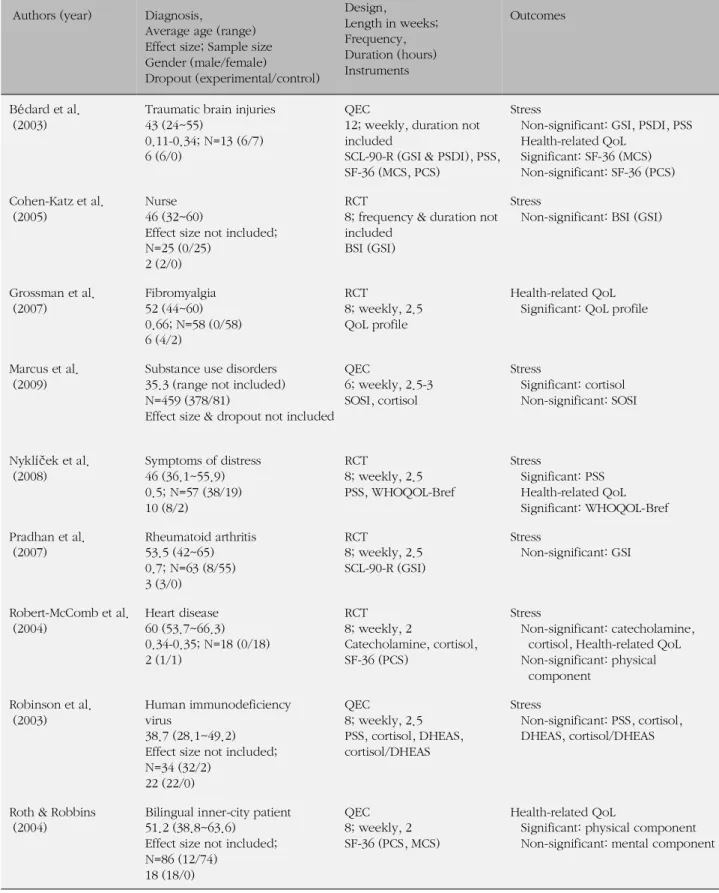
다(Table 1).대상자 관련 특성으로는 대학생 및 대학원생, 건강관련 전문인이 각각 편2 (14.3%)씩으로 나타났고 암, 환자 섬유근육통 류마티스 관절염 심장질환 물질사용, , , , 장애 외상성 뇌손상 환자, , HIV등 다양한 질환을 대상으 로 연구되고 있었다 대상자의 평균 나이는. 40~49세가 편5 으로 가장 많았고 최소 세에서 최대 세의 분포
(38.5%) , 18 82
를 이루고 있었다 대상자중 남자는. 516 ,명 여자는454명으 로 남자가51.5%로 여자보다 많았고 대상자 중에서는 여자, 대상자 유방암 간호사 섬유근육통 심장질환 만으로 구성( , , , ) 되어 있는 논문이 편 있었으며 성별에 대한 언급이 없는4 , 논문은 편으로 나타났다 또한2 . MBSR프로그램이 실시된 실험군은 총604명이었고 대조군은 총, 413명이었으며 실, 험군의 탈락자(dropout)는79 ,명 대조군의 탈락자는25명 으로 실험군의 탈락자율이 대조군보다 높았다 편. 8 (57.1%) 은 대조군이MBSR프로그램의 대기자(waitlist subject)로 써 구성되어 있었다 효과 크기에 대해서 편은 언급이 없었. 8 고 나머지 편은, 6 0.11~0.7로Cohen중간정도의 효과 크기 (
=.5)이상은 편으로 나타났다 연구설계는 편4 . 8 (57.1%) 이 무작위 임상 시험 편, 6 (42.9%)이 유사 실험연구이었다. 프로그램 제공방법에 있어서 기간은 주 프로그램MBSR 8
이11 (78.6%)편 으로 가장 많았고 빈도에 있어서는 일주일, 에 한 번씩이13 (92.9%),편 제공된 시간에서는2.5시간이6 편(42.9%)으로Kabat-Zinn이 제시한MBSR프로그램 제공 방법을 대부분 실시하고 있었다.
스트레스 측정 결과 2.
프로그램의 스트레스 관련 연구는 편으로 이에
MBSR 11
Table 1. Studies of the Effects of MBSR Programs on Stress Reduction & Health-related QoL Authors (year) Diagnosis,
Average age (range) Effect size; Sample size Gender (male/female)
Dropout (experimental/control)
Design,
Length in weeks;
Frequency, Duration (hours) Instruments
Outcomes
B dard et al. é (2003)
Traumatic brain injuries 43 (24~55)
0.11-0.34; N=13 (6/7) 6 (6/0)
QEC
12; weekly, duration not included
SCL-90-R (GSI & PSDI), PSS, SF-36 (MCS, PCS)
Stress
Non-significant: GSI, PSDI, PSS Health-related QoL
Significant: SF-36 (MCS) Non-significant: SF-36 (PCS) Cohen-Katz et al.
(2005)
Nurse 46 (32~60)
Effect size not included;
N=25 (0/25) 2 (2/0)
RCT
8; frequency & duration not included
BSI (GSI)
Stress
Non-significant: BSI (GSI)
Grossman et al.
(2007)
Fibromyalgia 52 (44~60) 0.66; N=58 (0/58) 6 (4/2)
RCT
8; weekly, 2.5 QoL profile
Health-related QoL Significant: QoL profile
Marcus et al.
(2009)
Substance use disorders 35.3 (range not included) N=459 (378/81)
Effect size & dropout not included QEC
6; weekly, 2.5-3 SOSI, cortisol
Stress
Significant: cortisol Non-significant: SOSI
Nykl ek et al. íč (2008)
Symptoms of distress 46 (36.1~55.9) 0.5; N=57 (38/19) 10 (8/2)
RCT
8; weekly, 2.5 PSS, WHOQOL-Bref
Stress
Significant: PSS Health-related QoL Significant: WHOQOL-Bref Pradhan et al.
(2007)
Rheumatoid arthritis 53.5 (42~65) 0.7; N=63 (8/55) 3 (3/0)
RCT
8; weekly, 2.5 SCL-90-R (GSI)
Stress
Non-significant: GSI
Robert-McComb et al.
(2004)
Heart disease 60 (53.7~66.3) 0.34-0.35; N=18 (0/18) 2 (1/1)
RCT 8; weekly, 2
Catecholamine, cortisol, SF-36 (PCS)
Stress
Non-significant: catecholamine, cortisol, Health-related QoL Non-significant: physical
component Robinson et al.
(2003)
Human immunodeficiency virus
38.7 (28.1~49.2) Effect size not included;
N=34 (32/2) 22 (22/0)
QEC
8; weekly, 2.5 PSS, cortisol, DHEAS, cortisol/DHEAS
Stress
Non-significant: PSS, cortisol, DHEAS, cortisol/DHEAS
Roth & Robbins (2004)
Bilingual inner-city patient 51.2 (38.8~63.6)
Effect size not included;
N=86 (12/74) 18 (18/0)
QEC 8; weekly, 2 SF-36 (PCS, MCS)
Health-related QoL
Significant: physical component Non-significant: mental component
BSI=brief symptom inventory; DHEAS=dehydroepiandrosterone sulfate; GSI=global severity index; MBSR=mindfulness-based stress reduction;
MCS=mental components summary; PCS=physical components summary; PSDI=positive symptom distress index; PSS=perceived stress scale;
QEC=quasi-experimental controlled; QoL=quality of life; RCT=randomized controlled trial; SCL-R-90=symptom checklist-90-revised; SF-36=short
form-36; SOSI=symptom of stress inventory; WHOQoL-Bref=the world health organization quality of life-brief.
사용된 도구는 생리적 지표와 신체 심리적 지표로 나눠볼/ 수 있다 생리적 지표로는 스트레스 관련 호르몬이 측정되. 었고 신체 심리적 지표로는, / Perceived Stress Scale (PSS), Symptom of Stress Inventory (SOSI), Brief Symptom In- ventory (BSI), Symptom Checklist-90-Revised(SCL-90-R)가 사용되었다 스트레스 관련 호르몬은. cortisol 편(4 ), dehydro- epiandrosterone sulfate(DHEAS; 1 ), crotisol/DHEAS편 (1편), catecholamine(1 )편 이 측정되었다.
을 포함한 는 를 대
Cortisol DHEAS, cortisol/DHEAS HIV 상으로 한 연구에서 사용되었고 심장질환을 대상으로는,
과 이 측정되었으나 두 연구 모두 통 cortisol catecholamine
계학적으로 유의한 차이는 없었다 하지만 유방암과 물질. , 사용 장애 환자를 대상으로 한cortisol측정 연구에서는 통 계학적으로 유의한 차이를 보여MBSR프로그램이 스트레 스 감소에 효과가 있음을 보여주었다 신체 심리적 지표에. /
사용된PSS는 편의 연구에서 사용되었는데 편이 통계학5 , 3 적으로 유의한 차이를 보였다. SCL-90-R을 이용하여 측정 한 연구 편 에서는 전반적인 정신적 스트레스를 측정할 수(3 ) 있는 Global Severity Index(GSI)와 증상의 강도를 측정할 수 있는 Positive Symptom Distress Index(PSDI)이 사용되 었고, 1편에서만 통계학적으로 유의한 차이가 있었다.
의 인 는 간호사를 대상으로 스트
SCL-90-R short version BSI
레스를 측정하였고, SOSI는 물질 사용 장애 환자를 대상으 로 측정되었으며 두 편 모두 통계학적으로 유의한 차이는, 없었다.
삶의 질 측정 결과 3.
삶의 질은14편 중 편에서 측정되었고7 , SF-36, WHOQOL- Bref,The Quality of Life Profile for the chronically ill이 측
Table 1. Studies of the Effects of MBSR Programs on Stress Reduction & Health-related QoL (Continued)
Authors (Year) Diagnosis,
Average age (range) Effect size; Sample size Gender (male/female)
Dropout (experimental/control)
Design,
Length in weeks; Frequency, Duration (hours)
Instruments
Outcomes
Shapiro et al.
(1998)
Premedical students
Age & effect size not included N=73 (32/41)
5 (1/4)
RCT
7; weekly, 2.5 SCL-90-R (GSI)
Stress
Significant: SCL-90-R (GSI)
Shapiro et al.
(2005)
Health care professionals 41.5 (18-65)
Effect size & gender not included;
N=28 10 (8/2)
RCT 8; weekly, 2 PSS
Stress
Significant: PSS
Shapiro et al.
(2007)
Graduate students 29.2 (20.1-38.3) Effect size & gender not included; N=54 10 (0/10)
QEC 8; weekly, 2 PSS
Stress
Significant: PSS
Surawy et al.
(2005)
Chronic fatigue syndrome 41.5 (18-65)
0.68; N=18 (10/8) 1 (0/1)
RCT
8; weekly, duration not included
SF-36 (physical functioning)
Health-related QoL
Non-significant: physical functioning
Witek-Janusek et al.
(2008)
Breast cancer 55 (35-75)
Effect size not included;
N=66 (0/66) 9 (6/3)
QEC
8; weekly, 2.5 Cortisol, SF-36
Stress
Significant: cortisol Health-related QoL Significant: SF-36
BSI=brief symptom inventory; DHEAS=dehydroepiandrosterone sulfate; GSI=global severity index; MBSR=mindfulness-based stress reduction;
MCS=mental components summary; PCS=physical components summary; PSDI=positive symptom distress index; PSS=perceived stress scale;
QEC=quasi-experimental controlled; QoL=quality of life; RCT=randomized controlled trial; SCL-R-90=symptom checklist-90-revised; SF-36=short
form-36; SOSI=symptom of stress inventory; WHOQoL-Bref=the world health organization quality of life-brief.
정도구로 사용되었다 심장질환자와 섬유근육통 환자를 대. 상으로SF-36의 신체적 측면 신체적 기능포함 을 측정한( ) 2 편의 논문은 통계학적으로 유의한 차이가 없었으나 MBSR 을 실시한 군이 대조군의 삶의 질 점수보다 더 높았다 나머. 지 편은5 MBSR프로그램 실시한 실험군의 삶의 질이 증가 되었고 그 중 편은 통계학적으로 유의한 차이가 있었으며, 3 , 편은 혼합된 결과가 나타났다 혼합된 결과를 나타낸 논문
2 .
에서는SF-36의subscale인 신체적 측면과 정신적 측면의 점수에서 각각 통계학적으로 유의한 차이가 없었지만, 프로그램을 실시한 그룹에서는 실시 전보다
MBSR MBSR
실시 후에 삶의 질 점수가 증가하였고 반면, MBSR프로그 램을 받지 않은 그룹에서는 삶의 질 점수가 오히려 감소하 였다.
논 의
은 스트레스 감소 및 건강 관련 삶의 질을 증진시키 MBSR
는 프로그램으로써 임상의 다양한 분야에서 적용되어지고 있고 개인이 가지고 있는 건강 보험의 종류에 따라서 보험, 이 적용되는 프로그램이다(Praissman, 2007).본 연구에서 스트레스 및 건강 관련 삶의 질의 효과에 관한14개의 논문 을 분석한 결과 스트레스 감소에 관해서는11편의 연구 중 6편에서 통계학적으로 유의한 차이가 있었고 건강 관련 삶, 에서는 편 중 편의 논문에서 통계학적으로 유의한 차이7 5 를 보여MBSR프로그램이 스트레스 감소와 건강 관련 삶의 질의 증진에 효과가 있는 것으로 나타났다 통계학적으로. 유의한 차이가 없었던 논문은MBSR프로그램을 시행하는 데 있어 중재 기간 빈도 제공된 시간이 일부만 제시되었거, , 나 효과 크기를 제시하지 않은 논문(Bedard et al., 2003;́ Cohen-Katz et al., 2005; Marcus et al., 2009; Surawy et al., 에서 주로 나타났으므로 앞으로의 연구 시행에
2005) MBSR
있어서는 이를 명확하게 언급함이 필요하겠다.
스트레스 감소를 위해MBSR프로그램을 적용한11편 의 연구 중 편에서 통계학적으로 유의한 차이가 없었다5 . 하지만 생리적 지표로 사용된 스트레스 관련 호르몬인, 측정 결과에서는 프로그램을 실시한 catecholamine MBSR
실험군이 대조군보다 catecholamine 수치의 감소율이 더 높았다. Cortisol관련 측정에서는 MBSR프로그램을 실시 한 군은 프로그램 실시 전보다cortisol수치가 감소하였으 나 대조군은 오히려 수치가 증가함을 보였다 또한 신체 심. , / 리적 지표의 스트레스 측정연구에서는 MBSR프로그램을
실시한 군의 스트레스 감소율이 대조군보다 높았다 이는. 명의 환자 돌봄자를 대상으로 한 실시한 연구
44 (Minor,
명의 유 Carlson, Mackenzie, Zernicke, & Jones, 2006), 42 방암과 전립선암 환자를 대상으로 한 연구(Carlson, Speca,
명 안면홍조 환자
Pater, & Goodey, 2003), 13 (Carmody, 및 신체적 및 정신적인 장애가 Crawford, & Churchil, 2006) 있 는21명의 환자(Majumdar, Grossman, Dietz-Waschkowski,
를 각각 단일 그룹으로 하여 Kersigh, & Walach, 2002) MBSR 프로그램을 실시한 후 스트레스 감소에 효과가 있는 연구결 과와 같은 것으로 스트레스 감소에 효과가 있음을 증명하, 고 있다.
비록 본 연구결과 중 몇 논문에서는MBSR프로그램을 실 시한 후 주째 측정한 스트레스 측정이 대조군과 비교하였8 을 때 통계학적으로 유의한 차이는 없었다 하지만. , 83명의 류마티스 관절염 환자와459명의 물질 사용 장애를 가진 환 자를 대상으로 개월 및 개월째 추후 측정을 한 결과에서6 9 는 통계학적으로 유의한 차이를 보여MBSR프로그램의 단 기적인 효과보다는 장기적인 효과를 보여주고 있다. 21명 의 신체적 정신적 질환이 있는 환자를 대상으로 주간의, 7 을 실시한 단일 그룹 연구에서도 역시 개월 후에 스
MBSR 3
트레스 감소에 효과가 있는 것(Majumdar et al., 2002)으로 나타나 본 연구결과를 뒷받침 해주는 것으로 프로그램 실시 직후에 효과가 없더라도 장기적인 효과를 기대할 수 있으므 로 장기적인 추후 측정이 필요하겠다.
프로그램이 스트레스 감소에 대해 통계학적으로 MBSR
유의한 차이를 보이지 않았던 편의 연구 중 편은 대조군5 3 의 일원이MBSR프로그램의 대기자로 구성되어 있어서 실 제적으로 연구결과에 영향을 줄 수 있다 즉. , MBSR의 대기 자들은MBSR프로그램에 관심이 있을 수 있어 직접적으로 연구에서 실시하는MBSR프로그램에 참여하지는 않지만, 집이나 다른 외부 장소에서 요가나 명상을 할 수 있으므로 순수한 대조군라고 보기는 어렵다(Praissman, 2008).이는 프로그램이 스트레스 감소에 통계학적으로 유의한 MBSR
차이를 보이지 않았던 연구결과에 영향을 미칠 수 있으므로 프로그램의 효과를 측정 시에는 대기자로 대
MBSR MBSR
조군을 구성하는 것을 고려해보아야 할 것이다.
건강 관련 삶의 질과 관련한MBSR프로그램의 효과를 분 석한 편의 연구 중 편에서 건강 관련 삶의 질이 증가하였7 5 고 만성피로 증후군과 심장질환을 대상으로 한 편은 통계, 2 학적으로 유의한 차이가 없었다 만성피로 증후군과 심장. 질환을 대상으로 한 연구가 통계학적으로 유의한 차이가 없
었으나MBSR프로그램을 실시하지 않은 대조군의 건강 관 련 삶의 질 신체적 기능만을 평가함 의 점수는 점 및( ) 6 22.2 점 감소한 반면, MBSR 프로그램을 실시한 실험군의 삶의 질 점수는0.56점 감소 및1.6점 증가하였다 또한 만성피. , 로 증후군의 실험군만을 대상으로 측정한MBSR프로그램 의 개월 후 삶의 질을 측정한 결과3 (62.50 )점 에서는 삶의 질 점수가15점 증가하였으며 통계학적으로 유의한 차이가 있었다(Surawy et al., 2005).이와 비슷하게, Majumdar등 의 연구에서는 단일군 실험연구로써 명의 안면 홍
(2002) 12
조 환자를 대상으로MBSR프로그램을 실시하고 개월 후, 3 의 건강 관련 삶의 질을 측정한 결과 삶의 질이 증가되었고, 통계학적으로 유의한 차이가 있었다 또한. 26명의 여성으 로만 구성된 섬유근육통 환자를 대상으로MBSR프로그램 을 실시한 후 년 후의 건강 관련 삶의 질을 측정한 결과 역3 시 통계학적으로 유의한 차이를 보여MBSR프로그램은 건 강 관련 삶의 질의 증진을 장기적인 효과로 기대할 수 있는 프로그램이라고 할 수 있겠다(Grossman et al., 2007).뿐만 아니라 통계학적으로 유의한 차이가 없었던 두 연구 모두, 대조군이MBSR대기자로써 본 연구결과에 영향을 줄 수 있 으므로 위에서 언급한 것처럼 대조군을 설정 시 프로그램의 대기자로 설정하는 것은 고려되어져야 할 것이다.
결 론 및 제 언
본 연구는MBSR프로그램이 스트레스 및 건강 관련 삶의 질에 미치는 효과에 대한 국외14개 논문을 분석한 연구로 써, MBSR프로그램은 스트레스 감소 및 건강 관련 삶의 질 향상에 효과가 있었다 통계학적으로 유의한 차이가 없었. 던 논문은MBSR프로그램에 대한 중재기간 빈도 제공 시, , 간이 일부만 제시되었거나 표본 크기를 결정하는 power, 가 제시되지 않았으며 대조군 significancy level, effect size , 의 대상자들이MBSR프로그램의 대기자로 설정되고 있었 다 그러므로. MBSR프로그램을 우리나라의 임상에서 간호 중재로써 적용을 해보고 적용 시에는 위에서 언급한 기초, 자료를 바탕으로 하여 장기적인 효과 측정 연구가 이루어져 야 할 것이다.
위에서 제시한 결과를 바탕으로MBSR프로그램은 스트 레스 감소와 건강 관련 삶의 질을 향상시키고 일시적인 효, 과보다는 장기적으로 효과를 나타낼 수 있음이 증명되었 다 또한 부작용이 없을 뿐 아니라 시간 및 장소에 관계없. 이 실시할 수 있는 프로그램으로 우리나라의 임상에 간호
중재로써 적용할 수 있도록 연구의 기초자료를 제공하였 음이 간호학적 의의라고 하겠다 이를 바탕으로 하여.
프로그
MBSR 램을 스트레스 감소 및 건강 관련 삶의 질과 관련된pilot study를 실시해보고, MBSR프로그램의 측정 지표를 스트레스 및 삶의 질에 국한하지 않고 우울 불안, , , 면역과 관련된 생리적 지표 등을 이용하여 측정해볼 것을 제언한다.