Varietal and Annual Variations of β-Glucan Contents in Korean Barley ( Hordeum vulgare L.) and Oat ( Avena sativa L.) Cultivars
Mi-Ja Lee*
†, Jae-Soo Yoo*, Yang-Kil Kim*, Jong-Chul Park*, Tae-Soo Kim*, Jae-Seong Choi*, Kee-Jong Kim*, and Hyung-Soon Kim**
*National Institute of Crop Science, Rural Development Administration, Iksan, 570-080, Republic of Korea
**Department of Environmental & Chemical Engineering, Seonam University, Namwon, Jeollabuk-do, 590-711, Republic of Korea
284
†
Corresponding author: (Phone) +82-63-840-2257 (E-mail) [email protected]
<Received 3 August 2011; Revised 17 September 2011; Accepted 26 September 2011>
ABSTRACT Varietal and annual variations in the contents of β-glucan fractions per weight grain samples were examined in sixteen covered and eighteen naked barley and five oat cultivars developed in Korea. Also, the effect of pearling on β-glucan content was investigated. Average contents of total, soluble and insoluble β-glucan fractions were 5.25, 3.72, and 1.53%, respectively, in covered barley, and 5.86, 3.51, and 2.35%, respectively, in naked barley. Soluble β- glucan content was higher in covered barley, though total β-glucan content higher in naked barley. The total and insoluble β-glucan contents were higher in pearled grains.
Total β-glucan content was higher in waxy barley than in non-waxy barley. Duwonchapssalbori, a two-rowed and waxy naked barley cultivar, was highest in total, soluble and insoluble β -glucan contents. Highly significant positive correlations were observed between total β-glucan and soluble β-glucan contents both in covered and naked barley. There were significant annual variations in total β-glucan content in barley. Average contents of total, soluble and insoluble β-glucans of oat cultivars were 4.33, 3.44, and 0.89%, respectively. Contents of all fractions of β-glucans were higher in barley than in oat.
These results would be useful for the breeding of high β- glucan variety and also for the use barley and oat as value- added food ingredients.
Keywords : barley, oat, β-glucan, soluble β-glucan, waxy
Mixed-linked (1→3), (1→4)-β-D-glucans, otherwise simply known as “β-glucan”, are non-starch polysaccharides forming a major component of the endosperm cell walls and a minor component of aleurone cell walls of barley and oat grains (Newman et al., 1987).
The structure of β-glucan is comprised of cellotriosyl and
cellotetraosyl units linked through beta-1→3 linkages, which lead to kinks in the straight chain polymer, allowing water to get in between the chains and making β-gucan soluble in water.
Therefore, β-glucan is classified as a soluble dietary fiber component. The degree of water solubility of a particular β- glucan is a significant factor in certain physiological effects.
β -Glucan content and solubility of β-glucan in barley depends on genetic and environmental factors which affect interrelationships between cell wall constituents (Woodward et al., 1983, Charles
& Louise, 2005). Although the relative contributions of these factors cannot be precisely quantified, there is a general agreement that the genetic background of the barley is more important than environmental conditions as a determinant of the final β- glucan content of the grain (Gill et al., 2002).
Soluble dietary fiber reduces serum cholesterol and postprandial blood glucose levels in humans, mainly due to the formation of viscous solutions, which decrease the absorption of components (e.g. glucose, bile acids, cholesterol) by the intestine (Trogh et al., 2004; Newman et al., 1989). The viscosity depends on the concentration of dietary fiber components, their solubility and molecular weight. On the other hand, insoluble dietary fiber has a high water-binding capacity which increases and softens fecal bulk. It also reduces transit time of fecal material through the large intestine (AACC, 2003). Therefore, the action of soluble dietary fiber reduces the risk of coronary heart disease, while the action of insoluble dietary fiber is beneficial for diabetics (Klopfenstein et al., 1988). A number of nutritional studies have demonstrated a link between the regular consumption of foods containing cereal β-glucan at physiologically effective concentrations and a reduced risk of chronic health problems.
β -Glucan reduces risks associated with cardiovascular diseases
through lowering of blood serum cholesterol (Braaten et al., 1994) and with diabetes through regulation of blood glucose levels (Wood et al., 1994; McIntosh et al., 1995). It is indicating that β-glucan-rich products may be useful food ingredients for people with low blood glucose tolerance (McIntosh et al., 1995).
Based on research evidences, the United States Food and Drug Administration (FDA) has allowed a health claim indicating that regular consumption of oat and barley products containing 3 g of soluble β-glucan per day mat lower the risk of heart disease (FDA, 2005). Consequently, the food and supplement industries are increasingly interested in concentrating this bioactive grain component at a commercial scale to allow them to incorporate β-glucan as an ingredient into their product formulations (Baik
& Steven, 2008). Therefore, it is important to distinguish the two types of β-glucan (soluble and insoluble β-glucan) and examine their ratios in various barley cultivars. However, there is little research for β-glucan and soluble β-glucan content of Korean barley and oat cultivars so far.
The main objectives of the present study were to investigate for total and soluble β-glucan content among a large number of registered Korean barley and oat cultivars grown in Korea, and to compare contents and solubility of β-glucans in several genotypes of barley and oat cultivars. And we also investigated the change of β-glucan content of barley by pearling and annual variations.
MATERIALS AND METHODS
Sample preparation
A total of thirty four Korean barley cultivars, sixteen covered and eighteen naked barley, were grown in 2006 and 2007 at National Institute of Crop Science, Rural Development Admini- stration, Korea. Five oat cultivars and lines were also investigated.
Grains of barley and oat cultivars were ground by a centrifugal mill (Retsch Zm 100, I. Kurt Rotech CmbH & Co. KG, Haan, Germany) with a 0.2 mm sieve. To investigate the change of β-glucan content according to pearling in barley, grains (200 g) of the two covered barley cultivars, Olbory and Seodunchal, and the two naked barley cultivars, Saessal and Saechalssal, were pearled 33 and 23%, respectively, of their original weight using the Sadake Test Mill (M05, Satake, Tokyo, Japan). All grains were harvested in 2007 except grains used in pearling
experiment which were harvested in 2006. Megazyme β-glucan assay kit was purchased from Megazyme Co. (International Ireland Ltd., Wicklow, Ireland). All other chemicals and solvents used were commercial analytical grade.
Cooking Properties
Cooking properties were investigated with 5 g of pearled grains. The volume (a) of grains was measured in a 50 mL mass cylinder containing 20 mL distilled water. Then the sample grains were transferred to a beaker and 80 mL of boiling water was added and cooked at 150℃ oven for 40 min. After removed the water, sample weight (b) was measured after 10 min. The volume (c) of the sample was checked again in a mass cylinder containing 20 mL of water. Water absorption and expansion rates were calculated by using the following equations. Each sample was prepared in triplicate.
Water absorption (%) = [weight after absorption (b) / weight of sample] ×100
Expansion (%) = [volume of cooked barley (c) / volume of sample (a)] ×100
Extraction of water soluble β-glucan
To investigate the extraction efficiency and determine the optimum extraction time of water soluble β-glucan, we extracted samples for 0.5, 1, 1.5, 2 hr with water (5 mL) at 38℃ in a shaking water bath. Then the samples were centrifuged (1,500
×g, 5 min), the supernatants decanted, and the pellets were washed twice with water (5 mL) and recovered by centrifugation (2,500
×g, 5 min). These pellets were analyzed to estimate the insoluble β -glucan content.
Analysis of total and soluble β-glucan
The β-glucan contents of the barley and oat samples were determined by measuring the absorbance at 510 nm after treat the sample using a Megazyme β-glucan assay kit applying McCleary method (McCleary & Codd, 1991; McCleary &
Mugford, 1992). From this experiment, total and insoluble β
-glucan contents were determined. Soluble β-glucan content
was calculated as the difference between the total and insoluble
β -glucan contents. Solubility was the ratio of soluble β-glucan
content and it was calculated from total and soluble β-glucan
content.
Table 1. Variations in contents and solubility of β-glucans, and cooking quality of whole and pearled grains of barley.
Cultivar Total β-glucan (%)
Soluble β-glucan (%)
Insoluble β-glucan (%)
Solubility (%)
Water absorption (%)
Expansibility (%) Olbori Whole
Pearled
5.37
h3)5.86
e3.62 3.63
1.75 2.23
67.4
61.9 233
b109
dSeodunchal
1)Whole Pearled
6.97
c8.73
a4.56 5.24
2.41 3.49
61.9
60.0 242
b416
bSaessal Whole Pearled
5.45
g5.76
f3.33 2.75
2.12 3.01
61.1
47.7 217
c373
cSaechalssal
1)Whole Pearled
6.54
d7.20
b4.02 3.73
2.52 3.47
61.5
51.8 263
a445
aLSD
2)0.51
**4)NS 0.41
*16.4
***24.4
***1)
Waxy barley cultivar.
2)
Least significant difference at 5% level of significance.
3)
The different superscripts in the same column mean significantly different at p<0.05.
4)
Levels of significance;
*p<0.1,
**p<0.01,
***p<0.001, NS : not significant.
Fig. 1. Variation of soluble β-glucan content in barley and oat according to extracting time.
Statistical analysis
All measurements were conducted at least in triplicate and the data were then analyzed by SAS software (version 9.2;
SAS Institute, Cray, NC, USA). Duncan’s multiple range test and Fisher’s least significant different test were used to compare the mean values at p<0.05.
RESULTS AND DISCUSSION
Effect of extraction time on soluble β-glucan content The result of extracted soluble β-glucan according to extraction time is presented in Fig. 1. The soluble β-glucan contents of Saechalssal and Olbori were increased rapidly in the first-0.5 hr
and then increased slowly to 1.5 hr and reached a maximum
value, thereafter, remained constantly up to 2 hr. The soluble β-glucan content of Saechalssal was 2.5% after 0.25 hr and increased to 3.6, 4.0, and 4.2% after 0.5, 1.0, and 1.5 hr, respectively. The soluble β-glucan content of Olbori showed the same tendency. Also, soluble β-glucan extraction from oat showed a similar tendency as in barley and maximum value was 4.0% after 1.5 hr. The optimum extraction time for soluble β-glucan of barley and oat was 1.5 hr. We applied these results to extract soluble β-glucan in the following experiments. Åman and Graham (1987) studied optimum extraction time and temperature for β-glucan. When a barley and oat sample was extracted with water at 38℃, soluble β-glucans were completely extracted after 2 hr with water.
β-Gucan contents and cooking properties of whole and pearled barley
Many researchers reported that contents of grain component were changed by pearling process (Klamczynski et al., 1998;
Paul et al., 2010). Therefore, it is important to distinguish the β-glucan contents of whole and pearled grains of barley cultivars.
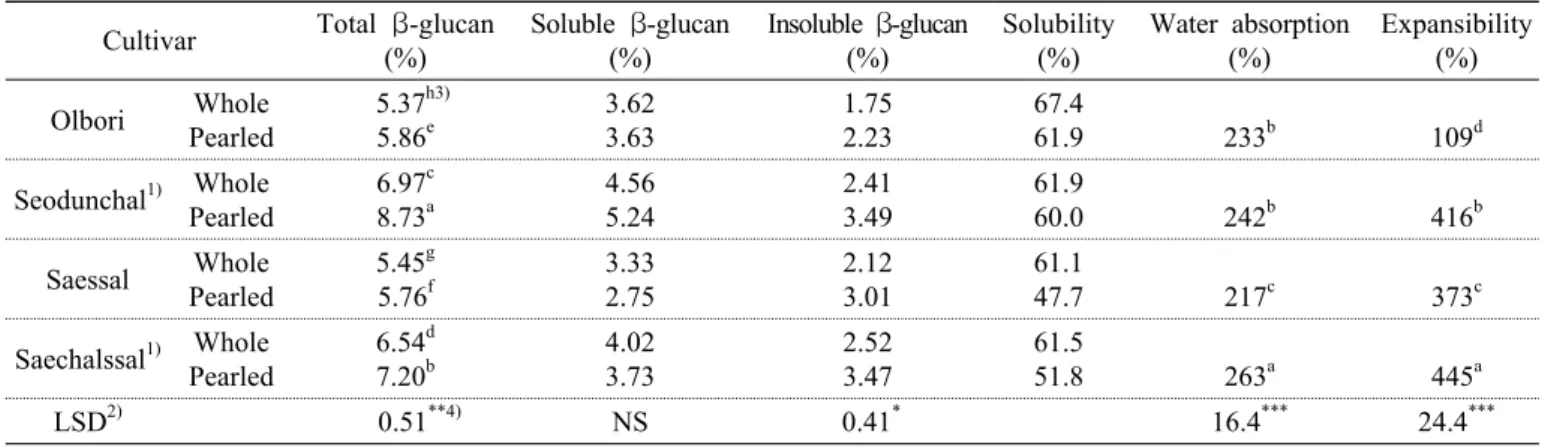
Table 1 presents the content of total, insoluble and soluble β-glucan and solubility of whole and pearled grain of barley cultivar. Total β-glucan content of whole and pearled barley ranged from 5.37 to 6.97%, and from 5.76 to 8.73%, respectively.
Pearled grains had higher total β-glucan content than whole grains by from 5.4 to 20.2% depending on cultivars (Table 1).
This indicates that outer layer has lower β-glucan content than
Fig. 2. Yearly variation of total β-glucan content of barley cultivars grown in 2006, 2007. The different superscripts mean significantly different at p<0.05.
the endosperm. Seodunchal was the highest in total β-glucan content in whole and pearled grains. Waxy barley cultivars had higher content than non-waxy barley cultivars. Insoluble β-glucan content was increased by pearling in all cultivars. However, soluble β-glucan content was increased in pearled grains only in covered barley. Solubility was higher in whole barley compared to pearled barley and it was highest in whole grains of Olbory.
The obtained results showed that the content of total, soluble and insoluble β-glucan decrease in the following order: pearled waxy barley > whole waxy barley > pearled non-waxy barley >
whole non-waxy barley. Solubility decreased in the following order: whole covered barley > pearled covered barley ≥ whole naked barley > pearled naked barley.
Panfili et al. (2008) studied the β-glucan levels of a number of varieties of barley. β-Glucan content ranged from 2.64 to 8.05%. They also studied the effect of pearling on a barley kernel, and found that pearling of kernel led to an increase in β-glucan from 4.34 to 4.82%, which is in agreement with the results of this study. Baik and Steven (2008), Cui (2001), and Quinde et al. (2004) reported that pearling reduces the contents of insoluble fiber, protein, ash and free lipids, but increases the contents of starch and β-glucan by the removal of outer layers, including the hull (palea and lemma), bran (pericarp, testa) and germ (embryo), which are rich in insoluble fiber, protein, ash and lipids and poorer in starch and β-glucan than the endosperm.
Baik and Steven (2008) reported that β-glucan content has a positive correlation with water uptake during cooking and waxy starch naked barley flour had higher mixograph water absorption and water-holding capacity than regular starch naked barley flour.
Water absorption ranged from 217 to 263% and expansibility from 109 to 445%. Seodunchal and Saechalssal with high β- glucan content had higher water absorption and expansibility.
Also, cultivars with higher soluble and insoluble β-glucan showed higher cooking properties.
Annual variation of β-glucan content
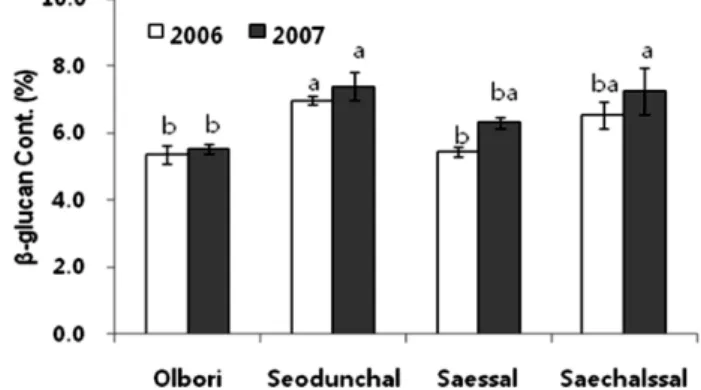
Total β-glucan content was determined in four barley cultivars for the grains produced in 2006 and 2007 under the same cultivation condition (Fig. 2). β-Glucan content was higher by about 0.16 to 0.86% in grains produced in 2007. Rainfall of April, May and June in 2007 was lower than that in 2006 and average and highest temperature was similar in 2006 and 2007.
Several studies showed that the level of β-glucan in barley could be affected by cultivar and growing conditions (Henry 1986; Åman & Graham, 1987). The availability of water during grain maturation influences the β-glucan levels, i.e. dry conditions before harvest have been related with high β-glucan levels (Anderson et al., 2003; Bendelow 1975). Hot and dry climate conditions, early harvesting time and increasing nitrogen rates give rise to increased viscosity of barley extracts, while rain induced a decrease in viscosity which could be related to the lower β-glucan content (Aastrup 1979).
β-Glucan contents of covered and naked barley cultivars According to the FDA, about 3 g/day of (1→3, 1→4)-β-D- glucan soluble dietary fiber is needed for cholesterol lowering effects (FDA, 1997). Increasing the levels of these dietary fiber constituents in food and finding the source containing high level dietary fiber might be beneficial for human health.
Total, soluble, and insoluble β-glucan contents and solubility
were determined in covered and naked barley cultivars (Table
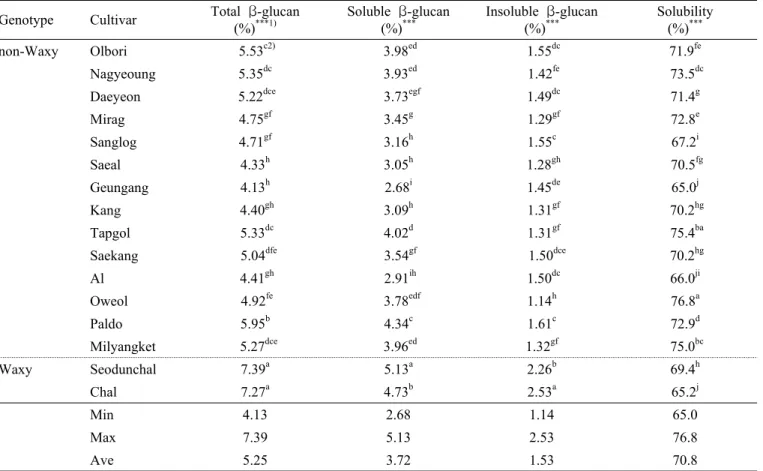
2 and 3). Average contents of total, soluble, and insoluble
fractions of β-glucan were 5.25, 3.72, and 1.53% in covered
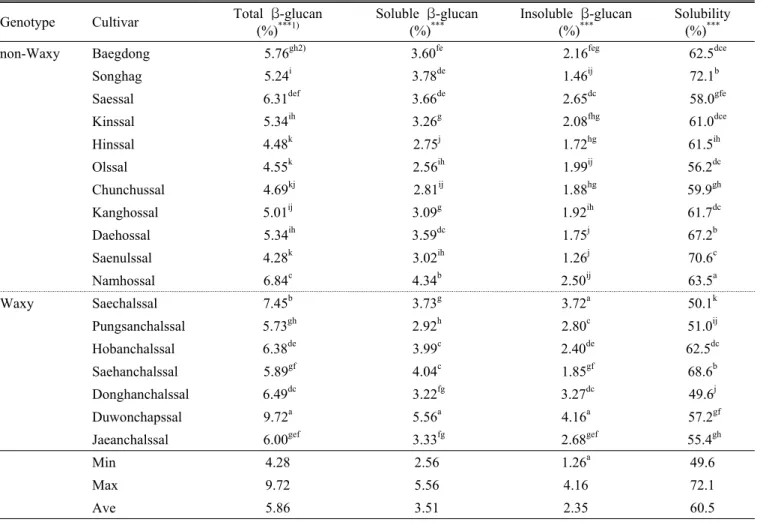
barley, and 5.86, 3.51, and 2.35% in naked barley. In general,
total and insoluble β-glucan contents were higher by about 10
and 35% in covered barley, while soluble β-glucan contents and
solubility of β-glucan were higher by about 6 and 18% in naked
barley (Table 2 and 3). There were significant differences among
cultivars in the contents of all the fractions of β-glucans in
both covered and naked genotypes. However, variation in the
content of each β-glucan fraction was consistently higher in naked
barley than in covered barley. Among the covered cultivars,
Table 2. Variations in content and solubility of β-glucans in Korean covered barley cultivars.
Genotype Cultivar Total β-glucan (%)
***1)Soluble β-glucan (%)
***Insoluble β-glucan (%)
***Solubility (%)
***non-Waxy Olbori 5.53
c2)3.98
ed1.55
dc71.9
feNagyeoung 5.35
dc3.93
ed1.42
fe73.5
dcDaeyeon 5.22
dce3.73
egf1.49
dc71.4
gMirag 4.75
gf3.45
g1.29
gf72.8
eSanglog 4.71
gf3.16
h1.55
c67.2
iSaeal 4.33
h3.05
h1.28
gh70.5
fgGeungang 4.13
h2.68
i1.45
de65.0
jKang 4.40
gh3.09
h1.31
gf70.2
hgTapgol 5.33
dc4.02
d1.31
gf75.4
baSaekang 5.04
dfe3.54
gf1.50
dce70.2
hgAl 4.41
gh2.91
ih1.50
dc66.0
jiOweol 4.92
fe3.78
edf1.14
h76.8
aPaldo 5.95
b4.34
c1.61
c72.9
dMilyangket 5.27
dce3.96
ed1.32
gf75.0
bcWaxy Seodunchal 7.39
a5.13
a2.26
b69.4
hChal 7.27
a4.73
b2.53
a65.2
jMin 4.13 2.68 1.14 65.0
Max 7.39 5.13 2.53 76.8
Ave 5.25 3.72 1.53 70.8
1)
Level of significance;
***p<0.001.
2)
The different superscripts in the same column mean significantly different at p<0.05.
total and soluble β-glucan contents were highest in Seodunchal.
Waxy barley cultivars had higher total β-glucan content than non-waxy barley cultivars.
Solubility ranged from 65.0 to 76.8% and Oweol had the highest value. Solubility was higher in non-waxy barley cultivars.
Barley β-glucan constitutes a relatively minor fraction (2-11%) of the weight of the total kernel carbohydrates and the β-glucan content varies depending on the genotype of barley (up to 15%, w/w) (Papageorgiou et al., 2005). Izydorczyk et al. (2000) reported that soluble β-glucan contents ranged from 1.16 to 3.55% (w/w) and solubility was 20.6-52.5%. These values were slightly lower than those of our study results. Duwonchapssal was highest in total, insoluble and soluble β-glucan content.
Åman and Graham (1987) analyzed 13 Montana and 51 Swedish barleys and found about half the total amounts to be soluble.
Two-rowed barley had higher β-glucan content than six-rowed barley and waxy cultivars have higher levels of β-glucan in
their endosperm than non-waxy varieties (Ulrich et al., 1986).
In this study, Duwonchapssal, the two-rowed genotypes and waxy barley cultivar had the highest value in β-glucan content.
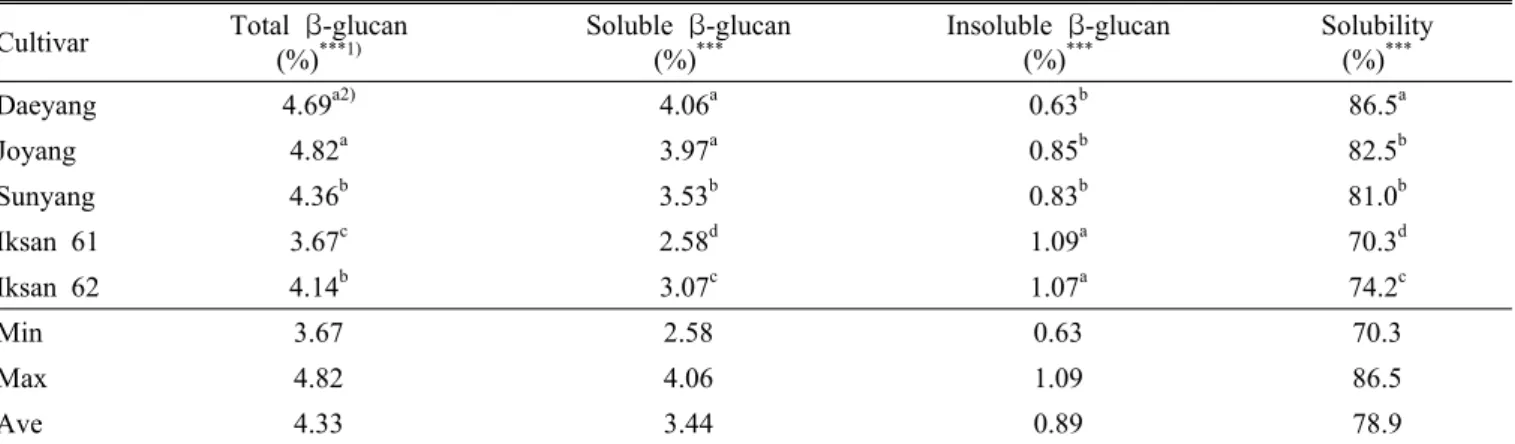
Total, insoluble and soluble β-glucans of oat cultivars Total β-glucan contents showed significant difference (p<0.001) and ranged from 3.67 to 4.82%. Daeyang and Joyang were the highest in total β-glucan content. Soluble β-glucan content was ranged from 2.58 to 4.06% and was the highest in Daeyang.
Solubility ranged from 70.3 to 86.5% and Daeyang had the highest value. Oat had lower total β-glucan content compared to barley. However, solubility was higher in oat than barley.
Compared to other cereals, barley and oats have relatively high contents of total β-glucan and figures between 2 and 10% for barley and 2 and 4% for oats have reported (McCleary & Codd, 1991; Wood, 1994).
Correlation between total and soluble β-glucan contents
Table 3. Variations in content and solubility of β-glucans in Korean naked barley cultivars.
Genotype Cultivar Total β-glucan (%)
***1)Soluble β-glucan (%)
***Insoluble β-glucan (%)
***Solubility (%)
***non-Waxy Baegdong 5.76
gh2)3.60
fe2.16
feg62.5
dceSonghag 5.24
i3.78
de1.46
ij72.1
bSaessal 6.31
def3.66
de2.65
dc58.0
gfeKinssal 5.34
ih3.26
g2.08
fhg61.0
dceHinssal 4.48
k2.75
j1.72
hg61.5
ihOlssal 4.55
k2.56
ih1.99
ij56.2
dcChunchussal 4.69
kj2.81
ij1.88
hg59.9
ghKanghossal 5.01
ij3.09
g1.92
ih61.7
dcDaehossal 5.34
ih3.59
dc1.75
j67.2
bSaenulssal 4.28
k3.02
ih1.26
j70.6
cNamhossal 6.84
c4.34
b2.50
ij63.5
aWaxy Saechalssal 7.45
b3.73
g3.72
a50.1
kPungsanchalssal 5.73
gh2.92
h2.80
c51.0
ijHobanchalssal 6.38
de3.99
c2.40
de62.5
dcSaehanchalssal 5.89
gf4.04
c1.85
gf68.6
bDonghanchalssal 6.49
dc3.22
fg3.27
dc49.6
jDuwonchapssal 9.72
a5.56
a4.16
a57.2
gfJaeanchalssal 6.00
gef3.33
fg2.68
gef55.4
ghMin 4.28 2.56 1.26
a49.6
Max 9.72 5.56 4.16 72.1
Ave 5.86 3.51 2.35 60.5
1)
Level of significance;
***p<0.001.
2)
The different superscripts in the same column mean significantly different at p<0.05.
(a) (b)
Fig. 3. Correlation of total β-glucan and soluble β-glucan content(a), and total β-glucan and insoluble β-glucan content(b) of covered and naked barley (
***p<0.001).
Correlations between total and other fractions of β-glucan were investigated, and a significant positive correlation was found between the total and soluble β-glucan (Fig. 3).
Izydorczyk et al. (2000) studied about correlation between
total and soluble β-glucan content in 29 registered naked barley
cultivars. They reported that in high amylose barley, the correlation
Table 4. Variations in content and solubility of β-glucans in Korean oat cultivars.
Cultivar Total β-glucan (%)
***1)Soluble β-glucan (%)
***Insoluble β-glucan (%)
***Solubility (%)
***Daeyang 4.69
a2)4.06
a0.63
b86.5
aJoyang 4.82
a3.97
a0.85
b82.5
bSunyang 4.36
b3.53
b0.83
b81.0
bIksan 61 3.67
c2.58
d1.09
a70.3
dIksan 62 4.14
b3.07
c1.07
a74.2
cMin 3.67 2.58 0.63 70.3
Max 4.82 4.06 1.09 86.5
Ave 4.33 3.44 0.89 78.9
1)
Level of significance;
***p<0.001.
2)