Kor. J. Hort. Sci. Technol. 29(1):61-67, 2011
Enhancement of Health Functional Compounds in the Sprouts of Barley (Hordeum vulgare L.) Cultivars by UV-B
and Salicylic Acid Treatments
Yong Hyun Kim
1, Seong Min Kim
1, Hyo Cheng Cheng
2, Young Woo Lee
1, and Ie Sung Shim
2*1Natural Science Research Institute, University of Seoul, Seoul 130-743, Korea
2Department of Environmental Horticulture, University of Seoul, Seoul 130-743, Korea
Abstract. Barley (Hordeum vulgare L.) sprouts are a vegetable commonly used as a functional food material due to its high vitamin C concentration and antioxidant activity. In this experiment, we measured the changes in the antioxidant activity of several barley cultivars as well as in the concentrations of related compounds such as ascorbate and glutathione upon treatment with UV-B or salicylic acid (SA). The six barely cultivars were grown in a plant growth chamber (25/18℃, 14/10 h, 200 µmol・m
-1・s
-1, 70% relative humidity) for 10 days. All barely cultivars showed different 1, 1-diphenyl-2-picryl-hydrazyl (DPPH) scavenging activities, which were increased by UV-B treatment and not by SA treatment. The changes in ascorbate concentrations were correlated with DPPH scavenging activity in both the treatments, suggesting that the antioxidant activity in barley sprouts was mainly dependent on ascorbate concentration. Furthermore, changes in ascorbate concentration showed similar tendencies to changes in free sugar concentration, especially glucose and sucrose, in both treatments. On the other hand, the concentrations of glutathione and cysteine highly increased by SA treatment, representing different tendencies compared to the DPPH scavenging activity and ascorbate concentration.
‘Donghanchal’ cultivar showed comparatively higher antioxidant activity, both constitutively and inducingly by UV-B treatment, with its higher concentrations of ascorbate and glutathione. These results suggest that barley sprouts could be used as a health-functional vegetable, contributing to the overall supply of antioxidant and sulfur-containing organic compounds.
Additional key words: antioxidant, ascorbate, barley, glutathione, vegetable
*Corresponding author: [email protected]
※ Received 29 September 2010; Accepted 8 December 2010. This work was supported by the 2009 Research Fund of the University of Seoul.
Introduction
In the past, the barley leaves were mainly consumed as vegetable materials. Recently, however, the sprouts of barley have been increasingly utilized as a functional food in powder and extract forms in Japan and the United States due to its various health supporting substances such as vitamins and minerals. Furthermore, it was also reported that barley sprouts are rich in glutathione (GSH), which is a major sulfur-containing compound and key antioxidant (Kim et al., 2009). Therefore, it is possible that barley sprouts could also be used to supply functional substance such as ascorbate and sulfur-containing thiol compounds for the promotion of human health.
Plants contain various enzymatic antioxidants such as super- oxide dismutase (SOD), catalase (CAT), glutathione reductase (GR), and ascorbate peroxidase (APX) and non-enzymatic antioxidants such as ascorbate, glutathione, carotenoid,
-tocopherol, and phenolic compounds in order to protect
themselves against oxidative stress (Alscher and Hess, 1993;
Inze and Montagu, 1995). These antioxidants play a crucial role as electron donors in the scavenging the reactive oxygen species (ROS) in cellular compartments, including the chlo- roplast, cytosol, membranes and other components (Mittler, 2002). Consequently, their biosynthesis is rapidly induced by environmental stress condition that can induce oxidative stress such as drought, salinity, chilling, heavy metal, and high light (Foyer et al., 1994; Shanker et al., 2004; Reddy et al., 2004; Vaidyanathan et al., 2003; Walker and Mckersie, 1993). Furthermore, antioxidants are also known as functional compounds for maintaining human health.
Ascorbate, one of the most important vitamins in the human
diet, is largely contained in vegetables, fruits, and other plant
materials. Furthermore, ascorbate is considered as an important
antioxidant, participating in the conversion of ROS (Foyer,
1993), in both animal and plant tissues. Ascorbate is mainly
synthesized from D-glucose through the L-galactose pathway,
which is the most dominant biosynthetic route among several biosynthetic pathways proposed in plants (Linster and Clarke, 2008). Therefore, its biosynthesis might be affected by both chemicals and physical stimuli including salicylic acid (SA) and light.
Glutathione performs many practical functions, and its redox properties play a major role in protecting human cell against oxidants, xenobiotics, and heavy metals (Pallardo et al., 2009). In the human body, glutathione must be obtained from the diet due to the inability to synthesize cysteine by humans, the sulfur-containing precursor of glutathione: Firstly, glutathione is synthesized from cysteine. Secondly, cysteine combines with glutamate and glycine to form glutathione by γ-glutamylcysteine synthase and glutathione synthetase. Glutathione cooperates with ascorbate in scavenging free radicals generated in living cells, and it also combines with glutathione S-transferase in order to detoxify toxic electrophilic compounds (Foyer et al., 2001). Glutathione concentration increased in plants by various kinds of oxidative stress (Alscher, 1989; Inze and Montagu, 1995). In this sense, the glutathione concentration increased by various oxidative stress conditions such as salinity, drought, and UV irradiation (Costa et al., 2002; Mittova et al., 2003; Zhang and Kirkham, 1996). Furthermore, it was reported that increased glutathione concentration might be related to SA accumulation in plants (Freeman et al., 2005).
Treatments with UV-B and SA have been investigated in various experiments with antioxidant systems as well as physiological effects. UV-B irradiation increased ascorbate and α-tocopherol concentration in garland chrysanthemum, leaf lettuce, and spinach even though it decreased fresh and dry weight (Yun et al., 2002). In addition, it inhibited over- growth in plug-transplant (Kwon et al., 2003a). Exogenous application of SA has an effect on plant growth, photo- synthesis ethylene production, mineral uptake, and flowering (Hayat et al., 2007). Also, since SA cause generation of ROS in the plant cellular space (Ganesan and Thomas, 2001), activation of antioxidant systems was induced by exogenous SA (Kim et al., 2006; Rao et al., 1997; Wang and Li, 2006).
Therefore, the objective of the present study was to investi- gate the changes in the antioxidant activity of several barley sprouts cultivars as well as in the concentrations of related compounds, including ascorbate and glutathione, upon SA and UV-B treatment in order to determine a suitable regu- lation of antioxidant and the best cultivar of barley sprouts as a functional vegetable.
Materials and Methods
Plant Materials and Treatments
Seeds of barley cultivars (Hordeum vulgare L.; six Korean
cultivars: ‘Donghanchal’, ‘Seahanchal’, ‘Cheongho’, ‘Seachal’,
‘Dasong’, and ‘Uho’) were sown into pots, containing soil substrate. Plants were grown in a plant growth chamber (25/18℃, 14/10 h, 200 µmol・m
-1・ s
-1, 70% relative humidity), and watered daily for ten days. Ten days after sowing, the barley sprouts reached about 150 mm in length in all cultivars, cutivars which were enough to use as vegetable, were treated with 0.5 mM SA into a spray and UV-B irradiation for 8 h (1.2 W・m
-2). Each treatment, including control, 0.5 mM SA, and UV-B, was replicated in triplicate. Sprouts were sampled 1 day after treatment and stored at -80℃ for later analysis.
Antioxidant Activity
The antioxidant activity was determined by the 1, 1-diphenyl- 2-picryl-hydrazyl (DPPH) method of Stoilova et al. (2007) with some modifications. Leaf tissue (0.2 g fresh weight) was ground using a chilled mortar and pestle in 10 mL of 100% methanol. After homogenization, the extract was filtered through No.1 Whatman (Whatman, Maidstone, England) filter paper. Half of the filtrate was added to equal volumes of 0.6 mM DPPH and 100% methanol respectively. The mixture was then placed in room temperature for 30 min, after which the absorbance of the mixture was observed at 517 nm using a UV-visible spectrophotometer (UV-2450, Shimadzu, Kyoto, Japan).
Ascorbic Acid Concentration
The total ascorbic acid concentration was extracted according to the method of Wang et al. (1991) with some modifications.
Leaf tissue (0.2 g fresh weight) was ground using a chilled mortar and pestle in 5 mL of 5% (v/v) trichloroacetic acid (TCA). The homogenized mixture was centrifuged at 16,000
× g at 4℃ for 10 min. The supernatant (2 mL) was then collected and was left to stand at room temperature for 10 min in 1.5 mL of 3.1 mM dithiotheritol (DTT) and 1.5 mL of 100% ethanol. The mixture was then added to 1.5 mL of 15.2 mM n-ethylmaleimide and 1.5 mL of 20% TCA (v/v). After shaking, the mixture was added to 1.5 mL of 0.4% H
2PO
4, 1.5 mL of 12 mM bathophenanthroline, and 1.5 mL of 1.5 mM FeCl
3, followed by incubation at 30℃
for 90 min and measurement of absorbance at 534 nm. Total ascorbic acid concentration was determined by the calibration curve using standard reagent (Ascorbic acid, Sigma, St. Louis, USA).
Cysteine, γ-glu-cys, and Glutathione Concentrations
Cysteine, γ-glu-cys, and glutathione concentrations were
determined using the method described by Kocsy et al. (2000)
with some modifications. Leaf tissue (0.2 g fresh weight)
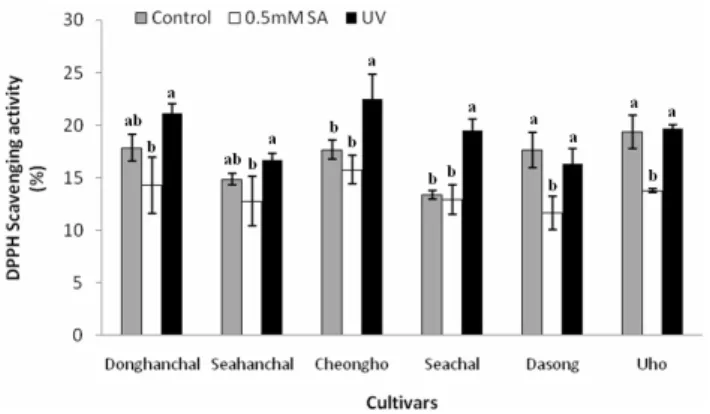
Fig. 1. Difference in DPPH scavenging activities in barley sprouts a day after treatment. Plants were treated with 0.5 mM SA and UV-B irradiation (8 h). Vertical bars indicate ± S.D. of three replicates. Different letters indicate significantly different values in each cultivar (P < 0.05) by Duncan’s multiple range test.
was ground using a chilled mortar and pestle in 0.1 mM HCl containing 1 mM Na
2EDTA). The homogenized extract was centrifuged at 16,000 × g at 4℃ for 15 min. A total of 400 µL of the supernatant was left to stand with 600 µL of 0.2 mM 2-(cyclohexylamino) ethane sulfonic acid and 100 µL of 400 mM NaBH4 at room temperature for 20 min.
Then 660 µL of the mixture was added to 15 µL of 15 mM monobromobimane. After shaking, the mixture was left to react at room temperature in the dark for 15 min. The mixture was then added to 500 µL of 5% (v/v) acetic acid and re-centrifuged at 16,000 × g at 4℃ for 15 min. The resulting supernatant was filtered through a 0.45 µm syringe filter for analysis. The filtrate was separated on an Ace 5 C18 column (46 × 240 mm; Ace, Aberdeen, Scotland) at 30℃ by high performance liquid chromatography (LC-20AD; Shimadzu, Kyoto, Japan) using a fluorescence detector (RF-10AXL;
Shimadzu, Kyoto, Japan). The mobile phase consisted of 0.1% (v/v) trifluoroacetic acid (solvent A) and 100% methanol (solvent B) at a flow rate of 0.8 mL・min. The following gradient elution was used for separation: 85% A at 0 min, 78% A at 30 min, 0% A at 35 min, 0% A at 40 min, 85%
A at 45 min, and 85% A at 50 min. Cysteine (Sigma, St. Louis, USA) γ-glu-cys (Sigma, St. Louis, USA), and glutathione (Sigma, St. Louis, USA) were detected at an excitation wavelength of 380 nm and an emission wavelength of 480 nm.
Glucose, Fructose, and Sucrose Concentrations
Leaf tissue (0.1 g fresh weight) was ground using a chilled mortar and pestle in 80% (v/v) ethanol. The homogenized extract was left to stand at room temperature for 1 h. The extract was centrifuged at 3,000 × g at 4℃ for 10 min.
The resulting supernatant was evaporated at 35℃ to dryness.
The residue was then dissolved in 1 mL of water, and filtered through a 0.45 µm syringe filter for analysis. The samples were subjected to ion chromatography (IC-3000; Dionex, Sunnyvale, CA, USA) using a column (Carbon PAC1, 4
× 200 mm, Dionex, Sunnyvale, CA, USA). The mobile phase consisted of 20% (v/v) 1 M NaOH/deionized water at flow rate of 0.7 mL・min. Glucose, fructose, and sucrose were detected using a electrochemical detector (ED 40 pulsed amperometric detection; Dionex, Sunnyvale, CA, USA).
Statistical Analysis
Values in the figure indicate mean value ± S.D. of three independent experiments. The significant difference between control and both treatments was analyzed by Duncan’s multiple range test.
Results
Antioxidant Activity
The six barley cultivars presented different DPPH sca- venging activities without UV-B or SA treatment (Fig. 1).
The DPPH scavenging activities were comparatively high in ‘Donghanchal’, ‘Cheongho’, ‘Dasong’, and ‘Uho’, but low in ‘Seahanchal’ and ‘Seachal’. The radical scavenging activities increased in barley sprouts exposed to UV-B treatment but not to SA treatment. Regarding cultivar, ‘Donghanchal’,
‘Cheongho’, and ‘Seachal’ had higher antioxidant activities than the other cultivars. In addition, SA treatment induced low DPPH scavenging activities in all cultivars tested.
Ascorbic Acid Concentration
The changes in ascorbate concentration of the six cultivars were relatively similar to the changes of DPPH scavenging activities although the rates of increase in ascorbate concent- ration were lower than that in antioxidants after UV-B treat- ment (Fig. 2). Ascorbate concentration was comparatively high in ‘Donghanchal’, ‘Cheongho’, and ‘Uho’ in control.
‘Donghanchal’ and ‘Cheongho’ showed higher increase in
ascorbate concentrations compared with the other cultivars
after UV-B treatment. Even though the DPPH scavenging
activity of ‘Seachal’ cultivar was highly increased by UV-B
treatment, its ascorbate concentration did not change. The
barley cultivars treated with SA showed a decreased ascorbate
concentration compared with control plants, which is similar
to that observed for the DPPH scavenging activities upon
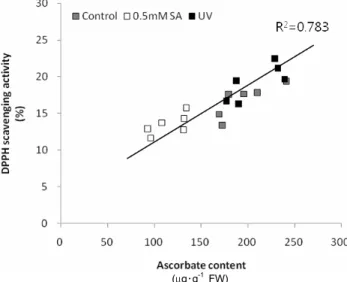
SA treatment (Fig. 1). Therefore, these results confirm a
significant correlation between DPPH scavenging activity
and ascorbate concentration in the six barley cultivars (Fig. 3).
Fig. 2. Difference in ascorbate concentrations in barley sprouts 1 day after treatment. Plants were treated with 0.5 mM SA and UV-B irradiation (8 h). Vertical bars indicate ± S.D. of three replicates. Different letters indicate significantly different values in each cultivar (P < 0.05) by Duncan’s multiple range test.
(μg・g-1 FW)
Fig. 3. Correlation between DPPH scavenging activity and ascorbate concentration in sprouts of six barley cultivars treated with SA and UV-B.
A
B
C
Donghanchal Seahanchal Cheongho Seachal Dasong Uho Cultivars
Fig. 4. Changes in free sugar concentration in barley sprouts 1 day after treatment with 0.5 mM SA and UV-B (8 h). A:
Glucose. B: Fructose n. C: Sucrose. Vertical bars indicate
± S.D. of three replicates. Different letters indicate significantly different values in each cultivar (P < 0.05) by Duncan’s multiple range test.
Glucose, Fructose, and Sucrose Concentrations The concentrations of free sugars (glucose, fructose, and sucrose) in six barley cultivars were changed after SA and UV-B treatments (Fig. 4). Especially, SA treatment caused a severe decrease in free sugars in all the cultivars compared with control plants. In ‘Cheongho’ cultivar, the glucose con- centration rapidly increased after UV-B treatment in com- parison with other cultivars, whereas ‘Donghanchal’ contained higher glucose concentration than control plants (Fig. 4A).
The fructose concentration in the ‘Donghanchal’, ‘Cheongho’, and ‘Seachal’ cultivars were rapidly increased by UV-B treat- ment, whereas ‘Dasong’ cultivar showed only a slight increase in fructose concentration after UV-B treatment (Fig. 4B).
The sucrose concentration in the ‘Donghanchal’ was higher under non-treatment, and it was remarkably increased in
‘Cheongho’ by UV-B treatment compared with other cultivars (Fig. 4C). However, ‘Cheongho’ contained less sucrose than other control cultivars.
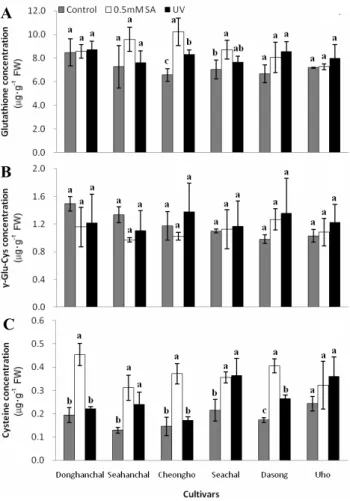
Cysteine, γ-glu-cys, and Glutathione Concentrations The concentration of thiol-compounds varied among the culivars, with ‘Donghanchal’ showing the highest concentration of glutathione and γ-glu-cys (Fig. 5). The cysteine concent- ration sharply increased in the ‘Donghanchal’, ‘Seahanchal’,
‘Cheongho’, and ‘Dasong’ cultivars after SA treatment, showing a different tendency than that of ascorbate (Fig.
4B). Furthermore, UV-B treatment influenced the increase in cysteine concentration in all six cultivars, and especially,
‘Seachal’ contained a higher cysteine concentration. The
concentration of γ-glu-cys, which is a precursor of glutathione,
could have been affected by UV-B or SA treatment, and
it was present at different concentrations among the cultivars
(Fig. 4C). However, there were no significant changes in
A
B
C
Fig. 5. Changes in the concentration of thiol compounds in barley sprouts 1 day after treatment with 0.5 mM SA and UV-B (8 h). A: Cysteine. B: γ-Glu-Cys. C: Glutathione. Vertical bars indicate ± S.D. of three replicates. Different letters indicate significantly different values in each cultivar (P < 0.05) by Duncan’s multiple range test.
γ -glu-cys concentration in most of cultivars subjected to the treatments. In the some cultivars, the glutathione concentration was clearly increased after SA treatment, as in ‘Seahanchal’,
‘Cheongho’, ‘Seachal’, and ‘Dasong’, and this increase might have been affected by SA treatment more than UV-B treatment (Fig. 4A). Specifically, ‘Cheongho’ showed remarkable increase in glutathione concentration after SA treatment.
Discussion
Plant leaves contain not only large amount of chlorophyll but also various secondary metabolites, including antioxidants, and it plays an important role in plant growth through photo- synthesis and protecting substances against environmental stress. In this respect, by plant growth stage, most of the plant metabolites are influenced in their biosynthesis, mobili- zation, and concentration in the tissue due to their charac- teristic metabolism. Several plants have a high antioxidant concentration in early growth stage or new emerged leaves
and fruits (Bergquist et al., 2006; Ferreyra et al., 2007; Kim et al., 2010). In addition, antioxidants concentration could be increased in sprout vegetable through the germination process (Khalil et al., 2007). In our results, barley cultivars showed different antioxidant activities and antioxidant con- centrations even though plants were grown for eleven days after sowing (Figs. 1, 2, and 5) while their growth had no difference among the cultivars.
UV-B irradiation can have a negative effect on photosynthesis and growth, and produce oxidative stress in plants. However, plants have an alleviation mechanism to cope with variety of stress such as UV-B exposure. Some previous studies reported that plants induced an accumulation of antioxidants and increased antioxidative enzyme activities in their tissue against UV-B treatment (Costa et al., 2002; Yun et al., 2002).
In addition, accordingly to results by Kwon et al. (2003b), ten days after UV-B treatment, photosynthesis rate was re- covered similar to control, and oxidative stress was mitigated.
Under UV-B irradiation, dicotyledons is relatively more sen- sitive than monocotyledons such as rice and barley (Musil, 1995). In our experiments, we sampled barley sprouts a day after treatments because the level of antioxidant systems and antioxidants immediately increase after stress conditions (Alscher, 1989), and stress symptoms were not observed in barley sprouts a day after UV-B treatment. It could be suggested that UV-B caused stress symptom may have been alleviated by increased ascorbate concentration and antioxidant activity (Figs. 1 and 2).
DPPH scavenging activity is well known as an indicator of antioxidant concentration in plants extracts (Wong et al., 2006). In our results, DPPH scavenging activities of barley sprouts were increased by UV-B irradiation, whereas barley sprouts treated with SA showed a decreased DPPH scavenging activity (Fig. 1). According to research by Ananieva et al.
(2004), however, barley treated with SA showed higher anti- oxidative enzyme activities compared with control plants treated with water, Wang and Li (2006) observed that SA treated leaves accumulated more antioxidants such as ascorbate and glutathione than control in young grape plants. Although SA pre-treatment could stimulate antioxidant systems in plants, by the mode of application and the difference in among the plant species, exogenous SA might cause a decreased DPPH scavenging activity compared with control in our results.
Also, it is possible that since SA can induce generation of ROS in the cellular space of plants (Rao et al., 1997), anti- oxidants in barley sprouts might be rapidly oxidized through antioxidative enzymes. Consequently, ascorbate concentration considerably decreased in SA treated barley sprouts (Fig.
2), and stress symptom was not emerged for a day after
SA treatment. In contrast, increase in DPPH scavenging
activities by UV-B treatment substantially corresponded with variations in ascorbate concentration after treatment (Fig. 2).
The antioxidant activities of barley sprouts subjected to UV-B irradiation might increase mainly due to the activation of the synthesis of antioxidants such as ascorbate. That is because increased glutathione concentration after UV-B treatment was lower in barley sprouts treated with SA (Fig. 5). The changes in ascorbate concentrations after both treatments were similar to changes in the concentration of free sugars such as glucose and sucrose (Fig. 4), indicating that ascorbate could be synthesized well under the condition that sugars are highly accumulated.
Carbohydrate pools in barley leaves are associated with both light intensity and ascorbic acid levels (Smirnoff and Pallanca, 1996). Generally, high carbohydrate concentration can characterize foods containing vitamin C (Navarro et al., 2006), and pepper also has a high vitamin C as well as a high sugar concentration.
Since glutathione is involved in the ascorbate-glutathione cycle for protection against ROS, oxidative stress-induced conditions may be able to increase the glutathione concent- ration in plants. Srivastava and Dwivedi (1998) observed that SA treatment induced the accumulation of glutathione in pea seedling. Exogenous application of SA induced an increase in glutathione concentration along with an increase in some enzyme activities at normal temperature in young grape plants (Wang and Li, 2006). Furthermore, the thiol concentration in leaves of UV-B treated bean plants was significantly higher than in the leaves of control plants (Bolink et al., 2001). Kalbin et al. (1997) reported that glutathione and oxidized form of glutathione were increased by continuous UV-B exposure in pea plants. We confirmed in six barley sprouts cultivars that increased glutathione concentrations were observed after SA and UV-B treatments, and barley sprouts treated with SA had higher glutathione concentrations than UV-B treated cultivars such as ‘Seahanchal’, ‘Cheongho’, and ‘Seachal’ (Fig. 5). Although the SA treatments of barley sprouts could have increased glutathione concentration due to SA-induced oxidative stress, the DPPH scavenging activity and ascorbate concentration were mostly decreased. In this respect, further studies may be necessary to understand the induction mechanism of antioxidants in barley sprouts through some kinds of treatment.
In conclusion, we found a general positive effect of treat- ment with SA and UV-B on increasing the concentrations of antioxidants such as ascorbate and glutathione in barley sprouts. In this sense, it would be interesting to use health functional compounds in selected barley cultivars such as
‘Donghanchal’ and ‘Cheongho’.
Literature Cited
Alscher, R.G. 1989. Biosynthesis and antioxidant function of glutathione in plants. Physiol. Plant 77:457-464.
Alscher, R.G. and J.L. Hess. 1993. Antioxidants in higher plants.
CRC Press. Boca Raton. Florida. USA.
Ananieva, E.A., K.N. Christov, and L.P. Popova. 2004. Exogenous treatment with salicylic acid leads to increased antioxidant capacity in leaves of barley plants exposed to paraquat. J.
Plant Physiol. 161:319-328.
Bergquist, S.Å.M., U.E. Gertsson, and M.E. Olsson. 2006. Influence of growth stage and postharvest storage on ascorbic acid and carotenoid content and visual quality of baby spinach (Spinacia oleracea L.). J. Sci. Food Agr. 86:346-355.
Bolink, E.M., I. van-Schalkwijk, F. Posthumus, and P.R. van- Hasselt. 2001. Growth under UV-B radiation increases tolerance to high-light stress in pea and bean plants. Plant Ecol. 154:
149-156.
Costa H., S.M. Gallego, and M.L. Tomaro. 2002. Effect of UV-B radiation on antioxidant defense system in sunflower cotyledons. Plant Sci. 162:939-945.
Ferreyra, R.M., S.Z. Viña, A. Mugridge, and A.R. Chaves. 2007.
Growth and ripening season effects on antioxidant capacity of strawberry cultivar Selva. Scientia Hort. 112:17-32.
Foyer, C.H. 1993. Ascorbic acid. P. 31-58 In: R.G. Alscher and J.L. Hess (eds.) Antioxidants in higher plants. CRC Press.
Boca Raton. Florida. USA.
Foyer, C.H., F.L. Theodoulou, and S. Delrot. 2001. The functions of inter-and intracellular glutathione transport systems in plants.
Trends Plant Sci. 6:486-492.
Foyer, C.H., M. Lelandais, and K.J. Kunert. 1994. Photooxidative stress in plants. Physiol. Plant 92:696-717.
Freeman, J.L., D. Garcia, D. Kim, A. Hopf, and D.E. Salt. 2005.
Constitutively elevated salicylic acid signals glutathione-mediated nickel tolerance in Thlaspi nickel hyperaccumulators. Plant Physiol. 137:1082-1091.
Ganesan, V. and G. Thomas. 2001. Salicylic acid response in rice: influence of salicylic acid on H2O2 accumulation and oxidative stress. Plant Sci. 160:1095-1106.
Hayat, S., B. Ali, and A. Ahmad. 2007. Salicylic acid: Biosynthesis, metabolism and physiological role in plants. P. 1-14 In: S.
Hayat and A. Ahmad (eds.) Salicylic acid- a plant hormone.
Springer, Netherland
Inze, D. and M.V. Montagu. 1995. Oxidative stress in plants.
Curr. Opin. Biotechnol. 6:153-l58.
Kalbin, G., A.B. Ohlsson, T. Berglund, J. Rydström, and Å.
Strid. 1997. Ultraviolet-B-radiation-induced changes in nicoti- namide and glutathione metabolism and gene expression in plants. Eur. J. Biochem. 249:465-472.
Khalil, A.W., A. Zeb, F. Mahmood, S. Tariq, A.B. Khattak, and H. Shah. 2007. Comparison of sprout quality characterisitics of desi and kabuli type chickpea cultivars (Cicer arietinum L.). LWT. Food Sci. Technol. 40:937–945.
Kim, J.H., D.J. Yu, and H.J. Lee. 2006. Salicylic acid modifies antioxidative system of ‘Kyoho’ grapevine cultivar as exposed to low temperature. Hort. Environ. Biotechnol. 47:280-287.
Kim, J.S., I.S. Shim, I.S. Kim, and M.J. Kim. 2010. Change of
cysteine, glutathione and ascorbic acid content in chinese cabbage, head lettuce and spinach by the growth stage. Kor.
J. Hort. Sci. Technol. 28:186-191.
Kim, S.M., Y.H. Kim, and I.S. Shim, 2009.Research on the barley (Hordeum vulgare L.) cultivars for use of functional barley bud. Kor. J. Hort. Sci. Technol. 27(Suppl. І):177 (Abstr.).
Kocsy, G., P. von-Ballmoos, M. Suter, A. Rüegsegger, U. Galli, G. Szalai, G. Galiba, and C. Brunold. 2000. Inhibition of glutathione synthesis reduces chilling tolerance in maize. Planta.
211:528-536.
Kwon, J.K., J.H. Lee, D.K. Park, and Y.H. Choi. 2003a. Overg- rowth retardation and physiological changes in plug-grown fruit vegetable transplants by ultraviolet-B irradiation. Kor.
J. Hort. Sci. Technol. 21 (Suppl. І):124 (Abstr.).
Kwon, J.K., J.H. Park, J.H. Lee, D.K. Park, Y.H .Choi, and M.A.
Cho. 2003b. Physiological changes and antioxidant enzyme activities of fruit vegetable plug transplants Irradiated with different UV-B intensities. J. Kor. Soc. Hort. Sci. 44:464-469.
Linster, C.L. and S.G. Clarke. 2008. L-Ascorbate biosynthesis in higher plants: the role of VTC2. Trends Plant Sci. 13:567-573.
Mittler, R. 2002. Oxidative stress, antioxidants and stress tolerance.
Trends Plant Sci. 7:405-410.
Mittova, V., F.L. Theodoulou, G. Kiddle, L. Gomez, M. Volokita, M. Tal, C.H. Foyer, and M. Guy. 2003. Coordinate induc- tion of glutathione biosynthesis and glutathione-metabolizing enzymes is correlated with salt tolerance in tomato. FEBS Lett. 554:417-421.
Musil, C.F. 1995. Differential effects of elevated ultraviolet-B radiation on the photochemical and reproductive performance of dicotyledonous and monocotyledons arid-environment ephemerals. Plant Cell Environ. 18:844-854.
Navarro, J.M., P. Flores, C. Garrido, and V. Martinez. 2006.
Changes in the contents of antioxidant compound in pepper fruits at different ripening stages, as affected by salinity.
Food Chem. 96:66-73.
Pallardo, F.V., J. Markovic, and J. Vina. 2009. Cellular com- partmentalization of glutathione. p. 35-45 In: R. Masella and G. Mazza (eds.) Glutathione and sulfur amino acids in human health and disease. Wiley and Sons, Hoboken, New Jersey.
Rao, M.V., G. Paliyath, D.P. Ormrod, D.P. Murr, and C.B.
Watkins. 1997. Influence of salicylic acid on H2O2 production, oxidative stress, and H2O2-metabolizing enzymes (salicylic
acid-mediated oxidative damage requires H2O2). Plant Physiol.
115:137-149.
Reddy, A.R., K.V. Chaitanya, and M. Vivekanandan. 2004.
Drought-induced responses of photosynthesis and antioxidant metabolism in higher plants. J. Plant Physiol. 161:1189-1202.
Shanker, A.K., M. Djanaguiraman, R. Sudhagar, C.N. Chan- drashekar, and G. Pathmanabhan. 2004. Differential antioxi- dative response of ascorbate glutathione pathway enzymes and metabolites to chromium speciation stress in green gram (Vigna radiate (L.) R.Wilczek. cv CO 4) roots. Plant Sci.
166:1035-1043.
Smirnoff, N. and J.E. Pallanca. 1996. Ascorbate metabolism in relation to oxidative stress. Biochemical Soc. Trans. 24:472-478.
Srivastava, M.K. and U.N. Dwivedi. 1998. Salicylic acid modulates glutathione metabolism in pea seedlings. J. Plant Physiol. 153:409-414.
Stoilova, I., A. Krastanov, A. Stoyanova, P. Denev, and S.
Gargova. 2007. Antioxidant activity of a ginger extract (Zingiber officinale). Food Chem. 102:764-770.
Vaidyanathan, H., P. Sivakumar, R. Chakrabarty, and G. Thomas.
2003. Scavenging of reactive oxygen species in NaCl-stressed rice (Oryza sativa L.) differential response in salt-tolerant and sensitive varieties. Plant Sci. 165:1411-1418.
Walker, M.A. and B.D. Mckersie. 1993. Role of the ascorbate- glutathione antioxidant system in chilling resistance of tomato.
J. Plant Physiol. 141:234-239.
Wang, L.J. and S.H. Li. 2006. Salicylic acid-induced heat or cold tolerance in relation to Ca2+ homeostasis and antioxidant systems in young grape plants. Plant Sci. 170:685-694.
Wang, S.Y., H.J. Jiao, and M. Faust. 1991. Changes in ascorbate, glutathione, and related enzyme activities during thidiazuron- induced bud break of apple. Physiol. Plant 82:231-236.
Wong, S.P., L.P. Leong, and J.H.W. Koh. 2006. Antioxidant activities of aqueous extracts of selected plants. Food Chem.
99:775-783.
Yun, H.K., Y.C. Kim, K.Y. Kim, T.C. Seo, and J.W. Lee. 2002.
Effect of UV-B irradiation on the growth and antioxidant contents of some leaf vegetables. J. Kor. Hort. Sci. 43:170- 172.
Zhang, J. and M.B. Kirkham. 1996. Antioxidant responses to drought in sunflower and sorghum seedlings. New Phytol.
132:361-373.