This is an Open Access ar ticle distributed under the terms of the Creative Commons Attribution Non-Commercial License (http:
//creativecommons.org/licenses/by-nc/4.0/) which permits unrestricted non-commercial use, distribution, and reproduction in any medium, provided the original work is properly cited.
The Korean Journal of Mycology
www.kjmycology.or.kr© 2021 THE KOREAN SOCIETY OF MYCOLOGY.
Accepted: September 27, 2021 Revised: September 25, 2021 Received: September 03, 2021 https://doi.org/10.4489/KJM.20210040 Kor. J. Mycol. 2021 September, 49(3): 417-423
OPEN ACCESS pISSN : 0253-651X eISSN : 2383-5249
RESEARCH NOTE
First Report of Apple Decline Caused by Botryosphaeria sinensis in Korea
Seung-Yeol Lee1,2, Leonid N. Ten1, Chang-Gi Back3, and Hee-Young Jung1,2,*
1College of Agriculture and Life Sciences, Kyungpook National University, Daegu 41566, Korea
2Institute of Plant Medicine, Kyungpook National University, Daegu 41566, Korea
3Horticultural and Herbal Crop Environment Division, National Institute of Horticultural and Herbal Science, Rural Development Administration, Wanju 55365, Korea
*Corresponding author: [email protected]
ABSTRACT
Apple decline symptoms were frequently observed on cv. Fuji apple orchards located in Gyeonggi, Gyeongbuk, and Gangwon provinces during surveys conducted from May until the end of September 2020. Three fungal strains were isolated from the margins of internal lesions of diseased apple trees, and their morphological characteristics were considered similar to Botryosphaeria sinensis. Phylogenetic analysis using internal transcribed spacer (ITS) regions, translation elongation factor 1-alpha (tef1), beta-tubulin (tub2), and the second largest subunit of RNA polymerase II (rpb2) gene sequences confirmed the closest relationship of isolates with B. sinensis at the species level. According to a pathogenicity test, the appearance of dark-brown discolorations and vascular necrosis on apple branches inoculated with the isolated strain KNUF-20-014 was observed. To the best of our knowledge, this is the first report of B. sinensis as the causal agent of apple disease in Korea.
Keywords: Apple decline, Botryosphaeria sinensis, cv. Fuji, Phylogeny
Apple (Malus domestica) is one of the most economically important fruits, with more than 31,000 ha cultivation area in South Korea [1]. However, numerous destructive pathogens infect apple trees and significantly reduce the commercial apple production worldwide. Among the fungal diseases, canker, twig dieback, and plant decline frequently occurs in apple orchards [2]. During the apple cultivation period, apple decline symptoms were observed from May until the end of September 2020 in apple (cv. Fuji) orchards located in Gyeonggi, Gyeongbuk, and Gangwon provinces. Mostly, declined trees were young (less than ten years), showing warts on the surface, darkening from the trunk, detachment of epidermis of the stem, embedded pycnidia on the bark, withering of branch, and eventually leading to decline (Fig. 1A-1G, and I).
In this present study, isolated fungal strains were described and illustrated as a causal agent of apple decline.
To isolate the causal fungus, the fragment (approximately 2 mm) was taken from the margin of internal
lesions, transferred onto potato dextrose agar (PDA; Difco, Detroit, MI, USA), and incubated at 25℃. As
a result, the three strains, KNUF-20-014, KNUF-20-072, and KNUF-20-074, were isolated from the
diseased apple tree. For molecular identification of strains at the genus and species levels, the total genomic
DNA was extracted from the isolates using a HiGene Genomic DNA prep kit (BIOFACT, Daejeon, Korea) according to the manufacturer ’s instructions. Molecular identification of the strains was conducted using the nucleotide sequences of internal transcribed spacer (ITS) regions and translation elongation factor 1-alpha (tef1), beta-tubulin (tub2), and second largest subunit of RNA polymerase II (rpb2) genes. The ITS regions,
Fig. 1. Natural apple decline symptoms caused by Botryosphaeria sinensis and description of the KNUF-20-014. A, declined apple tree; B, warts on a diseased tree; C and D, blackened trunk and observed symptoms inside; E and F, black dots on a diseased trunk;
G, observed necrosis on the internal of a diseased tree; H, pathogenicity test result shows
canker and necrosis on the inoculated branch of cv. Fuji and its internal symptom (red
arrows indicate inoculated zones); I and J, pycnidia on a diseased tree and on pine needle
agar (PNA) medium; K, cross-sections through pycnidium; L and M, colony on malt
extract agar after incubation at 28℃ for five days (L, front; M, reverse); N, conidia (scale
bar=10 µm).
Botryosphaeria sinensis Associated with Apple Decline in Korea
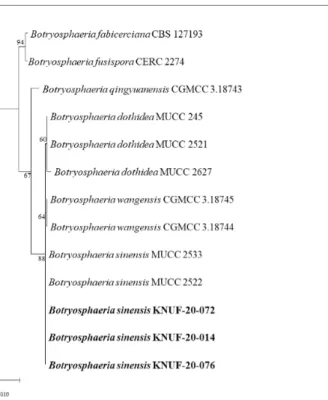
Bt2a/Bt2b [5], and RPB2-5F2/fRPB2-7cR [6], respectively. Amplified products of the polymerase chain reaction (PCR) were purified with EXOSAP-IT (Thermo Fisher Scientific, Waltham, MA, USA) and sequenced by Macrogen Co. Ltd. (Daejeon, Korea). Amplification of the ITS, tef1, tub2, and rpb2 loci of strains KNUF-20-014, KNUF-20-072, and KNUF-20-074 yielded fragments of 526, 512, 413, and 1,020 bp; 520, 500, 422, and 1,005 bp; and 497, 496, 423, and 1,029 bp, respectively. The comparative sequence analyses of the molecular markers of the three strains revealed their similarity of 100%, indicating their affiliation to the same species. A BLAST search of the NCBI database showed that the sequences obtained from ITS, tef1, tub2, and rpb2 loci of the three strains exhibited highest similarities of 99.8% (517 bp out of 518 bp), 100% (267 bp out of 267 bp), 100% (363 bp out of 363 bp), and 100% (577 bp out of 577) with that of Botryosphaeria sinensis MUCC 2533 (accession numbers LC585268, LC585140, LC585164, LC585188, respectively). To confirm the closest relationship between the three strains and B. sinensis at the species level, a phylogenetic analysis was conducted using concatenated sequences of the ITS regions, tef1, tub2, and rpb2 genes. The sequences of allied species were retrieved from the NCBI database (Table 1). A phylogenetic tree was constructed with maximum-likelihood method using the program MEGA7 [7].
The evolutionary distances were calculated using the Kimura two-parameter model [8] and the topology of the tree was evaluated using bootstrap analysis based on 1,000 replicates. In the phylogenetic tree, the isolated strains occupied a position within the genus Botryosphaeria and clustered together with B. sinensis, indicating their closest relationship at the species level (Fig. 2).
The representative isolate, KNUF-20-014, was cultured on pine needle agar (PNA) and malt extract agar (MEA) to check the cultural and morphological characteristics. On MEA the colonies grew up to 80 mm in Table 1. List of species used in phylogenetic analyses with the GenBank accession numbers.
Fungal species Isolates No. Host Country Accession number
ITS tef1 tub2 rpb2
Botryosphaeria dothidea MUCC 245 Daphniphyllum macropodum Japan LC585273 LC585145 LC585169 LC585192 Botryosphaeria dothidea MUCC 2521 Prunus sp. Japan LC585270 LC585142 LC585166 LC585189 Botryosphaeria dothidea MUCC 2627 Pyrus pyrifolia Japan LC585284 LC585156 LC585180 LC585202 Botryosphaeria fabicerciana CBS 127193 Eucalyptus sp. China HQ332197 HQ332213 KF779068 MF410137 Botryosphaeria fusispora CERC 2274 Eucalyptus hybrid China KX277969 KX278074 KX278179 MF410118 Botryosphaeria qingyuanensis CGMCC 3.18743 Eucalyptus hybrid China KX278001 KX278106 KX278210 MF410152 Botryosphaeria sinensis MUCC 2522 Prunus sp. Japan LC585277 LC585149 LC585173 LC585195 Botryosphaeria sinensis MUCC 2533 Aucuba japonica Japan LC585268 LC585140 LC585164 LC585188 Botryosphaeria sinensis KNUF-20-076 Malus domestica Korea MW644757 LC611450 LC611453 LC638625 Botryosphaeria sinensis KNUF-20-014 Malus domestica Korea MW644755 LC611448 LC611451 LC638623 Botryosphaeria sinensis KNUF-20-072 Malus domestica Korea MW644756 LC611449 LC611452 LC638624 Botryosphaeria wangensis CGMCC 3.18745 Cedrus deodara China KX278003 KX278108 KX278212 MF410154 Botryosphaeria wangensis CGMCC 3.18744 Cedrus deodara China KX278002 KX278107 KX278211 MF410153 Neofusicoccum parvum ATCC 58191 Populus nigra New Zealand AY236943 AY236888 AY236917 EU821963 The fungal strains isolated in this study and their accession numbers are indicated in bold.
ITS, internal transcribed spacer; tef1, translation elongation factor-1; tub2, beta-tubulin; rpb2, RNA polymerase II gene.
three days at 28 ℃, showing gray aerial mycelium, white and gray surface with an olivaceous black reverse (Fig. 1L and 1M), the pycnidia were produced on PNA after 21 days (Fig. 1J and 1K), conidia were hyaline, aseptate, obtuse apex, fusiform, smooth with granular contents, and 19.7-28.9 ×4.9-7.3 μm (av. 23.4×6.0 μm, l/w 4.1, n=50) (Fig. 1N). These cultural and morphological characteristics were similar to those of the previously described B. sinensis [9], but strain KNUF-20-014 was readily distinguishable from B. dothidea by its conidia size. The average conidia length of the strain (23.4 μm) was distinctly shorter than that of B.
dothidea (26.2 μm), while the width of its conidia (6.0 μm) was longer than that of B. dothidea (5.4 μm) [10]. The conidial length:width ratio of strain KNUF-20-014 (4.1) was the same as the reported value for B.
sinensis [9], but clearly different from that of B. dothidea (4.9) [10].
Currently, there are controversies regarding the classification of a few species of the genus Botryosphaeria [11,12] . Based on phylogenetic analysis using the three combined ITS, tef1, and tub2 sequences, B. sinensis [9] , B. minutispermatia [13], B. quercus [14], B. qinlingensis [15], and B. wangensis [16] were reclassified as a later synonym of B. dothidea by Zhang et al. [12]. At the same time, Hattori et al. [11] reexamined the genus Botryosphaeria based on phylogenetic analyses using the four molecular markers, namely ITS, tef1,
Fig. 2. Maximum-likelihood phylogenetic tree, based on internal transcribed spacer (ITS) regions, translation elongation factor-1 (tef1), beta-tubulin (tub2), and RNA polymerase II (rpb2) gene sequences, showing the phylogenetic position of strains KNUF-20-076, KNUF-20-014, and KNUF-20-072, among related strains of the genus Botryosphaeria.
Bootstrap values greater than 60% (percentage of 1,000 replications) are shown at
branching points. The tree was rooted using Neofusicoccum parvum ATCC 58191 as an
outgroup. Bar, 0.01 substitutions per nucleotide position.
Botryosphaeria sinensis Associated with Apple Decline in Korea
tub2, and rpb2, and showed that B. sinensis and B. dothidea represent separate species. Simultaneously, the conidia size was highlighted as a key morphological characteristic for the differentiating species in the genus Botryosphaeria. Typically, an increase in the number of genes used in multi locus sequence analysis (MLSA) resulted in more accurate identification of isolated strains, therefore, we conducted MLSA using the four molecular markers in our study. According to the phylogenetic analysis, cultural and morphological characteristics, KNUF-20-014 was identified to be the same with B. sinensis at the species level but differed from B. dothidea. These data are in good agreement with the results of the reexamination of the genus Botryosphaeria conducted by Hattori et al. [11].
A pathogenicity test of strain KNUF-20-014 was conducted with healthy branches cv. Fuji. The branches were inoculated by placing a mycelial plug (4-5 mm) from the five-day-old colony on fresh wound sites made with a sterilized needle, while PDA plugs were placed into similar wounds on the three branches as mock inoculation. The inoculation points were wrapped in parafilm to maintain the moisture for three days at 25℃ in a growth chamber. After four weeks, all inoculated branches showed dark-brown discolorations and vascular necrosis, whereas no symptoms were observed in the mock inoculated branches (Fig. 1H).
Pathogenicity test was conducted three times, and the pathogen was re-isolated from the inoculated branches.
Botryosphaeria species are known as plant saprobes, pathogens, and endophytes, with global distribution, on a wide variety of mainly woody hosts [13,17]. Diseases caused by pathogens belonging to the genus Botryosphaeria have resulted in significant losses in various economically important agricultural crops.
Apple black rot caused by B. obtusa has resulted in fruit loss of 25-50% in the USA [18] and 20% annual losses of vineyard productivity from B. stevensii infection were reported in France [19]. Among them, B.
dothidea is known to be a serious pathogen mainly of woody plants that were reported in 66 countries and confirmed in more than 24 host genera [20]. In Korea, B. dothidea has been previously reported to cause canker and warts on infected apple branches, mainly occurring on the cv. Hongro and rarely observed on the cv. Fuji [21,22]. However, in this study, B. sinensis was mainly isolated from the cv. Fuji, which could be related to host specificity.
B. sinensis was recorded on the twigs of Populus sp., Morus alba, Juglans regia in China [9], Paulownia tomentosa and Prunus sp. in Japan [11], and recently identified on Mangifera indica in Australia [23]. Our results increase the awareness of Botryosphaeria distribution, thereby improving our understanding of apple decline associated with B. sinensis and can be used for developing the control methods to prevent economic losses.
ACKNOWLEDGEMENTS
This work was carried out with the support of Cooperative Research Program for Agriculture Science
& Technology Development (Project No. PJ014998022021), funded by the Rural Development
Administration, Republic of Korea.
REFERENCES
1. Voluntary report: 2020 Apple update. KS2020-0045 [Internet]. Bethesda (MD): United States Department of Agriculture Foreign Agricultural Service; 2021 [cited 2021 Aug 12] Available from: https://kr.usembassy.gov/wp-content/uploads/sites/75/2020-Apple-Update_10-13-2020.
2. Sutton T, Aldwinckle H, Agnello A, Walgenbach J. Compendium of apple and pear diseases and pests. 2nd ed. Saint Paul: American Phytopathological Society Press; 2014.
3. White TJ, Bruns T, Lee S, Taylor JW. Amplification and direct sequencing of fungal ribosomal RNA genes for phylogenetics. PCR protocols: A guide to methods and applications. In: Innis MA, Gelfand DH, Sninsky JJ, White TJ, editors. San Diego: Academic Press; 1990. p. 315–22.
4. Alves A, Crous PW, Correia A, Phillips AJL. Morphological and molecular data reveal cryptic speciation in Lasiodiplodia theobromae. Fungal Divers 2008;28:1–13.
5. Glass NL, Donaldson GC. Development of primer sets designed for use with the PCR to amplify conserved genes from filamentous ascomycetes. Appl Environ Microbiol 1995;61:1323–30.
6. Liu YJ, Whelen S, Hall BD. Phylogenetic relationships among ascomycetes: Evidence from an RNA polymerase II subunit. Mol Biol Evol 1999;16:1799–808.
7. Kumar S, Stecher G, Tamura K. MEGA7: Molecular evolutionary genetics analysis version 7.0 for bigger datasets. Mol Biol Evol 2016;33:1870–4.
8. Kimura M. A simple method for estimating evolutionary rates of base substitutions through comparative studies of nucleotide sequences. J Mol Evol 1980;16:111–20.
9. Zhou Y, Dou Z, He W, Zhang X, Zhang Y. Botryosphaeria sinensia sp. nov., a new species from China. Phytotaxa 2016;245:43–50.
10. Slippers B, Crous PW, Denman S, Coutinho TA, Wingfield BD, Wingfield MJ. Combined multiple gene genealogies and phenotypic characters differentiate several species previously identified as Botryosphaeria dothidea. Mycologia 2004;96:83–101.
11. Hattori Y, Ando Y, Sasaki A, Uechi N, Nakashima C. Taxonomical study of noteworthy species of Botryosphaeria in Japan. Mycobiology 2021;49:122–32.
12. Zhang W, Groenewald JZ, Lombard L, Schumacher RK, Phillips AJL, Crous PW. Evaluating species in Botryosphaeriales. Persoonia 2021;46:63–115.
13. Ariyawansa HA, Hyde KD, Liu JK, Wu SP, Liu ZY. Additions to karst fungi 1: Botryosphaeria minutispermatia sp. nov., from Guizhou Province, China. Phytotaxa 2016;275:35–44.
14. Wijayawardene NN, Hyde KD, Wanasinghe DN, Papizadeh M, Goonasekara ID, Camporesi E, Bhat DJ, McKenzie EHC, Phillips AJL, Diederich P, et al. Taxonomy and phylogeny of dematiaceous coelomycetes. Fungal Divers 2016;77:1–316.
15. Liang LY, Jiang N, Chen WY, Liang YM, Tian CM. Botryosphaeria qinlingensis sp. nov.
causing oak frogeye leaf spot in China. Mycotaxon 2019;134:463–73.
16. Li GQ, Chen SF, Liu QL, Li JQ, Liu FF. Botryosphaeriaceae from Eucalyptus plantations and adjacent plants in China. Persoonia 2018;40:63–95.
17. Marsberg A, Kemler M, Jami F, Nagel JH, Postma-Smidt A, Naidoo S, Wingfield MJ, Crous PW, Spatafora JW, Hesse CN, et al. Botryosphaeria dothidea: A latent pathogen of global importance to woody plant health. Mol Plant Pathol 2017;18:477–88.
18. Brown EA, Britton KO. Botryosphaeria diseases of apple and peach in the southeastern United
States. Plant Dis 1986;70:480–84.
Botryosphaeria sinensis Associated with Apple Decline in Korea