Research in Plant Disease pISSN 1598-2262, eISSN 2233-9191 www.online-rpd.org
The Korean Society of Plant Pathology
This is an open access article distributed under the terms of the Creative Commons Attribution Non-Commercial License (http://creativecommons.org/licenses/
by-nc/4.0/), which permits unrestricted non-commercial use, distribution, and reproduction in any medium, provided the original work is properly cited.
First Report of a Bracken Blight Disease Caused by Didymella sp.
이정은1 · 김기범2 · 박주은2 · 김다운2 · 신유경2 · 윤성환2* · 정영륜1*
1(주)제일그린산업
2순천향대학교 의료생명공학과
Jung Eun Lee1, Ki Beom Kim2, Ju Eun Park2, Da-Woon Kim2, Yoo-Kyoung Shin2, Sung-Hwan Yun2* , and Young-Ryun Chung1*
1Research and Technology Development Institute, JGreen Inc., Jinju 52840, Korea
2Department of Medical Biotechnology, Soonchunhyang University, Asan 31538, Korea
An outbreak of new disease with leaf and stem blight symptom occurred at bracken-growing fields in Namhae-gun, Gyeongsangnam-do, Korea during the last 4 years. This new disease caused significant yield losses on bracken production in this area. We have collected diseased leaves and stems showing the blight symptom in May, July, and October 2018 to investigate causal pathogens. A total of 92 fungal isolates were obtained from the diseased samples and their pathogenicity was tested on healthy bracken leaves. From the total isolates, 22 isolates were able to produce the leaf blight symptom similar to the original one found in the fields. To identify two fungal pathogens which showed higher virulence levels compared to other pathogenic isolates, we constructed phylogenetic trees using the nucleotide sequences of genes for ribosomal RNA, RNA polymerase beta subunit, beta tubulin, and internal transcribed region. Most phylogenetic trees constructed indicate that both isolates, which are identical to each other, reside in a clade of the genus Didymella and pos- sibly similar to D. rumicicola or D. acetosellae. Nevertheless, the exact identification of these pathogens at the species level needs further investigations. This is the first report of a blight disease on bracken by Didymella sp.
Keywords: Bracken, Bracken blight disease, Didymella sp.
고사리(bracken, Pteridium aquilinum Kuhn)는 지구상 열대 지역으로부터 온대 지역에 걸쳐 광범위하게 분포하고 있는 고 사리과의 다년생 양치식물이다. 배수가 잘 되고 다소 그늘지며 비옥한 곳이면 어디든지 잘 자라는 특성을 가지고 있어 우리나 라 전국 산야에서도 자생하고 있다(Jo, 1978). 단위 면적당 생산 량과 소득은 재배 지역, 출하 시기, 농가의 기술 수준 등에 따라 차이가 있으나 비교적 재배가 쉽고 한 번 식재 후 동일 포장에
서 장기간 재배할 수 있어 매년 경운 식재가 필요하지 않다. 병 해충에도 강하고 타 작물에 비해 비교적 관리가 용이하다고 알 려져 농가의 새로운 소득원으로 부상하였으며, 앞으로 재배 면 적은 더욱 증가될 것으로 전망된다. 전국적으로 고사리 재배 면 적은 2,196ha, 생산량은 9,244톤(생산액 524억원, 2015년)이다.
경남 남해군은 국내 최대 고사리 주산지로서 전국 생산량의 37%를 차지하고 있으며, 단일 품목으로 연간 100억원 이상의 고소득을 창출하고 있다. 특히 남해군 창선면에서는 1,500여 농가가 460ha 규모로 고사리를 재배하고 있으며, 해풍과 따뜻 한 기후의 영향으로 향이 진하고 식감이 부드러워 남해군의 고 사리 대표 브랜드로 자리잡고 있다(Lee 등, 2008; Sim 등, 2015).
*Co-corresponding authors Y.-R. Chung
Tel: +82-55-761-4701 Fax: +82-55-761-8589 E-mail: [email protected] S.-H. Yun
Tel: +82-41-530-1288 Fax: +82-41-530-3085 E-mail: [email protected] ORCID
Sung-Hwan Yun
https://orcid.org/0000-0003-3438-6637 Young Ryun Chung
http://orcid.org/0000-0002-4060-1543
Received August 16, 2019 Revised September 11, 2019 Accepted September 11, 2019
그러나, 최근 몇 년 동안 남해군 창선면의 고사리 재배 농가에 서 잎과 줄기가 붉게 말라 죽는 증상이 대대적으로 발생되었 고, 2014년 약 2,000톤(생산액 약 99억원)이었던 남해군 고사 리 생산량이 2017년에는 1,276톤(생산액 약 60억원)으로 감소 하는 심각한 경제적 피해가 발생되었다. 이로 인하여 남해군이 2016년까지 고사리 주산지이었으나 2017년 이후부터는 전라남 도 구례군으로 주산지가 바뀌었다(Korea Forest Service, 2015, 2017).
본 연구에서는 2014년부터 경상남도 남해군 창선면 일대에 서 대대적으로 발생되고 있는 고사리 신규 마름병을 일으키는 병원균을 분리, 동정하였고 이를 바탕으로 이 병의 효과적인 방 제법 개발에 활용하고자 하였다.
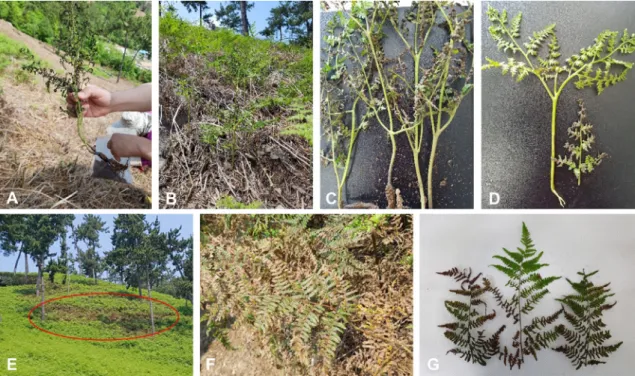
신규 병해 발생 조사 및 병원균 분리. 2018년 5월, 7월, 10월 3차례에 걸쳐 경남 남해군 창선면의 농가 방문을 통해 고사리 마름병의 발생 시기 및 특징 등을 조사하였다. 일반적으로 고 사리는 봄 시기에 새순이 나오기 시작하면서 5월–6월 중 새순 을 수확하고 7월부터는 채취가 중단되어 잎이 무성해 지고 10 월 하순부터 점차 갈변이 되면서 낙엽이 진다. 고사리 신규 마 름병은 기온이 20–25°C 정도 되는 초여름부터 발병하며, 잎 끝 에서부터 낙엽이 지듯 전체가 누렇게 변하면서 줄기까지 말라 검게 고사하는 증상을 나타낸다(Fig. 1). 이 병으로 인하여 고사
리는 정상적인 낙엽 시기인 10월 하순보다 훨씬 빠른 7–8월에 말라 죽기 때문에 지하부 생육이 불량해 지고 이로 말미암아 다음 해 고사리 새순 형성이 잘 안되어 새순 생산량이 감소하 는 것으로 생각되었다.
이병 시료는 5월, 7월, 10월 고사리 마름병 발생이 많은 농가 포장을 방문하여 3차례 채취하였으며, 병든 시료(잎, 줄기, 뿌 리)를 1% NaOCl 용액에 30초, 70% 에탄올에 30초 동안 침지 하여 표면 살균하였다. 이후 시료를 멸균수로 다시 세척하고 멸 균 여과지로 남은 수분을 제거한 후 1–2 mm 크기로 잘라 감자 한천배지(potato dextrose agar, PDA) 위에 올리고 25°C에서 3 일 동안 배양하였다. 이병 시료에서 자라 나온 곰팡이 균사체를 다시 분리하여 PDA 배지에서 20일 동안 순수 배양하였다. 이와 같은 방법을 통하여 2018년 채취 이병시료로부터 총 92종의 곰 팡이를 분리하였다.
병원성 검정. 이병 조직으로부터 분리된 모든 곰팡이 균주 들의 병원성 검정은 건전한 고사리 잎에 균사체를 접종한 후 습 실 처리된 일회용 Petri dish에서 실시하였다. 균 접종은 7–8 cm 길이의 고사리 잎이 달려 있는 줄기를 표면 살균하여 Petri dish 에 넣고 잎 표면에 PDA에서 순수 배양된 곰팡이 균사체(직경 0.8 cm 크기 agar disc)를 올려 놓았다. 이후 25°C에서 7일 동안 배양하여 고사리 잎의 마름병 증상 발생 여부를 조사하였다.
Fig. 1. Symptoms of a bracken blight found in bracken-growing field. Top (A–D) and bottom (E–G) panels were taken in May and July 2018, respectively.
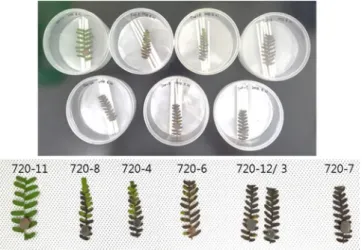
실험 결과 병징을 보이지 않는 72종을 제외한 22종의 곰팡이 균주가 포장에서 발생된 마름병 병징과 병징 발현 시간 차이는 있으나 유사한 병징을 나타내었다(Fig. 2). 이 중 5월 채취 시료 에서 분리된 4개 균주와 7월 채취 시료에서 분리된 18개 균주 는 PDA에서의 각각 배양 특성이 비슷하였다.
병원균의 균학적 특성. 이병 시료에서 분리된 마름병 증 상 유발 균주 중 병원성이 높은 7월 시료 유래 2개 균주(720-4, 720-12)의 균학적 특성을 조사하였다. 우선 균주의 포자 형태 를 관찰하기 위하여 각 균주의 균사체를 다양한 배지, 즉 PDA, tryptic soy agar (TSA), malt extract agar (MA), oatmeal agar
편, OA 배지에서는 배양 기간 동안 암회색의 균사를 형성하였 다(Fig. 3A). 균사체 위에 병자각(pycnidium)과 같은 구조는 형 성되지 않았다. 분생포자 형성은 OA 배지에서 5일부터 관찰되 었으나 MA 배지에서는 12일 이후부터 관찰되었다. 분생포자는 투명(hyaline)하였으며, 모양은 타원형(ellipsoid)이었으며 크기 는 (7.9–14.9)–(2.7–5.0) µm의 범위로 변이가 심하였다. 분생포 자 내 격막은 주로 1개가 관찰 되었으나 격막이 없는 분생포자 도 다수 관찰되었다(Fig. 3B, C, E, F). 이들 병원균의 균사 최적 생장은 PDA 와 TSA 배지 위, 25°C 조건에서 관찰되었으며, pH 3–8 범위에서 생장이 가능한 것으로 확인되었다.
병원균의 동정. 분리된 병원균의 internal transcribed region (ITS) 부위(primer 조합: ITS1: 5′-TCCGTAGGTGAACCT- GCGG-3′, ITS4: 5′-TCCTCCGCTTATTGATATGC-3′)와 18S rDNA 부위(NS1: 5′-GTAGTCATATGCTTGTCTC-3′, NS4: 5′-CTTCC- GTCAATTCCTTTAAG-3′)를 증폭하여 염기서열을 해독한 결 과, 5월 시료 분리 병원균 균주 4종은 모두 Fusarium속 균주 (F. oxysporum, F. fujikuroi, F. tricinctum)와 99% 수준의 상동성 을 보였으며, 7월 시료 분리 병원균 균주 18종은 모두 Phoma sp.와 98–99% 수준의 상동성을 보였다. 이후 병원균의 종 동 정 관련 계통발생학적 분석은 분리된 병원균 중 병원성이 높은 7월 시료 분리 균주 중 720-4와 720-12 균주를 대상으로 수행 Fig. 2. Pathogenicity of Didymella sp. isolates (cultivated on potato
dextrose agar at 25oC for 20 days) inoculated on healthy bracken leaves for 7 days at 25oC.
Fig. 3. Mycelial growth (A, D) and conidia morphology (B, C–F) of Didymella sp. 720-4 isolate on malt extract agar medium (A–C) and oatmeal agar medium (D–F), respectively. The enlarged images with ×1,000 magnification of conidia indicated by circles in B were shown in D and F, respectively.
하였다. 1차 염기서열 상동성 분석 결과 확인된 Phoma속 곰팡 이의 경우, NCBI와 같은 염기서열 데이터베이스에 기탁된 RNA polymerase β subunit 유전자 부위(RPB2) 유전자나 18S rDNA 부위의 염기서열 정보가 상대적으로 부족하기 때문에 일반적 으로 Phoma와 연관 속 곰팡이의 계통발생학적 분석(Chen 등, 2015)에 자주 사용되는 ITS 부위(primer 조합: ITS1와 ITS4, 증 폭크기: 532 bp) (White 등, 1990), rRNA의 large subunit 부위 (LSU, primer 조합: LR0R과 LR5, 증폭 크기: 900 bp) (Vilgalys and Hester, 1990), β-tubulin 유전자 부위(BTU, Btub3Fd와 Btub4Rd, 380 bp) (Woudenberg 등, 2009)를 720-4와 720-12 균주의 게놈 DNA로부터 각각 증폭하여 DNA 염기서열을 해독 하였다. 실험 결과 720-4와 720-12 균주로부터 증폭된 3 종 유 전자의 염기서열은 동일 하였기 때문에 추후 계통 발생학 연구 는 720-4 균주를 이용하여 진행하였다. 이 중 앞서 증폭된 ITS 부위와 LSU 유전자, BTU 유전자의 염기서열을 합쳐서 Phoma 와 인근 속 곰팡이의 해당 염기서열과 함께 정렬한 후 MEGA 6.0 프로그램의 neighbor joining, maximum parsimony, Un- weighted Pair Group Method with Arithmetic Mean 방법 등 을 사용하여 계통수를 작성하였다(Fig. 4). 계통수 작성에 이용 한 720-4 균주 유래 3종 유전자의 DNA 염기서열을 GenBank에 기탁하였다(ITS 부위: MN197668, LSU 유전자 부위: MN197671, BTU 유전자 부위: MN202267). 비교 분석에 사용된 Phoma 와 Didymella속 곰팡이는 Chen 등(2015)의 연구에 의해 분류 체계가 정립된 종으로서 계통수 작성에 사용된 해당 종의 유 전자 염기서열 정보는 Supplementary Table 1에 제공하였다.
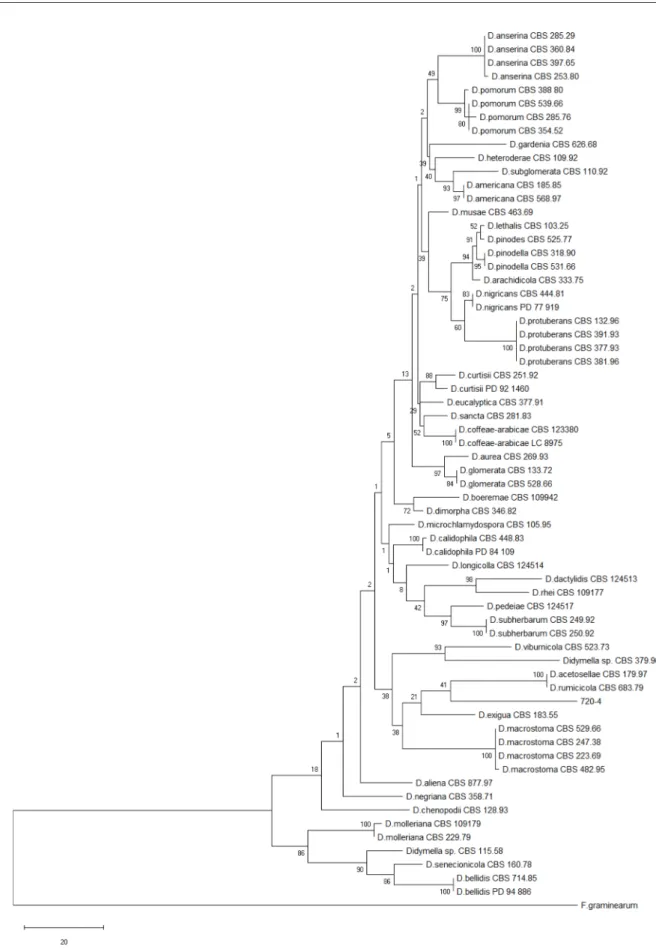
계통수 작성에 필요한 outgroup으로는 당초 Chen 등(2015) 이 사용한 Phoma herbarum, Xenodidymella humicola, Asco- chyta rabiei를 사용하였으나(Supplementary Table 1) 모든 계 통수에서 Chen 등(2015)의 결과와 달리 해당 종이 outgroup 으로 나뉘어지지 않아 그들보다 분류학적으로 먼 Fusarium graninearum을 outgroup으로 사용하였다. 계통수 작성 결과, 720-4 균주는 Didymella속 곰팡이의 clade에 포함됨을 확인 할 수 있었다. 비교 분석에 사용된 대부분의 Didymella속 곰팡 이는 기존 연구 결과(Chen 등, 2015)와 마찬가지로 종 수준의 subclade에 명확히 존재하는 반면, 720-4 균주는 이들 곰팡이 종의 subclade에 유의한 수준으로 포함되지 못하였다(Fig. 4).
단지 720-4 균주는 D. rumicicola와 D. acetosellae의 subclade 가 포함된 종 수준을 넘는 큰 범위의 subclade에 포함되었으나 통계적 유의성은 상대적으로 낮았다(bootstrap value=41%) (Fig. 4).
Didymella속은 2009년 새롭게 분류학적으로 정립된 Didy- mellaceae (Didymella과)에 속하며, 이 그룹에는 Didymella속
외 Aschochyta속과 Phoma속 곰팡이도 함께 포함되어 있다 (Chen 등, 2015). 하지만 이들 속에 속하는 곰팡이 종은 형태적 으로 구분이 어렵기 때문에 다양한 유전자의 염기서열을 활 용한 계통발생학적 분석(multi-locus phylogenetic analysis) 을 통한 종 구분이 널리 이용되고 있다. 이와 같은 결과를 통 하여 720-4 균주는 Didymella속에 속하지만 기존 NCBI Gen- Bank database에 기탁된 Didymella속 곰팡이 종과는 다른 종 일 가능성이 있다. 한편 720-4 균주의 분생포자 형태와 균사 배양체의 특성(Fig. 3)이 병자각 미형성을 제외하고 일반적인 Didymella속 곰팡이와 크게 다르지 않은 결과도 이를 뒷받침 한다. 지금까지 야생 고사리의 곰팡이 병원균 중 Didymella속 곰팡이는 알려진 경우가 없으나, 죽은 고사리의 엽상체(frond) 와 줄기 등으로부터 D. lophospora와 D. prominula가 분리된 적 이 있다(Ellis and Ellis, 1985). 또한 Didymella와 같은 과(family) 에 속한 Ascochyta pteridis와 Phoma aquiline는 고사리의 curl tip disease의 발생과 매우 밀접하게 연관되어 있다고 알려져 있으며(Angus 1958, Burge and Irvine, 1985), 종 동정이 안 된 Phoma 곰팡이도 Stagnospora sp., Cylindrocarpon destructans, Sordaria fimicola 등의 자낭균과 함께 고사리의 내생균으로 보 고된 적이 있다(Petrini 등, 1993). 현재까지 보고된 내용과 본 실 험 결과를 종합해 볼 때 경남 남해군 창선면에서 발생된 고사 리 신규 마름병은 고사리에 병원균으로 존재하는 Didymella속 곰팡이에 의해 발병된 것으로 추정된다. 신규 고사리 마름병 을 일으키는 병원균은 NCBI database에 기탁된 Didymella 곰 팡이와 다른 종으로서 염기서열이 아직까지 기탁되지 않은 D.
lophospora 또는 D. prominula와 유사할 가능성이 있거나 또는 D. lophospora과 D. prominula뿐 아니라 기존에 보고된 Didy- mella종과 다른 신종일 가능성도 배제할 수 없다. 따라서 본 연 구에서 보고한 Didymella속 곰팡이의 종 동정은 좀 더 다양한 Didymella 곰팡이와 DNA 염기서열을 확보한 이후에야 가능할 것으로 예상된다.
요 약
최근 4년간 경남 남해군 창선면 일대 고사리 재배 포장에서 마름병 증상을 보이는 새로운 병해가 발생하였고 이 병해로 인 하여 해당 지역 고사리 생산량이 해마다 크게 감소하고 있다.
2018년 5월, 7월, 10월에 이병 시료를 채취하여 그로부터 총 92 개의 곰팡이 균주를 분리하였다. 이들 균주를 건전한 고사리 잎에 접종하여 총 22개 곰팡이 균주가 포장에서 발생된 병징 과 동일한 병징을 일으킴이 확인되었다. 이 중 병원성이 가장 높은 2균주를 선발하여 ribosomal RNA, RNA polymerase β
Fig. 4. A phylogenetic tree constructed with the maximum parsimony method using combined nucleotide sequences of genes encoding ribosomal RNA, internal transcribed region, and β tubulin from the bracken blight pathogen (720-4 isolate) and its related Didymella spp.
The nucleotide sequences of Fusarium graminearum PH-1 strain were used as the outgroup to root the phylogeny. The bootstrap values are indicated above the internodes.
-subunit, β-tubulin 유전자 부위, internal transcribed region 을 증폭하였다. 해당 증폭 부위의 염기서열을 이용한 계통수 작 성을 통해 병원균 균주는 Didymella속의 clade에 속하며, 기존 균주 중 D. rumicicola 또는 D. acetosellae와 비슷하나 기존 종 수준의 subclade에는 포함되지 않았다. 따라서 고사리 마름병 을 일으키는 병원균의 정확한 종 동정을 위해 추가적인 분석이 필요하다. 본 결과는 Didymella sp.에 의한 고사리 마름병 발생 첫 보고이다.
Conflicts of Interest
No potential conflict of interest relevant to this article was reported.
Acknowledgements
This work was supported by Korea Institute of Planning and Evaluation for Technology in Food, Agriculture, Forestry (IPET) through Agri-Bio Industry Technology Development Program funded by Ministry of Agriculture, Food and Rural Affairs (MAFRA) (118029-02), and also supported by Soonc- hunhyang University.
Electronic Supplementary Material
Supplementary materials are available at Research in Plant Disease website (http://www.online-rpd.org/).
References
Angus, A. 1958. Note on diseases of bracken (Pteridium aquilinum) in Scotland. Trans. Bot. J. Linn. Soc. 130: 157-170.
Burge, M. N. and Irvine, J. A. 1985. Recent studies on the potential for biological control of bracken using fungi. Proc. R. Soc. Edinb.
Biol. Sci. 86: 187-194.
Chen, Q., Jiang, J. R., Zhang, G. Z., Cai, L. and Crous, P. W. 2015. Re- solving the Phoma enigma. Stud. Mycol. 82: 137-217.
Ellis, M. B. and Ellis, I. P. 1985. Microfungi on Land Plants: An Identifi- cation Handbook. Croom-Helm, London, UK. 868 pp.
Jo, J.-S. 1978. Physico-chemical properties of bracken (Pteridium aquilinum) root starch. 1. Morphology and chemical properties.
Korean J. Food Sci. Technol. 10: 57-62.
Korea Forest Service. 2015. Production of Forest Service. Korea For- est Service, Daejeon, Korea. 34 pp. (in Korean)
Korea Forest Service. 2017. Production of Forest Service. Korea For- est Service, Daejeon, Korea. 31 pp. (in Korean)
Lee, S.-S., Jeong J.-G., Choi, C.-H. and Kim, C.-H. 2008. A herbalogical study on the plants of Pteridaceae in Korea. Korean J. Herbol. 23:
33-40.
Petrini, O., Ficher, P. J. and Petrini, L. E. 1993. Fungal endophytes of bracken (Pteridium aquilinum) with some reflections on their use in biological control. Sydowia 4: 282-293.
Sim, H.-J., Hwang, C.-R., Kang, J.-R., Kang, M.-J. and Sin, J.-H. 2015.
Physicochemical characteristics and antioxidant activity of bracken (Pteridium aquilinum Kuhn) in Namhae. Korean J. Food Cook. Sci. 31: 288-295.
Vilgalys, R. and Hester, M. 1990. Rapid genetic identification and mapping of enzymatically amplified ribosomal DNA from sev- eral Cryptococcus species. J. Bacteriol. 172: 4238-4246.
White, T. J., Bruns, T., Lee, S. and Taylor, J. 1990. Amplification and direct sequencing of fungal ribosomal RNA genes for phyloge- netics. In: PCR Protocols: A Guide to Methods and Applications, eds. by M. A. Innis, D. H. Gelfand, J. J. Sninsky and T. J. White, pp.
315-322. Academic Press, Inc., San Diego, CA, USA.
Woudenberg, J. H. C., Aveskamp, M. M., De Gruyter, J., Spiers, A.
G. and Crous, P. W. 2009. Multiple Didymella teleomorphs are linked to the Phoma clematidina morphotype. Persoonia 22: 56- 62.