• 검색 결과가 없습니다.

Hybrid Solar Cells with Polymer/Fullerene Bulk Heterojunction Layers Containing in-situ Synthesized CdS Nanocrystals

N/A
N/A
Protected

Academic year: 2021

Share "Hybrid Solar Cells with Polymer/Fullerene Bulk Heterojunction Layers Containing in-situ Synthesized CdS Nanocrystals"

Copied!
5
0
0

로드 중.... (전체 텍스트 보기)

전체 글

(1)

Hybrid Solar Cells with Polymer/Fullerene Bulk Heterojunction Layers Containing in-situ Synthesized CdS Nanocrystals

Eunjoo Kwak

1)

․ Sungho Woo

1,2)

․ Hwajeong Kim

1,3)

․ Youngkyoo Kim

1)

*

1)

Organic Nanoelectronics Laboratory, School of Applied Chemical Engineering, Kyungpook National University, Daegu 702-701, Republic of Korea

2)

Energy Research Division, Daegu Gyeongbuk Institute of Science and Technology (DGIST), Daegu 711-873, Republic of Korea

3)

Research Institute of Advanced Energy Technology, Kyungpook National University, Daegu 702-701, Republic of Korea

ABSTRACT: We report hybrid solar cells fabricated with polymer/fullerene bulk heterojunction layers that contain inorganic nanocrystals synthesized by in-situ reaction in the presence of polymer chains. The inorganic (cadmium sulfide) nanocrystal (CdS

NC

) was generated by the reaction of cadmium acetate and sulfur by varying the reaction time up to 30 min. The synthesized CdS

NC

showed a rectangular flake shape, while the size of CdS

NC

reached ca. 150 nm when the reaction time was 10 min. The performance of hybrid solar cells with CdS

NC

synthesized for 10 min was better than that of a control device, whereas poor performances were measured for other hybrid solar cells with CdS

NC

synthesized for more than 10 min.

Key words: Hybrid solar cells, Bulk heterojunction, CdS nanocrystal, In-situ synthesis

*Corresponding author: [email protected]

Received November 3, 2014; Revised November 6, 2014;

Accepted November 6, 2014

ⓒ 2014 by Korea Photovoltaic Society

This is an Open Access article distributed under the terms of the Creative Commons Attribution Non-Commercial License (http://creativecommons.org/licenses/by-nc/3.0)

which permits unrestricted non-commercial use, distribution, and reproduction in any medium, provided the original work is properly cited.

Nomenclature

CdS

NP

: Cadmium sulfide nanocrystal J

SC

: Short circuit current density, mA/cm

2

V

OC

: Open circuit voltage, V

FF : Fill factor, %

PCE : Power conversion efficiency, % R

S

: Series resistance, kΩ∙cm

2

R

SH

: Shunt resistance, kΩ∙cm

2

1. Introduction

Polymer solar cells with single active (light-absorbing) layers, which feature bulk heterojunction (BHJ) structures, have recently attracted considerable attention because of their potentials for flexible and lightweight plastic solar modules

1-4)

. In particular, polymer solar cells can be fabricated by employing continuous roll-to-roll coating processes at low temperatures (<150°C), which are far lower than the fabrication temperatures for con- ventional inorganic solar cells. Therefore, polymer solar cells are expected to contribute to the realization of low-cost ultrathin plastic film-type solar modules like a wall paper

5,6)

.

However, the stability of polymer solar cells becomes a bottleneck for commercialization, even though the power con- version efficiency has recently reached 9~11%

7-18)

. Of various factors affecting the stability and lifetime of polymer solar cells, the morphological instability of BHJ layers is understood to lead to the gradually degraded device performances

13,14)

. One of the morphological instability can be attributed to the nanoscopic phase segregation between polymer chains and fullerene molecules and/or the chemical reaction among fullerene molecules. In this regard, it is considered as one of good approaches to introduce inorganic nanoparticles or nanocrystals instead of fullerene derivatives

19-25)

.

In this work, we introduced cadmium sulfide (CdS) nanocrystals (CdS

NC

) to the BHJ layer, which is composed of poly (3-hexyl- thiophene) (P3HT) and phenyl-C

61

-butyric acid methyl ester (PC

61

BM), by employing an in-situ reaction of precursor materials.

The resulting CdS nanocrystals showed rectangular shapes with various aspect ratios, while their size reached ~200 nm. The device performances were investigated by varying the reaction time compared to the control device without the CdS nanocrystals.

2. Experimental

To synthesize CdS

NC

, the co-solvent of 8 ml dichlorobenzene (DCB, Sigma-Aldrich, anhydrous, 99%) and 4 ml dimethyl

152

(2)

Cd(Ac) 2 . 2H 2 O + S + P3HT

DMSO + DCB 180

o

C

CdS NC + P3HT + CO 2 + H 2 O

Scheme 1. In-situ synthesis of CdS

NC

from its precursor, Cd(Ac)

2

, in the mixture solution containing P3HT. Three different reaction times (10 min, 20 min, 30 min) were applied

Glass ITO PEDOT:PSS Active Layer V Al

A

PC

61

BM P3HT

CdS

NC

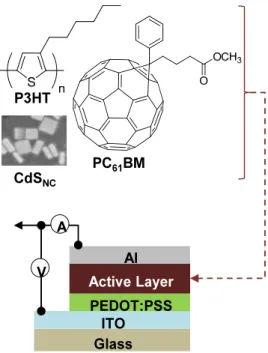
Fig. 1. Illustration for the device structure and the materials used for the active layer. Note that the SEM image for CdS

NC

was taken from Fig. 2

Fig. 2. SEM image for the film prepared from the CdS

NC

/P3HT mixture (reaction time: 10 min): The left-top image shows the SEM image measured with a higher magnification sulfoxide (DMSO, Sigma-Aldrich, analytical grade) was charged

into a three-necked flask and heated up to 100°C. Then cadmium acetate dihydrate (Cd(Ac)

2

, Sigma-Aldrich, powder, 98%) and P3HT (P3HT, Rieke Metals, weight-average molecular weight

= 50 kDa, polydispersity index = 2, regioregularity > 98%) were dissolved in the co-solvent (P3HT:Cd(Ac)

2

= 10:1 by weight).

Sulfur (20 mg) was added to another flask charged with DCB at 100°C and heated up to 180°C for complete dissolution. The sulfur-dissolved DCB solution was quickly added to the P3HT/

Cd(Ac)

2

-dissolved solution. This solution was heated up to 180°C and kept for 30 min for reaction (see scheme 1). The reaction was terminated by adding methanol (anhydrous), followed by removal of solvents and remained starting materials by employing centrifugation and extraction. The CdS

NC

/P3HT mixture was dried in a vacuum oven. Finally, the ternary solution (P3HT:CdS

NC

:PC

61

BM = 45:5:50 by weight) was prepared by mixing the CdS

NC

/P3HT mixture and PC

61

BM in DCB.

For the fabrication of solar cells, glass substrates coated with the indium-tin oxide (ITO) layer were subject to photolithography/

etching processes in order to make bottom electrodes (see Fig.

1). On top of the patterned ITO-glass substrates, poly (3,4- ethylenedioxythiophene): poly (styrenesulfonate) (PEDOT:PSS, Clevios PH500, 40 nm) was spin-coated and thermally annealed at 230°C for 15 min. Next, the hybrid bulk heterojunction layers (P3HT:CdS

NC

:PC

61

BM) were coated on the PEDOT:PSS layers and soft-baked at 60°C for 30 min. These samples were transferred to a vacuum chamber and the Al electrodes (80 nm) were deposited by thermal evaporation. Finally, the fabricated devices were thermally annealed at 150°C for 30 min. All devices were kept inside an argon-filled glove box before measurement.

The morphology of the hybrid bulk heterojunction films was measured using a scanning electron microscope (HD-2300, Hitachi). The performance of solar cells was measured using a specialized solar cell measurement system equipped with a solar simulator (Model 92250, Newport-Oriel) and an electrometer (Model 2400, Keithley). The intensity of the simulated solar light was fixed as 100 mW/cm

2

(air mass (AM) 1.5G).

3. Results and Discussion

As shown in Fig. 2, the CdS

NC

synthesized in the presence of

P3HT showed rectangular flake shapes with the maximum size

(longest axis) of ca. 150 nm. Considering the flake-like shapes

of CdS

NC

, it is considered that most of the CdS

NC

flakes in the

hybrid film may locate with their wider faces parallel to the film

(3)

Table 1. Summary of solar cell performances according to the reaction time for CdS

NC

. The series resistance (R

S

) was calculated at around open circuit voltages in the light J-V curves, while the shunt resistance (R

SH

) was calculated at around short circuit current densities in the light J-V curves. ‘CD’ denotes the control device with the binary BHJ layer (P3HT:PC

61

BM) without CdS

NC

Devices J

SC

(mA/cm

2

) V

OC

(V) FF (%) PCE (%) R

S

(kΩ∙cm

2

) R

SH

(kΩ∙cm

2

)

CD 9.2 0.59 45.3 2.46 0.23 3.6

10 min 9.7 0.59 45.4 2.60 0.17 2.2

20 min 6.0 0.62 41.6 1.55 0.42 7.9

30 min 6.9 0.62 35.0 1.50 0.48 3.7

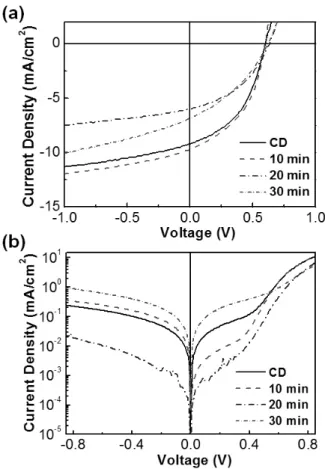
Fig. 3. (a) Light J-V curves of devices under illumination of a simulated solar light (AM 1.5G, 100 mW/cm

2

). (b) Dark J-V curves of devices. The reaction time for the in-situ synthesis of CdS

NC

is given on each graph

plane. However, the size of CdS

NC

became bigger (>500 nm) when the reaction time was increased more up to 30 min (images are not shown here).

Fig. 3(a) shows the current density-voltage (J-V) curves of devices with the P3HT:CdS

NP

:PC

61

BM BHJ layer. A control device (CD), which has the P3HT:PC

61

BM BHJ layer (without CdS

NC

), exhibited relatively good performance. Interestingly, the device with the hybrid BHJ layer, which contains the CdS

NC

component synthesized for 10 min, showed better performance than the control device. However, poor performances were obtained for the devices with the hybrid BHJ layers containing

the CdS

NC

component synthesized for 20 min and 30 min. The reason can be found from the dark J-V curves (Fig. 3(b)), which deliver the charge transport characteristics for each device.

Looking at the dark current density at a higher forward bias, we find that the lower dark current density was measured for the devices with the hybrid BHJ layers containing the CdS

NC

component synthesized for 20 min and 30 min. Hence it is supposed that the charge transport might be suppressed owing to the coarse morphology by the presence of large CdS

NC

com- ponents in the case of long reaction times (20 min and 30 min).

Here we need to understand the role of CdS

NC

in the BHJ layer because the better device performance was obtained for the hybrid device with the CdS

NC

component synthesized for 10 min. As illustrated in Fig. 3(b), the CdS

NC

component might play an electron-acceptor role together with the PC

61

BM component when it comes to the conduction band (3.6 eV) of CdS

NC26)

. After charge separation between P3HT and CdS

NC

, the electrons in the CdS

NC

component could undergo fast charge transport due to the highly ordered crystal features of CdS

NC

component. In addition, the light scattering by the presence of CdS

NC

in the BHJ layer is considered to contribute to the light harvesting leading to the increased short circuit current density (J

SC

). Considering the conduction band of CdS

NC

, the open circuit voltage (V

OC

) could not be lowered by the presence of CdS

NC

. As a consequence, the power conversion efficiency (PCE) of the hybrid device with the CdS

NC

component synthesized for 10 min reached 2.6%, which is slightly higher than the PCE (2.4%) of the control device.

4. Conclusions

The CdS nanocrystals (CdS

NC

) were in-situ synthesized from

their precursors in the mixture solution that contains P3HT

polymers. The synthesized CdS

NC

showed a rectangular flake

shape with a maximum size of less than 150 nm. The ternary

(4)

blend solutions were prepared by adding PC

61

BM to the CdS

NC

/ P3HT mixture, which were used as a BHJ layer for hybrid solar cells. The hybrid solar cells with the CdS

NC

synthesized for 10 min exhibited better performances than the control device, which was attributed to the improved charge transport through the CdS

NC

component in the BHJ layer and the enhanced light- harvesting by the light scattering caused by the CdS

NC

component.

However, longer reaction times led to the poor device performances.

Acknowledgments

This work was supported by the Korean government grants (Basic Science Research Program_2009-0093819, NRF_2012K1 A3A1A09027883, MOTIE_10048434, Basic Research Laboratory Program_2011-0020264, NRF_2012R1A1B3000523), DGIST R&D Program of the Ministry of Science, ICT and Future Planning of Korea (14-EN-03).

References

1. Y. Huang, E. J. Kramer, A. J. Heeger, G. C. Bazan. “Bulk het- erojunction solar cells: morphology and performance relation- ships”, Chem. Rev., Vol. 114, pp. 7006-7043, 2014.

2. S. E. Shaheen, C. J. Brabec, N. S. Sariciftci, “2.5% efficient or- ganic plastic solar cells”, Appl. Phys. Lett., Vol. 78, No. 6, pp.

841, 2001.

3. Y. Kim, S. Cook, S. M. Tuladhar, S. A. Choulis, J. Nelson, J.

R. Durrant, D. D. C. Bradley, M. Giles, I. McCulloch, C. S. Ha, M. Ree, “A strong regioregularity effect in self-organizing con- jugated polymer films and high-efficiency polythiophene: full- erene solar cells”, Nat. Mater., Vol. 5, No. 3, pp. 197-203, 2006.

4. H. Kim, S. Nam, J. Jeong, S. Lee, J. Seo, H. Han, Y. Kim,

“Organic solar cells based on conjugated polymers : History and recent advances”, Korean J. Chem. Eng., Vol. 31, No. 7, pp. 1095-1104, 2014.

5. F. C. Krebs, S. A. Gevorgyan, J. Alstrup, “A roll-to-roll process to flexible polymer solar cells: model studies, manufacture and operational stability studies”, J. Mater. Chem., Vol. 19, pp.

5442-5451, 2009.

6. S. Lee, S. Nam, J. Seo, J. Jeong, H. Kim, S. Woo, Y. Kim,

“Polymer solar cells with micrometer-scale engraved active nanolayers fabricated by pressing with metal molds”, Energy Technol., Vol. 2, pp. 731-720, 2014.

7. W. Li, A. Furlan, K. H. Hendriks, M. M. Wienk, R. A. J.

Janssen, “Efficient tandem and triple-junction polymer solar cells”, J. Am. Chem. Soc., Vol. 135, pp. 5529-5532, 2013.

8. Z. C. He, C. M. Zhong, S. J. Su, M. Xu, H. B. Wu, Y. Cao,

“Enhanced power-conversion efficiency in polymer solar cells

using an inverted device structure”, Nat. Photonics, Vol. 6, pp.

591-595, 2012.

9. S. Woo, W. H. Kim, H. Kim, Y. Yi, H. -K. Lyu, Y. Kim, “8.9%

single-stack inverted polymer solar cells with electron-rich poly- mer nanolayer-modified inorganic electron-collecting buffer layers”, Adv. Energy Mater., Vol. 4, pp. 1301692, 2014.

10. J. You, C.-C. Chen, Z. Hong, K. Yoshimura, K. Ohya, R. Xu, S. Ye, J. Gao, G. Li, Y. Yang, “10.2% power conversion effi- ciency polymer tandem solar cells consisting of two identical sub-cells”, Adv. Mater., Vol. 25, pp. 3973-3978, 2003.

11. E. Zimmermann, P. Ehrenreich, T. Pfadler, J. A. Dorman, J.

Weickert, L. Schmidt-Mende, “Erroneous efficiency reports harm organic solar cell research”, Nat. Photonics, Vol. 8, pp.

669-672, 2014.

12. M. O. Reese, S. A. Gevorgyan, M. Jørgensen, E. Bundgaard, S.

R. Kurtz, D. S. Ginley, D. C. Olson, M. T. Lloyda, P. Morvillo, E. A. Katz, A. Elschner, O. Haillant, T. R. Currier, V. Shrotriya, M. Hermenau, M. Riede, K. R. Kirov, G. Trimmel, T. Rath, O.

Inganäs, F. Zhang, M. Andersson, K. Tvingstedt, M. Lira-Cantu, D. Laird, C. McGuiness,S. Gowrisanker, M. Pannone, M.

Xiao, J. Hauch, R. Steim, “Consensus stability testing protocols for organic photovoltaic materials and devices”, Sol. Energy Mater. Sol. Cells, Vol. 95, pp. 1253-1267, 2011.

13. H. Kim, M. Shin, J. Park, Y. Kim, “Initial performance changes of polymer/fullerene solar cells by short-time exposure to simu- lated solar light”, ChemSusChem, Vol. 3, pp. 476-486, 2010.

14. S. Lee, S. Nam, H. Lee, H. Kim, Y. Kim, “Device performance and lifetime of polymer:fullerene solar cells with UV-ozone-ir- radiated hole-collecting buffer layers”, ChemSusChem, Vol. 4, pp. 1607-1612, 2011.

15. H. C. Wong, Z. Li, C. H. Tan, H. Zhong, Z. Huang, H. Bronstein, I. McCulloch, J. T. Cabral, J. R. Durrant, “Morphological sta- bility and performance of polymer-fullerene solar cells under thermal stress: the impact of photoinduced PC60BM oligome- rization”, ACS Nano, Vol. 8, pp. 1297-1308, 2014.

16. H. Kim, S. Nam, H. Lee, S. Woo, C. -S. Ha, M. Ree, Y. Kim,

“Influence of controlled acidity of hole-collecting buffer layers on the performance and lifetime of polymer:fullerene solar cells”, J. Phys. Chem. C, Vol. 115, pp. 13502-13510, 2011.

17. M. Jørgensen, K. Norrman, S. A. Gevorgyan, T. Tromholt, B.

Andreasen, F. C. Krebs, “Stability of polymer solar cells”, Adv.

Mater., Vol. 24, pp. 580-612, 2012.

18. F. C. Krebs, H. Spanggaard, “Significant improvement of poly- mer solar cell stability”, Chem. Mater., Vol. 17, pp. 5235–5237, 2005.

19. J. Kim, S. Lee, S. Nam, H. Lee, H. Kim, Y. Kim, “A pro- nounced dispersion effect of crystalline silicon nanoparticles on the performance and stability of polymer:fullerene solar cells”, ACS Appl. Mater. Interfaces, Vol. 4, pp. 5300-5308, 2012.

20. S. Shao, K. Zheng, K. Zidek, P. Chabera, T. Pullerits, F. Zhang,

“Optimizing ZnO nanoparticle surface for bulk heterojunction hybrid solar cells”, Sol. Energy Mater. Sol. Cells, Vol. 118, pp.

43-47, 2013.

(5)

21. E. K. Park, J. H. Kim, I. A. Ji, H. M. Choi, J. H. Kim, K. T.

Lim, J. H. Bang, Y. S. Kim, “Optimization of CdSe quantum dot concentration in P3HT:PCBM layer for the improved per- formance of hybrid solar cells”, Microelectron. Eng., Vol. 119, pp. 169-173, 2014.

22. S. Nam, J. Kim, H. Kim, Y. Kim, “Effect of film thickness in hybrid polymer/polymer solar cells with zinc oxide nano- particles”, J. Nanosci. Nanotechnol., Vol. 11, pp. 5733-5736, 2011.

23. J. Kim, S. Nam, J. Jeong, H. Kim, Y. Kim, “Effect of silicon- nanoparticle addition on the nanostructure of polythiophene:

fullerene bulk heterojunction solar cells”, J. Korean Phys. Soc.,

Vol. 61, pp. 434-438, 2012.

24. Z. Liu, Y. Sun, J. Yuan, H. Wei, X. Huang, L. Han, W. Wang, H. Wang, W. Ma, “High-efficiency hybrid solar cells based on polymer/PbSxSe1-x nanocrystals benefiting from vertical phase segregation”, Adv. Mater., Vol. 25, pp. 5772-5778, 2013.

25. S. Woo, S. Lee, Y. S. Han, H. Lyu, K. Kim, H. Kim, Y. Kim,

“Hybrid solar cells based on bulk heterojunction films of con- jugated polymers and single crystalline Si nanowires”, J.

Nanoelectron. Optoelectron., Vol. 5, pp. 139-142, 2010.

26. M. Li, J. C. Li, “Size effects on the band-gap of semiconductor

compounds”, Mater. Lett., Vol. 60, pp. 2526-2529, 2006.

수치

Fig. 2. SEM image for the film prepared from the CdS NC /P3HT  mixture (reaction time: 10 min): The left-top image shows the SEM image measured with a higher magnificationsulfoxide (DMSO, Sigma-Aldrich, analytical grade) was charged
Table 1. Summary of solar cell performances according to the reaction time for CdS NC

참조

관련 문서

• In-situ gamma-ray spectrometry for radioactivity analysis of soil using NaI(Tl) and LaBr 3 (Ce) detectors/ Radiation Protection Dosimetry, 2019. • In-situ CeBr

Table 4.1 Efficiency parameters in the flat plate solar collector using MWCNT nanofluid and water ··· 40.. Table 4.2 Efficiency parameters in the evacuated tube solar

3.8 Temperature histories in steel side of TIG-FSW hybrid welded joints in TIG preheating position 30mm · · · ·35 Fig.. 3.9 Temperature fields of TIG-FSW hybrid welded joints

This is because that the thermal conductivity and solar weighted absorption fraction of MWCNT/Fe 3 O 4 hybrid nanofluid is lower than those of MWCNT

COL-I is widely distributed in the body, and synthesized by fibroblasts, odontoblasts, osteoblasts, and chondroblasts. It weakly interacted with

Solar energy generator Frame setting for Solar PV Install Hydropower generator. The village with lights Installed

1. Free radical initiator abstract a hydrogen from polymer chains 2. Through chain transfer of propagating chain with polymer chain 3. Polymer mixtures are mechanically

verify that USF2 interacts with BRCA1 in HeLa cells, and investigate changing interaction between.. BRCA1 and USF2 after treatment of ionizing radiation (IR), we