The Clinical Experiences of B-type Natriuretic Peptide Blood Concentrations for Diagnosis in Congestive Heart Failure
- The Single Hospital Experience Based on the Large Clinical Database -
Byung-Su Yoo, MD 1 , Woo-Jae Kim, MD 1 , Hyun-Suk Jung, MD 1 , Jang-Young Kim, MD 1 , Seung-Whan Lee, MD 1 , Sung-Oh Hwang, MD 2 , Junghan Yoon, MD 1 and Kyung-Hoon Choe, MD 1
1
Department of Cardiology and
2Emergency Medicine, Wonju College of Medicine, Yonsei University, Wonju, Korea
ABSTRACT
Background : B-type natriuretic peptide (BNP) has been used as a standard diagnostic tool to define heart failure. The aim of this study was to evaluate the clinical experiences of BNP levels based on a large clinical database. Methods : From Oct. 2002 to July 2003, 3830 patients were analyzed. The patients were divided into the 3 groups: control, systolic (SHF) and diastolic heart failure (DHF) patient groups, via an echocardiography and the Framingham clinical criteria. The BNP was measured with a Triage ® kit. Both the clinical and echocar- diography profiles were analyzed. Results :The mean age of the patients was 62.8 years, with 49.0% males. The control group included 661, the SHF group 475 and the DHF group 287 patients. In the control group, the mean BNP level was 31.5±24.0 pg/mL, with the BNP level in the women higher than in the men (28.0±23.8 vs.
34.9±23.7 pg/mL, p=0.041). The SHF patients group had significantly higher BNP levels than the other groups (p=0.008). In the patients with SHF, the BNP levels, according to the NYHA grade, showed significant differences (I: 169.3±138.7, II: 391.1±231.4, III: 780.1±698.3 and IV: 1078.9±946.2 pg/mL, p=0.009). In the patients with diastolic dysfunction (n=787) according to the diastolic dysfunction, the BNP levels, showed significant differences (relaxation abnormality: 108.2±78.2, pseudo-normal: 419.0±109.8 and restrictive physiology: 510.4±231.6 pg/mL, p=0.009). The accuracy in the BNP level when separating the SHF from the control patients was 0.98 (AUC=0.98), with 92.5% sensifivity and 86.1% specificity at a cut-off of 108 pg/mL.
Conclusions :The levels of blood BNP were present in various ranges according to the clinical situation and extent of heart failure. (Korean Circulation J 2004;34 (7):684-692)
KEY WORDS :Natriuretic peptide;Congestive heart failure;Diagnosis.
Introduction
The pathophysiology of heart failure is its association with the activation of neuro-endocrines and the release of cytokines. In addition, several clinical syndromes have been reported that include not only the symptoms in the
heart, but also pathology in other organs as well. 1) As the present population ages and the number of cardiova- scular patients increases, the overall incidence of heart failure is increasing rapidly. Similarly, the incidence of heart failure in Korea is anticipated to rise substan- tially. 2) The application of the classical criteria from the Framingham study to diagnosis of heart failure shows low sensitivity and specificity and thus, the physician arriving at the correct diagnosis requires numerous diffe- rential diagnosis. 3)4) Although echocardiography was the most useful tool and the gold standard for the diagnosis of heart failure, it is expensive. Furthermore, it may be ineffective in some cases such as for patients with ch- Received:December 22, 2003
Revision Received:January 26, 2004 Accepted:February 18, 2004
Correspondence:Byung-Su Yoo, MD, Assistant Professor, Car-
diology Section, Internal Medicine, Wonju College of Medicine,
Yonsei University, 162 Ilsan-dong, Wonju 220-701, Korea
Tel:82-33-741-0917, Fax:82-33-741-1219
E-mail:[email protected]
ronic pulmonary diseases who require the differential diagnosis from respiratory failure, and obese patients. 5) In addition, for those patients visiting a hospital for acute respiratory difficulties and so they require immediate diagnosis and treatment, echocardiography may have poor accessibility and a high cost for repeated test. The plasma B-type natriuretic peptide (BNP) or N-terminal pro-BNP (NT-proBNP) concentration has been reported to be a marker of ventricular dysfunction as it is prima- rily produced and released by the ventricles in response to hemodynamic stimuli such as the increased volume of the ventricles, pressure load, etc. This peptide’s level has been recently proven to be useful by numerous clinical studies of the differential diagnosis of dyspnea. 6)7) How- ever, reports on a large number of patients in Korea are rare. 8)9) Here, we examined the clinical experiences of the BNP measurement in heart failure patients on a large number of patients that visited a single hospital.
Methods
Study population
We analyzed 3830 consecutive patients who were admitted in the Wonju Christian Hospital, Wonju College of Medicine, Yonsei University from October 2002 to July 2003 from whom BNP and echocardiogram were obtained. For all the patients, their height, weight, elect- rocardiogram, chest X-ray and plasma creatinine level were measured at the first visit. Echocardiograms were performed using routine echocardiographic parameters via Hewlett Packard 5500, and the M-mode and trans- mitral Doppler were analyzed. 187 patients in the study group underwent coronary angiography and an evalua- tion of the ventricular end-diastolic pressure at the same time at 2.7±2.3 days after admission.
Definition of heart failure and patient grouping Clinical symptoms of heart failure were defined by the Framingham clinical criteria. 10) Systolic heart failure was defined as clinical symptom stated by Framingham, with the following echocardiographic findings: an ejec-
tion fraction <50% and an end-diastolic dimension of left ventricle >5.5 cm. 11) Diastolic heart failure was de- fined using clinical symptoms presented by Framing- ham’s criteria with diastolic dysfunction on the echocar- diograph. Diastolic dysfunction was defined by applying the conventional echocardiography standard. 11) Rel- axation abnormality was defined as less than 1 or DT>
240 msec. In patients over 55 years, relaxation abnor- mality was defined as an E/A ratio less than 0.8 and a DT more than 240 msec. 9) Isolated diastolic dysfunction was defined as patients with diastolic dysfunction on echocardiography, but their symptoms did not concur to the Framingham clinical criteria. Systolic heart failure was classified by the severity determined by the New York Heart Association (NYHA) classification. Acute heart failure was defined as those patients with symptom deterioration within the last one month. Patients diag- nosed with heart failure and currently taking medicine, and without deterioration of the symptoms within the last one month were defined as stable chronic heart failure.
The control group were patients without a history of heart failure, without any evidence of coronary artery disease ( history of atherosclerosis, positive exercise test, or sig- nificant coronary artery stenosis on coronary angiogra- phy), and they had normal findings on echocardiography.
The control subjects were 4 volunteers (mean age 23 years), 28 individuals who underwent a routine check- up without specific symptoms or medical history (mean age 44 years), 311 patients presenting non-cardiac chest pain with structurally normal hearts, and 318 patients presenting mild dyspnea with structurally normal hearts.
The patients with typical clinical symptoms, but they had not received echocardiography were excluded in this study. Patients that were without NYHA classifica- tion in their medical records were excluded from the analysis (n=110). Patients with nephrotic syndrome in their medical history or if this was found on physical examination were also excluded.
Measurement of plasma BNP level
The plasma BNP concentration was measured by
Korean Circulation J 2004;34(7):684-692 686
drawing 3-5 mL blood in a tube containing EDTA, and then it was quantified by immunofluorescence using BNP kit (Triage ® , Biosite, San Diego, USA). For the measurement, the minimum value was 5 pg/mL and the maximum value was 5000 pg/mL.
Data analysis and statistics
All data were presented as means±standard devia- tion and analyzed using SPSS version 10.0. Continuous variables among the controls, the systolic heart failure group, and the diastolic heart failure group were an- alyzed by one-way ANOVA. Discontinuous variables were analyzed by Pearson’s Chi-square test. Continuous variables between the two groups were compared by t-test and discontinuous variables were compared by Chi-square test. To assess the accuracy of the BNP value for the diagnosis of heart failure, the sensitivity and the specificity were obtained by comparing the BNP values of systolic heart failure patients and the control subjects. The accuracy of the test was assessed by the area under the receiver operating characteristic curve ( AUROC). The cut-off value was determined by the highest sensitivity and 1-specificity by using a 2×2 table obtained by applying ROC curve. The correlation of plasma BNP values, echocardiography factors, and the enddiastolic left ventricle pressures were evaluated by linear regression analysis. p values less than 0.05 were considered statistically significant.
Results
The clinical characteristics of the study population and echocardiographic findings
For 3830 patients who underwent the BNP test, the males were 49.0% (n=1877), and their mean age was 62.8±13.8 years. The reasons for BNP testing were the evaluation of dyspnea or the differential diagnosis of heart failure (n=2378, 62.1%), follow-up of heart failure ( n=774, 20.2%), coronary artery disease (n=582, 15.2%), and the volunteers and to assess the heart’s condition prior to surgery and others causes were 12.7% (n=486).
661 cases were control subjects, 475 cases were systolic heart failure, and 787 cases were diastolic dysfunction including 500 cases with isolated diastolic dysfunction, and 287 cases were diastolic heart failure. 687 cases were ischemic heart disease patients, 305 cases were patients with acute or chronic pulmonary diseases, 148 cases were patients with atrial fibrillation and other ventricular arrhythmia without heart failure symptoms, 168 cases were patients who complained of dyspnea without having echocardiography preformed on them, and 166 cases were abnormal echocardiography without any previous history of heart disease on the medical records, anasarca patients without heart failure, multiple trauma and primary valvular heart disease. 269 cases were cardiac arrest or cardiopulmonary resuscitation (Figure 1). We compared the characteristic echocardiography and bioc- hemical markers in the control group, the systolic heart failure group, and the diastolic heart failure group. From the medical history, the incidence of hypertension in the control group, systolic heart failure group and diastolic heart failure group was 33.1%, 42.3%, and 43.8%, res- pectively. The incidence was significantly higher in the heart failure group (p=0.040). The incidence of diabetes
SHF:n=475
DHF:n=287 IDD:n= 500 IHD:n=687
Pulmonary disease:n=305 AF without HF:n=148 Dyspnea with inadequate Echocardiography data:n=166 Others:n=269
Mean age:62.8±13.8 Male:49.0% (n=1877)
CHF n=762 Control
n=661
Total n=3830
Others n=2495
Figure 1. The flow diagram of the patients. CHF: conges-
tive heart failure, SHF, DHF: systolic and diastolic heart
failure, IDD: isolated diastolic dysfunction, IHD: ischemic
heart disease, Pulmonary disease: COPD, pneumonia,
etc., Others: general edema, post-operation, multiple
trauma, cardiac resustation, chronic renal failure, etc.
was 15%, 19%, and 21% and smoking was 37%, 31%, and 37%, respectively, and the difference was not signi- ficant (p>0.05). The incidence of ischemic heart disease in systolic heart failure cases was 32.4%, and in the diastolic heart failure patients it was 14.8%, and this was significantly higher than in the systolic heart failure pa- tients. From the medical history, myocardial infarction was 16.8% and 2.5%, respectively (p=0.021). Patients with significant mitral or aortic valve regurgitation were 29.8% in the systolic heart failure group and 10.3% in the diastolic heart failure group (p=0.035). The plasma creatinine level and body mass index were not signifi- cantly different in these three groups (p>0.05). In regard to echocardiography findings, the left ventricular ejec- tion fraction was 33.1% in the systolic heart failure patients, which was significantly lower than the diastolic heart failure patients’ rate (59.1%) and the control rate ( 61.2%)(p=0.021). Similarly, the left ventricular end- diastolic dimension was significantly increased in the systolic heart failure patients (p=0.019). The left ventri- cular mass value in systolic heart failure patients was 134.3 g, which was significantly higher than the control value 86.3 g and the diastolic heart failure group 109.3 g (p=0.044). The left ventricular end-diastolic pressure in systolic heart failure group was significantly higher than
the diastolic heart failure group or the control group ( p=0.0091), and in the diastolic heart failure group, it was significantly higher than the control group (p=
0.042, Table 1).
The BNP concentration in study groups
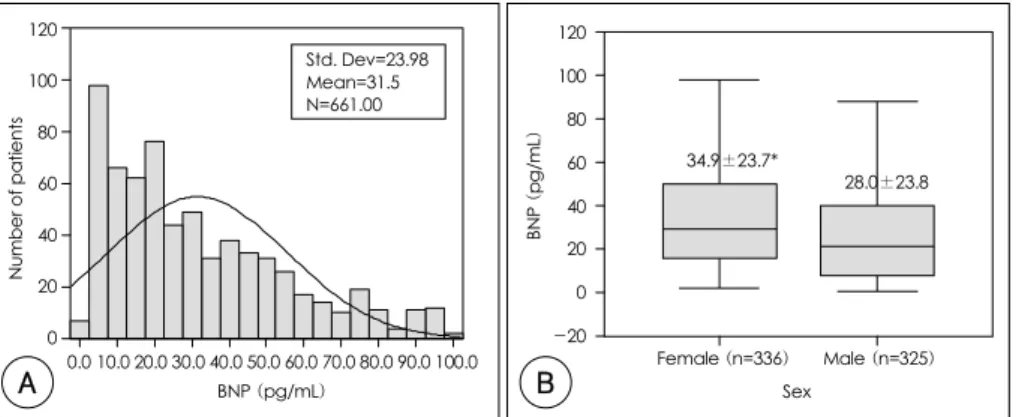
The BNP value in the controls (n=661) was 31.5±
24.0 pg/mL (Figure 2A); in males it was 28.0+23.8 pg/mL, and in females it was 34.9±23.7 pg/mL. The BNP level in females was significantly high (p=0.041, Figure 2B). In control subjects, the BNP level increased as their age increased: the level for under 30 years old was 10.8±8.2, 40 years old was 23.3±12.6, 50s was 27.4±19.9, 60s was 26.4±19.3, and over 70s was 46.8±28.5 pg/mL (p=0.042, Figure 3). In the systolic heart failure group (n=475) and diastolic heart failure group (n=287) the values were 564.1±418.2 and 193.2±108.1 pg/mL, respectively. It was significantly higher in the systolic heart failure group than the other groups (p=0.008, Figure 4). Within systolic heart failure group, its value in acute heart failure patients (n=128) was significantly higher than in chronic heart failure patients (859.8±1032.7 vs. 342.3±482.9 pg/mL, p=
0.008). The values were significantly different acc- ording to the severity of heart failure; according to the Table 1. Clinical and ehocardiographic characteristics of study patients
Clinical characteristics Control (n=661) Systolic HF (n=475) Diastolic HF (n=287)
Age 60.80±10.2 063.20±07.1 059.80±09.30
Sex (male) 49.2% 52.1% 49.3%
BMI 001.68±00.28 0001.70±00.33 001.71±00.34
Hypertension* 33.1% 42.3% 43.8%
Diabetes 15.3% 19.2% 21.2%
Smoking 37.1% 31.3% 37.8%
Serum Cr (mg/dL) 00.90±00.2 001.20±00.2 001.00±00.30
LVEF (%)* 61.21±08.7 033.10±10.4 059.10±09.30
E/A ratio* 01.23±00.2 0001.79±01.12 000.69±00.20
LVEDD (mm)* 004.73±00.49 0005.97±00.90 004.91±00.58
LVMI (g/m
2) * 86.30±14.2 134.30±41.2 109.30±21.80
LVEDP (mmHg)* 10.90±02.2 018.70±01.8 013.90±01.70
HF: heart failure, BMI: body mass index, Cr: creatinine, LVEF: left ventricular ejection fraction, E/A ratio: peak velocity during phssive phase of diastolic filling of left ventricle/late peak of velocity following atrial contraction ratio, LVMI: left ventricular mass index, LVEDD: left ventricular end diastolic dimension, LVEDP: left ventricular end diastolic pressure.
*: p<0.05
Korean Circulation J 2004;34(7):684-692 688
NYHA class, the values were: NYHA class I was 169.3±138.7, class II was 391.1±231.4, class III was 780.1±698.3, and class IV was 1078.9±946.2 pg/mL ( p=0.009, Figure 5). In isolated diastolic dysfunction patients, the mean BNP value was 103.2-56.1 pg/mL:
it was lower than in diastolic heart failure patients and systolic heart failure patients. In all patients with abnor- mal diastolic dysfunction on echocardiography (n=787), Figure 2. A: the distribution of BNP levels in control patients. B: comparison of BNP levels according to the sex in control patients. Data: mean±SD, p=0.041 between the groups, BNP: B-type natriuretic peptide. *: p<0.05.
120
100
80
60
40
20
0
Number of patients
0.0 10.0 20.0 30.0 40.0 50.0 60.0 70.0 80.0 90.0 100.0 BNP (pg/mL)
Std. Dev=23.98 Mean=31.5 N=661.00
34.9±23.7*
28.0±23.8
BNP (pg/mL)
Female (n=336) Male (n=325) Sex
120 100 80 60 40 20 0 -20
600 500 400 300 200 100 0
31.5±24.0
567.4±228.2
193.2±108.1
103.2±56.1
Control (n=661)
Systolic HF (n=475)
Diastolic HF
(n=287) Isolated DD (n=500)
BNP (pg/mL)
Figure 4. Comparison of BNP levels in congestive heart failure. Data: mean±SD, HF: heart failure, DD: diastolic dysfunction, BNP: B-type natriuretic peptide. p=0.008 among the groups.
Figure 3. Comparison of BNP levels according to the aging in control patients. BNP: B-type natriuretic pep- tide. Data: mean±SD, p=0.041 between the groups.
10.8
27.46 26.76 33.42 39.06 50.87
23.29 60
50 40 30 20 10
00<30 (n=9)
30-39 (n=34)
40-49 (n=110)
50-59 (n=138)
60-69 (n=252)
70-79 (n=102)
>79 (n=16)
BNP (pg/mL)
Age
1200 1000 800 600 400 200
0 Control (n=661)
NYHA I (n=101)
II (n=67)
III (n=124)
BNP (pg/mL)
31.5±24.0 169.3±138.7 391.1±231.4
780.1±698.3 1078.9±946.2
IV (n=73)
Figure 5. BNP levels according to the NYHA class in pa- tients with systolic heart failure (n=365). Some patients (n=110) was missed the record for NYHA class. BNP: B- type natriuretic peptide, NYHA: New York Heart Associ- ation. Data: mean±SD, p=0.009 among the groups.
Figure 6. BNP levels according to the transmitral doppler parameters in patients (n=787) with diastolic dysfunction by echocardiography. BNP: B-type natriuretic peptide.
Data: mean±SD, p=0.009 among the groups.
600 500 400 300 200 100 0
BNP (pg/mL)
Control (n=661)
Relaxation (n=651)
Pseudo-normal.
(n=78)
Restrictive (n=58) 31.5±24.0
108.2±78.2
419.0±109.8
510.4±231.6
A B
the significant difference was noted according to the severity of diastolic dysfunction as detected by tran- smitral Doppler: in patients with relaxation abnormality it was 108.2±78.2, pseudo-normalization was 419.0±
109.8, and restrictive physiology was 510.4±231.6 pg/mL (p=0.009, Figure 6).
The accuracy of the BNP test in the diagnosis of heart failure and their correlation
The accuracy of the BNP test at 108 pg/mL was 98%
on the ROC curve, which was the most accurate. The sensitivity and specificity was 92.5% and 88.9%, res- pectively (Figure 7). The plasma BNP concentration was not significantly correlated to the left ventricular end-diastolic pressure as tested by linear regression an- alysis (r=0.193, p=0.078, Figure 8A), and it was signifi- cantly and inversely correlated to the left ventricular ejection fraction (r=-0.491, p=0.012, Figure 8B).
Discussion
BNP, a hormone predominantly derived from the ven- tricular myocardium in compensation for increased pre- ssure or the activation of neuro-endocrinal system, has been recently used as an indicative marker for the left ventricular failure. 12)13) It has been reported that the BNP level in females is higher than males and its concen- tration has increase with an individual’s age in some studies. 14) Our data are in agreement with the findings.
Figure 7. Receiver operating characteristic (ROC) curve of BNP in diagnosis of systolic heart failure. Diagonal segments are produced by ties. BNP: B-type natriuretic peptide.
1.00
.75
.50
.25
0.00
Sensitivity
0.00 .25 .50 .75 1.00 1-Specificity
Area:0.980, p=0.00001 ROC curve
BNP Sensitivity 1-Specificity
034.5000
1.000 .306
037.0000
.988 .250
045.0000
.988 .222
052.5000
.975 .222
058.5000
.963 .194
067.0000
.963 .167
074.8000
.963 .139
085.3000
.950 .139
093.0000
.938 .139
100.0000 .925 .139
104.5000 .925 .138
108.0000 .925 .111
110.5000 .925 .083
117.5000 .913 .083
119.0000 .900 .083
121.5000 .888 .056
Figure 8. A: correlation between BNP level and EF (ejection fraction) in systolic heart failure patients. B: correlation between BNP level and LVEDP (left ventricular end-diastolic pressure) in systolic heart failure patients (n=187). BNP:
B-type natriuretic peptide.
LVEDP (mmHg)
3.0 2.5 1.5
1.0 0.0
-5 60 50 40 30 20 10 0
Log
10BNP
0.5 2.0
EF (%)