원 저 Korean Circulation J 2003;33(11):996-1003
고위험군 경동맥 협착 환자에서 경동맥 스텐트 시술의 초기 임상결과
울산대학교 의과대학 서울아산병원 심장내과학교실,1 신경과학교실2
김 준
1·박성욱
1·이승환
1·이재환
1·김영학
1·이철환
1홍명기
1·김재중
1·권순억
2·김종성
2·박승정
1Carotid Artery Stenting in High Risk Patients
Jun Kim, MD1, Seong-Wook Park, MD1, Seung-Whan Lee, MD1, Jae-Whan Lee, MD1, Young-Hak Kim, MD1, Cheol-Whan Lee, MD1, Myeong-Ki Hong, MD1, Jae-Joong Kim, MD1, Sun-Uck Kwon, MD2, Jong-Sung, Kim, MD2 and Seung-Jung Park, MD1
1Division of Cardiology and 2Department of Neurology, Asan Medical Center, University of Ulsan, College of Medicine, Seoul, Korea
ABSTRACT
Background and Objectives:A carotid endarterectomy (CEA) is known to decrease the risk of a stroke and the mortality in patients with symptomatic severe carotid stenosis. However, CEAs are declined by many patients with cardiac or medical diseases, due to the high perioperative risks. This study was performed to evaluate the early clinical outcomes of carotid artery stenting (CAS) in high risk patients. Subjects and Methods:Between March 2001 an September 2002, 23 patients with severe carotid stenosis underwent a CAS, among them 19 with ineligible NASCET (North American Symptomatic Carotid Endarterectomy Trial) criteria, or high cardiac risks, were included, and analyzed retrospectively. Results:Eighteen of the 19 patients had NASCET ineligible criteria (unstable angina in 9, severe congestive heart failure in 1, end-stage renal disease in 2, intracranial atherosclerosis in 2 and unstable neurologic examination in 4). Fifteen patients had high risk cardiac diseases (unstable angina in 9, severe congestive heart failure in 1 and severe multi-vessel disease or left main coronary artery disease in 5). Thirteen patients had a history of a stroke. The perioperative risks, according to the Sundt criteria, were grade 3 in 15 and grade 4 in 4 patients. Eleven stenotic lesions of the left, and 8 of the right internal carotid arteries were stented with a 100% procedural success rate. The mean pre- and post-procedural diameters stenosis were 90±6% and 8±5%, respectively. One major and one minor stroke developed immediately after the CAS, but there were no periprocedural deaths. The other in-hospital complications included:acute renal failure in one patient and an access site hematoma in another patient. However, there was no periprocedural myocardial ischemia, myocardial infarction or aggravation of heart failure. One patient died of an intracranial hemorrhage 3.5 months after the CAS. In the remaining patients there were no recurrences or new strokes. Conclusion: Carotid artery stenting should be considered as the treatment of choice in high-risk patients with severe carotid stenosis. (Korean Circulation J 2003;33 (11):996-1003)
KEY WORDS:Carotid artery disease;Stents;Risk.
논문접수일:2003년 3월 26일 심사완료일:2003년 8월 08일
교신저자:박성욱, 138-736 서울 송파구 풍납동 388-1 울산대학교 의과대학 서울아산병원 심장내과학교실 전화:(02) 3010-3153·전송:(02) 486-5918·E-mail:[email protected]
서 론
경동맥협착은 뇌졸중의 중요한 원인이며, 경동맥내막 절제술(carotid endarterectomy, CEA)은 심한 경동맥 협착 환자에서 뇌졸중의 위험을 감소시킨다고 연구 보 고되어 있다.1-3) 그러나 수술 후 사망률이나 이환율을 증가시킬 수 있는 임상 위험 인자가 있는 환자들이 연구 들에서 제외되었으며, 수술 후 약 3~5%의 환자에서 뇌 졸중이 발생하는 단점이 있다. 고위험군의 환자, 특히 심한 관동맥 질환이 동반된 환자에서 수술 전후의 사망 률 및 이환율이 더 높은 것으로 보고되고 있다.4)5) 위험 인자가 있는 심한 경동맥 협착 환자를 대상으로 한 무작 위대조 연구가 없으므로 이들에서 치료방침을 결정하는 것은 쉽지 않다. Sundt 등6)은 CEA의 이환율을 예측하 는 모델을 제시하였는데, 뇌졸중 및 사망률이 내과적 위 험 인자가 있으면 없는 경우의 0.9%에서 1.7%로 상승 되며, 혈관조영상의 위험인자가 있는 경우 3.7%로, 신 경학적 불안정성이 있으면 8.1%로 높아진다고 보고하 였다. 동반된 내과질환이 있는 경동맥 협착 환자에서 수술 전후의 높은 이환율을 고려하여 CEA를 시행하지 않고 약물 치료를 하게 되면 뇌졸중의 위험이 오히려 높 다고 알려져 있다.7)8) 일부 환자에서 시행되고 있는 경동 맥 스텐트 시술(carotid artery stenting, CAS)은 안전 하고 효과적인 치료이며,9-12) CEA만큼 임상효과가 있 는 것으로 보고되고 있다.13) 본 연구에서는 NASCET (North American Carotid Endartectomy Trial) ine- ligible criteria에 해당되거나, 심장위험도가 높은 경동 맥협착 환자에서의 CAS의 조기 임상 결과를 알아보고 자 후향적 연구를 시행하였다.
대상 및 방법
대상환자
2001년 3월부터 2002년 9월까지 23명의 내경협착 이 70%이상인 경동맥 협착 환자들이 서울아산병원 심 장내과에서 CAS를 시행받았으며, NASCET ineligible criteria에 해당하거나 고위험군의 심장질환이 있는 19 명의 환자가 본 연구에 포함되었다. 환자와 보호자로부 터 시술 전 고지된 동의서를 받았다.
시술방법
모든 환자에서 CAS는 국소마취하에 시행하였으며, 심 전도와 혈압을 지속적으로 감시하였다. Heparin 70 U/kg 를 정주하였고, 경동맥 조영술을 시행한 후 풍선카테터 로 predilatation을 시행하였다. 이후 self expandible stent을 deploy하였다. 2예에서 predilatation없이 di- rect stenting을 시행하였다. 스텐트 시술 후 고압 풍선 확장술을 시행하여 stent in-terstice가 동맥내강에 ap- position되도록 하였다. 시술 중 서맥, 저혈압의 발생되 는지 관찰하였으며, 시술 중 신경학적 검사를 시행하여 신경학적 악화가 발생하는지 확인하였다. 시술 3일 전부 터 시술 후 한달간 clopidogrel 75 mg과 aspirin 200 mg을 매일 지속적으로 복용하도록 하였다.
임상경과
신경과 전문의가 초기 신경학적 진찰 및 평가를 시행 하였으며, CAS 후 신경중환자실 또는 심장중환자실에 서 집중 관찰하였다. 추적관찰은 심장내과와 신경과 담 당의가 시행하였다. Minor stroke은 새로 발생한 신경 학적 이상소견(neurologic deficit)으로 7일내에 완전히 소실되거나 National Institute of Health(NIH) stroke score가 3 미만으로 증가한 경우로 정의하였으며, ma- jor stroke은 새로 발생한 신경학적 이상소견이 7일 이 상 지속되거나 NIH stroke score가 4이상 증가한 경 우로 정의하였다.10)
정량적 평가 및 통계
협착의 정도는 NASCET 방법으로 계산하였다. 모든 자료는 평균±표준편차로 제시하였다.
결 과
환자의 기저 특성 및 임상 발현
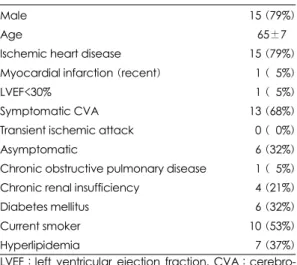
환자들의 임상 특징 및 동반된 내과적 질환은 Table 1에 기술되어 있다. 대상환자들의 평균연령은 65±7세 였으며, 남자가 15(79%)였다. 6명(32%)의 환자는 무 증상이었으며, 총 19명의 환자 중 9명의 환자가 관상동 맥우회로술 전 경동맥 초음파검사에서 70% 이상의 내 경동맥협착이 발견되었다. NASCET eligibility criteria 에서 제외된 기준들이 Table 2에 기술되어 있다. 어떤
환자들은 제외기준이 하나 이상 있었으나 단 하나의 주 요 기준만 표시하였다. 13명(68%) 환자에서 치료받은 혈관 영역에 임상적으로 중요한 뇌졸중이 있었다. 이전 에 CEA를 시행받은 후 재협착이 발생한 예 및 경부방 사선 조사 후 경동맥협착이 발생한 예는 없었다.
Sundt 분류에 의한 CEA 위험도 분석에서 grade 4가 4명(21%)이었으며, grade 3가 15명(79%)이었다(Ta- ble 3).
모든 환자가 내과적 위험이 있었으며, 4명의 환자에서 방사선학적 위험인자가, 4명의 환자에서 신경학적 위험 이 있었다(Table 4).
16명에서 다혈관 관상동맥 질환이 동반되었으며, 불안 정성 협심증이 9명에서 있었다. 심한 심부전 환자가 1 명 있었다.
혈관조영술 결과 및 시술 방법
좌내경동맥 협착 병변이 11예(58%)였다. 시술 전 평 균협착은 90±6%였으며, 시술 후 8±5%로 감소하였다.
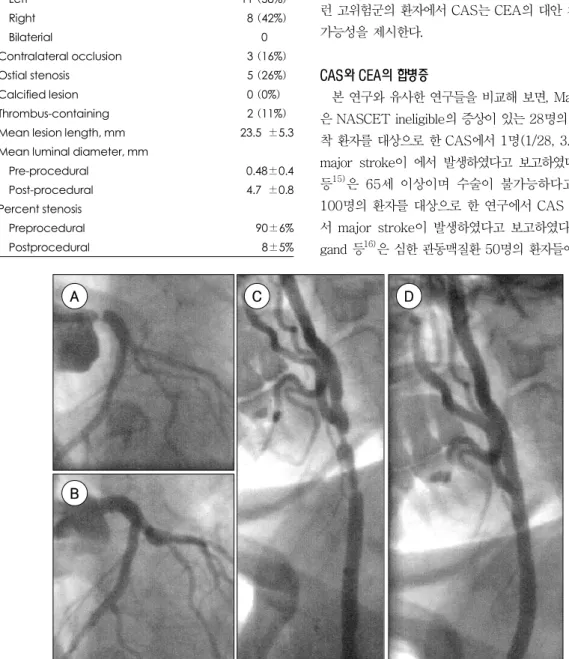
Plaque의 형태학적 특성은 다음과 같았다(Table 5). 궤 양성이거나 불규칙적인 plaque이 9명(47%)에서, tan- dem lesion이 3명(16%)에서 관찰되었다. 8명(42%) 에서 50% 이상의 편측 내경동맥 협착이 관찰되었으며 3명(16%)은 완전폐색이었다. 편측내경동맥의 평균협착 은 53±26%였다. 6명(32%)의 환자에서 척추동맥의 50%이상의 협착이 관찰되었다. 4명(21%)의 환자에서 심한 두개내 죽상경화가 관찰되었다.
Fig. 1은 심한 좌주관부 협착증 및 우측내경동맥의 협 착이 있었던 60세 여환에서 좌주간부 및 내경동맥 스텐 트시술을 one stage로 시행한 예이다. Self expanda- ble wall stent가 17명, Smart stent가 2명에서 사용되 었다. 1명의 환자에서 self expandable stent deploy 후 풍선확장술 시행 중 stent migration이 발생하여 추 가 stent를 사용하였다.
17명의 환자에서 stent interstice의 appostiton을 좋 Table 1. Baseline clinical and demographic characte-
ristics
Male 15 (79%)
Age 65±7 Ischemic heart disease 15 (79%) Myocardial infarction (recent) 01 (05%)
LVEF<30% 01 (05%)
Symptomatic CVA 13 (68%)
Transient ischemic attack 00 (00%)
Asymptomatic 06 (32%)
Chronic obstructive pulmonary disease 01 (05%) Chronic renal insufficiency 04 (21%)
Diabetes mellitus 06 (32%)
Current smoker 10 (53%)
Hyperlipidemia 07 (37%)
LVEF:left ventricular ejection fraction, CVA:cerebro- vascular accident
Table 2. Conditions leading to exclusion of patients from NASCET eligibility
NASCET ineligibility criteria
Intracranial atherosclerosis worse than
cervical lesion 2 (11%)
Unstable neuroligc examination 4 (21%) Unstable congestive heart failure 1 (05%)
Unstable angina 9 (74%)
End-stage renal disease 2 (11%) NASCET:north American carotid endarterectomy trial Table 3. Sundt criteria6)
Grade Risk factors Risk
I Neurologically stable; no medical* or angiographic risks†;with unilateral or bilateral ulcerative-
stenotic carotid disease <1%
II Neurologically stable;no medical risks, but with angiographic risks (contralateral ICA occlusion
most common) 1.8%
III Neurologically stable;medical risks, with and without angiographic risks 4%
IV Neurologically unstable‡, with or without medical or angiographic risks 8.5%
*:medical risks;angina, myocardial infarction within 6 months, congestive heart failure, severe hypertension (>180/
110 mmHg), chronic obstructive pulmonary disease, age greater than 70 years, and severe obesity. †:angiographic risks;contralateral internal carotid artery (ICA) occlusion, ipsilateral ICA siphon stenosis, ICA plaque extending more than 3 cm distal to the carotid bifurcation, common carotid artery (CCA) plaque extending more than 5 cm pro- ximal to the carotid bifurcation, and intraluminal thrombus propagating from a carotid ulcerative lesions. ‡:neu- rologic risks;progressive deficit, resolved neurologic deficit less than 24 hours pre CEA, global cerebral ischemia, recent stroke less than 7 days preoperative, deficits from multiple previous strokes, and crescendo (frequent and uncontrolled by anticoagulation) transient ischemic attacks (TIAs). CEA:carotid endarterectomy.
게 하기 위하여 고압 풍선확장술을 시행하였다.
1명의 환자에서 관동맥재개통술과 경동맥 스텐트시술 을 동시에 시행하였고(Fig. 1), 양측 경동맥스텐트 시술 이나 척추동맥 및 경동맥 스텐트시술을 동시에 받은 환 자는 없었다.
3명의 환자에서 distal protective device(Percu- Surge®)를 사용하였다. Glycoprotein IIb/IIIa inhibitor 를 사용한 예는 없었다.
합병증
시술 직후에 사망한 예는 없었다. Major stroke이 1 명에서 발생하였으며, 한 명에서 minor stroke이 발생
하였다. 일과성허혈성발작은 한예에서도 발생하지 않 았다.
재원 중 합병증으로 서혜부 혈종이 한예에서 발생하였 고 단순압박으로 치료하였다. 심근허혈, 심근경색, 심부 전의 악화는 한예에서도 관찰되지 않았다. 한예에서 급 성신부전이 발생하였으나, 보전적 치료 후 호전되었다.
임상경과
모든 환자에서 임상추적관찰을 시행하였으며, 평균추 적관찰 기간은 6.2±4.6개월이었다. 추적관찰기간 한명 이 CAS 시술 3.5개월 후에 뇌출혈로 사망하였다. 생존 하는 18명의 환자 중 새로운 뇌허혈의 증상, 뇌졸중이 발 Table 4. NASCET ineligible criteria and cardiac risk factor in individual patient
Case No. Age Sex Sundt
grade Angiographic risk Neurologic
risk Nascet ineligible criteria Cardiac high risk factors
01 70 Male 3 Unstable angina Unstable angina
02 51 Male 3 Contralateral
carotid occlusion End-stage renal disease None
03 60 Female 3 None Left main coronary
artery disease 04 68 Male 3 Intracranial atherosclerosis Triple vessel disease
05 61 Male 3 Unstable angina Unstable angina
06 67 Male 4
Contralateral carotid occlusion, intraluminal thrombus
Progressive deficit
Lung ca, unstable
neurologic status Triple vessel disease
07 61 Male 4 Progressive
deficit Unstable neurologic status Triple vessel disease
08 65 Male 3 Unstable angina Unstable angina
09 60 Female 3 Unstable angina Unstable angina
10 75 Male 4 Contralateral carotid occlusion
Progressive
deficit Unstable neurologic status None
11 82 Male 3 Age>80, end-stage renal
disease None
12 71 Male 3
Chronic renal failure, intracranial atheroclerosis, history of carotid endarterectomy
None
13 55 Male 3 Unstable angina Unstable angina
14 74 Male 3 None Triple vessel disease
15 74 Male 3 Unstable angina, chronic
renal failure Unstable angina 16 65 Female 3 Intraluminal
thrombus Congestive heart failure Congestive heart failure
17 58 Male 4 Progressive
deficit
Unstable angina, unstable
neurologic status Unstable angina
18 61 Male 3 Unstable angina Unstable angina
19 64 Female 3 Unstable angina Unstable angina
NASCET:north American carotid endarterectomy trial
생하는 예는 없었다.
4명에서 추적 경동맥초음파검사를 시행하였으며 스 텐트내 재협착은 없었다.
고 찰
본 연구에서 CAS는 고위험군 환자에서 비교적 안전 하며, 효과적인 치료법임을 알 수 있었다. 뇌졸중이 19 명 중 2명(11%)에서 발생하였으나, 대부분의 환자가 NASCET ineligible이거나 고위험군임을 감안하면, 이 런 고위험군의 환자에서 CAS는 CEA의 대안 치료가 될 가능성을 제시한다.
CAS와 CEA의 합병증
본 연구와 유사한 연구들을 비교해 보면, Malek 등14) 은 NASCET ineligible의 증상이 있는 28명의 경동맥협 착 환자를 대상으로 한 CAS에서 1명(1/28, 3.6%)에서 major stroke이 에서 발생하였다고 보고하였다. Gupta 등15)은 65세 이상이며 수술이 불가능하다고 판단된 100명의 환자를 대상으로 한 연구에서 CAS 후 1명에 서 major stroke이 발생하였다고 보고하였다.15) Wai- gand 등16)은 심한 관동맥질환 50명의 환자들에서 CAS Table 5. Angiographic characteristics
Carotid stenosis
Left 11 (58%)
Right 08 (42%)
Bilaterial 0 Contralateral occlusion 03 (16%)
Ostial stenosis 05 (26%)
Calcified lesion 00 (0%)0
Thrombus-containing 02 (11%)
Mean lesion length, mm 23.50±5.3 Mean luminal diameter, mm
Pre-procedural 00.48±0.4
Post-procedural 04.70±0.8
Percent stenosis
Preprocedural 90±6%
Postprocedural 8±5%
Fig. 1. Stenting of severe left main coronary artery and right internal carotid atery at one-stage in a 60-year-old wo- man who refused CABG and CEA. A:left coronary angiogram shows tight stenosis at the ostium of left main coro- nary artery. B:final angiogram shows no residual stenosis after stenting. C:carotid angiogram shows tandem tight stenosis from right common carotid to internal carotid artery. D:final angiogram shows no residual stenosis after stenting. CABG:coronary artery bypass surgery, CEA:carotid endarterectomy.
A
B
C D
후 TIA 3예, minor와 major stroke 각각 1예가 발생 하였음을 보고하였다(5/50,10%).
본 연구 및 이와 유사한 연구들의 결과는 CEA의 합 병증 발생율과 비교하여 뇌졸중 발생율에서 유사하다고 할 수 있다. 또한 본 연구의 뇌졸중 발생율 11%는 Eu- ropean Carotid Surgery Trial의 7.5%, North Ame- rican Carotid Endarterectomy Trial(NASCET)의 5.8%, Asymptomatic Carotid Endarterectomy Study 의 2.3%에 비하여 높으나, 환자가 고위험군임을 감안 하면, 아주 높은 것은 아니라고 사료된다. CAS 직후 뇌 졸중은 1~6.6%에서 발생한다고 보고되고 있다.14-19) 미국심장학회의 경동맥내막절제술의 권고에서 일과성허 혈성발작이 있었던 환자에서 위험도가 6% 미만, 그리고 증상있는 뇌졸중의 경우 위험도가 7% 미만이면 수용할 만한 위험도로 보고있으므로, 고위험군에서의 CAS 시 술결과는 CEA만큼 안전하다고 할 수 있다.20)
CAS 후 뇌졸중을 예측할 수 있는 인자로 고령의 나 이와 길거나 다발성 협착이 보고되고 있다.19)21) 또다른 연구에서는 뇌졸중 예측할 수 있는 임상적 또는 혈관조 영적 인자는 없다고도 보고되고 있다.18)
CAS의 가장 흔한 합병증은 debris 또는 혈전의 dis- tal embolization이며, 이 합병증을 막기 위해서 embo- lic protection devices이 사용되고 있다.22) 본 연구에 서는 3명의 환자에서 distal protection device를 사용 하였으며, 고위험군 환자에서 distal protection device 를 사용하였을 때 3~5%의 낮은 신경학적 합병증 발생 율이 보고되어 있다.23)24) 고위험 경동맥 협착 환자군에 서 distal protection device의 사용이 신경학적 합병증 을 감소시킬 수 있다고 보고되고 있다.25)
관동맥 질환이 동반된 환자에서의 치료
대부분의 환자에서 심한 관동맥질환이 있었으나 시술 과 연관된 합병증이 없었던 것은 경피적 접근법이 수술 보다 덜 침습적이고 국소마취하에 시술이 시행된 것과 연 관이 있을 것으로 사료된다. NASCET trial에서 CEA 후 심혈관 합병증이 8.1%에서 발생하며 심근경색은 1%
에서 합병된다고 보고하였으나,26) 또다른 연구에서는 CEA 후 심근경색 발생율을 9.1%까지 보고하고 있다.4) 최근 CEA는 이전보다 우수한 성적으로 보고되고 있다.
Lepore 등27)은 348명을 대상으로 시행한 CEA을 분석 하였고, NASCET/ACAS ineligible criteria가 있는
169명(46%)의 수술 후 뇌졸중발생율 및 사망율이 NA- SCET/ACAS eligible 환자와 비교하여 차이가 없다고 보고한 바 있다. Jordan 등28)은 389명의 환자들을 대 상으로 시행한 415건의 CEA 중 고위험군과 저위험군간 의 시술 후 뇌졸중 발생이나 사망률에서 차이가 없었으 며, 고위험군에서의 심장이환율이 3.1%로 저위험군의 1%에 비해 높았으나 통계적으로 유의한 차이가 없다 고 보고하였다. 두 연구 모두 고위험군에서 CEA를 시 행하더라도 뇌졸중 및 사망률이 높지 않다고 보고하였 으나, 한 연구에서 심장합병증이 높은 경향을 보인 것은 주목할 만하다. 반면 고위험군의 환자를 대상으로 한 CAS 후 심장합병증은 0~7.1%로 비교적 낮게 보고되 고 있다.14-17) 심한 심장장애가 있는 군에서 CEA 후 심 장합병증 발생빈도가 높고, CAS와 연관되어서는 낮은 발새율을 보인 것은 심한 심장장애가 있는 경동맥협착환 자에서의 치료방침 결정에 큰 영향을 미칠 것으로 사료 된다. 또한 수술에 의한 합병증(혈종, 재수술, 뇌신경마 비)도 간과해서는 안될 것으로 사료된다.
또한 관동맥우회로술을 시행 예정인 환자에서 심한 경 동맥 협착이 발견되는 경우가 있으며, CEA를 먼저 시 행한 후 관동맥우회로술을 시행하는 경우와 그 반대의 경우가 있으며, 관동맥우회로술과 CEA를 동시에 시행 한 보고도 있다.29)30) 본 연구에서 관동맥우회로술 예정 인 9명의 환자가 CAS를 시행받은 후, 수술을 거부한 1 명을 제외한 8명이 뇌졸중 없이 관동맥우회로술을 받을 수 있었다. 이는 심한 경동맥협착이 동반된 관동맥우회 로술 예정인 환자에서 CAS가 심근허혈 및 심근경색 없 이 안전하게 시행될 수 있고, 관동맥우회로술과 연관된 뇌졸중을 예방할 수 있을 가능성을 시사한다.
수술방법의 향상, 수술 전후의 마취기법의 향상에 힘 입어 고위험군에서의 CEA의 임상결과가 호전되고 있 다. 따라서 수술적으로 접근이 불가능하지 않고 고위험 군의 심한 경동맥협착 환자를 대상으로 한 CAS와 CEA 의 무작위대조군 연구를 시행하여 각 치료방법의 우수성 및 장단점을 비교하여야 할 것이다.
본 연구의 제한점으로 첫번째, 한 센터의 경험이 많은 중재시술 전문가의 임상결과이므로 경험이 풍부하지 않 은 의료진에서 동일한 결과가 나올 지는 미지수이다. 하 지만 경험이 많은 시술자가 CAS를 시행하고 경동맥중 재술에 사용되는 device가 좀더 개발되고 발전되면 임 상 결과가 더 향상될 것으로 예상된다. 두번째, 일부의
환자에서만 추적 경동맥 영상검사가 시행되어서 재협착 을 정확히 평가할 수는 없었으나, 이는 더 많은 환자를 대상으로 하여 장기간의 연구가 필요하다고 사료된다.
심한 관동맥질환을 포함한 심각한 내과적 질환이 동 반되어 있거나, 신경학적으로 불안정한 심한 경동맥협착 환자의 치료에서 경험이 많은 시술자가 시행하는 CAS 를 고려해 볼 수 있을 것으로 사료된다.
요 약
배경 및 목적:
경동맥내막절제술(CEA)은 증상이 있는 심한 경동맥 협착 환자에서 뇌졸중 발생위험을 감소시킬 수 있다. 하 지만 많은 환자들이 심한 동반질환, 혈관조영소견 및 신 경학적 이유로 CEA를 시행받지 못한다. 경동맥스텐트 시술(CAS)는 저위험군의 환자에서 CEA와 유사한 성적 을 얻을 수 있다고 알려져 있다. 본 연구에서는 수술 전 후의 이환율 및 사망률이 높은 고위험군 환자에서 CAS 의 안전성 및 초기 임상결과에 대하여 알아보고자 하였다.
방 법:
2001년 3월부터 2002년 9월까지 서울아산병원 심 장내과에서 CAS를 시행받은 23명 중 고위험군 19명(남 자 14명, 평균연령 66(8세)을 후향적으로 분석하였다.
결 과:
19명 중 18명이 NASCET ineligible criteria(불안정 성 협심증 9명, 심한 심부전 1명, ESRD 2명, intracra- nial atherosclerosis 2명, unstable neurologic exami- nation 4명)에 해당하였으며, 15명의 환자가 고위험군 의 심장질환(불안정성 협심증 9명, 심한 심부전 1명, 심 한 다혈관 질환 및 좌주간부 관상동맥질환 5명)이 있었 다. 13명이 뇌졸중의 병력이 있었으며, Sundt cirteria 에 의한 수술위험도는 grade 3이 15명, grade 4가 4명 이었다. 좌내경동맥 협착 11병변, 우내경동맥 협착 8병 변에 시술을 시행하였으며, 시술은 100%에서 성공적이 었다. 평균 협착정도는 90±6%에서 시술 후 8±5%로 감소하였다. 시술 중 사망은 없었으며, major 및 minor stroke이 1예씩 발생하였다. 입원 중 합병증으로 급성 신부전 1예, 혈종 1예 있었으나 심근허혈, 심근경색, 심 부전 악화는 없었다. 추적관찰 중 시술 3.5개월 후 1명 이 뇌출혈로 사망하였다. 생존하는 다른 환자들에서 뇌 졸중의 재발은 없었다.
결 론:
고위험군의 증상이 있는 심한 경동맥 협착 환자에서 CAS는 비교적 안전하고 효과적인 치료로 사료된다.
중심 단어:Carotid artery disease;Stents;Risk.
REFERENCES
1) North American Symptomatic Carotid Endartectomy Trial Collaborators. Beneficial effect of carotid endarterectomy in symptomatic patients with high-grade carotid stenosis. N Engl J Med 1991;325:445-53.
2) European Carotid Surgery Trialists’ Collabolator Group.
European Carotid Surgery Trial: interim results for symp- tomatic patients with severe (70-99%) or with mild (0- 29%) carotid stenosis. Lancet 1991;337:1235-43.
3) Executive Committee for the Asymptomatic Carotid Athe- rosclerosis Study. Endarterectomy for asymptomatic carotid artery stenosis. JAMA 1995;273:1421-8.
4) Ouriel K, Hertzer NR, Beven EG, O’Hara PJ, Krajewski LP, Clair DG, Greenberg RK, Sarac TP, Olin JW, Yadav JS.
Preprocedural risk stratification: identifying an appropriate population for carotid stenting. J Vasc Surg 2001;33:728-32.
5) McCrory DC, Goldstein LB, Samsa GP, Oddone EZ, Lands- man PB, Moore WS, Matchar DB. Predicting complications of carotid endarterectomy. Stroke 1993;24:1285-91.
6) Sundt TM, Sandok BA, Whisnant JP. Carotid endarterec- tomy: complications and preoperative assessment of risk.
Mayo Clin Proc 1975;50:301-6.
7) Gorelick PB. Carotid endarterectomy: where do we draw the line? Stroke 1999;30:1745-50.
8) Rothwell PM, Warlow CP. Prediction of benefit from caro- tid endarterectomy in individual patients: a risk-modelling study. Lancet 1999;353:2105-10.
9) Shawl FA, Efstratiou A, Hoff S, Dougherty K. Combined percutaneous carotid stenting and coronary angioplasty during acute ischemic neurologic and coronary syndromes.
Am J Cardiol 1996;77:1109-12.
10) Yadav JS, Roubin GS, King P, Iyer S, Vitek J. Angioplasty and stenting for restenosis after carotid endarterectomy:
initial experience. Stroke 1996;27:2075-9.
11) Yadav JS, Roubin GS, Iyer S, Vitek J, King P, Jordan WD, Fisher WS. Elective stenting of the extracranial carotid ar- teries. Circulation 1997;95:376-81.
12) Shim WH, Hong BK, Choi DH, Kim SH, Kim DI, Kim SM, Lee DY, Chang BC. Early results of carotid artery stenting.
Korean Circ J 1998;28:27-36.
13) Carotid and vertebral Artery Transluminal Angioplasty Study.
Endovascular versus surgical treatment in patients with ca- rotid stenosis in the Carotid and Vertebral Artery Translu- minal Angioplasty Study: a randomised trial. Lancet 2001;
357:1729-37.
14) Malek AM, Higashida RT, Phatouros CC, Lempert TE, Meyers PM, Smith WS, Dowd CF, Halbach VV. Stent an- gioplasty for cervical carotid artery stenosis in high-risk symptomatic NASCET-ineligible patients. Stroke 2000;31:
3029-33.
15) Gupta A, Bhatia A, Ahuja A, Shalev Y, Bajwa T. Carotid stenting in patients older than 65 years with inoperable
carotid artery disease: a single-center experience. Catheter Cardiovasc Interv 2000;50:1-8.
16) Waigand J, Gross CM, Uhlich F, Kramer J, Tamaschke C, Vogel P, Luft FC, Dietz R. Elective stenting of carotid artery stenosis in patients with severe coronary artery disease. Eur Heart J 1998;19:1365-70.
17) Shawl F, Kadro W, Domanski MJ, Lapetina FL, Iqbal AA, Dougherty KG, Weisher DD, Marquez JF, Shahab ST. Sa- fety and efficacy of elective carotid artery stenting in high- risk patients. J Am Coll Cardiol 2000;35:1721-8.
18) Stankovic G, Liistro F, Moshiri S, Briguori C, Corvaja N, Gimelli G, Chieffo A, Montorfano M, Finci L, Spanos V, di Mario C, Colombo A. Carotid artery stenting in the first 100 consecutive patients: results and follow up. Heart 2002;
88:381-6.
19) Roubin GS, New G, Iyer SS, Vitek JJ, al-Mubarak N, Liu MW, Yadav J, Gomez C, Kuntz RE. Immediate and late clinical outcomes of carotid artery stenting in patients with symptomatic and asymptomatic carotid artery stenosis: a 5- year prospective analysis. Circulation 2001;103:532-7.
20) Biller J, Feinberg WM, Castaldo JE, Whittemore AD, Har- baugh RE, Dempsey RJ, Caplan LR, Kresowik TF, Matchar DB, Toole JF, Easton JD, Adams HP Jr, Brass LM, Hobson RW 2nd, Brott TG, Sternau L. Guidelines for carotid en- darterectomy: a statement for healthcare professionals from a Special Writing Group of the Stroke Council, American Heart Association. Circulation 1998;97:501-9.
21) Mathur A, Roubin GS, Iyer SS, Piamsonboon C, Liu MW, Gomez CR, Yadav JS, Chastain HD, Fox LM, Dean LS, Vitek JJ. Predictors of stroke complicating carotid artery stenting. Circulation 1998;97:1239-45.
22) Wholey MH, Wholey M. Current status in cervical carotid artery stent placement. J Cardiovasc Surg 2003;44:331-9.
23) Mudra H, Ziegler M, Haufe MC, Hug M, Knape A, Meurer A, Pitzl H, Buchele W, Spes C. Percutaneous carotid an- gioplasty with stent implantation and protection device against embolism: a prospective study of 100 consecutive cases. Dtsch Med Wochenschr 2003;128:790-6.
24) Ohki T, Veith FJ, Grenell S, Lipsitz EC, Gargiulo N, McKay J, Valladares J, Suggs WD, Kazmi M. Initial experience with cerebral protection devices to prevent embolization during carotid artery stenting. J Vasc Surg 2002;36:1175-85.
25) Yadav JS. Stenting and angioplasty with protection in pa- tients at high risk for endarectomy (The SAPPHIRE study).
AHA Scientific Session;2002 Nov 19.
26) Paciaroni M, Eliasziw M, Kappelle LJ, Finan JW, Ferguson GG, Barnett HJ. Medical complications associated with ca- rotid endarterectomy. Stroke 1999;30:1759-63.
27) Lepore MR Jr, Sternbergh WC 3rd, Salartash K, Tonnessen B, Money SR. Influence of NASCET/ACAS trial eligibility on outcome after carotid endarterectomy. J Vasc Surg 2001;
34:581-6.
28) Jordan WD Jr, Alcocer F, Wirthlin DJ, Fisher WS, Warren JA, McDowell HA Jr, Whitley WD. High-risk carotid en- darterectomy: challenges for carotid stent protocols. J Vasc Surg 2002;35:16-21.
29) Plestis KA, Ke S, Jiang ZD, Howell JF. Combined carotid endarterectomy and coronary artery bypass: immediate and long-term results. Ann Vasc Surg 1999;13:84-92.
30) Evagelopoulos N, Trenz MT, Beckmann A, Krian A. Simul- taneous carotid endarterectomy and coronary artery bypass grafting in 313 patients. Cardiovasc Surg 2000;8:31-40.