228
Initial Experience of Retrograde Wire Approach in Coronary Chronic Total Occlusion Intervention
Suk Hwan Chung, MD, Moo Hyun Kim, MD, Long Hao Yu, MD, Jong Sung Park, MD, Kyung Ho Kim, MD, Dong Sung Kum, MD, Tae Ho Park, MD, Kwang Soo Cha, MD and Young Dae Kim, MD
Department of Internal Medicine, College of Medicine, Dong-A University, Busan, Korea ABSTRACT
Background and Objectives: Retrograde wire approach has been emerged as a useful tool to enhance success rate in coronary chronic total occlusion (CTO) intervention. Therefore, we tried to report the initial experience of retrograde approach and its clinical implication on CTO intervention. Subjects and Methods: From February 2007 to July 2008, retrograde approaches were performed in 28 patients with 31 CTO lesions out of 61patients.
A hydrophilic coated guidewire was inserted by using microcatheter or over-the-wire (OTW) balloon through the collateral channel (septal or epicardial artery) via several strategies. Results: Mean age of patients was 63.4±
11.6 years. Male and female were 20 and 8 patients, respectively. The target artery with CTO lesions included the right coronary artery (45.2%), the left anterior descending artery (51.6%), and the left circumflex artery (3.2%).
The mean length of CTO lesion was 18.4±16.4 mm. Overall technical success rate was 64.5%. The success rate of primary attempt was 78.9%, while the success rate of immediate and secondary attempt was 41.7%. Collateral ch- annel dissections were observed in 3 patients and no patients among these patients developed cardiac tamponade.
One patient had a silent non-Q wave myocardial infarction (MI) after the procedure. One failed patient died suddenly 3 days after the procedure. After percutaneous coronary intervention (PCI) procedure, no case was performed target vessel revascularization (TVR), urgent coronary artery bypass graft (CABG), and urgent PCI.
Conclusion: Retrograde approach is an evolving technique to improve the success rate of CTO intervention.
After the learning curve period, this technique could be the useful tool to enhance success rate in CTO interven- tion. (Korean Circ J 2009;39:228-235)
KEY WORDS: Coronary occlusion; Collateral circulation.
Introduction
It has been known that successful recanalization of coronary chronic total occlusion (CTO) of coronary ar- teries can reduce the need for subsequent coronary ar- tery bypass surgery1) and also increase the long-term survival of CTO patients.2-4) Recently, the development of more effective techniques and devices increased pri- mary success rate of percutaneous coronary interven- tion (PCI) for CTO, but the rate is still lower than PCI for non-CTO lesions.
Retrograde approach is a novel technique of PCI for CTO. It has been shown that retrograde wire approach can enhance the procedural success rate of PCI in CTO
without increasing peri-procedural complication.5)6) The retrograde approach was first introduced by Kahn and Hartzler in 19907) and was used as a route through sa- phenous vein grafts for coronary angioplasty in 17 pa- tients with prior coronary bypass surgery. Recently, the technique of retrograde approach was developed and various strategies were pioneered by Japanese cardiolo- gists.8-11) Strategies of retrograde approach are distinctly different to the use of saphenous vein grafts which was described by Kahn and Hartzler7) because they selected more tiny septal or epicardial colleterals for retrograde approach. These tiny collateral networks as a route of retrograde approach permitted successful CTO recana- lization to perform coronary angioplasty immediately or secondly following unsuccessful antegrade attempt.
In Korea, the success rate of PCI for CTO lesions with conventional techniques is been improving lately as developing of devices and guidewires by experienced CTO-operators. However, the success rate is still not high up to 90%. Retrograde approach has been in-
Received: November 13, 2008 Accepted: February 18, 2009
Correspondence: Moo Hyun Kim, MD,Department of Internal Medicine, College of Medicine, Dong-A University, 3-1 Dongdaesin-dong, Seo- gu, Busan 602-715, Korea
Tel: 82-51-240-2976, Fax: 82-51-255-2177 E-mail: [email protected]
to describe our initial experiences, technical detail and complications.
Subjects and Methods
Patient populations
From February 2007 to July 2008, 28 patients out of 61 CTO patients were performed using retrograde wire approach with various strategies by highly experienced CTO operators. Very small distal artery sizes with poor visualization were excluded and informed consent was obtained from all patients.
Definitions
Coronary chronic total occlusion was defined as an obstruction of native coronary artery with no luminal continuity and with the thrombolysis in myocardial infarction (TIMI) flow grade 0. The duration of CTO had to be more than 3 months. The duration of occlu- sion was defined as the interval from previous coronary angiogram in patients with total occlusion or from the first onset of clinical symptoms suggesting the ischemic heart disease in patients without a previous angiogram.
Technical success was defined as restoration of ante- grade flow with TIMI flow grade 2 or 3 and residual ste- nosis of <30% by quantitative coronary angiography.
In-hospital major cardiac events were defined as death, myocardial infarction (MI), target vessel revasculariza- tion (TVR), urgent PCI, and urgent coronary artery by- pass graft (CABG). MI was defined as more than 3 fold increase of creatine kinase-MB (CK-MB) upper limits.
The attempt of the retrograde approach was defined as the introduction of a guidewire into the collateral ch- annels, which connecting with the target coronary ar- tery distal to the target CTO lesion. The occlusion leng- th was assessed from the beginning of the occlusion to distal antegrade or retrograde vessel filling from either bridging collaterals, non-target vessel collaterals or follow- ing simultaneous left and right coronary injection by quantitative coronary angiography (QCA).
Selection of variable strategies of retrograde approach
The first strategy was a primary attempt of retrograde approach. That is, if the operator feels that antegrade wire technique seems very difficult to penetrate CTO lesion in terms of anatomical factors (heavily calcified
cessful parallel wire technique and the anatomy of CTO lesion became more difficult to do further antegrade attempts, the retrograde approach was attempted im- mediately.
The third strategy was a second stage procedure in selected patients several months after conventional ante- grade approach failure. That is, if the patient had a he- avily calcified lesion or previous big dissections which were unable to penetrate donor occluded vessel despite one or more previous attempt of antegrade approach, the retrograde approach was attempted secondly.
Techniques of retrograde approach
Procedural preparation
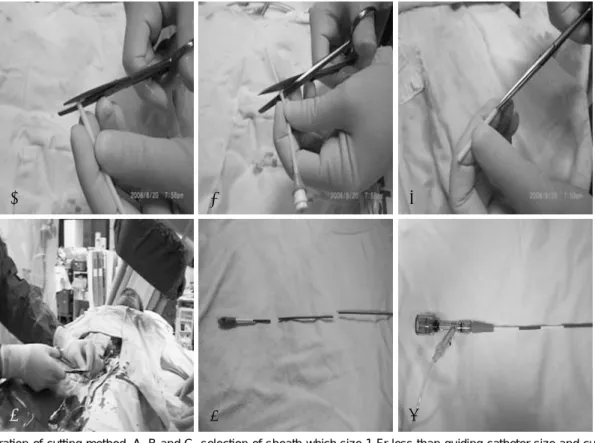
All patients were pretreated with aspirin and clopido- grel. Heparin was used to maintain an activated clot- ting time (ACT) more than 300 seconds. Also, additional heparin 2,000 or 3,000 units were injected every hour according to the ACT level. Both femoral punctures with 7-8 French (Fr) guiding catheter (GC) were used com- monly. In some cases, we performed radial or brachial route with femoral approach. Because of the long access route of retrograde approach from contralateral GC to CTO lesion, GC cutting method (usually 10-15 cm cut) was used for retrograde approach (Fig. 1).
Guide wire passage through collateral channels Guide wire (GW) passage through collateral channels means that the GW cross through collateral channel to reach the place distal to the donor CTO lesion follow- ing the procedures below:
A microcatheter was inserted into the target colla- teral artery with the aid of floppy GWs, and then the GW was exchanged to a hydrophilic floppy GW to cross through the collateral channel. The tip of hydrophilic GW was shaped as anatomy of collateral artery previ- ously, and then advanced along the route of collateral.
Following the hydrophilic GW into the collateral as far as possible, the microcatheter was advanced until the tip of the GW, and then the GW was pulled out. Oc- casionally, superselective contrast injections with small volume of dye were performed using a 2.5 cc rock syringe to visualize the collateral connection. The hydrophilic GW and the microcatheter were advanced alternatively to the target artery distal to the CTO lesion. After suc- cessful passage of hydrophilic GW into the target co-
ronary artery, the microcatheter was attempted to be passed into the target artery. When the microcatheter did not cross through, the microcatheter was exchanged with a 1.25 mm or 1.3 mm over-the-wire (OTW) bal- loon, and then dilatations of balloon at 2-4 atm in the collateral channel were performed to advance GW and OTW into the target artery distal to the CTO lesion.
After the microcatheter crossed through the collateral route to the distal cap of the CTO lesion, the retrograde GW was exchanged to a Miracle series GW to attempt penetration. If the distal cap was too hard for Miracle series GW, it was exchanged to a stiffer GW such as Conquest Pro 12.0 g.
Strategies of retrograde approach
The strategies of retrograde approach included mark wire (or landmark) technique, proximal kissing wire te- chnique, loop method (or pure retrograde wire crossing technique), and controlled antegade and retrograde sub- intimal tracking (CART) technique. Adjunctive strategies involved anchoring balloon technique and Tornus ca- theter assistant.
Mark wire (or landmark) technique
After successful crossing through collateral artery into the target artery distal to the CTO lesion, the retrograde GW which has not been attempted to penetrate the CTO lesion was just used as a landmark for antegrade
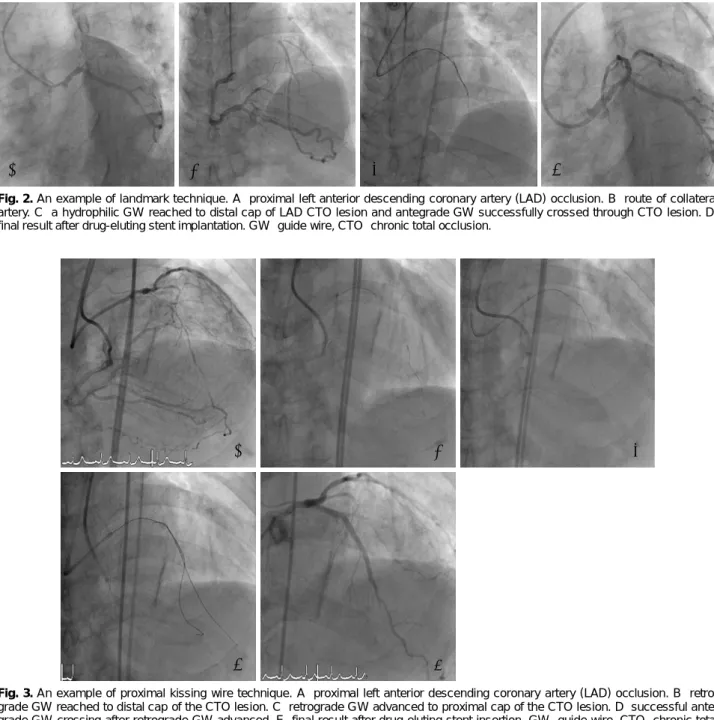
GW manipulation. This technique would reduce the amount of contrast dye used (Fig. 2).
Proximal kissing wire technique
On the hypothesis that the distal cap of CTO lesion is softer than the proximal cap of the CTO lesion, the retrograde GW could advance easily to the proximal part within the CTO lesion. If the tip of retrograde GW came near the proximal cap of the CTO lesion, an antegrade GW was attempted to penetrate the proximal cap, and finally, both GW could met within the true lumen, and then the antegrade GW crossed through the occluded lesion into the distal part of the target artery (Fig. 3).
Loop method
If the antegrade GW was hard to cross through the CTO lesion in the previous “proximal kissing wire te- chnique” or complex dissection was created due to bal- loon dilatation with reverse CART technique which us- ually made procedure of antegrade wiring difficult to cross through occluded site into the true lumen, we could consider the loop method (or so called “pure re- trograde wire crossing technique”). In this situation, a retrograde GW was introduced into the antegrade GC crossing through the CTO lesion, and then a microca- theter was advanced over this GW into the GC. If the MC could not be passed through GC, 2.5 mm balloon was inflated in the GC antegradely to anchor the GW
Fig. 1. Illustration of cutting method. A, B and C: selection of sheath which size 1 Fr less than guiding catheter size and cutting off the sheath about 4 cm length. D, E and F: guiding catheter was cut off 10-15 cm of catheter shaft proximal to sheath and two ends were connected with 4 cm sheath.
A B C
D E F
for advancing retrograde MC into the antegrade GC.
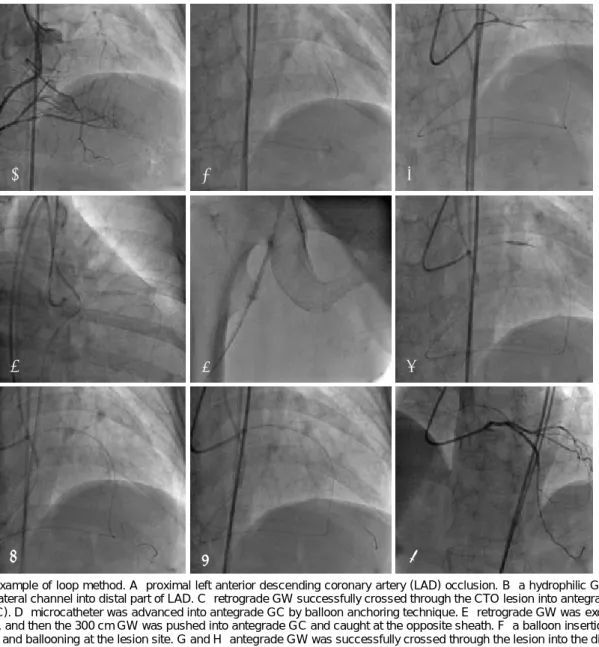
Once the retrograde MC passed through antegrade GC, the retraograde GW was exchanged mostly to Choice PT 300 cm GW (Boston Scientific, USA). By pushing the Choice PT 300 cm GW into antegrade guiding ca- theter through the microcatheter, the distal tip of the GW could be caught manually in the part of opposite sheath, and then a balloon was put into the CTO le- sion antegradely over the GW and inflated at the oc- cluded site. Thereafter, an antegrade GW could be in- serted easily into the distal true lumen of the target artery.
Following successful antegrade wiring, the Choice PT 300 cm GW was removed with microcatheter (Fig. 4).
Controlled antegrade and retrograde subintimal tracking technique
If both antegrade and retrograde GW could not been advanced successfully with previous strategies, the retro- grade GW was then inserted carefully into the subinti- mal space of the CTO lesion parallel with antegrade GW which also within the subintimal space of the same lesion. Thereafter, a balloon was put into the subinti- mal space of the lesion retrogradely over the retrograde GW and then dilated to make the target space for the antegrade GW access. The target space was distinctly connected with the distal true lumen, so that the tip of antegrade GW was back out and advanced forward the
Fig. 3. An example of proximal kissing wire technique. A: proximal left anterior descending coronary artery (LAD) occlusion. B: retro- grade GW reached to distal cap of the CTO lesion. C: retrograde GW advanced to proximal cap of the CTO lesion. D: successful ante- grade GW crossing after retrograde GW advanced. E: final result after drug-eluting stent insertion. GW: guide wire, CTO: chronic total occlusion.
A B C
D E
A B C D
Fig. 2. An example of landmark technique. A: proximal left anterior descending coronary artery (LAD) occlusion. B: route of collateral artery. C: a hydrophilic GW reached to distal cap of LAD CTO lesion and antegrade GW successfully crossed through CTO lesion. D:
final result after drug-eluting stent implantation. GW: guide wire, CTO: chronic total occlusion.
target space. It could be easily inserted into the distal true lumen (Fig. 5).
On the contrary, the balloon also was inserted an- tegradely into the subintimal space within the CTO le- sion and inflated in order to make the target space for retrograde GW penetration. It refers to Reverse CART technique.
Anchoring balloon technique
To reach strong backup support for antegrade guid- ing catheter, a second balloon with small size was in- serted and inflated in the side branch proximal to the CTO lesion. This could increase the penetration power of first balloon through the CTO lesion.
Tornus catheter assistance
If the lesion was too hard to cross with microcatheter and OTW, the Tornus catheter could be used.
Statistical analysis
Descriptive analyses were performed for the data. Con- tinuous data were presented as mean±SD and discrete variables were expressed as percentage.
Results
Baseline clinical characteristics
Mean age of patients was 63.4±11.6 years. Male and female were 20 (71.4%) and 8 (28.6%) patients, respec- tively. The cardiac risk factor involved diabetes mellitus, hypertension, hyperlipidemia, and smoking. The per- centage of risk factors was shown in Table 1. Six patients had prior MI history, 11 patients were underwent PCI previously, and no patients had prior CABG history.
Seven patients had left ventricular dysfunction with left ventricle ejection fraction (LVEF) less than 40%.
Eight, 12, and 8 patients had single-, double-, and tri-
Fig. 4. An example of loop method. A: proximal left anterior descending coronary artery (LAD) occlusion. B: a hydrophilic GW crossed through collateral channel into distal part of LAD. C: retrograde GW successfully crossed through the CTO lesion into antegrade guiding catheter (GC). D: microcatheter was advanced into antegrade GC by balloon anchoring technique. E: retrograde GW was exchanged to 300 cm GW, and then the 300 cm GW was pushed into antegrade GC and caught at the opposite sheath. F: a balloon insertion over the 300 cm GW and ballooning at the lesion site. G and H: antegrade GW was successfully crossed through the lesion into the distal part. I:
final result after ballooning and stent implantation. CTO: chronic total occlusion.
A B C
D E F
G H I
plevessel disease, respectively. Comparison of baseline characteristics between two methods of antegrade and retrograde approach in the same period was also appear- ed in Table 1.
Angiographic characteristics of the chronic total oc- clusion lesion
The target artery with CTO lesions included the right coronary artery (RCA, 45.2%), the left anterior des- cending artery (LAD, 51.6%), and the left circumflex artery (LCX, 3.2%). The target CTO lesion showed the blunted stump in 7 (22.5%), the tapered stump in 14 (45.2%), occluded at side branch in 10 (32.3%), and the bridging collateral in 4 (12.9%). The mean length of CTO lesion was 18.4±16.4 mm. Two patients had vi- sible calcification (moderate) and one patient had se- vere calcification in the CTO lesion. The mean fluoro- scopic time was 56.7±25.9 minutes and the average amount of contrast dye used was 342.9 ±71.1 mL. An- giographic characteristics of the patients with retrograde approach revealed no difference compared with that in the patients with antegrade approach which was per- formed in the same period (Table 2).
Strategies and procedural characteristics Primary, immediate, and secondary attempt of retro- grade approach were performed in 19, 8, and 4 CTO lesions, respectively. Overall technical success rate was 64.5% (n=20). The success rate of primary attempt was 78.9% (n=15), while the success rate of immediate and secondary attempt was 41.7% (n=5).
Septal artery in 28 CTO lesions and epicardial ar- tery in 3 CTO lesions were chosen as a collateral chan-
Table 1. Baseline clinical characteristics of the patients Variables
Retrograde approach
(n=28)
Antegrade approach (n=33)
p
Age (yrs) 63.4±11.6 64.5±11.2 0.36
Male/Female (n) 20/8 24/9 0.91
Risk factor, n (%)
Diabetes mellitus 09 (32.1) 14 (42.4) 0.409 Hypertension 16 (57.1) 19 (57.6) 0.973 Hyperlipidemia 06 (21.4) 08 (24.2) 0.795 Smoking 06 (21.4) 09 (27.3) 0.597 Prior MI, n (%) 06 (21.4) 06 (18.2) 0.751 Prior PCI, n (%) 11 (39.2) 15 (45.5) 0.627
Prior CABG, n (%) 0 0
LVEF <40%, n (%) 7 (25) 09 (27.3) 0.841 No. of vessel disease,
n (%)
0.398
1 08 (28.5) 07 (21.2)
2 12 (42.8) 11 (33.3)
3 08 (28.5) 15 (45.5)
MI: myocardial infarction, PCI: percutaneous coronary interven- tion, CABG: coronary artery bypass graft, LVEF: left ventricular ejection fraction, VD: vessel disease
Fig. 5. An example of CART technique. A and B: unsuccessful parallel wire technique was done antegradely. C and D: successful re- trograde GW was crossed through the septal collateral channel and put into subintimal space of the CTO lesion. E: ballooning in the subintimal space of the CTO lesion retrogradely. F: antegrade GW was advanced successfully into distal true lumen crossing the target space of CTO leion. G: insertion of drug-eluting stent. H: image after stent insertion. CART: controlled antegade and retrograde sub- intimal tracking, GW: guide wire, CTO: chronic total occlusion.
A B C D
E F G H
nel of retrograde approach. Successful passage of retro- grade approach which reached to the distal cap of CTO lesion was done in 25 patients (80.6%), and retrograde GW was successfully crossed through CTO lesions in 20 patients. The mark wire technique, proximal kissing wire technique, loop method, and CART technique were performed in 5, 14, 5, and 1 patient, respectively (Table 3). During the later phase (n=16), the success rate of retrograde approach increased dramatically after learn- ing period (n=15) (40% vs. 88%).
Complications and in-hospital major adverse car- diac event
Collateral channel dissections during the procedures
were observed in 3 patients and no patient among these patients developed cardiac tamponade. The reasons of dissections were GW tip induced in 2 patients and 300 cm bare wire removal without microcatheter in one patient. One of these patients had a silent non-Q wave MI after the procedure possibly due to dissection or spasm of the septal channel. After PCI procedure, no case was performed TVR, urgent CABG, and urgent PCI. One patient with unstable angina died suddenly 3 days after the failure of the second attempt of the PCI procedure for CTO lesion of LAD. A week ago, two drug eluting stents were inserted at totally occlud- ed mid right coronary artery in this patient.
Discussion
This study included our initial experience of retro- grade approach in the CTO lesions. The success rate (78.9%) of combined attempt of retrograde and ante- grade approach or pure retrograde approach is not higher than that of purely antegrade approach which was per- formed in the same period (84.8%). The reasons of lo- wer success rate in retrograde approach seem to be due to difficult lesion morphology, previous failed CTO lesions, and learning curve of the procedure.
Saito et al.5) previously explained the reasons why re- trograde approach work even after previous antegrade approach failed. First reason, previous failed attempts of antegrade approach induce intimal dissection, and as a result the anatomy becomes more difficult on future occasions for further antegrade attempts. Second, the distal cap of the CTO lesion is hypothesized to be sof- ter than the proximal cap. Third, the entry point into the CTO lesions, which is inferred from the angiogra-
Table 2. Angiographic characteristics of the patients
Variables Retrograde approagh (n=31) Antegrade approach (n=33) p
Lesion site, n (%) 0.91
LAD 16 (51.6) 13 (39.4)
RCA 14 (45.2) 13 (39.4)
LCX 1 (3.2) 07 (21.2)
Stump morphology, n (%) 0.148
Blunted stump 07 (22.5) 2 (6.1)
Tapered stump 14 (45.2) 20 (60.6)
Occluded at side branch 10 (32.3) 11 (33.3)
Bridging collateral present 04 (12.9) 3 (9.1) 0.625
Calcification (%) 0.087
None to mild 28 (90.3) 23 (69.7)
Moderate 2 (6.5) 09 (27.3)
Severe 1 (3.2) 1 (3.0)
Lesion length of CTO (mm) 18.4±16.4 14.3±10.7 0.058
Fluoroscopy time (min) 56.7±25.9 51.3±22.9 0.43
Amount of contrast dye (mL) 342.9±71.1 34.3.3±135.5 0.577
LAD: left anterior descending coronary artery, RCA: right coronary artery, LCX: left circumflex artery, CTO: chronic total occlusion
Table 3. Strategies and procedural characteristics of retrograde approach
Variables Value (n=31)
Strategies of RA, n (%)
Primary attempt 19 (61.3)
Immediate attempt 08 (25.8)
Second attempt 04 (12.9)
Techniques used, n (%)
Mark wire technique 05 (16.1)
Proximal kissing wire technique 14 (45.2)
Loop method 05 (16.1)
CART technique 1 (3.2)
Collateral channel, n (%)
Septal artery 28 (90.3)
Epicardial artery 3 (9.7)
Successful passage of RA 25 (80.6)
Success rate of RA 20 (64.5)
RA: retrograde approach, CART: controlled antegrade and retro- grade subintimal tracking
because our technology was in evolving state. Also, we performed CART technique only in one case because of it needed more advanced technical experiences and devices. Several group also reported that the retrograde approach can help to achieve successful recanalization of CTO lesion in the patients with failure of antegrade approach.5)6)12) Therefore, we considered retrograde appro- ach as another choice after failure of antegrade attempt.
During the procedure, three collateral channel dissec- tions were induced and no patient among these pa- tients developed cardiac tamponade. One patient had a silent non-Q wave MI possibly due to the septal ar- tery dissection or spasm of the septal channel after the procedure of retrograde approach. After PCI proce- dure, no case was performed TVR, urgent CABG, and urgent PCI. One patient died suddenly 3 days after the failed retrograde approach, who was previously implant- ed 2 overlapping drug eluting stents in the other vessel a week before the 2nd procedure. The cause of death is not yet clear, but possibly due to subacute stent thrombosis.
Although several groups9)10)12) reported that retrograde approach had no more increase of complication than conventional antegrade approach, retrograde approach actually is technically demanding and it includes some risk of donor vessel dissection or thrombosis and/or cardiac event during the procedure.13) Therefore, the operator should concern about the anticoagulation and donor vessel status, such as spasm or dissection. Also, prolonged nitrate infusion with anticoagulation is ne- cessary, even after the procedure.
In conclusion, retrograde approach could increase the success rate of PCI after antegrade approach failed and would become a useful tool of the recanalization of CTO lesions, but further experience and technical develop- ment are needed.
Acknowledgments
The present work was supported in part by research grants from Dong-A University Medical Center.
long-term survival among patients undergoing percutaneous co- ronary intervention of a chronic total occlusion in native coro- nary arteries: a 20-year experience. J Am Coll Cardiol 2001;38:
409-14.
4) Nakamura S, Bae JH. Recent progress of the use of interven- tional therapy for chronic total occlusion. Korean Circ J 2008;
38:295-300.
5) Saito S. Different strategies of retrograde approach in coronary angioplasty for chronic total occlusion. Catheter Cardiovasc In- terv 2008;71:8-19.
6) Sianos G, Barlis P, Mario CD, et al. European experience with the retrograde approach for the recanalisation of coronary ar- tery chronic total occlusion: a report on behalf of the EuroCTO club. Eurointervention 2008;4:84-92.
7) Kahn JK, Hartzler GO. Retrogade coronary angioplasty of iso- lated arterial segments through saphenous vein bypass grafts.
Cathet Cardiovasc Diagn 1990;20:88-93.
8) Ozawa N. A new understanding of chronic total occlusion from a novel PCI technique that involves a retrograde approach to the right coronary artery via a septal branch and passing of the gruidewire to a guiding catheter on the other side of the lesion.
Catheter Cardiovasc Interv 2006;68:907-13.
9) Surmely JF, Katoh O, Tsuchikane E, Nasu K, Suzuki T. Coro- nary septal collaterals as an access for the retrograde approach in the percutaneous treatment of coronary total occlusions. Ca- theter Cardiovasc Interv 2007;69:826-32.
10) Surmely JF, Tsuchikane E, Katoh O, et al. New concept for CTO recanalization using controlled antegrade and retrograde sub- intimal tracking: the CART technique. J Invasive Cardiol 2006;
18:334-8.
11) Matsumi J, Saito S. Progress in the retrograde approach for ch- ronic total coronary artery occlusion: a case with successful an- gioplasty using CART and reverse-anchoring techniques 3 years after failed PCI via a retrograde approach. Catheter Cardiovasc Interv 2008;71:810-4.
12) Biondi-Zoccai GG, Bollati M, Moretti C, et al. Retrograde per- cutaneous recanalization of coronary chronic total occlusions:
outcomes from 17 patients. Int J Cardiol 2008;130:118-20.
13) Choi JH, Seo HS, Seo J, Cho YH, Lee NH. Technical aspects and mid-term results of retrograde angioplasty for coronary ch- ronic total occlusion. Korean Circ J 2008;205. Abstract.