Evaluation of the genotoxicity and cytotoxicity in the buccal epithelial cells of patients undergoing orthodontic treatment with three light-cured
bonding composites by using micronucleus testing
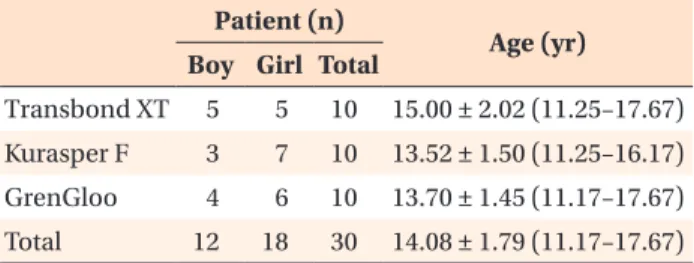
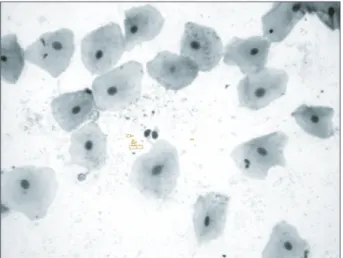
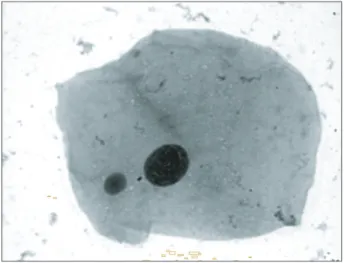
Objective: This study evaluated the cytotoxicity and genotoxicity of fixed orthodontic treatment with three different light-cured orthodontic bonding composites by analyzing micronucleus (MN) formation in the buccal mucosa during a 6-month period. Methods: Thirty healthy volunteers were selected from consecutive patients referred for orthodontic treatment. Equilibrium 2 brackets and molar tubes (Dentaurum) were bonded with three different light- cured orthodontic bonding composites—Transbond XT (3M Unitek), Kurasper F (Kuraray Europe), or GrenGloo (Ormco Corporation)— to all teeth in both arches. Exfoliated buccal epithelial cells were scraped from the middle part of the inner cheeks with sterile cement spatulas before treatment and at 1, 3, and 6 months after treatment. MNs and nuclear alterations, such as karyorrhexis (KR), karyolysis (KL), and binucleated cells (BNs), were scored under a light microscope. Repeated measure ANOVA was used to calculate statistical differences in degenerative nuclear abnormalities. Results: MN rates did not significantly differ among different time points within the same cell type (p >
0.05). In contrast, the number of BNs in buccal epithelial cells significantly increased in all composite groups (p < 0.01, Transbond XT; p < 0.001, Kurasper F and GrenGloo). KL frequency significantly increased between the beginning and end of the study in the Kurasfer F (0.80 ± 0.79 to 1.90 ± 1.10; p < 0.05) and GrenGloo (1.30 ± 1.06 to 2.40 ± 1.08; p < 0.05) groups. Conclusions: After 6 months of fixed orthodontic treatment with different light-cured composites, morphological signs of cytotoxicity were observed but genotoxic effects were absent.
[Korean J Orthod 2014;44(3):128-135]
Key words: Genotoxicity, Cytotoxicity, Buccal epithelial cells, Orthodontic com- posites, Micronucleus test
Ebubekir Toy
aSengul Yuksel
bFirat Ozturk
cOrhan Hakki Karatas
aMuhammet Yalcin
d© 2014 The Korean Association of Orthodontists.
The authors report no commercial, proprietary, or financial interest in the products or companies described in this article.
This is an Open Access article distributed under the terms of the Creative Commons Attribution Non-Commercial License (http://creativecommons.org/licenses/by-nc/3.0) which permits unrestricted non-commercial use, distribution, and reproduction in any medium, provided the original work is properly cited.
pISSN 2234-7518 • eISSN 2005-372X http://dx.doi.org/10.4041/kjod.2014.44.3.128
a
Department of Orthodontics, Faculty of Dentistry, Inonu University, Malatya, Turkey
b
Department of Medical Biology and Genetics, Faculty of Medicine, Inonu University, Malatya, Turkey
c
Department of Orthodontics, Faculty of Dentistry, Pamukkale University, Denizli, Turkey
d