INTRODUCTION
Recent evidence has demonstrated the beneficial effect of ex- ercise based cardiac rehabilitation (CR) in improving clinical outcomes and secondary prevention for acute myocardial in- farction.1-3 Thus, current practical guidelines recommend re- ferral to CR with exercise training for patients with myocardial
infarction or chronic stable angina. However, very little re- search has been conducted to clarify the impact of exercise training on clinical outcomes in patients with ST-elevation myocardial infarction (STEMI) undergoing primary percuta- neous coronary intervention (PCI) with drug-eluting stents (DESs) implantation on the infarct-related artery. Moreover, several studies have reported that only 22–30% of patients with myocardial infarction participate in CR programs.4-6 Since guidelines recommend that patient counseling to maxi- mize adherence to evidence-based post-STEMI treatment should begin during the early phase of hospitalization, occur intensively at discharge, and continue at follow-up visits, un- derutilization of exercise-based CR, especially in patients with myocardial infarction, may deprive an important therapy in these high-risk patients. Thus, it is important to determine who can benefit from CR with ET in patients with myocardial infarction.
In the present study, we aimed 1) to evaluate whether exer-
Effect of Cardiac Rehabilitation on Outcomes
in Patients with ST-Elevation Myocardial Infarction
Hye Young Lee1*, Sung-Jin Hong2*, In Hyun Jung1, Gwang Sil Kim1, Young Sup Byun1, and Byung Ok Kim1
1Division of Cardiology, Department of Internal Medicine, Sanggye Paik Hospital, Inje University College of Medicine, Seoul;
2Division of Cardiology, Yonsei University College of Medicine, Seoul, Korea.
Purpose: Whether cardiac rehabilitation (CR) improves clinical outcomes in patients with ST-elevation myocardial infarction (STEMI) undergoing primary percutaneous coronary intervention (PCI) with drug-eluting stents (DESs) has not been thoroughly evaluated. Moreover, few studies have sought to identify patients who would benefit most from CR among STEMI patients.
Materials and Methods: Consecutively, 265 STEMI patients who underwent primary PCI with implantation of DESs and follow- up angiography were examined. Seventy-six patients (30%) who received CR were assigned to the CR+ group. Another 178 pa- tients (70%) who did not participate in CR were assigned to the CR- group. Second generation DESs were implanted in 238 (94%) patients.
Results: Major adverse cardiovascular events (MACEs), including death, myocardial infarction, and revascularization, were com- pared. The CR+ group tended to have lower MACE than the CR- group at 3 years, although the difference was not statistically sig- nificant (9.9% vs. 18.3%, hazard ratio=0.54, p=0.138). Subgroup analysis revealed a significant interaction according to CR and preprocedural thrombolysis in myocardial infarction (TIMI) flow (p value for interaction=0.011). In patients with low preproce- dural TIMI flow (TIMI flow ≤1, n=161), those in the CR+ group had significantly lower MACE than those in the CR- group (p=0.005), whereas MACE was not different among patients with higher TIMI flow (TIMI flow ≥2, n=93).
Conclusion: CR including exercise training was associated with lower MACE, particularly in patients with lower preprocedural TIMI flow during primary PCI for STEMI in the current DES era.
Key Words: Cardiac rehabilitation, myocardial infarction, drug eluting stent
pISSN: 0513-5796 · eISSN: 1976-2437
Received: November 9, 2018 Revised: February 27, 2019 Accepted: April 2, 2019
Corresponding author: Byung Ok Kim, MD, PhD, FESC, Division of Cardiology, Department of Internal Medicine, Sanggye Paik Hospital, Inje University College of Medicine, 1342 Dongil-ro, Nowon-gu, Seoul 01757, Korea.
Tel: 82-2-950-1266, Fax: 82-2-950-1248, E-mail: [email protected]
*Hye Young Lee and Sung-Jin Hong contributed equally to this work.
•The authors have no potential conflicts of interest to disclose.
© Copyright: Yonsei University College of Medicine 2019
This is an Open Access article distributed under the terms of the Creative Com- mons Attribution Non-Commercial License (https://creativecommons.org/licenses/
by-nc/4.0) which permits unrestricted non-commercial use, distribution, and repro- duction in any medium, provided the original work is properly cited.
Yonsei Med J 2019 Jun;60(6):535-541 https://doi.org/10.3349/ymj.2019.60.6.535
cise-based CR improves major adverse cardiovascular events (MACEs) in patients with STEMI undergoing primary PCI in the current DES era and 2) to find subsets of patients that would benefit most from exercise-based CR.
MATERIALS AND METHODS
A total of 265 patients who underwent primary PCI for STEMI between 2009 and 2014 were screened. All patients were en- couraged to participate in CR with an exercise program unless they had third degree atrioventricular block, severe aortic ste- nosis, systolic blood pressure above 200 mm Hg at rest, dia- stolic blood pressure above 110 mm Hg at rest, pericarditis, uncontrolled tachycardia, exercise induced malignant ven- tricular arrhythmia, acute systemic illness, skeletal vascular disease, or acute metabolic disorders. The patients who were unwilling to provide informed consent to the exercise training program were also excluded. Finally, a total of 254 STEMI pa- tients were enrolled in this study, and 76 of 254 STEMI pa- tients (30%) participated in the exercise-based CR program.
Of 178 nonparticipants, 120 patients refused to participate in the CR program, and 58 patients did not complete the planned CR program. The Institutional Review Board of Sanggye Paik Hospital approved this study. The requirement for informed consent was waived because of the retrospective nature of the study (IRB number: 2019-01-003-001, IRB institution: Sanggye Paik hospital, Inje University).
Participation in the CR program was defined as commence- ment of a CR session starting within 4 weeks of the index PCI and completion of phase 2 supervised exercise in the hospital for a period of 6–8 weeks and maintenance of community- based self-managed exercise over 9 months.7 Cardiorespirato- ry capacity was measured twice by a symptom-limited tread- mill exercise test under the protocol of modified Bruce before the commencement and at the end of the phase 2 supervised exercise training. Maximal oxygen uptake (VO2max) was de- fined as the highest valuce or the plaeteau of directly mea- sured oxygen consumption using a respiratory gas analyzer (QMC, Quinton Intrument CO., Boston, MA, USA). The exer- cise test was supervised by experienced physicians and ECG monitoring was conducted throughout the test. The exercise program included a 10-minute warm-up, a 40-minute aerobic exercise on a treadmill, and a 10-minute cool-down phase.
Exercise intensity in the first stage was gradually increased from 50% to 80% of VO2max determined by the exercise test.
After the 6 weeks of supervised exercise, community-based and self-managed exercise was performed according to the reassessed cardiorespiratory capacity. Patients were required to exercise at a local fitness center and maintain aerobic exer- cise on a treadmill in a same manner. Every exercise training session should be composed of 1 hour, and patients were re- quired to exercise three times a week. Adherence to exercise
was monitored every month at an outpatient clinic.7
MACE was defined as the composite of death, myocardial infarction, and revascularization. Clinical events were defined according to the Academic Research Consortium and an ex- pert consensus document that defined the third universal definition for myocardial infarction.8,9 All deaths were consid- ered cardiac related unless an unequivocal non-cardiac cause could be established.8 During follow up, myocardial infarction was defined by the following parameters: the presence of clinical symptoms, ECG changes, or abnormal imaging find- ings indicative of myocardial infarction and an increase in creatine kinase myocardial band fraction above the upper normal limits or an increase in troponin-T/troponin-I above the 99th percentile of the upper normal limit. Any revascular- ization was defined as a repeat PCI or bypass surgery.9
Statistical analyses were performed using IBM SPSS, ver- sion 19.0 (IBM Corp., Armonk, NY, USA). Categorical vari- ables are reported as numbers and percentages. Continuous variables are reported as a mean and SD. Cumulative MACEs at 1 year and 3 year were calculated using Kaplan-Meier esti- mates and compared using the log-rank test. Although pa- tients could experience more than one MACE component, each patient was assessed until the occurrence of the first event during analysis. Also, factors associated with MACE were determined by performing a univariable analysis using Cox proportional hazards regression with all variables listed in Tables 1 and 2. All variables achieving a p value <0.10 in univariate analysis were entered using the enter method into a multivariate analysis model. Subgroup analyses were per- formed according to clinical and angiographic subgroups. All tests were two-sided, and a p value <0.05 was considered sta- tistically significant.
RESULTS
Of 254 STEMI patients who were eligible for the exercise pro- gram, 76 patients (30%) participated in CR with an exercise program the during study period (CR+ group). Nonpartici- pants to CR (178 of 254 STEMI patients, CR- group) comprised those who were under standard medical care for myocardial infarction, including medication, abstinence from smoking, and diet modification during study period. Baseline clinical characteristics according to the CR group are presented in Table 1. There were no significant differences in baseline character- istics, including age, sex, body mass index, diabetes, hyper- tension, and left ventricular ejection fraction. Angiographic characteristics are presented in Table 2. There were no signifi- cant differences in initial thrombolysis in myocardial infarc- tion (TIMI) grade, severity of coronary artery disease, location of infarct-related artery, and lesion morphology. Among 254 patients, 238 (94%) patients received second-generation DESs.
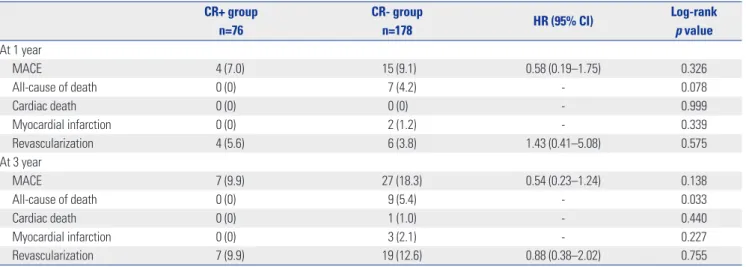
Clinical outcomes are presented in Table 3. During a medi-
an follow up of 943 days (interquartile range: 514–1096 days), MACEs occurred in 37 patients. At 1 year, the MACEs did not differ between groups [7.0% vs. 9.1%, hazard ratio (HR)=0.58, 95% confidence interval (CI)=0.19–1.75, p=0.326]. At 3 years, although not statistically significant, the CR+ group had fewer MACEs than the CR- group, (9.9% vs. 18.3%, HR=0.54, 95%
CI=0.23–1.24, p=0.138) (Fig. 1). As for clinical outcomes, all- cause death at 3 years was significantly lower in the CR+
group than in the CR- group (0% vs. 5.4%, p=0.033). Cardiac death, myocardial infarction, and any revascularization were not different between groups. Univariable and multivariable
Table 1. Baseline Characteristics
CR+ group n=76
CR- group n=178 p value
Age (yr) 59±11 60±14 0.846
Male 63 (83) 146 (82) 0.868
BMI (kg/m2) 24.5±3.8 24.1±2.9 0.396
Hypertension 33 (43) 86 (48) 0.474
Diabetes 13 (17) 41 (23) 0.290
Dyslipidemia 8 (11) 22 (12) 0.678
Smoking 0.084
Never 28 (37) 52 (29)
Ex-smoker 18 (24) 29 (16)
Current smoker 30 (41) 97 (55)
Prior myocardial infarction 2 (3) 5 (3) 0.937
Prior percutaneous coronary intervention 3 (4) 12 (7) 0.387 Previous cerebrovascular event 4 (5) 12 (7) 0.657 Left ventricular ejection fraction (%) 54±11 51±11 0.087 Medication at discharge
Aspirin 76 (100) 174 (98) 0.188
Clopidogrel 71 (93) 156 (88) 0.171
Ticagrelor 5 (7) 18 (10) 0.369
ACE inhibitor or ARB 39 (51) 95 (53) 0.764
Beta-blocker 61 (80) 132 (74) 0.297
Statin 75 (99) 173 (97) 0.473
ACE, angiotensin converting enzyme; ARB, angiotensin II receptor blocker;
BMI, body mass index; CR, cardiac rehabilitation.
Numbers are presented as a mean±SD or number (percentage).
Table 2. Angiographic Characteristics CR+ group
n=76
CR- group
n=178 p value
Preprocedural TIMI grade 0.440
0 39 (51) 89 (50)
1 11 (15) 22 (12)
2 6 (8) 27 (15)
3 20 (26) 40 (22)
Postprocedural TIMI grade 0.667
1 0 (0) 1 (1)
2 7 (9) 21 (12)
3 69 (91) 156 (88)
Severity of coronary artery disease 0.066
1 45 (59) 80 (45)
2 23 (30) 62 (35)
3 8 (11) 36 (20)
Location of infarct-related artery 0.218
Left anterior descending 42 (55) 92 (52)
Left circumflex 3 (4) 19 (11)
Right coronary artery 31 (41) 67 (38)
Lesion morphology 0.202
A 7 (8) 14 (8)
B1 12 (16) 16 (9)
B2 28 (37) 57 (32)
C 29 (38) 91 (51)
Type of stent 0.599
No use of stent 0 (0) 3 (2)
Bare-metal stent 2 (3) 4 (2)
First-generation DES 3 (4) 4 (2)
Second-generation DES 71 (93) 167 (94)
CR, cardiac rehabilitation; DES, drug-eluting stent; TIMI, thrombolysis in myocardial infarction.
Numbers are a presented as number (percentage).
Table 3. Clinical Outcomes
CR+ group n=76
CR- group
n=178 HR (95% CI) Log-rank
p value At 1 year
MACE 4 (7.0) 15 (9.1) 0.58 (0.19–1.75) 0.326
All-cause of death 0 (0) 7 (4.2) - 0.078
Cardiac death 0 (0) 0 (0) - 0.999
Myocardial infarction 0 (0) 2 (1.2) - 0.339
Revascularization 4 (5.6) 6 (3.8) 1.43 (0.41–5.08) 0.575
At 3 year
MACE 7 (9.9) 27 (18.3) 0.54 (0.23–1.24) 0.138
All-cause of death 0 (0) 9 (5.4) - 0.033
Cardiac death 0 (0) 1 (1.0) - 0.440
Myocardial infarction 0 (0) 3 (2.1) - 0.227
Revascularization 7 (9.9) 19 (12.6) 0.88 (0.38–2.02) 0.755
CR, cardiac rehabilitation; HR, hazard ratio; CI, confidence interval; MACE, major adverse cardiovascular event.
MACE was defined as a composite of death, myocardial infarction, and revascularization. Event rates were calculated by Kaplan-Meier curves.
analyses for MACE are also presented in Supplementary Table 1 (only online).
In subgroup analysis to identify patients who would benefit from CR, we found a significant interaction between the CR
group and preprocedural TIMI flow (Fig. 2). The CR+ group had significantly fewer MACEs in the subgroup of patients with lower TIMI flow (TIMI flow ≤1, n=161) than in the sub- group of patients with higher TIMI flow (TIMI flow ≥2, n=93) (p-value for interaction=0.011). Also, among patients with low TIMI flow (TIMI flow ≤1), the CR+ group had significantly fewer MACEs than the CR- group (p=0.005) (Fig. 3). However, among patients with higher TIMI flow (TIMI flow ≥2), MACEs were not different between groups (p=0.247) (Fig. 3). There were no significant differences in baseline characteristics ac- cording to preprocedural TIMI flow (Supplementary Table 2, only online).
DISCUSSION
The main findings of the present study are that, although the CR+ group only exhibited a lower tendency for MACEs than the CR- group after 3 years, there was a significant interaction in subgroup analysis according to the CR group and prepro- cedural TIMI flow. The CR+ group had significantly lower MACE than the CR- group, particularly in patients with low Fig. 1. Kaplan-Meier survival curves of MACEs according to CR. CI, confi-
dence interval; CR, cardiac rehabilitation; HR, hazard ratio; MACE, major adverse cardiovascular event; PCI, percutaneous coronary intervention.
30
20
10
0
0 1 2 3 Years after primary PCI
HR=0.54 (95% CI=0.23–1.24) Log-rank p=0.138
CR- group
CR+ group
MACE rate (%)
Fig. 2. Subgroup analysis of major adverse cardiovascular events. CI, confidence interval; CR, cardiac rehabilitation; HR, hazard ratio; LAD, left anterior descending; LCx, left circumflex; RCA, right coronary artery; TIMI, thrombolysis in myocardial infarction.
Subgroup
CR (+) CR (-)
(95% CI)HR p value No. of
patients (n/N)
Event rate (%)
No. of patients (n/N)
Event rate (%)
All patients 7/76 9.9 27/178 18.3 0.58 (0.23–1.24) 0.138
Age (yr)
≤65 6/57 10.9 17/111 17.8 0.63 (0.25–1.59) 0.320
>65 1/19 6.2 1-/67 19.0 0.32 (0.04–2.47) 0.245
Sex
Male 7/63 11.9 24/146 20.2 0.59 (0.26–1.38) 0.221
Female 0/13 0 3/32 10.1 - 0.264
Hypertension
Yes 2/33 6.7 14/86 19.8 0.32 (0.07–1.41) 0.111
No 5/43 12.3 13/92 16.9 0.75 (0.27–2.11) 0.585
Diabetes melitus
Yes 2/13 16.7 8/41 22.2 0.71 (0.15–3.34) 0.661
No 5/63 8.5 19/137 17.8 0.51 (0.19–1.36) 0.168
Left ventricular ejection fraction
≤40% 0/9 0 5/31 19.3 - 0.209
>40% 7/67 11.0 22/147 15.9 0.62 (0.27–1.46) 0.269
No. of diseased vessels
One or two 6/68 9.4 20/142 17.3 0.55 (0.22–1.38) 0.193
Three 1/8 14.3 7/36 22.6 0.67 (0.08–5.46) 0.706
Coronary arteries
LAD 5/42 12.1 12/92 15.2 0.79 (0.28–2.25) 0.663
LCx or RCA 2/34 6.8 15/86 21.5 0.31 (0.07–1.35) 0.098
Initial TIMI grade
0 ro 1 1/50 2.1 19/111 20.0 0.24 (0.13–0.74) 0.005
2 or 3 6/26 25.6 8/67 15.3 1.85 (0.64–5.34) 0.247
p value for interaction
0.536
-
0.359
0.736
- 0.92
0.319
0.011 Favors
CR (+) Favors CR (-)
0.1 0.2 0.5 1.0 2.0 5.0 10.0 HR (95% CI)
TIMI flow, during primary PCI, whereas MACE was not differ- ent between groups among patients with higher TIMI flow, suggesting that CR with exercise training would be most clini- cally beneficial to patients with low preprocedural TIMI flow during primary PCI for STEMI in the current DES era.
Much evidence has demonstrated the beneficial effect of CR including regular exercise on the improvement of clinical outcomes in patients with coronary heart disease.1-3 In 2004, Taylor, et al.1 reported that CR was associated with a 20% re- duction in all-cause mortality and a 25% reduction in cardiac death from a meta-analysis of randomized trials of ischemic heart disease. Also, in 2004, Hambrecht, et al.3 reported that a 12-month program of regular physical exercise in patients with stable coronary artery disease showed superior event- free survival and exercise capacity at lower costs to those who were treated with PCI. Also, recent data have demonstrated an inverse relationship between CR program participation and adverse cardiovascular events in an analysis of Medicare claims data, including 30161 patients with coronary artery disease who attended at least one CR session. After 4 years of follow up, patients who attended 36 sessions had a 14% lower risk of death and a 12% lower risk of myocardial infarction than those who attended 24 sessions; a 22% lower risk of death and a 23% lower risk of myocardial infarction than those who attended 12 sessions; and a 47% lower risk of death and a 31% lower risk of myocardial infarction than those who attended one session.10 Therefore, recent major guidelines from the American Heart Association and the American Col- lege of Cardiology Foundation regarding the management and prevention of coronary heart disease provide a class 1 level recommendation (i.e., procedure/treatment should be
performed/administered) for referral to a CR program for pa- tients with recent myocardial infarction or acute coronary syndrome, chronic stable angina, or heart failure or for pa- tients following coronary artery bypass surgery or percutane- ous coronary intervention.11,12 In line with previous findings, the CR+ group had fewer MACEs than the CR- group at 3 years, although the difference was not statistically significant (9.9% vs. 18.3%, HR=0.54, p=0.122). However, different from previous studies, which were mainly performed in the bare- metal stents era, the majority of the patients analyzed in our study was treated with second-generation DESs: of note, 94%
of the patients received a second-generation DES. Although the advent of DES significantly lowered rates of in-stent reste- nosis and the need of target-lesion revascularization, com- pared to bare-metal stents, increased rates of stent thrombosis emerged as another concern, particularly for first-generation DESs. However, even in patients with STEMI, steady improve- ments in outcomes have been realized with the evolution from bare-metal stent to first-generation and now second- generation DES, with the most favorable safety and efficacy profile.13-15 Thus, these significant reductions in device-related MACEs with the use of second-generation DES might mitigate the clinical benefit of CR in the present study. Also, the small number of patients with a relatively short-term follow up in the present study may account for the lack of statistical signifi- cance.
Despite the importance of participation in a CR program af- ter myocardial infarction, participation rates have been re- ported as only 22–30% according to recent studies.4-6 In the present study, among 254 STEMI patients who were dis- charged after primary PCI, 76 patients (30%) participated in Fig. 3. Kaplan-Meier survival curves of MACEs according to preprocedural TIMI flow. CR, cardiac rehabilitation; PCI, percutaneous coronary interven- tion; TIMI, thrombolysis in myocardial infarction; MACE, major adverse cardiovascular event.
0.5 0.4
0.3 0.2 0.1
0.0
0.5 0.4
0.3 0.2 0.1
0.0
0 1 2 3 0 1 2 3
Years after primary PCI Years after primary PCI
Preprocedural TIMI flow ≤1 n=161
Preprocedural TIMI flow ≥2 n=93
p value for interaction=0.011
p=0.005 CR- group p=0.247
CR- group
CR+ group
CR+ group
MACE rate (%) MACE rate (%)
the CR program including exercise training. The major rea- sons of the nonparticipants were refusal to enroll the pro- gram. Therefore, it may be important to identify patients who would benefit from CR in patients with myocardial infarction.
Although other clinical or procedural characteristics did not show a significant interaction in subgroup analysis, we found that there was a significant interaction in subgroup analysis according to CR group and preprocedural TIMI flow. Accord- ing to a recent study, during primary PCI, low preprocedural TIMI flow was reversely associated with myocardial injury and was an independent predictor of myocardial damage as- sessed by cardiac magnetic resonance.16 Also, patients under- going primary PCI in whom TIMI-3 flow is present before an- gioplasty present with greater clinical and angiographic evidence of myocardial salvage, are less likely to develop complications related to left ventricular failure, and have im- proved early and late survival.17 In this sense, for patients with low preprocedural TIMI flow, CR could be more beneficial, compared to those with high preprocedural TIMI flow.
This study has several limitations. First, this study was a ret- rospective study of single-center data from a relatively small group of patients. Notwithstanding, we included patients with STEMI undergoing primary PCI in the current DES era, and second-generation DESs were used in 94%. Second, our study might be under-powered because of low event rates. Third, a longer follow up is needed.
In conclusion, CR including exercise training was associat- ed with fewer MACEs, particularly among patients with lower preprocedural TIMI flow, during primary PCI for STEMI in the current DES era.
AUTHOR CONTRIBUTIONS
Conceptualization: Hye Young Lee, Sung-Jin Hong, Byung Ok Kim.
Data curation: Hye Young Lee. Formal analysis: Hye Young Lee, Sung-Jin Hong. Investigation: Hye Young Lee, Sung-Jin Hong, In Hyun Jung, Gwang Sil Kim, Young Sup Byun, Byung Ok Kim. Meth- odology: Hye Young Lee, Sung-Jin Hong, Byung Ok Kim. Project ad- ministration: Hye Young Lee, Sung-Jin Hong, In Hyun Jung, Gwang Sil Kim, Young Sup Byun, Byung Ok Kim. Resources: Hye Young Lee, Sung-Jin Hong, In Hyun Jung, Gwang Sil Kim, Young Sup Byun, Byung Ok Kim. Supervision: Hye Young Lee, Sung-Jin Hong, Byung Ok Kim. Validation: Hye Young Lee, Sung-Jin Hong, In Hyun Jung, Gwang Sil Kim, Young Sup Byun, Byung Ok Kim. Visualization: Hye Young Lee, Sung-Jin Hong. Writing—original draft: Hye Young Lee, Sung-Jin Hong. Writing—review & editing: Hye Young Lee, Sung-Jin Hong.
ORCID iDs
Hye Young Lee https://orcid.org/0000-0003-3187-3667 Sung-Jin Hong https://orcid.org/0000-0003-4893-039X In Hyun Jung https://orcid.org/0000-0002-1793-215X Gwang Sil Kim https://orcid.org/0000-0001-5206-8187 Young Sup Byun https://orcid.org/0000-0002-6360-6400 Byung Ok Kim https://orcid.org/0000-0002-7920-2750
REFERENCES
1. Taylor RS, Brown A, Ebrahim S, Jolliffe J, Noorani H, Rees K, et al.
Exercise-based rehabilitation for patients with coronary heart disease: systematic review and meta-analysis of randomized con- trolled trials. Am J Med 2004;116:682-92.
2. Clark AM, Hartling L, Vandermeer B, McAlister FA. Meta-analy- sis: secondary prevention programs for patients with coronary artery disease. Ann Intern Med 2005;143:659-72.
3. Hambrecht R, Walther C, Möbius-Winkler S, Gielen S, Linke A, Conradi K, et al. Percutaneous coronary angioplasty compared with exercise training in patients with stable coronary artery dis- ease: a randomized trial. Circulation 2004;109:1371-8.
4. Pouche M, Ruidavets JB, Ferrières J, Iliou MC, Douard H, Lorgis L, et al. Cardiac rehabilitation and 5-year mortality after acute coro- nary syndromes: The 2005 French FAST-MI study. Arch Cardio- vasc Dis 2016;109:178-87.
5. Cottin Y, Cambou JP, Casillas JM, Ferrières J, Cantet C, Danchin N.
Specific profile and referral bias of rehabilitated patients after an acute coronary syndrome. J Cardiopulm Rehabil 2004;24:38-44.
6. Suaya JA, Shepard DS, Normand SL, Ades PA, Prottas J, Stason WB. Use of cardiac rehabilitation by Medicare beneficiaries after myocardial infarction or coronary bypass surgery. Circulation 2007;116:1653-62.
7. Lee HY, Kim JH, Kim BO, Byun YS, Cho S, Goh CW, et al. Regular exercise training reduces coronary restenosis after percutaneous coronary intervention in patients with acute myocardial infarc- tion. Int J Cardiol 2013;167:2617-22.
8. Cutlip DE, Windecker S, Mehran R, Boam A, Cohen DJ, van Es GA, et al; Academic Research Consortium. Clinical end points in coronary stent trials: a case for standardized definitions. Circula- tion 2007;115:2344-51.
9. Thygesen K, Alpert JS, Jaffe AS, Simoons ML, Chaitman BR, White HD, et al. Third universal definition of myocardial infarction. Cir- culation 2012;126:2020-35.
10. Hammill BG, Curtis LH, Schulman KA, Whellan DJ. Relationship between cardiac rehabilitation and long-term risks of death and myocardial infarction among elderly Medicare beneficiaries. Cir- culation 2010;121:63-70.
11. Writing Committee Members, Thomas RJ, King M, Lui K, Old- ridge N, Piña IL, Spertus J. AACVPR/ACCF/AHA 2010 update:
performance measures on cardiac rehabilitation for referral to cardiac rehabilitation/secondary prevention services: a report of the American Association of Cardiovascular and Pulmonary Re- habilitation and the American College of Cardiology Foundation/
American Heart Association Task Force on Performance Mea- sures (Writing Committee to Develop Clinical Performance Mea- sures for Cardiac Rehabilitation). Circulation 2010;122:1342-50.
12. Smith SC Jr, Benjamin EJ, Bonow RO, Braun LT, Creager MA, Franklin BA, et al. AHA/ACCF Secondary Prevention and Risk Reduction Therapy for Patients with Coronary and other Athero- sclerotic Vascular Disease: 2011 update: a guideline from the American Heart Association and American College of Cardiology Foundation. Circulation 2011;124:2458-73.
13. Sabaté M, Brugaletta S, Cequier A, Iñiguez A, Serra A, Jiménez- Quevedo P, et al. Clinical outcomes in patients with ST-segment elevation myocardial infarction treated with everolimus-eluting stents versus bare-metal stents (EXAMINATION): 5-year results of a randomised trial. Lancet 2016;387:357-66.
14. Sabaté M, Räber L, Heg D, Brugaletta S, Kelbaek H, Cequier A, et al. Comparison of newer-generation drug-eluting with bare-met- al stents in patients with acute ST-segment elevation myocardial
infarction: a pooled analysis of the EXAMINATION (clinical Eval- uation of the Xience-V stent in Acute Myocardial INfArcTION) and COMFORTABLE-AMI (Comparison of Biolimus Eluted From an Erodible Stent Coating With Bare Metal Stents in Acute ST-Ele- vation Myocardial Infarction) trials. JACC Cardiovasc Interv 2014;7:55-63.
15. Palmerini T, Biondi-Zoccai G, Della Riva D, Mariani A, Sabaté M, Valgimigli M, et al. Clinical outcomes with drug-eluting and bare- metal stents in patients with ST-segment elevation myocardial in- farction: evidence from a comprehensive network meta-analysis.
J Am Coll Cardiol 2013;62:496-504.
16. Joost A, Stiermaier T, Eitel C, Fuernau G, de Waha S, Desch S, et al. Impact of initial culprit vessel flow on infarct size, microvascu- lar obstruction, and myocardial salvage in acute reperfused ST- elevation myocardial infarction. Am J Cardiol 2016;118:1316-22.
17. Stone GW, Cox D, Garcia E, Brodie BR, Morice MC, Griffin J, et al.
Normal flow (TIMI-3) before mechanical reperfusion therapy is an independent determinant of survival in acute myocardial in- farction: analysis from the primary angioplasty in myocardial in- farction trials. Circulation 2001;104:636-41.