교신저자 : 최유진([email protected]) || 접수일: 2019.06.12 || 심사일: 2019.07.23
|| 게재승인일: 2019.07.24 재활치료과학 제 8 권 제 3 호
Therapeutic Science for Rehabilitation Vol. 8. No. 3. 2019.
https://doi.org/10.22683/tsnr.2019.8.3.057
단기 집단 복합중재가 정상 노인의 인지기능 및 우울에 미치는 영향
정범진*
,
최유진***중원대학교 의료보건대학 작업치료학과 학부과정
**중원대학교 의료보건대학 작업치료학과 교수
국문초록
목적
:
신체활동과 인지운동, 사회적 상호작용을 혼합한 단기 집단 복합중재가 75세 이상의 고령 정상 노인의 인지기능과 우울 수준에 미치는 영향을 알아보고자 하였다.연구방법
:
본 연구 설계는 단일 집단 사전-사후 설계(one group pretest-posttest design)로 중재는 회당 70분, 주 1회, 총 4회기 동안 실시하였다. 중재 전과 후의 인지기능과 우울 수준, 신체기능의 변화를 비교하기 위해서 치매 선별용 간이 정신상태검사(Mini-Mental State Examination-Dementia Screening;MMSE-DS)와 단축형 노인우울척도(Short Form for Geriatric Depression Scale; SGDS), 버그균형척도 (Berg Balance Scale; BBS)를 사용하였다.
결과
: 75
세 이상의 고령 정상노인에게 집단 복합중재를 적용한 후 인지기능은 통계적으로 유의미한 향상이 있었고(p<.01), 우울 수준은 통계적으로 유의미한 감소가 있었다(p<.05). 균형수준도 중재 전46.83±9.11점에서 중재 후 48.08±7.00점으로 평가점수의 증가는 있었으나, 통계적으로 유의미하지는
않았다(p>.05).
결론
:
신체활동과 인지운동, 사회적 상호작용을 혼합한 단기 집단 복합중재는 75세 이상의 고령 정상노인의 인지기능의 저하를 늦추고 우울수준을 감소시키는데 유의한 효과가 있었다. 본 연구는 정상노인들의 치매, 우울 예방을 위한 중재에 있어서 보다 체계적인 중재를 제공하기 위한 근거를 제시한다는 점에 의의가 있다. 향후 연구에서는 작업치료사에 의한 전문적인 치료에 대한 효과연구와 실험군-대조군 연구를 통해 효과입증이 이루어져야 할 것이다.주제어
:
균형, 노인, 우울, 인지기능, 지역사회 작업치료, 집단 복합중재Ⅰ. 서 론
1980년 우리나라 남녀 평균수명은 65.9세에 불과했 으나, 2017년, 82.7세로 크게 증가하였다. 의학의 발전 과 생활수준의 향상으로 노인인구의 비율이 급증하고
있다. 2018년에는 65세 이상의 노인인구가 전체 인구
의 14.3%를 차지했으며, 2026년에는 전체 인구의 20%
가 노인에 해당하는 초고령사회 진입이 예상된다 (Statistics Korea, 2018). 고령화 사회에서 오는 노인 문제의 양상은다양한데(Kwon, 2004), 노화과정에서 신 체 기능의 감소와 심리적 변화를 겪는 것이 일반적이다 (Kim, Kim, & Park, 2017). 노화로 인한 신체 기능의 감소는 근육위축에서 근력약화로 이어지게 된다 (Janssen, Baumgartne, Ross, Rosenberg, & Roubenoff, 2004; Janssen, 2006; Seo & Lee, 2013). 특히 복부 근육 에서 다른 부위 보다 더 많은 근육위축을 보인다 (Kanehisa, Miyatani, Azuma, Kuno, & Fukunaga, 2004;
Rankin, Stokes, & Newham, 2006). 복부 근육의 약화는 낙상 요인을 증가시키고 일상생활동작의 기능이상을 초 래한다(Teyhen et al., 2007; Seo & Lee, 2013). 신체기능 의 감소는 노인우울의 가장 일반적인 원인으로(Bae, Um, & Kim, 2009), 불안감을 증가시키고, 사회적 역할 상실로 낮은 자아존중감을 갖게 하여 일상생활의 수행 에 문제를 야기하고 우울을 경험하게 한다(Han, Song,
& Lim, 2010; Kim & Lee, 2015). 우울은 노인에게서 가장 흔하게 관찰되는 정신적 문제(Kang & Kim, 2000) 로 유병률이 계속하여 증가하고 있다(Lee, Kahng, &
Lee, 2008). 2017년 한국보건사회연구원이 65세 이상 의 노인 10,073명을 대상으로 한 연구에 따르면 대상자 의 21.1%가 우울증상을 지니고 있었다(Jeong et al.,
2017). 젊은 연령층의 우울과 비교했을 때 노인의 우울
은 인지장애와 깊은 관련이 있었고(Kok & Reynolds,
2017), 우울한 노인은 그렇지 않은 노인에 비해 인지기
능의 저하속도가 약 20% 더 빠르게 진행되는 것으로 보고되었다(Wilson, DeLeon, Bennett, Bienias, &
Evans, 2004; National Collaborating Centre for Mental Health, 2007; Shin, Lee, Kim, & Jeon, 2013).
노인 우울은 신체 기능과 삶의 만족도에 부정적인 영향을 미치고, 인지기능의 저하와 치매로까지의 진행 될 수 있다는 점에서 많은 관심이 필요한 사회적 문제 이다(The korean geriatrics society, 2005). 때문에 우 울의 중재, 실태와 영향 요인에 대해서 학계에서는 다 방면으로 연구를 진행해 오고 있다. 의학과 보건학에서 는 우울 연구의 초점을 주로 질병의 유병율과 치료 및 예방에 두는 경향이 있다(Park, 2018). 과거 우울의 회복 과정에는 반드시 약물복용 해야 한다는 점이 강조 되었던 것에 반해(Lee, Joung, & Hwang, 2016; Yoon
& Han, 2012), 최근 약물복용은 오히려 부작용을 초래 할 수 있고, 망상 등의 정신과적 문제가 있는 경우에만 선별적으로 활용할 것이 제안됨에 따라(Kwon, 2013), 노인 우울의 비약물적 중재법 개발을 위해 연구자들이 많은 노력을 쏟고 있다. 우울의 비약물적 중재는 미술 치료, 음악치료, 보드게임, 신체활동, 인지행동치료, 심 리상담, 사회적 상호작용 등이 있는데, 단일 또는 복합 중재는 약물 복용의 부작용과 치료효과의 한계를 보완 할 수 있어 그 중요성과 효과성이 제기되며 다양한 시설 및 지역사회 프로그램에서 제공되고 있다(Kim, Park, & Kim, 2012). 그 중 대표적인 단일 중재방법인 신체활동은 노인 우울 감소에 효과적이며(Oh, Park,
& Kang, 2003; Cho & Cho, 2003; Sim, 2004; Kim, 2006; Kang, Jeong, Park, Kim, & Moon, 2005), 인지 기능의 전반적인 향상과도 관련 있었다(Boyle, Buchman, Wilson, Leurgans, & Bennett, 2010). 또한 인지운동은 기억력, 집중력, 문제해결능력과 같은 특 정 인지기능을 반영하도록 구성된 표준화된 과제들로 (Galante, Venturini, & Fiaccadori, 2007), 노인의 신체 활동, 사회적 상호작용과 삶의 질에 긍정적인 영향이 보고되고 있다(Coelho et al., 2013). 따라서 신체활동 과 인지운동을 혼합하여 복합중재를 실시했을 때 그 효과는 더욱 긍정적일 것이다. 실제로 Lee, Lee, Kim,
Characteristics Frequency(%) M ± SD
Gender Male 5(41.66)
Female 7(58.33) -
Age(yr)
76~80 3(25.00)
83±2.92
81~85 7(58.33)
86~90 2(16.66)
Attendance rate No absence 12(100) 100
Table 1. General Characteristics of Subjects (
N=12)
Yang과 Park(2014)이 65세 이상의 치매 노인 10명에게10주간 8회기의 집단 복합중재를 실시한 연구결과에 따르면 집단 복합중재는 대상자들의 삶의 질에 효과적 이었고, 우울과 인지기능에도 긍정적인 영향을 끼쳤다 고 한다.
이외에도 간단한 신체활동, 인지운동, 놀이 및 수공 예 등의 목적이 있는 활동, 사회적 상호작용을 혼합하여 집단에게 실시한 집단 복합중재의 효과가 여러 연구에 서 증명되었다(Burgener, Yang, Gilbert, & Marsh-Yant, 2008; Lee et al., 2014). 하지만 대부분의 연구가 중재방 법에 대한 자세한 기술이 없었고, 정상노인 보다는 치매 노인을 대상으로 한 연구가 주를 이루었다(Lee et al., 2014; Ham, Kim, Yoo, & Lee, 2018; Cho & Yang,
2017). 65세 정상 노인을 대상으로 복합중재를 실시한
기존의 연구들은 중재 진행을 작업치료사가 하지 않았 으며(Han et al., 2010; Park et al., 2013), 인지기능과 우울만 측정하거나(Kim & Jo, 2018), 신체기능의 변화 만 측정한 제한점이 있었다(Kim, 2008). 그리고 여성의 우울 유병률이 높다는 이유로 여성만을 대상으로 성별 에 제한을 두었다(Park, Park, Yun, & choi, 2015).
따라서 정상 노인의 우울에 대해 집단 복합중재가 단기간 이루어진 연구는 미비한 실정이며, 평균수명의 증가로 노인의 기준에 대한 새로운 정의가 필요한 현 시점에서 학문적, 임상적 근거를 축적할 필요가 있다. 이에 본 연구는 선행연구를 참고하고, 정상 노인임을
감안하여 상지, 하지, 균형기능을 포함한 신체활동, 인 지운동과 사회적 상호작용이 혼합된 4주간의 4회기의 단기 집단 복합중재가 75세 이상의 고령 정상노인의 인지기능과 우울에 미치는 영향을 알아보고자 한다.
Ⅱ. 연구 방법
1. 연구 대상
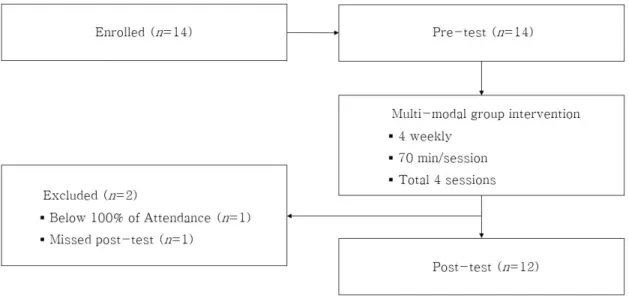
본 연구는 충청북도 ○○보훈청과 충청북도 소재 대학의 지역사회 연계 프로그램으로 진행되었으며, 모 든 평가는 대상자로부터 정보 이용 동의를 얻은 후 실시하였다. 대상자는 보훈청에 등록된 보훈대상자 및 해당가족으로, 프로그램 참여를 희망하여 자발적으로 참여하였다. 이들은 모두 자택에 거주하고, 집단 중재 에 참여하는데 신체적, 인지적 제한이 없고, 독립적인 보행이 가능하였으나 자택과 중재를 실시하는 대학 사 이를 이동할 때는 활동보조인이 차를 이용하여 대상자 들을 보조하였다. 총 14명이 집단 복합중재에 참여하 였으나, 단기 프로그램인 점을 고려하여 100% 참여하 지 않았거나, 사후 평가를 실시하지 않은 대상자 2명을 제외하여 총12명의 자료가 사용되었다. 대상자의 일반 적 정보는 Table 1에 제시하였다.
Figure 1. Research Procedure
2. 연구과정
1) 연구 설계
본 연구는 단일그룹 사전-사후 설계이다. 실험 기간 은 2018년 10월 30일부터 11월 27일까지로 중재 첫 회기에 사전평가, 중재 마지막 회기에 프로그램 직후 사후 평가를 실시 하였다. 중재는 회당 70분, 주 1회, 4회기 실시하였다(Figure 1).
2) 프로그램 계획 과정 및 내용
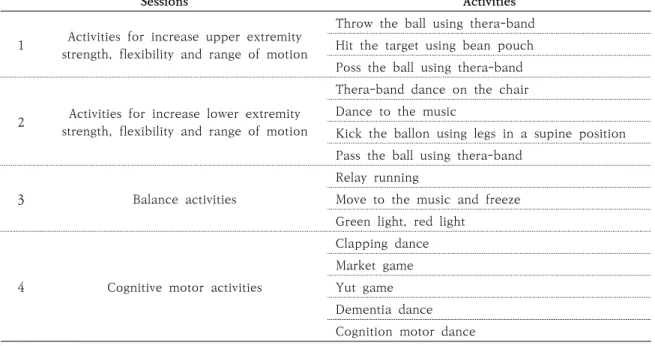
중재는 회당 70분, 주 1회, 총 4회기 동안 실시하였 고, 충청북도 소재 대학교의 작업치료학과 실습실에서 작업치료학과 학부생들에 의해서 진행되었다. 대상자 평가 및 프로그램 계획 모든 과정은 작업치료학과 교수 의 지도하에 이루어졌으며, 작업치료학과 학부생 1명이 중재를 진행하고, 2명이 진행을 보조하였다. 14명의 학 부생이 대상자와 2인 1조를 형성하여 활동에 참여하였 다. 모든 회기는 각각의 주제를 가지고 실시되었다. 1회 기의 주제는 상지의 유연성, 근력과 관절가동범위의 증 진으로 Pourtaghi, Emami-Moghadam, Ramezani,
Behnam-Vashani와 Mohajer(2017)의 연구에서 사용 된 Thera-band 운동을 참고하였고, 2회기는 하지의 근력증진을 주제로 Lee 등(2014)의 연구의 Swiss ball exercise를 참고하여 계획하였다. 3회기, 4회기는 각각 균형과 인지운동을 주제로 하였으며, Hafstrom, Malmstrom, Terden, Fransson과 Magnusson (2016)의 연구에서 사용된 균형 운동과 Giuli, Papa, Lattanzio와 Postacchini(2016)의 연구에서 사용된 인지운동을 참 고하여 계획하였다(Table 2). 각 회기의 모든 활동은 본 연구에 참가하는 대상자들에 맞게 수정 보완하여 실시하였다.
중재의 각 회기를 자세히 설명하면 다음과 같다. 회 기가 시작하기 전 작업치료학과 학부생들과 동료노인 과의 의사소통 기회를 제공하는 등 자연스럽게 사회적 상호작용을 촉진하였다. 회기가 시작되면 간단한 인사 와 날짜, 장소를 확인하여 시간, 공간, 사람 지남력을 확인한 뒤 오늘 할 활동을 소개하고, 출석을 부른 뒤, 간단한 설명을 통해서 호기심을 갖게 하였다(5분). 적 절한 각성수준을 갖고 다음 활동을 준비하는 목적으로 대상자들은 치매예방체조의 영상을 보며 따라하여 기
Processes Times
Introduction of today’s activities 05 minutes
Dementia prevention dance 05 minutes
Main activities 50 minutes
Dementia prevention dance 05 minutes
Introduction of next session activities 05 minutes
Table 3. Schedule of Every Session
Sessions Activities
1 Activities for increase upper extremity strength, flexibility and range of motion
Throw the ball using thera-band Hit the target using bean pouch Poss the ball using thera-band
2 Activities for increase lower extremity strength, flexibility and range of motion
Thera-band dance on the chair Dance to the music
Kick the ballon using legs in a supine position Pass the ball using thera-band
3 Balance activities
Relay running
Move to the music and freeze Green light, red light
4 Cognitive motor activities
Clapping dance Market game Yut game Dementia dance Cognition motor dance Table 2. Main Activity List
억및 응용하였다(5분). 본 활동은 50분간 진행이 되었 으며, 모든 활동은 동료 노인과의 사회적인 관계를 갖 도록 대상자들을 2개 팀으로 나누었다. 또 대상자들이 상호 협동, 경쟁을 할 수 있게끔 회기들이 계획되었으 며, 대상자들의 참여와 흥미유도를 위해 사전 리허설을 거치는 등 엄선된 활동들로 매회기를 구성하였다. 본 활동이 끝나면 다시 치매예방체조를 실시하였으며(5 분), 회기 마무리에는 작업치료학부생과 대상자들이 서로 이야기하거나 회기 중에 나타난 특별한 반응이나 사건을 떠올려보도록 하여 당일의 활동을 정리하였다. 이후 다음 회기의 날짜와 시간을 공지하고 활동내용을
간략하게 설명하였다(5분)(Table 3). 본 연구에서 본 활 동 전후의 치매예방체조는 중앙치매센터(National Institute of Dementia, 2014)에서 개발한 치매예방체 조를 일부 참고하여, 재촬영 후 사용하였다.
3) 연구 도구
(1) 치매 선별용 간이 정신상태 검사 (Mental State Examination for Dementia Screening; MMSE-DS)
MMSD-DS는 치매 노인 이외에도 치매의 예방과 조
기 검진을 위해 사용 선별검사이다. 지남력, 기억력, 주의집중력, 언어능력, 실행능력, 판단 및 추상적 사고
력으로 총 8개 영역, 19개 문항으로 구성되어 있다. 총점은 30점으로 학력과 나이를 감안하여 점수를 계산 하며 점수가 높을수록 인지기능의 손상 가능성이 적은 것을 의미한다. 점수범위는 0-30점이며, 점수가 높을 수록 인지기능이 정상수준임을 의미한다. 도구의 신뢰 도는 Cronbach’s α=0.82이다(Han et al., 2010).
(2) 단축형 노인우울척도(Short form for Geriatric Depression Scale; SGDS)
Yesavage 등(1983)에 의해 개발된 노인우울척도인 Geriatric Depression Scale(GDS)의 30문항 중에서 우 울증상과 상관관계가 가장 높은 15문항을 선택해 축약 한 것이다. 예/아니오로 간단히 대답할 수 있는 응답방 식의 채택과 우울증의 신체 증상을 묻는 문항이 포함되 지 않는 등의 특징들을 가지고 있어서, 노인층에서의 우울증상을 선별하고 측정하는데 유용하게 사용되고 있다. 15개 문항 중 10개 문항은 긍정적인 응답의 경우 1점을 부여하고 나머지 5문항은 부정적인 응답을 한 경우 1점을 부여한다. 5점 미만이면 정상, 5~9점이면 우울의심, 10점 이상이면 우울증으로 분류하며 도구의 신뢰도는 Cronbach’s α=0.89이다(Cho et al., 1999).
3) 버그균형척도(Berg Balance Scale; BBS)
버그균형 척도(Berg Balance Scale ; BBS)는 Catherine Berg가 1989년에 개발한 정적균형능력을 평가하는 도 구로 일상생활에서 자주 활용되는 동작들로 총 14개 의 항목으로 구성되어 있으며, 각 항목별 최저 0점에서 최고 4점으로 총점은 56점이다. 41점 이상은 낙상 위험 이 작으며, 21~40점은 중간정도의 낙상 위험, 20점 이하는 낙상 위험이 높은 것으로 나타났다. 측정된 점수가 낮을수록 대상자의 균형능력이 저하되어 있음 을 의미하고 높을수록 균형능력수준이 높다는 것을 의미한다. 검사의 측정자 간 신뢰도는 r=.97이며, 측 정자 내 신뢰도는 r=.97이다(Berg, Wood-Dauphinee, Williams, & Maki, 1992).
4. 분석 방법
본 연구는 연구대상자의 일반적 특성을 파악하기 위해 빈도분석과 기술통계를 사용하였고, 집단 복합중 재가 정상 노인의 인지기능, 우울 및 균형에 미치는 효과를 분석하기 위해 비 모수 검정-윌콕슨 부호순위 (wilcoxon matched-pairs signed-ranks test)를 사용하 였다. 통계프로그램 SPSS Version 21.0을 사용하였으 며, 유의수준
p
값은 .05로 설정하였다.Ⅲ. 연구 결과
1. 집단 복합중재 실시 전후 인지기능 비교
집단 복합중재 실시 전과 실시 후의 치매선별용 한 국판 간이 정신상태검사(MMSE-DS)의 점수를 비교한 결과 실시 전 21.00±4.51점에서 실시 후 23.08±4.21 점으로 통계적으로 유의한 증가를 보였다(
p
〈.01) (Table 4).2. 집단 복합중재 실시 전후 우울수준 비교
집단 복합중재 실시 전과 실시 후의 한국판 노인 우울척도 단축형(SGDS)의 점수를 비교한 결과 실시 전 5.08±4.94점에서 실시 후 3.42±4.64점으로 통계적 으로 유의미한 증가를 보였다(
p
〈.01)(Table 4).3. 집단 복합중재 실시 전후 균형수준 비교
집단 복합중재 실시 전과 실시 후의 버그 균형척도 (Berg Balance Scale, BBS)의 점수를 비교한 결과 실시 전 46.83±9.11점에서 실시 후 48.08±7.00점으로 증 가하였지만 통계적으로 유의미하지 않았다(
p
〉.05) (Table 4).Assessment M ± SD z p
MMSE-DS(pre) 21.00±4.51
-2.99 0.00
**MMSE-DS(post) 23.08±4.21
SGDS-K(pre) 05.08±4.94
-2.05 0.04
**SGDS-K(post) 03.42±4.64
BBS(pre) 46.83±9.11
-1.60 0.11
**BBS(post) 48.08±7.00
*p
〈.05, **p
〈.01
MMSE-DS: Mini-Mental State Examination-Dementia Screening, SGDS-K: Korean Version of Short form Geriatric Depression Scale, BBS: Berg-Balance Scale
Table 4. Comparison of Pre-test and Post-test Result (
N=12)
Ⅳ. 고 찰
본 연구에서는 75세 이상의 정상 노인을 대상으로 회당 70분씩, 주 1회, 총 4회기로 구성된 집단 복합중재 를 실시하였다. 각 회기 별 프로그램은 신체 활동, 인지 운동 활동, 사회적 상호작용 활동을 포함하였다. 그 결과, 대상자들의 인지기능 평균점수는 통계적으로 유 의하게 향상되었고 우울 수준 평균점수는 통계적으로 유의하게 감소하였다. 균형능력 평가 결과, 평균 점 수는 증가 하였으나, 통계적으로 유의하지 않았다. 집단 복합중재를 시행한 선행연구들의 연구결과를 살펴보면, Kim, Park과 Jung(2017)은 평균연령이 74세 인 18명의 초기치매 노인에게 8회기의 집단 복합중재 를 실시하였는데, 중재 실시 전후를 비교했을 때 중재 실시 후 대상자들의 인지기능 평가점수는 통계적으로 유의하게 향상되었고, 우울 평가점수는 통계적으로 유 의하게 감소하여 본 연구 결과와 일치하였다. 또 Ham
등(2018)이 만 65세 이상의 경도 알츠하이머치매환자
59명에게 실시한 무작위 대조군 연구에서도 총 16회기 의 집단 복합중재를 실시한 실험군에서 대조군과 비교 했을 때 인지기능과 수단적 일상생활 수행능력이 향상 된 것으로 보고하였는데, 본 연구결과를 지지하는 근거 가 된다. 그러나 상위 두 연구에서는 연구대상이 초기 또는 경증 치매 환자였고, 모두 신체기능은 평가하지
않았다.
선행연구와의 차이점은 본 연구는 노인들의 지역사 회 이동의 어려움과 참여율을 고려하여, 연구 참가자들 과 일정을 조정하는 과정을 거쳐 중재 4회기, 평가 기간 을 포함하여 총 5주간 실시하였다. 초기치매 노인을 대상자로 설정한 선행연구와 비교하였을 때, 정상 노인 을 대상으로 했기 때문에 단기간의 중재를 적용했음에 도 불구하고 인지와 우울 기능에는 중재의 효과가 있었 을 것으로 된다. 선행연구와 달리 본 연구에서는 균형 능력을 평가한 결과 평균점수는 향상되었으나, 통계적 으로 유의하지는 않았다.
본 연구와 비슷한 연구로, Park, Park, Yun과 Choi(2015)는 70세 이상의 정상 여성 지역사회 노인 26명에게 치매 예방을 목적으로 12회기의 집단 복합중 재를 실시하였다. 중재 전과 후를 비교하였을 때 인지 기능이 통계적으로 유의하게 향상하였고, 우울 수준이 통계적으로 유의하게 감소한 것은 본 연구결과와 일치 하였다. 정상 노인을 대상을 한 연구와 비교하였을 때 도 선행연구의 12회기에 비해 4회기라는 단기 중재에 도 불구하고 인지 및 우울함에 긍정적인 효과를 보여, 단기 복합중재가 우울과 인지기능에 긍정적인 효과가 있음을 입증한 것으로 볼 수 있다. 그러나 선행연구에 서는 신체기능도 부분적으로 향상되었는데, 본 연구결 과와 차이가 있었다. 치매 노인을 대상으로 한 연구에
서도 복합중재 프로그램을 12주 동안 실시한 결과 균 형능력의 향상을 보였다(Kim, Lee, Jung, Lee, & Kim, 2015).
Kim과 Oh(2017)의 메타분석 연구결과에 따르면 노 인의 균형 및 근력은 유산소 및 수중운동을 8주간, 최소 50분 이상 했을 때 가장 큰 효과가 있음을 보고하였으 며, Ko와 Park(2014)도 노인의 운동 처지 기간은 길어 질수록 균형능력이 유의미하게 향상된다고 한 것에 비 해, 본 연구의 4주간의 중재는 균형능력의 상승을 위한 근력 변화를 가져오기에는 중재 기간이 짧았던 것으로 사료된다.
본 연구는 중재의 완성도를 높이기 위해 매회기를 실시하기 전 사전 리허설을 실시하였고, 선행연구에서 사용된 활동들을 한국 정서에 맞게 변형시켰다. Pourtaghi등(2017)의 연구에서 사용된 세라밴드의 저 항운동의 동작들을 참고하여 어깨 근육을 자극할 수 있는 새총 놀이, 박 터뜨리기 등으로 변형하여 상지활 동을 구성하였고, 또 Lee등(2014)의 연구에서 사용된 Swiss ball exercise의 개인 운동을 다 같이 할 수 있는 집단 운동으로 변형하여 하지활동을 구성하였다. 균형 운동의 경우에는 Hafstrom등(2016)의 연구에서 실시 된 한발 서기, 까치발 서기 등의 동작을 혼합하여 노래 에 맞춰 춤을 추다가 멈추기 등의 활동으로 구성하였 고, 인지운동은 Giuli등(2016)의 연구에서 사용된 단어 외우기, 순서 기억하기 활동을 본 연구에서도 동일하게 기억력과 집중력을 향상 시킬 수 있는 구입할 목록을 기억하여 시장보기와 같은 활동으로 변형하여 시행하 였다. 그 외에도 중재자가 상황에 맞게 난이도 조절, 상호작용 촉진, 대상자별 과제 수정 등의 방법을 통해 서 대상자들의 적극적인 참여를 유도하고자 노력하였 다. 본 연구는 선행연구 고찰을 통해 근거에 기반한 중재목표를 계획하고, 한국노인에게 비교적 친숙한 활 동에 중재 목표를 반영하여 활동 내용과 방법을 비교적 자세히 기술했다. 이를 통해 임상에서 정상 노인에게 단기 복합중재를 직접 시행하는 데 참고하여 적용 가능
한 프로토콜과 근거를 제시한다는 데에 의의가 있다. 본 연구의 제한점 및 제안점은 다음과 같다. 첫째, 본 연구는 대상자 중재를 학부생이 실시하였기 때문에, 후속연구에서는 집단 치료 경험이 있는 작업치료사가 중재하여 중재자의 역량을 강화할 필요가 있다. 둘째, 연구 설계에 있어 단일집단의 사전-사후 설계는 대조 군이 없어 내적 타당도에 문제가 될 수 있기 때문에, 후속연구에서는 실험군-대조군 연구 또는 무작위 비교 연구 설계하여 결과를 검증할 필요가 있다. 셋째, 본 연구대상은 최종자료 분석 인원이 12명으로 일반화하 기 어려워, 더 많은 수의 정상 노인을 대상으로 연구가 필요할 것이다.
Ⅴ. 결 론
본 연구는 단기 집단 복합중재가 75세 이상의 정상 노인의 인지기능과 우울함에 미치는 효과를 알아보고 자 하였다. 4주간의 신체 활동, 인지 운동, 사회적 상호 작용을 혼합한 집단 복합중재를 실시한 결과 집단 복합 중재는 75세 이상의 정상 노인의 인지기능 저하를 늦 추고, 우울 수준을 감소시키는 데 유의한 효과가 있음 을 확인할 수 있었다.
본 연구는 적은 수의 대상자를 대상으로 진행하였지 만, 집단 복합중재가 정상 노인의 경우 선행연구 대비 단기간에 인지저하와 우울의 예방에 의미 있는 중재법 이라는 것을 확인할 수 있었고, 임상에서 작업치료사들 의 정상 노인 중재에 근거를 제공할 수 있을 것으로 기대된다. 정상 노인 인지저하와 우울의 예방을 목적으 로 다양한 중재법들이 연구되고 있지만, 증거의 일반화 와 타당화를 위해서는 추후에도 집단 복합중재의 추가 적인 개발과 연구가 지속적으로 이뤄져야 할 것이다.
Reference
Bae, Y. S., Um, K. M., & Kim, N. S. (2009). The effect of proprioceptive exercise of ankle joint on postural alignment in woman elderly person. The Journal of Korean Physical Therapy, 21(3), 53-60.
Berg, K., Wood-Dauphine, S., Williams, J. I., & Gayton, D. (1989). Measuring balance in the elderly: Preliminary development of an instrument. Physiotherapy Canada, 41(6), 304-311. doi:10.3138/ptc.41.6.304
Berg, K. O., Wood-Dauphinee, S. L., Williams, J. I., &
Maki, B. (1992). Measuring balance in the elderly:
Validation of an instrument. Canadian Journal of Public Health, 83(2), 7-11.
Boyle, P. A., Buchman, A. S., Wilson, R. S., Leurgans, S.
E., & Bennett, D. A. (2010). Physical frailty is associated with incident mild cognitive impairment in community
‐based older persons. Journal of the American Geriatrics Society, 58(2), 248-255. doi:10.1111/j.1532-5415.2009.
02671.x
Burgener, S. C., Yang, Y., Gilbert, R., & Marsh-Yant, S.
(2008). The effects of a multimodal intervention on outcomes of persons with early-stage dementia.
American Journal of Alzheimer's Disease & Other Dementias, 23(4), 382-394. doi:10.1177/15333175083 17527
Cho, C. H., & Cho, Y. J. (2003). The effects of specialty aptitude education activity on anxiety and depression of the middle school boy. Korea Sport Research, 14(5), 1131-1141.
Cho, M. J., Bae, J. N., Suh, G. H., Hahm, B. J., Kim, J.
K., Lee, D. W., & Kang, M. H. (1999). Validation of geriatric depression scale Korean version (GDS) in the assessment of DSM-III-R major depression. Journal Korean Neuropsychiatric Association, 38(1), 48-63.
Cho, S. H., & Yang, Y. A. (2017). The effect of occupa- tional therapy based multimodal cognitive re- habilitation therapy on cognitive function in elderly people with mild dementia: A randomized controlled trial. The Journal of Korean Society of Occupational Therapy, 25(3), 71-86. doi:10.14519/jksot.2017.25.3.06 Coelho, F. G. D. M., Andrade, L. P., Pedroso, R. V., Santos
‐Galduroz, R. F., Gobbi, S., Costa, J. L. R., & Gobbi,
L. T. B. (2013). Multimodal exercise intervention im- proves frontal cognitive functions and gait in Alzheimer's disease: A controlled trial. Geriatrics &
Gerontology International, 13(1), 198-203. doi:10.1111 /j.1447-0594.2012.00887.x
Galante, E., Venturini, G., & Fiaccadori, C. (2007).
Computer-based cognitive intervention for dementia:
Preliminary results of a randomized clinical trial.
Giornale Italiano di Medicina del Lavoro ed Ergonomia, 29(3), 26-32.
Giuli, C., Papa, R., Lattanzio, F., & Postacchini, D. (2016).
The effects of cognitive training for elderly: Results from my mind project. Rejuvenation Research, 19(6), 485-494. doi:10.1089/rej.2015.1791
Hafstrom, A., Malmstrom, E. M., Terden, J., Fransson, P.
A., & Magnusson, M. (2016). Improved balance con- fidence and stability for elderly after 6 weeks of a mul- timodal self-administered balance-enhancing exercise program: A randomized single arm crossover study.
Gerontology and Geriatric Medicine, 2, 1-13, doi:10.1177/2333721416644149
Ham, M. J., Kim, S. K., Yoo, D. H., & Lee, J. S. (2018).
The effects of a multimodal interventional program on cognitive function, instrumental activities of daily liv- ing in patients with mild alzheimer's disease. The Journal of Korean Society of Occupational Therapy, 26(1), 91-102. doi:10.14519/jksot.2018.26.1.07 Han, J. W., Kim, T. H., Jhoo, J. H., Park, J. H., Kim, J.
L., Ryu, S. H., ... Do, Y. J. (2010). A normative study of the Mini-Mental State Examination for Dementia Screening (MMSE-DS) and its short form (SMMSE-DS) in the Korean elderly. Journal of Korean Geriatric Psychiatry, 14(1), 27-37.
Han, Y. R., Song, M. S., & Lim, J. Y. (2010). The effects of a cognitive enhancement group training program for community-dwelling elders. Journal of Korean Academy of Nursing, 40(5), 724-735. doi:10.4040/
jkan.2010.40.5.724
Janssen, I. (2006). Influence of sarcopenia on the develop- ment of physical disability: The cardiovascular health study. Journal of the American Geriatrics Society, 54(1), 56-62. doi:10.1111/j.1532-5415.2005.00540.x
Janssen, I., Baumgartner, R. N., Ross, R., Rosenberg, I.
H., & Roubenoff, R. (2004). Skeletal muscle cut points
associated with elevated physical disability risk in older men and women. American Journal of Epidemiology, 159(4), 413-421. doi:10.1093/aje/kwh058
Jeong, K. H., Oh, Y. H., Kang, E. N., Kim. K. R., Lee, Y. K., Oh. M. A., ... Hong S. Y. (2017). 2017 national survey of the older Koreans. Sejong: Ministry of health and welfare, Korea insititute for health and social affairs.
Kanehisa, H., Miyatani, M., Azuma, K., Kuno, S., &
Fukunaga, T. (2004). Influences of age and sex on ab- dominal muscle and subcutaneous fat thickness.
European Journal of Applied Physiology, 91, 534-537.
doi:10.1007/s00421-003-1034-9
Kang, H. S., & Kim, K. J. (2000). The correlation between depression and physical health among the aged.
Journal Korean Public Health Association, 26(4), 451-459.
Kang, K. B., Jeong, U. J., Park, C. W., Kim, S. R., & Moon, D. G. (2005). A case study on the effect of leisure activ- ities on the depression of the disabled elderly - the case of therapeutic recreation. Korea Sport Research, 6(6), 665
–672.
Kim, C. M., Park, M. S., &
Kim, S. H. (2012). Analysis of trends in non-pharmacological studies for elders with dementia in Korea. Journal of Korean Gerontological Nursing Society, 14(2), 129-141.
Kim, H. A., & Lee, J. S. (2015). A study on the moderating effects of social support in between physical health and depression of elderly women. Korean Journal Care Management, 17(17), 29-54.
Kim, H. J., Lee, C. Y., Jung, H. R., Lee, G. H., & Kim, D.H. (2015). The effect of the multi intervention pro- gram applying to dementia elderly. The Journal of Korean Society of Community Based Occupational Therapy, 5(2), 11-21. doi:10.18598/kcbot.2015.05.02.02 Kim, J. K., Kim, H. S., & Park, S. J. (2017). The effect
of occupational participation on the quality of life and self-esteem of the elderly. Journal of Society of Occupational Therapy for the Aged and Dementia, 11(1), 21-28.
Kim, S. S., & Jo, H. M. (2018). Dementia prevention pro- grams among Koreans: A systematic review. The Journal of the Korea Contents Association, 18(4), 89-98. doi:10.5392/JKCA.2018.18.04.089
Kim, S. I. (2006). The analysis of social and cultural factors by subjective well-being, social support, depression and self-esteem of old sports participants. Korea Sport Research, 17(2), 485- 502.
Kim, S. E., Park, S. M., & Jung, M. Y. (2017). Effects of a multimodal intervention program on cognitive func- tion and depression of the elderly with early dementia.
The Journal of Korean Society of Occupational Therapy, 25(1), 45-55. doi:10.14519/jksot.2017.25.1.04 Kim, Y. H. (2008). Effect of the physical activity promo- tion program on physical function and quality of life in elderly. Journal of Korean Biological Nursing Science, 10(1), 11-18.
Kim, Y. W., & Oh, S. H. (2017). Meta-analysis of the effects of regularly exercise on fitness and body composition in elderly people. The Korean Journal of Physical Education, 56(1), 753-769. doi:10.23949/kjpe.2017.01.
56.1.56
Ko, D. S., & Park, W. S. (2014). The effects of fall pre- vention exercise programs on the balancing ability of elderly women: A meta analysis. Journal of the Korea Entertainment Industry Association, 8(4), 117-126.
doi:10.21184/jkeia.2014.12.8.4.117
Kok, R. M., &Reynolds, C. F. (2017). Management of de- pression in older adults: A review. Journal of American medical Association, 317(20), 2114-2122. doi:10.1001/
jama.2017.5706
Kwon, S. M. (2013). Contemporary abnormal psychology.
Seoul, Korea: Hakjisa.
Kwon, Y. S. (2004). Life health of the elderly. Seoul, Korea:
Yoopoong.
Lee, H. J., Kahng, S. K., & Lee, J. Y. (2008). The effects of socioeconomic position and health behavior on geriatric depressive symptom. Journal of The Korean Gerontological Society, 28(4), 1129-1145.
Lee, M. S., Joung, W. J., & Hwang, E. M. (2016). Recovery process from depression of middle-aged low-income women in Korea through text analysis on the data of depression experience. Textlinguitics, 40, 199-223.
Lee, Y. J., Lee, J. H., Kim, Y. J., Yang, N., Y., & Park,
J., H. (2014). The effect of multimodal intervention on
quality of life, depression, and cognitive function in
elderly people with dementia: A pilot study. The Journal
of Korean Society of Occupational Therapy, 22(3),
85-97. doi:10.14519/jksot.2014.22.3.07
Lee, Y. J., Park, J. Y., Park, H. J., Shin, H. J., Choi, D.
K., & Shin, H. S. (2014). The effect of swiss ball pro- gram on lower extremity function of elderly with mild cognitive impairment. Journal of International Academy of Physical Therapy Research, 5(1), 691-695.
doi:10.5854/JIAPTR.2014.03.31.691
National Collaborating Centre for Mental Health. (2007).
Dementia: A NICE-SCIE guideline on supporting peo- ple with dementia and their carers in health and social care. Retrieved from https://www.scie.org.uk/pub- lications/misc/dem entia/dementia-fullguideline.pdf National institute of dementia. (2014). Dementia pre-
vention dance. Retrieved fromhttps://www.nid.or.kr/
Oh, Y. S., Park, J. Y., & Kang, S. G. (2003). The effect of physical activity participation on the loneliness and depression for Korean, Chinese, and Japanese elderly.
Korean Journal of Sport Psychology, 14(3), 1-13.
Park, J. S., Park, S. J., Yun, J. Y., & Choi, K. G. (2015).
Efficacy of dementia prevention program for cognitive function, depression, and physical function in the eld- erly non-demented women-focused on senior citizens center. The Journal of Korean Society of Occupational Therapy, 23(3), 79-96. doi:10.14519/jksot.2015.23.3.07 Park, K. S., Jeong, H. Y., So, S. Y., Park, Y. H., Yang,
H. J., Jung, K. R., ... Yang, K. H. (2013). The effects of the activity program for preventing dementia against depression, cognitive function, and quality of life for the elderly. Journal of Oriental Neuropsychiatry, 24(4), 353-362. doi:10.7231/jon.2013.24.4.353
Park, S. Y. (2018). The effects of health-related factors and social networks on depressive symptoms in elderly men and women. Health and Social Welfare Review, 38(1), 154-190. doi:10.15709/hswr.2018.38.1.154 Pourtaghi, F., Emami Moghadam, Z., Ramezani, M.,
Behnam Vashani, H., & Mohajer, S. (2017). Effect of resistance training using thera-band on muscular strength and quality of life among the elderly. Evidence Based Care, 7(3), 7-16. doi:10.22038/EBCJ.2017.25876.
1584
Rankin, G., Stokes, M., & Newham, D. J. (2006). Abdominal muscle size and symmetry in normal subjects. Muscle
& Nerve: Official Journal of the American Association of Electrodiagnostic Medicine, 34(3), 320-326. doi:10.
1002/mus.20589
Seo, D. K., & Lee, S. W. (2013). The age related changes of thickness and symmetry of deep trunk muscles.
Journal of the Korean Society of Physical Medicine, 8(3), 379-385. doi:10.13066/kspm.2013.8.3.379 Shin, S. J., Lee, J. S., Kim, S. K., & Jeon, B. J. (2013).
The effect of a group occupational therapy on cogni- tive function and depression for mild dementia patients in a community. Journal of Korean Society of Occupational Therapy, 21(3), 45-60.
Sim, C. S. (2004). The effect of sports participation on self-esteem, depression and anxiety. Korea Sport Research, 15(5), 719-729.
Statistics Korea. (2018). Estimated future population of Korea. Retrieved from http://kosis.kr
Teyhen, D. S., Gill, N. W., Whittaker, J. L., Henry, S. M., Hides, J. A., & Hodeges, P. (2007). Rehabilitative ultra- sound imaging of the abdominal muscles. Gournal of Orthopaedic & Sports Physical Therapy, 37(8), 450-466. doi:10.2519/jospt.2007.2558
The Korean Geriatrics Society. (2005). Geriatric medicine.
Seoul: Uihak
Wilson, R. S., De Leon, C. M., Bennett, D. A., Bienias, J.
L., & Evans, D. A. (2004). Depressive symptoms and cogni- tive decline in a community population of older persons.
Journal of Neurology, Neurosurgery & Psychiatry, 75(1), 126-129.
Yesavage, J. A., Brink, T. L., Rose, T. L., Lum, O., Huang, V., Adey, M., & Leirer, V. O. (1983). Development and validation of a geriatric depression screening scale: A preliminary report. Journal of Psychiatric Research, 17, 37-49. doi:10.1016/0022-3956(82)90033-4
Yoon, S. Y., & Han, J. H. (2012). Analysis on the recovery
process of depression of the undergraduates. Journal
of Human Understanding and Counseling, 33(1), 21-33.
Abstract
Effects of a Short-term Multimodal Group Intervention Program on Cognitive Function and Depression of the Elderly
Jung, Beom-Jin
*, B.H.Sc., O.T., Choi, Yu-Jin
**, Ph.D., O.T.
*Dept. of Occupational Therapy, College of Health Science, Jungwon University, Student
**Dept. of Occupational Therapy, College of Health Science, Jungwon University, Professor