Received: 2013.2.14. Revised: 2013.5.6. Accepted: 2013.5.20.
Corresponding author: Seung Cheol Kim
Department of Obstetrics and Gynecology, Ewha Womans University Mokdong Hospital, Ewha Womans University School of Medicine, 1071 Anyangcheon-ro, Yangcheon-gu, Seoul 158-710, Korea Tel: +82-2-2650-5587 Fax: +82-2-2647-9860
E-mail: [email protected]
Articles published in Obstet Gynecol Sci are open-access, distributed under the terms of the Creative Commons Attribution Non-Commercial License (http://creativecommons.
org/licenses/by-nc/3.0/) which permits unrestricted non-commercial use, distribution, and reproduction in any medium, provided the original work is properly cited.
Copyright © 2013 Korean Society of Obstetrics and Gynecology
Introduction
Ovarian cancer is the second most common gynecological cancer in Western countries as well as the leading cause of gynecological cancer-related death, with an incidence estimated at 8.8 per 100,000 women-years in USA [1-4].
In Korea, ovarian cancer is also the second most common gynecological cancer, with an incidence of 8.0 per 100,000 women-years in 2010 [4,5]. Though ovarian cancer can be curable in early-diagnosed cases where the disease is limited to the ovary, however most patients are diagnosed
Clinical efficacy of serum human epididymis protein 4 as a diagnostic biomarker of ovarian cancer: A pilot study
Shin Hye Chung
1, Soo Yoon Lee
2, Woong Ju
1, Seung Cheol Kim
11
Department of Obstetrics and Gynecology, Ewha Womans University Mokdong Hospital, Ewha Womans University School of Medicine, Seoul;
2
Department of Obstetrics and Gynecology, Cheil General Hospital and Women’s Healthcare Center, Kwandong University College of Medicine, Seoul, Korea
Objective
To compare accuracy of serum human epididymis protein 4 (HE4) levels with cancer antigen 125 (CA-125) levels as biomarkers for ovarian cancer.
Methods
The study population included 94 Korean women, including 32 patients with a diagnosis of ovarian cancer and 62 patients with a diagnosis of benign ovarian tumor. All diagnoses were confirmed by histopathological analysis. Serum HE4 levels were assessed using an HE4 enzyme immunoassay, which were performed according to the manufacturer’s instructions. Serum CA-125 levels were determined using a Modular analytics E170 module.
Results
The median serum CA-125 and HE4 levels were significantly higher in patients with ovarian cancer than those with other benign tumors (CA-125, 394.1 U/mL vs. 22.7 U/mL; HE4, 56.7 pM vs. 18.5 pM; P < 0.05 in both). An additional comparison revealed that the patients with endometriosis had greater median serum CA-125 levels than those with other benign ovarian tumors (32.0 U/mL vs. 17.9 U/mL, P = 0.03). Conversely, the median serum HE4 levels were similar among the two benign ovarian tumor groups, with no statistically significant difference observed (19.0 pM vs. 18.2 pM, P = 0.49). The receiver operating characteristics curve analysis for the benign ovarian tumor and ovarian cancer patients showed that HE4 showed a greater area under the curve with borderline significance when compared with CA-125 in both groups (0.93 vs. 0.85).
Conclusion
Serum HE4 levels may not only allow for the detection of ovarian cancer, but also allow for better differentiation of cases of ovarian cancer versus other benign ovarian tumors compared with serum CA-125.
Keywords: Biochemical tumor markers; CA-125; HE4 protein; Koreans; Ovarian cancer http://dx.doi.org/10.5468/ogs.2013.56.4.234
pISSN 2287-8572 · eISSN 2287-8580
when at more advanced stages (International Federation of Obstetrics and Gynecology [FIGO] stage III-IV) [6].
Among gynecologic cancers, the incidence of cervical can- cer has been decreasing in Korea [5], which has been attrib- uted to earlier diagnoses secondary to routine pap smears.
However, increasing the rate of earlier diagnosis for ovarian cancer has remained difficult due to the relative dearth of associated symptoms and lack of specific serum biomarker.
Currently used as a diagnostic marker for ovarian cancer, cancer antigen 125 (CA-125) is elevated in roughly 80% of patients with ovarian cancer and 30% of patients with other primary cancers with extensive intra-abdominal disease.
Accordingly, serum CA-125 levels are not only elevated in ovarian malignancies, but also benign ovarian diseases as well as any other inflammatory conditions of the perito- nieum, pleura and pericardium [7-10]. Moreover, as CA-125 levels are elevated in less than half of cases of early stage ovarian cancer [11,12], a new biomarker for ovarian cancer is clearly needed.
First identified in the epithelium of the distal epididymis, human epididymis protein 4 (HE4) was originally believed to represent a protease inhibitor for sperm maturation and contribute to intrinsic immunity. HE4 is also one of 14 ho- mologous genes on chromosome 20q12-13.1 that encodes proteins with a whey acidic protein-type four disulphide core domain [13-15]. Emerging data now suggests that serum levels of HE4 is elevated in ovarian cancer patients, demon- strating similar sensitivity and increased specificity for ovar- ian cancer when compared with CA-125 [16]. HE4 is also elevated in lung adenocarcinoma, transitional cell, breast, renal and pancreatic carcinomas [17].
In the current study, we analyzed the serum levels of HE4 and CA-125 among patients with ovarian cancer as well as other benign ovarian tumors in order to assess the possible role of serum HE4 levels as an ovarian cancer biomarker.
Materials and methods
1. Study population
In the current case-controlled 1:2 matching study, patients were recruited from Ewha Woman’s University Mokdong Hospital in Seoul, Korea between October 2005 and March 2010. Informed consent was obtained in all cases prior to enrollment. The inclusion criteria were: no other diagnosed
gynecologic disease except ovarian mass, the ovarian mass had to be the primary diagnosis availability of complete clinical records, informed consent and agreement to have additional testing for new markers, clinical and histological diagnosis with staging and grading of ovarian cancer, ac- cording to the current classification and guidelines. And if any cases were not satisfied in criteria, they were excluded.
During the period, 367 women underwent operation, 47 women received a diagnosis of cancer, and 320 women received a diagnosis of benign ovarian tumor. Based on the inclusion criteria, a total of 94 women were enrolled. The 32 cases of ovarian cancer included 16 serous, 5 clear-cell, 5 mucinous, 4 mixed, 2 endometrioid carcinomas. Of 32 ovar- ian cancer patients, 6 (18.8%) had stage I disease, 4 (12.5%) had stage II disease, 20 (62.5%) had stage III disease and 2 (6.25%) had stage IV disease as per the International Federation of Gynecology and Obstetrics (FIGO) criteria. His- topathology of 62 patients with benign ovarian tumors were as follows: 23 endometriomas (37.1%), 16 mature cystic teratomas (25.8%), 8 mucinous cystadenomas (12.9%), 8 serous cystadenomas (12.9%), 7 other non-specified neo- plasms (11.3%). All enrolled patients underwent laparos- copy or laparotomy, and all diagnoses were histopathologi- cally confirmed by pathologic examination at Ewha Womans University Mokdong Hospital.
2. CA-125 and HE4 levels
In all cases, patient sera was obtained on the day prior to the laparotomy/laparoscopy and was stored frozen at -80
oC until analysis.
Serum HE4 levels were measured by HE4 enzyme immuno- assay (Fujirebio Diagnostics Inc., Malvern, PA, USA), which were performed as per the manufacturer’s instructions. Spe- cifically, the HE4 assay is a solid-phase immunoassay derived from the direct sandwich technique, which uses biotinylated anti-HE4 monoclonal antibody (MAb), streptavidin coated microstrips, and HRP labeled anti-HE4 MAb. To date, no de- finitive diagnostic thresholds for HE4 have been reported in Korean women, however previous data from other western countries identified 74.2 pM as a cut-off point, as this value corresponded with the upper 95% among healthy individuals from Verona, Italy [18].
Serum CA-125 levels were determined by Modular analyt-
ics E170 module (Roche Diagnostics, Mannheim, Germany),
an electrochemiluminescence immunoassay derived from the
sandwich principle using two monoclonal antibodies, a bioti- nylated monoclonal CA-125−specific antibody, and a mono- clonal CA-125−specific ruthenium complex-labeled antibody.
Notably, this assay is able to measure CA-125 levels between 0.600 to 5,000 U/mL, though the manufacturer’s suggested cut-off level is 35 U/mL.
3. Statistical analysis
All the data were analyzed using SPSS ver. 21.0 (IBM, Ar- monk, NY, USA). The median values of the serum HE4 and CA-125 levels were calculated separately for individuals with other benign ovarian tumor and the patients with a diagnosis of ovarian cancer. The relative serum tumor marker levels were compared among the two groups using the Wil- coxon signed-rank test because they did not follow a normal distribution. In all cases, P-values <0.05 were defined as statistically significant.
Receiver operating characteristic (ROC) curves were as- sessed for both serum values of HE4 and CA-125. Values with the best diagnostic performance as per the ROC curve were identified in order to estimate the area under the curve (AUC).
Results
The clinical characteristics and study groups demograph- ics are presented in Table 1. There were some demographic differences between two groups. The mean age of ovarian cancer group is older than that of benign ovarian tumor group and menopausal patients were more larger in ovarian cancer group.
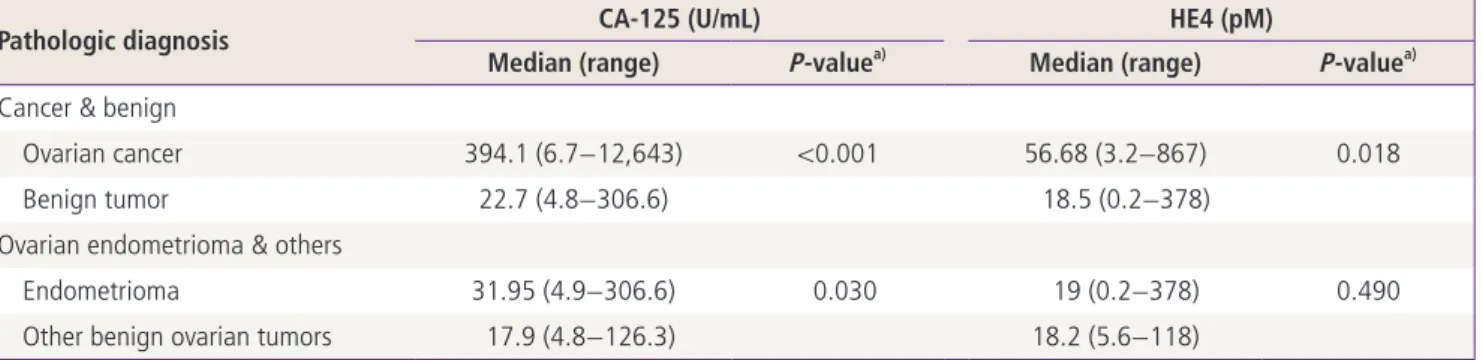
The median serum levels of CA-125 and HE4 were signifi- cantly higher among individuals with ovarian cancer when compared with those with other benign ovarian tumors, with the values for each group reaching statistical signifi- cance (CA-125, 394.1 U/mL vs. 22.7 U/mL; HE4, 56.7 pM vs. 18.5 pM; P<0.05 in both) (Table 2, Fig. 1).
The patients with benign ovarian tumors were further stratified by known endometriosis as confirmed by a patho- logic diagnosis. The median serum CA-125 and HE4 levels were then recalculated for both groups (Table 2) revealing significantly higher serum CA-125 levels in the ovarian endometrioma group when compared with the patients with other benign ovarian tumors (31.95 U/mL vs. 17.9 U/
mL, P = 0.03). Conversely, the median serum HE4 levels did
Table 2. Comparison of the serum human epididymis-specific protein E4 (HE4) and CA-125 levels among patients with ovarian cancer versus other benign ovarian tumors
Pathologic diagnosis CA-125 (U/mL) HE4 (pM)
Median (range) P-value
a)Median (range) P-value
a)Cancer & benign
Ovarian cancer 394.1 (6.7−12,643) <0.001 56.68 (3.2−867) 0.018
Benign tumor 22.7 (4.8−306.6) 18.5 (0.2−378)
Ovarian endometrioma & others
Endometrioma 31.95 (4.9−306.6) 0.030 19 (0.2−378) 0.490
Other benign ovarian tumors 17.9 (4.8−126.3) 18.2 (5.6−118)
a)
P-value, calculated using the Wilcoxon signed-rank test.
Table 1. The demographic and clinical characteristics of the study group
Characteristic Ovarian cancer
(n=32) Benign ovarian tumor
(n=62) P-value
Age (yr) 49.5 (38-71) 35.5 (13-71) <0.001
Marital status (%) 29 (90.6) 43 (69.4) 0.008
Menopause 14 (43.8) 8 (12.9) 0.003
Gravida 3.1 2.0 0.030
Parity 1.9 1.2 0.020
Values are presented as median (range) or number (%).
not vary significantly between groups (19.0 pM vs. 18.2 pM, P = 0.49). Furthermore, serum CA-125 and HE4 values
were compared between patients with ovarian cancer and the ovarian endometrioma subgroup, showing significantly elevated serum levels of both biomarkers among the ovarian cancer group (CA-125, P = 0.004; HE4, P = 0.001).
The ROC curve analysis of the diagnostic performance of patients with ovarian cancer revealed a higher AUC with borderline significance for HE4 when compared with CA- 125 (0.93 [95% confidence interval, CI: 0.90−0.97] vs. 0.85 [95% CI, 0.77−0.92]) (Fig. 2, Table 3). Additionally, the AUC for the combination of the two serum markers was 0.89 (95% CI, 0.83−0.95), but a significant difference was not found when comparing HE4 and CA-125 alone.
Using a serum cut-off level of 76.0 pM for HE4 a sensi- tivity and specificity of 78.1% and 86.8% was observed.
Using a serum cut-off level of 37.45 U/mL for serum CA- 125, a sensitivity and specificity of 84.4% and 67.4% was observed.
7.074.5 2,237.7 454 306.6 170.6 96.2 39.4 27.4 20.9 18.5
10.8 6.7
CA-125
Group
Cancer Benign
394.1
22.7 P < 0.001
378 256.4 118 70 53.8 36.8
21 19.4 18.6 14 9
0.2
HE4
Group
Cancer Benign
56.68
18.5 P < 0.05
A B
Fig. 1. Comparison of (A) the serum CA-125 and (B) human epididymis-specific protein E4 (HE4) levels between ovarian cancer and be- nign ovarian tumor.
Fig. 2. Comparison of the area under the curve from the receiver operating characteristics (ROC) curve analysis for serum CA-125 and human epididymis-specific protein E4 (HE4) levels.
1.0 0.8
0.6
0.4 0.2
0.0
Sensitivity
1-Specificity ROC
HE4CA-125 CA-125+HE4 Reference line
0.0 0.2 0.4 0.6 0.8 1.0