Vol. 15, No. 1 pp. 99-112, 2014
AHP 기반 PL상품 업체 평가모델
최소영
1, 김용민
1, 이홍철
1*1고려대학교 산업경영공학과
An assessment model for PL-product companies based on the Analytic Hierarchy Process
So-Young Choi
1, Yong-Min Kim
1and Hong-Chul Lee
11Department of Industrial Management Engineering, Korea University
요 약 본 연구는 PL(Private Level)상품 업체 선정을 위한 평가모델을 다룬다. 제안하는 평가모델은 AHP(Analytic Hierarchy Process)를 기반으로 다수의 평가항목에 대한 가중치를 도출한다. 평가항목은 국내 대형마트에서 활용하는
실 업체 선정기준으로, 특히 매출 비중이 높은 식품품목을 대상으로 한다. 식품품목에 대한 54개의 평가항목을 4단계
로 계층화 하며, 이를 기반으로 해당 업계 전문가들을 대상으로 한 설문을 수행한다. 설문을 통해 형성한 쌍대비교를
활용하여 평가항목 별 가중치를 추정하며, 이를 실 산업에서 활용 가능한 정량적 대안으로서 제안한다. 마지막으로,
제안하는 평가모델과 기존의 단순합산방식을 비교하는 평가모델 검증을 포함한다. 연구를 통해 PL상품 업체 선정에
중요도가 높은 요소로 HACCP 검증 및 유효성 평가 (0.279281), 운송(원료 입고 및 제품 출하) (0.117706), 법규 준수
중점 관리 (0.066392) 를 선별하였다. 제안하는 평가모델은 기존방식으로 우위를 판단하기 힘든 대안들에 대하여 평가
항목의 중요도를 반영함에 따라 업체 선정이 용이한 결과를 제시함을 검증하였다.
Abstract This paper addresses an assessment model for selecting PL(Private Level) product companies. The proposed model extracts the weights of evaluation elements based on AHP(Analytic Hierarchy Process). These evaluation elements are from real-world instances in a domestic hyper market. Especially, the model points at food products which constitute a large portion of entire profits in the market. In this model, we first classify the 54 evaluation elements into 4 layers and secondly carry out a survey with relevant specialists based on them. We also estimate the weights of evaluation elements according to pairwise comparisons from the survey, and propose them as a quantitative alternative which can be applied in real-world problems. Finally, the pilot-study is conducted to compare the proposed model with the existing simple summation method. From this study, HACCP system assessment and Review(0.279281), Transportation(0.117706) and Fundamental law observance(0.066392) are presented as the key evaluation elements for selecting PL product companies. The proposed model facilitates the company selection among those candidate companies which is not easy to determine the superiority by reflecting the importance of evaluation elements.
Key Words : Analytic Hierarchy Process, Assessment Model, Private Level Product
본 논문은 2013년도 3단계 BK21PLUS 사업에 의하여 지원되었음.
*Corresponding Author : Hong-Chul Lee(Korea Univ.) Tel: +82-3-290-3389 email: [email protected]
Received September 24, 2013 Revised (1st November 20, 2013, 2nd December 17, 2013) Accepted January 9, 2014
1. 서론
유통업체에서는 브랜드에 대한 책임의 주체에 따라 제 조업체 브랜드(NB, National Brand)와 유통업체 브랜드
(PL, Private Label)로 구분한다[1]. PB(Private Brand)라고 도 불리는 PL은 제조업체가 소유권을 갖는 NB와는 달리 유통업체가 브랜드의 소유권을 갖는 것이 가장 큰 특징 이다. 이는, 유통업체가 독자적 혹은 제조업체와 제휴하
여 개발한 상품을 유통업체의 단독 브랜드로 판매 또는 서비스함을 의미한다[2,3].
PL상품은 높은 수익률, 제조업체와의 협상수단 및 유 통업체에 대한 충성도 형성과 같은 이점 때문에 북미 및 서유럽 시장에서 빠른 속도로 성장하고 있다[4]. 또한, 최 근에는 대형 유통업체의 가격파괴 및 공격적 경영에 의 해 관심이 증대되고[5], 소비자의 소득변화와 소비패턴 변화에 탄력적으로 대응하기 위해 PL상품의 제품개발과 판매시장 확대됨에 따라 그 중요성이 강조되고 있다[6].
Table 1은 주요 대형마트의 PL상품 매출 상위 품목 현 황으로 2011년 상반기 기준 신선식품 40.3%, 가공식품 27.0%, 위생용품 7.7% 순으로 나타난다. 특히 신선식품 과 가공식품을 포함하는 식품품목의 비중이 67.3%로, 식 품품목이 주요 PL상품임을 알 수 있다.
[Table 1] Current state of PL products high on the list based on sales
[derived from each enterprise in June, 2011]
Item The number of products
Ratio (%)
Fresh food 121 40.3
Processed food 81 27.0
Hygienic goods 23 7.7
Home appliances 20 6.7
Bedding 13 4.3
Detergent 7 2.3
Kitchen utensils 6 2.0
Disposable product 5 1.7
Bath supplies 5 1.7
Office supplies 4 1.3
PL상품 관련연구는 크게 네 가지 분야로 분류된다. 첫 번째는 마케팅 전략 분야, 두 번째는 소비자 관련 분야, 세 번째는 광고 분야, 네 번째는 제조업체 관련 분야이다.
기존의 PL상품에 대한 연구는 마케팅 전략 분야에서 활 발히 진행되었다. 그러나 유통업체가 PL상품에 대한 수 익을 극대화하기 위해서는 제조업체에 대한 관리도 중요 함에도 불구하고 이에 대한 연구는 상대적으로 부족한 것이 현실 이다[7,8].
PL상품 제조업체 관련 연구로 유통업체와 제조업체 간 제휴에 관한 연구[9-11] 및 점포 충성도에 관한 연구 [4] 등이 있다. 제조업체 관련 분야에서 업체선정은 PL상 품을 효과적으로 관리하기 위한 중요한 요건 중 하나로 인식된다. 제조업체 선정에 관한 연구로 Kumar 등 [12]
은 PL상품 업체 선정에 대한 연구를 다루었다. Kumar 등
은 고객의 가치 및 마진률에 따라 NB상품을 보유한 제조 업체에게 PL상품을 위탁하는 것이 최적임을 보였지만, 업체선정을 위한 정량적 기준을 설정하는 데에 한계가 있다.
국내 대형마트의 PL상품 업체 선정 방식은 동종 제조 업계 2,3,4위 업체를 대상으로 심사하여 최고점 평가를 받은 업체를 PL상품 제조업체로 선정한다. 상대적으로 판매율이 높은 1위 제조업체는 대부분 PL 상품의 필요성 을 인식하지 못해 협상하지 않는다. 국내 대형마트 PL상 품 중 매출이 높은 식품품목 업체선정에 대한 실 평가항 목은 Table 2 와 같다. 각 평가 항목에 대해 5단계 등급으 로 평가하여 합산하고, 최종 평가점수를 총 1000점으로 환산한다. 이러한 방식으로 평가할 경우, 각 항목에 대한 단순합산방식으로 평가가 이루어지고 있음에 따라 항목 간의 상대적 중요도를 반영하는데 어려움이 따른다.
제안하는 방법론은 AHP(Analytic Hierarchy Process) 를 기반으로 하며, PL상품 중 가장 큰 매출 비중을 차지 하는 식품 관련 업체에 초점을 맞춘다. 연구에 대한 사례 분석은 실 업체에 대하여 진행하며, 해당 업체에서 활용 하는 평가항목과 전문가 설문을 바탕으로 각 평가항목의 상대적 중요도를 제시한다. 연구를 통해 기존의 단순 합 계 방식을 벗어나 평가항목의 중요도를 반영하는 정량적 방법론을 제시할 것으로 기대한다.
현재 국내 대형마트의 PL상품 업체 선정에 관한 연구 는 전무한 실정이다. 따라서 본 연구에서는 국내 PL상품 업체 선정에 대해 AHP를 기반으로 한 정량적 방법론을 제시하여, 그동안 활발하지 못했으나 이제 막 PL상품 업 체 선정에 관심을 가지고 시작단계에 있는 우리나라의 PL상품 업체 선정 관련 연구에 초석이 되고자 한다.
2. 업체 선정 관련 연구
업체 선정을 위한 방법론으로는 선형계획법(Linear Program), 다목적계획법(Multi-objective program), 시뮬레 이션(Simulation), AHP(Analytic Hierarchy Process), DEA (Data Envelopment Analysis) 등을 활용할 수 있다.
그 중에서도 AHP는 계층화 및 쌍대비교 설문을통해 전문가 설문의 직관성을 증대하고, 다수의 의사결정 기준 에 대한 가중치를 형성할 뿐만 아니라 또한 CR계수 평가 를 통해 설문의 타당성을 검증할 수 있는 데에 강점이 있 다. AHP는 전문가 설문을 기반으로 다기준 의사결정문 제의 평가항목에 대한 가중치를 산출하는 방법으로 일반 적으로 계층화, 쌍대비교, 가중치 추정, 가중치 통합 및 일관성 검증으로 구성된다[13].
[Table 2] existing method for selecting a PL product company
Factors Simple Summation
Score Final Score Fundamental Law Observance a1
sum
= a1+a2+a3 +...+
a53+a54 (1000)
Law Observance a2
Morality a3
Surroundings a4
Working Area a5
Floor, Wall, Ceiling a6 Subsidiary Facility a7 Drainage and Piping a8 Exit and Passage a9
Window a10
Illumanation a11
Temperature, Humidity a12
Ventilation a13
Insect Proof a14
Worker Health Care a15 Individual Health Control a16 Process Contamination a17
Waste Management a18
Disinfection a19
Machinery Management a20 Refrigeration Plant a21
Transportation a22
Supply Management a23
Storage a24
Facility Inspection a25 Product Designing a26
Packing a27
Water Management a28
Product Inspection a29
Recall Program a30
Foreign Material a31 Defective Product a32 System Construction a33 Preceding Requisite a34 Product Characteristic a35 Process Flow Diagram a36
Hazard Analysis a37
Critical Control Point a38
Threshold Level a39
Monitoring a40
HACCP Correction Measure a41
Verification a42
Documentation a43
System Examination a44 Quality Policy and Goals a45
Quality Manual a46
Responsibility and Authority a47 Standard of Goods a48
Document Control a49
Maintenance of Record a50
Process Control a51
Correction Measure a52 Complaint Handling a53 Instruction and Training a54
AHP기반 업체 선정에 관한 연구는 다음과 같다. 김대 기 [14]는 AHP를 활용하여 물류업체의 선정 우선순위를 설정하였고, 최영윤 [15]은 전자상거래 업체에서 발생하 는 택배업체 선정에 대한 연구를 다루었다. 최세종 [16]
은 항공기 엔진수리 업체 선정에 관한 연구를 제시하였 으며, 김승렬 [17]은 소프트웨어 외주업체 선정방안에 대 해 연구하였다.
3. 모델 연구
제 2장에서 설명된 AHP 방법론을 기반으로 PL상품 업체 선정 모델을 제시한다. 특히 PL상품 중 가장 큰 매 출 비중을 차지하는 식품 관련 업체에 초점을 맞추며, 실 업체에서 사용하는 평가항목을 활용한다. 평가항목을 계 층화하고, 전문가 설문을 통해 쌍대비교행렬을 구성하여, 평가항목의 가중치와 종합 가중치를 산출한다.
3.1 평가항목 구성 및 계층화
AHP는 의사결정문제를 상호 관련된 의사결정 사항들 의 계층으로 분류하여 의사결정계층-의사결정모형을 설 정한다[18]. 본 연구에서 사용하는 AHP 평가항목은 국내 최대 대형마트의 식품업체 선정 시 고려되는 실 평가 기 준을 이용하며, 이를 계층화 하는 과정은 10년 이상 경력 의 PL상품 업체 선정 전문가에 의해 이루어진다. Fig. 1 에서와 같이 총 54개 평가항목을 4단계로 계층화하며, 1 단계에서 경영적 요인, 환경적 요인 및 품질적 요인으로 구분한다. 경영적 요인은 각 항목을 2단계로 구성하고 환 경적 요인과 품질적 요인은 각 항목을 4단계로 구성한다.
3.1.1 경영적 요인
경영적 요인은 법규준수 중점관리, 법규준수 일반 및 윤리경영을 평가항목으로 포함한다. 법규준수 중점관리 는 자가품질검사, 원산지, 유통기한 및 원료에 대한 적법 성을 평가한다. 법규준수 일반은 무게·용량·개수의 허용 오차, 행정처분 및 위해식품 관리에 대한 적법성을 평가 한다. 윤리경영은 위험물 안전 관리, 응급 대응책 관리 및 작업시간·임금 관리에 대한 적법성을 평가한다.
3.1.2 환경적 요인
환경적 요인은 작업장 환경, 위생 관리, 제조시설 및 자재관리로 구성한다. 작업장환경은 물리적 작업장 환경 과 순환적 작업장 환경으로 구성하며, 물리적 작업장 환 경은 작업장주변, 작업장, 건물바닥·벽·천장 및 부대시설
[Fig. 1] The structure of factors for evaluating PL products enterprise
을 평가항목으로 포함하고, 순환적 작업장 환경은 배수 및 배관, 출입구 및 통로, 창, 채광 및 조명을 평가항목으 로 포함한다.
위생관리는 시설 위생관리, 작업자 위생관리 및 오염
물 위생관리로 구성한다. 시설 위생 관리는 온도·습도 관 리, 환기시설 관리, 방충·방서 관리를 평가항목으로 포함 하고, 작업자 위생관리는 종업원 건강관리, 개인위생 관 리를 평가항목으로 포함하며, 오염물 위생관리는 동선계
획 및 공정간 오염방지, 폐기물관리, 세척·소독 관리를 평 가항목으로 포함한다.
제조시설 및 자재관리는 설비관리, 원료 및 자재관리 로 구성한다. 설비관리는 제조시설 및 기계 기구류 등 설 비관리, 냉장·냉동 설비 관리를 평가항목으로 포함하며, 원료 및 자재관리는 운송(원료 입고 및 제품 출하), 구매 및 공급자 관리, 보관· 식별 및 추적성을 평가항목으로 포 함한다.
3.1.3 품질적 요인
품질적 요인은 제품관리, HACCP시스템, 품질경영 시 스템으로 구성한다. 제품관리는 생산 및 제조 관리와 불 량 검사 및 관리로 구성한다. 생산 및 제조 관리는 시설·
설비·기구 등검사, 제품설계 및 개발, 포장, 용수관리를 평가항목으로 포함하고, 불량 검사 및 관리는 제품검사, 회수프로그램관리, 이물질 관리, 부적합품 관리를 평가항 목으로 포함한다.
HACCP 시스템은 HACCP 시스템 개발, HACCP 시 스템 분석 및 보완, HACCP시스템 평가 및 검토로 구성 한다. HACCP 시스템 개발은 HACCP 시스템 구축, 선행 요건 프로그램, 제품 특성, 제조공정 흐름도를 평가항목 으로 포함하고, HACCP 시스템 분석 및 보완은 위해요소 분석, 중요 관리점, 한계기준, 모니터링, HACCP 시정조 치를 평가항목으로 포함하며, HACCP시스템 평가 및 검 토는 검증 및 유효성 평가, 문서화 및 기록 관리, HACCP 시스템 검토를 평가항목으로 포함한다.
품질경영 시스템은 품질 규약, 기록 관리, 사후관리로 구성한다. 품질 규약은 품질방침 및 목표, 품질 매뉴얼, 책임과 권한, 제품 규격을 평가항목으로 포함하며, 기록 관리는 문서관리, 기록 유지를 평가항목으로 포함하고, 사후 관리는 공정 관리, 시정 조치, 불만 처리, 교육 및 훈 련을 평가 항목으로 포함한다.
3.2 항목별 가중치 형성
쌍대비교행렬 의 고유벡터는 Saaty가 제안한 누승법 (Power method)을 이용하여, 최대 고유값에 해당하는 고 유벡터를 각 평가항목의 가중치 벡터 로 계산한다. 해 당 업체 전문가 3명의 설문조사를 통해 쌍대비교행렬을 구성하고, 쌍대비교행렬은 AIJ(Aggregation of Individ -ual Judgments)기법으로 통합한다. AIJ 기법은 다수의 설 문조사 결과를 통합하는 방법론 중 하나로 쌍대비교행렬 의 기하평균값을 활용한다.
Table 3 은 전문가 설문조사 통해 산출한 그룹별 상대 적 가중치를 나타낸다. 상대적 중요도 측정 결과, 최상위 단계에서는 품질적 요인(0.566)이 경영적 요인, 환경적
요인 보다 중요도가 높게 나타났다. 품질적 요인 중에서 는 HACCP 시스템(0.806)이 제품관리, 품질경영 시스템 보다 중요하게 나타났으며, HACCP 시스템에서는 HACCP 시스템 평가 및 검토(0.793)가 HACCP 시스템 개발, HACCP 시스템 분석 및 보완보다 중요도가 높게 나타났다. 마지막으로, HACCP 시스템 평가 및 검토에서 는 HACCP에 대한 검증 및 유효성 평가(0.772)가 HACCP에 대한 문서화 및 기록관리, HACCP 시스템 검 토 보다 중요하게 나타났다.
3.3 평가모델 제시
PL상품 업체 선정을 위한 최종 점수는 Bottom-up 방 식으로 산출한다. Fig 2.와 같이 가장 하위단계인 Level 4 요인에 대한 평가 점수로부터 Level 3, Level 2, Level 1 을 거쳐 최종 점수를 순차적으로 계산한다. 최하위 단계 에 해당하는 Level 4 평가항목은 실제 PL상품 업체 선정 을 담당하는 전문가들이 점수를 책정한다. 상위 요인들은 각 요인이 포함하고 있는 하위 평가항목 점수의 가중산 술평균으로 도출한다.
Table 3에 제시된 가중치를 기반으로 한 최종 PL업체 선정 평가 모델은 Table 4와 같다. 최종 평가점수 산출을 위해 평가항목 별 전문가 평가점수를 Table 4의 a1 ~ a54 에 입력한다. 각 PL상품 업체들에 대한 각 평가항목의 입 력점수는 일반적으로 전문가에 의해 평가되나 이 역시 AHP 방법론을 활용하여 산출 가능하다.
각 단계에 대한 평가점수는 Table 4에 제시한 수식에 의해 순차적으로 산출한다. Level 4에 대한 평가 점수 a1
~ a54를 기반으로 Level 3의 평가점수 b1 ~ b15를 계산 하고, 평가점수 b1 ~ b15를 활용하여 Level 2의 평가점수 c1 ~ c6을 계산한다. 그리고 평가점수 c1 ~ c6을 활용하 여 Level 1에 대한 평가점수를 계산하며, 최종점수는 d1
~ d4의 가중산술 평균으로 산출한다.
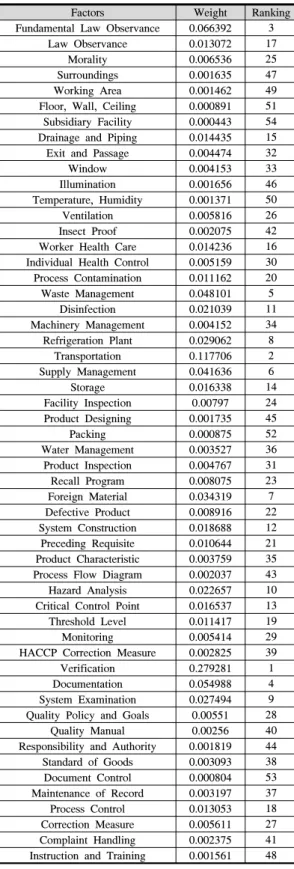
앞서 살펴본 Table 3 을 통하여 가장 하위 단계인 level 4 평가항목에 대한 종합가중치를 계산 할 수 있다. 그 결 과 Table 5 와 같은 결과가 나타났다. level 4 의 종합가중 치는 level 1, level 2, level 3, level 4의 가중치를 곱하여 계산한다. level 4 평가항목의 우선순위는 HACCP 검증 및 유효성 평가 (0.279281), 운송(원료 입고 및 제품 출 하) (0.117706), 법규 준수 중점 관리 (0.066392), HACCP 문서화 및 기록 관리 (0.054988), 폐기물 관리 (0.048101) 등의 순으로 나타난다.
이러한 분석 결과를 토대로 PL상품 업체 선정에 우선 적으로 영향을 미치는 평가항목들을 고려하면 더 용이한 PL업체 선정이 가능할 것이라 판단한다.
The name of table Pairwise comparison factors Weight Three highest Factors
Management Environment
Quality
0.086 0.347 0.566 Management
Fundamental Law Observance Law Observance
Morality
0.772 0.152 0.076 Environment
Working Condition Health Control
Manufacturing facility and Material Management
0.084 0.314 0.602 Quality
Quality Control HACCP System Quality Management System
0.124 0.806 0.070 Working Condition Physical Working Condition
Circular Working Condition
0.152 0.848 Health Control
Facility Health Control Worker Health Control Contamination Control
0.085 0.178 0.737 Manufacturing facility and Material Management Facility Management
Raw Material Management
0.159 0.841
Quality Control Manufacturing Management
Fault Inspection
0.201 0.799 HACCP System
HACCP System Development HACCP System Analysis and Supplementation
HACCP System Assessment and Review
0.077 0.129 0.793 Quality Management System
Quality Regulation Record Keeping Follow-up Management
0.328 0.101 0.571
Physical Working Condition
Surroundings Working Area Floor, Wall, Ceiling
Subsidiary Facility
0.369 0.330 0.201 0.100
Circular Working Condition
Drainage and Piping Exit and Passage
Window Illumanation
0.584 0.181 0.168 0.067 Facility Health Control
Temperature, Humidity Ventilation Insect Proof
0.148 0.628 0.224
Worker Health Control Worker Health Care
Individual Health Control
0.734 0.266 Contamination Control
Process Contamination Waste Management
Disinfection
0.139 0.599 0.262
Facility Management Machinery Management
Refrigeration Plant
0.125 0.875 Raw Material Management
Transportation Supply Management
Storage
0.670 0.237 0.093 [Table 3] Relative Weights of factors for evaluation
[Fig. 2] The process for score calculation
The name of table Pairwise comparison factors Weight
Manufacturing Management
Facility Inspection Product Designing
Packing Water Management
0.565 0.123 0.062 0.250
Fault Inspection
Product Inspection Recall Program Foreign Material Defective Product
0.085 0.144 0.612 0.159
HACCP System Development
System Construction Preceding Requisite Product Characteristic Process Flow Diagram
0.532 0.303 0.107 0.058
HACCP System Analysis and Supplementation
Hazard Analysis Critical Control Point
Threshold Level Monitoring HACCP Correction Measure
0.385 0.281 0.194 0.092 0.048
HACCP System Assessment and Review
Verification Documentation System Examination
0.772 0.152 0.076
Quality Regulation
Quality Policy and Goals Quality Manual Responsibility and Authority
Standard of Goods
0.424 0.197 0.140 0.238
Record Keeping Document Control
Maintenance of Record
0.201 0.799
Follow-up Management
Process Control Correction Measure Complaint Handling Instruction and Training
0.577 0.248 0.105 0.069 [Table 3] Relative Weights of factors for evaluation (continued)
Factors Level 4 Level 3 Level 2 Level 1 Final score
Fundamental Law Observance a1 d1
= (0.772 * a1) + (0.152 * a2) + (0.076 * a3)
Final score
= (0.086 * d1) + (0.347 * d2) + (0.566 * d3)
Law Observance a2
Morality a3
Surroundings a4 b1 = (0.369 * a4) + (0.330 * a5) + (0.201 * a6)
+ (0.100 * a7) c1
= (0.152 * b1) + (0.848 * b2)
d2
= (0.084 * c1) + (0.314 * c2) + (0.602 * c3)
Working Area a5
Floor, Wall, Ceiling a6 Subsidiary Facility a7
Drainage and Piping a8 b2 = (0.584 * a8) + (0.181 * a9) + (0.168 * a10) + (0.067 * a11) Exit and Passage a9
Window a10
Illumination a11
Temperature, Humidity a12 b2 = (0.148 * a12) + (0.628 * a13)
+ (0.224 * a14) c2
= (0.085 * b3) + (0.178 * b4) + (0.737 * b5)
Ventilation a13
Insect Proof a14
Worker Health Care a15 b2 = (0.734 * a15) + (0.266 * a16) Individual Health Control a16
Process Contamination a17 b2 = (0.139 * a17) + (0.599 * a18) + (0.262 * a19) Waste Management a18
Disinfection a19
Machinery Management a20 b2 = (0.125 * a20)
+ (0.875 * a21) c3
= (0.159 * b6) + (0.841 * b7) Refrigeration Plant a21
Transportation a22 b2 = (0.670 * a22) + (0.237 * a23) + (0.093 * a24) Supply Management a23
Storage a24
Facility Inspection a25 b1 = (0.565 * a25) + (0.123 * a26) + (0.062 * a27)
+ (0.250 * a28) c4
= (0.201 * b8) + (0.799 * b9)
d3
= (0.124 * c4) + (0.806 * c5) + (0.070 * c6) Product Designing a26
Packing a27
Water Management a28
Product Inspection a29 b1 = (0.085 * a29) + (0.144 * a30) + (0.612 * a31) + (0.159 * a32) Recall Program a30
Foreign Material a31 Defective Product a32
System Construction a33 b1 = (0.532 * a33) + (0.303 * a34) + (0.107 * a35) + (0.058 * a36)
c5
= (0.077 * b10) + (0.129 * b11) + (0.793 * b12) Preceding Requisite a34
Product Characteristic a35 Process Flow Diagram a36
Hazard Analysis a37 b1 = (0.385 * a37) + (0.281 * a38) + (0.194 * a39) + (0.092 * a40) + (0.048 * a41) Critical Control Point a38
Threshold Level a39
Monitoring a40
HACCP Correction Measure a41
Verification a42 b2 = (0.772 * a42) + (0.152 * a43) + (0.076 * a44)
Documentation a43
System Examination a44
Quality Policy and Goals a45 b1 = (0.424 * a45) + (0.197 * a46) + (0.140 * a47)
+ (0.238 * a48) c6
= (0.328 * b13) + (0.101 * b14) + (0.571 * b15) Quality Manual a46
Responsibility and Authority a47 Standard of Goods a48
Document Control a49 b1 = (0.201 * a49) + (0.799 * a50) Maintenance of Record a50
Process Control a51 b1 = (0.577 * a51) + (0.248 * a52) + (0.105 * a53) + (0.069 * a54) Correction Measure a52
Complaint Handling a53 Instruction and Training a54
[Table 4] An integrated assessment score for selecting a PL product company
Factors Weight Ranking Fundamental Law Observance 0.066392 3
Law Observance 0.013072 17
Morality 0.006536 25
Surroundings 0.001635 47
Working Area 0.001462 49
Floor, Wall, Ceiling 0.000891 51 Subsidiary Facility 0.000443 54 Drainage and Piping 0.014435 15 Exit and Passage 0.004474 32
Window 0.004153 33
Illumination 0.001656 46
Temperature, Humidity 0.001371 50
Ventilation 0.005816 26
Insect Proof 0.002075 42
Worker Health Care 0.014236 16 Individual Health Control 0.005159 30 Process Contamination 0.011162 20 Waste Management 0.048101 5
Disinfection 0.021039 11
Machinery Management 0.004152 34 Refrigeration Plant 0.029062 8
Transportation 0.117706 2
Supply Management 0.041636 6
Storage 0.016338 14
Facility Inspection 0.00797 24 Product Designing 0.001735 45
Packing 0.000875 52
Water Management 0.003527 36 Product Inspection 0.004767 31 Recall Program 0.008075 23 Foreign Material 0.034319 7 Defective Product 0.008916 22 System Construction 0.018688 12 Preceding Requisite 0.010644 21 Product Characteristic 0.003759 35 Process Flow Diagram 0.002037 43 Hazard Analysis 0.022657 10 Critical Control Point 0.016537 13 Threshold Level 0.011417 19
Monitoring 0.005414 29
HACCP Correction Measure 0.002825 39
Verification 0.279281 1
Documentation 0.054988 4
System Examination 0.027494 9 Quality Policy and Goals 0.00551 28
Quality Manual 0.00256 40
Responsibility and Authority 0.001819 44 Standard of Goods 0.003093 38 Document Control 0.000804 53 Maintenance of Record 0.003197 37 Process Control 0.013053 18 Correction Measure 0.005611 27 Complaint Handling 0.002375 41 Instruction and Training 0.001561 48
[Table 5] Integrated weights of evaluation elements
3.4 일관성 검증
Table 6는 일관성 검증 결과로 제시된 사례에 대한 CR 지표 산출 결과 25개 그룹에서 모두 0.2 이하의 수치가 나타남에 따라 설문조사 결과가 타당함을 확인하였다.
[Table 6] Consistency ratio of the survey
The name of table Consistency atio Three highest Factors 0.013
Management 0.037
Environment 0.003
Quality 0.094
Working Condition 0.000
Health Control 0.095
Manufacturing facility and Material Management 0.000
Quality Control 0.000
HACCP System 0.040
Quality Management System 0.061 Physical Working Condition 0.132 Circular Working Condition 0.041 Facility Health Control 0.105 Worker Health Control 0.000 Contamination Control 0.031 Facility Management 0.000 Raw Material Management 0.099 Manufacturing Management 0.085
Fault Inspection 0.011
HACCP System Development 0.038 HACCP System Analysis and Supplementation 0.041 HACCP System Assessment and Review 0.037 Quality Regulation 0.103
Record Keeping 0.000
Follow-up Management 0.084
4. 평가모델의 검증
본 연구를 통해 제안하는 평가모델과 기존의 단순합산 방식과의 차이점을 검증하기 위해 평가사례 예시에 대한 분석을 수행한다. 기존의 실 산업에서 활용하는 단순합산 방식은 각 평가 항목에 대해 5단계 등급으로 평가하여 합 산하고, 최종 평가점수를 총 1000점으로 환산한다. 평가 사례 예시에서는 단순합산방식으로 평가할 경우 최종 평 가점수가 유사한 세 후보 업체 A, B, C를 가정한다. 제안 하는 평가모델과 단순합산방식의 최종 평가점수 산정 결 과는 Table 7과 같다. 두 가지 방법론에 대한 점수 산정 과정은 Table 8, Table 9, Table 10 에 각각 제시되어 있다.
Company A
Company B
Company C Simple Summation 792.6 807.4 796.3
Proposed Model 790.8 748.2 839.7 [Table 7] Pilot-study result
Factors Simple Summation Proposed Model
Score Final Score Level 4 Level 3 Level 2 Level 1 Final Score Fundamental Law Observance 3
792.6 (1000)
3
3.152
790.8 (1000)
Law Observance 4 4
Morality 3 3
Surroundings 4 4
4.029
3.213
4.084
Working Area 5 5
Floor, Wall, Ceiling 3 3
Subsidiary Facility 3 3
Drainage and Piping 2 2
3.067
Exit and Passage 4 4
Window 5 5
Illumanation 5 5
Temperature, Humidity 5 5
3.744
3.667
Ventilation 3 3
Insect Proof 5 5
Worker Health Care 5 5
4.734
Individual Health Control 4 4
Process Contamination 4 4
3.401
Waste Management 3 3
Disinfection 4 4
Machinery Management 3 3
3.875
4.422
Refrigeration Plant 4 4
Transportation 5 5
4.526
Supply Management 3 3
Storage 5 5
Facility Inspection 5 5
5
4.873
4.003
Product Designing 5 5
Packing 5 5
Water Management 5 5
Product Inspection 5 5
4.841
Recall Program 5 5
Foreign Material 5 5
Defective Product 4 4
System Construction 4 4
3.942
3.903
Preceding Requisite 4 4
Product Characteristic 4 4
Process Flow Diagram 3 3
Hazard Analysis 2 2
2.847
Critical Control Point 3 3
Threshold Level 3 3
Monitoring 5 5
HACCP Correction Measure 4 4
Verification 4 4
4.076
Documentation 5 5
System Examination 3 3
Quality Policy and Goals 3 3
3.473
3.617
Quality Manual 3 3
Responsibility and Authority 3 3
Standard of Goods 5 5
Document Control 3 3
3.799
Maintenance of Record 4 4
Process Control 3 3
3.667
Correction Measure 5 5
Complaint Handling 4 4
Instruction and Training 4 4
[Table 8] Comparison between simple summation method and the proposed model of Company A
Factors Simple Summation Proposed Model
Score Final Score Level 4 Level 3 Level 2 Level 1 Final Score Fundamental Law Observance 4
796.3 (1000)
4
3.924
839.7 (1000)
Law Observance 4 4
Morality 3 3
Surroundings 4 4
4.33
4.306
3.475
Working Area 5 5
Floor, Wall, Ceiling 4 4
Subsidiary Facility 4 4
Drainage and Piping 5 5
4.302
Exit and Passage 3 3
Window 3 3
Illumanation 5 5
Temperature, Humidity 4 4
3.372
4.313
Ventilation 3 3
Insect Proof 4 4
Worker Health Care 3 3
Individual Health Control 3 3 3
Process Contamination 5 5
4.738
Waste Management 5 5
Disinfection 4 4
Machinery Management 3 3
3
2.922
Refrigeration Plant 3 3
Transportation 3 3
2.907
Supply Management 3 3
Storage 2 2
Facility Inspection 3 3
3.247
3.861
4.692
Product Designing 4 4
Packing 5 5
Water Management 3 3
Product Inspection 4 4
4.015
Recall Program 3 3
Foreign Material 4 4
Defective Product 5 5
System Construction 5 5
4.483
4.919
Preceding Requisite 4 4
Product Characteristic 3 3
Process Flow Diagram 5 5
Hazard Analysis 5 5
4.718
Critical Control Point 4 4
Threshold Level 5 5
Monitoring 5 5
HACCP Correction Measure 5 5
Verification 5 5
5
Documentation 5 5
System Examination 5 5
Quality Policy and Goals 4 4
3.939
3.548
Quality Manual 3 3
Responsibility and Authority 5 5
Standard of Goods 4 4
Document Control 5 5
Maintenance of Record 5 5 5
Process Control 3 3
3.066
Correction Measure 3 3
Complaint Handling 3 3
Instruction and Training 4 4
[Table 9] Comparison between simple summation method and the proposed model of Company B
Factors Simple Summation Proposed Model
Score Final Score Leve l4 Level 3 Level 2 Level 1 Final Score Fundamental Law Observance 5
807.4 (1000)
5
4.848
748.2 (1000)
Law Observance 4 4
Morality 5 5
Surroundings 4 4
4.631
4.238
4.149
Working Area 5 5
Floor, Wall, Ceiling 5 5
Subsidiary Facility 5 5
Drainage and Piping 4 4
4.168
Exit and Passage 4 4
Window 5 5
Illumanation 4 4
Temperature, Humidity 4 4
3.596
4.337
Ventilation 3 3
Insect Proof 5 5
Worker Health Care 5 5
Individual Health Control 5 5 5
Process Contamination 4 4
4.262
Waste Management 4 4
Disinfection 5 5
Machinery Management 5 5
5
4.038
Refrigeration Plant 5 5
Transportation 4 4
3.856
Supply Management 3 3
Storage 5 5
Facility Inspection 3 3
3.374
3.989
3.329
Product Designing 3 3
Packing 5 5
Water Management 4 4
Product Inspection 4 4
4.144
Recall Program 5 5
Foreign Material 4 4
Defective Product 4 4
System Construction 5 5
4.697
3.225
Preceding Requisite 4 4
Product Characteristic 5 5
Process Flow Diagram 5 5
Hazard Analysis 3 3
3.756
Critical Control Point 5 5
Threshold Level 4 4
Monitoring 3 3
HACCP Correction Measure 3 3
Verification 3 3
3
Documentation 3 3
System Examination 3 3
Quality Policy and Goals 4 4
3.659
3.356
Quality Manual 3 3
Responsibility and Authority 3 3
Standard of Goods 4 4
Document Control 3 3
Maintenance of Record 3 3 3
Process Control 3 3
3.245
Correction Measure 4 4
Complaint Handling 3 3
Instruction and Training 3 3
[Table 10] Comparison between simple summation method and the proposed model of Company C
단순합산방식으로 산출한 최종 평가점수는 후보 업체 A 792.6점, 후보 업체 B 807.4점, 후보 업체 C 796.3점으 로 후보업체 B가 가장 높게 나타나고, 제안하는 평가모 델로 산출한 최종 평가점수는 후보 업체 A 790.8점, 후보 업체 B 748.2점, 후보 업체 C 839.7점으로 후보 업체 C가 가장 높게 나타난다. 단순합산방식의 경우 선정 업체 B 와 후보 업체 A, C와의 차이가 각각 14.8점, 11.1점으로 나타나는 반면, 제안하는 모델의 경우 선정 업체 C와 후 보 업체 A, B와의 차이가 각각 48.9점, 91.5점으로 나타 난다. 이와 같은 차이는 각 평가항목 점수의 단순 합계로 이루어지는 기존 방식에서 벗어나, 각 항목의 상대적 가 중치를 반영함에 따른다. 자세히 말해, 후보업체 B의 경 우 중요도가 낮은 평가항목에 대하여 상대적으로 높은 점수를 가지지만, 후보 업체 C의 경우는 중요도가 높은 평가항목에 대하여 점수가 높음을 의미한다. 이와 같은 결과를 통해 기존방식으로 우위를 판단하기 힘든 대안들 에 대하여 제안하는 모델이 PL상품 업체 선정에 용이한 결과를 제시함을 검증하였다.
5. 결론 및 향후연구
본 연구는 기존 PL상품 업체 선정에 관한 연구가 미비 했던 점을 감안하여, AHP기법을 이용해 PL상품 업체 선 정을 위한 평가항목에 대한 중요도를 반영하는 정량적 평가모델을 제시함에 의의를 가지고, 이를 실 산업에서 발생하는 문제 해결에 활용할 경우 기존의 단순합산방식 과 비교하여 더욱 정교한 의사결정이 가능할 것으로 기 대한다.
AHP기법을 적용하는 과정에서는 국내 대형마트 PL상 품 중 매출 비중이 가장 높은 식품품목 업체선정에 대한 실 평가항목을 활용하였고, 이에 대한 계층화, 전문가 설 문을 통해 각 평가항목에 대한 가중치를 산출하였다. PL 상품 업체 선정에 우선적으로 영향을 미치는 요인들을 살펴본 결과 HACCP 검증 및 유효성 평가 (0.279281), 운 송(원료 입고 및 제품 출하) (0.117706), 법규 준수 중점 관리 (0.066392)가 높게 나타났다.
평가 모델의 검증을 위해 최종 평가 점수가 유사한 세 후보 업체에 대해 기존 단순합산방식과 제안하는 평가모 델방식을 비교하여 중요도가 높은 평가항목의 점수에 따 라 PL 상품 업체 선정 결과가 달라짐을 보였다. 기존방식 으로 우위를 판단하기 힘든 대안들에 대하여 제안하는 모델이 PL상품 업체 선정에 용이한 결과를 제시함을 검 증하였다.
이번 연구가 이제 막 시작단계에 있는 국내 PL상품업
체선정 관련연구에 있어 초석이 되길 기대하며, 향후 연 구로는 의사결정 기준들에 대한 상호관련성을 고려하여 모델의 현실 반영도를 향상시킬 수 있을 것으로 기대하 고, 이에 대한 대안으로 ANP(Analytic Network Process) 방법론을 고려하고자 한다.
References
[1] Stren, L. W., A. Al-Ansary, & J. T. Brown,
“Management in Marketing Challels”, Englewood Cliffs, New Jersey Prentice Hall, Inc., 1996.
[2] Boone, L. E., & D. L. Kurtz, “Contemporary Marketing”, Fort Worth, T.X.: Dryden, 1995.
[3] McGoldrick, P. J., “Grocery generics-an extension of the private label concept”, European Journal of Marketing, Vol.18, pp.5-24, 1984.
DOI: http://dx.doi.org/10.1108/EUM0000000004760 [4] Kumar, N. and J. B. E. M. Steenkamp, “Private Label
Strategy: How to Meet the Store Brand Challenge”, Havard Business School Press, Boston, Massachusetts, 2007.
[5] Chang-Hyun Jin, “The Relationship between Consumers Awareness, Image, Perceived Quality toward Private Brand and Brand Loyalty”, Journal of Korean academy of business administration, Vol.24, No.6, pp.3461-3480, December, 2011.
[6] Yeong-Geun Park, Chang-Wan Kim, “A Study on Factors Affecting PB(Private Brand) Products Preference”, Journal of Korean academy of marketing science, Vol.9, pp.189-201, 2002.
[7] Dunne, D. and C. Narasimhan, “The New Appeal of Private Labels,” Harvard Business Review, pp.41-52, 1999.
[8] Góez, M. and N.R. Benito, “Manufacturer’s Characteristics that Determine the Choice of Producing Store Brands”, European Journal of Marketing, Vol.42, No.1/2, pp.154-177, 2008.
DOI: http://dx.doi.org/10.1108/03090560810840952 [9] Vaidyanathan, R. and P. Aggarwal, “Strategic Brand
Alliances: Implications of Ingredient Branding for National and Private Lavel Brands”, Journal of Product and Brand Management, Vol.9, No.4, pp.214-228, 2000.
DOI: http://dx.doi.org/10.1108/10610420010344013 [10] Gyeongdo-Park, Jinyong-Park, and Seungeun-Jeon,
“Successful Alliance Between Private and National Brands : The Moderating Effect of Price and Quality
Sensitivity”, Journal of korea distribution association, Vol.12, No.4, pp.109-125, October, 2007.
[11] Verhoef, P. C., E. J. Nijssen, and L. M. Sloot,
“Strategic Reactions of National Brand Manufacturers Towards Private Labels: An Empirical Study in The Netherlands,” European Journal of Marketing, Vol.36, No.11/12, pp.1309-1326, 2002.
DOI: http://dx.doi.org/10.1108/03090560210445191 [12] Kumar, N., S. Radhakrishnan, and R.C. Rao, “Private
Label Vender Selection in a Supply Chain:Quality and Clientele Effects”, Journal of Retailing, Vol.86, No.2, pp.148-158, 2010.
DOI: http://dx.doi.org/10.1016/j.jretai.2010.02.007 [13] Saaty, T. L., “The Analytic Hierarchy Process”,
Mcgraw-Hill, New York, 1980.
[14] Daegi-Kim and Ogyeong-Kwuan "A Study on the Development of Criteria and Priority Orders for Selecting Third Party Logistics Companies", Journal of korean Operations Research and Management Science Society, Vol.20, No.2, pp.151-163 , November, 2003.
[15] Changi-,Nam and Byeongrae-Kim "A Study on E-Commerce Firms' Selecting Criteria for Small Package Express Service Provider by Using the Analytic Hierarchy Process", Journal of Korea Internet Electronic Commerce Association, Vol.3, No.1, 27p ~ 42p, September, 2008.
[16] Sejong-Choi "A Study on the Selection of Aircraft Engine Overhaul Company using AHP", Journal of korean Operations Research and Management Science Society, Vol.1, pp.88-99, 1998.
[17] Seungryeol-Kim, Huisuk-Jeon and Huisuk-Jung “A study on the selection method of the software developer using AHP”, Journal of Korean academy of business administration, Vol.12, No.2, pp.15-30, 1995.
[18] wikipedia. Analytic Hierarchy Process. [cited 2013 March 15] http://ko.wikipedia.org/wiki/%EA%B3%84%
EC%B8%B5%EB%B6%84%EC%84%9D%EB%B2%95.
(accessed Nov., 18, 2013)
최 소 영
(So-Young Choi) [준회원]• 2007년 3월 ~ 현재 : 고려대학교 산업경영공학과 석사과정
<관심분야>
SCM, 인지모델, 생산 및 물류 정보시스템
김 용 민
(Yong-Min Kim) [준회원]• 2013년 9월 ~ 현재 : 고려대학교 산업경영공학과 석사과정
<관심분야>
SCM, 생산 및 물류 정보시스템, 적재 최적화
이 홍 철
(Hong-Chul Lee) [정회원]• 1983년 2월 : 고려대학교 산업공 학 학사
• 1988년 2월 : Univ of Texas 산 업공학 석사
• 1993년 2월 : Texas A&M Univ.
산업공학박사
• 1996년 3월 ~ 현재 : 고려대학 교 산업경영공학과 교수
<관심분야>
SCM, 생산 및 물류 정보시스템, PLM