대한소화기학회지 2010;55:217-224 □ REVIEW □ DOI: 10.4166/kjg.2010.55.4.217
연락처: 홍수진, 420-853, 경기도 부천시 원미구 중동 1174 순천향대학교 의과대학 부천병원 내과
Tel: (032) 621-5090, Fax: (032) 621-5080 E-mail: [email protected]
Correspondence to: Su Jin Hong, M.D.
Department of Internal Medicine, Soonchunhyang University School of Medicine, 1174, Jung-dong, Wonmi-gu, Bucheon 420-853, Korea
Tel: +82-32-621-5090, Fax: +82-32-621-5080 E-mail: [email protected]
식도성 흉통의 진단과 치료
순천향대학교 의과대학 내과학교실
홍 수 진
Diagnosis and Management of Esophageal Chest Pain
Su Jin Hong, M.D., Ph.D.
Department of Internal Medicine, Soonchunhyang University School of Medicine, Bucheon, Korea
Esophageal pain that manifests as heartburn or chest pain, is a prevalent problem. Esophageal chest pain is most often caused by gastroesophageal reflux disease (GERD), but can also result from inflammatory processes, in- fections involving the esophagus, and contractions of the esophageal muscle. The mechanisms and pathways of esophageal chest pain are poorly understood. Vagal and spinal afferent pathways carry sensory information from the esophagus. Recently, esophageal hypersensitivity is identified as an important factor in the development of esophageal pain. A number of techniques are available to evaluate esophageal chest pain such as endoscopy and/or proton-pump inhibitor trial, esophageal manometry, a combined impedance-pH study, and esophageal ultra- sound imaging. Proton pump inhibitors (PPIs) have the huge success in the treatment of GERD. Other drugs such as imipramine, trazadone, sertraline, tricyclics, and theophylline have been introduced for the control of esophageal chest pain in partial responders to PPI and the patients with esophageal hypersensitivity. Novel drugs which act on different targets are anticipated to treat esophageal pain in the future. (Korean J Gastroenterol 2010;55:
217-224)
Key Words: Esophagus; Chest pain
서 론
식도성 흉통은 허혈성 심장병의 통증과 매우 유사하여, 흉 통의 본질을 구별하는 것은 진단과 치료에 있어 매우 중요 한 일이다. 식도성 흉통은 비심장성 흉통(noncardiac chest pain)의 가장 흔한 원인이 되며, 위식도역류질환(gastroeso- phageal reflux disease, GERD)은 식도성 흉통 발생의 가장 강 력한 자극이기 때문에1,2 아칼라지아 또는 미만성식도경련의 가능성이 낮은 환자에 있어 시험적 양성자펌프억제제(pro-
ton pump inhibitor, PPI) 치료는 유용한 초기 접근 방식으로 여겨진다.3 위식도역류질환보다 빈도는 적지만 이차성 식도 근육경련도 식도성 흉통의 주요 원인이며,1 아칼라지아(특 히 vigorous achalasia), 미만성 식도 경련증은 통상적인 식도 내압검사로 확인할 수 있다. 그러나, 식도 종주근(longi- tudinal muscle)의 경련은 식도내압검사로 확인이 불가능하 여 별도의 검사로 확인하기도 한다.4 그 외에도 폐쇄성 병변 에 의한 이차성 식도경련, 다른 염증성 질환들도 급성 흉통 을 유발한다. 이 글에서는 식도성 흉통의 원인에 대한 이해
218 대한소화기학회지: 제55권 제4호, 2010
와 적절한 치료에 대하여 문헌 고찰을 통하여 정리하고자 한다.
본 론
1. 식도성 흉통의 정의와 유병률
간혹 심한 가슴쓰림(heartburn)이 흉통으로 느껴지기도 하 지만, 일반적으로 식도성 흉통은 마치 허혈성 심장병의 흉 통과 아주 유사한 통증을 말한다. 식도성 흉통의 진단은 심 장성 흉통이 아님을 관상동맥조영술을 위시한 검사방법들 로 확인해야 하기 때문에 쉽지 않은 과정이며, 심장검사들 이 음성이라도 식도성 흉통을 직접적으로 의미하지는 않는 다. 때로 비심장성 흉통(noncardiac chest pain)이 위식도역류 질환에 대한 문헌 등에서 식도성 흉통의 의미로 사용되는데 이는 엄밀하게는 올바르지 않으며, 단지 식도성 흉통은 비 심장성 흉통의 가장 흔한 원인이라 할 수 있다.
진단 과정이 쉽지 않기 때문에 식도성 흉통의 유병률은 대략적으로만 추정할 수 있으나 상당히 높음을 간접적으로 알 수 있다. 심장성 흉통과 유사한 증상을 가진 환자 중 위 식도역류질환의 비율은 22%에서 66%로 보고되었다.1,2,5
2. 식도성 흉통의 발생 기전
산 역류에 의한 강렬한 점막 통증은 식도성 흉통을 가장 빈번하게 유발하며 이차성 식도근육경련의 빈도는 이보다 적다.1,2 식도 종주근의 경련은 식도내압검사로 검출되지 않 으며, 내강 초음파검사를 비롯한 다른 방법으로 확인할 수 있다. 폐색성 식도 병변에 인한 이차성 경련도 빈도는 적지 만 급성 심장성 통증과 유사한 통증을 일으킬 수 있다.
전형적인 위식도역류질환의 증상이 있으나, 내시경에서 관찰되는 식도점막이 정상인 경우 비미란성 역류질환(no- nerosive reflux disease, NERD)으로 부른다. 비미란성 역류질 환으로 추정되는 환자의 50% 정도에서 24시간 식도산도검 사는 정상 소견을 보인다.6 기능성 식도질환에 대한 Rome II 위원회는 기능성 가슴쓰림(functional heartburn)을 정상 식도 점막과 정상 24시간 식도산도검사를 가진 환자군이라 정의 하고, 이들을 다시 산 역류 시점에서 증상을 보이는 그룹과 산 역류 시점과 증상이 전혀 관련이 없는 그룹으로 분류하 였다. 이후 Rome III 위원회는 산역류 시점에서 증상을 보이 는 그룹과 양성자펌프억제제에 반응을 보이는 환자들을 기 능성 가슴쓰림에서 제외하였다.7 기능성 가슴쓰림 환자들은 식도풍선팽창이나 전기적 자극에 대하여 위식도역류질환 환자에 비하여 낮은 통증감각 역치를 나타낸다.8 실제로 기 능성 가슴쓰림 환자의 90%는 식도풍선팽창 또는 식도 산관 류검사(Bernstein test)에 양성을 보였다.9 식도과민성(esopha-
geal hypersensitivity)은 기능성 가슴쓰림의 주요한 기전으로 여겨지고 있다. 스트레스, 불안, 우울과 같은 정신적 자극도 식도 감각을 변화시킬 수 있으며,10 담즙산의 역류11와 같은 화학적 자극, 식도 확장, 종주근 수축, 식도 운동의 기계적 자극12이 관여한다고 믿어진다.
미주 및 척수 구심성경로는 식도로부터 감각에 대한 정보 를 전달하며, 산 유발성 염증이나 손상은 식도 구심성 신경 섬유의 반응성을 변화시킨다. 그러나 염증의 정도와 증상의 심한 정도는 상관성을 보이지 않는다. 미주 구심성경로는 수용체의 위치에 따라 3군으로 분류된다. 점막수용체는 휴 지기에는 반응이 없다가 점막의 급성 염증이나 손상 후 유 리되는 5-HT (5-hydroxytryptamine)과 같은 물질에 활성화된 다.13 장력수용체(tension receptor)는 식도벽 장력에 대하여 반응을 나타내며 이차성 연동운동을 일으키거나 식괴를 감 지한다. 척수 구심성경로는 불쾌감이나 통증과 같은 감각을 중추신경계로 전달한다.14
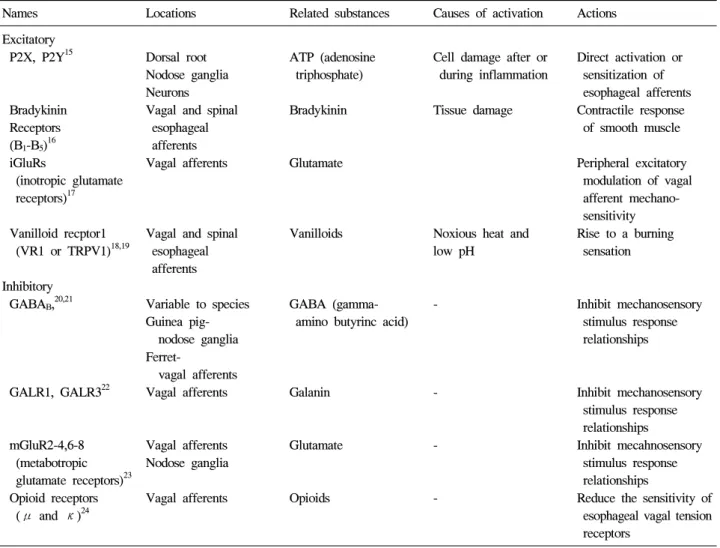
식도의 편평상피세포는 내인성 매개체(endogenous media- tors) 분비를 담당하는 분비성 세포가 소장 등에 비하여 적 은 편이다. Table 1은 식도 상피세포에 존재는 수용체들을 정 리하였으며, 식도에 작용하는 약물의 기전의 이해에 도움이 될 수 있다. 조직 손상이나 염증은 열(heat), 이온(K+, H+), amines (5-HT, histamine), kinins (bradykinin), prostanoids (PGE2), purines (ATP), cytokines (TNF, IL-1, IL-6), 신경성장인자 (nerve growth factor, NGF)같은 여러가지 물리적, 화학적, 생 물학적 인자들의 축적을 가져 오고, 이러한 물질들은 특정 수용체 또는 세포전령물질(cellular messengers)을 통하여 신 경적 감작(sensitization)을 가져 온다.25 염증성 과민성(inflam- matory hypersensitivity)은 세포 골격의 충실 여부에 따라 다 르게 나타난다. 세포 골격이 염증에 의해 손상되면, 유해물 질에 의한 신경적 감작이 더 쉽게 일어나게 된다.
3. 식도성 흉통의 진단 전략
위식도역류질환의 유병률이 높기 때문에 양성자펌프억제 제는 위식도역류질환 연관 증상이 있는 경우 별도의 진단검 사 없이 시도되는 경우가 있다. 그러나 내시경 검사를 양성 자펌프억제제 치료 이전에 시행하여야 하는 가는 현재까지 도 논쟁거리이다. 내시경검사로는 미란성 식도염을 평가할 수 있고, 감염성 식도염이나 약제유발성 식도염 등을 감별 해낼 수 있다.
한편, 내시경검사에 뚜렷한 소견이 없는 환자들에서 24시 간 식도산도검사가 양성자펌프억제제 치료 이전에 필요한 것인가도 논쟁이 되고 있다. 그러나 현재 소화기의사들의 일반적인 합의는 합병증이 없는 가슴쓰림은 검사 이전에 경 험적 양성자펌프억제제 치료를 하는 것이다. 증상이 양성자 펌프억제제 치료 4주 이내에 충분한 호전을 보이면 위식도
홍수진. 식도성 흉통의 진단과 치료 219
Table 1. Receptors of Esophageal Afferents
Names Locations Related substances Causes of activation Actions Excitatory
P2X, P2Y15 Dorsal root Nodose ganglia Neurons
ATP (adenosine triphosphate)
Cell damage after or during inflammation
Direct activation or sensitization of esophageal afferents Bradykinin
Receptors (B1-B5)16
Vagal and spinal esophageal afferents
Bradykinin Tissue damage Contractile response of smooth muscle
iGluRs
(inotropic glutamate receptors)17
Vagal afferents Glutamate Peripheral excitatory modulation of vagal afferent mechano- sensitivity Vanilloid recptor1
(VR1 or TRPV1)18,19
Vagal and spinal esophageal afferents
Vanilloids Noxious heat and low pH
Rise to a burning sensation
Inhibitory
GABAB,20,21 Variable to species
Guinea pig- nodose ganglia
GABA (gamma- amino butyrinc acid)
- Inhibit mechanosensory stimulus response relationships Ferret-
vagal afferents
GALR1, GALR322 Vagal afferents Galanin - Inhibit mechanosensory stimulus response relationships mGluR2-4,6-8
(metabotropic glutamate receptors)23
Vagal afferents Nodose ganglia
Glutamate - Inhibit mecahnosensory stimulus response relationships Opioid receptors
(μ and κ)24
Vagal afferents Opioids - Reduce the sensitivity of esophageal vagal tension receptors
역류질환과 관련된 증상이라 추정하고 치료하게 된다. 잘못 된 진단을 피하고, 위식도역류질환의 합병증을 구별해 내려 면 “경고 증상” 유무를 잘 살펴야 한다.
감별해야 할 질환으로는 관상동맥질환, 담낭질환, 위 및 식도의 악성 종양, 소화성 궤양, 호산구성 식도염, 감염성 식도염, 부식성 식도염 등이 있다. 이 중에서 허혈성 심질환 은 질환의 사망률이 높으므로 특히 유의하여 감별해야 한 다. 경고 증상으로는 구토, 위장관 출혈의 증거, 체중 감소, 연하곤란, 빈혈, 심와부 종물 등이 있다.26,27 하루 2회의 충 분한 양성자펌프억제제 치료에도 반응을 보이지 않는 가슴 쓰림 또는 흉통에서는 내시경검사를 통하여 바렛식도, 협 착, 호산구성 식도염, 그 외 다른 질환의 진단을 확인하기 위하여 내시경검사가 필요하다. 연하곤란이 있는 경우, 식 도의 폐쇄성 질환이 없더라도 호산구성 식도염을 확인하기 위하여 여러 위치에서 조직생검을 얻어야 한다.28
정상 내시경소견을 보이며 양성자펌프억제제 치료에도 증상이 지속되면 역류유도성 식도확장(reflux-elicited esopha- geal distention)29 또는 역류유도성 지속적 식도수축(reflux-
elicited sustained esophageal contraction)30의 가능성을 생각할 수 있다. 이런 경우 역류억제약물이나 항역류수술이 필요하 다. 역류억제약물로는 GABAB 작용제(agonist)인 baclofen이 현재 사용 가능한 유일한 약제이다. 불행히도 baclofen은 때 로 부작용으로 진정(sedation)이 나타나기 때문에 이러한 부 작용을 최소화하고 유사한 약물 작용을 보이는 새로운 baclofen 유사 약물을 기대하고 있다.
식도내압검사는 위식도역류질환으로 오인된 일부의 아칼 라지아, 미만성 식도경련 등을 감별할 수 있다. 최근 이용되 고 있는 고해상도 내압검사(high-resulotion manometry)는 아 칼라지아와 미만성 식도경련의 비전형적 예를 보다 잘 진단 할 수 있다. 고해상도 내압검사는 내시경검사 후 두 번째 진 단 도구로 이용하는 것이 권장된다. 한편, 식도 종주근 수축 은 1-2 mm의 가느다란 catheter probe를 이용한 내강 초음파 검사로 측정이 가능하다. 그러나 내강 초음파검사는 간편하 고 비침습적이라는 장점이 있지만, 보행성 검사가 불가능하 며, 판독에 많은 시간과 노력이 필요하다는 단점이 있다. 고 해상도 내압검사는 상부 및 하부식도조임근을 명확하게 보
Table 2. Efficacy and Safety of Therapeutic Trials in Esophageal Chest Pain Drugs Study design Study
size (n) Mean
age F/M Duration Outcome
measure Results Safety analysis Clonidine Double-blind, 60 50 40/20 10 weeks Frequency Imipramine Imipramine:
0.01 mg BID placebo of chest pain decreased prolonged
or controlled (CPF) CPF QT interval
imipramine crossover (p=0.03)
50 mg QHS clonidine
or placebo no effect on
BID37 CPF
Nifedipine Double-blind 20 50 8/12 14 weeks Distal esophageal Nifedipine Nifedipine 10-30 mg placebo contraction (DEC), decreased >placebo:
TID33 controlled CPF, severity, DEC amplitude facial crossover index (p<0.005), flushing,
Daily CPF, edema, severity, index headache similar to lightheaded- placebo ness,
nervousness Botulinum Open-label 29 61 24/5 1-18 CPF Botulinu toxin Not reported toxin 100U prospective months reduced chest
Injection35 pain in 62%
(p<0.0001), regurgitation and dysphagia
Trazadone Double-blind, 29 47.5 21/8 6 weeks Global index Trazadone Sedation 100-150 mg placebo of health (GIH), increased GIH
QD or controlled residual distress, (p=0.02),
placebo QD38 manometric decreased
changes residual effect on manometry
Amitriptyline, Open-label 21 49.7 14/7 Mean 2.7 Chest pain Tricyclic Sedation, imipramine, retrospective years (0.8-8.6) index (CPI), antidepressants anticholinergic nortriptyline, review dstress (TCA) symptoms
desipramine40 decreased CPI
(varying doses) and distress
(p<0.01) at follow-up
Sertraline Double-blind 30 - - 8 weeks Daily pain Sertraline Sertraline:
50-200 mg placebo daries (DPD) decreased nausea, QD or controlled Beck Depression daily pain restlessness, placebo39 Inventory (BDI), (p<0.02), decreased
SF36 no effect libido, on BDI delayed or SF36 ejaculation
(all mild) Theopylline Double-blind 25 46 18/7 8 weeks CPF, CPI Theophylline Theophylline:
SR 200 mg placebo decreased nausea,
BID or controlled CPF (p<0.05) insomnia,
placebo and CPI tremor, and
lightheaded- ness;
Placebo:
palpitations, insomnia 220 The Korean Journal of Gastroenterology: Vol. 55, No. 4, 2010
Hong SJ. Diagnosis and Management of Esophageal Chest Pain 221
Fig. 1. Diagnostic and treatment strategy of esophageal chest pain.
GERD, gastroesophageal reflux disease; TLESR, transient lower esophageal sphincter relaxation.
여주어, 식도길이(esophageal length) 측정이 가능하다. 따라 서 고해상도 내압검사를 시행하면, 식도 종주근 수축과 증 상과의 연관성을 관찰할 수 있으리라 생각한다.
내시경검사와 식도 내압검사 이후에 세 번째 진단도구로 는 고식적 24시간 식도산도검사, 임피던스-pH 검사, 또는 wireless pH 검사가 있다. 이들 검사로써 비정상적 산노출의 양을 측정할 수 있고, 현재와 같이 양성자펌프억제제가 널 리 사용되는 현실에서 양성자펌프억제제가 실제로 효과를 발휘하고 있는지 여부를 확인할 수 있다.
마지막으로 식도과민성과 관련된 기능성 가슴쓰림에 대 한 평가를 하고, 우울증, 강박증, 신체화장애(somatization), 불안장애와 같은 정신질환의 유병률이 이들 환자에서 상당 히 높기 때문에 이에 대한 고려가 필요하다.
4. 식도성 흉통의 치료
앞서 기술한 바와 같이 식도성 흉통의 가장 흔한 원인은 위식도역류질환이다. 고용량 양성자펌프억제제의 경험적 투여는 식도성 흉통에 대한 비용 효과가 우수한 접근 방식
이다. Fass 등은 하루 60 mg의 omeprazole 1주 투여 후 흉통 이 65% 호전됨을 보고한 바 있다.31
미만성 식도경련, 호두까기식도, 아칼라지아, 공피증, 비 특이적 식도운동장애 등과 같은 여러가지 식도운동장애 역 시 식도성 흉통의 원인으로 생각되나, 식도내압검사에서 이 같은 질환이 진단된 일부 환자에서도 비정상적 식도운동의 시기에 식도성 흉통이 동반하여 나타나지 않는 것을 볼 수 있다. 한편 식도 내강 초음파검사에서 흉통 기간 동안에 지 속적인 식도수축이 관찰되었지만,32 이러한 현상은 일부 환 자군에서만 관찰되며, 일부 통증시점에서만 나타나는 것으 로 여겨진다. Calcium channel blockers, nitrates와 같은 평활 근이완제뿐 아니라 보툴리눔독소 주입 등이 흉통의 호전을 보여 주었다. 그러나 이러한 약물에 의한 흉통의 호전은 단 지 일시적이어서 장기적 효과를 보여 주지 못하였다.33-35 불 응성 증상을 가진 환자에서 long esophageal myotomy와 같은 수술적 치료를 시행하기도 한다. 흉강경적 수술과 복강경적 수술 방법에는 별다른 차이가 없지만 보다 중요한 것은 일 부 환자에서만 수술적 치료가 효과를 보인다는 것이다.36 따
222 대한소화기학회지: 제55권 제4호, 2010
라서 수술적 치료의 임상적 적용에 대해서는 잘 디자인된 임상 연구가 필요한 실정이다.
식도과민성(esophageal hypersensitivity)은 최근에 식도성 흉통의 중심적 병인의 하나로 인식되고 있다. Imipramine,37 trazadone,38 sertraline,39 tricyclics40같은 약물들이 도움을 줄 수 있다. Theophylline도 식도성 흉통에 도움이 된다.41 Theo- phylline 정주는 식도과민성을 감소시키고, 식도벽 확장능 (esophageal distensibility)을 호전시켰다.42 Theophylline은 내 장 감각에 있어 진통 효과와 평활근 이완제의 효과를 가지 며 이는 adenosine 수용체 길항과 phosphor-diesterase의 억제 에 의해 중재되는 것으로 생각된다. Adenosine은 정상인에 서 식도 통각과민을 발생시키는 것으로 보고되어43 추후 선 택적 adenosine길항제의 개발이 기대된다. Table 2는 양성자 펌프억제제를 제외한 약물들의 치료연구 결과들을 정리하 였다. 최근에는 최면요법(hypnotherapy)도 치료의 한 방법으 로 시도되고 있다.44
위와 같은 약물 이외에도 식도성 흉통의 발생기전에 근거 를 둔 신약 개발이 활발하다. 위산 분비 억제 약물 이외에도 Motilin4 항진제, 5-HT4 수용체 항진제, GABAB 수용체 작용 제, mGluR5 길항제, 5-HT3 수용체 길항제, TRPV1 길항제, adenosine A1 수용체 길항제 등이 개발 중에 있다. Fig. 1은 식도성 흉통의 진단과 치료과정에 대하여 설명하고 있다.
결 론
식도성 흉통의 발생에는 위식도역류질환이 가장 흔한 원 인적 인자로 작용하지만, 그 외에도 식도 근육의 운동성 질 환, 염증성 질환, 감염성 질환 등과 함께 우울증, 강박증, 신 체화 장애와 같은 정신과적 질환 등을 감별해야 하며, 최근 식도과민성이 주요 병인의 하나로 인식되고 있다. 양성자펌 프억제제는 식도성 흉통을 가진 환자에서 좋은 치료적 시도 로 생각되나, 경고증상이 있는 경우 반드시 상부위장관내시 경검사를 통하여 점막 병소의 유무, 병변의 특징을 평가하 여 진단하고, 위식도역류질환인 경우 미란성 식도염, Barrett 식도, 협착 등의 유무를 파악하여야 한다. 최근 개발된 고해 상도 내압검사는 기존의 고식적인 내압검사에 비해 세밀한 관찰이 가능하고, 경우에 따라 식도종주근의 수축을 반영하 는 식도길이의 단축을 관찰할 수 있어, 식도종주근 수축에 의한 식도성 흉통 진단이 조금은 간편해지리라 생각된다.
또한 24시간 식도산도검사와 임피던스검사는 양성자펌프억 제제 불응성 위식도역류질환자의 진단 및 치료에 도움을 줄 수 있다. 최근 여러가지 약물이 식도성 흉통의 치료에 이용 되었고, 기전에 바탕을 둔 새로운 약물의 개발이 기대된다.
향후 이러한 약물의 효능을 입증하는 수준높은 임상연구들 의 지속적인 발표가 필요하다 하겠다.
참고문헌
1. Fass R, Dickman R. Non-cardiac chest pain: an update.
Neurogastroenterol Motil 2006;18:408-417.
2. Kim JH, Rhee PL, Park EH, Son HJ, Kim JJ, Rhee JC.
Clinical usefulness of subgrouping of patients with non-car- diac chest pain according to characteristic symptoms in Korea. J Gastroenterol Hepatol 2007;22:320-325.
3. Kim JH, Sinn DH, Son HJ, Kim JJ, Rhee JC, Rhee PL.
Comparison of one-week and two-week empirical trial with a high-dose rabeprazole in non-cardiac chest pain patients. J Gastroenterol Hepatol 2009;24:1504-1509.
4. Balaban DH, Yamamoto Y, Liu J, et al. Sustained esophageal contraction: a marker of esophageal chest pain identified by intraluminal ultrasonography. Gastroenterology 1999;116:29-37.
5. Fruergaard P, Launbjerg J, Hesse B, et al. The diagnoses of patients admitted with acute chest pain but without my- ocardial infarction. Eur Heart J 1996;17:1028-1034.
6. Martinez SD, Malagon IB, Garewal HS, Fass R. Non-erosive reflux disease (NERD)--acid reflux and symptom patterns.
Aliment Pharmacol Ther 2003;17:537-545.
7. Douglas A Drossman. Rome III: The Functional Gastrointesti- nal Disorders. 3rd ed. McLean, Va: Degnon Associates, Inc., 2006.
8. Fass R, Tougas G. Functional heartburn: the stimulus, the pain and the brain. Gut 2002;51:885-892.
9. Rodriguez-Stanley S, Robinson M, Earnest DL, Greenwood- Van Meerveld B, Miner PB Jr. Esophageal hypersensitivity may be a major cause of heartburn. Am J Gastroenterol 1999;94:628-631.
10. Mayer EA. Spinal and supraspinal modulation of visceral sensation. Gut 2000;47(suppl 4):iv69-72.
11. Tack J, Koek G, Demedts I, Sifrim D, Janssens J. Gastroes- ophageal reflux disease poorly responsive to single-dose pro- ton pump inhibitors in patients without Barrett’s esophagus:
acid reflux, bile reflux, or both? Am J Gastroenterol 2004;99:
981-989.
12. Ang D, Sifrim D, Tack J. Mechanisms of heartburn. Nat Clin Pract Gastroenterol Hepatol 2008;5:383-392.
13. Blackshaw LA, Grundy D. Effects of 5-hydroxytryptamine on discharge of vagal mucosal afferent fibres from the upper gastrointestinal tract of the ferret. J Auton Nerv Syst 1993;45:
41-50.
14. Cervero F. Sensory innervationsof the viscera: peripheral ba- sis of visceral pain. Physiol Rev 1994;74:95-138.
15. Page AJ, O’Donnell TA, Blackshaw LA. P2X purinoceptor- induced sensitization of ferret vagal mechanoreceptors in oe-
홍수진. 식도성 흉통의 진단과 치료 223
sophageal inflammation. J Physiol 2000;523:403-411.
16. Sengupta JN, Saha JK, Goyal RK. Differential sensitivity to brakykinin of esophageal distension-sensitive mechanor- eceptors in vagal and sympathetic afferents of the opossum. J Neurophysiol 1992;68:1053-1067.
17. Slattery JA, Page AJ, Dorian DL, Brierley SM, Blackshaw LA. Potentiation of mouse vagal afferent mechanosensitivity by ionotropic and metabotropic glutamate receptors. J Physiol 2006;577:295-306.
18. Matthews PJ, Aziz Q, Facer P, Davis JB, Thompson DG, Anand P. Increased capsaicin receptor TRPV1 nerve fibres in the inflamed human oesophagus. Eur J Gastroenterol Hepatol 2004;16:897-902.
19. Bhat YM, Bielefeldt K. Capsaicin receptor (TRPV1) and non-erosive reflux disease. Eur J Gastroeterol Hepatol 2006;
18:263-270.
20. Page AJ, Blackshaw LA. GABA(B) receptors inhibit mecha- nosensitivity of primary afferent endings. J Neurosci 1999;19:
8597-8602.
21. Partosoedarso ER, Young RL, Blackshaw LA. GABA(B) re- ceptors on vagal afferent pathways: peripheral and central inhibition. Am J Physiol Gastrointest Liver Physiol 2001;280:
G658-668.
22. Page AJ, Slattery JA, Brierley SM, Jacoby AS, Blackshaw LA. Involvement of galanin receptors 1 and 2 in the modu- lation of mouse vagal afferent mechanosensitivity. J Physiol 2007;583:675-684.
23. Page AJ, Young RL, Martin CM, et al. Metabotropic gluta- mate receptors inhibit mechanosensitivity in vagal sensory neurons. Gastroenterology 2005;128:402-410.
24. Page AJ, O’Donnell TA, Blackshaw LA. Opioid modulation of ferret vagal afferent mechanosensitivity. Am J Physiol Gastrointest Liver Physiol 2008;294:G963-970.
25. Dray A. Inflammatory mediators of pain. Br J Anaesth 1995;
75:125-131.
26. Armstrong D, Marshall JK, Chiba N, et al. Canadian Consen- sus Conference on the management of gastroesophageal reflux disease in adults-update 2004. Can J Gastroenterol 2005;19:
15-35.
27. Vakil N, Moayyedi P, Fennerty MB, Talley NJ. Limited val- ue of alarm features in the diagnosis of upper gastrointestinal malignance: systematic review and meta-analysis. Gastroenter- ology 2006;131:390-401.
28. Gonsalves N, Policarpio-Nicolas M, Zhang Q, Rao MS, Hirano I. Histopathologic variability and endoscopic correlates in adults with eosinophilic esophagitis. Gastrointest Endosc 2006;64:313-319.
29. Williams D, Thompson DG, Heggie L, Bancewicz J. Res- ponses of the human esophagus to experimental intraluminal distension. Am J Physiol 1993;265:G196-203.
30. Balaban DH, Yamamoto Y, Liu J, et al. Sustained esophageal contraction: a marker of esophageal chest pain identified by intraluminal ultrasonography. Gastroenterology 1999;116:29- 37.
31. Fass R, Fennerty MB, Ofman JJ, et al. The clinical and eco- nomic value of a short course of omeprazole in patients with noncardiac chest pain. Gastroenterology 1998;115:42-49.
32. Balaban D, Yamamoto Y, Liu J, et al. Sustained esophageal contraction: a marker of esophageal chest pain identified by intraluminal ultrasonography. Gastroenterology 1999;116:29- 37.
33. Richter JE, Dalton CB, Bradley LA, Castell DO. Oral nifedi- pine in the treatment of noncardiac chest pain in patients with nutcracker esophagus. Gastroenterology 1987;93:21-28.
34. Kikendall JW, Mellow MH. Effect of sublingual nitroglycerin and lon-acting nitrate preparations on esophageal motility.
Gastroenterology 1980;79:703-706.
35. Miller LS, Pullela SV, Parkman HP, et al. Treatment of chest pain in patients with noncardiac, nonreflux, nonachalasia spastic esophageal motor disorders using botulinum toxin in- jection into the gastroesophageal junction. Am J Gastroenterol 2002;97:1640-1646.
36. Patti MG, Gorodner MV, Galvani C. Spectrum of esophageal motility disorders: implications for diagnosis and treatment.
Arch Surg 2005;140:442-448.
37. Cannon RO 3rd, Quyyumi AA, Mincemoyer R, et al. Imipra- mine in patients with chest pain despite normal coronary angiograms. N Engl J Med 1994;330:1411-1417.
38. Clouse RE, Lustman PJ, Eckert TC, Ferney DM, Griffith LS.
Low dose trazadone for symptomatic patients with esophageal contaction abnormalities. A double-blind placebo-controlled trial. Gastroenterology 198792:1027-1036.
39. Varia I, Logue E, O’Conner C, et al. Randomized trial of sertraline in patients with unexplained chest pain of non- cardiac origin. Am Heart J 2000;140:367-372.
40. Prakash C, Clouse RE. Long-term outcome from tricyclic an- ti-depressant therapy of functional chest pain. Dig Dis Sci 1999;44:2373-2379.
41. Rao SS, Mudipalli RS, Mujica V, Utech CL, Zhao X, Conklin JL. An open-label trial of theophylline for functional chest pain. Dig Dis Sci 2002;47:2763-2768.
42. Rao SS, Mudipalli RS, Remes-Troche JM, Utech CL, Zimmerman B. Theophylline improves esophageal chest pain-a randomized, placebo-controlled study. Am J Gastroenterol
224 The Korean Journal of Gastroenterology: Vol. 55, No. 4, 2010
2007;102:930-938.
43. Remes-Troche JM, Chahal P, Mudipalli R, Rao SS. Adeno- sine modulates oesophageal sensorimotor function in humans.
Gut 2009;58:1049-1055.
44. Jones H, Cooper P, Miller V, Brooks N, Whorwell PJ.
Treatment of non-cardiac chest pain: a controlled trial of hyp- notherapy. Gut 2006;55:1403-1408.