https://doi.org/10.5624/isd.2018.48.2.139
Nature harbors different classes of fungi, some of which are pathogenic for humans. Aspergillus is a genus of fungi belonging to the Ascomycota phylum. Despite the enor- mous diversity among species of Aspergillus, only a few thermotolerant groups are capable of causing an opportu- nistic infection, known as aspergillosis, in human beings.1-3 Aspergilloma is the most common subtype of aspergillosis;
it is defined as noninvasive chronic fungal sinusitis, and is predominantly seen in the maxillary antrum of immuno- competent hosts.4 Aspergilloma is usually asymptomatic and it may take several years for symptoms to occur.5 It usually affects a unilateral sinus cavity and is detected inci- dentally, with the characteristic appearance of an area with iron-like density resembling a foreign body in a homoge- nously clouded maxillary sinus on radiographic examina- tion.4,6 In symptomatic cases, the clinical manifestation of aspergilloma is often nonspecific and includes purulent or blood-stained nasal discharge, chronic sinus pain, nasal con-
gestion, impaired sense of smell, headache, and orbicular pain.7 Complete removal of the lesion via the Caldwell-Luc or endoscopic surgical techniques, with the establishment of natural sinus drainage, is sufficient for the management of aspergilloma, and leads to a low recurrence rate.4,7,8
The aim of this paper is to discuss the etiology and man- agement of maxillary sinus aspergilloma of odontogenic origin, to present 2 new cases, and to review the previously reported cases. For this purpose, a systematic search of the literature on maxillary sinus aspergilloma of odontogenic origin was carried out on PubMed/MEDLINE and Google Scholar through 2017. The search was performed using the keywords ‘aspergillosis,’ ‘aspergillus,’ ‘aspergilloma,’
‘fungus ball,’ ‘mycetoma,’ ‘maxillary sinus,’ ‘odontogenic,’
and ‘dental’ and combinations thereof.
Case Reports
Case 1
A 54-year-old woman was referred to our clinic because of a radiopacity in the left maxillary sinus that was noticed on a routine dental examination by a general practitioner.
She had undergone endoscopic sinus surgery due to this
Maxillary sinus aspergilloma of odontogenic origin: Report of 2 cases with cone-beam computed tomographic findings and review of the literature
Damla Torul1, Ezgi Yuceer1,*, Mahmut Sumer1, Seda Gun2
1Department of Oral and Maxillofacial Surgery, Faculty of Dentistry, Ondokuz Mayis University, Samsun, Turkey
2Department of Pathology, Faculty of Medicine, Ondokuz Mayis University, Samsun, Turkey
AbstRACt
Aspergilloma of the maxillary sinus is considered rare in immunocompetent patients, but a considerable increase has recently been seen in the incidence of reported cases. Dental procedures involving the antral region are thought to predispose individuals to this form of aspergillosis. Because aspergilloma shares similar clinical features with other sinus pathologies, its diagnosis may be delayed. Thus, an early diagnosis confirmed by a histopathological examination plays a crucial role in the adequate management of aspergilloma. This article provides a concise review of the reported cases of aspergilloma associated with dental procedures and reports 2 new cases of aspergilloma in middle-aged female patients, with a presentation of their cone-beam computed tomographic findings.(Imaging Sci Dent 2018; 48: 139-45)
Key woRds: Fungi; Maxillary Sinus; Aspergillus; Cone-Beam Computed Tomography
Copyright ⓒ 2018 by Korean Academy of Oral and Maxillofacial Radiology
This is an Open Access article distributed under the terms of the Creative Commons Attribution Non-Commercial License(http://creativecommons.org/licenses/by-nc/3.0) which permits unrestricted non-commercial use, distribution, and reproduction in any medium, provided the original work is properly cited.
Imaging Science in Dentistry·pISSN 2233-7822 eISSN 2233-7830 Received January 15, 2018; Revised February 22, 2018; Accepted February 28, 2018
*Correspondence to : Dr. Ezgi Yuceer
Department of Oral and Maxillofacial Surgery, Faculty of Dentistry, Ondokuz Mayis University 55139 Kurupelit, Samsun Turkey
Tel) 90-362-3121919-8207, Fax) 90-362-4576032, E-mail) [email protected]
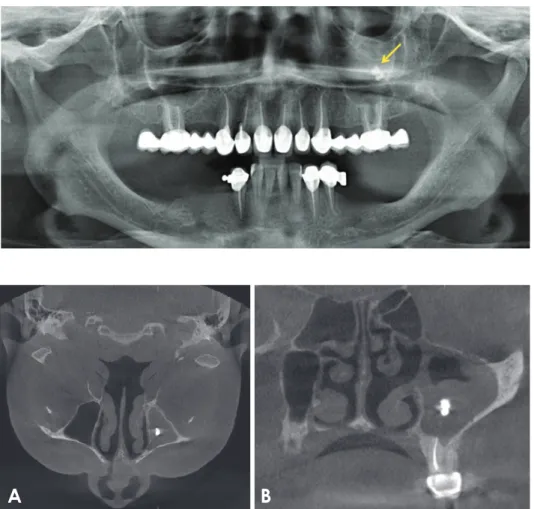
radiopacity 3 years ago. The patient’s general health was unremarkable. She had a history of a nasal obstruction that occurred after root canal treatment of the left maxillary first molar tooth several years previously. Upon clinical examination, no pathology was observed. Panoramic ra- diography showed a small radiopacity that resembled a foreign body in the maxillary antrum(Fig. 1). Cone-beam computed tomography(CBCT) revealed an iron-like opaci- ty in the central area of the left maxillary sinus(Fig. 2). No evidence of bone destruction was seen on the sinus walls.
Under local anesthesia and sedation, extraction of the left maxillary first molar and the Caldwell-Luc procedure were planned. During the operation, a thick gray-brown, paste- like material that resembled root-canal sealer was observed in the sinus. The palatal root of the left maxillary first mo- lar seemed to have perforated the floor of the sinus. Com- plete curettage and irrigation were performed. An antibi- otic was prescribed after the operation to prevent bacterial superinfection. The specimen was sent for a histological examination, which revealed matted fungal hyphae that were evident on hematoxylin and eosin staining. The acute- branched septate hyphae were similar to Aspergillus and
showed no tissue invasion. The histopathologic diagnosis was aspergillosis(Fig. 3).
The patient had an uneventful postoperative recovery.
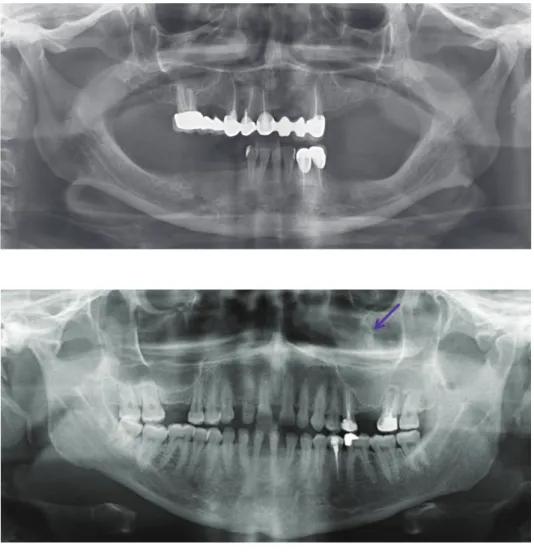
One year after surgery, she had no clinical and radiographic evidence of disease(Fig. 4).
Fig. 1. Panoramic radiograph shows a radiopaque mass in the left maxil- lary sinus.
A B
Fig. 2. A. An axial cone-beam com- puted tomographic(CBCT) image shows an iron-like opacity in the central area of the left maxillary si- nus. B. CBCT image on the coronal plane shows the lesion in the max- illary sinus and the sinusitis caused by the aspergilloma.
Fig. 3. Histopathologic finding shows a tangled mass of hyphae (H&E staining, original magnification ×100).
Case 2
A 41-year-old woman was referred to our clinic with a complaint of occasional left-sided pain in her upper face.
Her medical history included Raynaud syndrome and asthma. Upon clinical examination, no pathology was ob- served. A panoramic radiographic examination showed a radiopaque area at the level of the left maxillary sinus
(Fig. 5). Her left first molar tooth had been extracted 13 years ago and the left first premolar and second molar teeth had undergone endodontic treatment. CBCT showed a piece of the root of the left first molar tooth in the sinus cavity and mucosal thickening in the sinus walls(Fig.
6). A Caldwell-Luc procedure was performed on the left maxillary sinus under local anesthesia and sedation. A
Fig. 4. Postoperative panoramic radiograph of the lesion at 1-year follow-up.
Fig. 5. Panoramic radiograph shows increased radiopacity in the left maxillary sinus and the root of the left maxillary first molar.
Fig. 6. A. An axial cone-beam com- puted tomographic(CBCT) image shows an iron-like opacity surround- ed by dense tissue and mucosal thickening in the sinus walls. B.
CBCT image on the coronal plane shows the lesion in the left maxillary sinus.
A B
full-thickness mucoperiostal flap was raised. A bony win- dow was made using a trephine bur and the root of the left first molar tooth with granulation tissue was removed.
The sinus mucosa seemed healthy. The bony window was replaced and sutured with 4-0 Vicryl stiches to the bone.
Closure of the flap was performed with 3-0 silk stiches.
An antibiotic and analgesic were prescribed after the op- eration. Curetted granulation tissue around the piece of the root was submitted for a histological examination, the results of which were compatible with aspergilloma(Fig.
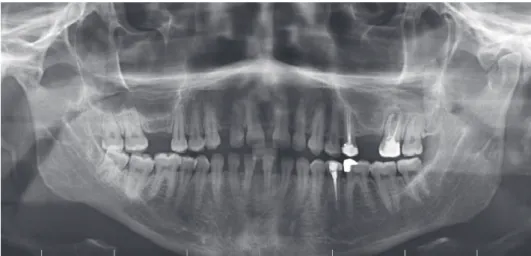
7). The patient was followed periodically for 1 year. At 1-year check-up, she was completely asymptomatic(Fig.
8).
discussion
Fungal infection of the maxillary sinus is relatively rare in healthy individuals, but because of the globally uncon- trolled consumption of chemotherapeutics that cause pa-
tients to be vulnerable to fungal infections and as a result of improvements in diagnostic imaging techniques, the detection of this infection among healthy subjects seems to be increasing.4,7 It has been reported that more than 10%
of patients who had chronic sinusitis were found to have aspergilloma, predominantly in the maxillary sinus.5,8 The main aspects of the pathophysiology of aspergilloma of the maxillary sinus are still debated, although contamination of the maxillary sinus with Aspergillus has been suggested to occur through various pathways.3 Because Aspergillus species do not have the ability to penetrate intact mucus membranes, Aspergillus is usually considered to cause in- fections in maxillary sinus as a result of the inhalation of the airborne spores of Aspergillus that are ubiquitous in the environment.1,3 According to the aerogenic theory, the accumulation of fungal spores in the maxillary sinus may become pathogenic under relatively anaerobic conditions.9 However, unlike the other paranasal sinuses, Aspergil- lus spores may also be transmitted to the maxillary sinus through an iatrogenic pathway associated with dental pro- cedures.1,10
Recently, an increasing number of researchers have sug- gested that because of the close relationship between the antral teeth and sinus floor, dentogenic factors increase the risk of aspergilloma of the maxillary sinus.9,11 Tomazic et al.9 suggested that if a dentogenic factor is present, the risk of developing an aspergilloma is 2.7-fold higher than in un- affected sinuses. Dental procedures are thought to be able to cause massive fungal inoculation of the maxillary an- trum as a result of perforation of the sinus membrane.8 Ad- ditionally, dental materials that contain heavy metals(e.g., zinc), such as root canal sealer, gutta-percha, silver cones, and amalgam, may penetrate into the sinus during dental procedures and provide favorable conditions for the growth of Aspergillus species.4,11 Although eugenol in dental mate-
Fig. 7. Histopathologic finding shows the characteristic septate hyphae(Grocott-Gomori methenamine silver stain, ×400).
Fig. 8. Postoperative panoramic radiograph of the sinus at 1-year follow-up.
Table 1. Published cases of aspergilloma of odontogenic origin in the literature Author YearAge-SexSystemic statusSite Symptoms Etiology FBSDOSImaging modality Surgical approachAntifungal therapyFollow-up Axelsson et al. 197818 36-FNCLP, NO, RExtraction-NA-6YNACL-3Y Kawana et al. 198719 47-MNCLS, P, F, NDExtraction-26Root22YWCLNA De Foer et al. 199010 31-FNALİmp. surgery-25İmplant6MNACL-9Y De Foer et al. 199010 31-FNARPExtraction-16-3MNACL-6Y De Foer et al. 199010 30-MBL-RCT-26Sealer10MNACL-4Y De Foer et al. 199010 35-FNALS, PRCT-25,27SealerNANACL-1Y De Foer et al. 199010 35-FNAL-RCT-26Sealer12MNACL-7Y De Foer et al. 199010 56-MNCRNO, RExtraction-13Root1MNACL-5M Kobayashi 199520 22-FNAR-RCT-15,16GuttaPANCL-8Y Falworth et al. 19961 41-FNALPRCT-24Sealer6MOM, PANCL-1Y Ogata et al. 199717 58-MNALPDExtraction-NAAntrolithNACTCLAmphotericin B6M Khongkhunthian et al. 20014 25-FNCR-RCT-16SealerNAPAN, WA-NA Khongkhunthian et al. 20014 25-FNALP, SRCT-14Sealer2YPAN, WA-NA Horre et al. 200221 28-FNCRPRCT-16ZOE10YPAN, WNAAntifungalNA Martins et al. 200422 30-FNCLS, NO, PDRCT-27SealerNAWCLItraconazole12M Matjaz et al. 200411 22-NANALS, PRCT-26Sealer1YPANESS-4M Giardino et a. 200515 60-MNCRNARCT-15Sealer2YPAN, CTCL-1Y Burnham et al. 20098 46-MNARP, NO, NDExtraction-17Amalgam2YCT, OMFESS-6M Sohn et al. 20097 48-MNCR-Bone graftingGraft6MCT, PANCL-15M Bosi et al. 201023 78-FNALPRCT-26Sealer6MCTESS-NA Sato et al. 20106 50-MNCLSİmp surgery-Zygomaticİmplant12MCTSE-12M Fanucci et al. 201314 54-FNALSin, P, R RCT-26Sealer2YPAN, CTCL-NA Guivarc’h et al. 201512 64-NAPR, DRSinRCT-16SealerNACTCL-6M Urs et al. 20153 35-FNCLP, SExtraction-25Root1MCECTNAItraconazole6M Vinciguerra et al. 201616 34-MNCB-RCT-15,16,25,26Sealer-PAN, CTESS-12M Harada et al. 20175 59-FNCLNO, ND, P, Sİmp. surgery-NAİmplant4YPAN, CTCL-12M Cansiz et al. 201724 32-FNCLNO, NDSARPE-2WCTFESS-3M Present case 1 201754-FNCLNORCT-26-6YPAN, CBCTCL-12M Present case 2 201741-FA, RFLPExtraction-26Root13YPAN, CBCTCL-12M NA: not available M: male F: female NC: non-contributory, B: Behçet, D: diabetes, PR: psoriatic rheumatism, A: asthma, RF: Raynaud phenomania, R: right, L: left, S: swelling, P: pain, F: fewer, ND: nasal discharge, NO: nasal obstruction, PD: purulent dıscharge, R: rhinorrhea, NB: numbness, Sin: sinusitis, RCT: root canal treatment, FBS: foreign body in maxillary sinus, M: month, Y: year, DOS: duration of symptoms occur, CL: Caldwell-Luc, LR: lateral rhinoscopy, A: antroscopy, ESS: endoscopic sinus surgery, FESS: functional endoscopic sinus surgery, SE: sinusectomy, SARPE: surgically assisted rapid palatal expansion
rials has a fungicidal effect, it loses its inhibitory function when it penetrates into the sinus, enabling heavy metals to promote fungal growth.12 Furthermore, dental procedures that perforate the sinus membrane can cause mucociliary paralysis and mucosal hyperemia, resulting in epithelial dysfunction in the maxillary sinus.6 Due to disturbances in mucociliary action, the natural sinus drainage deteriorates and an anaerobic environment associated with local tissue hypoxia occurs.8
Among the published cases of aspergilloma associated with dental procedures, the predominant etiologic factor is root canal treatment, but aspergilloma associated with den- tal implants, extraction, or grafting procedures has also been reported.4,5,7,10 In the studies of Tomazic et al.9 and Legent et al.,13 it was reported that 84% and 96% of patients with aspergilloma had undergone previous root canal therapy, respectively. Similarly, several cases of aspergilloma in the literature have been detected in sinuses that had been perfo- rated by a previous dental procedure, while the contralateral side remained unaffected(Table 1).1,3-8,10-12,14-24 Root canal treatment and the displaced root were considered to be etiologic factors for the occurrence of aspergilloma in our cases.
From a clinical point of view, aspergilloma is usually underestimated because the infection only becomes symp- tomatic after a long period of fungal contamination.5 It was reported that in 29% of patients, aspergilloma was diag- nosed 1 year after the onset of symptoms because of the noninvasive character and slow progression of the lesion.14 Giardino et al.15 reported a case of aspergilloma that arose 2 years after root canal therapy. In another case, Sohn et al.7 reported a case of Aspergillus 1 year after the patient had undergone sinus bone grafting. However, in some cas- es, the time of onset of the infection was shorter.6 In our cases, the fungal infections were detected 6 and 13 years after the dental procedures, respectively. Thus, it is critical to ensure adequate follow-up after dental treatment involv- ing the maxillary sinus.
Panoramic radiographic examinations are a straightfor- ward way to evaluate the maxillary sinus bilaterally for the diagnosis of aspergilloma.14 Maxillary sinus aspergilloma is usually seen unilaterally, and bilateral lesions are very rare.1,4 However, a case of bilateral maxillary-ethmoidal sinus aspergilloma that occurred after bilateral endodon- tic treatment was reported by Vinciguerra et al.16 The pathognomonic iron-like density could be seen inciden- tally on panoramic radiography or on the Waters view.4,7 This characteristic appearance is due to high levels of cal- cium phosphate in the intracellular milieu of the necrotiz-
ing Aspergillus cells, and in some cases may result from accumulation of the heavy metals that were pushed into the sinus with the dental materials.7,8,10 A more precise examination with computed tomography(CT) may be necessary to exclude other sinus diseases, such as antro- lith, osteoma, mucocele, B cell lymphoma, squamous cell carcinoma, adenoid cystic carcinoma, and inflammatory myofibroblastic tumors, from the differential diagnosis.14 The extent of the lesion, bone involvement, and erosion can also be evaluated using CBCT, which requires a low- er radiation dose, is cost-effective, and is not time-con- suming.14 Magnetic resonance imaging(MRI) can also be helpful, as decreased signal intensity on T2-weighted MRI has been described as characteristic of aspergilloma, and MRI can also help clinicians to differentiate aspergil- loma from inflammatory or neoplastic changes.1,10
The treatment of aspergilloma primarily consists of surgical removal of the lesion. Both the Caldwell-Luc and endoscopic techniques can be used.4,8 In most of the reported cases, the Caldwell-Luc procedure was used suc- cessfully for the management of aspergilloma.5,10,12,14,17
Systemic antifungal therapy is not generally required.
However, if symptoms persist for a long time after surgery, an oral antimycotic drug may be required as an additional therapy.7 Nonetheless, clinicians should be careful about using these drugs because of severe adverse effects, such as nephrotoxicity.6 Since bacterial superinfection can cause acute sinusitis attacks, an appropriate antibiotic therapy is recommended in order to avoid bacterial coinfections.1
Different types of dental procedures that involve the maxillary sinus may facilitate the occurrence of fungal si- nusitis, which shares similar features with other infections of the sinus. Clinicians should be aware of the possibility of fungal etiology, especially in cases resistant to treatment, and should follow the patient periodically if sinus perfora- tion occurs during a procedure to minimize toxicity, costs, and other complications because of an inappropriate treat- ment strategy. Although the management of aspergilloma is much simpler than the management of the invasive form of aspergillosis, delays can occur in management because the likelihood of fungal origin may be underestimated.
Thus, diagnostic tools, especially imaging modalities, play a crucial role in detecting aspergilloma, which is usually an incidental finding. CBCT can provide useful information to clinicians about the location and the extent of the lesion.
References
1. Falworth MS, Herold J. Aspergillosis of the paranasal sinuses.
A case report and radiographic review. Oral Surg Oral Med Oral Pathol Oral Radiol Endod 1996; 81: 255-60.
2. Martinez D, Burgueno M, Forteza G, Martin M, Sierra I.
Invasive maxillary aspergillosis after dental extraction. Case report and review of the literature. Oral Surg Oral Med Oral Pathol 1992; 74: 466-8.
3. Urs AB, Singh H, Nunia K, Mohanty S, Gupta S. Post end- odontic Aspergillosis in an immunocompetent individual. J Clin Exp Dent 2015; 7: e535-9.
4. Khongkhunthian P, Reichart PA. Aspergillosis of the maxil- lary sinus as a complication of overfilling root canal material into the sinus: report of two cases. J Endod 2001; 27: 476-8.
5. Harada T, Isomura ET, Uchihashi T, Kogo M. Aspergillosis associated with migration of a dental implant into the maxil- lary sinus: a case report. J Oral Maxillofac Surg Med Pathol 2017; 29: 448-51
6. Sato FR, Sawazaki R, Berretta D, Moreira RW, Vargas PA, de Almeida OP. Aspergillosis of the maxillary sinus associated with a zygomatic implant. J Am Dent Assoc 2010; 141: 1231- 7. Sohn DS, Lee JK, Shin HI, Choi BJ, An KM. Fungal infection 5.
as a complication of sinus bone grafting and implants: a case report. Oral Surg Oral Med Oral Pathol Oral Radiol Endod 2009; 107: 375-80.
8. Burnham R, Bridle C. Aspergillosis of the maxillary sinus secondary to a foreign body(amalgam) in the maxillary an- trum. Br J Oral Maxillofac Surg 2009; 47: 313-5.
9. Tomazic PV, Dostal E, Magyar M, Lang-Loidolt D, Wolf A, Koele W, et al. Potential correlations of dentogenic factors to the development of clinically verified fungus balls: a retro- spective computed tomography-based analysis. Laryngoscope 2016; 126: 39-43.
10. De Foer C, Fossion E, Vaillant JM. Sinus aspergillosis. J Craniomaxillofac Surg 1990; 18: 33-40.
11. Matjaz R, Jernej P, Mirela KR. Sinus maxillaris mycetoma of odontogenic origin: case report. Braz Dent J 2004; 15: 248- 12. Guivarc’h M, Ordioni U, Catherine JH, Campana F, Camps 50.
J, Bukiet F. Implications of endodontic-related sinus aspergil- losis in a patient treated by infliximab: a case report. J Endod
2015; 41: 125-9.
13. Legent F, Billet J, Beauvillain C, Bonnet J, Miegeville M. The role of dental canal fillings in the development of Aspergillus sinusitis. A report of 85 cases. Arch Otorhinolaryngol 1989;
246: 318-20.
14. Fanucci E, Nezzo M, Neroni L, Montesani L Jr, Ottria L, Gargari M. Diagnosis and treatment of paranasal sinus fungus ball of odontogenic origin: case report. Oral Implantol(Rome) 2014; 6: 63-6.
15. Giardino L, Pontieri F, Savoldi E, Tallarigo F. Aspergillus mycetoma of the maxillary sinus secondary to overfilling of a root canal. J Endod 2006; 32: 692-4.
16. Vinciguerra A, Saibene AM, Lozza P, Maccari A. Unusual case of bilateral maxillary fungus ball. BMJ Case Rep 2016;
2016. pii: bcr2016217930.
17. Ogata Y, Okinaka Y, Takahashi M. Antrolith associated with aspergillosis of the maxillary sinus: report of a case. J Oral Maxillofac Surg 1997; 55: 1339-41.
18. Axelsson H, Carlsöö B, Weibring J, Winblad B. Aspergillosis of the maxillary sinus: clinical and histopathological features of 4 cases and a review of the literature. Acta Otolaryngol 1978; 86:
303-8.
19. Kawana T, Yamamoto H, Izumi H. A case of aspergillosis of the maxillary sinus. J Nihon Univ Sch Dent 1987; 29: 298- 20. Kobayashi A. Asymptomatic aspergillosis of the maxillary si-302.
nus associated with foreign body of endodontic origin. Report of a case. Int J Oral Maxillofac Surg 1995; 24: 243-4.
21. Horré R, Schumacher G, Marklein G, Krömer B, Wardelmann E, Gilges S, et al. Case report. Maxillary sinus infection due to Emericella nidulans. Mycoses 2002; 45: 402-5.
22. Martins WD, Ribeiro Rosa EA. Aspergillosis of the maxillary sinus: review and case report. Scand J Infect Dis 2004; 36:
758-61.
23. Bosi GR, de Braga GL, de Almeida TS, de Carli A. Fungus ball of the paranasal sinuses: report of two cases and literature review. Int Arch Otorhinolaryngol 2012; 16: 286-90.
24. Cansiz E, Akbas E, Isler SC. Aspergillosis associated with sur- gically assisted rapid maxillary expansion. Natl J Maxillofac Surg 2016; 7: 105-7.