항암화학요법 유방암환자의 인지기능 증진 중재에 대한 논문 분석
최은희1·정복례2·김경덕3·김경혜4·변혜선5
1영남이공대학 간호과 조교수, 2경북대학교 간호대학 교수, 3대구보건대학 간호과 조교수, 4김천과학대학 간호과 조교수,
5대구산업정보대학 간호과 전임강사
Literature Review of Cognitive Developmental Interventions on Patients with Breast Cancer undergoing Chemotherapy
Choi, Eun Hee
1· Chung, Bok Yae
2· Kim, Gyung Duck
3· Kim, Kyung Hae
4· Byun, Hye Sun
51Assistant Professor, Department of Nursing, Yeungnam College of Science and Technology, Daegu; 2Professor, School of Nursing, Kyungpook National University, Daegu; 3Assistant Professor, Department of Nursing, Daegu Health College, Daegu; 4Assistant Professor, Department of Nursing, Kimcheon Science College, Kimcheon; 5Full-time Lecturer, Department of Nursing, Daegu Polytechnic College, Daegu, Korea
Purpose: The purpose of this study was to analyze the trend of cognitive developmental interventions on patients with breast cancer who underwent chemotherapy. Methods: The researcher searched databases and selected 17 literatures using chemotherapy, breast cancer, cognitive function and intervention as searching key words. Searched databases included Ovid, Pubmed, Proquest and Med- line and data collection period was from January 2000 to May 2010. Results: Interventions for patients with breast cancer have been continuously developed and frequent research topics included breast cancer, chemotherapy, quality of life, and cognitive function. In terms of study design, four research articles were pre-experimental study designs, one was case study, and the rest of studies were non- equivalent pretest-posttest control group design. Effects of intervention were examined in only 5 studies among 17. The interventions were not found to have direct effects in cognitive improvement. Conclusion: It is needed to figure out the mechanism of cognitive deterioration of the patients with breast cancer who underwent chemotherapy. And nursing interventions needs to be developed in order to hold up the cognitive downhill and help their cognitive rehabilitation.
Key Words: Drug therapy, Breast neoplasms, Cognition, Intervention studies
주요어: 항암화학요법, 유방암, 인지, 중재, 분석 Address reprint requests to: Chung, Bok Yae
School of Nursing, Kyungpook National University, 101 Dongin-dong 2 ga, Jung-gu, Daegu 700-422, Korea
Tel: 82-53-420-4933 Fax: 82-53-425-1258 E-mail: [email protected]
투 고 일: 2010년 11월 15일 심사의뢰일: 2010년 11월 19일 심사완료일: 2011년 1월 29일
서 론
1. 연구의 필요성
인지기능이란 다양한 상황에서 문제를 해결하고 각종 고도의 기 술을 수행하는 통합적인 특성으로1) 인지기능 장애가 있는 경우 일 상생활의 불편함뿐 만 아니라 심할 경우 정상적인 생활을 영위하기 가 어려울 수 있다. 유방암 치료에 주요역할을 하는 항암화학요법 은2-3) 기억, 주의집중, 관심, 실행기능 및 정신운동 영역에 장애를 유 발하여4) 인지기능에 영향을 미치는 것으로 알려져 있다. 유방암환 자에서의 인지기능장애는 10% 정도이나, 항암화학요법을 받는 유
방암환자의 경우에는 25%까지 나타날 수 있으며 결국에는 삶의 질 저하를 초래한다.5) 현재까지 연구되고 있는 유방암환자의 인지장 애는 항암화학요법과 관련된 직접적인 세포파괴뿐만 아니라 호르 몬 요법으로 인한 폐경, 면역기능 저하, 피로, 스트레스, 정서, 감염, 열, 영양부족, 대사 장애, 혈액학적 장애, 투약과 노화 및 수면 장애 등이 원인이 되고 있는 것으로 보고되고 있으며2,4-10) 이를 해결하기 위한 중재로 인지 행동요법, 요가, 요가와 걷기, 명상 등이 연구되고
있으나7,11,12) 과학적 간호중재로서는 근거가 부족하다.
특히 항암화학요법을 받는 유방암 환자의 인지기능 장애에 대한 다수의 보고에도3,4,13) 불구하고 정신질환자나 만성질환자의 인지기 능을 증진시키는 중재연구에14-17) 비해 유방암 환자를 위한 중재 개 발이나 효과 검증 연구는 일부에 그치고 있다. 또한 정신질환자 및 만성질환자의 인지기능 증진 중재를 항암화학요법을 받는 유방암 환자에게 적용하기에는 인지기능장애 원인과 대상자의 상태가 다 르기 때문에 중재에도 차이가 있어야 한다. 더구나 항암화학요법을 받는 유방암 환자에게 실시한 소수의 연구 결과도 중재 실시 후 나
타난 결과가 일관적이지 않아 중재개발 연구와 반복연구를 통한 중 재효과의 검증이 지속적으로 이루어져야 할 것으로 사료된다.
이상적으로 항암화학요법을 받는 유방암환자의 인지기능 증진 을 위한 맞춤형 간호중재 개발을 위해서는 기존 연구에서 유방암환 자의 인지기능 장애의 특성을 충분히 고려한 간호중재가 개발되는 것이 필요하다. 따라서 본 연구에서는 현재까지 항암화학요법을 받 는 유방암환자를 대상으로 인지기능을 증진시키고자 시도한 중재 연구를 분석하고, 더 나아가 인지기능이 향상된 영역에 대한 분석 을 시도하여 항암화학요법을 받는 유방암환자의 인지기능증진프 로그램 개발에 기틀이 되고자 한다. 특히 간호중재는 시대적 변화 및 대상자의 문화적 차이에 따라 결과가 차이가 있을 수 있으므로 현재 항암화학요법을 받는 유방암환자의 인지기능 증진 중재를 파 악하기 위해서는 최근 연구가 대상자의 현실을 밀접하게 반영한다 고 할 수 있다.
이에 본 연구에서는 최근 20년 동안의 연구 즉, 1990년 이후 항암 요법을 받는 유방암 환자의 인지기능 증진 중재 연구를 파악하여 연구 경향을 파악하고자 하였다.
2. 연구 목적
본 연구는 현재 발표된 항암화학요법을 받는 유방암환자의 인지 기능 증진 중재에 관한 논문을 분석하기 위한 것이며 구체적인 목 적은 다음과 같다.
첫째, 유방암환자의 인지기능 증진 중재 논문의 발표연도, 제목 및 주요어를 분석하여 경향성을 파악한다.
둘째, 유방암 환자의 인지기능 증진 중재에 대한 설계유형, 대상 자 수 및 중재 기간을 분석하여 중재 프로그램의 특성을 파악한다.
셋째, 유방암환자의 인지기능 증진 중재 프로그램의 효과를 파 악하기 위해 결과를 기술하고 중재 결과 변수를 인지기능과 인지관 련 기능으로 구분하여 파악한다.
연구 방법
1. 연구 설계
본 연구는 항암화학요법을 받는 유방암환자의 인지기능 증진 중 재 관련 논문을 분석하는 서술적 조사연구이다.
2. 연구 대상
본 연구의 대상으로 국내논문은 한국교육학술정보원(http://
www.riss4u.net), 국가전자도서관(http://www.dlibrary.go.kr), 국회도 서관(http://www.nanet.go.kr), 한국학술정보(http://kiss.kstudy.com) 에서 키워드를 ‘항암화학요법’, ‘유방암환자’, ‘인지기능’ 및 ‘중재’로 하
여 검색을 한 후에 유방암 환자를 대상으로 한 중재연구를 확인하 였으나 해당되는 것이 없었다. 국외논문으로 Ovid (http://ovidsp.tx.
ovid.com/sp-3.2/ovidweb.cgi), Pubmed (http://www.ncbi.nlm.nih.gov), Proquest (http://proquest.umi.com) 및 Medline (http://www.ebscohost.
com)에서 ‘Chemotherapy’, ‘Breast cancer’, ‘Cognitive function’, ‘Inter- vention’으로 검색하여 항암요법을 받는 유방암환자의 인지기능 중 재와 관련된 저널을 선택하여 총 17편이었다.
3. 연구대상논문 분석 기준
항암화학요법 유방암환자의 인지기능 증진 중재 논문의 경향성 은 발표연도, 제목 및 주제어를 분류하여 확인하였으며, 유방암환 자의 인지기능 증진 중재 프로그램 특성은 설계방법, 대상자 수(실 험군과 대조군), 중재 기간으로 분석하였다. 유방암환자의 인지기 능 증진 중재 프로그램의 효과는 구체적 중재를 기술하고 중재결과 변수를 인지기능과 인지관련 기능으로 구분하여 분석하였다.
4. 연구의 신뢰도와 타당도
본 연구의 신뢰도를 높이기 위해서는 동일 키워드를 사용해 한 명의 연구자가 일관되게 문헌을 탐색하여 항암화학요법을 받는 유 방암환자의 중재연구를 추출하였으며, 타당도를 높이기 위하여 추 출된 자료를 간호학 박사학위를 소지하고 있으며 유방암 관련 연구 전문가 4인에게 자문하여 분석하고 분류할 수 있도록 하였다.
연구 결과
1. 중재논문의 경향성
1990년 1월부터 2010년 6월까지 항암화학요법을 받는 유방암환자 의 인지기능 증진 중재 연구는 1997년부터 2001년, 2006년과 2010년 을 제외하고 매년 1편에서 2편씩 시행되었다. 또한 2001년 이전에는 약물요법에 대한 효과를 파악한 중재가 없었으나 2002년부터 epoe- tin alfa에 대한 효과를 파악하기 위한 중재연구가 시행되었다. 중재 논문의 주요어로 가장 많이 사용된 것은 유방암, 항암치료, 삶의 질, 인지기능(인지장애)의 순으로 본 연구자가 검색어로 사용한 ‘항암 화학요법’, ‘유방암환자’, ‘인지기능’ 및 ‘중재’와 유사하였다(Table 1).
2. 인지기능 증진 중재 프로그램 특성
인지기능 증진 중재는 총 17편의 논문 중 실험 전 연구 설계인 원 시실험설계를 시행한 것이 4편이었으며, 사례연구가 1편이었고 나 머지 12편이 모두 유사 실험설계이었다. 대상자 수는 총 300명 이상 인 논문이 2편, 200명 이상인 논문이 2편, 100명 이상인 논문이 1편 이었으며 총 40명 미만은 유사 실험설계 중에서는 1편이었다. 프로
그램 유형은 인지-존재 그룹 요법, 기억과 집중 적응 훈련, 인지행동 그룹요법, 인지행동요법, 자조수행 프로젝트, 이완과 명상요법, 자가 간호 측정, 상담, Epoetin alfa 요법, Erythropoietin, 심리교육 프로그 램과 항암화학요법 후 인지기능 손상에 대한 정보제공 및 사전 지 식 등이 있었으며 중재 기간은 일회성인 즉시부터 30개월까지이었 다(Table 2).
3. 인지기능 증진 중재 프로그램의 효과
인지기능 증진 중재 프로그램의 구체적인 예로는 지지적인 환경 을 만들고 상실에 대한 슬픔을 용이하게 할 뿐만 아니라 비정상적 인 인지유형을 수정하고 문제해결능력과 대체기술을 증진시키는 것을 포함하며 불확실성을 관리하고 이완시키고, 자가 간호를 확인 하도록 한다. 또한 상담하고 적절한 운동을 하며 Epoetin을 주사하 고 기억과 집중 적응훈련도 포함시킨다. 중재를 위해서는 직접 대면 법과 전화 중재를 사용하였으며 17편의 중재 연구 중 단지 6편만 유 의하게 효과가 있는 것으로 나타났다. 효과가 유의하게 있다고 보고 한 논문 6편 중에서도 3편이 인지기능을 확인한 것이 아닌 인지기 능 관련 변수인 삶의 질, 증상 스트레스, 자가 간호에 대한 자기 효능
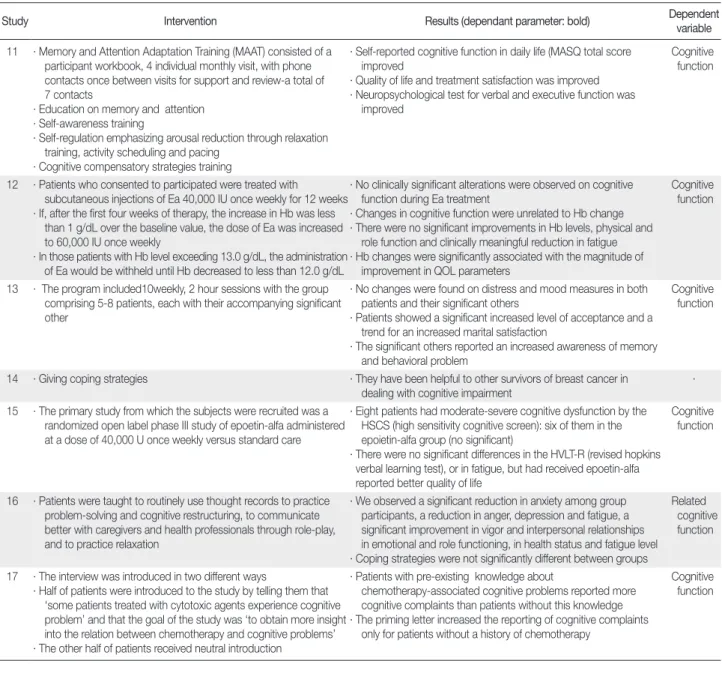
감, 불안, 가족기능, 분노, 우울, 피로, 활력과 대인관계, 정서, 역할 기 능, 건강상태 및 대처전략 등을 결과변수로 확인하여 유의하게 효 과가 있다고 발표한 연구 중 단 3편만이 인지기능을 확인하였다. 중 재 연구 중 인지 기능을 결과변수로 파악한 논문은 총 17편 중 8편 이었으며, 이 중 Epoetin을 주사로 주입한 후 인지기능을 분석한 연 구가 5편을 차지하였으나 1편을 제외한 4편에서 유의한 효과가 없 는 것으로 나타났다(Table 3).
논 의
인지기능이란 자극을 받아들이고 저장하고 인출하는 일련의 과 정으로 지각, 기억, 상상, 개념, 판단, 추리 등을 포함하는 포괄적인 개념이다.18) 사고의 위험을 증가시키고, 의사소통 장애 및 부적절한 인간관계로 인해 결국에는 삶의 질에 영향을 미치는 유방암 환자 에서 나타나는 인지기능 손상은 항암화학요법과 관련이 있는 것으 로 보고되고 있어19) 이에 대한 간호중재가 필요하다. 그러므로 항암 화학요법을 받는 환자의 인지기능을 증진시키기 위한 중재연구의 분석은 이상적인 인지기능을 증진시킬 수 있는 간호중재를 개발하 Table 1. Trends of cognitive function intervention study
Year Title of study Key Words
1997 · Cognitive-existential group therapy for patients with primary breast cancer-techniques and themes
1998 · Self-help Intervention project Breast cancer, resourcefulness, self-care, self-help
1999 · Psychological, clinical and pathological effects of relaxation training and guided imagery during primary chemotherapy
· An intervention to increase use and effectiveness of self-care measures for breast cancer chemotherapy patients
Chemotherapy, breast cancer, quality of life, randomized trial
2000 · Counseling woman with breast cancer using principles developed by Albert Bandura Communication, counseling, psychosocial oncology, self-care, self-efficacy
2002 · Adherence to moderate-intensity exercise during breast cancer therapy
· Effects of epoetin alfa on cognitive function, mood, asthenia, and quality of life in woman with breast cancer undergoing adjuvant chemotherapy
Breast cancer, chemotherapy, exercise adherence, radiation therapy, rehabilitation, symptom management
2003 · Cognitive-existential group psychotherapy for women with primary breast cancer:
a randomized controlled trial
2004 · Weekly administration of epoetin alfa improves cognition and quality of life in patients with breast cancer receiving chemotherapy
2005 · Feasibility of quantifying the effects of epotin alfa therapy on cognitive function in woman with breast cancer undergoing adjuvant or neoadjuvant chemotherapy 2007 · Cognitive-behavioral management of chemotherapy related cognitive change
· Effect of epoetin alfa therapy on cognitive function in anaemic patients with solid tumors undergoing chemotherapy
Breast cancer, chemotherapy, cognitive dysfunction, cognitive-behavioral treatment, survivorship
Anaemia, epoetin alfa, chemotherapy, cognitive function, quality of life
2008 · A cognitive behavioral group therapy for patients diagnosed with mild cognitive impairment and their significant others: feasibility and preliminary results
· Cognitive impairment after breast cancer treatment
2009 · The influence of erythropoietin on cognitive function in women following chemotherapy for breast cancer
· The effectiveness of a psycho-educational group after early-stage breast cancer treatment: results of a randomized french study
· The influence of priming and pre-existing knowledge of chemotherapy-associated cognitive complaints on the reporting of such complaints in breast patients
Epoetin-alfa, cognitive function, chemotherapy, breast cancer, quality of life
Group therapy, psycho-education, randomized controlled trial, breast cancer, oncology
Cognitive complaints, priming, chemotherapy, breast cancer, oncology
는 데 기틀이 될 수 있다.
본 연구에서 인지기능 중재의 경향성은 1997년부터 2001, 2006과 2010년 즉 3년을 제외하고는 매년 한두 편의 연구가 시행되어 항암 화학요법을 받는 유방암환자의 인지기능을 증진시키기 위한 시도 가 꾸준히 되고 있음을 알 수 있으며 과학적 근거를 마련하기 위한 노력이 계속되고 있음을 유추할 수 있다. 1990년부터 2010년 6월 현 재까지의 항암화학요법을 받는 환자의 인지기능 증진 중재 연구 분
석 검색어로 ‘항암화학요법’, ‘유방암환자’, ‘인지기능’ 및 ‘중재’를 사용 한 결과 총 17개의 논문이 추출되었다. 이후 추출된 논문을 주요어 별로 분석했을 때 유방암, 항암치료, 삶의 질, 인지기능(인지불능)의 순으로 많이 나타나 연구자의 검색어와 유사하였으나 ‘삶의 질’이 더 추가되었다. 이는 항암화학요법을 받는 환자에서 인지기능 장애 와 삶의 질과의 관계를 유추할 수 있는 근거가 될 수 있다고 사료된 다.20-22)
인지기능 증진 중재 설계 측면에서 본 연구는 17편의 연구 중 70.6%인 12편이 유사실험설계이었으며 단지 4편만이 원시실험설계 로 과학적 근거를 마련하기 위한 노력을 유추할 수 있다. 이는 유사 실험설계는 대조군과 실험군을 대상으로 효과를 파악하여 중재 프로그램을 개발하려고 한 것으로 원시실험설계에 비해 인지기능 중재를 과학적으로 증명하기 위한 노력이라 할 수 있기 때문이다.
이때 대상자의 수 또한 실험효과를 파악하기 위해서는 중요한데 대 상자가 300명 이상인 논문이 2편, 200명 이상인 논문이 2편, 100명 이상인 논문이 1편으로 많은 대상자를 대상으로 중재를 일반화하 려고 하였다. 그러나 실험군 10명, 대조군 8명으로 대상자의 수가 중 재효과를 파악하기에는 매우 적은 것도 있어 과학적인 검증을 위 해서는 좀 더 많은 대상자를 대상으로 하는 연구가 계속될 필요가 있다. 또한 Epoetin 투여를 제외하고는 같은 중재 프로그램을 반복 연구한 것이 없어 중재 프로그램의 효과가 하나의 논문에서 인정되 었다 하더라도 모든 항암화학요법을 받는 유방암환자에게 일반화 하기에는 한계가 있으며, Epoetin 투여 역시 5편의 반복연구 중 단 1 편만이 인지기능장애에 유의한 효과가 있는 것으로 나타나 효과를 명확하게 하기 위한 반복 실험연구가 필요하다고 할 수 있다.
본 연구의 인지기능 증진 중재 방법의 효과 측면에서는 17편의 중 재연구 중 단지 6편만이 유의하게 효과가 있는 것으로 나타났다. 효 과가 유의하게 있다고 보고한 논문 6편 중 3편은 인지기능을 확인 한 것이 아닌 인지기능 관련 변수인 삶의 질, 증상 스트레스, 자가 간 호에 대한 자기효능감, 불안, 가족기능, 분노, 우울, 피로, 활력과 대인 관계, 정서, 역할 기능, 건강상태 및 대처전략 등을 결과변수로 확인 하였다. 이는 인지기능을 증진시키기 위한 중재 개발이 제대로 되지 못해 인지기능을 증진시키지 못함으로 인해 인지기능 관련 변수를 측정했을 수도 있으며 인지기능과 인지기능 관련 변수와의 개념의 혼돈으로 변수측정을 제대로 못했을 수도 있다. 이는 Joyce5)가인지 기능을 측정하기 위해 사용했던 clock drawing task (CLOX)가 항암 화학요법을 받는 유방암대상자의 인지기능을 측정하는데 민감하 지 않아 적절하지 않은 것을 언급한 것과 같이 기존 연구에서 적절 한 도구를 사용하지 못했을 수 있음을 간과할 수 없음을 의미한다.
항암화학요법을 받는 유방암환자의 결과 변수 측면에서 분석한 결과, 인지기능을 결과변수로 파악한 논문은 총 17편 중 8편에 불과 Table 2. Studies of cognitive function intervention
Design (N) Numbers of subjects Program title Duration pre-
experimental (4)
Total Total Total Total
48 29 50 22
Cognitive-existential group therapy Memory and attention adaptation training Epoetin alfa therapy Cognitive behavioral group therapy
6 months 6 months 12 weeks 10 weeks
Case study (1) Cognitive behavioral therapy
quasi- experimental (12)
Experimental 1 (Self Care Help/
Uncertainty Management) Uncertainty Management Self Care Help Control Total Experimental Control Total Experimental Control Total Experimental Control Total Experimental Control Total Experimental Control Total
37
57 50 49 193 48 48 96 26 22 48 10 8 18 25 23 48 51 49 100
Self-help intervention project
Relaxation with guided imagery
Self-care measures
Counseling (using Principles developed by Albert Bandura) Moderate intensity exercise Epoetin alfa therapy
8 weeks
18 weeks
At once
8 months
1 month
6 months
quasi- experimental (12)
Experimental Control Total Experimental Control Total Experimental Control Total Experimental Control Total Experimental Control Total Experimental Control Total
154 149 303 177 177 354 51 49 100 45 42 87 102 101 203 130 131 261
Cognitive-existential group therapy Epoetin alfa therapy
Epoetin alfa therapy
Erythropoietin
Psycho-educational program
Priming and pre-existing knowledge of chemotherapy
12 months
12 weeks
12 weeks
30 months
8 weeks
At once
하였다. 이 중 신체적·생리적 중재인 Epoetin을 사용한 후 결과를 파악한 연구가 5편을 차지하였으나 1편을 제외한 나머지 연구는 모 두 유의한 효과가 없어 항암화학요법을 받는 유방암환자의 인지기 능장애에 대한 Epoetin의 효과는 반복 연구될 필요가 있다. 또한 신
체적·생리적 중재를 제외한 나머지 3편 중 2편은 효과가 있다고 하 였으나 유사 실험설계가 아니어서 인지기능 증진 중재의 직접적인 효과인지를 확인하기가 어렵다. 결국 나머지 한 편만이 유사 실험설 계를 통해서 항암화학요법을 하는 유방암환자에게는 인지기능장 Table 3. Results of cognitive function intervention
Study Intervention Results (dependant parameter: bold) Dependent
variable 1 · Promoting a supportive environment
· Facilitating grief work over multiple losses
· Altering maladaptive cognitive patterns
· Enhancing problem solving and coping skill
· Fostering a sense of mastery
· Providing an opportunity to sort out priorities for the future
· Model, initially tested with seven groups, 48 patients, was generally well received
2 · Consisted of a series of six 90 minute classes offered in a self-help course
· 6-week uncertainty management-focused telephone contact
· Combined self-help course/uncertainty management
· Participation in SHIP interventions resulted in higher levels of self-care, self-help, psychological adjustment, and confidence in cancer knowledge
Related cognitive function 3 · Patients were progressive muscular relaxation and cue-controlled
relaxation
· They were asked to practice at least daily and to keep a daily relaxation diary
· The two groups did not differ in terms of clinical or pathological response
· Patients in the experimentalgroup were more relaxed and easy going during the study
· Quality of life was better in the experimental group
· The incidence of clinically significant mood disturbance was very low
Related cognitive function
4 · Three telephone calls and oral and written self-care measures
for specific side effects · A telephone call and written self-care measures
after the second, third, and fourth chemotherapy treatments did not increase use effectiveness of self-care measures
Related cognitive function 5 · A counseling technique designed by the author
· The counseling given towomen in this study included several components: viewing a video tape, receive booklet describing self-care behaviiors
· Receiving five counseling interventions at monthly
· Interaction effects for the functional assessment of cancer treatment breast, used to measure quality of life ranged from small for functional concern to large for social concerns
· Interaction effects for symptom distress were large
· Interaction effects for self-care self-efficacy ranged from small for enjoying life and stress reduction, medium for stress reduction, and large for making decision
Related cognitive function
6 · All subjects assigned to the exercise group received a progressive “walking prescription” that was tailored to their current activity level
· Initial prescription to walk briskly for 10 to 15 minutes per day for of the maximal heart rate
· Subjects were advanced to 30 minute walking sessions to 6 days per week when possible.
· Analysis of self-reported daily activity levels revealed a diffusion of treatment effect
· Analysis of self-reported disease symptoms and treatment side effects did not reveal clinically meaningful differences between two groups
Related cognitive function
7 · Epoetin alfa was administered as a 40,000 U subcutaneously · Hemoglobin level is significant higher than placebo
· CLOX (clock drawing tasking) is insensitive and EXIT (executive interview) test is significantly decline than placebo
Cognitive function 8 · Women were randomized to 20 sessions of weekly group therapy
plus 3 relaxation classes or to a control arm receiving 3 relaxation classes
· Promoting a supportive environment, facilitating grief over loses, reframing negative thought, hope, and examining priorities
· There was a trend for those receiving group therapy to have reduce anxiety
· Women in group therapy also showed a trend towards improved family functioning compared to control
· The women in the groups reported greater satisfaction with their therapy, appreciating the support and citing
Related cognitive function
9 · Patients were randomized to receive epoetin alfa 40,000 IU
subcutaneously once weekly or placebo · There are no difference between groups in mean change in EXIT25 score (Cognitive function was assessed by Executive Interview)
· Mean hemoglobin levels were higher in the epoetin alfa group compared with placebo
Cognitive function
10 · Conducted a pilot study of epoetin alfa versus placebo · Executive interview 25 test can detect the subtle cognitive impairment in verbal fluency, attention, and short-term memory observed with chemotherapy
· Epoetin alfa-treated patients have less evidence of cognitive dysfunction compared with control-treated patients
Cognitive function
(Continued to the next page)
Table 3. (Continued from the previous page)Results of cognitive function intervention
Study Intervention Results (dependant parameter: bold) Dependent
variable 11 · Memory and Attention Adaptation Training (MAAT) consisted of a
participant workbook, 4 individual monthly visit, with phone contacts once between visits for support and review-a total of 7 contacts
· Education on memory and attention
· Self-awareness training
· Self-regulation emphasizing arousal reduction through relaxation training, activity scheduling and pacing
· Cognitive compensatory strategies training
· Self-reported cognitive function in daily life (MASQ total score improved
· Quality of life and treatment satisfaction was improved
· Neuropsychological test for verbal and executive function was improved
Cognitive function
12 · Patients who consented to participated were treated with subcutaneous injections of Ea 40,000 IU once weekly for 12 weeks
· If, after the first four weeks of therapy, the increase in Hb was less than 1 g/dL over the baseline value, the dose of Ea was increased to 60,000 IU once weekly
· In those patients with Hb level exceeding 13.0 g/dL, the administration of Ea would be withheld until Hb decreased to less than 12.0 g/dL
· No clinically significant alterations were observed on cognitive function during Ea treatment
· Changes in cognitive function were unrelated to Hb change
· There were no significant improvements in Hb levels, physical and role function and clinically meaningful reduction in fatigue
· Hb changes were significantly associated with the magnitude of improvement in QOL parameters
Cognitive function
13 · The program included10weekly, 2 hour sessions with the group comprising 5-8 patients, each with their accompanying significant other
· No changes were found on distress and mood measures in both patients and their significant others
· Patients showed a significant increased level of acceptance and a trend for an increased marital satisfaction
· The significant others reported an increased awareness of memory and behavioral problem
Cognitive function
14 · Giving coping strategies · They have been helpful to other survivors of breast cancer in dealing with cognitive impairment
· 15 · The primary study from which the subjects were recruited was a
randomized open label phase III study of epoetin-alfa administered at a dose of 40,000 U once weekly versus standard care
· Eight patients had moderate-severe cognitive dysfunction by the HSCS (high sensitivity cognitive screen): six of them in the epoietin-alfa group (no significant)
· There were no significant differences in the HVLT-R (revised hopkins verbal learning test), or in fatigue, but had received epoetin-alfa reported better quality of life
Cognitive function
16 · Patients were taught to routinely use thought records to practice problem-solving and cognitive restructuring, to communicate better with caregivers and health professionals through role-play, and to practice relaxation
· We observed a significant reduction in anxiety among group participants, a reduction in anger, depression and fatigue, a significant improvement in vigor and interpersonal relationships in emotional and role functioning, in health status and fatigue level
· Coping strategies were not significantly different between groups
Related cognitive function
17 · The interview was introduced in two different ways
· Half of patients were introduced to the study by telling them that ‘some patients treated with cytotoxic agents experience cognitive problem’ and that the goal of the study was ‘to obtain more insight into the relation between chemotherapy and cognitive problems’
· The other half of patients received neutral introduction
· Patients with pre-existing knowledge about
chemotherapy-associated cognitive problems reported more cognitive complaints than patients without this knowledge
· The priming letter increased the reporting of cognitive complaints only for patients without a history of chemotherapy
Cognitive function
애 발생에 대한 설명을 하지 않는 것이 긍정적임을 파악하여 간호중 재프로그램으로서의 효과를 증명하였다.
항암화학요법을 받는 유방암환자의 인지기능 손상은 흔히 나타 나는 증상이며, 이를 해결하기 위해서 개발된 인지기능 증진 프로 그램은 대상자의 인지기능을 증진시켜야 하는 것이 당연하다. 그러 나 현재까지 항암화학요법을 받는 유방암환자를 대상으로 개발된 인지기능 중재 프로그램은 결과변수로 지각과 기억을 포함한 인지 기능을 측정한 연구가 미비하고, 인지기능의 증진을 과학적으로 충 분히 증명하지 못했다고 사료된다. 그러므로 본 연구결과를 바탕으 로, 항암화학요법을 받는 유방암환자의 인지기능을 증진시키는 프 로그램을 개발하여 인지기능의 증진을 확인하는 추후 연구가 계속
적으로 이루어져야 할 것이다.
결론 및 제언
본 연구는 항암화학요법을 받는 유방암 환자의 인지기능을 증진 시키는 중재 연구를 분석하여 이상적인 항암화학요법을 받는 유방 암 환자의 인지기능 증진 프로그램의 기틀을 마련하고자 하였다.
연구의 대상은 1990년 이후부터 2010년 6월 현재까지 Ovid (http://
ovidsp.tx.ovid.com/sp-3.2/ovidweb.cgi), Pubmed (http://www.ncbi.nlm.
nih.gov), Proquest (http://proquest.umi.com) 및 Medline (http://www.
ebscohost.com)에서 ‘Chemotherapy’, ‘Breast cancer’, ‘Cognitive func-
tion’, ‘Intervention’으로 검색하여 추출된 논문 중 중재연구인 17편이 었으며 논문의 경향성, 인지기능 중재 프로그램 특성 및 인지기능 중재 프로그램의 효과를 확인하였으며 그 결과는 다음과 같다.
1) 논문의 경향성을 분석한 결과 1997년 이후부터 2001년, 2006년 과 2010년을 제외하고 매년 1편 이상의 논문이 발표되고 있으며 분 석된 논문의 주요어로 가장 많이 사용된 것은 유방암, 항암치료, 삶 의 질, 인지기능(인지불능)의 순이었다.
2) 인지기능 중재 프로그램의 특성을 분석한 결과 총 17편의 논문 중 실험 전 연구 설계인 원시실험설계를 시행한 것이 4편이었으며, 사 례연구가 1편이고 나머지 12편이 모두 유사 실험설계이었다. 대상자 수는 총 300명 이상인 논문이 2편, 200명 이상인 논문이 2편, 100명 이 상인 논문이 1편이었으며 총 40명 미만은 유사 실험설계 중에서는 1 편이었으며, 중재 기간은 일회성인 즉시부터 30개월까지이었다
3) 인지기능 중재 프로그램의 효과를 분석한 결과 17편의 중재연 구 중 단지 6편만 유의하게 효과가 있는 것으로 나타났다. 효과가 유 의하게 있다고 보고한 논문 6편 중 에서도 3편은 인지기능을 확인 한 것이 아닌 인지기능 관련 변수인 삶의 질, 증상 스트레스, 자가 간 호에 대한 자기 효능감, 불안, 가족기능, 분노, 우울, 피로, 활력과 대 인관계, 정서, 역할 기능, 건강상태 및 대처전략을 확인한 것으로 나 타났다.
이상의 결과를 바탕으로 다음과 같이 제언하고자 한다.
첫째, 기존의 연구에서 항암화학요법을 받는 유방암 환자의 인지 기능을 유의하게 증진시킨다고 알려진 중재의 효과 크기와 과학적 근거를 명확하게 하기 위해서 반복 연구할 필요가 있다.
둘째, 항암화학요법을 받는 유방암 환자의 인지기능을 증진시키 는 실제적인 프로그램을 개발하기 위해서는 프로그램 개발 후 그 효과를 파악하기 위한 결과변수로 인지기능을 측정한 연구가 필요 하다.
참고문헌
1. Kang JJ. Effects of cognitive function enhancement program: focusing on working memory [master]. Seoul: Seoul National University;2008.
2. Downie FP, Mar Fan HG, Houede-tchen N, Yi Q, Tannock IF. Cognitive function, fatigue, and menopausal symptoms in breast cancer patients receiving adjuvant chemotherapy: evaluation with patient interview af- ter formal assessment. Psychooncology 2006;15:921-30.
3. Vardy J, Wefel JS, Ahles T, Tannock IF, Schange SB. Cancer and cancer- therapy related cognitive dysfunction: an international perspective from the Venice cognitive workshop. Ann Oncol 2008;19:623-9.
4. Bender CM, Pacella BA, Sereika SM, Brufsky AM, Vogel VG, Rastogi P, et al. What do perceived cognitive problems reflect? J Support Oncol 2008;6:238-42.
5. O’Shaughnessy JA. Effects of epoetin alfa on cognitive function, mood,
asthenia, and quality of life in women with breast cancer undergoing ad- juvant chemotherapy. Clin Breast Cancer 2002;3:S116-20.
6. Schilder CM, Eggens PC, Seynavev C, Linn SC, Gundy CM, Beex LV, et al. Neuropsychological functioning in postmeno: cross-sectional find- ings from the neuropsychological TEAM-side study. Pausal breast cancer patients treated with tamoxifen or exemestane after AC-chemotherapy.
Acta Oncol 2009;48:76-85.
7. Biegler KA, Chaoul MA, Cohen L. Cancer, cognitive impairment, and meditation. Acta Oncol 2009;48:18-26.
8. Vetto IP, Vetto JT, Cognitive Dysfunction in Cancer Patients: An educa- tional needs area improved by a single intervention. J Cancer Educ 2007;22:197-201.
9. Freeman JR, Broshek DK. Assessing cognitive dysfunction in breast cancer: what are the tools? Clin Breast Cancer 2002;3:S91-9.
10. Jenkins V, Shilling V, Fallowfield, Howell A, hutton S. Does hormone therapy for the treatment of breast cancer have a detrimental effect on memory and cognition? A pilot study. Psychooncology 2004;13:61-6.
11. Mulrooney T. Cognitive impairment after breast Cancer treatment.
Clin J Oncol Nurs 2008;12:678-80.
12. Ferguson RJ, Ahles TA, Saykin AJ, McDonald BC, Furstcnberg CT, Cole BF, et al. Cognitive-behavioral management of chemotherapy-related cognitive change. Psychooncology 2007;16:772-7.
13. Jim HS, Donovan KA, Small BJ, Andrykowski MA, Munster PN, Jacob- sen PB. Cognitive functioning in breast cancer survivors: a controlled comparison. Cancer 2009;115:1776-83.
14. Bell M, Bryson G, Wexler BE. Cognitive remediation of working mem- ory deficits: durability of training effects in severely impaired and less se- verely impaired schizophrenia. Acta Psychiatr Scand 2003;108:101-9.
15. Cahn-Weiner AD, Malloy FP, Rebok WG, Ott RB. Results of a random- ized placebo-controlled study of memory training for mildly impaired Alzheimer’s disease patients. Appl Neuropsychol 2003;10:215-23.
16. Gorman P, Dayle R, Hood CA, Rumr ell L. Effectiveness of the ISAAC cognitive prosthetic system for improving rehabilitation outcomes with neurofunctional impairment. NeuroRehabilitation 2003;18:57-67.
17. Edelman S, Bell DR, Kidman AD. A group cognitive behaviour therapy programme with metastatic breast cancer patients. Psychooncology 1999;8:295-305.
18. Si JY. The effects of chronic schizophrenia patients’ symptoms and cog- nitive functions on their social functions [master]. Gyeongbuk: Catho- lic University of Daegu;2009.
19. Bender CM, Sereika SM, Berga SL, Vogel VG, Brufsky AM, Paraska KK, et al. Cognitive impairment associated with adjuvant therapy in women with breast cancer. Psychooncology 2006;15:422-30.
20. Marino P, Roche H, Biron P, Janvier M, Spaeth D, Fabbro M, et al. Dete- rioration of quality of life high-risk breast cancer patients treated with high-dose chemotherapy: the PEGASE 01 quality of life study. Value Health 2008;11:709-18.
21. Lemieux J, Maunsell E, Provencher L. Chemotherapy-induced alopecia effects on quality of life among women with breast cancer: a literature review. Psychooncology 2008;17:317-28.
22. Jansen SJ, Otten W, van de Velde CJ, Nortier JW, Stiggelbout AM. The impact of the percetption of treatment choice on satisfaction with treat- ment, experienced chemotherapy burden and current quality of life. Br J Cancer 2004;91:56-61.