Differences in perioperative complications and outcomes
based on racial and ethnic disparities have been well documented in orthopedic surgery. A systemic review showed that racial and ethnic minority populations were at increased risk of perioperative complications and mor- tality following spine and arthroplasty surgery.1) In this review, the authors showed that 77% of the studies assess- ing differences for African Americans reported healthcare inequalities compared to whites. Similarly, 44% and 36%
of these studies assessing differences for Hispanics and non-whites recorded disparities in care as well, respec-
Racial Disparity in Time to Surgery and Complications for Hip Fracture Patients
Suresh K. Nayar, MD, Majd Marrache, MD, Iman Ali, BS, Jarred Bressner, MD, Micheal Raad, MD, Babar Shafiq, MD, Uma Srikumaran, MD
Department of Orthopaedic Surgery, The Johns Hopkins University, Baltimore, MD, USA
Background: Racial and ethnic disparities in orthopedic surgery may be associated with worse perioperative complications. For patients with hip fractures, studies have shown that early surgery, typically within 24 to 48 hours of admission, may decrease postoperative morbidity and mortality. Our objective was to determine whether race is associated with longer time to surgery from hospital presentation and increased postoperative complications.
Methods: We queried the National Surgical Quality Improvement Program database from 2011 to 2017 for patients (> 65 years) with hip fractures who underwent surgical fixation. Patients were identified using Current Procedural Terminology codes (27235, 27236, 27244, and 27245). Delayed surgery was defined as time to surgery from hospital admission that was greater than 48 hours. Time to surgery was compared between races using analysis of variance. A multivariate logistic regression analysis adjust- ing for comorbidities, age, sex, and surgery was performed to determine the likelihood of delayed surgery and rate of postoperative complications.
Results: A total of 58,456 patients who underwent surgery for a hip fracture were included in this study. Seventy-two percent were female patients and the median age was 87 years. The median time to surgery across all patients was 24 hours. African Americans had the longest time to surgery (30.4 ± 27.6 hours) compared to Asians (26.5 ± 24.6 hours), whites (25.8 ± 23.4 hours), and other races (22.7 ± 22.0 hours) (p < 0.001). After adjusting for comorbidities, age, sex, and surgery, there was a 43% increase in the odds of delayed surgery among American Africans compared to whites (odds ratio, 1.43; 95% confidence interval, 1.29–1.58;
p < 0.001). Despite higher odds of reintubation, pulmonary embolism, renal insufficiency or failure, and cardiac arrest in African Americans, mortality was significantly lower compared to white patients (4.41% vs. 6.02%, p < 0.001). Asian Americans had the lowest mortality rate (3.84%).
Conclusions: A significant disparity in time to surgery and perioperative complications was seen amongst different races with only African Americans having a longer time to surgery than whites. Further study is needed to determine the etiology of this dis- parity and highlights the need for targeted strategies to help at-risk patient populations.
Keywords: Racial disparity, Hip fracture, Complications, National surgical quality improvement program
Copyright © 2020 by The Korean Orthopaedic Association
This is an Open Access article distributed under the terms of the Creative Commons Attribution Non-Commercial License (http://creativecommons.org/licenses/by-nc/4.0) which permits unrestricted non-commercial use, distribution, and reproduction in any medium, provided the original work is properly cited.
Clinics in Orthopedic Surgery • pISSN 2005-291X eISSN 2005-4408 Received January 23, 2020; Accepted March 5, 2020
Correspondence to: Uma Srikumaran, MD
Department of Orthopaedic Surgery, The Johns Hopkins University, 601 N.
Caroline St., JHOC 5223, Baltimore, MD 21287, USA Tel: +1-410-502-2160, Fax: +1-443-287-6015 E-mail: [email protected]
tively. Compounding this problem, in a survey of over 300 orthopedic surgeons, only 9% of respondents believed that differences in race/ethnicity could adversely affect ortho- pedic care.2)
For hip fracture care specifically, there has been mixed evidence of the effects of racial disparity on patient outcomes. While other demographic factors, such as age and sex, are well documented, the effects of race/ethnicity are less understood as most population studies have fo- cused primarily on white populations.3) In a retrospective review of New York State administrative data, black pa- tients were found to have greater risks for delayed surgery, reoperation, readmission, and 1-year mortality than white patients.4) In contrast, in a universally insured popula- tion, no disparity was observed in terms of surgical delay, 90-day emergency department visits, or reoperation rate amongst different races.5) In another study of 5 intrare- gional hospitals, the authors found that black patients had a significantly longer delay to radiography and surgery from initial presentation.6)
To better understand the effects of race on hip fracture care across a wider set of hospitals, our objective was to determine whether race is associated with longer time to surgery from hospital presentation and increased perioperative complications by using the National Surgical Quality Improvement Program (NSQIP).
METHODS
Data Source
The American College of Surgeons NSQIP database was retrospectively reviewed to identify patients that under- went surgical repair of hip fractures between January 2011 and December 2017. The NSQIP database contains over 150 data variables on surgical procedures performed in more than 500 facilities worldwide. Data were collected and inputted by a trained clinical nurse reviewer at each participating site.
Study Population
Subjects were identified using the Current Procedural Ter- minology codes: 27235 (percutaneous fracture fixation of the femoral neck), 27236 (fixation of femoral fracture us- ing internal fixation or prosthetic replacement, including hemiarthroplasty), 27244 (treatment of intertrochanteric, peritrochanteric, or subtrochanteric femoral fracture with plate/screw type implant), and 27245 (treatment of inter- trochanteric, peritrochanteric, or subtrochanteric femoral fracture with intramedullary implant). This subset of codes excluded any patient undergoing a femoral shaft or distal
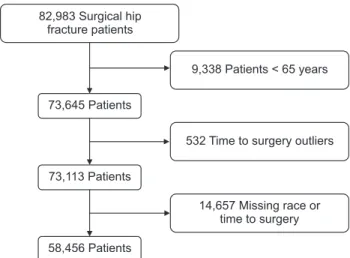
femur fracture. Only patients older than 65 years were included in the study. Extreme outliers in time to surgery were excluded from analysis and determined at ≥ 99th per- centile (≥ 168 hours). Patients with missing race were ex- cluded from the analysis (Fig. 1). Race categories included African American, Asian American, white, and other.
Outcome
Our primary outcome was to determine racial differences in the time to surgical repair of hip fractures. Time to sur- gery was defined as time (hours) of hospital admission to operation. Delayed time to surgery was defined as greater than or equal to 48 hours. Preoperative demographic vari- ables including age, sex, modified Charlson comorbidity index, body mass index, and race were collected. Second- ary outcomes included assessing 30-day postoperative complications (reintubation, pulmonary embolism, failure to wean from ventilator, renal insufficiency, renal failure, cardiac arrest, wound dehiscence, deep and superficial wound infection, pneumonia, urinary tract infection, cerebrovascular accident, and myocardial infarction) and mortality.
Statistical Analysis
All analyses were performed using SAS ver. 9.4 (SAS In- stitute Inc., Cary, NC, USA). Continuous variables were reported as mean ± standard deviation and categorical variables were reported as count (%), unless otherwise specified. To assess significant variability in time to sur- gery between different races, analysis of variance was per- formed. Chi-square test was used to determine differences
Fig. 1. Patient selection flowchart showing identification of the cohort who underwent surgical fixation for hip fractures from 2011 through 2017.
73,645 Patients
58,456 Patients 73,113 Patients 82,983 Surgical hip
fracture patients
9,338 Patients < 65 years
532 Time to surgery outliers
14,657 Missing race or time to surgery
in short-term 30-day complication rates among African Americans and other races. Delayed surgery was defined as greater than 48 hours from hospital presentation. A multivariate logistic regression analysis, adjusting for age, sex, comorbidities, and type of anesthesia and surgery per- formed, was conducted to determine associations between race, delayed surgery, and perioperative complications.
The p-value was set at 0.05 for statistical significance.
RESULTS
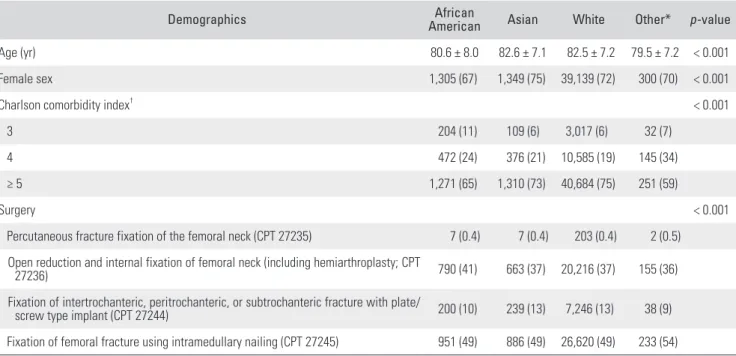
A total of 58,456 patients were included in the study, of which 42,093 (72%) were women and the median age was 84 years (interquartile range, 77–89 years). There were 54,285 white (92.8%), 1,948 African American (3.3%), 1,795 Asian (3.1%), and 428 other patients (0.7%). At baseline, African Americans were significantly younger and more commonly male than whites and Asians (Table 1).
Time to Surgery
African Americans had significantly longer time to surgery (30.4 ± 27.6 hours) than whites (25.8 ± 23.4 hours), Asians (26.5 ± 24.6 hours), and other races (22.7 ± 22.0 hours; all p < 0.001) (Fig. 2). African Americans also had a signifi-
cantly higher incidence of delayed time to surgery (≥ 48 hours, 28%) compared to whites (21%), Asians (21%), and other races (17%; p < 0.001). After adjusting for comor- bidities, sex, age, and type of surgery, Africans Americans had a 43% higher odds of having delayed surgery than whites (odds ratio [OR], 1.43; 95% confidence interval [CI], 1.29–1.58) and Asians (OR, 1.43; 95% CI, 1.22–1.65).
Table 1. Demographics of 58,456 Patients Who Sustained Hip Fractures in the National Surgical Quality Improvement Program Database
Demographics African
American Asian White Other* p-value
Age (yr) 80.6 ± 8.0 82.6 ± 7.1 82.5 ± 7.2 79.5 ± 7.2 < 0.001
Female sex 1,305 (67) 1,349 (75) 39,139 (72) 300 (70) < 0.001
Charlson comorbidity index† < 0.001
3 204 (11) 109 (6) 3,017 (6) 32 (7)
4 472 (24) 376 (21) 10,585 (19) 145 (34)
≥ 5 1,271 (65) 1,310 (73) 40,684 (75) 251 (59)
Surgery < 0.001
Percutaneous fracture fixation of the femoral neck (CPT 27235) 7 (0.4) 7 (0.4) 203 (0.4) 2 (0.5) Open reduction and internal fixation of femoral neck (including hemiarthroplasty; CPT
27236) 790 (41) 663 (37) 20,216 (37) 155 (36)
Fixation of intertrochanteric, peritrochanteric, or subtrochanteric fracture with plate/
screw type implant (CPT 27244) 200 (10) 239 (13) 7,246 (13) 38 (9)
Fixation of femoral fracture using intramedullary nailing (CPT 27245) 951 (49) 886 (49) 26,620 (49) 233 (54) Values are presented as mean ± standard deviation or number (%).
CPT: current procedural terminology.
*Other included American Indians, Alaska native, Native Hawaiian or Pacific Islander. †Minimum value for modified Charlson comorbidity index is 3 due to inclusion of only patients older than 65 years.
Fig. 2. Time to surgery from hospital presentation for 58,456 patients sorted by race (National Surgical Quality Improvement Program, 2011–
2017). Error bars show 95% confidence interval, p < 0.001.
African American 35
30 25 20 15 10 5
Timetosurgery(hr)
0
Asian White Other
Perioperative Complications and Mortality
For perioperative complications, African Americans expe- rienced significantly higher rates of reintubation (2.2% vs.
1.4%, p = 0.004), pulmonary embolism (1.3% vs. 0.7%, p = 0.004), failure to wean from ventilator (1.0% vs. 0.6%, p = 0.04), renal insufficiency (0.8% vs. 0.4%, p = 0.008), renal failure (0.7% vs. 0.3%, p = 0.002) and cardiac arrest (1.9%
vs. 0.8%, p < 0.001) than all other races (Table 2). On multivariate logistic regression analysis adjusting for age, sex, comorbidities, and type of anesthesia and surgery per- formed, African Americans had a higher odds of reintuba- tion (OR, 1.5; 95% CI, 1.1–2.1), pulmonary embolism (OR, 1.8; 95% CI, 1.2–2.7), renal insufficiency (OR, 1.9; 95% CI, 1.2–3.3) or failure (OR, 2.2; 95% CI, 1.3–3.9), and cardiac arrest (OR, 2.3; 95% CI, 1.6–3.3). Despite the increased rates of these major perioperative complications, mortality was significantly higher among white patients than Afri- can American patients (6.02% vs. 4.41%, p < 0.001). Asian Americans had the lowest mortality rate (3.84%), followed by other (4.21%).
DISCUSSION
In this study assessing the associations of racial disparity with time to surgery and perioperative complications in
patients with hip fracture, African Americans had a longer time to surgery and an increased rate of delayed surgery.
Despite the higher odds of several major perioperative complications in African Americans, mortality was signifi- cantly higher among white patients.
While not novel, these findings support concerns of racial disparity in hip fracture care observed in other stud- ies.4,6) Similar to our findings of higher mortality among white patients, a California (USA) population-based study of hip fracture patients showed that whites had greater 30- day, 90-day, and 1-year mortality rates than Asian, African American, and Hispanic patients.7) In contrast, in another study investigating outcomes of patients receiving either hemiarthroplasty or total hip arthroplasty, the authors found that Asians were at a greater risk of suffering a major postoperative complication and had higher mortal- ity (0.9%) compared to both whites (0.3%) and African Americans (0.4%).8) However, in an integrated and closed insurance group population for hip fractures, 1-year mor- tality rates were similar for white (33.7%), black (32.4%), and Hispanics (31.1%), but lower for Asian men (23.1%).9) Our study found similarly low rates of mortality among Asian Americans. Interestingly, despite both increased odds of delayed surgery and higher rates of major compli- cations (pulmonary embolism, renal failure, and cardiac
Table 2. Proportion of Patients Experiencing 30-Day Complications in 58,456 Patients Who Sustained Hip Fracture in the United States (National Surgical Quality Improvement Program, 2011–2017)
Complication African American (n = 1,948) Asian (n = 1,795) White (n = 54,285) Other (n = 428)* p-value
Deep wound infection 6 (0.31) 1 (0.06) 129 (0.24) 2 (0.47) 0.27
Cardiac arrest 36 (1.85) 18 (1.00) 437 (0.81) 2 (0.47) < 0.001
Failure to wean from ventilator 20 (1.03) 13 (0.72) 348 (0.64) 2 (0.47) 0.20
Myocardial infarction 32 (1.64) 28 (1.56) 954 (1.76) 4 (0.93) 0.54
Pneumonia 65 (3.34) 71 (3.96) 2,182 (4.02) 30 (7.01) < 0.001
Pulmonary embolism 25 (1.28) 8 (0.45) 394 (0.73) 2 (0.47) 0.014
Reintubation 42 (2.16) 32 (1.78) 744 (1.37) 3 (0.70) < 0.001
Renal failure 14 (0.72) 7 (0.39) 167 (0.31) 1 (0.23) 0.017
Renal insufficiency 16 (0.82) 9 (0.50) 230 (0.42) 0 0.031
Stroke 16 (0.82) 17 (0.95) 428 (0.79) 2 (0.47) 0.76
Superficial infection 8 (0.41) 9 (0.50) 305 (0.56) 3 (0.70) 0.79
Urinary tract infection 87 (4.47) 58 (3.23) 2,268 (4.18) 21 (4.91) 0.17
Wound dehiscence 2 (0.10) 0 35 (0.06) 0 0.59
Values are presented as number (%).
*Other included American Indians, Alaska native, Native Hawaiian or Pacific Islander. Minimum value for modified Charlson comorbidity index is 3 due to inclusion of only patients older than 65 years.
arrest), mortality was lower in African Americans than in whites. It should be noted that NSQIP only tracks 30-day outcomes, and short-term mortality cannot be extrapo- lated to 1-year mortality rates.
There are certain limitations to this study. First, our analysis lacks data on insurance and socioeconomic status, which may create a level of confounding. However, our analysis controlled for similar baseline patient comorbidi- ties, which may be more indicative of patient vigor and also be predictive of perioperative complications. Our analysis does not provide any stratification by surgery type, as subanalysis would substantially decrease the pow- er of each group. We also only examined 30-day outcomes and mortality, which is a limitation of the NSQIP database.
Finally, while the relationship we found between race and
hip fracture care remains correlational, further study is needed to determine a direct etiology for delays in surgery.
In summary, we found a significant disparity in both time to surgery and rate of delayed surgery for African Americans compared to whites. African Americans also experienced a higher complication rate than all other races but had a lower rate of mortality than whites. Further study is needed to determine the etiology of this disparity and highlight the need for targeted strategies to help at- risk patient populations.
CONFLICT OF INTEREST
No potential conflict of interest relevant to this article was reported.
REFERENCES
1. Schoenfeld AJ, Tipirneni R, Nelson JH, Carpenter JE, Iwashy- na TJ. The influence of race and ethnicity on complications and mortality after orthopedic surgery: a systematic review of the literature. Med Care. 2014;52(9):842-51.
2. Adelani MA, O'Connor MI. Perspectives of orthopedic surgeons on racial/ethnic disparities in care. J Racial Ethn Health Disparities. 2017;4(4):758-62.
3. Sterling RS. Gender and race/ethnicity differences in hip fracture incidence, morbidity, mortality, and function. Clin Orthop Relat Res. 2011;469(7):1913-8.
4. Dy CJ, Lane JM, Pan TJ, Parks ML, Lyman S. Racial and socioeconomic disparities in hip fracture care. J Bone Joint Surg Am. 2016;98(10):858-65.
5. Okike K, Chan PH, Prentice HA, Paxton EW, Navarro RA.
Association between race and ethnicity and hip fracture outcomes in a universally insured population. J Bone Joint
Surg Am. 2018;100(13):1126-31.
6. Ali I, Vattigunta S, Jang JM, et al. Racial disparities are pres- ent in the timing of radiographic assessment and surgical treatment of hip fractures. Clin Orthop Relat Res. 2020;
478(3):455-61.
7. Sullivan KJ, Husak LE, Altebarmakian M, Brox WT. Demo- graphic factors in hip fracture incidence and mortality rates in California, 2000-2011. J Orthop Surg Res. 2016;11:4.
8. Rudasill SE, Dattilo JR, Liu J, Kamath AF. Hemiarthro- plasty or total hip arthroplasty: is there a racial bias in treatment selection for femoral neck fractures? Geriatr Orthop Surg Rehabil. 2019 April 30 [Epub]. https://doi.
org/10.1177/2151459319841741
9. Liu LH, Chandra M, Gonzalez JR, Lo JC. Racial and ethnic differences in hip fracture outcomes in men. Am J Manag Care. 2017;23(9):560-4.