A hip fracture may be associated with blood loss, warrant- ing transfusion. Older patients with hip fractures represent an important, large group of inpatients in acute care hos-
pitals, along with elderly patients with osteoporotic frac- tures.1-3)
Hip fracture surgery is associated with blood loss, which may lead to adverse patient outcomes, for example, hemodynamic stress, increased cardiac demand, and po- tential tissue hypoxia in the elderly population, so anemia might contribute to the high morbidity and mortality rates after hip fracture surgery.4) In most cases of hip fracture including femoral neck and intertrochanteric fractures, hemoglobin decreases gradually following the fracture.
Hip Fracture Surgery without Transfusion in Patients with Hemoglobin Less Than 10 g/dL
You-Sung Suh, MD, Jae-Hwi Nho, MD, Jonghyeon Seo, MD, Byung-Woong Jang, MD, Jong-Seok Park, MD*
Department of Orthopaedic Surgery, Soonchunhyang University Hospital Seoul, Seoul,
*Department of Orthopaedic Surgery, Soonchunhyang University Cheonan Hospital, Cheonan, Korea
Background: Hip fracture surgery is associated with blood loss, which may lead to adverse patient outcomes. The hemoglobin level declines gradually in most hip fracture cases involving femoral neck fractures and intertrochanteric fractures. It decreases further after hip fracture surgery due to perioperative bleeding. We developed a protocol, which avoids transfusion in hip fracture surgery, and reviewed the hemodynamic outcomes of patients with hemoglobin less than 10 g/dL without transfusion.
Methods: From 2014 to 2019, we retrospectively recruited 34 patients with hip fractures and a hemoglobin level less than 10 g/dL, who refused to undergo transfusion. There were 19 patients with femoral neck fractures and 15 patients with intertrochanteric fractures. Our patient blood management (PBM) protocol involving 4,000 U erythropoietin (3 times a week) and 100 mg iron supple- ment (every day) was applied to all included patients. Intraoperatively, a cell saver and tranexamic acid were used. Postoperatively, the protocol was maintained until the patients’ hemoglobin level reached 10 g/dL. We evaluated the feasibility of our protocol, perioperative complications, and hemodynamic changes.
Results: Nineteen patients with femoral neck fractures underwent bipolar hemiarthroplasty and 15 patients with intertrochanteric frac tures underwent internal fixation with a cephalomedullary nail. The mean hemoglobin level was 8.9 g/dL (range, 7.3–9.9 g/dL) pre- operatively, 7.9 g/dL (range, 6.5–9.3 g/dL) immediately postoperatively, 7.7 g/dL (range, 4.3–9.5 g/dL) on postoperative day 1, 7.4 g/dL (range, 4.2–9.4 g/dL) on postoperative day 3, 8.1 g/dL (range, 4.4–9.7 g/dL) on postoperative day 5, 8.5 g/dL (range, 4.5–9.9 g/dL) on post operative day 7, and 9.9 g/dL (range, 5.7–11.1 g/dL) on postoperative day 14. The average intraoperative bleeding was 206.2 ± 78.7 mL. There was no case associated with complications of anemia.
Conclusions: Hip fracture surgery in patients with hemoglobin less than 10 g/dL was feasible without the need for transfusion using our PBM protocol in 34 patients. Using this protocol, the operation was conducted safely despite the anemic condition of patients with fractures whose hemoglobin was less than 10 g/dL.
Keywords: Patient blood management, Transfusion, Hip fracture, Femoral neck fracture, Intertrochanteric fracture
Copyright © 2021 by The Korean Orthopaedic Association
This is an Open Access article distributed under the terms of the Creative Commons Attribution Non-Commercial License (http://creativecommons.org/licenses/by-nc/4.0) which permits unrestricted non-commercial use, distribution, and reproduction in any medium, provided the original work is properly cited.
Clinics in Orthopedic Surgery • pISSN 2005-291X eISSN 2005-4408 Received April 9, 2020; Accepted June 16, 2020
Correspondence to: Jae-Hwi Nho, MD
Department of Orthopaedic Surgery, Soonchunhyang University Hospital Seoul, 59 Daesagwan-ro, Yongsan-gu, Seoul 04401, Korea
Tel: +82-2-709-9250, Fax: +82-2-710-3191 E-mail: [email protected]
After fracture surgery, hemoglobin decreases further due to perioperative bleeding. In general, perioperative bleed- ing ranges from 500 to 1,500 mL in hip fracture surgery.2,5) Despite perioperative advances in hip fracture surgery, anemia is highly prevalent (39%–69%) in patients un- dergoing surgery for acute hip fractures.4) Therefore, al- logeneic blood transfusion is generally required in elderly patients undergoing hip fracture surgery.1,6)
The level of preoperative hemoglobin is a major predictor of the need for transfusion following orthopedic surgery.2,6) A few studies reported that elective surgery could be done safely in patients with a preoperative hemo- globin level above 10 g/dL if the estimated blood loss was greater than 500 mL.2,7,8) Thus, we determined the target hemoglobin level before surgery as 10 g/dL. We developed a protocol to avoid the need for transfusion in hip fracture surgery and reviewed the hemodynamic outcomes of hip fracture surgery without transfusion in patients with he- moglobin less than 10 g/dL.2,6)
The purpose of this study was to determine the fea- sibility and safety of our protocol and to analyze hemato- logic changes and complications during the perioperative period of hip fracture surgery without transfusion.
METHODS
Developing a Patient Blood Management Protocol for Fracture Surgery without Transfusion
We conducted this study in compliance with the principles
of the Declaration of Helsinki. The study design and pro- tocol were approved by the Institutional Review Board of Soonchunhyang University Hospital Seoul (IRB No. 2019- 04-010-001) and all patients provided written informed consent after the risk of fracture surgery without transfu- sion was explained.
According to our patient blood management (PBM) protocol for hip fracture surgery without transfusion, when the preoperative hemoglobin level was higher than 10 g/dL, we administered recombinant erythropoietin and iron supplements just once before the operation. However, when the preoperative hemoglobin level was lower than 10 g/dL, we administered the recombinant erythropoietin ev- ery other day (3 times a week) and iron supplements every day until the hemoglobin level reached 10 g/dL. Immedi- ately before the operation, 1 g of intravenous tranexamic acid was given, except for high-risk patients with venous thromboembolism. During the operation, reinfusion of drainage blood using a cell saver and plasma expanders was performed. The cell saver device (Haemonetics Cor- poration, Braintree, MA, USA) filtered and washed the collected blood to remove hemolyzed cells, free hemoglo- bin, and other impurities, which was followed by admin- istration of 1 g of tranexamic acid immediately before the operation, except in high-risk patients for venous throm- boembolism. Postoperatively, recombinant erythropoietin and iron supplements were administered similarly using the preoperative protocol, which was continued until the hemoglobin level reached 10 g/dL (Fig. 1).2,6)
Preoperative and postoperative alternative protocol: SC recombinant erythropoietin and IV iron supplements
- Hb < 10 g/dL: 3 times a week SC recombinant erythropoietin and daily IV iron supplements until Hb level reaches around 10 g/dL - IV TXA: 1 g of TXA is given immediately before operation
- Cell saver
Preoperative alternative protocol: SC recombinant erythropoietin and IV iron supplements - Hb > 10 g/dL: SC recombinant erythropoietin and IV iron supplements once before operation
- Hb < 10 g/dL: 3 times a week SC recombinant erythropoietin and daily IV iron supplements until Hb level reaches around 10 g/dL 71 Excluded
- Patients with Hb more than 10 g/dL 109 Enrolled in the original study
4 Excluded
- Internal fixation for femoral neck fractures
- Bipolar hemiarthroplasties for intertrochanteric fractures 34 Hip fracture patients with Hb less than 10 g/dL
Femoral neck fracture:
19 bipolar hemiarthroplasty
Intertrochanteric fracture:
15 cephalomedullary nailing
Fig. 1. Flowchart showing inclusion and exclusion criteria of the study. Hb: hemoglobin, SC: subcutaneous, IV: intravenous, TXA: tranexamic acid.
Demographic Characteristics
From January 2014 until December 2019, we performed 109 hip fracture operations in patients who refused trans- fusion during the perioperative period due to religious beliefs or personal preferences. All of them provided writ- ten informed consent regarding the risk and protocol for transfusion-free arthroplasty without allogeneic transfu- sion. They agreed with the risk of surgery without transfu- sion, including death due to massive bleeding.
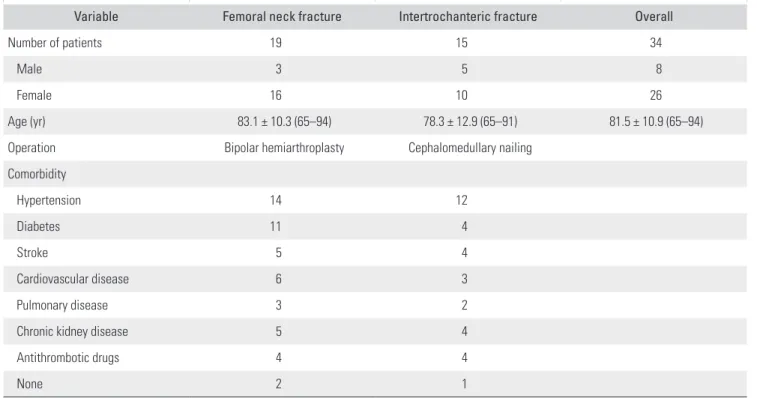
In 71 of the 109 patients, the preoperative hemo- globin level was higher than 10 g/dL, and thus the opera- tion as performed without transfusion immediately after admission according to the above protocol. However, in 34 patients with a hemoglobin level 10 g/dL or below, the changing pattern of hemoglobin level was evaluated by monitoring the daily levels of hemoglobin. The demo- graphic characteristics of these 34 patients are summarized in Table 1. We evaluated only 2 fracture types: femoral neck fractures and intertrochanteric fractures. Nineteen patients had fractures of the femoral neck: 3 men and 16 women with a mean age of 83.1 years (standard deviation [SD], 6.5 years; range, 65–94 years). Fifteen patients had intertrochanteric fractures: 5 men and 10 women with a mean age of 78.3 years (SD, 12.9 years; range, 65–91 years).
Patients who underwent internal fixation for femoral neck fracture (1 patient) and bipolar hemiarthroplasty for in-
tertrochanteric fractures (3 patients) were not included in this study due to scarcity of data. (Fig. 1).
Performing Arthroplasty without Transfusion When Hemoglobin Is Less Than 10 g/dL
In older patients, a delay in fracture operation can lead to poor outcomes with worsening of the general condition, such as pneumonia, sores, infection, and various unex- pected illnesses, and mortality caused by loss of mobil-
ity.9-14) We performed the operation immediately after the
rebound of preoperative hemoglobin level according to the above protocol.
When hemoglobin levels continued to decrease due to fractures, the operations were delayed until the hemo- globin level reached the nadir. When the hemoglobin level started increasing gradually by maintaining the above pro- tocol, hip fracture operations were performed even when the hemoglobin level was 10 g/dL or less to prevent the complications associated with delayed operation. The av- erage number of days from the date of fracture to the date of operation was 4.8 days (SD, 1.54; range, 1–7 days).
All operations were performed by a single senior surgeon (YSS) with the patient under spinal anesthesia and/or epidural anesthesia. On the fracture table, bipolar hemiarthroplasty was performed via the conventional posterior approach in patients with femoral neck fractures
Table 1. Demographic Characteristics
Variable Femoral neck fracture Intertrochanteric fracture Overall
Number of patients 19 15 34
Male 3 5 8
Female 16 10 26
Age (yr) 83.1 ± 10.3 (65–94) 78.3 ± 12.9 (65–91) 81.5 ± 10.9 (65–94)
Operation Bipolar hemiarthroplasty Cephalomedullary nailing
Comorbidity
Hypertension 14 12
Diabetes 11 4
Stroke 5 4
Cardiovascular disease 6 3
Pulmonary disease 3 2
Chronic kidney disease 5 4
Antithrombotic drugs 4 4
None 2 1
Values are presented as number or mean ± standard deviation (range).
and osteosynthesis by intramedullary nailing in patients with intertrochanteric fractures. The prosthesis for bipo- lar hemiarthroplasty was the Bencox stem and the Coren bipolar cup (Corentec, Seoul, Korea). Osteosynthesis was performed using cephalomedullary nailing (Compression hip nail, TDM, Seongnam, Korea). Suction drainage was routinely inserted after the operation and removed on the postoperative day 1 to 2. After removal of the suction drainage, patients started ambulation. Gradual weight- bearing was initiated with a crutch or walker.
Hemodynamic Evaluation
We measured the levels of intraoperative bleeding, blood infused by the cell saver, and postoperative drainage. The hemoglobin and hematocrit levels were measured imme- diately before and after the operation and on postoperative days 1, 3, 5, 7, and 14. We monitored the changing pattern of hemoglobin after fracture operation and evaluated the feasibility of our protocol, perioperative complications, hematological changes, mortality, and infection associated with the protocol.
Statistical Analysis
Baseline characteristics and perioperative clinical data were analyzed for all patients and by gender and operation type with descriptive statistics. Bivariate tests of associa- tion were based on either Pearson’s chi-square or Fisher’s exact tests for categorical variables. Next, the least signifi- cant difference method of post hoc multiple comparisons with Tamhane T2 was used to compare each group of operations to determine significant differences before and immediately after the operation, and on postoperative days 1, 3, 5, 7, and 14. All hemoglobin and hematocrit levels measured in this study were analyzed as continuous vari- ables. All tests were two-sided, and statistical significance was accepted for a p-value of < 0.05, and statistical analysis was performed using IBM SPSS ver. 21.0 (IBM Corp., Ar- monk, NY, USA).
RESULTS
Thirty-four patients manifested 19 femoral neck fractures and 15 intertrochanteric fractures, with a hemoglobin level less than 10 g/dL. Bipolar hemiarthroplasty was performed in 19 patients with femoral neck fractures; 15 patients with intertrochanteric fractures underwent internal fixa- tion with cephalomedullary nails. In these 34 patients, the preoperative protocol was applied: if the hemoglobin level was < 10 g/dL, subcutaneous recombinant erythropoietin administration (3 times a week) and intravenous iron sup-
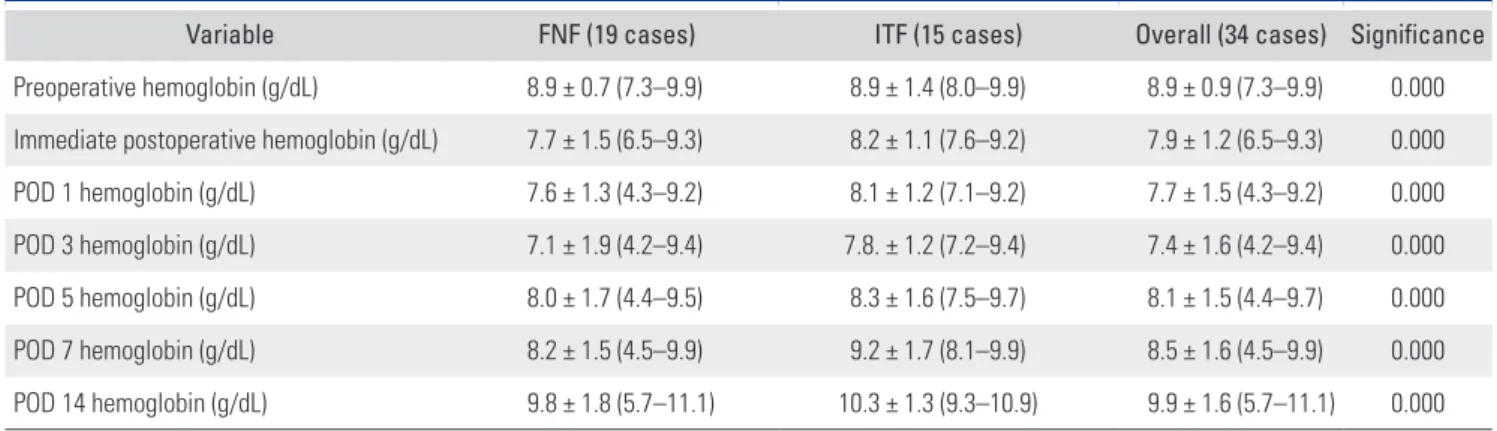
plementation (every day) were performed until the hemo- globin level of 10 g/dL was reached. The mean hemoglobin level of overall patients was 8.9 g/dL (range, 7.3–9.9 g/dL) preoperatively, 7.9 g/dL (range, 6.5–9.3 g/dL) immediately postoperatively, 7.7 g/dL (range, 4.3–9.5 g/dL) on postoper- ative day 1, 7.4 g/dL (range, 4.2–9.4 g/dL) on postoperative day 3, 8.1 g/dL (range, 4.4–9.7 g/dL) on postoperative day 5, 8.5 g/dL (range, 4.5–9.9 g/dL) on postoperative day 7, and 9.9 g/dL (range, 5.7–11.1 g/dL) on postoperative day 14. The lowest mean hemoglobin level was observed on postoperative day 3. After postoperative day 3, the hemo- globin level recovered gradually, and by postoperative day 14, the hemoglobin level increased to around 10 g/dL (Fig.
2, Table 2).
The average intraoperative bleeding was 225 ± 81 mL in patients with femoral neck fractures who under- went bipolar hemiarthroplasty and 75 ± 56 mL in those with intertrochanteric fractures treated with cephalomed- ullary nails. The mean volume of reinfused blood by the cell saver was 152 ± 62 mL in the femoral neck fracture group and 124 ± 68 mL in the intertrochanteric fracture group. The average amount of postoperative drainage was 338 ± 142 mL in the femoral neck fracture group and 103
± 59 mL in the intertrochanteric fracture group (Table 3).
The average duration from admission to surgery was 5.0 ± 1.5 days in patients treated with bipolar hemi- arthroplasty for femoral neck fractures and 4.6 ± 2.1 days in patients treated with cephalomedullary nails for inter- trochanteric fractures. During hospitalization, 1 patient had deep vein thrombosis and recovered after treatment with anticoagulatory medication. Five patients had post- operative delirium (3 after bipolar hemiarthroplasty and
Fig. 2. Hemoglobin (Hb) changes after bipolar hemiarthroplasty for femoral neck fractures and cephalomedullary nailing for intertrochanteric fractures in patients with our blood management protocol. Preop:
preoperative, Postop: postoperative, POD: postoperative day.
PreopImmediate
postop POD 1 POD 3 POD 5 POD 7 POD 14 11
10
9
8
7
Hblevel
Period
Femoral neck fracture Intertrochanteric fracture Overall
2 after cephalomedullary nailing). No medical emergency occurred, and the direct cause of death was not related to postoperative anemic symptoms or complications associ- ated with the PBM protocol during 3 months postopera- tively.
DISCUSSION
Hip fracture surgery is associated with blood loss, which may lead to adverse patient outcomes.15-17) Older patients with hip fractures represent an important, large group of in-patients in acute hospitals.3) In most cases of hip frac- ture including femoral neck and intertrochanteric frac- tures, the hemoglobin level decreases gradually following the fracture. Postoperatively, the hemoglobin level declines further due to perioperative bleeding. Jehovah’s Witnesses do not accept transfusion for religious reasons even in life- threatening situations.2,18) Performing hip fracture surgery in patients who do not accept transfusion has been a mat- ter of concern. It is very difficult and challenging to oper-
ate on a patient with hip fracture and anemia when the hemoglobin level is 10 mg/dL or less.
Fracture operations differ from elective arthroplas- ties including total hip arthroplasty and total knee arthro- plasty. Patients with anemia do not need to undergo these elective arthroplasties. However, in the case of acute hip fractures, if fracture operations are postponed until after correction of anemia and other unexpected complications, the risk of mortality increases.9-14,17) A delayed operation may lead to worsening of systemic conditions and unex- pected progression. Whether to correct anemia or perform a rapid fracture operation is a difficult decision.
More than 98% of the patients with hip fractures undergo an operation, and urgent surgical treatment is very important in elderly patients.19) Preoperative al- logeneic blood transfusions have often been performed to maintain hemoglobin levels before and after fracture operations.1,20) However, orthopedic surgeons and their pa- tients have been plagued by transfusion in the periopera- tive period.2,15,21-23) Hence, surgery without transfusion is of interest, especially for the elderly who often carry multiple comorbidities.24,25)
Complications associated with allogeneic blood transfusion in patients undergoing surgery for hip frac- tures are an increasing cause for concern and allogeneic blood transfusions are associated with increased long- term mortality after hip fracture surgery.4,9,26) In addition, an increased risk of postoperative illness including pneu- monia, delirium, short-term mortality, length of hospital stay, and systemic inflammatory response syndrome in patients receiving blood transfusion was reported.4) Fur- thermore, perioperative allogeneic transfusions were as- sociated with a higher rate of reoperation for suspected acute infection.27) Therefore, prompt surgical intervention Table 3. Comparison of Perioperative Hemodynamic Data and Ope-
rational Delay between the FNF Group and ITF Group
Variable FNF ITF Significance
Intraoperative blood loss (mL) 225 ± 81 75 ± 56 0.000
Cell saver (mL) 152 ± 63 64 ± 68 0.000
Postoperative drainage (mL) 338 ± 72 103 ± 59 0.000 Operation delay (from admission
to ope ration) 5.0 ± 3.1 4.6 ± 2.2 0.000 Values are presented as mean ± standard deviation.
FNF: femoral neck fracture, ITF: intertrochanteric fracture.
Table 2. Hemodynamic Changes from before Surgery to 14 Days after Surgery in the FNF Group and ITF Group
Variable FNF (19 cases) ITF (15 cases) Overall (34 cases) Significance
Preoperative hemoglobin (g/dL) 8.9 ± 0.7 (7.3–9.9) 8.9 ± 1.4 (8.0–9.9) 8.9 ± 0.9 (7.3–9.9) 0.000 Immediate postoperative hemoglobin (g/dL) 7.7 ± 1.5 (6.5–9.3) 8.2 ± 1.1 (7.6–9.2) 7.9 ± 1.2 (6.5–9.3) 0.000
POD 1 hemoglobin (g/dL) 7.6 ± 1.3 (4.3–9.2) 8.1 ± 1.2 (7.1–9.2) 7.7 ± 1.5 (4.3–9.2) 0.000
POD 3 hemoglobin (g/dL) 7.1 ± 1.9 (4.2–9.4) 7.8. ± 1.2 (7.2–9.4) 7.4 ± 1.6 (4.2–9.4) 0.000
POD 5 hemoglobin (g/dL) 8.0 ± 1.7 (4.4–9.5) 8.3 ± 1.6 (7.5–9.7) 8.1 ± 1.5 (4.4–9.7) 0.000
POD 7 hemoglobin (g/dL) 8.2 ± 1.5 (4.5–9.9) 9.2 ± 1.7 (8.1–9.9) 8.5 ± 1.6 (4.5–9.9) 0.000
POD 14 hemoglobin (g/dL) 9.8 ± 1.8 (5.7–11.1) 10.3 ± 1.3 (9.3–10.9) 9.9 ± 1.6 (5.7–11.1) 0.000 Values are presented as mean ± standard deviation (range).
FNF: femoral neck fracture with bipolar hemiarthroplasty, ITF: intertrochanteric fracture with cephalomedullary nailing, POD: postoperative day.
without transfusion and perioperative PBM are imperative for fracture patients with anemia with a hemoglobin level of 10 mg/dL or less.
In this study, we obtained successful results with our programmed PBM protocol using the combination of re- combinant erythropoietin, iron supplements, tranexamic acid, and a cell saver without allogeneic transfusion. Our protocol was not associated with any notable complica- tions related to anemic symptoms. Our study showed that it can be safe to perform hip fracture surgery without allo- geneic transfusion in anemic patients whose hemoglobin level is less than 10 g/dL with use of our protocol. We used a variety of methods including bleeding reduction, eryth- ropoietin therapy, iron supplements, and a cell saver in this study. Treatment with tranexamic acid has been used to reduce blood loss and transfusion rates in orthopedic surgery.28-30) However, our protocol focused not only on blood conservation management but also on reproduction by inducing erythropoiesis.2,6)
Despite the PBM protocol, in the fracture patients, the hemoglobin level declined until the postoperative day 3, which was followed by a gradual increase. The hemoglo- bin nadir was observed on postoperative day 3. A similar hemodynamic pattern was reported in previous studies of patients with hemoglobin less than 10 g/dL.2) Understand- ing of these altered hemoglobin patterns is very important in maintaining the protocol.
There are several limitations to our study. First, it was not a randomized trial and it was a retrospective study including 2 different operations: bipolar hemiarthroplasty for femoral neck fractures and cephalomedullary nailing for intertrochanteric fractures in a small number of pa- tients. In addition, patients who underwent internal fixa-
tion for femoral neck fractures and bipolar hemiarthro- plasty for intertrochanteric fractures were not included in this study because of scarcity of the data. We have a plan for further research including these cases, as the volume increases. However, patients with anemic fractures who refused transfusion because of religious beliefs or personal preference were rare. Second, all arthroplasties were done by a single high-volume surgeon. Low-volume surgeons may not be able to reproduce our results. Third, the pro- tocol was used mostly in Jehovah’s Witness patients who did not accept transfusion due to their religious beliefs.
However, transfusion is a serious issue for patients regard- less of their religion, and our protocol would be applicable to patients who are not Jehovah’s Witnesses. Finally, we could not evaluate postoperative clinical outcomes such as ambulatory status and functional scores.
Despite these limitations, hip fracture operations in patients with a hemoglobin level less than 10 g/dL could be done without transfusion using the programmed PBM protocol. In patients who refused to undergo allogeneic transfusion, the hemodynamic pattern was similar to that reported previously. Our protocol can be a safe alternative to hip fracture operation without transfusion. Using this protocol, it can be possible to reduce overall blood transfu- sion levels and rates during the perioperative period in hip fracture surgery, even in cases of fractures in patients with anemia, who are considering allogeneic transfusion.
CONFLICT OF INTEREST
No potential conflict of interest relevant to this article was reported.
REFERENCES
1. Suh YS, Lee JJ, Nho JH, Lee JJ, Won SH, Yang HJ. Transfu- sion trends in hip arthroplasty in Korea: a nationwide study by the Korean National Health Insurance Service. Transfu- sion. 2019;59(7):2324-33.
2. Suh YS, Nho JH, Choi HS, Ha YC, Park JS, Koo KH. A pro- tocol avoiding allogeneic transfusion in joint arthroplasties.
Arch Orthop Trauma Surg. 2016;136(9):1213-26.
3. Martinsen MI, Valland H, Solheim LF, Holvik K, Ranhoff A. A restrictive policy for red blood cell transfusion in older hip fracture patients: experiences from a patient register.
BMC Res Notes. 2016;9:75.
4. Smeets SJ, Verbruggen JP, Poeze M. Effect of blood transfu- sion on survival after hip fracture surgery. Eur J Orthop
Surg Traumatol. 2018;28(7):1297-303.
5. Kim SK, Seo WY, Kim HJ, Yoo JJ. Postoperative intravenous ferric carboxymaltose reduces transfusion amounts after orthopedic hip surgery. Clin Orthop Surg. 2018;10(1):20-5.
6. Suh YS, Lee JJ, Nho JH, et al. Blood management protocol without transfusion in orthopedic surgery. Korean J Blood Transfus. 2019;30(1):15-22.
7. Nelson CL, Bowen WS. Total hip arthroplasty in Jehovah’s Witnesses without blood transfusion. J Bone Joint Surg Am.
1986;68(3):350-3.
8. Nelson CL, Fontenot HJ, Flahiff C, Stewart J. An algorithm to optimize perioperative blood management in surgery.
Clin Orthop Relat Res. 1998;(357):36-42.
9. Ozturk B, Johnsen SP, Rock ND, Pedersen L, Pedersen AB.
Impact of comorbidity on the association between surgery delay and mortality in hip fracture patients: a Danish na- tionwide cohort study. Injury. 2019;50(2):424-31.
10. Cordero J, Maldonado A, Iborra S. Surgical delay as a risk factor for wound infection after a hip fracture. Injury.
2016;47 Suppl 3:S56-60.
11. Ryan DJ, Yoshihara H, Yoneoka D, Egol KA, Zuckerman JD. Delay in hip fracture surgery: an analysis of patient- specific and hospital-specific risk factors. J Orthop Trauma.
2015;29(8):343-8.
12. Daugaard CL, Jorgensen HL, Riis T, Lauritzen JB, Duus BR, van der Mark S. Is mortality after hip fracture associated with surgical delay or admission during weekends and pub- lic holidays? A retrospective study of 38,020 patients. Acta Orthop. 2012;83(6):609-13.
13. Lefaivre KA, Macadam SA, Davidson DJ, Gandhi R, Chan H, Broekhuyse HM. Length of stay, mortality, morbidity and delay to surgery in hip fractures. J Bone Joint Surg Br.
2009;91(7):922-7.
14. Leer-Salvesen S, Engesaeter LB, Dybvik E, Furnes O, Kris- tensen TB, Gjertsen JE. Does time from fracture to surgery affect mortality and intraoperative medical complications for hip fracture patients? An observational study of 73 557 patients reported to the Norwegian Hip Fracture Register.
Bone Joint J. 2019;101(9):1129-37.
15. Arshi A, Lai WC, Iglesias BC, et al. Blood transfusion rates and predictors following geriatric hip fracture surgery. Hip Int. 2020 Jan 8 [Epub]. https://10.1177/1120700019897878.
16. Xu BY, Yan S, Low LL, Vasanwala FF, Low SG. Predictors of poor functional outcomes and mortality in patients with hip fracture: a systematic review. BMC Musculoskelet Disord.
2019;20(1):568.
17. Saul D, Riekenberg J, Ammon JC, Hoffmann DB, Sehmisch S. Hip fractures: therapy, timing, and complication spec- trum. Orthop Surg. 2019;11(6):994-1002.
18. Posluszny JA Jr, Napolitano LM. How do we treat life- threatening anemia in a Jehovah’s Witness patient? Transfu- sion. 2014;54(12):3026-34.
19. Lefaivre KA, Starr AJ, Barker BP, Overturf S, Reinert CM.
Early experience with reduction of displaced disruption of the pelvic ring using a pelvic reduction frame. J Bone Joint Surg Br. 2009;91(9):1201-7.
20. Yoon BH, Ko YS, Jang SH, Ha JK. Feasibility of hip fracture surgery using a no transfusion protocol in elderly patients:
a propensity score-matched cohort study. J Orthop Trauma.
2017;31(8):414-9.
21. Glassou EN, Kristensen N, Moller BK, Erikstrup C, Hansen TB, Pedersen AB. Impact of preadmission anti-inflamma- tory drug use on the risk of RBC transfusion in elderly hip fracture patients: a Danish nationwide cohort study, 2005- 2016. Transfusion. 2019;59(3):935-44.
22. Daugaard C, Pedersen AB, Kristensen NR, Johnsen SP. Pre- operative antithrombotic therapy and risk of blood transfu- sion and mortality following hip fracture surgery: a Danish nationwide cohort study. Osteoporos Int. 2019;30(3):583-91.
23. Zhu C, Yin J, Wang B, et al. Restrictive versus liberal strat- egy for red blood-cell transfusion in hip fracture patients: a systematic review and meta-analysis. Medicine (Baltimore).
2019;98(32):e16795.
24. Hong KH, Pan JK, Yang WY, Luo MH, Xu SC, Liu J. Com- parison between autologous blood transfusion drainage and closed-suction drainage/no drainage in total knee arthroplasty: a meta-analysis. BMC Musculoskelet Disord.
2016;17:142.
25. Kopolovic I, Ostro J, Tsubota H, et al. A systematic review of transfusion-associated graft-versus-host disease. Blood.
2015;126(3):406-14.
26. Engoren M, Mitchell E, Perring P, Sferra J. The effect of erythrocyte blood transfusions on survival after surgery for hip fracture. J Trauma. 2008;65(6):1411-5.
27. Newman ET, Watters TS, Lewis JS, et al. Impact of peri- operative allogeneic and autologous blood transfusion on acute wound infection following total knee and total hip arthroplasty. J Bone Joint Surg Am. 2014;96(4):279-84.
28. Yamaguchi A, Goto K, Kawai T, Kuroda Y, Sano K, Matsuda S. Dose optimization of topical tranexamic acid for primary total hip arthroplasty: a prospective cohort study. J Orthop Sci. 2019;24(2):275-9.
29. Wang N, Xiong X, Xu L, et al. Transfusions and cost-benefit of oral versus intravenous tranexamic acid in primary total hip arthroplasty: a meta-analysis of randomized controlled trials. Medicine (Baltimore). 2019;98(17):e15279.
30. Tzatzairis T, Drosos GI, Vogiatzaki T, Tilkeridis K, Ververi- dis A, Kazakos K. Multiple intravenous tranexamic acid doses in total knee arthroplasty without tourniquet: a randomized controlled study. Arch Orthop Trauma Surg.
2019;139(6):859-68.