ISSN 2234-3806 • eISSN 2234-3814
https://doi.org/10.3343/alm.2020.40.5.431 www.annlabmed.org 431
Ann Lab Med 2020;40:431-434
https://doi.org/10.3343/alm.2020.40.5.431
Letter to the Editor
Transfusion Medicine
Successful Desensitization by Post-Centrifugal Plasma Filtration in Two Highly Sensitized Heart and Lung
Transplant Recipients
Hyun-Ji Lee , M.D., Ph.D.1, Kyung-Hwa Shin , M.D., Ph.D.2, Hyung-Hoi Kim , M.D., Ph.D.2, Hyung Gon Je , M.D., Ph.D.3, Dohyung Kim , M.D.3, Woo Hyun Cho , M.D., Ph.D.4, Jeong Su Kim , M.D., Ph.D.5, Soo Yong Lee , M.D., Ph.D.5, and Hye Ju Yeo , M.D., Ph.D.4
1Department of Laboratory Medicine and Research, Institute for Convergence of Biomedical Science and Technology, Pusan National University Yangsan Hospital, Yangsan, Korea; 2Department of Laboratory Medicine, Pusan National University Hospital, Busan, Korea; 3Department of Cardiovascular and Thoracic Surgery and Research, Institute for Convergence of Biomedical Science and Technology, Pusan National University Yangsan Hospital, Yangsan, Korea; 4Department of Pulmonology and Critical Care Medicine, Pusan National University Yangsan Hospital, Yangsan, Korea; 5Division of Cardiology, Department of Internal Medicine and Research, Institute for Convergence of Biomedical Science and Technology, Pusan National University Yangsan Hospital, Pusan National University School of Medicine, Yangsan, Korea
Dear Editor,
The presence of donor-specific antibodies (DSAs) not only in- creases the incidence of antibody-mediated rejection (AMR) but also leads to other complications, such as increased frequency of high-grade T cell-mediated rejection, chronic lung allograft dysfunction, bronchiolitis obliterans syndrome, cardiac allograft vasculopathy, and poor allograft survival in heart and lung trans- plant recipients [1-3]. Sensitized patients have a lower five-year survival rate than non-sensitized patients (65% vs. 74%), and rejection occurs more acutely and severely in the former than in the latter [3, 4]. We describe successful desensitization using post-centrifugal plasma filtration (PCPF) in two heart and lung transplant recipients with multiple DSAs. There is no report of desensitization treatment using PCPF in heart and lung trans- plant recipients. This retrospective study was approved by the Institutional Review Board at Pusan National University Yangsan Hospital, Yangsan, Korea (No. 05-2015-106).
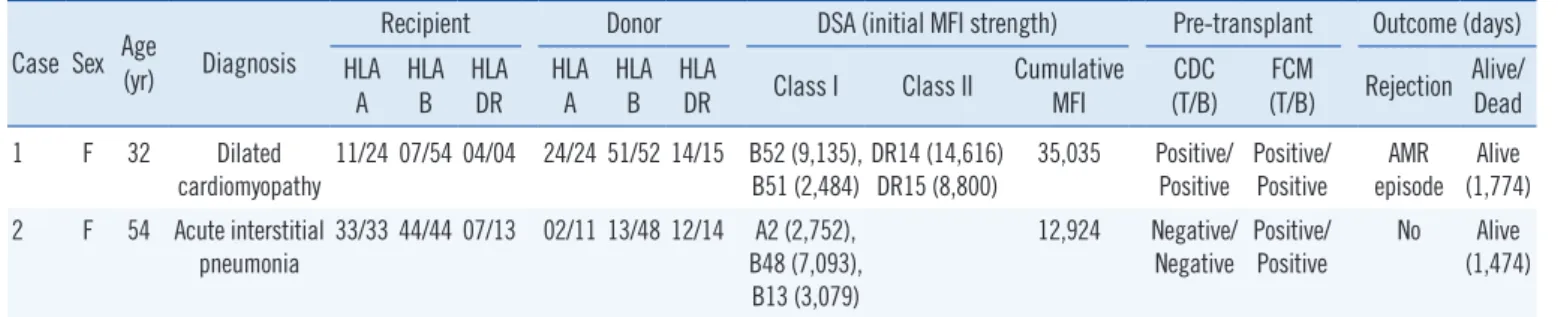
One patient (Case 1, Table 1) was admitted on May 2015 for
heart transplantation and showed high levels of four preformed DSAs, with a cumulative mean fluorescence intensity (MFI) of 35,035 at admission. As high DSA levels can predispose to AMR, the patient was desensitized. Two and 10 sessions of PCPF were performed before and after transplantation, respec- tively, using Com.Tec (Fresenius, Kabi, Germany). The primary plasma separator was a plastic disposable kit (PL1; Fresenius), and the secondary plasma fractionator was a 2A column (Eva- flux; Asahi Kasei Medical, Japan) with an albumin sieving coef- ficient of 0.62. To reduce the AMR risk, rituximab, corticoste- roid, and bortezomib were administered. Multiple treatments with immunosuppressants and 12 sessions of PCPF reduced the DSA MFI from 35,035 to 4,559 (Fig. 1A). Moreover, only two of the four DSAs were detected. The patient recovered from the rejection episode and was alive on day 1,774 post-trans- plantation.
Another patient (Case 2, Table 1), a candidate for lung trans- plantation, admitted on January 2016, presented high levels of
Received: November 5, 2019 Revision received: January 6, 2020 Accepted: March 3, 2020
Corresponding author: Hyung-Hoi Kim, M.D., Ph.D.
Biomedical Research Institute, Pusan National University Hospital Clinical Trial Center (CTC), Department of Laboratory Medicine and Biomedical Informatics Unit of Pusan National University School of Medicine, 1-10 Ami-dong, Seo-gu, Busan 49241, Korea
Tel: +82-51-240-7418, Fax: +82-51-247-6560, E-mail: [email protected]
© Korean Society for Laboratory Medicine
This is an Open Access article distributed under the terms of the Creative Commons Attribution Non-Commercial License (https://creativecommons.org/licenses/by-nc/4.0) which permits unrestricted non-commercial use, distribution, and reproduction in any medium, provided the original work is properly cited.
1 / 1 CROSSMARK_logo_3_Test
2017-03-16 https://crossmark-cdn.crossref.org/widget/v2.0/logos/CROSSMARK_Color_square.svg
Lee HJ, et al.
Successful desensitization by PCPF of strong DSAs
432 www.annlabmed.org https://doi.org/10.3343/alm.2020.40.5.431 Fig. 1. Changes in DSAs with desensitization treatment. (A) A heart transplant recipient (Case 1, Table 1) with preformed DSAs and (B) a lung transplant recipient (Case 2, Table 1) who underwent desensitization before donor matching.
Abbreviations: ATG, anti-thymocyte globulin; DSA, donor-specific antibody; IVIG, intravenous immunoglobulin; MFI, mean fluorescence in- tensity; PCPF, post-centrifugal plasma filtration; POD, postoperative day.
Table 1. Baseline characteristics of the two patients with DSAs Case Sex Age
(yr) Diagnosis
Recipient Donor DSA (initial MFI strength) Pre-transplant Outcome (days) HLA
A HLA
B HLA
DR HLA
A HLA
B HLA
DR Class I Class II Cumulative MFI
CDC (T/B)
FCM
(T/B) Rejection Alive/
Dead
1 F 32 Dilated
cardiomyopathy 11/24 07/54 04/04 24/24 51/52 14/15 B52 (9,135),
B51 (2,484) DR14 (14,616)
DR15 (8,800) 35,035 Positive/
Positive Positive/
Positive AMR episode Alive
(1,774) 2 F 54 Acute interstitial
pneumonia
33/33 44/44 07/13 02/11 13/48 12/14 A2 (2,752), B48 (7,093), B13 (3,079)
12,924 Negative/
Negative Positive/
Positive
No Alive (1,474)
Abbreviations: AMR, antibody-medicated rejection; CDC, complement-dependent cytotoxicity crossmatch; DSA, donor-specific antibody; FCM, flow cytometry crossmatch; HLA, human leukocyte antigen; MFI, mean fluorescence intensity; T/B, T cell/B cell.
40,000 30,000 20,000 10,000
12,000
8,000
4,000
-10 -5 0 5 10 15 20 25 30 35 40 45 50 55 60 65 70
-20 -15 -10 -5 0 5 10 15 20 25 30 35 40 45 50 55 60 65 70 -10 -5 0 5 10 15 20 25 30 35 40 45 50 55 60 65 70
-20 -15 -10 -5 0 5 10 15 20 25 30 35 40 45 50 55 60 65 70
MFIMFI
35,035
12,924
2,937 2,191
14,268
9,152 26,403
23,826 28,352 A
B
25,434 20,831
10,871
4,559 6,215
Total A2 B48 Total B52 B51 DR14 DR15
PCPF
PCPF Rituximab
Rituximab Steroid
Steroid Bortezomib
Bortezomib ATG
ATG IVIG POD
POD
IVIG
46 anti-HLA antibodies (Abs); of these, five showed MFI >
10,000; 27 showed MFI 3,000-10,000, and 14 showed MFI <
3,000. High DSA levels were predicted for this patient, and ini-
tial desensitization with rituximab before and during PCPF was scheduled. Four PCPF sessions were performed before the op- eration or donor matching to reduce anti-HLA Ab levels. A
Lee HJ, et al.
Successful desensitization by PCPF of strong DSAs
https://doi.org/10.3343/alm.2020.40.5.431 www.annlabmed.org 433
matched donor was found after four sessions of PCPF, and the cumulative MFI of three DSAs decreased from 12,924 to 2,937 on the day of transplantation (Fig. 1B). DSA MFI values in- creased to 14, 268 one month after transplantation, and the pa- tient was subjected to another PCPF session. The patient was alive on day 1,474 post-transplantation.
Rituximab (375 mg/m2) and plasmapheresis should be ad- ministered as pre-transplantation treatment to the highly sensi- tized patients. Intravenous immunoglobulin (IVIg; 1-2 g/kg) and anti-thymocyte globulin (0.75-1.5 mg/kg) were administered as induction therapy. Depending on the patient condition, steroids and bortezomib may be administered [3-5]. IVIg therapy is at the core of most desensitization protocols and provides protec- tion against infectious complications [6]. Within one week of IVIg administration, a 33% decrease in panel-reactive Ab was observed in heart transplant recipients, and a >80% reduction in cytotoxicity was achieved with repeated doses [1]. Recently, therapeutic monoclonal Abs have been used to prevent graft re- jection [3]. Rituximab, a chimeric anti-CD20 monoclonal Ab, has no effect on plasma cells, but does affect B cells [3]. Thera- peutic plasma exchange (TPE) also decreases intravascular IgG levels, with an efficacy comparable to that of IVIg, but it requires a longer treatment period. Bortezomib is a reversible 26S prote- asome inhibitor that decreases plasma cell levels and has other pleiotropic immunomodulatory effects [6]. Bortezomib treat- ment reduced alloantibody levels in heart transplant recipients [7]. In this study, two patients with high DSA levels were treated with rituximab and/or bortezomib, with no graft loss. Positive T cell flow cytometry crossmatch is a risk factor for AMR [4]. An MFI of 3,000-5,000, a widely recognized flow cytometry cross- match-positive cutoff, is considered a target for desensitization treatment [8].
In cases of cadaveric transplantation, the donors are not known in advance, and thus, the desensitization treatment be- fore transplantation is shorter after donor selection. As TPE re- places all plasma, drugs are also removed. Similar to immuno- adsorption, PCPF removes only Ig in the plasma that do not pass through the secondary filter. Therefore, it is possible to re- move plasma Abs while perpetuating the effects of the drug, which is more effective for desensitization treatment. Our study has some limitations; the treatment method would differ accord- ing to the condition of each patient, and owing to the small number of patients, the usefulness of the desensitization proto- col could not be statistically validated. In conclusion, we report two patients with high levels of preformed DSAs who underwent PCPF before transplantation. Although the desensitization pe-
riod was short owing to the critical condition of the patients, the transplantation was successful. This study shows that success- ful desensitization in heart and lung transplant recipients can be achieved under favorable circumstances.
ACKNOWLEDGMENTS
None.
AUTHOR CONTRIBUTIONS
Conceptualization: HHK. Investigation and data curation: HGJ, DHK, WHC, JSK, SYL and HJY. Writing-original draft preparation and writing: HJL. Writing-review and editing: KHS and HJL. Su- pervision: HHK. Approval of final manuscript: all authors.
CONFLICTS OF INTEREST
None declared.
RESEARCH FUNDING
None declared.
ORCID
Hyun-Ji Lee https://orcid.org/0000-0002-9021-5632 Kyung-Hwa Shin https://orcid.org/0000-0002-8454-4448 Hyung-Hoi Kim https://orcid.org/0000-0003-3989-2037 Hyung Gon Je https://orcid.org/0000-0003-4713-2898 Dohyung Kim https://orcid.org/0000-0002-8774-3397 Woo Hyun Cho https://orcid.org/0000-0002-8299-8008 Jeong Su Kim https://orcid.org/0000-0001-6877-4289 Soo Yong Lee https://orcid.org/0000-0003-2616-1294 Hye Ju Yeo https://orcid.org/0000-0002-8403-5790
REFERENCES
1. Al-Mohaissen MA and Virani SA. Allosensitization in heart transplanta- tion: an overview. Can J Cardiol 2014;30:161-72.
2. Li F, Atz ME, Reed EF. Human leukocyte antigen antibodies in chronic transplant vasculopathy-mechanisms and pathways. Curr Opin Immu- nol 2009;21:557-62.
3. Colvin MM, Cook JL, Chang PP, Hsu DT, Kiernan MS, Kobashigawa JA, et al. Sensitization in heart transplantation: Emerging knowledge: A sci- entific statement from the American Heart Association. Circulation 2019;
139:e553-78.
4. Colvin MM, Cook JL, Chang P, Francis G, Hsu DT, Kiernan MS, et al.
Lee HJ, et al.
Successful desensitization by PCPF of strong DSAs
434 www.annlabmed.org https://doi.org/10.3343/alm.2020.40.5.431 Antibody-mediated rejection in cardiac transplantation: emerging
knowledge in diagnosis and management: a scientific statement from the American Heart Association. Circulation 2015;131:1608-39.
5. Park BG. Desensitization in HLA incompatible transplantation. Korean J Blood Transfus 2019;30:1-14.
6. Jordan SC, Reinsmoen N, Lai CH, Vo A. Novel immunotherapeutic ap- proaches to improve rates and outcomes of transplantation in sensitized
renal allograft recipients. Discov Med 2012;13:235-45.
7. Patel J, Everly M, Chang D, Kittleson M, Reed E, Kobashigawa J. Re- duction of alloantibodies via proteasome inhibition in cardiac transplan- tation. J Heart Lung Transplant 2011;30:1320-6.
8. Iyer HS, Jackson AM, Zachary AA, Montgomery RA. Transplanting the highly sensitized patient: trials and tribulations. Curr Opin Nephrol Hy- pertens 2013;22:681-8.