Review Article
Received: Apr 23, 2017; Revised: Jun 19, 2017; Accepted: Jun 20, 2017 Correspondence to: Michael L Eisenberg
Departments of Urology, Obstetrics and Gynecology, Stanford University School of Medicine, 300 Pasteur Drive, A259B, Stanford, CA 94305, USA.
Tel: +1-650-723-3391, Fax: +1-650-724-9609, E-mail: [email protected] Copyright © 2017 Korean Society for Sexual Medicine and Andrology
This is an Open Access article distributed under the terms of the Creative Commons Attribution Non-Commercial License (http://creativecommons.
org/licenses/by-nc/4.0) which permits unrestricted non-commercial use, distribution, and reproduction in any medium, provided the original work is properly cited.
Hypertension and Male Fertility
David Guo1, Shufeng Li1, Barry Behr2, Michael L Eisenberg1,2
Departments of 1Urology, 2Obstetrics and Gynecology, Stanford University School of Medicine, Stanford, CA, USA
As the age of paternity rises in the developed world, issues of chronic disease may affect prospective fathers. Given the high prevalence of hypertension, researchers have begun to explore the relationship between hypertensive disease and male fertility.
The current literature suggests an association between hypertension and semen quality. The use of various antihypertensive medications has also been linked to impaired semen parameters, making it difficult to discern whether the association exists with hypertension or its treatment. Further investigation is warranted to determine whether the observed associations are causal.
Key Words: Adrenergic beta-antagonists; Hypertension; Infertility; Semen analysis
INTRODUCTION
The average age of paternity is rising in America. Data from the Centers for Disease Control have shown that the birth rate for fathers from ages 25 to 29 years decreased 15%, while the birthrate for fathers from ages 35 to 39 years increased by 18% from 2000 to 2013 [1]. Importantly, as men age, they are more prone to develop chronic illnesses. Considering the link between several medical diseases and impaired semen quality [2], it is important to investigate the potential impact of chronic illness on male fertility.
Hypertension is the most common chronic illness re- ported among men in the USA, affecting 30% of adult males [3]. Not surprisingly, the use of prescription anti- hypertensive medications is also common. Antihypertensive medications lead all other categories in annual pre-
scriptions, with 705 million prescriptions dispensed in 2014 [4]. Despite this, the relationship between hyper- tension and male fertility has received limited attention.
The prior literature has posited a link between the in- fertility and the metabolic syndrome, a cluster of con- ditions including insulin insensitivity, obesity, hyper- lipidemia, and hypertension. For example, several groups have highlighted a collection of studies that suggested an association between infertility and obesity/high body mass index, diabetes, and dyslipidemia [5-8]. Ventimiglia et al [9] explored the association between medical co- morbidity and semen quality, reporting an inverse rela- tionship and implying that metabolic syndrome had a neg- ative impact on reproductive health. Nevertheless, the lit- erature regarding hypertension in isolation, or its treat- ment, is limited.
https://doi.org/10.5534/wjmh.2017.35.2.59
HYPERTENSION AND CURRENT SEMEN QUALITY
Rare studies have linked hypertension to some aspects of sperm physiology. A Brazilian group employed a rat model for renovascular hypertension to demonstrate de- creased sexual behavior and impaired spermatogenesis, which they attributed to imbalances in prolactin, testoster- one and follicle stimulating hormone [10]. In addition, an Italian group found higher levels of clusterin, a glyco- protein associated with abnormal sperm morphology, in a small cohort hypertensive men compared to normo- tensive men [11]. These studies were small in scale and ex- ploratory in nature.
We utilized the Stanford Infertility data to investigate the association between hypertension and semen quality.
The study cohort consists of men who were evaluated for infertility as part of an infertile couple between 1994 and 2011 at the Stanford Reproductive Endocrinology and Infertility Center. This center evaluates and treats infertile couples with both male and female infertility. The labo- ratory performs a high volume of semen analyses for fertil- ity evaluation and sperm preparations for use with assisted reproductive techniques. Men evaluated for infertility were self-referred, or were referred by an internist, gyne- cologist, urologist, or reproductive endocrinologist. The methods used for analysis of semen (sperm concentration, motility, volume, morphology) have been previously de- scribed [12-14].
After receiving approval from the Institutional Review Board, the assembled cohort was linked to insurance claims and electronic medical record data for each patient using unique medical record numbers. We collected data including medical diagnoses (International Classification of Disease, 9th edition, ICD-9), procedures (Current Procedural Terminology, CPT), and medications prescribed.
Complete medication data were available beginning in 2008. For antihypertensive medications, we classified them into five categories: beta beta-blockers, calcium channel blockers, angiotensin-converting enzyme in- hibitors (ACEIs), angiotensin receptor blockers, and diuretics.
Men with an ICD-9 code between 401.0 and 405.9 were considered to have a diagnosis of hypertension. To
capture prevalent disease, only men who were diagnosed with hypertension prior to or within one year after semen analysis were included. Abnormal semen parameters were defined based on the World Health Organization (WHO) 5th edition of the Manual on Semen Analyses (i.e., subfertile values: semen volume <1.5 mL, sperm concen- tration <15 mol/mL, sperm motility <40%, sperm mor- phology <14% normal forms) [14]. Antihypertensive medications were only included if taken in the year prior to the semen analysis.
To compare men with hypertension and those without, we used the Wilcoxon rank-sum test for age, and chi-square for age group and year of evaluation. Semen tests were analyzed in a mixed effect linear model with re- peated measures. All semen tests were square-root-trans- formed per convention for the analyses given their non- Gaussian distribution. The percentage of men with Subop- timal Semen Parameters according to WHO 5th edition criteria were analyzed using a generalized linear mixed model with repeated measures. The tests were adjusted for patient age and the year of fertility evaluation. For the comparisons between men who took diuretics and those who did not, the Wilcoxon rank-sum test was also applied due to their limited number. All p-values were two-sided, with p<0.05 considered statistically significant. Analyses were performed using SAS ver. 9.3 (SAS Institute, Cary, NC, USA).
Men with hypertension were found to be more likely to have one or more semen abnormalities compared to nor- motensive men [2]. Moreover, compared to men without hypertension, men diagnosed with hypertension demon- strated impaired semen parameters [15]. Hypertensive men had a lower semen volume (2.1 mL vs. 3.0 mL, p<
0.001), sperm motility (41.0% vs. 47.0%, p=0.008), total sperm count (103.8 vs. 147.0, p=0.005) and total motile sperm count (43.1 vs. 65.9, p=0.003). When stratifying men by WHO (5th edition) semen quality criteria, a higher prevalence of men with hypertension had subfertile se- men volume (18.1% vs. 10.0%, p=0.03), sperm concen- tration (19.4% vs. 12.2%, p=0.02), and total motile sperm count (25.8% vs. 15.5%, p=0.01). There were also trends toward suboptimal motility and total motile count in men with hypertension, but these were not statistically sig- nificant (Table 1).
www.wjmh.org Table 1. Comparison of men with hypertension and men without hypertension, according to absolute semen parameters and World Health Organization (WHO) 5th criteria suboptimal semen parametersa
Variable Men with hypertension Men without hypertension p-valueb Absolute semen parameter
Semen volume (mL) 2.1 (1.5∼3.0) 3.0 (2.0∼4.0) <0.001
Sperm concentration (mol/mL) 45.9 (20.9∼87.7) 53.5 (27.4∼93.0) 0.19
Motility (%) 41.0 (19.0∼59.0) 47.0 (28.0∼64.0) 0.008
Total count 103.8 (42.8∼208.7) 147.0 (67.2∼269.4) 0.005
Total motile count 43.1 (8.3∼106.9) 65.9 (19.8∼154.8) 0.003
Morphology (% normal forms) 9.0 (6.0∼14.0) 9.0 (6.0∼14.0) 0.667
WHO 5th criteria suboptimal semen parameters
Semen volume <1.5 mL 31 (18.1) 1,020 (10.0) 0.032
Sperm concentration <15 mol/mL 30 (19.4) 1,213 (12.2) 0.022
Motility <40% 75 (48.4) 3,924 (39.5) 0.079
Total count <39 mol 34 (21.9) 1,420 (14.2) 0.059
Total motile count <9 mol 40 (25.8) 1,533 (15.5) 0.011
Morphology <14 mol 90 (70.9) 5,056 (72.7) 0.951
Values are presented as median (interquartile range) or number (%).
aData points not available for all men (e.g., morphology); % calculated based on men for whom data is available.
bAdjusted for age, year of analysis.
We next looked at men for whom medication data were available (n=1,167). Of those men, 88 men were taking 1 antihypertensive medication and 45 were taking 2 or more antihypertensive medications. Compared to men not taking medications, men taking 1 antihypertensive medication had a statistically significant decrease in se- men volume (2.0 mL vs. 2.5 mL, p=0.05) with a trend to- ward a lower sperm count (p=0.07).
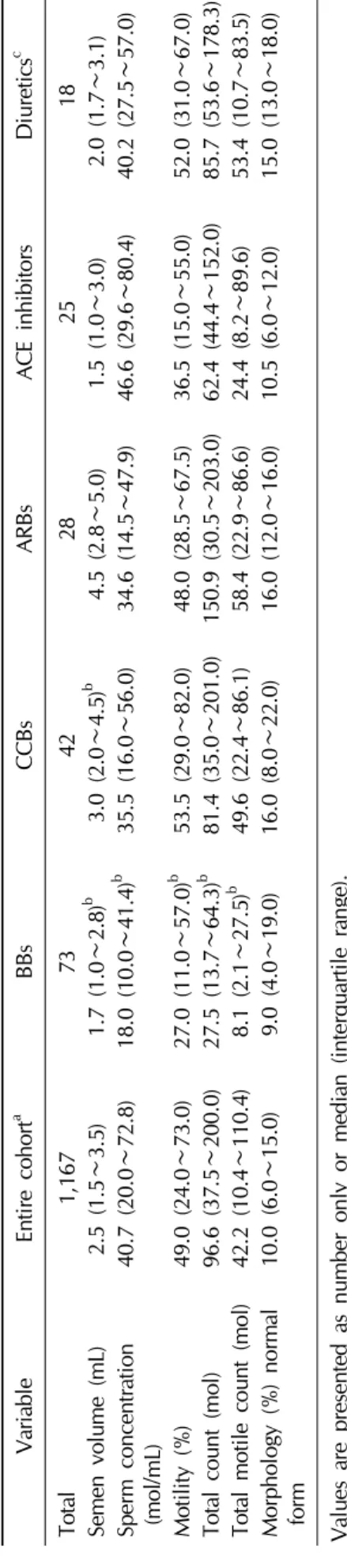
We then stratified men by individual class of anti- hypertensive medication [15]. Several differences were identified between classes of antihypertensives. Men who were taking beta-blockers were noted to have decreased volume, concentration and motility compared to men not taking medications (p<0.05). Men taking calcium chan- nel blockers had relatively decreased sperm concen- tration. Men taking angiotensin-receptor blockers had rel- atively increased volume and decreased sperm concentra- tion. Men taking ACEIs had relatively decreased volume and decreased motility. Lastly, men taking diuretics had relatively decreased volume (Table 2).
INCIDENT HYPERTENSIVE DISEASE
Infertility may be a harbinger of health. As such, a man's reproductive fitness may also reflect his somatic fitness.
Studies in the USA and Europe have demonstrated higher mortality rates among infertile men [16,17]. In addition, higher rates of certain types of cancers have also been re- ported among infertile men in the years following a fertil- ity evaluation [18-21]. Recently, data from a large USA in- surance claims database demonstrated a higher incidence of heart disease and diabetes among infertile men [22].
Importantly, a higher incidence of hypertension was not identified in this group, suggesting that male infertility is not a risk factor for hypertension itself.
SUMMARY
Existing data suggest an association between hyper- tension and impaired semen quality. Men diagnosed with hypertension have a lower semen volume, sperm motility, total sperm count, and motile sperm count relative to men in the cohort who did not carry a diagnosis of hyper- tension. Importantly, more men with a diagnosis of hyper- tension had impaired semen volume, concentration, and total motile count, according to WHO 5th edition criteria for subfertile semen parameters. Moreover, the use of be- ta-blockers was associated with lower semen volume, concentration, motility, total sperm count, and total mo- tile sperm count, while men taking other antihyperten-
sives had more isolated impairments in semen parameters.
The direct end-organ effects of hypertension on the ar- teries and kidneys have been studied in depth, but the ef- fect on the testes is not well characterized. Prior research has addressed the relationship between hypertension and the endocrine axis, which may affect reproductive ability.
For example, in a cross-sectional study of 1,548 men, Svartberg et al [23] demonstrated an inverse association between total testosterone level and systolic blood pressure. In a case-control study of 110 newly diagnosed hypertensive men, Fogari et al [24] showed a 10% reduc- tion in total testosterone levels compared to normotensive men. However, given study design, causal pathways be- tween hypertension and testicular function cannot be inferred.
While the etiology of the association between hyper- tension and semen quality remains unknown, the relation- ship between somatic health and semen production has been reported [9,24,25]. Authors have suggested several plausible hypotheses. For example, the fetal origins of dis- ease theory posits a common in utero exposure could lead to both infertility and hypertension [26-28]. In addition, the coexistence with other components of the metabolic syndrome (e.g., obesity, hyperlipidemia) have been dem- onstrated to associate with impaired semen quality [7,8].
The etiology may also relate to treatment rather than the disease alone. The current report identified multiple ab- normalities associated with beta-blockers but not other in- dividual classes of antihypertensives. This is particularly relevant given that beta-blockers represent one of the most commonly medications prescribed, with over 85.3 mil- lion prescriptions dispensed in the USA in 2014 [4].
Importantly, several medications have been investi- gated previously for their impact on fertility. For example, retrograde ejaculation is known to be a common side ef- fect of alpha-blockers and consequently would decrease semen volume [29]. Thus, the non-selective alpha-blocker phenoxybenzamine was investigated as a male oral con- traceptive in the 1980s [30]. In addition, a case report documented a pregnancy for an infertile couple following the discontinuation of the calcium channel-blocker nifidi- pine [31]. An in vitro study suggested that certain receptors for normal acrosomal reaction were reversibly impaired by calcium-channel blockers [32].
Table 2.Semen parameters and individual classes of medications VariableEntire cohorta BBsCCBsARBsACE inhibitorsDiureticsc Total1,1677342282518 Semen volume (mL)2.5 (1.5∼3.5)1.7 (1.0∼2.8)b 3.0 (2.0∼4.5)b 4.5 (2.8∼5.0)1.5 (1.0∼3.0)2.0 (1.7∼3.1) Sperm concentration (mol/mL)40.7 (20.0∼72.8)18.0 (10.0∼41.4)b 35.5 (16.0∼56.0)34.6 (14.5∼47.9)46.6 (29.6∼80.4)40.2 (27.5∼57.0) Motility (%)49.0 (24.0∼73.0)27.0 (11.0∼57.0)b 53.5 (29.0∼82.0)48.0 (28.5∼67.5)36.5 (15.0∼55.0)52.0 (31.0∼67.0) Total count (mol)96.6 (37.5∼200.0)27.5 (13.7∼64.3)b 81.4 (35.0∼201.0)150.9 (30.5∼203.0)62.4 (44.4∼152.0)85.7 (53.6∼178.3) Total motile count (mol)42.2 (10.4∼110.4)8.1 (2.1∼27.5)b 49.6 (22.4∼86.1)58.4 (22.9∼86.6)24.4 (8.2∼89.6)53.4 (10.7∼83.5) Morphology (%) normal form10.0 (6.0∼15.0)9.0 (4.0∼19.0)16.0 (8.0∼22.0)16.0 (12.0∼16.0)10.5 (6.0∼12.0)15.0 (13.0∼18.0) Values are presented as number only or median (interquartile range). BBs: beta-blockers, CCBs: calcium channel-blockers, ARBs: angiotensin receptor-blockers, ACE inhibitors: angiotensin converting-enzyme inhibitors. a Analysis confined to men for whom medication data was available. b p<0.05. c Wilcoxon rank-sum test instead of repeated mixed model due to limited number of diuretics.
www.wjmh.org
Interestingly, not all antihypertensives have been asso- ciated with impaired semen quality. Mbah et al [33] exam- ined ACEIs through a placebo-controlled randomized study of normotensive men with idiopathic oligospermia and actually showed that low-dose lisinopril treatment re- sulted in improvements in the form of higher percent mo- tility and decreased abnormal morphology, although aver- age volume remain unchanged. In the current report, no significant improvements were seen with any class of anti- hypertensives while beta blockers were associated with significant impairments in semen quality.
It is important to note several limitations to the current literature examining male fertility and hypertension. First, the populations consisted of men who presented specifi- cally for evaluation of infertility, and therefore may not be generalizable to the general population. Next, the retro- spective nature of most studies leads to the possibility of bias.
Given the prevalence of hypertension and its treatment in the USA, the current literature suggests a novel ob- servation about the possible fertility implications of a com- mon chronic disease (and treatment), and is applicable to a growing category of older fathers. While infertile men do not have a higher risk for developing hypertension, they do have an elevated risk for vascular disease [22]. Never- theless, further investigation of hypertension and semen quality appears warranted to understand if the reported as- sociations are causal.
CONFLICT OF INTEREST
No potential conflict of interest relevant to this article was reported.
REFERENCES
1. Martin JA, Hamilton BE, Osterman MJ, Curtin SC, Matthews TJ. Births: final data for 2013. Natl Vital Stat Rep 2015;64:1-65.
2. Eisenberg ML, Li S, Behr B, Pera RR, Cullen MR. Relation- ship between semen production and medical comorbidity.
Fertil Steril 2015;103:66-71.
3. Nwankwo T, Yoon SS, Burt V, Gu Q. Hypertension among adults in the United States: National Health and Nutrition Examination Survey, 2011-2012. NCHS Data Brief 2013;
(133):1-8.
4. Aitken M. Medicines use and spending shifts: a review of
the use of medicines in the U.S. in 2014. Parsippany (NJ):
IMS Institute for Health Informatics; 2015.
5. Bener A, Al-Ansari AA, Zirie M, Al-Hamaq AO. Is male fer- tility associated with type 2 diabetes mellitus? Int Urol Nephrol 2009;41:777-84.
6. Eisenberg ML, Kim S, Chen Z, Sundaram R, Schisterman EF, Buck Louis GM. The relationship between male BMI and waist circumference on semen quality: data from the LIFE study. Hum Reprod 2014;29:193-200.
7. Schisterman EF, Mumford SL, Chen Z, Browne RW, Boyd Barr D, Kim S, et al. Lipid concentrations and semen qual- ity: the LIFE study. Andrology 2014;2:408-15.
8. Sermondade N, Faure C, Fezeu L, Shayeb AG, Bonde JP, Jensen TK, et al. BMI in relation to sperm count: an updated systematic review and collaborative meta-analysis. Hum Reprod Update 2013;19:221-31.
9. Ventimiglia E, Capogrosso P, Boeri L, Serino A, Colicchia M, Ippolito S, et al. Infertility as a proxy of general male health: results of a cross-sectional survey. Fertil Steril 2015;
104:48-55.
10. Breigeiron MK, Lucion AB, Sanvitto GL. Effects of reno- vascular hypertension on reproductive function in male rats.
Life Sci 2007;80:1627-34.
11. Muciaccia B, Pensini S, Culasso F, Padula F, Paoli D, Gandini L, et al. Higher clusterin immunolabeling and sperm DNA damage levels in hypertensive men compared with controls. Hum Reprod 2012;27:2267-76.
12. Coetzee K, Kruger TF, Lombard CJ. Repeatability and var- iance analysis on multiple computer-assisted (IVOS) sperm morphology readings. Andrologia 1999;31:163-8.
13. Kruger TF, Acosta AA, Simmons KF, Swanson RJ, Matta JF, Oehninger S. Predictive value of abnormal sperm morphol- ogy in in vitro fertilization. Fertil Steril 1988;49:112-7.
14. Cooper TG, Noonan E, von Eckardstein S, Auger J, Baker HW, Behre HM, et al. World Health Organization reference values for human semen characteristics. Hum Reprod Update 2010;16:231-45.
15. Guo D, Li S, Behr B, Eisenberg M. PD52-12 The impact of hypertension and antihypertensives on semen quality. J Urol 2015;193:e1117.
16. Eisenberg ML, Li S, Behr B, Cullen MR, Galusha D, Lamb DJ, et al. Semen quality, infertility and mortality in the USA.
Hum Reprod 2014;29:1567-74.
17. Jensen TK, Jacobsen R, Christensen K, Nielsen NC, Bostofte E. Good semen quality and life expectancy: a cohort study of 43,277 men. Am J Epidemiol 2009;170:559-65.
18. Eisenberg ML, Li S, Brooks JD, Cullen MR, Baker LC.
Increased risk of cancer in infertile men: analysis of U.S.
claims data. J Urol 2015;193:1596-601.
19. Jacobsen R, Bostofte E, Engholm G, Hansen J, Olsen JH, Skakkebaek NE, et al. Risk of testicular cancer in men with abnormal semen characteristics: cohort study. BMJ 2000;
321:789-92.
20. Walsh TJ, Croughan MS, Schembri M, Chan JM, Turek PJ.
Increased risk of testicular germ cell cancer among infertile
men. Arch Intern Med 2009;169:351-6.
21. Walsh TJ, Schembri M, Turek PJ, Chan JM, Carroll PR, Smith JF, et al. Increased risk of high-grade prostate cancer among infertile men. Cancer 2010;116:2140-7.
22. Eisenberg ML, Li S, Cullen MR, Baker LC. Increased risk of incident chronic medical conditions in infertile men: analy- sis of United States claims data. Fertil Steril 2016;105:629- 36.
23. Svartberg J, von Mühlen D, Schirmer H, Barrett-Connor E, Sundfjord J, Jorde R. Association of endogenous testosterone with blood pressure and left ventricular mass in men. The Tromsø Study. Eur J Endocrinol 2004;150:65-71.
24. Fogari R, Zoppi A, Preti P, Rinaldi A, Marasi G, Vanasia A, et al. Sexual activity and plasma testosterone levels in hy- pertensive males. Am J Hypertens 2002;15:217-21.
25. Salonia A, Matloob R, Gallina A, Abdollah F, Saccà A, Briganti A, et al. Are infertile men less healthy than fertile men? Results of a prospective case-control survey. Eur Urol 2009;56:1025-31.
26. Barker DJ. Fetal origins of coronary heart disease. BMJ 1995;311:171-4.
27. Skakkebaek NE, Rajpert-De Meyts E, Buck Louis GM, Toppari J, Andersson AM, Eisenberg ML, et al. Male re-
productive disorders and fertility trends: influences of envi- ronment and genetic susceptibility. Physiol Rev 2016;96:
55-97.
28. Skakkebaek NE, Rajpert-De Meyts E, Main KM. Testicular dysgenesis syndrome: an increasingly common developmental disorder with environmental aspects. Hum Reprod 2001;16:
972-8.
29. Samplaski MK, Nangia AK. Adverse effects of common medications on male fertility. Nat Rev Urol 2015;12:401-13.
30. Homonnai ZT, Shilon M, Paz GF. Phenoxybenzamine: an effective male contraceptive pill. Contraception 1984;29:
479-91.
31. Hershlag A, Cooper GW, Benoff S. Pregnancy following dis- continuation of a calcium channel blocker in the male partner. Hum Reprod 1995;10:599-606.
32. Benoff S, Cooper GW, Hurley I, Mandel FS, Rosenfeld DL, Scholl GM, et al. The effect of calcium ion channel blockers on sperm fertilization potential. Fertil Steril 1994;62:606-17.
33. Mbah AU, Ndukwu GO, Ghasi SI, Shu EN, Ozoemena FN, Mbah JO, et al. Low-dose lisinopril in normotensive men with idiopathic oligospermia and infertility: a 5-year rando- mized, controlled, crossover pilot study. Clin Pharmacol Ther 2012;91:582-9.