Ⅰ. 서 론
일반적으로 유치가 빠지고 나면 그때부터 영구치 를 갖고 평생을 살아가게 된다. 그러나 영구치를 잘 관리하여 생활하기는 생각만큼 쉬운 일이 아니다.
유치와 달리 영구치는 한 번 빠지면 다시 나지 않기 때문에 영구치를 대신할 치아에 대한 관심이 높아지 고 있으며, 최근에 사용되는 방법으로는 임플랜트 (인공치아 이식술)시술이 있다. 이처럼 치아 임플랜 트는 특수한 환경인 구강내에 식립되어 치아의 역할 을 대신하여 정하중 및 동하중을 복합적으로 계속 받게 되므로 생체역학과 연관하여 많은 문제점들이 발생될 수 있다. 이러한 문제점 중 가장 흔한 현상은 유지나사의 이완 및 파단으로 인한 보철물의 느슨함 과 임플랜트 고정체의 파단 및 임플랜트 고정체 경 부 부위의 골손실 등을 생각할 수 있으며, 이들은 임 플랜트의 기능을 상실시킨다. 따라서 임플랜트의 재 료나 기하학적 형태 뿐 아니라 전체적인 교합력 및 응 력 분석에 대한 연구가 활발하게 이루어지고 있다.1,2) 그러나 ISO(The International Organization for Standardization) 규정에 맞는 연구와 임플랜트의 신 뢰성을 나타내는 피로수명에 대한 연구는 미미하므 로 이에 대한 연구의 필요성이 제기되고 있다. 새로 운 치아 임플랜트를 개발하여 성능을 증명하기 위해 서는 피로시험을 수행해야 한다. 그러나 피로시험은 많은 시간과 실험의 정밀성이 요구되어 어려움이 있
다. 새로운 치아 임플랜트를 개발하고 성능을 개선 하기 위해서는 여러 가지 형상의 샘플을 제작하여 각각의 경우에 대하여 피로실험을 수행해야 한다.
이러한 어려움에 대한 대안으로 수치해석 방법을 이 용하여 피로수명 해석을 예측하는 기법을 적용하면, 새로운 제품개발 및 성능향상에 유용하게 사용할 수 있다.
본 연구에서는 3차원 유한요소법을 이용하여 ISO 규정에 따라 (주)티스트롱(경남, 김해시, 한국)에서 개발한 치아 임플랜트 U-fit(Internal Type)에 대하 여 피로하중을 적용하여 치아 임플랜트의 형상변형 및 응력해석을 수행하였다. 또한, 응력해석 결과 및 Sine’s method를 이용하여 티타늄 재질의 S-N 피로 선도(Stress-Life fatigue curve)를 근거로 하여 임플 랜트의 피로 수명(fatigue life)을 예측하였다. 유효성 을 검증하기 위하여 피로실험을 통해서 확인하였다.
Ⅱ. 연구재료 및 방법
(주)티스트롱에서 개발한 치아 임플랜트 U- fit(Internal Type)에 대하여 3차원 유한요소해석을 수행하였다. U-fit은 보편적인 Internal Type과는 임 플랜트 고정체의 형태가 다른, 원추형 형태이다. U- fit의 장점은 원추형 Fixture에 의한 골 삭제량 감소, 저작력 분산효과, 초기 고정력 양호 등이다.
대한치과보철학회지:Vol. 44, No. 4, 2006
유한요소법을 이용한 치아 임플랜트 피로수명 예측
*새날치과의원, **전남대학교 기계공학과, ***(주) 티스트롱 한인숙*∙손정훈**∙양영수**∙이승영***
※ 본 연구는 (주)티스트롱의 협찬에 의하여 이루어졌음.
2.1 연구재료
치아 임플랜트는 인체에 거부반응이 없는 티타늄 (Titanium) 재료로 구성되어 있으며 현재 대표적으 로 사용하고 있는 치아 임플랜트는 그 형태와 체결 방식에 따라 외부연결방식(External Type)과 내부연 결방식(Internal Type)으로 구분할 수 있다. 본 연구 에서는 내부연결법을 다루었다. 치아 임플랜트 고정
체는 내부연결방식의 U-fit(T.strong사)의 �4.1×
13.317 mm을 이용하였고, abutment는 M2.0×
0.4P을 사용하였다. Fig. 1은 이를 나타내었다.
2.2 유한요소 모델링
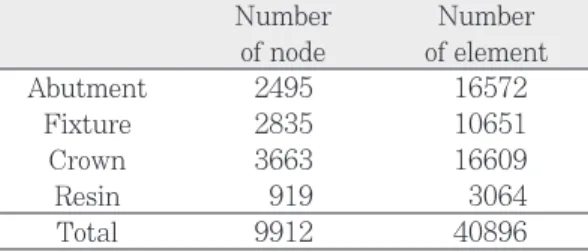
치아 임플랜트의 응력해석을 위한 수치 해석 기법 은 유한요소법(FEM)을 사용하였으며, 해석영역의 모델링 및 요소분할작업을 위해서는 IDEAS을 사용 하였고 응력 해석을 위해서 유한요소해석 프로그램 인 ABAQUS Ver 6.4를 이용하였다. 유한요소모델은 Table I 및 Fig. 2과 같다.
2.3 재료의 물성
치아 임플랜트의 재료는 순수 Titanium과 Ti- 6Al-4V로 응력 분포를 해석함에 있어서 필요한 재료 의 물성치는 Table II와 같다.5,6)
Table II. Material properties in finite element analysis
Properties
Material Elastic modulus Poisson’s ratio Yield strength Tensile strength
(Kgf/mm2) (Kgf/mm2) (Kgf/mm2)
Abutment� 11.7×10³ 0.35 111.0 120.5
(Ti-6Al-4V)
Fixture 11.7×10³ 0.35 50.7 63.6
(Pure Titanium)
Crown 20.0×10³ 0.35 58.6 66.5
(SM45C)
Resin 1.7×10³ 0.24 58.6 66.5
Table I. Finite element model
Number Number
of node of element
Abutment 2495 16572
Fixture 2835 10651
Crown 3663 16609
Resin 919 3064
Total 9912 40896
Fig. 2. Finite element mesh.
Abutment Fixture Fig. 1. Internal Type (U-fit).
Abutment Fixture
2.4 하중 및 경계조건
치아 임플랜트의 경계조건 및 하중조건은 Fig. 3에 서 보는 바와 같이 치과용 임플랜트의 피로시험 (Fatigue Test for endosseous dental Implant) ISO 14801에 따른다.3)
피로하중 F(50, 40, 30 Kgf)는 임플랜트 축(DE)이 시험기기의 하중인가 방향(AB)와 30�±1�의 각도를 이루도록 했다. 임플랜트의 구강뼈 점착부분은 고정 장치에 의해 완전 구속하였다. 피로시험은 단일 압 축 하중으로 실험하였다. 하중은 nominal peak 값과 이 값의 10%사이에서 정현적으로 변화시켰다.
2.5 나사의 인장력 고려
치아 임플랜트 장착은 나사의 결합력에 의해 고정 된 후 사용된다. 그러므로 응력해석시에 Fig. 3에서 와 같이 나사의 결합력에 의한 인장력을 고려하였 다. 나사의 인장력Q는 식 (1)과 같이 나타낼 수 있다.
λ는 나선곡선의 경사를 나타내는 것으로 리드각이 라 하고 ρ′는 나사면의 마찰각, P는 피치(pitch), l은 리드,de는 유효지름를 나타낸다. T는 나사를 일정 토크로 조인 후, 탄성 양 만큼 반대방향으로 변형 후 에 작용되고 있는 토크로, 실제 시술에서 사용하는 토크를 가한 후 다시 나사를 풀면서 측정한 값 T=29.75Kgfmm를 사용하였으며, 나사의 마찰계 수=0.3이다.
2.6 피로수명 예측
치아 임플랜트의 신뢰성을 나타내는 피로수명을 구하기 위해 Sine’s Method를 사용하였다4). 이 방법 은, 치아 임플랜트에 작용하는 3축응력을 1축으로 등가시켜서 치아 임플랜트의 재료인 Titanium과 Ti-6Al-4V의 S-N선도와 비교, 피로수명을 예측하는 방법이다. 다음 식(2)에서 m=0.2를 사용하였으며 K=1을 사용하였다.
2.7 재료의 S-N Curve
치아 임플랜트의 피로반복하중에 대한 응력해석을 수행하고 이 응력값을 이용하여 피로등가응력을 구 하고 피로수명을 예측하기 위해서는 재료의 S-N Curve Fig. 4를 이용한다.5,6)피로실험에서 최대응력 과 최소응력 비 R=-1로 실시한 실험데이터이다.
Ⅲ. 피로실험
실험은 Fig. 5에서 보는 바와 같이 치과용 임플랜 트의 피로시험 ISO 14801에 따른다. 실험장치는 INSTON사의 인장시험기로 14 Hz의 하중 인가 주 Fig. 3. Schematic diagram of experimental system.
m : Coefficient of mean stress influence K : Fatigue notch factor
SN: Uniaxial fully reversed fatigue stress that is expected to give the same life on smooth specimens as the multi-axial stress state
Alternating component of the stresses Mean component of the stresses
파수로 Table III과 같은 하중을 주어 치아 임플랜트 가 완전히 파절 될 때까지 진행하였다. 모든 실험조 건은 ISO 14801 규격에 따른 값이다. 또한 나사의 조임은 실제 시술에서 사용하는 토크하중 35Kgf
mm를 토크렌치를 사용하여 가하였다.
Ⅳ. 결과 및 고찰
치아 임플랜트의 문제점 중의 하나인 피로 파괴에 대해 3차원 유한요소해석을 이용하여 피로등가응력 을 구하고 치아 임플랜트의 피로수명을 예측하였다.
최대피로하중 50, 40, 30Kgf이 치아 임플랜트에 작 용하였을 때 von Mises 응력분포는 Fig. 6과 같다.
Fig. 7은 치아 임플랜트에 작용하는 3축 응력을 1축 으로 등가시키는 Sine’s Method를 사용하여 1축 등가응력을 나타내었다. Fig. 8(a), (b)에서 보듯이 실험은 40Kgf이상의 피로하중을 가할 때에는 해석 과 비교하여 피로파괴가 일어나는 부분(Fixture)이 일치했다. 즉, 해석에서 최대응력이 작용되는 위치와 실험에서 파단이 발생한 부분이 동일하다. Max.
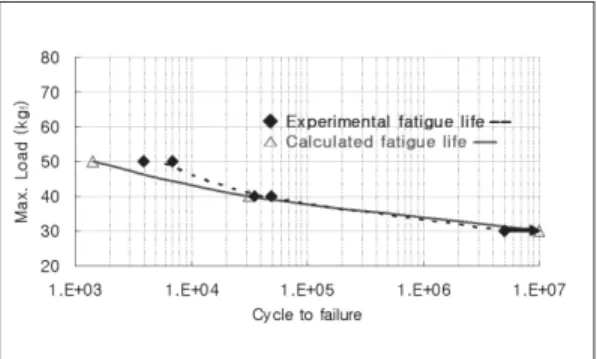
Load가 30Kgf일때 피로한도(fatigue limit)를 얻을 수 있었다. Fig. 9는 실험으로 얻은 피로수명과 유한 요소해석으로 예측한 피로수명을 비교하였다. 해석 결과와 피로실험결과는 잘 일치되고 있음을 알 수 있다. 그러므로 새로운 형상의 치아 임플랜트를 개 발하거나 성능향상을 위하여 임플랜트의 형상을 변 화시키는 등 설계를 변경하고자 할 때는 모든 경우 에 대하여 실험을 수행하지 않고, 해석적 방법을 이 용한 제품개발이 가능하다.
Fig. 7에서 보듯이 해석결과 fixture가 abutment에 비해 응력집중이 많으므로 이 부분이 피로에 의해 파괴가 먼저 일어남을 알 수 있었다. 사람의 저작력 Table III. Experimental conditions
Max. load Min. load Frequency Fatigue life (Kgf) (Kgf) (Hz) (Cycle)
50 5 14 3.91×10³, 6.86×10³ 40 4 14 3.54×10⁴, 4.85×10⁴ 30 3 14 5×10⁶(Fatigue limit)
Fig. 5. Photograph of the experimental system.
(a) Ti-6Al-4V (b) Pure titanium
Fig. 4. Stress versus life (S-N) curves.
(a) maximum loading 50Kgf (b) maximum loading 40Kgf (c) maximum loading 30Kgf
Fig. 6. von Mises stress distribution for maximum fatigue load.
(a) maximum loading 50Kgf (b) maximum loading 40Kgf (c) maximum loading 30Kgf
Fig. 7. Calculated equivalent fatigue stress distribution for fatigue load.
(a) maximum loading 50Kgf (b) maximum loading 40Kgf (c) maximum loading 30Kgf
Fig. 8. Fracture position after fatigue load.
Fig. 9. Experimental and calculated fatigue life.
은 일반적으로 25Kgf이하이다. 내부연결방식 (Internal Type)인 U-fit 의 임플랜트는 사람의 저작 력 보다 큰 30Kgf이하의 하중에서 피로수명값이 5×
106 Cycle 이상이 나오므로 내부연결방식(Internal Type)인 U-fit Type의 임플랜트는 반영구적임을 알 수 있었다.
Ⅴ. 결 론
본 연구에서는 3차원 유한요소법을 이용하여 ISO 규정에 따라 (주) 티스트롱사에서 개발한 Internal Type 치아 임플랜트인 U-fit에 대해 피로하중을 적용 하여, 치아 임플랜트의 응력해석을 수행하였다. 또 한, 응력해석 결과 및 Sine’s Method를 이용하여 티 타늄 재질의 S-N 선도(Stress-Life curve)를 근거로 하여 치아 임플랜트의 피로 수명(fatigue Life)을 예 측하였다.
해석값의 유효성을 검증하기 위하여 피로실험을 통해서 이를 확인한 결과 해석결과와 실험결과가 잘 일치하였다. 따라서 실험을 통하지 않고서도 피로수 명을 구할 수 있음을 알 수 있었고, 추후 새로운 제 품개발에 적용이 가능하다. 또한 해석결과 임플랜트 고정체(Fixture)부분에서 피로파괴가 일어남을 알 수 있었고 실험에서도 같은 결과를 얻었다. 내부연 결방식(Internal Type)인 치아임플랜트 U-fit는 사람 의 저작력을 고려하였을 때 피로 수명에서 다른 내 부연결방식(Internal Type)과 차이가 없음을 알 수 있었다.
참고문헌
1. Ibrahim A. Influence of occlusal forces on stress distribution in preloaded dental implant screw. J Prosthet Pent 2004;
91:319-325.
2. Bulent E. Numerical analysis of a dental implant system in three-dimension.
Advances in Engineering Software 2002;
33:109-113.
3. Fatigue test for endosseous dental implants.
ISO14801 The International Organization for Standardization 2003.
4. Funch HO. Metal fatigue in engineering.
1980;173-186.
5. Matthew JD. Titanium a technical guide:
ASM interanational; 2000;105.
6. Kazuaki S. Titanium and Titanium alloys.
In: Databook on fatigue strength of metal- lic materials. Amsterdam: Elsevier; 1996;
2;1746-64.
Reprint request to:
Young-Soo Yang, Ph.D.
Department of Mechanical Engineering, Chonnam National University 300 Yongbong-dong, Kwang-ju, 500-757, Korea
Purpose: The purpose of this study is to use finite element analysis to predict the fatigue life of an implant system subjected to fatigue load by mastication (chewing force). The reliability and the stability of implant system can be defined in terms of the fatigue strength. Not only an implant is expensive but also it is almost impossible to correct after it is inserted. From a bio-engineer- ing standpoint, the fatigue strength of the dental implant system must be evaluated by simulation (FEA).
Material and Methods: Finite element analysis and fatigue test are performed to estimate the fatigue strength of the implant system. Mesh of implant is generated with the actual shape and size. In this paper, the fatigue strength of implant system is estimated: U-fit (T.Strong, Korea, internal type). The stress field in implant is calculated by elastic-plastic finite element analysis.
The equivalent fatigue stress, considering the contact and preload stretching of a screw by torque for tightening an abutment, is obtained by means of Sine’s method. To evaluate the reliability of the calculated fatigue strength, fatigue test is performed.
Results: A comparison of the calculated fatigue strength with experimental data showed the validity and accuracy of the proposed method. The initiation points of the fatigue failure in the implant system exist in the region of high equivalent fatigue stress values.
Conclusion: The above proposed method for fatigue life estimation can be applied to other con- figurations of the differently designed and improved implant. In order to prove reliability of pro- totype implant, fatigue test should be executed. The proposed method is economical for the pre- diction of fatigue life because fatigue testing, which is time consuming and precision-dependent, is not required.
FATIGUE LIFE ESTIMATION OF IMPLANT USING A FINITE ELEMENT METHOD
In-Sook Han*, Jung-Hun Son**, Young-Soo Yang**, Ph.D., Seung-Young Lee***
*
Saenal Dental Clinic
**
Department of Mechanical Engineering, Chonnam National University
***
T. Strong Co. Ltd.
ABSTRACT
Key words: Dental implants, Fatigue, Sine’s method, Finite element analysis (FEA)