A STUDY ON MECHANICAL PROPERTIES OF TiN, ZrN AND WC COATED FILM ON
THE TITANIUM ALLOY SURFACE
Dong-Joon Oh, D.D.S., M.S.D., Hee-Jung Kim, D.D.S., M.S.D., Ph.D., Chae-Heon Chung, D.D.S., M.S.D., Ph.D.
Department of Prosthodontics, College of Dentistry, Chosun University, Korea
Statement of problems. In an attempt to reduce screw loosening, dry lubricant coatings such as pure gold or tefron have been applied to the abutment screw. However, under repeated tight- ening and loosening procedures, low wear resistance and adhesion strength of coating mate- rial produced free particles on the surface of abutment screw and increased frictional resis- tance resulting in screw tightening problems.
Purpose.The aim of this study was to compare friction coefficient, adhesion strength, vickers hardness and evaluate coating surface of titanium alloy specimens coated with TiN(titanium nitride), ZrN(zirconium nitride) and WC(tungsten carbide).
Material and method.Titanium alloy(Ti-6Al-4V) discs of 12mm in diameter and 1mm in thick- ness divided into 4 groups. TiN, ZrN and WC was coated for the specimens of 3 groups respec- tively, and those of 1 group were not coated. Each group was made up of 4 specimens. In this study, sputtering method was used among the PVD(Physical Vapor Deposition) techniques available for TiN, ZrN and WC coatings. Friction coefficient, adhesion strength, vickers hardness and coating surface of 4 groups were measured.
Results.
1. For all three coating conditions, friction coefficient was significantly decreased. Especially, ZrN coat- ed surface showed the lowest value. TiN(0.39± 0.02), ZrN(0.24±0.01), WC(0.31±0.03).
2. TiN coating showed the highest adhesion strength, however ZrN coating had the lowest value. TiN(25.3N±1.6), ZrN(14.8N±0.6), WC(18.4N±0.7).
3. Vickers hardness of all three coatings was remarkably increased as compared with that of none coated specimen. TiN coating had the highest Vickers hardness, however WC coating showed the lowest value. TiN(1865.2±33.8), ZrN(1814.4±18.6), WC(1008.5±35.9).
4. The ZrN or WC coated specimen showed a homogeneous and smooth surface, however the rough surface with defects was observed for TiN coating.
Conclusions. When TiN, ZrN and WC coating applied to the abutment screw, frictional resis- tance would be reduced, as a result, the greater preload and prevention of the screw loosen- ing could be expected.
Key Words
TiN(titanium nitride), ZrN(zirconium nitride), WC(tungsten carbide), Screw loosening J Korean Acad Prosthodont : Volume 44, Number 6, 2006
※ This study was supported by research funds from Chosun University, 2005.
R
ecently, dentists are administering pros- thetic treatments using dental implants more than ever before on many occasions and indeed, implant prosthesis can restore stomatognathic function close to a normal level. Implant prostheses can be attached to their superstructure or fix- tures in two different ways: cement retained type and screw retained type. Although each type has its own merit comparing with the other, clinicians has preferred to use the screw retained type because of the retrievability. Although the screw retained type deserves its credit for the struc- ture can be removed more easily, it may also cause problems such as screw loosening. Jemt1,2 reported that mobile prostheses caused by the loos- ened gold screws was the most common problem after the final tightening.1,2Worthington et al.3also reported that abutment screw had more problems such as loosening and fracture than any other com- ponents. Minimizing the screw loosening is essential for long term successful rates. Therefore, it is essential for clinicians to understand the mechanics and physical properties of the screw.Forces attempting to disengage the parts are called “joint separating forces”. The force keep- ing the parts together can be called the “clamping force”. Screw loosening occurs when the joint separating forces acting on the screw joint are greater than the clamping forces holding the screw unit together.4 To achieve secure assemblies, screw should be tensioned to produce greater clamping force than separating force. Clamping load is usually proportionate to the tightening torque. Applied torque developing force within a screw called “preload”. Preload is the initial load in tension on the screw.4This tensile force on the screw develops a compressive clamping force between the parts. Increasing the torque will increase the preload. Increasing preload will maximize the stability of the screw joint by
increasing clamping threshold that separating forces must overcome to cause screw loosen- ing.4,5
But the torque applied to the screw joint during tightening is not entirely translated into screw pre- load since part of this torque is expended to overcome friction. About 50% of the energy transmitted by torque tightening is expended to overcome the friction between the abutment screw head and the abutment-seating surface.
About 40% of the applied torque is used to over- come thread friction and only 10% produces the screw tension.6-8Thus we have to maximize pre- load by minimizing the loss of torque for the stability of screw joint assemblies.
In an attempt to reduce frictional resistance, dry lubricant coating has been applied to the abutment screw. The notable products were GoldTite(Implant Innovation, 3i) coated with 0.76㎛ thickness of pure gold and TorqTite(Nobel Biocare, Steri-oss) coat- ed with teflon.9Martin et al.10 reported that GoldTite and TorqTite abutment screw with enhanced surfaces produced greater rotational angles and preload values than the convention- al gold alloy and titanium alloy screws. However, under repeated tightening and loosening pro- cedures, low wear resistance and adhesion strength of coating material produced free particles on the surface of abutment screw and increased frictional resistance resulting in screw tightening problems. Therefore, further studies for surface treatment of abutment screw would be need to minimize frictional resistance as well as increase surface stability and strength.
TiN (titanium nitride), ZrN (zirconium nitride) and WC(tungsten carbide) coated surface has been considered as the solution of the surface treat- ment problems. Some studies have reported that TiN, ZrN, WC coatings could decrease the coef- ficient of friction and improve resistance of cor- rosion and physical properties.11,12
The aim of this study was to compare friction coefficient, adhesion strength, vickers hardness and evaluate coating surface of titanium alloy speci- mens coated with TiN, ZrN and WC.
MATERIALS AND METHODS 1. Materials
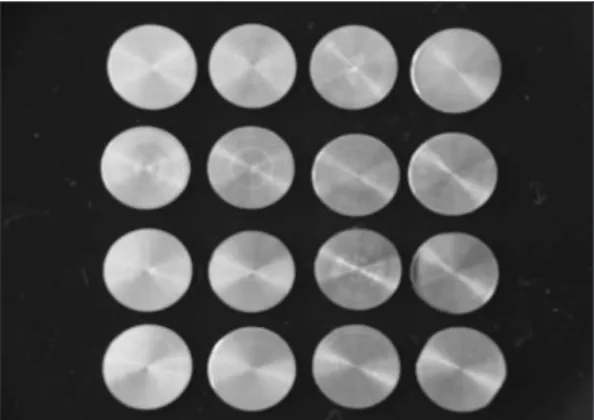
Titanium alloy(Ti-6Al-4V) discs of 12mm in diameter and 1mm in thickness divided into 4 groups. TiN, ZrN and WC was coated for the spec- imens of 3 groups respectively, and those of 1 group were not coated. Each group was made up of 4 specimens(Fig. 1, Table I).
2. Methods
1) Mounting of titanium alloy disc
Each specimen was mounted in liquid unsat- urated polyester as shown in fig. 2. The mouting
media(Epovia, CrayValley Inc. Korea) was a 2-part system made up of a resin and hardener(Fig. 2).
Two components were mixed together and poured to be cured overnight.
2) Polishing and ultrasonic cleansing of mount- ed specimens
All specimens were polished with automatic pol- ishing unit (Mecapol P 260, Presi, France) in which 200, 600, 1000 and 1200 grit silicon carbide paper were used in order. Micropolishing was finally done with Al2O3(0.3㎛)(Fig. 3). The polished specimens were cleansed in the solution of alco- hol and aceton by ultrasonic cleaner (Branson 3510, Bransonic, USA) for 10 minutes(Fig. 4).
3) TiN, ZrN and WC film coating using RF sputtering
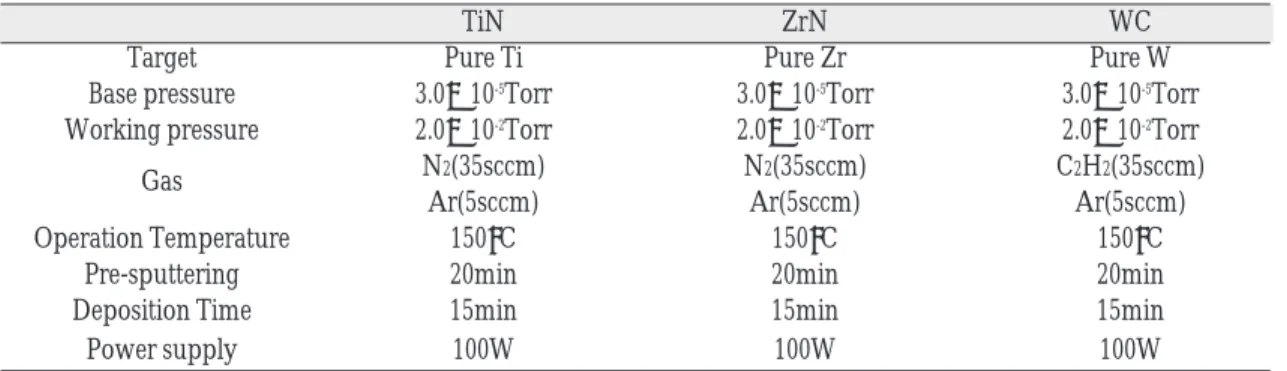
In this study, sputtering method was used among the PVD(Physical Vapor Deposition) techniques available for TiN, ZrN and WC coat- ings. TiN, ZrN and WC was coated by mag- netron sputtering equipment(Fig. 5). Table II shows coating conditions of TiN, ZrN and WC.
4) Measurement of friction coefficient for coat- ed specimens
Mobile friction meter(SF-2, FACE, Japan) were used to measure friction coefficient of the coated specimens(Fig. 6). Each specimens were mea- sured 10 times.
Fig. 1. Titanium alloy discs used in this study.
Table I. Kinds of coated materials used in this study
Group of specimen Coated materials Diameter * Length of specimen
A TiN �12 * 1mm
B ZrN �12 * 1mm
C WC �12 * 1mm
D Uncoated �12 * 1mm
Fig. 2. Mounting media(Epovia, CrayValley Inc. Korea) and specimens which were mounted.
Fig. 5. Magnetron sputtering equipment and flow chart.
Fig. 3. Polishing unit (Mecapol P 260, Presi, France). Fig. 4. Ultrasonic cleaner (Branson 3510, Bransonic, USA).
Table II. Coating conditions of TiN, ZrN and WC
TiN ZrN WC
Target Pure Ti Pure Zr Pure W
Base pressure 3.0×10⁻⁵Torr 3.0×10⁻⁵Torr 3.0×10⁻⁵Torr
Working pressure 2.0×10⁻²Torr 2.0×10⁻²Torr 2.0×10⁻²Torr
Gas N2(35sccm) N2(35sccm) C2H2(35sccm)
Ar(5sccm) Ar(5sccm) Ar(5sccm)
Operation Temperature 150�C 150�C 150�C
Pre-sputtering 20min 20min 20min
Deposition Time 15min 15min 15min
Power supply 100W 100W 100W
Fig. 6. Mobile friction meter. Fig. 7. Scratch tester.
Fig. 8. Vickers hardness tester (MXT70, Matszawa Seiki Co.
Japan).
Fig. 9. FE-SEM instruments (XL 30 SFEG by Phillips Co.).
5) Measurement of adhesion strength of coated specimen
Adhesion strength were measured with scratch tester(Revetest, CSM instrument, Switzerland), in which adhesion strength is evaluated by the analysis of friction coefficient and acoustic emis- sion(Fig. 7). One specimen in each group were ran- domly selected, and adhesion strength was mea- sured 10 times for each specimen.
6) Vickers hardness test of each specimen One specimen in each group were randomly selected, and vickers hardness was measured 10 times for each specimen(Fig. 8).
7) Surface roughness investigation using FE-SEM instruments
The coated surfaces of specimens were observed by FE-SEM(Field Emission Scanning Electron Microscopy, XL 30 SFEG, Phillips Co., Netherlands) with the magnification of 1000 times(Fig. 9).
8) Statistical analysis
SPSS version 10.0.7 program has been utilized for statistics. Statistical significances were tested by oneway ANOVA(analysis of variances) among
groups and significant difference between groups was tested by Tukey’s multiple comparison test.
RESULTS
1. Friction coefficient
The magnitude of friction coefficient was greater in order of uncoated group, TiN group, WC group, ZrN group. Friction coefficient of three coat- ed groups was remarkably reduced as compared with that of uncoated group(Table III).
2. Vickers hardness
The magnitude of vickers hardness was greater in order of TiN group, ZrN group, WC group, uncoated group. Vickers hardness of three coat- ed groups was increased as compared with that of uncoated group(Table IV).
3. Adhesion strength
The magnitude of adhesion strength was greater in order of TiN group, WC group, ZrN group (Table V).
Table III. Friction coefficient for three coated groups
Coated materials Mean S.D. P-value
TiN 0.39 0.02
ZrN 0.24 0.01
<0.05
WC 0.31 0.03
Uncoated 0.48 0.01
Table IV. Vickers hardness of three coated groups
Coated materials Mean (Hv) S.D. P-value
TiN 1865.2 33.8
ZrN 1814.4 18.6 <0.05
WC 1008.5 35.9
Uncoated 313.9 18.9
4. Coating surface investigation
The coating surface was observed and evaluated by FE-SEM. The SEM micrographs of TiN, ZrN or WC coating surface are shown in Fig. 10. ZrN or WC coated specimen showed the homogeneous and smooth surface. However TiN coated spec- imen showed the rough surface with some defects.
DISCUSSION
Previous studies have been reported that the most common problem associated with dental implant system is loosening of the screw that holds the prosthesis and implant together.1-3To solve the screw loosening problems, 3i (Implant Innovations Inc) altered the palladium-gold abutment screw Table V. Adhesion strength of three coated group
Coated materials Mean (N) S.D. P-value
TiN 25.3 1.6
ZrN 14.8 0.6 <0.05
WC 18.4 0.7
Group A (TiN) Group B (ZrN)
Group C (WC) Group D (Uncoated)
Fig. 10.SEM investigation of TiN, ZrN and WC coated film (×1000).
surface itself, adding a solid lubricant to decrease the friction coefficient and increase preload val- ues. Steri-Oss (Nobel Biocare) also altered the surface of its titanium abutment screw through a treatment process to decrease friction coefficient and increase fatigue strength.9,13
Under repeated tightening and loosening pro- cedures, however, free particles on the surface of abutment screw were produced because of the low wear resistance and adhesion strength of coating material. The particles increased frictional resis- tance and lead to the problems in tightening the screw.10 From those reasons, improvement of coating material has became a prominent fig- ure to get better mechanical properties.
Thin film coatings are achieved by using CVD(chemical vapor deposition) or PVD. Thin hard coatings deposited by CVD or PVD are used to improve metallic surface properties for industrial purposes. Its high hardness, low coef- ficient of friction and resistance to adhesive wear are favourable, for example, for drills and cutting tools.12,14-16 CVD deposition takes place at a tem- perature of about 1000�C, and thus its range of applications is limited. Much lower deposition tem- perature can be achieved with PVD processes between 150�C and 500�C.14Valvoda et al.17 men- tioned that such a high stress was unlikely able to originate from the different thermal expansion coef- ficients of the coatings and the substrate with respect to the low deposition temperature.
In this study, sputtering method was used among the PVD techniques available for TiN, ZrN and WC coatings. Sputtering has been one of the most commonly used method because dense structure films and better adhesion could be obtained comparing with the CVD coating.
Sputtering is a physical process whereby atoms in a solid target material are ejected into the gas phase due to bombardment of the material by energetic ions.11Sputtering is largely driven by
momentum exchange between the ions and atoms in the material, due to collisions. Although the first collision pushes atoms deeper into the clus- ter, subsequent collisions between the atoms can result in some of the atoms near the surface being ejected away from the cluster. The number of atoms ejected from the surface per incident ion is called the “sputter yield”and is an important measure of the efficiency of the sputtering process.
Other things the sputter yield depends on are the energy of the incident ions, the masses of the ions and target atoms, and the binding energy of atoms in the solid. The ions for the sputtering process are supplied by a plasma that is induced in the sputtering equipment. In practice a variety of techniques is used to modify the plasma prop- erties, especially ion density, to achieve the opti- mum sputtering conditions, including usage of RF alternating current, utilization of magnetic fields, and application of a bias voltage to the target. The sputtered atoms, those ejected into the gas phase, are not in their thermodynamic equilibrium state.
Therefore, they tend to condense back into the sol- id phase upon colliding with any surface in the sputtering chamber. This results in deposition of the sputtered material on all surfaces inside the chamber. This phenomenon is used extensively in the semiconductor industry to deposit thin films of various materials onto silicon wafers.
One important advantage of sputtering as a deposition technique is that the deposited films have the same composition as the target materi- al.
Friction coefficient
To achieve optimum joint stability, preload should be as high as possible and frictional resis- tance causing loss of torque should be mini- mize.18For that reason, it is important to reduce frictional resistance while tightening screw.
Frictional force depends on the properties of the two contact materials, lubricant and preload.
Martin et al.10mentioned that abutment screw with enhanced surfaces reduced the coefficient of fric- tion resulting in greater rotation angles and pre- load values than the conventional abutment screw. Elias et al.7also mentioned that the greater the preload applied to a screw joint, up to a maximum equal to the ultimate strength, the greater the resistance to loosening and the more stable the joint. As frictional force is proportion- ate to friction coefficient, low friction coefficient of abutment screw could produce greater rotational angle and preload, which decrease the screw loosening.5,10
From the results of this study, the coated groups had lower coefficient of friction than non-coated control groups. In particular, the ZrN coating showed the lowest coefficient of friction. When TiN, ZrN and WC coating applied to the abutment screw, frictional resistance would be reduced, as a result, the greater preload and prevention of the screw loosening could be expected.
However, accoriding to Elias7, this results might have adverse effects on the stability of abutment screws in a lower opening torque. Hagiwara and Chashi19noted that abutment screw removal torque values decreased with a reduction in the friction coefficient. Therefore, further studies should be needed whether too high reduction of coefficient of friction promotes screw loosening.
Vickers hardness
A significant mechanism that results in screw loosening of implant prostheses is the settling effect.
The settling effect,5,20which plays a critical role in screw stability, is the result of no surface being completely smooth. Settling occurs when the microsurface irregularities of the contacting com- ponent surfaces become burnished flat from
functional loads and vibrations. Wear of the con- tact areas brings the two surfaces closer together.
Sakaguchi et al.21reported that 2% to 10% of the initial preload is lost as a result of settling.
Consequently, the torque necessary to remove a screw is less than the torque initially used to place the screw. When settling exceeds the elas- tic elongation of the screw, the screw loosening occurs because there are no longer any contact forces to hold it in place.20,22The extent of settling depends on the initial surface roughness, surface hardness, and magnitude of the loading forces.5,20,22) Therefore, high surface hardness of the abut- ment screw could diminish settling effect.
In this study, TiN, ZrN, WC coating experi- mental groups showed the significant increasing Vickers hardness comparing with the control group. Particularly, from the result that TiN and ZrN had high Vickers hardness in this mea- surement. TiN or ZrN coated abutment screw could be expected to reduce the settling effect.
SEM investigation of coating surface
Mezger et al.23mentioned that although TiN coat- ing certainly had remarkable properties, more improvements would be needed, especially regarding to the continuity of the coated surface such as absence of pores or microcracking. In recent study about comparison with TiN and ZrN surface roughness, TiN surface showed more roughness than ZrN surface.12
In this study, while ZrN and WC showed smooth and homogeneous surface, TiN had rough surface with defects. The results, TiN had more rough surface than ZrN, was compatible with the previous study. It has been known that coat- ed surface roughness influences to the frictional coefficient. Moreover, smooth coating surface could be expected to reduce the settling effect.
Adhesion strength
In mechanical aspects, the coating adhesion to the surface of the substrate is one of the most important properties.14 Adhesion strength of coatings is widely studied by using the scratch test.
This consists of introducing stresses by deform- ing the surface by means of indentation of a moving diamond tip. The applied load is increased continuously until film detachment. The smallest load at which the coating is damaged is called the critical load.
Milic et al.11noted that hard coatings exhibited good corrosion, abrasion and wear resistance.
For this reason, the coatings should have good adhesion to the substrate.
In the measurement of TiN, ZrN and WC coat- ing adhesion strength, TiN showed the highest adhesion strength and ZrN had the lowest adhe- sion strength. When the titanium substrate with bodycentered cubic lattice(bcc) is coated with TiN, good structural match is shown.24Therefore, it is considered that the match will bring the high adhesion strength.
However, to get more objective information about adhesion strength, further studies with comparative control group would be needed.
In addition, study for the clinically acceptable adhe- sion strength also might be needed.
CONCLUSION
In this study, friction coefficient, adhesion strength and vickers hardness of TiN, ZrN and WC coated film on the titanium alloy surface were eval- uated respectively, and the coating surface of titanium alloy specimens were also observed by FE-SEM. The results were as follows :
1. For all three coating conditions, friction coeffi- cient was significantly decreased. Especially, ZrN coated surface showed the lowest value.
2. TiN coating showed the highest adhesion strength, however ZrN coating had the lowest value.
3. Vickers hardness of all three coatings was remarkably increased as compared with that of none coated specimen. TiN coating had the highest Vickers hardness, however WC coating showed the lowest value.
4. The ZrN or WC coated specimen showed a homogeneous and smooth surface, however the rough surface with defects was observed for TiN coating.
Conclusively, when TiN, ZrN and WC coating applied to the abutment screw, frictional resistance would be reduced, as a result, the greater preload and prevention of the screw loosening could be expected.
And TiN, ZrN and WC coated abutment screw expected to reduce the settling effect.
REFERENCES
1. Jemt T. Failures and complications in 391 con- secutively inserted fixed prostheses supported by Branemark Implants in edentulous Jaws: A study of treatment from the time of prosthesis placement to the first annual checkup. Int J Oral Maxillofac Implants 1991;6:270-276.
2. Jemt T, Linden B, Lekholm U. Failures and com- plications in 127 consecutively placed fixed partial prostheses supported by Branemark Implants : From prosthetic treatment to first annual chekup.
Int J Oral Maxillofac Implants 1992;7:40-44.
3. Worthington P, Bolender CL, Taylor TD. The Swedish system of osseointegrated implant : prob- lems and complications encountered during a 4-year trial period. Int J Oral Maxillofac Implants 1987;2:77.
4. McGlumphy EA, Mendel DA, Holloway JA.
Implant screw mechanics. Dent Clin North Am 1998;42:71-89.
5. Binon P, Sutter F, Brunski J, Gulbransen H, Weiner R. The role of screws in implant systems. Int J Oral Maxillofac Implants 1994;9:48-63 .
6. Haack JE, Sakaguchi RL, Sun T, Coffey JP.
Elongation and preload stress in dental implant abutment screws. Int J Oral Maxillofac Implants 1995;10:529-536.
7. Elias CN, Figueira DC, Rios PR. Influence of the coating material on the loosing of dental implant
abutment screw joints. Materials Science and Engineering C 2005;1-6,.
8. Motosh N. Development of design charts for bolts preloaded up to the plastic range. J Eng Ind 1976;98:849-851.
9. Binon PP. Implants and components : Entering the new millenium. Int J Oral Maxillofac Implants 2000;15:76-94.
10. Martin WC, Woody RD, Miller BH, Miller AW.
Implant abutment screw rotations and preloads for four different screw materials and surfaces. J Prosthet Dent 2001;86:24-32.
11. Milic M, Milosavljevic M, Bibic N, Nenadovic T.
Mechanical properties of sputtered TiN coatings.
Thin Solid Films 1985;126:319-323.
12. Arias DF, Arango YC, Devia A. Characterization of bilayer coatings of TiN/ZrN grown using pulsed arc PAPVD. Appl. Sur. Sci 2005;252:1175- 1181.
13. Squier RS, Psoter WJ, Taylor TD. Removal torques of conical, tapered implant abutments : The effects of anodization and reduction of surface area. Int J Oral Maxillofac Implants 2002;17:24-27.
14. Takadoum J, Bennani HH. Influence of substrate roughness and coating thickness on adhesion, friction and wear of TiN films. Surf. & Coat. Tech.
1997;96:272-282.
15. Sundgren JE. Structure and properties of TiN coatings. Thin Solid Films 1985;128:21-44.
16. Polonsky IA, Chang TP, Keer LM, Sproul WD. A study of rolling-contact fatigue of bearing steel coat- ed with physical vapor deposition TiN films:
Coating response to cyclic contact stress and phys- ical mechanisms underlying coating effect on the fatigue life. Wear 1998;215:191-204.
17. Valvoda V, Kuzel R, Cerny R. Structure of TiN coat-
ings deposited at relatively high rates and low temperatures by magnetron sputtering. Thin Solid Films 1988;156:53-63.
18. Burguete RL, Johns RB, King T, Patterson EA.
Tightening characteristics for screwed joints in osseointegrated dental implants. J Prosthet Dent 1994;71:592-599.
19. Hagiwara M, Chashi N. New tightening tech- nique for threaded fasteners. Materials and Engineering Proceedings of the International Offshore mechanics and Artic Engineering Symposium vol 3. New York : ASME 1992;371-376.
20. Winkler S, Ring K, Ring JD, Boberick KG. Implant screw mechanics and the settling effect : An overview. J Oral Implantol 2003;29:242-245.
21. Sakaguchi RL, Borgersen SE. Nonlinear contact analysis of preload in dental implant screws. Int J Oral Maxillofac Implants 1995;10:295-302.
22. Jorneus L, Jemt T, Carlsson L. Loads and designs of screw joints for single crowns supported by osseointegrated implants. Int J Oral Maxillofac Implants 1992;7:353-359.
23. Mezger PR, Creugers NHJ. Titanium nitride coat- ings in clinical dentistry. J Dent 1992;20:342-344.
24. Calister WD, Materials Science and Engineering An Introduction, 5th. Edition. Jhon Willey & Sons, Inc. New York, 2000, pp30-59.
Reprint request to:
CHAE-HEONCHUNG D.D.S., M.S.D., PH.D.
DEPARTMENT OFPROSTHODONTICS,COLLEGE OFDENTISTRY, CHOSUNUNIVERSITY,
421, SEOSUK-DONG,DONG-GU,GWANGJU,501-825, KOREA [email protected]