1. Introduction
Nuclear power plants have used austenitic stainless steels extensively for heat exchanger tubing, reactor in- ternals, and valves, since these steels have good mechan- ical properties including strength, toughness, and high cor- rosion resistance1,2). However, because of the exposure to high temperature and high pressure, the internals of the nuclear power plants have experienced stress corrosion cracking under thermal and external stress. In particular, intergranular and transgranular stress corrosion crackings at the weldments have occurred mainly by chromium car- bide precipitation and the depletion of chromium3). From the thermodynamical point of view of chromium carbide precipitation, chromium carbide is very stable un- der 850 oC, the chromium diffusion rate is very fast to form the carbide over 500 oC and then the stainless steel
can be sensitized in this temperature range. Therefore, grain boundaries result in chromium carbide precipitation.
If the sensitized stainless steel exposured to corrosive en- vironments, the chromium depletion zone will preferen- tially corrode4). From the kinetics point of view of the time-temperature-precipitation curve, carbide can precip- itate in the range of 500 ~ 800 oC depending upon the sensitization time and the alloying system5).
In order to mitigate the stress corrosion cracking of weldments, there are many applicable methods, which in- clude substitution with high corrosion resistant materials, modification of water chemistry, and reduction of residual stress. Among these remedies, the reduction of residual stress from tensile stress to compressive stress can be ob- tained by surface treatment. Applicable and studied techni- ques to induce compressive residual stress on the weld- ments can be summarized as shot peening6-8), laser shock peening9,10), water jet peening11), ultrasonic peening12), and UNSM13,14). In a typical UNSM technique, a tungsten car-
Intergranular Corrosion Mechanism of Slightly-sensitized and UNSM-treated 316L Stainless Steel
J. H. Lee1, K. T. Kim1, Y. S. Pyoun2 and Y. S. Kim1,†
1Materials Research Center for Energy and Clean Technology, School of Materials Science and Engineering, Andong National University, 1375 Gyeongdongro, Andong, Gyeongbuk, 36729, Korea
2Department of Mechanical Engineering, Sun Moon University, 221 Sunmoon-ro, Asan, Chungnam, 31460, Korea (Received October 16, 2016; Revised October 24, 2016; Accepted October 24, 2016)
316L stainless steels have been widely used in many engineering fields, because of their high corrosion resistance and good mechanical properties. However, welding or aging treatment may induce intergranular corrosion and stress corrosion cracking etc. Since these types of corrosion are closely related to the formation of chromium carbide in grain boundaries, the alloys are controlled by methods such as the lowering of carbon content, solution heat treatment. This work focused on the intergranular corrosion mechanism of slightly-sensitized and Ultrasonic Nano-crystal Surface Modification (UNSM)-treated 316L stainless steel.
Samples were sensitized for 1, 5, and 48 hours at 650 ℃ in N2 gas atmosphere. Subsequently UNSM treatments were carried out on the surface of the samples. The results were discussed on the basis of the sensitization by chromium carbide and carbon segregation, the residual stress and grain refinement. Even though chromium carbide was not precipitated, the intergranular corrosion rate of 316L stainless steel was drastically increased with aging time, and it was confirmed that the increased intergranular corrosion rate of slightly-sensitized (not carbide formed) 316L stainless steel was due to the carbon segregation along the grain boundaries. However, UNSM treatment improved the intergranular corrosion resistance of aged stainless steels, and its improvement was due to the reduction of carbon segregation and the grain refinement of the outer surface, including the introduction of compressive residual stress.
Keywords : 316L stainless steel, intergranular corrosion, sensitization, UNSM, carbon segregation, residual stress
†Corresponding author: [email protected]
bide (WC) tip is attached to an ultrasonic horn, which strikes the specimen surface up to 20,000 or more times per second, with 1,000 to 10,000 shots per square milli- meter in a very short time. These strikes, which can be described as micro cold forging, bring severe plastic de- formation to surface layers, and thus induce nano-crystal- line structure13). This is very similar to the ultrasonic tech- nique mentioned by Mukhanov15), who used a magne- to-strictive transducer instead of a piezo-transducer to pro- vide ultrasonic vibratory energy. Compared with other me- chanical surface nano-crystal treatments, UNSM produces the best hardness, and good surface roughness13,14). The UNSM effects and their anticipated benefits are that the uniformed micro dimple pattern on the surface and nano- crystalline structure induce compressive residual stress in the subsurface layer. This change has the potential to si- multaneously improve the static and fatigue strength, as well as the surface hardness and surface roughness of the work piece13,14,16).
The nano-crystalline surface could increase the density of diffusion paths available for alloying elements to mi- grate and rapidly form a protective passive film17,18). In addition, residual stress in the surface layer affects the critical current density and the current density for passiva- tion which are closely related to the formation and re- tention of the passivation layer19). The high mechanical energy imparted by UNSM to the steel surface may also induce the diffusion of the alloying elements13,14,18) and therefore can affect the intergranular corrosion resistance of the stainless steels. We already reported that the inter- granular corrosion properties by aging treatment was closely related to the formation of chromium carbides and carbon segregation, and UNSM treatment reduced the re- sidual stress and thus improved the intergranular corrosion
resistance20), but we couldn’t propose the mechanism in detail between its resistance and carbon segregation.
This work focused on the effects of sensitization and UNSM on the microstructure and intergranular corrosion resistance of 316L stainless steel and elucidated the im- portance of carbon segregation in grain boundaries on the intergranular corrosion.
2. Experimental Procedures
2.1 Materials and UNSM treatment
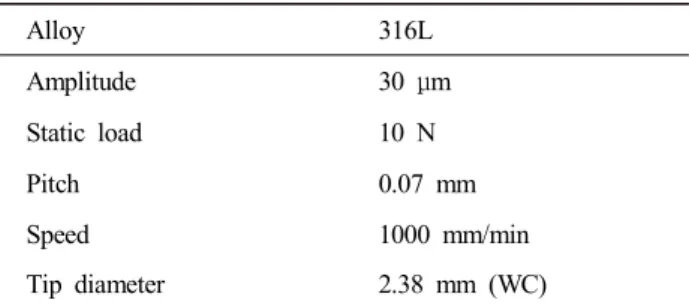
Table 1 gives the composition of the material inves- tigated in this study, which is AISI 316L austenitic stain- less steel. Aging treatments were performed at 650 oC for 1, 5, and 48 hours in N2 protective atmosphere and then water quenched. Table 2 lists the conditions of the annealed and aged samples that were treated by UNSM.
2.2 Intergranular corrosion tests
The intergranular corrosion rate was determined by Huey test (ASTM A262 Practice C) 21). The weight loss per unit area was measured after each of five 48-hour boils in 65 % nitric acid. The intergranular corrosion rate was calculated as the average corrosion rate of five boils in millimeters per year (mmpy). In order to differentiate the effect of UNSM treatment, we used the immersion time of 9 or 3-hours, besides of 48 hours.
The degree of sensitization (DOS) was determined by double loop electrochemical potentiokinetic reactivation test (DL-EPR). The test solution was 1M H2SO4 + 0.005M KSCN4), and the solution temperature of 30 ± 1 oC, and scan rate of 0.833 mV s-1 were used.
2.3 Microstructure analysis
Microstructure was studied by optical microscope (OM) using Zeiss Axiotech 100HD, scanning electron micro- scopy (SEM) at 20kV using Tescan Vega Ⅱ LMU, EPMA using Oxford EPMA-1600, and EBSD with step size of 1μm at 30kV using Oxford Lyra 3 XMH. The etching solution was aqua regia (10mL of HNO3 + 30mL of HCl).
2.4 Residual stress measurement
The surface residual stress was evaluated using an X-ray diffraction method employing a Cu target operated at 40 kV and 30 mA using Rigaku D/MAX RAPID-S.
Table 1. Chemical composition of commercial 316L stainless steel (wt%)
Alloy Cr Mo Ni C Mn Si P S Fe
316L 16.69 1.99 10.19 0.01 1.19 0.59 0.04 0.01 Bal
Table 2. Condition of UNSM treatment13)
Alloy 316L
Amplitude 30 μm
Static load 10 N
Pitch 0.07 mm
Speed 1000 mm/min
Tip diameter 2.38 mm (WC)
The residual stress was calculated by sin2ψ method with the Residual stress analysis II program.
3. Results
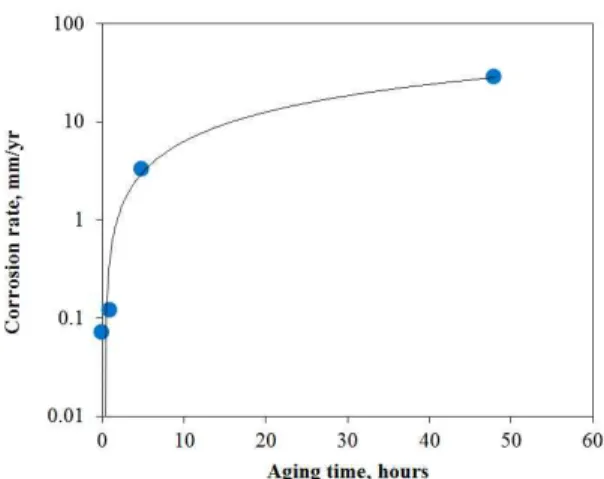
Intergranular corrosion of stainless steel is known to oc- cur due to electrochemical potential difference between the matrix and Cr depleted zone in the vicinity of the grain boundary area. According to the conventional intergranular corrosion mechanism, Cr depletion and consequent inter- granular corrosion are induced by the formation of Cr-car- bide along grain boundaries22-24). Intergranular corrosion in the stabilized stainless steels is also induced by Cr de- pletion, due to the segregation of solute Cr atoms near grain boundary carbides such as TiC, (Ti, Nb)C, or NbC, but not due to the formation of Cr-carbide25-28). Therefore, the general commercial recommendation to prevent inter- granular corrosion of stainless steel is the reduction in the content of carbon to less than 0.03 wt%22). Fig. 1 shows that increasing aging time (t) at 650 oC greatly facilitated the intergranular corrosion of 316L stainless steel, even at the short aging time of 1 and 5 hours. In this figure, the intergranular corrosion rate and co- efficient of determination (R²) can be derived as follows : Intergranular corrosion rate, mm/yr =
- 0.0016t2 + 0.6669t – 0.2003 (1) (t; hour, R² = 0.9996)
However, according to the TTT diagram of 316L stain- less steel,4) it is well known that if chromium carbide was not precipitated in grain boundaries and chromium de- pleted zone was not formed, the stainless steels doesn’t be sensitized,. In order to identify the occurrence of inter- granular corrosion, surface appearance after Huey test was observed. Fig. 2 shows the corroded surface appearance of 316L stainless steel aged at 650 oC after one 48 h period tested by ASTM A262 practice C (note that the corrosion rate in Fig. 1 was determined after five 48 h period im- mersion tests. but the surface appearance after one 48 h period test was shown to differentiate the effect of aging time because of the high corrosion rate by five 48 h period tests). After one 48 h immersion test, the annealed speci- men (0 h-aged) showed a scratched surface and 1 h-aged specimen revealed grain boundaries, but many grains were detached in the 5 h-aged specimen, and also, in the case of 48 h-aged specimen20), it was confirmed that grains and grain boundaries were severely corroded and detached. On the basis of the TTT diagram5) and proposed mechanisms22-24), the high corrosion rate and severely cor- roded appearance in the 48 h-aged specimen were under- Fig. 1. Effect of aging time at 650 oC on the intergranular corrosion
rate of 316L stainless steel determined by ASTM A 262 practice C.
(a)
(b)
(c)
Fig. 2. Corroded surface appearance of 316L stainless steel aged at 650 oC after one 48 period tested by ASTM A262 practice C: (a) 0 h-aged, (b) 1 h-aged, (c) 5 h-aged.
stood, but why did the 5 h-aged specimen reveal a high corrosion rate and severely detached grains? Even though from the thermodynamical aspect, there was no possibility that chromium carbide could form.
Moreover, intergranular corrosion is closely related to the degree of sensitization of stainless steels. The degree of sensitization can be quantitatively determined using a DL-EPR test. Fig. 3 shows the degree of sensitization de- termined by the DL-EPR test. Similar to the corrosion rate in Fig. 1, 48 h-aged specimen showed high DOS.
The degree of sensitization and coefficient of determi- nation (R²) can be derived as follows:
DOS, % = 0.0108e0.0899t (2) (t: hour, R² = 0.9992)
In general, it is well known that the precipitation of chromium carbide and the depletion of chromium near grain boundaries induces intergranular corrosion of stain- less steels29). This sensitization process needs a critical time4,5). Therefore, if this mechanism is correct, the speci- men aged shorter than the transformation starting time in the TTT diagram should not be sensitized or corroded.
However, Figs. 1, 2, and 3 show that intergranular corro- sion and sensitization occurred in even shortly aged specimens. Comparison of Figs 1 and 3 indicates that in- tergranular corrosion is closely related to the degree of sensitization but their relationship is not linear. This means that other factors may affect the intergranular corrosion.
Residual stress in the alloys can affect the corrosion prop- erties including stress corrosion cracking and corrosion fatigue. Recently, it was reported that compressive re- sidual stress may improve the intergranular corrosion re- sistance19,30,31). Fig. 4 shows the effect of aging time on the residual stress of the surface of 316L stainless steel.
Comparison of Figs 1 and 4 indicates that increasing the residual stress from negative to positive direction gen- erally increased the intergranular corrosion rate.
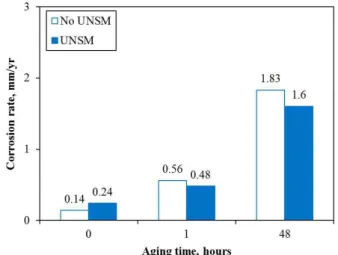
In a typical UNSM technique, a tungsten carbide tip strikes the specimen surface up to 20,000 or more times per second, with 1,000 to 10,000 shots per square milli- meter in a very short time. These strikes bring severe plas- tic deformation to surface layers and thus induce nano-crystalline structure.13) Fig. 5 shows the effect of UNSM treatment on the intergranular corrosion rate of 316L stainless steel aged at 650 oC determined by ASTM A262 practice C (note that corrosion rates in this figure Fig. 3. Effect of aging time at 650 oC on the degree of sensitization
of 316L stainless steel determined by DL-EPR test in 1 M H2SO4
+ 0.005 M KSCN at 30 oC.
Fig. 4. Effect of aging time at 650 oC on the residual stress of 316L stainless steel determined by X-ray diffraction method.
Fig. 5. Effect of UNSM treatment on the intergranular corrosion rate of 316L stainless steel aged at 650 oC determined by ASTM A262 practice C: 0 h-aged specimen, after five 48 h test periods;
1 h-aged specimen, after five 9 h test periods; 48 h-aged specimen, after five 3 h test periods.
mean the rates after five 48 h test periods for 0 h-aged specimen, and after five 9 h test periods for 1 h-aged specimen, and after five 3 h test periods for 48 h-aged specimen in order to differentiate the effect of UNSM on intergranular corrosion because of the formation of very thin surface layer by UNSM treatment) 13). UNSM treat- ment slightly increased the intergranular corrosion rate of the 0 h-aged specimen, but the treatment reduced the cor- rosion rate of the 1 h-aged and 48 h-aged specimens. Fig.
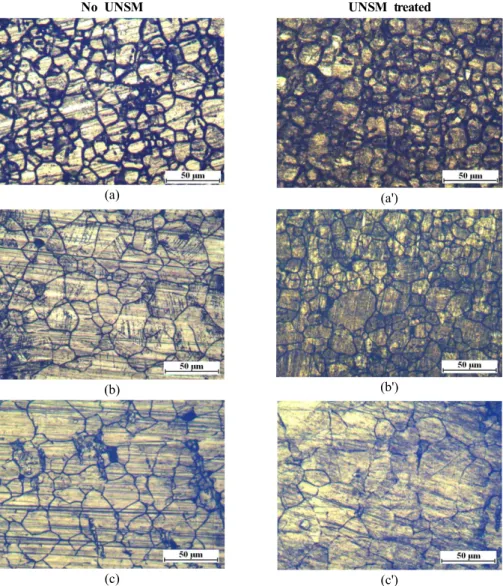
6 reveals the corroded surface appearance of 316L stain- less steel tested by ASTM A262 practice C. In Fig. 6, (a and a') are the optical micrographs after five 48 h test periods of 0 h-aged specimen, (b and b') are the optical micrographs after five 9 h test periods of 1 h-aged speci- men, and (c and c') are the optical micrographs after five 3 h test periods of 48 h-aged specimen. The degrees of
corrosion in Fig. 6 coincide with the corrosion rates in Fig. 5.
Fig. 7 reveals the effect of UNSM treatment on the degree of sensitization by a DL-EPR test. UNSM treat- ment did reduce the degree of sensitization even including the non-aged specimen. Reduced DOS should improve the intergranular corrosion resistance but Fig. 5 shows that the rate of the non-aged specimen increased. This implies that intergranular corrosion is closely related to the degree of sensitization but other factors may affect the inter- granular corrosion as described above.
Residual stress in the alloys can affect the corrosion properties. Shot peening6,7,8), laser shock peening9,10), wa- ter jet peening11), ultrasonic peening12), and UNSM13,14) can reduce the residual stress from tensile stress to com- pressive stress. Fig. 8 shows the effect of UNSM treatment
No UNSM UNSM treated
(a) (a')
(b) (b')
(c) (c')
Fig. 6. Corroded surface appearance of 316L stainless steel tested by ASTM A262 practice C; (a, a') after five 48 h test periods of 0 h-aged specimen, (b, b') after five 9 h test periods of 1 h-aged specimen, and (c, c') after five 3 h test periods of 48 h-aged specimen.
on the residual stress of the surface. In the case of 48 h-aged specimen, the residual stress was greatly reduced from tensile to compressive stress. Figs 5, 6, and 7 show that UNSM treatment improved the intergranular corro- sion resistance of the aged specimen which was followed by the reduction of DOS and the induced compressive stress. However, in the case of the non-aged specimen, UNSM treatment increased the corrosion rate which was followed by increase of the residual stress from com- pressive to tensile, even though the UNSM treatment re- duced the DOS.
Grain boundary engineering proposed by T. Watanabe32), means the intentional modification of the grain boundary structure to improve the materials properties; and also, UNSM treatment can refine the grain size of the surface13). Fig. 9 shows the deformed fraction determined by EBSD on the cross-section treated by UNSM for the 48 h-aged specimen. UNSM treatment increased the ratios of de- formed area in the 48 h-aged specimen, but it seems that in Fig. 7, the increased ratios of deformed area did not affect the intergranular corrosion.
4. Discussion
As described above, aging heat treatment sensitized the austenitic 316L stainless steel and increased its inter- Fig. 7. Effect of UNSM treatment on the degree of sensitization
of 316L stainless steel aged at 650 oC determined by DL-EPR test in 1 M H2SO4 + 0.005 M KSCN at 30 oC.
Fig. 8. Effect of UNSM treatment on the residual stress of 316L stainless steel aged at 650 oC determined by X-ray diffraction method.
(a) (b)
Deformed Sub-structured Re-crystallized Fig. 9. The effect of UNSM treatment on deformed fraction of the cross section of 316L stainless steel aged at 650 oC for 48 hours determined by EBSD with step size of 1 μm at 30 kV:
(a) No UNSM, and (b) UNSM.
(a) (b)
(c) (d)
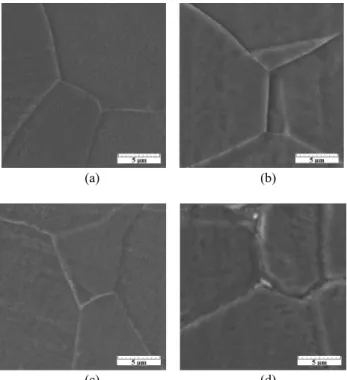
Fig. 10. SEM image showing grain boundary of 316L stainless steel with aging time at 650 oC: (a) 0 h-aged, (b) 1 h-aged, (c) 5 h-aged, and (d) 48 h-aged.
granular corrosion rate and also UNSM treatment refined the grain and reduced the degree of sensitization, and im- proved its intergranular corrosion rate. In this paper, we first focused on the relationship between chromium car- bide formation and intergranular corrosion. Even though from the thermodynamical aspect there was no possibility that chromium carbide could form4,5), we asked why the
5 h-aged specimen reveal a high corrosion rate in Fig.
1 and severely detached grains in Fig. 2.
Fig. 10 shows the SEM images showing the grain boun- dary of 316L stainless steel with aging time at 650 oC.
In the non-aged, 1 h-aged, and 5 h-aged specimens, no precipitation was observed at the grain boundaries; but in the 48 h-aged specimen, precipitation was observed at BSE
Mode
Fe
Cr
C
(a) (b)
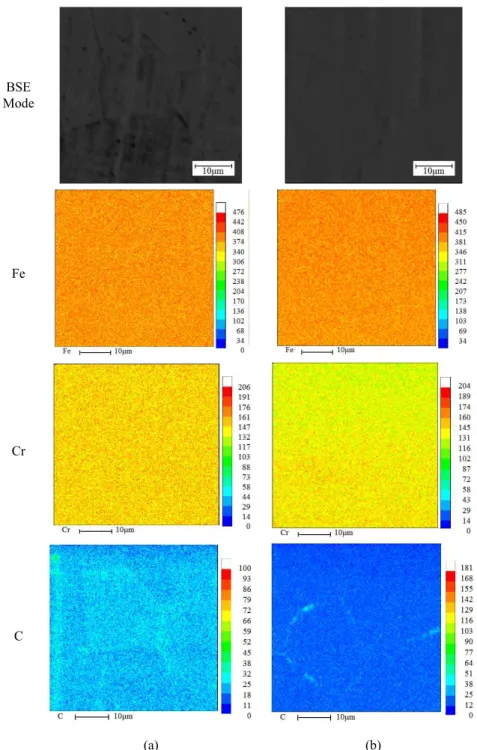
Fig. 11. Effect of aging time at 650 oC on grain boundary segregation of 316L stainless steel analyzed by EPMA: (a) 1 h-aged, (b) 5 h-aged.
the grain boundaries. From Figs 1 and 10, we confirmed that no precipitation was formed in the shortly aged specimen, but its intergranular corrosion rate drastically increased.
Fig. 11 shows the effect of aging time at 650 oC on the grain boundary segregation of 316L stainless steel ana- lyzed by EPMA. Increasing the aging time depleted the iron and enriched the chromium and segregated and en-
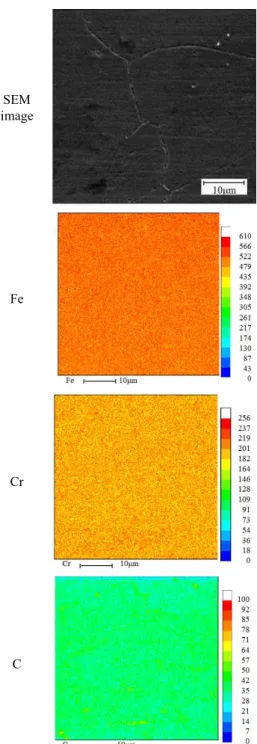
riched the carbon. The high intergranular corrosion rate of the 48 h-aged specimen was already interpreted on the basis of elemental segregation and enrichment20). However, in the 5 h-aged specimen, chromium was not enriched, but carbon was segregated in grain boundaries. Therefore, we also confirmed that the increased intergranular corro- sion rate of the 5 h-aged specimen was due to the segrega- tion of carbon in the grain boundaries. Fig. 12 shows the effect of UNSM treatment on the grain boundary segrega- tion of surface in the 48 h-aged specimen analyzed by EPMA(EPMA result about non-UNSM treated specimen was described in the previous report20).). As described be- fore, the UNSM treatment in the 48 h-aged specimen greatly reduced carbon (also chromium and iron) segrega- tion and enrichment in the grain boundaries. Namely, it is considered that the high mechanical energy of UNSM treatment can diffuse the segregated carbon (also chro- mium and iron), and reduce the segregation of carbon (also chromium and iron) in grain boundaries, and thus decrease its intergranular corrosion rate. This behavior was confirmed by the result for the cross-section. Fig.
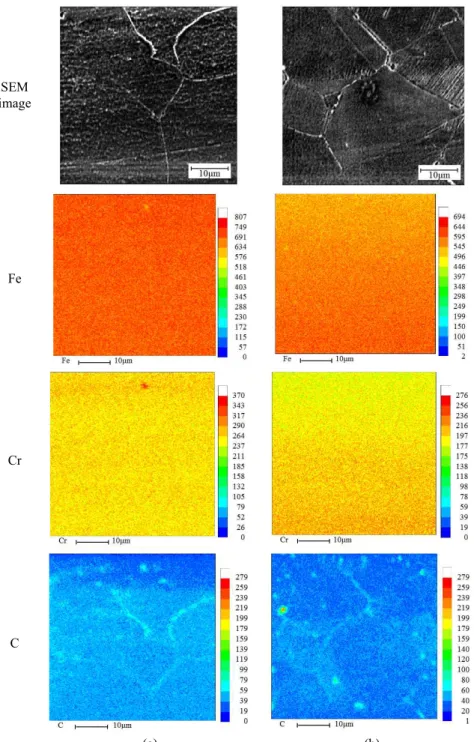
13 shows the effect of UNSM treatment on the grain boun- dary segregation of the cross-section in 48 h-aged speci- men analyzed by EPMA. As for the result on the surface in Fig. 12, UNSM treatment greatly reduced carbon (also chromium and iron) segregation and enrichment in the grain boundaries in the 48 h-aged specimen.
However, residual stress is one of the important factors that affect intergranular corrosion.20) The intergranular cor- rosion rate by aging in Fig. 1 was attributed to the summa- tion of the increased degree of sensitization in Fig. 3, and the increased residual stress in Fig. 4. The intergranular corrosion rate by UNSM treatment in Fig. 5 was due to the change of residual stress. That is, UNSM treatment reduced the degree of sensitization of non-aged specimen in Fig. 7, but conversely increased the intergranular corro- sion rate in Fig. 5 a little, and this behavior can be related to the increased residual stress by UNSM treatment in Fig. 8. Therefore, note that tensile residual stress facili- tates intergranular corrosion, while compressive residual stress suppressed intergranular corrosion.
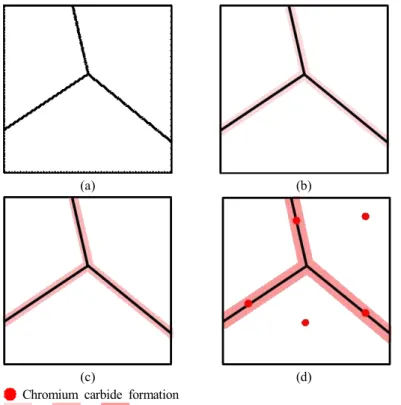
We can therefore propose a new intergranular corrosion model by aging and UNSM treatment; Fig. 14 shows the intergranular corrosion model of 316L stainless steel with aging time – increasing aging time at sensitization temper- ature range first segregates free carbon in grain bounda- ries, and then segregates it more and more with time.
Finally, after the critical time to form any carbide, carbon segregates in grain boundaries and enriches to form metal- lic carbides. In summary, carbon segregates in grain boun- daries with aging time, and thereafter the carbide formed SEM
image
Fe
Cr
C
Fig. 12. Grain boundary segregation of UNSM-treated surface in 48 h-aged specimen analyzed by EPMA.
after the critical time results in tensile residual stress;
Therefore, carbide formation (finally chromium depletion) and carbon segregation in grain boundaries increase inter- granular corrosion, and residual stress may affect inter- granular corrosion. Fig. 15 shows the mechanism of the improvement of intergranular corrosion by UNSM treat- ment for aged stainless steel – application of UNSM treat-
ment on the surface refines the grain size, eliminates the metallic carbides, and reduces the carbon segregation.
Moreover, in depth, UNSM treatment refines the grain size and reduces the concentration of carbon segregation and metallic carbide in grain boundaries, and introduces compressive residual stress. These factors improve the in- tergranular corrosion resistance.
SEM image
Fe
Cr
C
(a) (b)
Fig. 13. Effect of UNSM on grain boundary segregation of the cross-section in 48 h-aged specimen analyzed by EPMA: (a) No UNSM, and (b) UNSM.
5. Conclusions
1) Even though chromium carbide was not precipitated, the intergranular corrosion rate of 316L stainless steel was drastically increased with aging time, and it was confirmed that the increased intergranular corrosion rate of slightly-sensitized (not carbide formed) 316L stainless steel was due to the carbon segregation along the grain boundaries.
2) UNSM treatment improved the intergranular corrosion resistance of aged stainless steels, and its improvement was due to the reduction of carbon segregation and the grain refinement of the outer surface, including the introduction of compressive residual stress.
Acknowledgement
This work was supported by a collaborative research fund of the future nuclear power system development be- tween Korea and the United States of 2014, from the National Research Foundation of Korea.
References
1. R. S. Dutta, P. K. De, and H. S. Gadiyar, Corros. Sci.,
(a) (b)
(c) (d)
Chromium carbide formation
< < Increasing carbon segregation
Fig. 14. Intergranular corrosion model by aging time of 316L stainless steel at sensitization temperature range: (a) 0 h-aged, (b) 1 h-aged, (c) 5 h-aged, and (d) 48 h-aged.
(a)
(b) Chromium carbide
> Decreasing carbon segregation Fig. 15. Improvement of intergranular corrosion by UNSM treat- ment of aged 316L stainless steel: (a) No UNSM, and (b) UNSM.
34, 51 (1993).
2. Y. Asada, M. Ueta, T. Kanaoka, M. Sukekawa, and T.
Nishida, Proceedings of the ASME PVP on Stress Classification, Robust Methods, and Elevated Temperature Design, 230, 61 (1992).
3. E. C. Bain, R. H. Aborn, and J. J. B. Rutherford, Trans.
of Am. Soc. Steel Treat., 21, 481 (1933).
4. G. H. Aydog˘du, and M. K. Aydinol, Corros. Sci., 48, 3565 (2006).
5. H. Sahlaoui, K. Makhlouf, H. Sidhom, and J. Philibert, Mater. Sci. Eng. A, 372, 98 (2004).
6. V. Azar, B. Hashemi, and M. R. Yazdi, Surf. Coat.
Tech., 204, 3546 (2010).
7. G. Liu, S. C Wang, X. F. Lou, J. Lu, and K. Lu, Scripta Mater., 44, 1797 (2001).
8. P. Sanjurjo, C. Rodriguez, I. F. Pariente, F. J. Belzunce, and A. F. Canteli, Procedia Eng., 2, 1539 (2010).
9. P. Peyre, C. Braham, J. Ledion, L. Berthe, and R.
Fabbro, J. Mater. Eng. Perform., 9, 656 (2000).
10. U. Trdan, and J. Grum, Corros. Sci., 59, 324 (2012).
11. EPRI 1025839, Materials Reliability Program:
Technical Basis for Primary Water Stress Corrosion Cracking Mitigation by Surface Stress Improvement (MRP-267, Revision 1) , EPRI (2012).
12. A. K. Gujba, and M. Medraj, Mater., 7, 7925 (2014).
13. A. Telang, A. S. Gill, D. Tammana, X. Wen, M. Kumar, S. Teysseyre, S. R. Mannava, D. Qian, and V. K.
Vasudevan, Mater. Sci. Eng. A, 648, 280 (2015).
14. H. S. Lee, D. S. Kim, J. S. Jung, Y. S. Pyun, and K. Shin, Corros. Sci., 51, 2826 (2009).
15. I. I. Mukhanov, and Y. M. Golubev, Met. Sci. Heat Treat., 11, 701 (1969).
16. C. Ye, A. Telang, A. S. Gill, S. Suslov, Y. Idell, K.
Zweiacker, J. M. K. Wiezorek, Z. Zhou, D. Qian, S.
R. Mannava, and V. K. Vasudevan, Mater. Sci. Eng.
A, 613, 274 (2014).
17. T. Wang, J. Yu, and B. Dong, Surf. Coat. Tech., 200, 4777 (2006).
18. W. Ye, Y. Li, and F. Wang, Electrochim. Acta, 51, 4426 (2006).
19. O. Takakuwa and H. Soyama, Adv. Chem. Engineer.
Sci., 5, 62 (2015).
20. J. H. Lee and Y. S. Kim, Corros. Sci. Tech., 14, 313 (2015).
21. ASTM A262, Standard practices for detecting suscepti- bility to intergranular attack in austenitic stainless steels, ASTM (2002).
22. A. J. Sedriks, Corrosion of Stainless Steels, 2nd ed., p. 110, Wiley, New York (1996).
23. A. Pardo, M. C. Merino, A. E. Coy, F. Viejo, M.
Carboneras, and R. Arrabal, Acta Mater., 55, 2239 (2007).
24. R. Steigerwald, Metallurgically Influenced Corrosion, in Metals Handbook, 9th edition, p. 123, ASM International, Metals Park, OH (1990).
25. J. K. Kim, Y. H. Kim, J. S. Lee, and K. Y. Kim, Corros.
Sci., 52, 1847 (2010).
26. J. K. Kim, Y. H. Kim, B. H. Lee, and K. Y. Kim, Electrochim. Acta, 56, 1701 (2011).
27. J. K. Kim, Y. H. Kim, S. H. Uhm, J. S. Lee, and K.
Y. Kim, Corros. Sci., 51, 2716 (2009).
28. J. K. Kim, B. J. Lee, B. H. Lee, Y. H. Kim, and K.
Y. Kim, Scripta Mater., 61, 1133 (2009).
29. M. G. Fontana, Corrosion Engineering, 3rd ed., p. 73, McGraw-Hill Book Company, New York (1986).
30. N. M. Alanazi, A. M. El-Sherik, S. H. Alamar, and S. Shen, Int. J. of electrochem. Sci., 8, 10350 (2013).
31. X. Zhao, P. Munroe, D. Habibi, and Z. Xie, J. of Asian Ceramic Soc., 1, 86 (2013).
32. V. Randle, and G. Owen, Acta Mater., 54, 1777 (2006).