• 검색 결과가 없습니다.

Stress Corrosion Cracking Behavior of Cold Worked 316L Stainless Steel in Chloride Environment

N/A
N/A
Protected

Academic year: 2021

Share "Stress Corrosion Cracking Behavior of Cold Worked 316L Stainless Steel in Chloride Environment"

Copied!
5
0
0

로드 중.... (전체 텍스트 보기)

전체 글

(1)

-박성준: 선임연구원, 주형규: 교수

Received: Aug. 7, 2020 ; Revised: Oct. 14, 2020 ; Accepted: .Oct. 30, 2020

Corresponding author: Heongkyu Ju (Gachon Univ.) Tel: +82-31-750-8552, Fax: +82-31-750-8552 E-mail: [email protected]

Journal of Korea Foundry Society 2020. Vol. 40 No. 5, pp. 129~133 http://dx.doi.org/10.7777/jkfs.2020.40.5.129 pISSN 1598-706X / eISSN 2288-8381

© Korea Foundry Society, All rights reserved.

This is an Open-Access article distributed under the terms of the Creative Commons Attribution Non-Commercial License (http://creative- commons.org/licenses/by-nc/3.0) which permits unrestricted non-commercial use, distribution, and reproduction in any medium, provided the original work is properly cited.

Stress Corrosion Cracking Behavior of

Cold Worked 316L Stainless Steel in Chloride Environment

Sung Joon Pak* and Heongkyu Ju**

,†

*Korea Institute of Industrial Technology (KITECH), Siheung, Republic of Korea

**Department of Physics, Gachon University, Seongnam, Republic of Korea

Abstract

The outcomes of solution annealing and stress corrosion cracking in cold-worked 316L austenitic stainless steel have been studied using x-ray diffraction (XRD) and the slow strain rate test (SSRT) technique. The good compatibility with a high-tem- perature water environment allows 316L austenitic stainless steel to be widely adopted as an internal structural material in light water reactors. However, stress corrosion cracking (SCC) has recently been highlighted in the stainless steels used in commercial pressurized water reactor (PWR) plants. In this paper, SCC and inter granular cracking (IGC) are discussed on the basis of solu- tion annealing in a chloride environment. It was found that the martensitic contents of cold-worked 316L stainless steel decreased as the solution annealing time was increased at a high temperature. Moreover, mode of SCC was closely related to use of a chloride environment. The results here provide evidence of the vital role of a chloride environment during the SCC of cold- worked 316L.

Key word: Chloride, Solution annealing, Stress corrosion cracking, Austenitic stainless steels, SSRT

1. Introduction

Intergranular attack in austenitic stainless steels has been of great interests during the last century[1]. Specifically, intergranular corrosion and sensitization have been focused in the context of chromium depletion at the grain boundaries[2-8]. Austenitic stainless steels have been commonly used for internal structural materials of light water reactors and heavy water reactors, due to its good compatibility with high temperature water environment.

However, in early 1970s, intergranular cracking (IGC) was observed in the 25 % Cr-20 % Ni austenitic stainless steel of the parts of the fuel assembly for a steam generating heavy water reactor[9], and the Cr depletion and Ni, Si enrichment were detected near its grain boundaries.

The material flow during plastic deformation process considerably affected the product quality, i.e., its structural

and mechanical properties, the process efficiency and the deformation force amplitude. The changes in basic properties (resistance and plasticity) of the deformed material needed to be addressed to ensure the final mechanical characteristics of the components that supported an appropriate behavior in working condition[10,11].

The plastic deformation induces the concentrated stress

and the consequent martensitic transformation increased the

α’(110) martensitic structure, leading to a change in

physical properties of austenitic stainless steels. Stainless

steels were then susceptible to the localized corrosion

attack such as the pitting, the intergranular corrosion, and

the stress corrosion cracking[12-19], though stainless steels

having a good resistance to general corrosion via having a

thin chromium rich passive surface film formed. In this

paper, we studied the effects of solution annealing and

stress corrosion cracking (SCC) on the alpha prime (α’)

(2)

martensitic phase of the cold-worked 316L austenitic stainless steel under the chloride (Cl) environment and dissolved oxygen (DO) in the slow strain rate test (SSRT).

Such environment in the SSRT permitted the SCC of 316L to develop along the grain boundaries associated with IGC.

The SSRT taken under oxygen and chloride environment permitted us to see the SCC effects of 316L that could simulate stress phase production that possibly occurred through vibration of the internal structure components of the nuclear light-water reactors near seashore at room temperature.

2. Experimental Methods

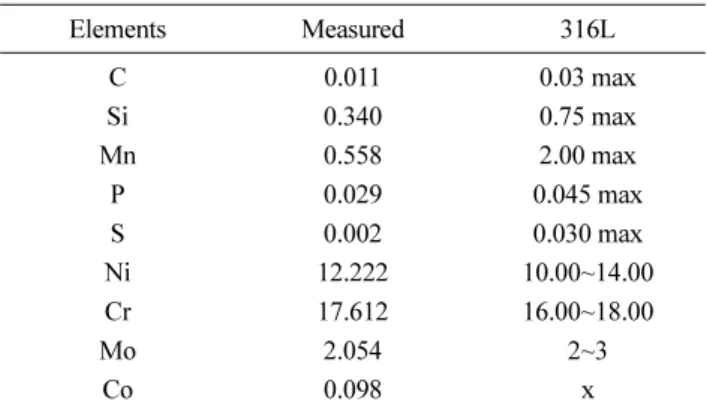
We used a 316L austenitic stainless steel with its chemical composition shown in Table 1. The 316L samples were cold-worked by plastic deformation of 10 % and 20 %.

Residual martensitic contents were examined via a x-ray diffraction (XRD) after solution annealing at 1,050

o

C and 1,075

o

C. The dimensions of the samples for the corrosion test was 40×15×2 mm, and the gauge section of the SSRT specimens was 2×2 mm with a gauge length of 10 mm. We conducted the corrosion and SSRT tests in an autoclave connected to a water chemistry control loop.

Fig. 1 shows a photo of the SSRT system, being operated at the pressure of up to 20 MPa and the temperature of 360

o

C. The SSRT test conditions and results for the corrosion are listed in Table 2. The oxygen content was controlled by bubbling high-purity argon into the primary water with Li 2 ppm and B 1,200 ppm. A scanning electron microscope (SEM) was used to characterize the microstructure of the fractured surface of specimen that took the SSRT.

3. Results and Discussion

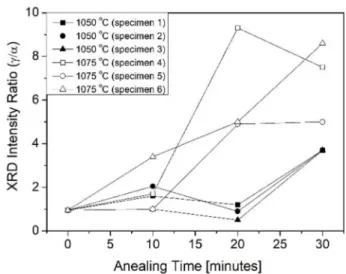
We examined the effects of the solution annealing of the cold-worked specimens. Fig. 2 shows the XRD intensity ratio ( γ -austenite/ α -martensite) for the 316L specimens cold-worked by 10% plastic deformation. It was revealed that the martensitic phase proportion of the specimen altered with solution annealing time for a given annealing temperature, due to microstructure transfer processes at the grain boundaries. The solution annealing of 20 minutes exhibited the most effective microstructure transfer at 1 ,050

o

C, while the annealing time of more than 20 minutes showed the significant microstructure transfer at 1,075

o

C.

So, when the cold working amount was 10%, it was found to be most effective when heat treatment at 1,050

o

C for 20 minutes. That is, when the amount of cold work is small, it seems effective to increase the heat treatment temperature and shorten the time. Alternatively, it seems to be effective if it lasts for 30 minutes at 1,075

o

C. That is, when the heat treatment temperature is low, it is effective to lengthen the heat treatment time for the microstructure transfer.

Fig. 3 shows the XRD intensity ratio ( γ -austenite/ α - martensite) change with increasing the annealing time, for Fig. 1. A photo for the corrosion and SSRT test system.

Table 2. SSRT Test conditions and results for 2 weeks at 20 MPa and 360

o

C (DO: dissolved oxygen level, CL: chlorine level)

Tests No. Strain rate (s

-1

) DO (ppm) Cl (ppm) Fracture

1 2 × 10

-7

3~4 0 No

2 2 × 10

-5

3~4 0 No

3 2 × 10

-7

5~6 0 No

4 2 × 10

-5

3~4 4~5 Yes

Table 1. Chemical composition of the 316L austenitic stainless steel (wt. %).

Elements Measured 316L

C 0.011 0.03 max

Si 0.340 0.75 max

Mn 0.558 2.00 max

P 0.029 0.045 max

S 0.002 0.030 max

Ni 12.222 10.00~14.00

Cr 17.612 16.00~18.00

Mo 2.054 2~3

Co 0.098 x

(3)

the specimens cold-worked by plastic deformation of 20 %.

Unlike Fig. 2, the ratio increased with much higher efficiency at the annealing temperature of 1,075

o

C than at 1,050

o

C. This led to a consequence of martensitic phase proportion diminished, particularly for solution annealing time of 20 minutes. It thus followed that more effective removal of stress at higher solution annealing temperature for more heavily cold-worked specimens. When the cold working amount is 20%, the efficiency seems to increase when heat treatment at 1,075

o

C for 20 minutes. That is, when the amount of α -martensitic microstructure is large, it

seems effective to perform heat treatment for 20 to 30 minutes at high temperature. In the case of a large amount of cold working, heat treatment at 1,050

o

C was relatively inefficient. Although the α -martensitic microstructure tended to decrease with respect to a specific temperature and heat treatment time, experimental errors for some specimens will be reduced through future experiments.

Fig. 4 shows the morphological structure of the fractured surface of the specimen after the SSRT for 2 weeks in primary cooling water with the DO 4 ppm. This revealed a general ductile fracture on the surface because the specimen Fig. 3. The XRD intensity ratio ( γ-austenite/α-martensite) as a function of solution annealing time for 316L specimens cold- worked by 20 % plastic deformation. Specimens at two different annealing temperatures (1050 and 1,075

o

C).

Fig. 2. The XRD intensity ratio ( γ-austenite/α-martensite) as a function of solution annealing time for 316L specimens cold- worked by 10 % plastic deformation. Specimens at two different annealing temperatures (1,050 and 1,075

o

C).

Fig. 4. The SEM images for the morphology of the intentionally fractured surface of the specimen that went through the stress in SSRT for 2

weeks in primary cooling water with the DO 4ppm at 360

o

C. (a) The 100-fold magnification, (b) 500-fold magnification.

(4)

was intentionally fractured without SCC after SSRT.

The morphological structure of the fractured surface of the specimen that took the SSRT in primary water with the DO 4 ppm and Cl 5 ppm at 360

o

C was shown in Figs.

5(a) and 5(b) via 100-fold and 1,000-fold magnifications, respectively. This revealed a significant stress corrosion cracking. Particularly, the more highly magnified image (Fig. 5b) offered an evidence of the presence of intense corrosion along the grain boundaries of the specimen. The corrosion attack to the grain boundaries of the specimen was made into its deeper region, as observed in the image at the low magnification (Fig. 5a). We thus found that, for given the conditions seen in Table 2, oxygen and chloride contents increased the intergranular corrosion of the specimens, confirming the 316L susceptibility to it[3,17].

5. Conclusions

The good compatibility of 316L with ambient water of high temperature, lent itself to the wide use as the internal structure materials of nuclear light-water reactors. However, the intergranular cracking recently found in the stainless steels gathered serious attention, particularly for that possibly occurring in the commercialized PWR power plants. The susceptibility of the 316L stainless steel to intergranular corrosion was highly affected by martensite and cold rolling. The corrosion characteristics of the test s pe c im e ns c oul d be a tt ri but ed t o the tr ansf er of

microstructures (mainly martensitic structure). We thus found that the corrosion resistance of 316L could be improved by decreasing the martensitic content while Cl content increases the SCC (IGC) in the 316L stainless steel.

Acknowledgments

This work was supported by the Gachon University Research fund of 2018 (GCU-2018-0674) and also supported by the National Research Foundation of Korea (NRF) grant funded by the Korean government (MSIT) (No. 2020R1F1A1050885).

References

[1] A. Padilha, R. Plaut and P. Rios, Steel Heat Treatment Handbook, 2nd ed., CRC Press, FL (2007) 695.

[2] A. Zingales, G. Quartarone and G. Moretti, Corrosion, “Sigma phase intergranular corrosion effects in austenitic welds containing ferrite”, 41 (1985) 136.

[3] P. Muraleedharan, J. B. Gnanamoorthy and P. Rodriguez, Corrosion, “Comparative study: degree of sensitization and intergranular stress corrosion cracking susceptibility of type 304 stainless steel”, 52 (1996) 790.

[4] I. Chattoraj, A. Bhattamishra, S. Jana, S. Das, S. Chakraborty and P. De, Corr Sci,. “The association of potentiokinetic reactivation and electrochemical pitting tests on a nitrogen bearing 19 Cr-17 Mn steel with its thermal history”, 38 (1996) 957.

[5] P. Shankar, H. Shaikh, S. Sivakumar, S. Venugopal, D.

Sundararaman and H. Khatak, J Nucl Mater, “Effect of

thermal aging on the room temperature tensile properties of

Fig. 5. The SEM images for the morphology of the fractured surface of the specimen that went through the stress in SSRT for 2 weeks in

pimary cooling water with the DO 4 ppm and Cl 5 ppm at 360

o

C. (a) The 100-fold magnification, (b) 1,000-fold magnification.

(5)

AISI type 316LN stainless steel”, 264 (1999) 29.

[6] H. Sahlaoui, K. Makhlouf, H. Sidhom and J. Philibert, Mater Sci Eng A, “Effects of ageing conditions on the precipitates evolution, chromium depletion and intergranular corrosion susceptibility of AISI 316L: experimental and modeling results”, 372 (2004) 98

[7] Z. Stonawska, M. Svoboda, M. Sozanska, M. Kristková, J.

Sojka, C. Dagbert and L. Hyspecka, J Microsc, “Structural analysis and intergranular corrosion tests of AISI 316L steel”, 224 (2006) 62.

[8] M. Terada, M. Saiki, I. Costa and A. Padilha, J Nucl Mater,

“Microstructure and intergranular corrosion of the austenitic stainless steel 1.4970”, 358 (2006) 40.

[9] P. M. Scott, W. Foot, L. A. Goldsmith, S. Dumbill, T. M.

Williams and J. M. Perks, C. A. English and W. G. Burns, NEA/UNIPEDE specialists Mtg. on life-limiting & regulatory aspects of core internals and pressure vessels, Stockholm (1987).

[10] M. Sanga, N. Yukawa and T. Ishikawa, Proc. International Symposium on Designing, Toyohashi, Japan (1997).

[11] P. Gabrielson, E. Schedin and G. Ekstrand, Advanced Technology of Plasticity II, Springer, Berlin (1999) 1383.

[12] N. N., Contract 248/1999, Research on corrosion behaviour of heat exchanger plates from Apaterm SA, (GALATI, 1999).

[13] K. Chandra, V. Kain and P. Ganesh, J of Mater. Eng. and

Performance, “Controlling End-Grain Corrosion of Austenitic Stainless Steels”, 17 (2008) 115.

[14] N. Solomon and I. Solomon, U.P.B. Sci. Bull., Series B, 72 (2010) 197.

[15] Kim KJ, Ju HK, Moon YD, Hong JH and Pak SJ, Metall Trans., “Effect of the Solution Annealing and Chemical Passivation Followed by Aging on the Corrosion of Shell Mold Cast CF8 Stainless Steel”, 47 (2016) 4979. Affiliated withDepartment of Mechanical Engineering, University of New Hampshire

[16] Kim KJ, Lim SG and Pak SJ, Corrosion Science and Technology, “Effects of the solid solution heat treatment on the corrosion resistance property of SSC13 cast alloy”, 14 (2015) 93.

[17] N. Solomon and I. Solomon, Engineering Failure Analysis,

“Effect of deformation-induced phase transformation on AISI 316 stainless steel corrosion resistance”, 79 (2017) 865.

[18] Kim YS, Lee DJ, Kang YJ and Pak SJ, Aspects in Mining &

Mineral Science, “Effect of solution annealing on alpha prime martensitic microstructure of cold rolled AISI316L stainless steel” 4 (2019) 481.

[19] K. Kim, S. Lim, H. Ju and S. Pak J. Korea Foundry Society,

“Effect of austenitizing ratio on the delta ferrite volume

fraction and corrosion resistance of shell mold cast SSC13

elbow fitting”, 35 (2015) 109.

수치

Table 2.  SSRT Test conditions and results for 2 weeks at 20 MPa and 360 o C (DO: dissolved oxygen level, CL: chlorine level)
Fig. 4 shows the morphological structure of the fractured surface of the specimen after the SSRT for 2 weeks in primary cooling water with the DO 4 ppm

참조

관련 문서

Standard Test Method for Electrochemical Reactivation (EPR) for Detecting Sensitization of AISI type 304 and 304L Stainless Steels. al., “Variation of Slow Strain Rate

Effect of Porosity on Mechanical Anisotropy of 316L Austenitic Stainless Steel Additively Manufactured by Selective Laser Melting.. Jeong Min Park a , Jin Myoung Jeon a , Jung Gi Kim

Keywords: Sintered stainless steel, Anti-corrosion, Oxides additives, Oxidation

Methods of the CISCC mitigation [4] For CISCC of austenitic stainless steel, there are three components that must be simultaneously present for CISCC degradation to occur as

For comparing the general and galvanic corrosion in new heater material, the test material of Zirconium (Zr), Titanium (Ti) and STS 316L are tested

Fig. 3 TEM micrographs showing the reversed austenite obtained by annealing treatment at 600℃ and 700℃ for 10min.. 5 Anodic polarization curve of 202 austenitic stainless steel

The decrease of solution annealing temperature enhanced the resistance to pitting corrosion greatly in acidified chloride environments due to a decrease of PREN

This study was investigated with corrosion, stress corro- sion cracking, and corrosion fatigue behaviour of the weld- ing zone when the stainless steel is welded with arc weld-