http://dx.doi.org/10.5534/wjmh.2012.30.2.123
Original Article
Received: May 25, 2012; Revised: Jun 19, 2012; Accepted: Jun 28, 2012 Correspondence to: Yun Seob Song
Department of Urology, Soon Chun Hyang University Seoul Hospital, Soon Chun Hyang University College of Medicine, 59, Daesagwan-ro, Yongsan-gu, Seoul 140-743, Korea.
Tel: +82-2-709-9375, Fax: +82-2-709-9378, E-mail: [email protected] Copyright © 2012 Korean Society for Sexual Medicine and Andrology
This is an Open Access article distributed under the terms of the Creative Commons Attribution Non-Commercial License (http://creativecommons.
org/licenses/by-nc/3.0) which permits unrestricted non-commercial use, distribution, and reproduction in any medium, provided the original work is properly cited.
Strong Impact of Nocturia on Sleep Quality in Patients with Lower Urinary Tract Symptoms
Seung Whan Doo1, Hong Jun Lee2,3, Jin Ahn1,2, Jae Heon Kim1, Jong Hyun Yun1, Won Jae Yang1, Yun Seob Song1
1Department of Urology, Soon Chun Hyang University College of Medicine, 2Medical Research Institute, Chung-Ang University School of Medicine, Seoul, Korea, 3Division of Neurology, Department of Medicine, University of British Columbia, Vancouver, Canada
Purpose: Nocturia is a bothersome symptom that impacts sleep quality in patients with lower urinary tract symptoms (LUTS)/benign prostatic hyperplasia (BPH). This study was performed to evaluate the impact of nocturia on sleep quality.
Materials and Methods: A total of 58 male patients with LUTS/BPH were enrolled. LUTS/BPH patients without nocturia were included in the control group. The inclusion criteria were eight or more points on the International Prostate System Score (IPSS) including more than one episode of nocturia and a prostate volume larger than 20 ml. IPSS, prostate volume, uroflowmetry, and the Pittsburgh Sleep Quality Index (PSQI) from each patient were recorded.
Results: Patients with nocturia showed a higher mean global PSQI (8.5±0.4) than patients without nocturia (4.82±0.4) (p<0.01). Patients with nocturia showed a higher percentage of severe sleep disorders (74.1%) than patients without nocturia (35.3%) (p<0.01). The regression coefficient between the number of episodes of nocturia and mean global PSQI was 0.42 (p<0.01).
Conclusions: Patients with nocturia showed poor sleep quality, and this was related to the number of episodes of nocturia. This suggests that nocturia has a strong impact on sleep quality in patients with LUTS/BPH.
Key Words: Nocturia, Sleep, Prostatic hyperplasia
INTRODUCTION
Nocturia is one of the common lower urinary tract symptoms (LUTS), the third most bothersome symptom in all subject and the most bothersome symptom in men with benign prostatic hyperplasia (BPH).1-4 This symptom is of-
ten associated with bladder outlet obstruction and with impairing health related quality of life (QoL).4,5 Nocturia is defined as waking at night one or more times to void.6 Evaluating the impact of nocturia on sleep quality in pa- tients with LUTS is needed.
Although the International Prostate Symptom Score
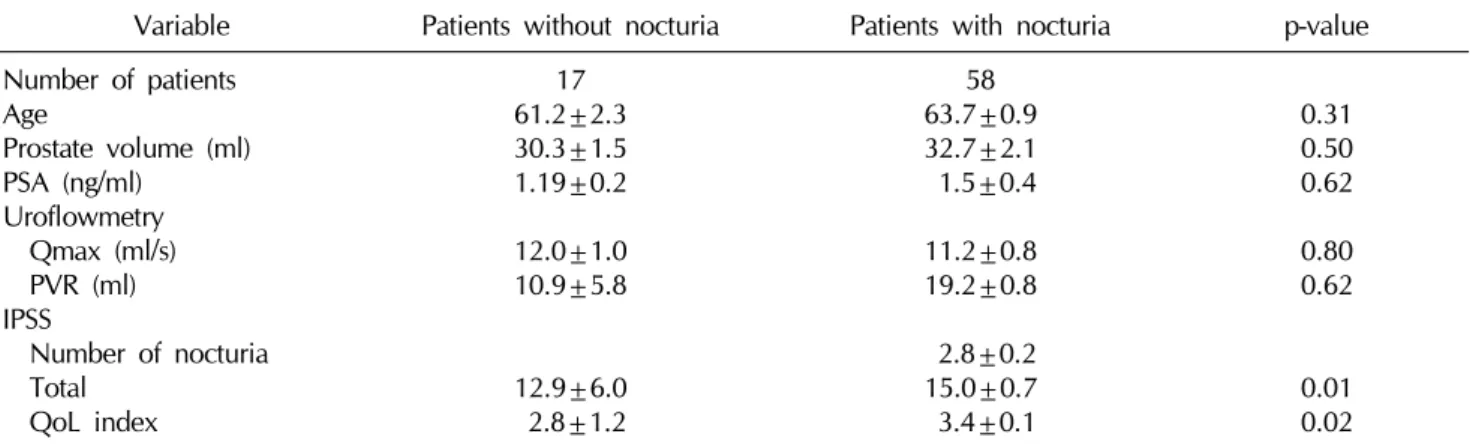
Table 1. Profiles in patients without and with nocturia
Variable Patients without nocturia Patients with nocturia p-value Number of patients
Age
Prostate volume (ml) PSA (ng/ml)
Uroflowmetry Qmax (ml/s) PVR (ml) IPSS
Number of nocturia Total
QoL index
17 61.2±2.3 30.3±1.5 1.19±0.2 12.0±1.0 10.9±5.8
12.9±6.0 2.8±1.2
58 63.7±0.9 32.7±2.1 1.5±0.4 11.2±0.8 19.2±0.8 2.8±0.2 15.0±0.7 3.4±0.1
0.31 0.50 0.62 0.80 0.62
0.01 0.02 Values are presented as mean±standard error.
PSA: prostate specific antigen, Qmax: maximum flow rate, PVR: post-void residual, IPSS: International Prostate Symptom Score, QoL: quality of life.
(IPSS) is commonly used, it does not show how strongly nocturia decreases sleep quality.7 The Pittsburgh Sleep Quality Index (PSQI) is a questionnaire related to the sleep quality used worldwide.8,9 This study was performed to evaluate that how strongly nocturia impacts sleep quality evaluated by PQSI in patients with LUTS/BPH.
MATERIALS AND METHODS
Men with LUTS/BPH who visited a hospital’s Depart- ment of Urologybetween January and December 2010 were selected for the study. Approval for this study was ob- tained from the Institutional Review Board at the hospital and informed consent was obtained from each patient.
Patients were included in the study if they met the criteria of the 5th International Consensus Committee on BPH (Paris, 2000), voided more than 150 ml during uro- flowmetry, and were measured postvoid residual urine (PVR) volume and prostate size. Patients who reported more than one episode of nocturia per night using ques- tion 7 of the IPSS, had a maximum urinary flow rate (Qmax) under 15 ml/sec, a total IPSS over 7, a digital rectal examination negative for suspected malignancy, and a prostate volume larger than 20 ml were assessed as being in the LUTS/BPH group. LUTS/BPH patients without noc- turia were included in the control group. The exclusion criteria included the use of diuretics for treating con- gestive heart failure, the use of sedatives or tranquilizers
for treating sleep disturbances, or having neurogenic blad- der dysfunction. Patients were also excluded from the analysis if they had a documented history or clinical symp- toms of prostatitis, prostate cancer, a history of prostate surgery or radiotherapy, or acute urinary retention. The quality of sleep was measured using the PSQI. The overall score can range from 0 (absence of sleep-related prob- lems) to 21 (severe sleep-related problems). A total score of >5 is considered an indicator of severe sleep disorders.8 Prostate volume was measured by transrectal ultrasonography. Data are expressed as mean± standard error and compared statistically using the Student’s t-test, chi-squared test, and Pearson correlation test. A level of p
<0.05 was considered statistically significant.
RESULTS
1. Profiles
Seven patients without nocturia (41.2%) had associated diseases, including 1 (5.9%) with hypertension, 4 (23.5%) with diabetes, 1 (5.9%) with herniated intervertebral disk, and 1 (5.9%) with hypothyroidism. Thirty two patients with nocturia (55.2%) had associated diseases, including 14 (24.1%) with hypertension, 11 (19.0%) with diabetes, and 7 (12.1%) with hyperlipidemia. A total of 75 male pa- tients (17 without and 58 patients with nocturia) with LUTS/BPH were enrolled. 58 patients with nocturia had one or more episodes of nocturia: one (11 patients), two
Fig. 2. Severe sleep disorders of the patients without and with nocturia. Nocturia has an impact on patient's sleep (p<0.01, chi-square test). A total Pittsburgh Sleep Quality Index over 5 is considered an indicator of severe sleep disorders.
Table 2. The PQSI in LUTS/BPH patients without or with nocturia
Components Patients
without nocturia Patients
with nocturia p-value
Number of patients Subjective sleep quality Sleep latency
Sleep duration
Habitual sleep efficiency Sleep disturbances Use of sleep medication Daytime dysfunction Global PSQI score
Ratio of severe sleep disorders
17 0.76±0.5 1.23±0.83 1.53±0.94
0±0 1.06±0.24 0.58±0.24 0.41±0.71 4.82±0.4 6/17 (35.3)
58 61.61±0.83
1.21±0.96 1.68±1.10 0.70±1.01 1.43±0.55 0.39±0.91 0.80±0.92 8.5±0.4 43/58 (74.1)
<0.001 0.950 0.596 0.011 0.008 0.150 0.089
<0.01
<0.01 Values are presented as mean±standard error or number (%).
PSQI: Pittsburgh Sleep Quality Index, LUTS: lower urinary tract symptoms, BPH: benign prostatic hyperplasia.
Fig. 1. Mean global PSQI of the patients without and with nocturia. Nocturia has an impact on patient's sleep (p<0.01, ANOVA test). PSQI: Pittsburgh Sleep Quality Index.
(15 patients), three (15 patients), four (11 patients), and five (6 patients) episodes. Baseline mean age, prostate vol- ume, and prostate specific antigren (PSA) levels did not differ between patients with or without nocturia (Table 1).
2. Uroflowmetry
The baseline mean Qmax of the patients without and with nocturia were 12.0±1.0 and 11.2±0.8, respectively.
The baseline mean PVR volume of the patients without and with nocturia were 10.9±5.8 and 19.2±0.8, respectively. There was no significant difference in Qmax or PVR volume between patients without or with nocturia (p>0.05, Table 1).
3. IPSS
The mean number of episodes of nocturia using ques- tion 7 of the IPSS was 2.8±0.2. The mean total IPSS of the patients without and with nocturia was 12.94±6.04 and 15.0±0.7, respectively. The mean QoL index of the pa- tients without and with nocturia was 2.82±1.2 and 3.4±0.1, respectively. The mean total IPSS and QoL index of patients with nocturia were higher than those of patients without nocturia (p<0.05, Table 1).
4. Sleep quality
The patients with nocturia showed a higher mean glob-
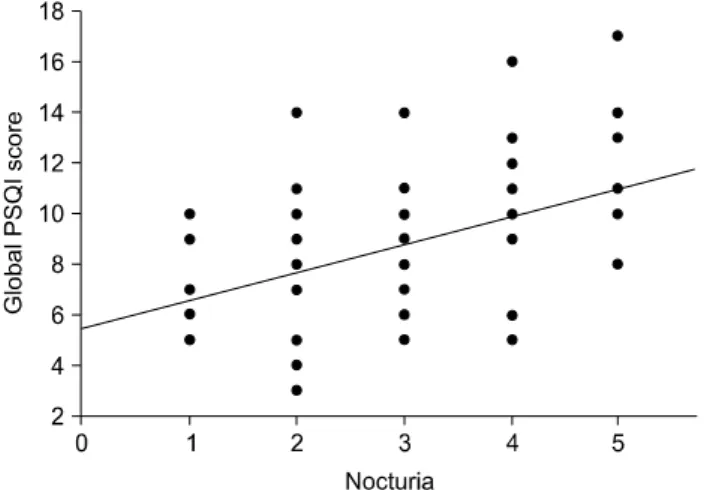
Fig. 3. Regression coefficiency of number of nocturia and global PSQI score. R=0.42 (p<0.01, Pearson correlation test). PSQI:
Pittsburgh Sleep Quality Index, R: regression coefficient.
al PSQI (8.5±0.4) than the patients without nocturia (4.82±0.4). (p<0.01, Fig. 1). The patients with nocturia showed a higher percentage of severe sleep disorders (74.1%) than the patients without nocturia (35.3%, Fig. 2) (p<0.01). The patients with nocturia showed a lower sub- jective sleep quality, habitual sleep efficiency, sleep dis- turbances, and daytime dysfunction than patients without nocturia (Table 2). The regression coefficient between number of nocturia and mean global PSQI was 0.42 (p<0.01, Fig. 3).
DISCUSSION
The incidence of nocturia has been reported at a fre- quency of 16% in men aged 40∼49 years, to 60% in men aged 70∼79 years.10,11 In many cases nocturia may be caused by BPH.12
Poor sleep quality due to nocturia increased daytime fa- tigue and lowered levels of general well-being.10 Moreover, nocturia can be a risk factor for falling.13,14 The decrease in a patient’s QoL due to nocturia represents a so- cial and economic problem,15 and a higher prevalence of cardiovascular diseases was reported in men with nocturia.16
In this study, there was no significant difference in age, prostate volume, PSA, QMax, or PVR between patients without or with nocturia. The mean total IPSS scores and QoL index of patients with nocturia were higher than
those of patients without nocturia.
The IPSS and QoL index are questionnaires used world- wide in relation to LUTS/BPH. Nocturia also has a severe impact on a patient’s sleep quality because it causes a con- dition of worry about the need to wake to urinate.
However, the IPSS and QoL index do not show how strongly nocturia decreases sleep quality.7 The PSQI is a simple, self administered questionnaire that contains 19 items assessing a wide variety of factors related to sleep quality.8,9 Global PSQI scores over 5 are considered to be an indicator of severe sleep disorders.8 In this study, pa- tients with nocturia showed a higher mean global PSQI than patients without nocturia. Patients with nocturia also showed a higher percentage of severe sleep disorders, subjective sleep quality, habitual sleep efficiency, sleep disturbances, and daytime dysfunction than patients with- out nocturia. The regression coefficient between the num- ber of episodes of nocturia and the mean global PSQI was significant. Therefore, nocturia has strong impact on sleep quality in patients with LUTS/BPH.
CONCLUSIONS
Patients with nocturia showed poor sleep quality and this was related to the number of episodes of nocturia. This suggests that nocturia has a strong impact on sleep quality in patients with LUTS/BPH.
REFERENCES
1. Eckhardt MD, van Venrooij GE, van Melick HH, Boon TA.
Prevalence and bothersomeness of lower urinary tract symptoms in benign prostatic hyperplasia and their impact on well-being. J Urol 2001;166:563-8
2. Jolleys JV, Donovan JL, Nanchahal K, Peters TJ, Abrams P.
Urinary symptoms in the community: how bothersome are they? Br J Urol 1994;74:551-5
3. Abrams P. Nocturia: the major problem in patients with lower urinary tract symptoms suggestive of benign prostatic obstruction (LUTS/BPO). Eur Urol 2005;3(Suppl):8-16 4. Stanley N. The underestimated impact of nocturia on qual-
ity of life. Eur Urol 2005;4(Suppl):17-9
5. Kim BS, Lee JW, Kim YT, Park HY, Kwon SW, Lee TY. The prevalence and risk factors of nocturia for males participat- ing in a prostate examination survey. Korean J Urol 2008;
49:818-25
6. van Kerrebroeck P, Abrams P, Chaikin D, Donovan J, Fonda
D, Jackson S, et al. Standardisation Sub-committee of the International Continence Society. The standardisation of ter- minology in nocturia: report from the Standardisation Sub- committee of the International Continence Society. Neuro- urol Urodyn 2002;21:179-83
7. Chapple CR. Night time symptom control with Omnic (Tamsulosin) Oral Controlled Absorption System (OCASⓇ).
Eur Urol 2005;4(Suppl):14-6
8. Buysse DJ, Reynolds CF 3rd, Monk TH, Berman SR, Kupfer DJ. The Pittsburgh Sleep Quality Index: a new instrument for psychiatric practice and research. Psychiatry Res 1989;28:193-213
9. De Gennaro L, Martina M, Curcio G, Ferrara M. The rela- tionship between alexithymia, depression, and sleep com- plaints. Psychiatry Res 2004;128:253-8
10. Abraham L, Hareendran A, Mills IW, Martin ML, Abrams P, Drake MJ, et al. Development and validation of a qual- ity-of-life measure for men with nocturia. Urology 2004;63:
481-6
11. Jackson S. Lower urinary tract symptoms and nocturia in men and women: prevalence, aetiology and diagnosis. BJU Int 1999;84(Suppl 1):5-8
12. Asplund R. The nocturnal polyuria syndrome (NPS). Gen Pharmacol 1995;26:1203-9
13. Coyne KS, Zhou Z, Bhattacharyya SK, Thompson CL, Dhawan R, Versi E. The prevalence of nocturia and its effect on health-related quality of life and sleep in a community sample in the USA. BJU Int 2003;92:948-54
14. Stewart RB, Moore MT, May FE, Marks RG, Hale WE.
Nocturia: a risk factor for falls in the elderly. J Am Geriatr Soc 1992;40:1217-20
15. Kobelt G, Borgström F, Mattiasson A. Productivity, vitality and utility in a group of healthy professionally active in- dividuals with nocturia. BJU Int 2003;91:190-5
16. Asplund R. Nocturia: consequences for sleep and daytime activities and associated risks. Eur Urol 2005;3(Suppl):24-32
Appendix
PITTSBURGH SLEEP QUALITY INDEX INSTRUCTIONS:
The following questions relate to your usual sleep habits during the past month only. Your answers should indicate the most accurate reply for the majority of days and nights in the past month.
Please answer all questions.
1. During the past month, what time have you usually gone to bed at night?
BED TIME
2. During the past month, how long (in minutes) has it usually taken you to fall asleep each night?
NUMBER OF MINUTES
3. During the past month, what time have you usually gotten up in the morning?
GETTING UP TIME
4. During the past month, how many hours of actual sleep did you get at night? (This may be different than the number of hours you spent in bed.)
HOURS OF SLEEP PER NIGHT
For each of the remaining questions, check the one best response. Please answer all questions.
5. During the past month, how often have you had trouble sleeping because you...
a) Cannot get to sleep within 30 minutes
Not during the Less than Once or twice Three or more
past month once a week a week times a week b) Wake up in the middle of the night or early morning
Not during the Less than Once or twice Three or more
past month once a week a week times a week c) Have to get up to use the bathroom
Not during the Less than Once or twice Three or more
past month once a week a week times a week d) Cannot breathe comfortably
Not during the Less than Once or twice Three or more
past month once a week a week times a week e) Cough or snore loudly
Not during the Less than Once or twice Three or more
past month once a week a week times a week f) Feel too cold
Not during the Less than Once or twice Three or more
past month once a week a week times a week g) Feel too hot
Not during the Less than Once or twice Three or more
past month once a week a week times a week h) Had bad dreams
Not during the Less than Once or twice Three or more
past month once a week a week times a week i) Have pain
Not during the Less than Once or twice Three or more
past month once a week a week times a week
j) Other reason(s), please describe How often during the past month have you had trouble sleeping because of this?
Not during the Less than Once or twice Three or more
past month once a week a week times a week 6. During the past month, how would you rate your sleep quality overall?
Very good Fairly good Fairly bad Very bad
7. During the past month, how often have you taken medicine to help you sleep (prescribed or "over the counter")?
Not during the Less than Once or twice Three or more
past month once a week a week times a week
8. During the past month, how often have you had trouble staying awake while driving, eating meals, or engaging in social activity?
Not during the Less than Once or twice Three or more
past month once a week a week times a week
9. During the past month, how much of a problem has it been for you to keep up enough enthusiasm to get things done?
No problem at all
Only a very slight problem Somewhat of a problem A very big problem
10. Do you have a bed partner or room mate?
No bed partner or room mate Partner/room mate in other room Partner in same room, but not same bed Partner in same bed
If you have a room mate or bed partner, ask him/her how often in the past month you have had...
a) Loud snoring
Not during the Less than Once or twice Three or more
past month once a week a week times a week b) Long pauses between breaths while asleep
Not during the Less than Once or twice Three or more
past month once a week a week times a week c) Legs twitching or jerking while you sleep
Not during the Less than Once or twice Three or more
past month once a week a week times a week d) Episodes of disorientation or confusion during sleep
Not during the Less than Once or twice Three or more
past month once a week a week times a week
e) Other restlessness while you sleep; please describe Not during the Less than Once or twice Three or more
past month once a week a week times a week