INTRODUCTION
Lower urinary tract symptom (LUTS) increases with aging and the most common cause of LUTS in aging men is benign prostatic hyperplasia (BPH) (1, 2). Reported data show that an enlarged prostate is not always associated with LUTS sever- ity (3, 4). Asian men have a smaller prostate than Caucasians, but may have similar or higher symptom scores and a more impaired quality of life (QL) (5).
It should come as no surprise that couples that have lived together for many decades share health concerns that direct- ly affect one partner. This is particularly true in cases of LUTS and clinical BPH as they occur in aging men, at a time when both partners are increasingly concerned about health mat- ters, and their vulnerabilities and susceptibilities to diseases (6). Moreover, cultural and perceptional differences may influ- ence the impact of a disease on the health-related quality of life (HRQL) of non-affected partner. Korean men with health problems traditionally tend to overlook the spousal incon- venience caused, and conversely, women consider it a virtue not to express such concerns. Several reports have been issued on the impact of a husband’s urinary problems on spouse HRQL in the West (7-11), but there have been few studies on an Asian population (9). This study was conducted to explore the impact of LUTS in Korean men on spousal HRQL
in relation to LUTS severity and demographic parameters.
MATERIALS AND METHODS
Patients with LUTS who visited our hospital for treatment were asked to complete the linguistically validated Interna- tional Prostate Symptom Score (IPSS) questionnaire. Digi- tal rectal examination, urinalysis, uroflowmetry, serum pro- state specific antigen testing, and transrectal ultrasonogra- phy were performed on all patients.
A total of 130 female partners, whose husbands had noc- turia with a frequency of more than once per night, who shared a bed with their husbands, accompanied husbands at consultation, and who consented to participate in this study, were sequently enrolled and asked to complete a structured questionnaire. The questionnaire form was handed directly to spouses, who were asked to complete it without interview.
The questionnaire used was originally developed by Sells et al. (7), and was validated specifically to assess partner’s mor- bidity in BPH. The Korean version of the questionnaire was linguistically validated. It was composed of 8 multi-choice questions, which addressed inconvenience (sleep disturbances, fatigue, social disruption, disturbance of essential tasks), psy- chological impact (embarrassment, fear of cancer, fear of sur-
Lower urinary tract symptoms (LUTS) in men may have an adverse effect on spouse health-related quality of life (HRQL), and these effects are probably influenced by cultural and perceptional differences. This study was conducted to explore the im- pact of LUTS in Korean men on their spousal HRQL in relation to symptom severi- ties and other demographic parameters. A total of 130 spouses, whose husbands had a nocturia, frequency of greater than once per night, who shared a bed with their husbands, and accompanied husbands at consultation, were subsequently enrolled and asked to complete a structured questionnaire. Almost all spouses (98%) suf- fered one or more inconveniences that affected HRQL to some degree. Sleep dis- turbance was rated to be most inconvenient. The sleep disturbances were significantly correlated with nocturia frequency and husband co-morbidity. Husband’s LUTS caused partners to feel fatigued (62%), embarrassed (79%), concerned about the possibilities of cancer (69%) and surgery (81%), sexual life deteriorated (58%), and dissatisfied, unhappy, or terrible (36%). Spouse’s perception on HRQL was found to be well correlated with husband’s quality of life. Men with LUTS need to under- stand that their LUTS is also mental and physical sufferings for their spouses.
Key Words : Lower Urinary Tract Symptom; Prostate; Spouse, Quality of Life
320
Sae Chul Kim and Shin Young Lee
Department of Urology, College of Medicine, Chung-Ang University, Seoul, Korea
Address for correspondence Sae Chul Kim, M.D.
Department of Urology, Chung-Ang University Hospital, 224-1 Heukseok-dong, Dongjak-gu, Seoul 156-861, Korea
Tel : +82.2-6299-1785, Fax : +82.2-822-8496 E-mail : [email protected]
DOI: 10.3346/jkms.2009.24.2.320
Men’ s Lower Urinary Tract Symptoms Are Also Mental and Physical Sufferings for Their Spouses
Received : 12 February 2008 Accepted : 26 June 2008
gery), sex life, and other demographic parameters (age, mar- riage duration, schooling, economic conditions, co-morbidi- ties, and others). Each question was scored from 0 to 4: 0 (not at all); 1 (somewhat); 2 (moderate); 3 (much); 4 (a great deal).
In addition, we added a question concerning spouse’s percep- tion of HRQL scored from 0 (completely happy) to 6 (terri- ble) (Appendix). No women refused to respond to any ques- tion of the questionnaire.
Main outcome measures were prevalence of spousal incon- veniences affecting HRQL due to their husband’s urinary symptoms, comparison of patients’ QL with their wives’
HRQL, and probabilities of spouse inconveniences and HR- QL vs. demographic data (age, schooling, marriage duration, economic condition, prostate volume, co-morbidity), IPSS, nocturia frequency, and duration of symptoms.
Statistical analyses were performed using analysis of covari- ance, the Student’s t-test, Pearson’s correlation test, and mul- tiple regression analysis. All statistical analyses were adjust- ed for patient and partner age.
RESULTS
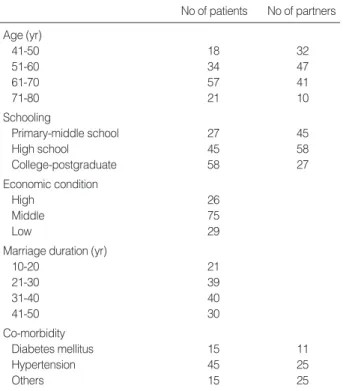
Patient and spouse demographics are presented in Table 1 and 2. Patient mean age was 62.2±8.2 yr (43-79 yr), and that of their partners was 57.8±8.5 yr (41-75 yr); a mean age difference of 4.4±4.0 yr (-5~+27 yr). Marriage duration was 34.0±9.5 yr (7-54 yr). Wives’ education backgrounds were slightly lower than their husbands’. The most common
co-morbidity was hypertension in both patients and spouses (34.6% & 19.2%, respectively) followed by diabetes melli- tus (11.5% & 8.5%, respectively).
Patient IPSS, nocturia frequencies, symptom durations, QL, and prostate volumes are detailed on Table 2. Mean pa- tient IPSS was 20.3±7.1 (8-35) with a mean symptom dura- tion of 8.4±5.2 yr (0.2-26 yr).
Almost all spouses (98%) suffered one or more inconve- niences of varying degrees. The majority of spouses (77%) experienced sleep derangement (awoken once or more), and 47% were awoken twice or more; 62% felt fatigued due to sleep disturbances (Fig. 1). These sleep disturbances were independent of ages of spouses or husbands, age difference, marriage duration, schooling, economic condition, prostate size, spouse co-morbidities, IPSS, or duration of LUTS. How- ever, nocturia frequency (p<0.01) and the presence of a co- morbidity in the husband (p<0.05) were found to increase spouse sleep disruption. In addition, feeling tired during the day because of sleep disturbances was found to correlate with IPSS (p<0.05) and with nocturia frequency (p<0.05) (Table 3).
Although the social lives of spouses (e.g., meeting friends, one day trips, favorite pastimes) and essential tasks (such as, shopping) were found to be least affected, 13% reported mod- erate to severe limitations (Fig. 1). The limitations of social lives were found to be dependent on IPSS (p<0.05) and eco- nomic condition (p<0.05), and those of essential tasks were found to correlate with IPSS (p<0.05) and nocturia frequen-
No of patients No of partners Age (yr)
41-50 18 32
51-60 34 47
61-70 57 41
71-80 21 10
Schooling
Primary-middle school 27 45
High school 45 58
College-postgraduate 58 27
Economic condition
High 26
Middle 75
Low 29
Marriage duration (yr)
10-20 21
21-30 39
31-40 40
41-50 30
Co-morbidity
Diabetes mellitus 15 11
Hypertension 45 25
Others 15 25
Table 1. Demographics of patients and their partners
IPSS, International Prostate Symptom Score.
Number of patients IPSS
8-19 57
20-35 73
Nocturia frequency
1-2 55
3 51
≥4 24
Duration of symptoms (yr)
<3 43
3-<5 39
≥5 48
Quality of life (0-6)
≤3 22
4 41
5 41
6 26
Prostate volume (mL)
20 22
21-30 73
31-40 16
>40 19
Table 2. IPSS, nocturia frequency, symptom duration, quality of life, and prostate volume on transrectal ultrasonogram
cy (p<0.01) (Table 3).
Patients urinary symptoms caused spouses to feel embar-
rassed (79%), and this was significantly correlated with IPSS (p<0.01) and nocturia frequency (p<0.01). Moreover, 69%
of spouses were concerned about possibility of cancer, and this concern was found to be significantly correlated with nocturia frequency (p<0.01), the presence of a co-morbidity in the husband (p<0.05), and marriage duration (p<0.05), whereas a fear of surgery (81%) was not found to be corre- lated with husband’s urinary symptoms but with the pres- ence of a co-morbidity in the spouse (p<0.01).
Fifty eight percent of spouses reported that their sexual life had deteriorated because of their husband’s urinary symp- toms. In particular, nocturia frequency (p<0.01) and IPSS (p<0.05) were found to significantly affect sexual life.
Thirty six percent of spouses said they would feel mostly dissatisfied, unhappy or terrible if they had to spend the rest of their lives with their husbands’ voiding symptoms (Fig.
2). Spouse’s perception of HRQL was found to correlate well with husband QL (p<0.01), but not with other parameters studied.
Sleep disturbance Fatigue Social life Essential task Embarrassment Fear of cancer Fear of surgery Sex life
0 20 40 60 80 100
%
Not at all Somewhat Moderate
Completely happy Happy Mostly satisfied
Mixed about equally satisfied & unsatisfied Mostly dissatisfied
Unhappy Terrible Much A great deal
Fig. 1. Prevalence of spousal inconveniences affecting health- related quality of life due to their husband’s urinary symptoms.
Fig. 2. Patients’ quality of life and their wives’ health-related quality of life.
Patient
Partner
0 10 20 30 40 50 60 70 80 90 100
%
*p<0.05, Statistically significant; �p<0.01, Statistically very significant.
r, correlation coefficient; r2, coefficient of determination.
1, sleep disturbance; 2, fatigue; 3, social life; 4, essential tasks; 5, embarrassment; 6, sex life; 7, fear of cancer; 8, fear of surgery; 9, health-related quali- ty of life; IPSS, International Prostate Symptom Score; QL, quality of life.
Spouse inconveniences and health-related QL
1 2 3 4 5 6 7 8 9
Patient’s age (r) -0.09 0.06 0.05 0.06 0.08 0.15 0.05 0.06 0.00
Spousal age (r) -0.10 0.05 0.03 0.05 0.07 0.09 0.05 0.07 0.00
Age difference (r2) 0.01 0.00 0.00 0.00 0.01 0.02 0.00 0.00 0.00
Marriage duration (r2) 0.02 0.02 0.01 0.01 0.03 0.02 0.04* 0.02 0.01
Patient’s schooling (p) 0.56 0.33 0.08 0.07 0.08 0.15 0.28 0.06 0.07
Spousal schooling (p) 0.95 0.91 0.66 0.63 0.37 0.54 0.31 0.09 0.46
Economic condition (p) 0.86 0.36 0.02* 0.17 0.47 0.67 0.94 0.92 0.3
Prostate volume (r2) 0.02 0.01 0.00 0.01 0.01 0.03 0.03 0.01 0.00
Patient’s co-morbidity (p) 0.03* 0.29 0.93 0.51 0.74 0.29 0.01* 0.74 0.88
Spousal co-morbidity (p) 0.67 0.59 0.98 0.53 0.67 0.98 0.2 0.00� 0.11
IPSS (r2) 0.02 0.05* 0.05* 0.05* 0.09� 0.05* 0.01 0.01 0.03
Nocturia frequency (r2) 0.07� 0.05* 0.03 0.06� 0.15� 0.09� 0.07� 0.01 0.02
Duration of symptoms (r2) 0.01 0.01 0.02 0.00 0.02 0.04 0.01 0.01 0.01
Table 3. Probabilities of spouse inconveniences and health-related QL vs. patient demographic data, IPSS, nocturia frequency, dura- tion of symptoms, and QL
DISCUSSION
In men with LUTS, a strongest association was found be- tween total IPSS and QL (1, 12). Likewise, a man’s urinary symptoms may adversely affect the HRQL of his wife (7- 11). It has been suggested that an association exists between spousal bother and husband’s IPSS, and that this relation dif- fers between countries (9). Thus, the impact of a man’s uri- nary symptoms on spouse HRQL may be influenced by cul- tural and perceptional differences.
It has been shown that symptom scores are highest for self- reported processes, lower for face-to-face interviews, and low- est for telephone interviews (13). Previous studies on the effect of LUTS on spouse HRQL have been conducted by telephone interview (8), direct interview, by post (7, 9), or have been self-reported (10). In the present study, we used a self-report- ing process.
Sleep is a primary determinant of QL (14), and nocturia is the most frequently reported cause of sleep disturbance in both men and women (14, 15). Women have also been re- ported to be bothered by sleep disturbance related to hus- band’s nocturia (9, 10). Many women become lighter sleep- ers with aging and would be easily awaken when sleep dis- turbed. In our study, the majority of wives (77%) experien- ced sleep disturbance, which is a higher figure than the 28%
found by Mitropoulos et al. in a Greek population (10), the 46% of Shvartzman et al. in an Israeli population (8), and than the 66% of Sells et al. in a U.K. study (7). Spouse sleep derangement in the present study was found to be indepen- dent of husband IPSS, which concurs with the findings of Mitropoulos et al. (10). Instead, it was found to be depen- dent primarily on nocturia frequency.
Spousal social lives and essential tasks were found to be relatively unaffected. However, higher IPSS and economic condition were associated with a higher disruptive impact on social life. Essential tasks in this study were significantly correlated with husband’s nocturia frequency and IPSS, while Mitropoulos et al. (10) found no correlation with all parame- ters studied.
Rates of spouse concerns about the prospect of surgery and the possibility of cancer were slightly higher in the present study than in Mitropoulos et al. study (10), in which the concerns were found to be independent of any parameter studied. In our study, fear of cancer was found to be signifi- cantly correlated with nocturia frequency and the presence of co-morbidity in the husband. However, the fear of possi- ble surgical intervention was found to be not correlated with the nocturia frequency and the presence of co-morbidity in the husband but to be related to the presence of co-morbid- ity in the spouse, which can be attributed not to operation per se, but rather to the unselfish belief held by spouses that an operation would make it difficult to care for her husband.
Eerectile dysfunction is common in men with LUTS and is strongly associated with symptom severity and their both-
ersomeness (16, 17). In our study, 58% of spouses stated that their husband’s condition detrimentally affected their sex life. This rate, which is compatible to 54% found by a study on the prevalence of erectile dysfunction in Korean men aged 40-80 yr (18), is higher than the 48% of Mitropoulos et al.
(10) and the 37% of Shvartzman et al. (8) In the present study, sex life was found to be significantly affected by noc- turia frequency and IPSS, whereas Mitropoulos et al. (10) concluded that sex life was independent of all parameters examined.
Despite the measurable effect that LUTS has on QL, few men with LUTS seek medical help, because they perceive that their symptoms are a normal feature of aging, and because they fear a diagnosis of cancer, surgery, and the potential side- effects of surgery (19). In addition, if a man with LUTS is unaware of its impact on his spouse, he may be less inclined to seek treatment (11), and a lack of communication between men with LUTS and their spouses probably contributes to delays in seeking help. Our study found that spouses expe- rienced one or more inconveniences, and that 63% of spous- es had an impaired HRQL due to their husband’s LUTS.
These findings indicate that spouses and men with LUTS should be the focus of an educational drive on understand- ing the disease. Several previous studies in Western (1, 12), and Korean (20) men have found a strongest association bet- ween LUTS and QL. Interestingly, in the present study, a spouse’s perception of HRQL was found to be well correlat- ed with husband’s QL. This observation suggests that spouse HRQL is hardly affected by inconveniences associated with her husband’s urinary symptoms, but rather that it is gov- erned by the extent to which her husband’s QL has deterio- rated. Generally, Korean women accept that it is their duty to patiently cope with such inconveniences, and thus, hus- band QL has a huge influence on spouse QL. When women whose husbands have LUTS also have LUTS, it may affect their QL no matter whether it acts more or less negatively to the impaired QL due to husband’s LUTS. However, this study did not investigate whether women had LUTS or not.
In conclusion, all most all spouses (98%) suffered one or more inconveniences due to their husband’s LUTS. Sleep dis- turbance was rated to be most inconvenient. Nocturia fre- quency was the most influential factor on the sleep distur- bance. Spouse’s perception of health-related quality of life was found to be well correlated with their husband’s quality of life. An educational drive will be needed to promote an understanding of this disease for spouses as well as men with LUTS.
REFERENCES
1. Haltbakk J, Hanestad BR, Hunskaar S. How important are men’s lower urinary tract symptoms (LUTS) and their impact on the quali- ty of life (QOL)? Qual Life Res 2005; 14: 1733-41.
2. Michel MC, Heemann U, Schumacher H, Mehlburger L, Goepel M.
Association of hypertension with symptoms of benign prostatic hyper- plasia. J Urol 2004; 172: 1390-3.
3. Jacobsen SJ, Girman CJ, Guess HA, Panser LA, Chute CG, Oester- ling JE, Lieber MM. Do prostate size and urinary flow rates predict health care-seeking behavior for urinary symptoms in men? Urolo- gy 1995; 45: 64-9.
4. Poulsen AL, Schou J, Puggaard L, Torp-Pedersen S, Nordling J. Pro- static enlargement, symptomatology and pressure/flow evaluation:
interrelations in patients with symptomatic BPH. Scand J Urol Ne- phrol Suppl 1994; 157: 67-73.
5. Homma Y, Kawabe K, Tsukamoto T, Yamanaka H, Okada K, Oka- jima E, Yoshida O, Kumazawa J, Gu FL, Lee C, Hsu TC, dela Cruz RC, Tantiwang A, Lim PH, Sheikh MA, Bapat SD, Marshall VR, Tajima K, Aso Y. Epidemiological survey of lower urinary tract symp- toms in Asia and Australia using the international prostate symptom score. Int J Urol 1997; 4: 40-6.
6. Mitropoulos D, Anastasiou I, Giannopoulou C, Nikolopoulos P, Ala- manis C, Zervas A, Dimopoulos C. Symptomatic benign prostate hyperplasia: impact on partners’ quality of life. Eur Urol 2002; 41:
240-4.
7. Sells H, Donovan J, Ewings P, MacDonagh RP. The development and validation of a quality-of-life measure to assess partner morbidi- ty in benign prostatic enlargement. BJU Int 2000; 85: 440-5.
8. Shvartzman P, Borkan JM, Stoliar L, Peleg A, Nakar S, Nir G, Ta- benkin H. Second-hand prostatism: effects of prostatic symptoms on spouses’ quality of life, daily routines and family relationships. Fam Pract 2001; 18: 610-3.
9. Boyle P, Robertson C, Mazzetta C, Keech M, Hobbs R, Fourcade R, Kiemeney L, Lee C; UrEpik Study Group. The relationship between lower urinary tract symptoms and health status: the UREPIK study.
BJU Int 2003; 92: 575-80.
10. Mitropoulos D, Anastasiou I, Giannopoulou C, Nikolopoulos P, Ala- manis C, Zervas A, Dimopoulos C. Symptomatic benign prostatic
hyperplasia: impact on partners’ quality of life. Eur Urol 2002; 41:
240-4.
11. Roehrborn CG, Marks L, Harkaway R. Enlarged prostate: a land- mark national survey of its prevalence and impact on US men and their partners. Prostate Cancer Prostatic Dis 2003; 9: 30-4.
12. Perrin P, Marionneau N, Cucherat M, Taieb C. Relationship between lower urinary symptoms frequency assessed by the IPSS and bother- someness (SPI) among men older than 50 years old. Eur Urol 2005;
48: 601-7.
13. Rhodes T, Girman CJ, Jacobsen SJ, Guess HA, Hanson KA, Oester- ling JE, Lieber MM. Does the mode of questionnaire administration affect the reporting of urinary symptoms? Urology 1995; 46: 341-5.
14. Hetta J. The impact of sleep deprivation caused by nocturia. BJU Int 1999; 84 (Suppl 1): 27-8.
15. Swithinbank LV, Donovan JL, du Heaume JC, Rogers CA, James MC, Yang Q, Abrams P. Urinary symptoms and incontinence in women: relationships between occurrence, age, and perceived im- pact. Br J Gen Pract 1999; 49: 897-900.
16. Braun MH, Sommer F, Haupt G., Mathers MJ, Reifenrath B, Engel- mann UH. Lower urinary tract symptoms and erectile dysfunction:
co-morbidity or typical ‘‘Aging Male’’ symptoms? Results of the
‘‘Cologne Male Survey’’. Eur Urol 2003; 44: 588-94.
17. Shiri R, Hakkinen JT, Hakama M, Huhtala H, Auvinen A, Tammela TL, Koskima_ki J. Effect of lower urinary tract symptoms on the inci- dence of erectile dysfunction. J Urol 2005; 174: 205-9.
18. Kim T, Chung TG, Ahn TY. Relation between lower urinary tract symptoms and erectile dysfunction; epidemiologic study in Jeong- Eup, Korea. Korean J Androl 1998; 16: 87-91.
19. Kirby R, Fitzpatrick J, Kirby M, Fitzpatrick A. Shared Care for Pro- static Diseases. Oxford, ISIS Medical Media; 2000; 11-24.
20. Cho KS, Jo MK, Lim DJ, Son H, Park SK, Yoo KY, Kim HH, Lee C. Epidemiologic survey using International Prostate Symptom Score (I-PSS) of lower urinary tract symptoms (LUTS) in elderly men above 40 years old in Seoul area. Korean J Urol 2001; 42: 840-8.
■ Appendix ■
Questionnaire for the wives of patients with LUTS
1. How many times do you experience sleeping disturbances because your husband rises from bed to pass water during the night?
none 0-1 time 1 time 2-3 times 4 times or more
2. Do you feel tired during the day because of sleep disturbances caused by your husband’s voiding problem at night?
not at all somewhat moderate much a great deal
3. Is your social life (meeting friends, day trips, favorite pastimes, etc) limited because of your husband’s voiding problem?
not at all somewhat moderate much a great deal
4. Is your ability to take care of essential tasks (go shopping, etc) outside your home affected by your husband’s voiding problem?
not at all somewhat moderate much a great deal 5. Does your husband’s voiding symptoms make you embarrassed or concerned?
not at all somewhat moderate much a great deal 6. Has your sex life deteriorated since your husband developed voiding symptoms?
not at all somewhat moderate much a great deal 7. Do you feel anxious that your husband’s voiding symptoms might be due to cancer?
not at all somewhat moderate much a great deal 8. Is the possibility of your husband undergoing surgery stressful to you?
not at all somewhat moderate much a great deal
9. If you were to spend the rest of your life with your husband’s voiding symptoms as they are now, how would feel?
completely happy pleased mostly satisfied mixed about equally satisfied and unsatisfied mostly dissatisfied unhappy terrible