Influence of Daytime or Nighttime Dosing with Solifenacin for Overactive Bladder with Nocturia: Impact on Nocturia and Sleep Quality
We compared changes in nocturia and sleep-related parameters between daytime and nighttime solifenacin dosing in patents with overactive bladder (OAB) and nocturia. We comparatively analyzed the data of a 12-week prospective, open-label, multicenter, randomized study. All 127 patients who presented to 5 centers in Korea for the treatment of OAB with nocturia between January 2011 and December 2013 were enrolled in this study. The patients were divided into 2 groups by medication timing: group 1, daytime (n = 62); and group 2, nighttime (n = 65). The International Prostate Symptom Score (IPSS), Overactive Bladder Symptom Score (OABSS), and Athens Insomnia Scale (AIS) were used to assess OAB symptoms and sleep quality. We evaluated the parameter changes before and 12 weeks after daytime or nighttime solifenacin administration. Baseline data, which included sex, age, body mass index (BMI), total AIS, IPSS, and OABSS, did not differ between the 2 groups. Total IPSS, OABSS, and total AIS significantly improved after solifenacin administration regardless of timing (P < 0.001). After solifenacin
administration, the number of nocturia episodes decreased in the group 1 and 2 (P < 0.001). There were no significant intergroup differences in changes in AIS, IPSS, OABSS, and number of nocturia episodes 12 weeks after solifenacin administration.
Treating OAB with solifenacin may improve nocturia and sleep quality, but advantages did not differ significantly by medication timing.
Keywords: Urinary Bladder, Overactive; Solifenacin Succinate; Nocturia; Sleep Taekmin Kwon,1 Tae Hee Oh,2 Seong Choi,3
Won Yeol Cho,4 Kweonsik Min,5 Jeong Zoo Lee,6 and Kyung Hyun Moon1
1Department of Urology, Ulsan University Hospital, University of Ulsan College of Medicine, Ulsan, Korea; 2Department of Urology, Samsung Changwon Hospital, Sungkyunkwan University School of Medicine, Changwon, Korea; 3Department of Urology, Kosin University College of Medicine, Busan, Korea; 4Department of Urology, Dong-A University College of Medicine, Busan, Korea;
5Department of Urology, Inje University College of Medicine, Busan, Korea; 6Department of Urology, Pusan National University School of Medicine, Busan, Korea
Received: 23 March 2017 Accepted: 3 June 2017 Address for Correspondence:
Kyung Hyun Moon, MD
Department of Urology, Ulsan University Hospital, University of Ulsan College of Medicine, 877 Bangeojinsunhwando-ro, Dong- gu, Ulsan 44033, Republic of Korea
E-mail: [email protected]
https://doi.org/10.3346/jkms.2017.32.9.1491 • J Korean Med Sci 2017; 32: 1491-1495
INTRODUCTION
Overactive bladder (OAB) syndrome is a condition that accom
panies urgency, with or without urge incontinence, frequently with increased daytime frequency and nocturia (1). Urgency, the main symptom of OAB, seems to affect nocturia and incon
tinence (2). The International Continence Society defines noc
turia as waking to void one or more times during the night (3).
Nocturia is the most common storage symptom in the general population (4). Nocturia is due to nocturnal polyuria, a decre
ased nocturnal bladder capacity, or a mixture of these 2 terms (5). Various duplicating factors for nocturia have been reported, including pathological conditions such as diabetes, lower uri
nary tract disorder, cardiovascular disease, primary sleep disor
ders, and sleep apnea (6). Nocturia can significantly influence quality of life, efficiency, vigor, and awareness of health, primar
ily due to sleep disruption (7,8). Thus, the feasibility for the bet
terment of nocturia may increase sleep quality. Moreover, ur
gency, which is a key symptom of OAB, is also a significant fac
tor for sleep disruption (9).
Antimuscarinic drugs, the most appropriate treatment for OAB, improve urination urgency and frequency and effectively reduce involuntary contractions and increase bladder capacity in patients with storage symptoms (1012). Solifenacin succi
nate (Vesicare; Astellas Pharma Co. Ltd., Tokyo, Japan) is a once
daily oral agent that is particularly effective in the bladder (13).
In phase 2 and 3 trials, solifenacin has shown significantly de
creased frequency and significantly increased voiding volume in symptomatic OAB patients (14,15).
Solifenacin is an antimuscarinic drug that is indicated for the treatment of OAB. OAB symptoms respond to extendedrelease solifenacin. Peak plasma concentrations of solifenacin are reach
ed 3–8 hours after absorption from the gut (13). Thus, nighttime dosing with solifenacin would more effectively improve night
time symptoms such as nocturia. Moreover, the nighttime dos
ing of antimuscarinic drugs may improve tolerance compared with daytime dosing (16,17). Although several recent studies reported the efficacy of antimuscarinic agents on nocturia and sleep disturbances, these analyzed efficacy regardless of ad
ministration time (1820). Therefore, we compared changes in Urology
2017-03-16 https://crossmark-cdn.crossref.org/widget/v2.0/logos/CROSSMARK_Color_square.svg
nocturia and sleeprelated parameters between daytime and nighttime solifenacin dosing in patents with OABassociated nocturia.
MATERIALS AND METHODS Study design and participants
We performed comparative analyses of data from a 12week prospective, openlabel multicenter, randomized study (Ulsan University Hospital, Samsung Changwon Hospital, Kosin Uni
versity Gospel Hospital, DongA University Hospital, and Pusan National University Hospital). All patients were assessed by a diseasespecific selfreported questionnaire including the In
ternational Prostate Symptom Score (IPSS), Overactive Bladder Symptom Score (OABSS), and Athens Insomnia Scale (AIS). OA
BSS is obtained as the total of 4 symptom scores that address frequency in daytime, frequency in night time, urgency, and urgency incontinence. The maximum scores for each compo
nent were defined as 2, 3, and 5, respectively (21). The AIS is a selfadministered questionnaire consisting of 8 items. Each item on the AIS can be rated from 0 (no problem at all) to 3 (very se
rious problem) (22). The study criteria were follows: nocturia
≥ 2 (times per night), OABSS scale 2 ≥ 2, OABSS scale 3 ≥ 2, and AIS ≥ 6. Patients with urethral stricture, severe bladder outlet obstruction, bladder stones, active urinary tract infection, or chro
nic bacterial prostatitis were excluded from the study.
All 127 patients who presented to 5 centers in Korea for the treatment of OAB with nocturia between January 2011 and De
cember 2013 were enrolled in this study. All patients took solif
enacin 5 mg once per day for > 12 weeks. Participants were then randomly assigned in a 1:1 ratio to group 1, daytime dosing; and group 2, nighttime dosing. Daytime dosing occurred after break
fast, while nighttime dosing occurred after dinner. We evaluat
ed the changes of each parameter before and 12 weeks after daytime or nighttime solifenacin administration. This analysis of nocturia data included patients who completed a bladder di
ary for 3 consecutive days, whose voiding frequency and voided volume were recorded, and who voided at least once during the night with a mean of 2 nighttime records at baseline. The analysis included patients who continued treatment during the study period and those who completed efficacy and symptom assessments at baseline as well as at 12 weeks.
Adverse events (AEs) were assessed for patients who took at least 1 dose of solifenacin. AEs reported in response to general and nonspecific questioning by the researcher or selfreported by the patient were described with severity at each visit. Safety evaluation at weeks 4, 8, and 12 included vital sign, physical ex
amination finding, and AE recordings. The postvoid residual volume was measured by bladder scanning at the start and end of the 12week treatment period.
Statistical analysis
The 2 groups were compared in terms of clinical characteristics using Pearson’s χ2 test for categorical variables and Student’s t
test for continuous variables. The quantitative data are expressed as mean and standard deviation. The number of voiding episo
des per night, nighttime voided volume, AIS, IPSS, and OABSS were compared between baseline and 12 weeks after adminis
tration in each patient group. Efficacy measured between the groups included the mean change from baseline to 12 weeks in the number of voiding episodes per night, nighttime voided volume, AIS, IPSS, and OABSS. Pearson correlation testing was used to examine the correlation among AIS, OABSS, and noc
turia. All statistical tests were 2sided, and values of P < 0.050 were considered significant. The data were analyzed using IBM SPSS Statistics version 21 (IBM, Somers, NY, USA).
Ethics statement
The study protocol was approved by the Institutional Review Board at all sites (IRB No. 2011007). Informed consent was ob
tained by all subjects when they were enrolled.
RESULTS
The mean age of the entire cohort was 59.2 years; and all pati
ents presented for treatment of OAB with nocturia. Of these pa
tients, 62 (48.8%) with daytime dosing were assigned to group 1 and 65 (51.2%) with nighttime dosing were assigned to group 2.
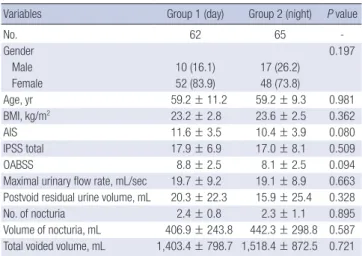
The descriptive characteristics by group are presented in Table 1. Baseline data, which included sex, age, BMI, AIS, total IPSS, and OABSS did not differ between the 2 groups. Mean nocturia before treatment of the whole cohort was 2.4 ± 1.0 episodes per night, but no difference was noted between groups 1 and 2 (2.4
± 0.8 vs. 2.3 ± 1.1; P = 0.895).
Table 1. Baseline demographic and clinical characteristics
Variables Group 1 (day) Group 2 (night) P value
No. 62 65 -
Gender 0.197
Male 10 (16.1) 17 (26.2)
Female 52 (83.9) 48 (73.8)
Age, yr 59.2 ± 11.2 59.2 ± 9.3 0.981
BMI, kg/m2 23.2 ± 2.8 23.6 ± 2.5 0.362
AIS 11.6 ± 3.5 10.4 ± 3.9 0.080
IPSS total 17.9 ± 6.9 17.0 ± 8.1 0.509
OABSS 8.8 ± 2.5 8.1 ± 2.5 0.094
Maximal urinary flow rate, mL/sec 19.7 ± 9.2 19.1 ± 8.9 0.663 Postvoid residual urine volume, mL 20.3 ± 22.3 15.9 ± 25.4 0.328
No. of nocturia 2.4 ± 0.8 2.3 ± 1.1 0.895
Volume of nocturia, mL 406.9 ± 243.8 442.3 ± 298.8 0.587 Total voided volume, mL 1,403.4 ± 798.7 1,518.4 ± 872.5 0.721 Data are shown as mean ± standard deviation or number (%).
BMI = body mass index, AIS = Athens Insomnia Scale, IPSS = International Prostate Symptom Score, OABSS = Overactive Bladder Symptom Score.
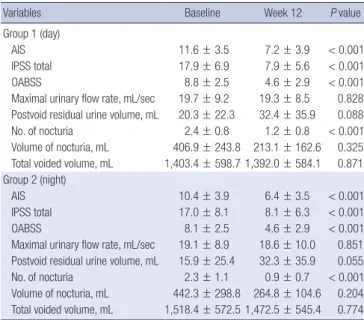
Table 2 shows changes from baseline after 12 weeks of solife
nacin in each group. Total AIS significantly improved from 11.6 at baseline to 7.2 at 12 weeks in group 1 and from 10.4 to 6.4 in group 2 (P < 0.001). The OABSS significantly improved from 8.8 at baseline to 4.6 at 12 weeks in group 1 and from 8.1 to 4.6 in group 2 (P < 0.001). Total IPSS and nocturia also significantly improved after solifenacin administration regardless of admin
istration timing (P < 0.001). Although there were no statistically significant differences, mean nocturia volume also improved from 406 mL at baseline to 213 mL after 12 weeks in group 1 (P = 0.325) and from 442 mL to 268 mL in group 2 (P = 0.204).
Postvoid residual urine volume increased from 20.3 mL at base
line to 32.4 mL at 12 weeks in group 1 and from 15.9 mL to 32.3 mL in group 2, but there were no significant differences.
Between groups, there was no statistically significant differ
ence in change of total AIS, IPSS, OABSS, and nocturia before treatment and after 12 weeks of solifenacin (Table 3). Although almost every category except residual urine improved at 12 weeks
after solifenacin administration, and there were no significant differences by administration timing. We also assessed the cor
relation between improved AIS and OABSS and decreased noc
turia. We found a correlation between AIS improvement and decreased nocturia from the patient’s record (r = 0.303; P = 0.023) and between OABSS improvement and decreased nocturia (r = 0.146; P = 0.383).
There were no cases of discontinuation because of AEs. The overall AE incidence was 13.3% (17/127). The percentages of AEs were 14.5% (9/62) and 12.3% (8/67) in groups 1 and 2, re
spectively (P = 0.797). Among the treatment groups, the inci
dence of the most common AE, dry mouth was similar for the 2 groups (11.2% in group 1 and 7.7% in group 2, P = 0.458). Con
stipation, which was mainly mild in all cohorts, occurred in 3.2%
of patients in group 1 and 4.6% of patients in group 2. The inci
dence of constipation was not statistically different between the groups (P = 0.696).
DISCUSSION
This study is the first to evaluate the influence of daytime or nighttime solifenacin dosing in patients with OAB and noctu
ria. A strict definition of nocturia was used as the inclusion cri
terion in this study; only patients with ≥ 2 episodes of nocturia were enrolled. Moreover, urgency is the main condition of OAB;
therefore, patients who also had urgency (OABSS scale 3 ≥ 2) were enrolled. As a result, our data advocated that solifenacin had the possibility to improve OAB symptoms and sleep quality of patients with sleep disruption and nocturia, which coincides with previous solifenacin clinical studies (18,19). Both nocturia and urgency are significant factors for sleep disruption. Thus, using antimuscarinic agents to improve urgency may increase bladder stability and improve sleep quality (9).
The AIS is a selfrating inventory consisting of 8 objectives (22,23). The first 5 assess difficulty falling asleep, awakening dur
ing the sleep, early morning awakening, total sleep duration, and overall sleep quality, which are representative of nocturnal AIS. The last 3 items are related to the daytime consequences of insomnia. This study also showed that AIS improvement after Table 2. Outcome measures among treatment groups
Variables Baseline Week 12 P value
Group 1 (day)
AIS 11.6 ± 3.5 7.2 ± 3.9 < 0.001
IPSS total 17.9 ± 6.9 7.9 ± 5.6 < 0.001
OABSS 8.8 ± 2.5 4.6 ± 2.9 < 0.001
Maximal urinary flow rate, mL/sec 19.7 ± 9.2 19.3 ± 8.5 0.828 Postvoid residual urine volume, mL 20.3 ± 22.3 32.4 ± 35.9 0.088
No. of nocturia 2.4 ± 0.8 1.2 ± 0.8 < 0.001
Volume of nocturia, mL 406.9 ± 243.8 213.1 ± 162.6 0.325 Total voided volume, mL 1,403.4 ± 598.7 1,392.0 ± 584.1 0.871 Group 2 (night)
AIS 10.4 ± 3.9 6.4 ± 3.5 < 0.001
IPSS total 17.0 ± 8.1 8.1 ± 6.3 < 0.001
OABSS 8.1 ± 2.5 4.6 ± 2.9 < 0.001
Maximal urinary flow rate, mL/sec 19.1 ± 8.9 18.6 ± 10.0 0.851 Postvoid residual urine volume, mL 15.9 ± 25.4 32.3 ± 35.9 0.055
No. of nocturia 2.3 ± 1.1 0.9 ± 0.7 < 0.001
Volume of nocturia, mL 442.3 ± 298.8 264.8 ± 104.6 0.204 Total voided volume, mL 1,518.4 ± 572.5 1,472.5 ± 545.4 0.774 Data are shown as mean ± standard deviation.
AIS = Athens Insomnia Scale, IPSS = International Prostate Symptom Score, OABSS = Overactive Bladder Symptom Score.
Table 3. Comparison of treatment outcomes by medication timing
Variables Group 1 Group 2 P value
AIS improvement 3.9 ± 3.3 3.9 ± 3.7 0.952
IPSS total improvement 9.1 ± 6.5 8.6 ± 8.0 0.744
OABSS improvement 4.4 ± 2.7 3.3 ± 2.7 0.060
Maximal urinary flow rate improvement, mL/sec 2.6 ± 11.4 1.5 ± 15.8 0.285
Postvoid residual urine volume decrease, mL 6.7 ± 48.9 9.2 ± 36.8 0.841
No. of nocturia improvement 1.4 ± 0.9 1.1 ± 1.2 0.413
Volume of nocturia improvement, mL 181.5 ± 116.8 170.7 ± 117.3 0.203
Total voided volume change, mL 5.94 ± 505.20 62.70 ± 408.70 0.693
Data are shown as mean ± standard deviation.
AIS = Athens Insomnia Scale, IPSS = International Prostate Symptom Score, OABSS = Overactive Bladder Symptom Score.
treatment was related to decreased nocturia. We expect that the decrease in nocturia by solifenacin may improve bladder ca
pacity and reduce contractions. Solifenacin acts as a muscarin
ic receptor antagonist. Inhibited bladder stimulation may origi
nate a decrease of drive to the brain stem. One paper reported that solifenacin significantly improves nocturnal polyuria and nocturia (24). Although no statistically significant differences were detected, the mean nocturia volume was also reduced in our study. This means that anticholinergic drug use decreases the nocturnal urine volume.
Solifenacin is an excellent drug with few AEs associated with the treatment of OAB with daytime dosing (18,19). The results from our study proved that the 24hour clinical effect of solife
nacin persisted with nighttime dosing. A significant reduction in OAB symptoms, nocturia, and sleep disturbances was achi
eved regardless of administration time. The nighttime dosing of antimuscarinic drugs may improve tolerance compared with daytime dosing (16,17). In our study, the overall incidence of AEs was 13.3%, similar between the 2 groups. Although the study populations were different, the lower AE rates in other studies suggest that, in addition to continuing 24hour efficacy, night
time dosing may further reduce the AEs related to antimusca
rinic therapy (16,25). The maximum serum solifenacin concen
tration is reached 3–8 hours after absorption from the gut (13), and the maximum concentration is likely associated with anti
cholinergic AEs. Therefore, lower AE rates related with night
time dosing may be related to the maximum serum concentra
tions being reached while the patients were sleeping.
Our study has some limitations. First, it was not a placebo
controlled study, so we could not investigate the placebo effect.
We also did not conduct urodynamics studies in our patients;
rather, we diagnosed OAB using a questionnaire. Furthermore, we could not identify the direct relationship between urgency and sleep quality. Finally, although daytime or nighttime dos
ing of the anticholinergic drug solifenacin improved OAB symp
toms and sleep disturbance, we could not know whether the small reduction in nocturia and the increase in sleep may actu
ally improve patient satisfaction or quality of life. A further study that includes more patients is needed to solve these problems.
In conclusion, our study confirmed that the improved urgen
cy and nocturia by solifenacin administration may also improve sleep quality. However, there were no significant differences by administration timing. Although there are various cau ses of noc
turia, this antimuscarinic drug may not only improve storage symptoms by decreasing urgency and nocturia but also improve sleep disruption for OAB patients with sleep disruptions.
DISCLOSURE
The authors have no potential conflicts of interest to disclose.
AUTHOR CONTRIBUTION
Conceptualization: Kwon T, Moon KH. Data curation: Kwon T, Oh TH. Formal analysis: Kwon T, Choi S, Cho WY, Min K, Lee JZ. Investigation: Kwon T, Choi S, Cho WY, Min K, Lee JZ. Su
pervision: Moon KH. Writing original draft: Kwon T. Writing review & editing: Moon KH.
ORCID
Taekmin Kwon https://orcid.org/000000032280319X Tae Hee Oh https://orcid.org/0000000332714780 Seong Choi https://orcid.org/0000000210175299 Won Yeol Cho https://orcid.org/0000000166407872 Kweonsik Min https://orcid.org/0000000291252961 Jeong Zoo Lee https://orcid.org/0000000265559724 Kyung Hyun Moon https://orcid.org/0000000259660025 REFERNECES
1. Abrams P, Cardozo L, Fall M, Griffiths D, Rosier P, Ulmsten U, Van Kerre- broeck P, Victor A, Wein A; Standardisation Sub-Committee of the Inter- national Continence Society. The standardisation of terminology in lower urinary tract function: report from the standardisation sub-committee of the International Continence Society. Urology 2003; 61: 37-49.
2. Chapple CR, Artibani W, Cardozo LD, Castro-Diaz D, Craggs M, Haab F, Khullar V, Versi E. The role of urinary urgency and its measurement in the overactive bladder symptom syndrome: current concepts and future pros- pects. BJU Int 2005; 95: 335-40.
3. van Kerrebroeck P, Abrams P, Chaikin D, Donovan J, Fonda D, Jackson S, Jennum P, Johnson T, Lose G, Mattiasson A, et al. The standardisation of terminology in nocturia: report from the Standardisation Sub-committee of the International Continence Society. Neurourol Urodyn 2002; 21: 179- 83.
4. Irwin DE, Milsom I, Kopp Z, Abrams P, Artibani W, Herschorn S. Preva- lence, severity, and symptom bother of lower urinary tract symptoms among men in the EPIC study: impact of overactive bladder. Eur Urol 2009; 56: 14-20.
5. Weiss JP, Blaivas JG, Jones M, Wang JT, Guan Z; 037 Study Group. Age re- lated pathogenesis of nocturia in patients with overactive bladder. J Urol 2007; 178: 548-51.
6. Miller M. Nocturnal polyuria in older people: pathophysiology and clini- cal implications. J Am Geriatr Soc 2000; 48: 1321-9.
7. Coyne KS, Zhou Z, Bhattacharyya SK, Thompson CL, Dhawan R, Versi E.
The prevalence of nocturia and its effect on health-related quality of life and sleep in a community sample in the USA. BJU Int 2003; 92: 948-54.
8. Kobelt G, Borgström F, Mattiasson A. Productivity, vitality and utility in a group of healthy professionally active individuals with nocturia. BJU Int 2003; 91: 190-5.
9. Tsujimura A, Takao T, Miyagawa Y, Yamamoto K, Fukuhara S, Nakayama J, Kiuchi H, Suganuma N, Nakamura T, Kumano-Go T, et al. Urgency is an independent factor for sleep disturbance in men with obstructive sleep apnea. Urology 2010; 76: 967-70.
10. Committee for Establishment of the Clinical Guidelines for Nocturia of the Neurogenic Bladder Society. Clinical guidelines for nocturia. Int J Urol 2010; 17: 397-409.
11. Andersson KE. Drug therapy of overactive bladder--what is coming next?
Korean J Urol 2015; 56: 673-9.
12. Song C, Park JT, Heo KO, Lee KS, Choo MS. Effects of bladder training and/
or tolterodine in female patients with overactive bladder syndrome: a pro- spective, randomized study. J Korean Med Sci 2006; 21: 1060-3.
13. Ikeda K, Kobayashi S, Suzuki M, Miyata K, Takeuchi M, Yamada T, Honda K. M(3) receptor antagonism by the novel antimuscarinic agent solifena- cin in the urinary bladder and salivary gland. Naunyn Schmiedebergs Arch Pharmacol 2002; 366: 97-103.
14. Chapple CR, Araño P, Bosch JL, De Ridder D, Kramer AE, Ridder AM. So- lifenacin appears effective and well tolerated in patients with symptom- atic idiopathic detrusor overactivity in a placebo- and tolterodine-con- trolled phase 2 dose-finding study. BJU Int 2004; 93: 71-7.
15. Chapple CR, Rechberger T, Al-Shukri S, Meffan P, Everaert K, Huang M, Ridder A; YM-905 Study Group. Randomized, double-blind placebo- and tolterodine-controlled trial of the once-daily antimuscarinic agent solife- nacin in patients with symptomatic overactive bladder. BJU Int 2004; 93:
303-10.
16. Rackley R, Weiss JP, Rovner ES, Wang JT, Guan Z; 037 STUDY GROUP.
Nighttime dosing with tolterodine reduces overactive bladder-related nocturnal micturitions in patients with overactive bladder and nocturia.
Urology 2006; 67: 731-6.
17. Van Kerrebroeck P, Kreder K, Jonas U, Zinner N, Wein A; Tolterodine Study Group. Tolterodine once-daily: superior efficacy and tolerability in the
treatment of the overactive bladder. Urology 2001; 57: 414-21.
18. Takao T, Tsujimura A, Yamamoto K, Fukuhara S, Nakayama J, Matsuoka Y, Miyagawa Y, Nonomura N. Solifenacin may improve sleep quality in pa- tients with overactive bladder and sleep disturbance. Urology 2011; 78:
648-52.
19. Yokoyama O, Yamaguchi O, Kakizaki H, Itoh N, Yokota T, Okada H, Ishi- zuka O, Ozono S, Gotoh M, Sugiyama T, et al. Efficacy of solifenacin on nocturia in Japanese patients with overactive bladder: impact on sleep evaluated by bladder diary. J Urol 2011; 186: 170-4.
20. Yokoyama O, Hiro S, Hotta S, Mogami S, Yamagami H. Efficacy of fesoter- odine on nocturia and quality of sleep in Asian patients with overactive bladder. Urology 2014; 83: 750-5.
21. Homma Y, Yoshida M, Seki N, Yokoyama O, Kakizaki H, Gotoh M, Yama- nishi T, Yamaguchi O, Takeda M, Nishizawa O. Symptom assessment tool for overactive bladder syndrome--overactive bladder symptom score.
Urology 2006; 68: 318-23.
22. Soldatos CR, Dikeos DG, Paparrigopoulos TJ. Athens Insomnia Scale:
validation of an instrument based on ICD-10 criteria. J Psychosom Res 2000; 48: 555-60.
23. Soldatos CR, Dikeos DG, Paparrigopoulos TJ. The diagnostic validity of the Athens Insomnia Scale. J Psychosom Res 2003; 55: 263-7.
24. Brubaker L, FitzGerald MP. Nocturnal polyuria and nocturia relief in pa- tients treated with solifenacin for overactive bladder symptoms. Int Uro- gynecol J Pelvic Floor Dysfunct 2007; 18: 737-41.
25. Malhotra BK, Crownover PH, LaBadie R, Glue P, MacDiarmid SA. The pharmacokinetic profile of fesoterodine 8 mg with daytime or nighttime dosing. Eur J Clin Pharmacol 2010; 66: 171-6.