J. Appl. Biol. Chem.50(2), 101-103 (2007)
Short Communication
Antibacterial Effects of Medicinal Plants from Jeju Island against Acne-inducing Bacteria
Sang-Suk Kim
1, Chang-Gu Hyun
2,*, Ji-Young Kim
2, Jongsung Lee
1and Deokhoon Park
1,*
1SkinCure Cosmetics Inc. JeJu Bio-Industry Development Center, JeJu 690-121, Korea
2Laboratory of Microbiology and Biotechnology, Jeju Biodiversity Research Institute (JBRI), JeJu 690-121, Korea
Received March 26, 2007; Accepted June 8, 2007
Key words: acnes, Propionibacterium acnes, Staphylococcus epidermidis
As therapeutic agents for acne, antibiotics are typically employed to inhibit inflammation or kill bacteria [Guin et al., 1979]. Triclosan, benzoyl peroxide, azelaic acid, retinoid, tetracycline, erythromycin, macrolide, and clindamycin are among these antibiotics [Breathnach et al., 1984].
However, antibiotic resistance has become increasingly prevalent within the dermatologic setting. The development
of antibiotic resistance is multifactorial, involving the specific nature of the relationship of bacteria to antibiotics, for example, how the antibacterial is used, host characteristics, and environmental factors. To overcome antibiotic resistance, medicinal plants have been studied as alternative treatments for diseases. Traditional herbal medicines provide an interesting, largely unexplored source for the development of new drugs. Indeed, the potential use of traditional herbal medicines as a basis for new skin-care cosmetics has been emphasized recently [Kiken and Cohen, 2002]. It is of great interest to know whether preparations used cosmetically in folk medicine have activities that could be useful in modern formulations.
In our efforts to find new functional ingredients for anti- acne preparations, 100 medicinal plant extracts were examined for antimicrobial activity against Propionibacterium acnes and Staphylococcus epidermidis.
An ethnobotanical survey was carried out in Jeju Island of South Korea from July to October 2005. Freshly picked plant components were air-dried at room temperature for 2 weeks with no direct sunlight. Voucher specimens were identified by Dr. G. Kim (JeJu High-Tech Industry Development Institute) and deposited in the JeJu Bio- Industry Development Center of the Jeju Hi-Tech Industry Development Institute (Jeju, South Korea). All plants used in this study were subsequently shredded and powdered. The powdered samples were then extracted with 70% (v/v) ethanol. After the sample was filtered
*Corresponding authors
Phone: +82-64-724-4992; Fax: +82-64-724-9105 E-mail: [email protected]
Phone: +82-64-720-2326; Fax: +82-64-724-2301 E-mail: [email protected]
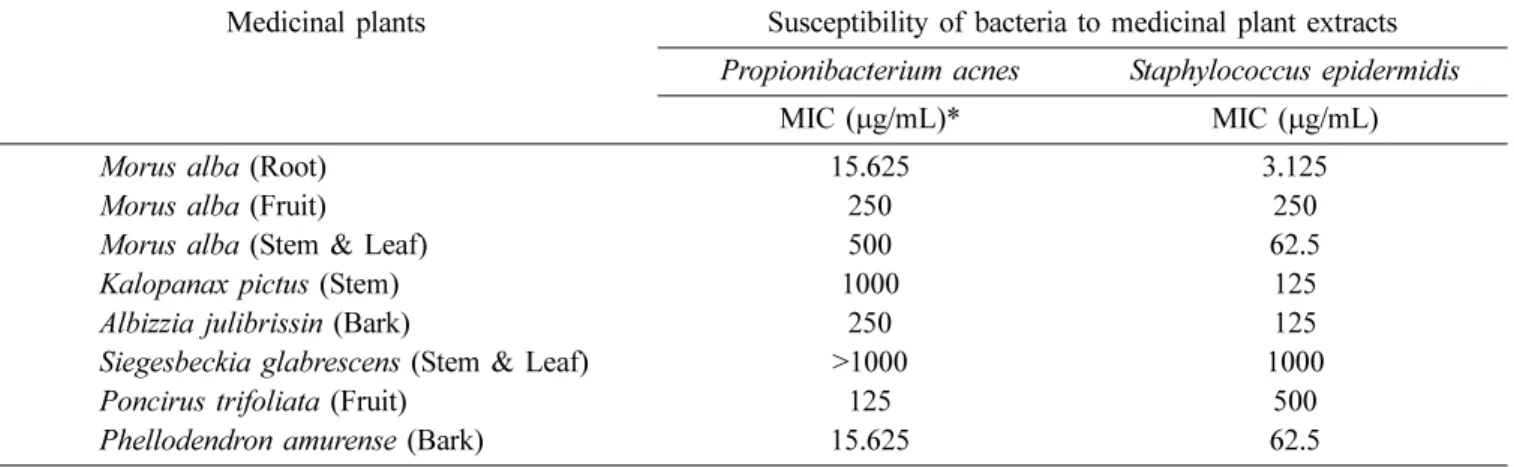
Table 1. The minimal inhibitory concentration (MIC) of Jeju medicinal plants on acne-inducing pathogenic microor- ganisms
Medicinal plants Susceptibility of bacteria to medicinal plant extracts Propionibacterium acnes Staphylococcus epidermidis
MIC (µg/mL)* MIC (µg/mL)
Morus alba (Root) 15.625 3.125
Morus alba (Fruit) 250 250
Morus alba (Stem & Leaf) 500 62.5
Kalopanax pictus (Stem) 1000 125
Albizzia julibrissin (Bark) 250 125
Siegesbeckia glabrescens (Stem & Leaf) >1000 1000
Poncirus trifoliata (Fruit) 125 500
Phellodendron amurense (Bark) 15.625 62.5
*The minimal inhibitory concentration is defined as the lowest broth concentration of 70% ethanol extract that resulted in no visible microorganism growth.
102 Sang-Suk Kim et al.
through two layers of cheesecloth, the filtered cakes were extracted and filtered three more times to increase the extraction yield. All extracts were mixed together and then filtered through Whatman No. 1 filter paper. The filtrates were concentrated under reduced pressure, freeze-dried, and stored in a closed container until used.
Two Gram-positive bacterial species that are involved in acne, P. acnes ATCC 6919 and S. epidermidis KCTC 3958, were selected as test microorganisms based on their pathological capacity. P. acnes ATCC 6919 was cultured at 37oC for 24 h in GAM broth (Nissui, Japan) under anaerobic conditions before the assay. S. epidermidis
KCTC 3958 was cultured at 37oC for 24 h with Corynebacterium media before the assay. The minimal inhibitory concentration (MIC) of each test fraction was estimated by the broth dilution method. The MIC was taken as the lowest volatile fraction concentration that prevented visible bacterial growth after 24 h incubation at 37oC.
The in vitro antibacterial activity of Jeju medicinal plants against P. acnes and S. epidermidis was assessed by the presence or absence of inhibition zones and by MIC values. As seen in Table 1, the plant extracts exhibited notable antibacterial activity against P. acnes Fig. 1. Cytotoxicity of Jeju medicinal plants against normal human fibroblasts (A) and HaCaT cells (B). Human der- mal fibroblast cells were cultured in DMEM (Hyclone) containing 10% fetal bovine serum and penicillin-streptomycin at 37oC in a humidified 95% air: 5% CO2 atmosphere. Cells were seeded on 24-well plates and sample treatment was initi- ated 24 h after seeding. General viability of cultured cells was determined by the reduction of MTT to formazan. The MTT assay was performed after incubation of normal fibroblast cells with various concentrations of plant extracts for 24 h at 37oC in 5% CO2 atmosphere. MTT (1 mg/mL in phosphate-buffered saline) was added to each well in a 1/10 volume of media. Cells were incubated at 37oC for 3 h, and dimethylsulfoxide (DMSO) was added to dissolve the formazan crystals.
The absorbance was then measured at 570 nm using a spectrophotometer (Power Wave, Bio-tek Inc., VT, USA). The entire experiment was performed in triplicate, and the results were confirmed by three independent experiments.
Anti-acne Effects of Jeju Medicinal Plants 103 and S. epidermidis. The lowest MIC values against P.
acnes and S. epidermidis were produced by the Morus alba extract (15.6µg/mL and 3.1µg/mL, respectively).
Extracts from Phellodendron amurense, Albizzia julibrissin, and Poncirus trifoliate also produced remarkably low MIC values against both pathogens. On the other hand, Siegesbeckia glabrescens exhibited very weak activities.
However, despite their promising antibacterial effects against these acne-inducing bacteria, the extracts could have cytotoxic effects on human skin cells when applied as a therapeutic agent for acne. If so, they would not be suitable therapeutic agents [Park et al., 2004]. To examine the cytotoxic effects of selected medicinal plants, MTT assays were performed in both normal human fibroblasts and HaCaT cells [Mosmann, 1983]. All plant extracts displayed relatively low cytotoxicity, with cell viabilities above 80% at a concentration of 10µg/mL (Fig. 1).
In conclusion, this work furthers our knowledge of the medicinal plants of Jeju Island and provides compelling evidence for the rational exploration of indigenous medicinal plants as a source of skin-care materials. Considering that most regional plants have not been investigated chemically or pharmacologically, they remain an untapped source of potential skin-care materials. Further investigations will focus on the in vivo assessment of the biological activity
of these plant extracts and on the chemical identification of the major active components responsible for antibacterial activity in the efficacious extracts.
Acknowledgments. This research was supported by the Regional Technology Innovation Program (RTI04-02-07) from the Ministry of Commerce Industry and Energy of the Korean Government.
References
Breathnach AS, Nazzaro-Porro M, and Passi S (1984) Aze- laic acid. Br. J. Dermatol. 111, 115-120.
Guin J, Huber D, and Gielerak P (1979) Antibiotic sensitiv- ity of comedonal Propionibacterium acne. Acta Derm.- Venereol. 59, 552-554.
Kiken DA and Cohen DE (2002) Contact dermatitis to botanical extracts. Am. J. Contact Dermat. 13, 148-152.
Mosmann T (1983) Rapid colorimetric assay for cellular growth and survival: application to proliferation and cytotoxicity assays. J. Immunol. Methods. 65, 55-63.
Park J, Lee J, Jung E, Park Y, Kim K, Park B, Jung K, Park E, Kim J, and Park D (2004) In vitro antibacterial and anti-inflammatory effects of honokiol and magnolol against Propionibacterium sp. Eur. J. Pharmacol. 496, 189-195.