서 론
자궁경부암은 여성에서 두 번째로 흔한 암으로 특히 개발 도상국에서는 가장 흔한 암으로 알려져 있다.1 초기의 자궁 경부암에서는 광범위 자궁절제술이나 방사선치료로 완치를 기대할 수 있으나 종양의 크기가 크거나 국소적으로 진행된 병기에서는 예후가 나쁜 것으로 보고되고 있다.2-6 이들 종양 의 예후를 향상시키기 위해 새로운 치료법으로써 화학방사 선 병합요법이나 선행보조 화학요법이 시도되고 있다.4 선행보조 화학요법의 효과에 대해서는 아직 이견이 있으 나, 많은 연구자들이 국소적으로 진행된 자궁경부암에서 효과적이라고 보고하였다.6-12 최근에 보고된 meta-analysis
에 의하면 선행보조 화학요법 후 수술을 시행한 경우가 방 사선 단독치료에 비해 14%의 생존율 향상을 가져왔다고 보고하였다.13
선행보조 화학요법의 장점으로는 미세 전이를 미리 조 절할 수 있고 종양에 대한 혈액 공급이 원활하고 저항성이 없는 상태에서 항암제를 투여함으로써 효과를 높일 수 있 으며 환자의 전신상태가 양호한 시기에 치료함으로써 심 각한 독성이 발생할 가능성을 줄일 수 있다는 데 있다.
Cisplatin은 자궁경부암에서 가장 효과적인 약물로 알려 져 있고, 또한 선행보조 화학요법에서도 효과적으로 사용 될 수 있다고 보고되고 있다.14-16 Vincristine, bleomycin, mitomycin-C과 cisplatin의 병합요법이 자궁경부암의 선행 보조 화학요법으로 보고된 바 있고, MVC (mitomycin-C, vincristine and cisplatin) 병합요법의 골반동맥주사(pelvic intra- arterial infusion)가 bulky IIb의 자궁경부암에서 효과 적이었다고 보고되었다.17-19
본 연구는 병기가 Ib에서 IIb까지인 자궁경부암 환자(Ib,
국소적으로 진행된 자궁경부암 환자에서 선행보조 화학요법 (Mitomycin-C, Vincristine, Cisplatin) 의 효과
성균관대학교 의과대학 삼성서울병원 산부인과 최철훈․김태중․이정원․김병기․이제호․배덕수
목적:국소적으로 진행된 자궁경부암에서 선행보조 화학요법으로써 MVC (mitomycin-C, vincristine, cisplatin) 병합요 법의 효과를 알아보고자 하였다.
연구 방법:46명의 환자를 대상으로 하였고 mitomycin-C 10 mg/m2, vincristine 1 mg/m2, cisplatin 75 mg/m2을 3주 간 격으로 정맥투여하였다. 3주기의 항암요법 후 수술가능 여부에 따라 수술이나 방사선치료가 계획되었다.
결과:임상적 완전 관해 23.9%와 조직학적 완전 관해 13.0%를 포함하여 82.6%의 환자에서 임상적으로 반응을 보였 다. 모든 대상환자에서 항암요법 후 수술이 가능하였으며 항암요법의 가장 흔한 부작용으로는 Grade 1이나 2의 오심 과 구토증상이었다(86.8%). 28개월의 중간 추적 관찰기간에 3년 무병생존율과 전체생존율은 각각 74.0%와 80.0%이었 다. 초기의 종양 크기, 병리조직검사에서의 림프절 전이, 자궁방 침범 등이 무병생존율과 유의한 상관관계를 나타내었 다(p=0.001, p=0.040, p=0.000, respectively). 수술 후 위험인자가 없는 경우에 시행한 보조방사선치료는 생존율의 향상을 가져오지 않았고 결과적으로 26명(56.5%)의 환자는 방사선치료 없이 치료를 종결할 수 있었던 환자였다.
결론:국소적으로 진행되었거나 bulky한 자궁경부암에서 선행보조 화학요법으로써의 MVC 병합요법은 심각한 부작 용 없이 투여될 수 있으며 종양의 범위를 감소시켜 수술을 가능하게 하는데 효과적이었다.
중심단어:선행보조 화학요법, Mitomycin-C, Vincristine, Cisplatin, 자궁경부암
논문접수일:2006년 2월 1일 채택일:2006년 2월 10일 교신저자:배덕수, 135-710 서울시 강남구 일원동 50번지
삼성서울병원 산부인과
전화 02) 3410-3511․전송 02) 3410-0630 E-mail:[email protected]
IIa인 경우는 종양의 크기가 4 cm 이상인 경우)에게 mito- mycin-C, vincristine과 cisplatin을 병합한 선행보조 화학요 법을 정맥투여하였고 그 효과를 알아보고자 하였다.
연구 대상 및 방법
1. 연구 대상
1995년부터 2004년까지 삼성서울병원에서 자궁경부암 으로 진단받고 선행보조 화학요법을 시행받은 환자를 대 상으로 하였다. 선행보조 화학요법의 선정기준은 과거에 자궁경부암에 대한 치료를 받은 경험이 없는 침윤성 자궁 경부암 환자로 병리조직검사상 자궁경부암(FIGO stage Ib-IIb)으로 확진된 46명을 포함하였다. Stage Ib-IIa의 경우 종양의 크기가 4 cm 이상인 경우로 제한하였다. 보다 구체 적인 기준으로 75세 이하, Eastern Cooperative Oncology Group (ECOG) performance status≤2, 백혈구수≥3.5×10⁹/L, 혈소판수≥100×109/L, 간기능 및 신장기능 검사에서 정상 소견을 보인 환자를 대상으로 하였고, 과거에 암으로 진단 받고 항암요법이나 방사선치료의 기왕력이 있거나 심장질 환 등의 내과적인 문제가 있는 환자는 제외하였다.
2. 치료 계획
사용된 항암제의 용량은 vincristine 1 mg/m2, mitomycin-C 10 mg/m2과 생리 식염수 150 ml에 혼합된 cisplatin 75 mg/m2이었다. 충분한 수액 공급과 vincristine, mitomycin-C 의 주사 후에 1시간에 걸쳐 cisplatin을 정맥투여하였다. 항 암제 투여 후 1,500 ml의 포도당 생리식염수로 수액을 공급 하였다. 중성구수가 1.0×10⁹/L 이하이거나 혈소판수가 100
×109/L 이하일 경우 항암치료는 연기하였다. 선행보조 화 학요법은 3주 간격으로 3회 투여하였다.
항암요법 후 부인과적 진찰에서 자궁방 침범이 의심되 지 않은 경우 마지막 항암투여 3주 이내에 광범위 자궁절 제술을 시행하였고, 그렇지 않은 경우 방사선치료가 계획 되었다. 수술 후 림프절 전이, 절단면 양성, 자궁방 침범이 발견되었을 경우에는 보조방사선치료를 추가하였고, 위의 위험인자가 없는 경우에는 환자의 치료요구에 따라 방사 선치료가 시행되었다.
3. 환자 평가
치료 전 종양의 크기와 병기 결정을 위하여 병력, 이학적
및 부인과적 골반진찰, 병리조직학적 검사, 신우조영술, 방 광경 검사, 직작경 검사, CT scan이나 MRI 촬영을 시행하 였다. 일반 혈액검사와 간기능 및 신기능 검사 등을 매 항 암투여 전에 시행하여 부작용을 평가하였다.
항암화학요법에 대한 반응정도는 3번째 항암화학요법이 끝난 후 2주째에 골반의 이학적 검사와 MRI 검사를 통해 얻은 치료 전후의 장경의 길이와 이에 수직인 최장경의 길 이의 변화를 비교하여 판정하였다. 반응정도는 WHO 기준 을 사용하였으며 4주 이상 간격으로 두 번 측정 시 육안적 으로 병변이 소실되는 경우를 완전 관해(complete remis- sion; CR), 병변의 면적이 50% 이상 감소되는 경우를 부분 관해(partial remission; PR), 병변의 면적이 50% 이하의 변화 를 보이는 경우를 안정 군(stable disease; SD), 25% 이상 증 가하거나 새로운 병변이 출현한 경우를 진행병변(pro- gressive disease; PD)으로 정하였다. 항암화학요법 후 수술 을 시행받은 환자에서는 반응률을 병리학적으로 확인하였 으며 병리학적 완전 관해는 자궁경부에 침윤성 종괴가 없 고 림프절 전이가 없는 경우로 정의하였다. 부작용은 WHO 기준에 의해 평가하였다.
4. 통계분석
범주 변수의 통계 분석은 chi-square 혹은 Fisher’s exact test로 시행되었다. 생존율 곡선은 Kaplan-Meier 방법으로 구하였고, 여러 인자에 따른 반응기간과 생존곡선 간의 차 이는 log-rank test를 사용하여 비교하였다.20
결 과
1995년부터 2004년까지 46명의 환자가 연구 대상이 되 었으며 모든 환자가 3회의 항암 요법을 모두 마칠 수 있었 다. 환자의 주요 특징은 Table 1과 같다. 평균 연령은 46세 (range, 29-74세)였고 15명(32.6%)의 환자는 임상병기 IIb이 었다. 수술 후 위험인자가 없었던 환자 중 방사선치료를 받은 군과 받지 않은 군 간에 환자 특징의 차이는 없었다.
모든 대상환자에서 수술이 가능하였으며 13명(28.3%)의 환 자는 광범위 자궁절제술과 골반 림프절 절제술만으로 치 료가 종결되었다. 33명의 환자는 수술 후에 보조방사선치 료를 받았으며 이들 중 20명은 위험인자를 가지고 있었으 며 13명은 위험인자가 없었으나 환자의 요구에 의해 보조 방사선치료를 시행하였다.
1. 반응률
임상적인 완전 관해 11예(23.9%), 조직학적인 완전 관해 6예(13.0%), 임상적인 부분 관해 27예(58.7%)를 포함하여 82.6%에서 임상적인 반응을 보였다(Table 2). MRI 검사로 평가한 림프절 전이와 자궁방 침범의 반응률은 각각 28.6%
(6/21)와 76.5% (13/17)이었다.
2. 생존율
임상양상에 따른 무병생존율과 전체생존율은 Table 2와 같다. 28개월(range, 3-107개월)의 중간 추적 관찰기간에 3년 생존율과 무병생존율은 각각 80%와 74%였다. 반응률, 조직
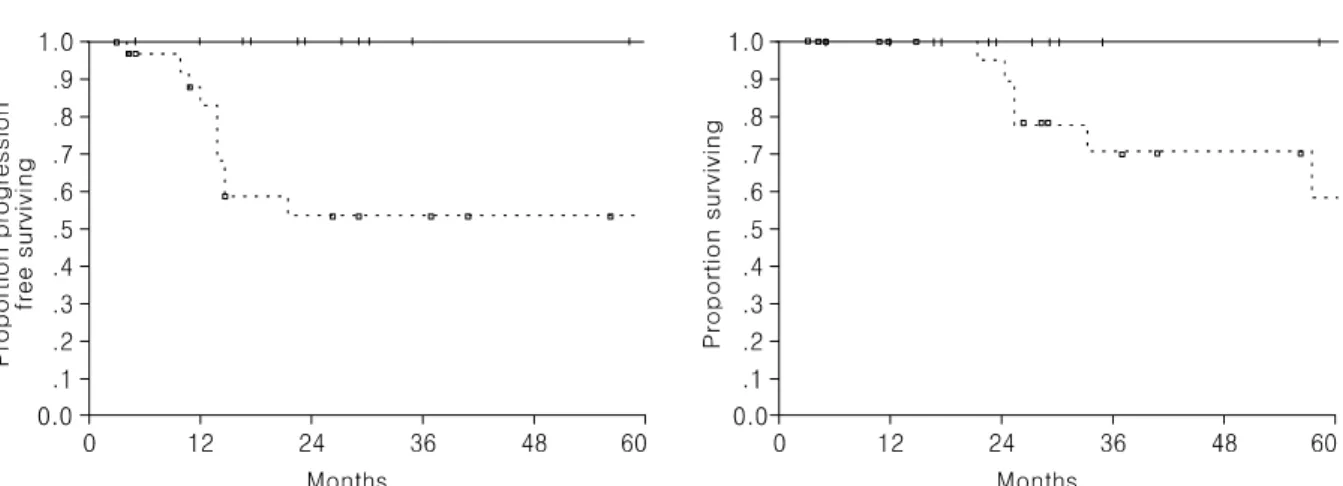
학적 분포와 임상병기에 따른 생존율의 차이는 없었다. 종 양의 면적이 16 cm2 보다 작은 경우에 증가된 3년 무명생존 율과 전체생존율을 보였다(100% vs. 53%, 100% vs. 70%, re- spectively)(Table 2, Fig. 1). 조직병리소견에서 림프절 전이 를 보이거나 자궁방 침범을 보인 경우 짧은 무병생존율을 Table 1. Characteristics of patients
ꠏꠏꠏꠏꠏꠏꠏꠏꠏꠏꠏꠏꠏꠏꠏꠏꠏꠏꠏꠏꠏꠏꠏꠏꠏꠏꠏꠏꠏꠏꠏꠏꠏꠏꠏꠏꠏꠏꠏꠏꠏꠏꠏꠏꠏꠏꠏꠏꠏꠏꠏꠏꠏ 26 patients without risk factors postoperatively*
Total patients
Characteristics ꠏꠏꠏꠏꠏꠏꠏꠏꠏꠏꠏꠏꠏꠏꠏꠏꠏꠏꠏꠏꠏꠏꠏꠏꠏꠏ n=46 Adj RT (+) Adj RT (-) p
(n=13) (n=13) value ꠏꠏꠏꠏꠏꠏꠏꠏꠏꠏꠏꠏꠏꠏꠏꠏꠏꠏꠏꠏꠏꠏꠏꠏꠏꠏꠏꠏꠏꠏꠏꠏꠏꠏꠏꠏꠏꠏꠏꠏꠏꠏꠏꠏꠏꠏꠏꠏꠏꠏꠏꠏꠏ Age (years)
Median 46 48 48 0.650
Range 29-74 29-60 32-70
Histologic type Squamous cell
42 (91.3%) 12 (92.3%) 13 (100%)
carcinoma 1.000
Other cell types 4 (8.7%) 1 (7.7%) 0 (0%) FIGO Stage
Ib2 21 (45.7%) 5 (38.5%) 9 (69.2%) IIa 10 (21.7%) 2 (15.4%) 2 (15.4%) 0.208 IIb 15 (32.6%) 6 (46.2%) 2 (15.4%) Performance status
0 43 (93.5%) 12 (92.3%) 13 (100%) 1.000 1 3 (6.5%) 1 (7.7%) 0 (0%) Tumor size (cm2)†
≥16 27 (58.7%) 5 (38.5%) 6 (46.2%) 0.695 <16 19 (41.3%) 8 (61.5%) 7 (53.8%) Lymph node metastasis‡
Present 21 (45.7%) 4 (30.8%) 7 (53.8%) 0.428 Absent 25 (54.3%) 9 (69.2%) 6 (46.2%) PM involvement‡
Present 17 (37.0%) 5 (38.5%) 5 (3.8.5%) 1.000 Absent 29 (63.0%) 8 (61.5%) 8 (61.5%) ꠏꠏꠏꠏꠏꠏꠏꠏꠏꠏꠏꠏꠏꠏꠏꠏꠏꠏꠏꠏꠏꠏꠏꠏꠏꠏꠏꠏꠏꠏꠏꠏꠏꠏꠏꠏꠏꠏꠏꠏꠏꠏꠏꠏꠏꠏꠏꠏꠏꠏꠏꠏꠏ Adj RT; postoperative adjuvant radiation
*Patients with no evidence of parametrial involvement, lymph node metastasis or surgical margin involvement, postoperatively, †Multi- plication of longest diameter by the greatest perpendicular diameter,
‡Pretreatment MRI findings
Table 2. Overall survival and disease free survival according to prognostic variables with a median follow up of 28 months (range, 3 months to 107 months) ꠏꠏꠏꠏꠏꠏꠏꠏꠏꠏꠏꠏꠏꠏꠏꠏꠏꠏꠏꠏꠏꠏꠏꠏꠏꠏꠏꠏꠏꠏꠏꠏꠏꠏꠏꠏꠏꠏꠏꠏꠏꠏꠏꠏꠏꠏꠏꠏꠏꠏꠏꠏꠏ
Overall Disease free survival survival Variables No (%) ꠏꠏꠏꠏꠏꠏꠏꠏꠏꠏꠏꠏꠏꠏꠏꠏꠏꠏꠏꠏꠏꠏꠏ
3YSR p 3YDFS p
(%) value (%) value ꠏꠏꠏꠏꠏꠏꠏꠏꠏꠏꠏꠏꠏꠏꠏꠏꠏꠏꠏꠏꠏꠏꠏꠏꠏꠏꠏꠏꠏꠏꠏꠏꠏꠏꠏꠏꠏꠏꠏꠏꠏꠏꠏꠏꠏꠏꠏꠏꠏꠏꠏꠏꠏ
Total 46 80 74
Clinical Response
CR 11 (23.9%) 100 90
PR 27 (58.7%) 77 0.320 69 0.875
SD/PD 8 (17.4%) 69 74
Pathologic Response
CR 6 (13.0%) 100 100
0.285 0.188
Residual disease 40 (87.0%) 79 70 Histology
Squamous cell 42 86 76
carcinoma 0.478 0.093
Adenocarcinoma 4 50 50
FIGO stage
Ib2 21 91 81
IIa 10 83 0.478 67 0.531
IIb 15 75 69
Tumor size (cm2)*
≥16 27 70 53
0.025 0.001
<16 19 100 100
LN metastasis†
Present 16 (34.8%) 64 57
0.185 0.040
Absent 30 (65.2%) 90 83
Parametrial involvement†
Present 7 (15.2%) 67 29
0.051 0.000
Absent 39 (84.8%) 88 84
Adjuvant treatment‡
Adjuvant RT done 13 89 90
0.378 0.970
Adjuvant RT not done 13 100 90 ꠏꠏꠏꠏꠏꠏꠏꠏꠏꠏꠏꠏꠏꠏꠏꠏꠏꠏꠏꠏꠏꠏꠏꠏꠏꠏꠏꠏꠏꠏꠏꠏꠏꠏꠏꠏꠏꠏꠏꠏꠏꠏꠏꠏꠏꠏꠏꠏꠏꠏꠏꠏꠏ 3YSR; three-year survival rate, 3YDFS; three-year disease free survival, CR; complete response, PR; partial response, SD; stable disease, PD; progressive disease, RT; radiotherapy
*Multiplication of longest diameter by the greatest perpendicular diameter, †Findings in surgical specimen, ‡26 patients with no evidence of parametrial involvement, lymph node metastasis or surgical margin involvement, postoperatively
나타내었다(p=0.040, p=0.000, respectively)(Table 2, Fig. 2).
위험인자가 없었던 경우 보조방사선치료의 여부가 생존율 의 향상에 영향을 주지는 못하였다(Table 2).
3. 부작용
WHO 기준에 의한 부작용은 Table 3과 같다. 가장 흔한 비 혈액학적 부작용은 Grade 1 또는 2의 오심 또는 구토 증상이었고 단지 2.9%에서만 Grade 3 이상의 정도를 나타 내었다. 가장 흔한 혈액학적 부작용은 빈혈이었으나 그 정 도는 모두 Grade 1-2이었다. Grade 3 또는 4의 중성구감소 증과 혈소판감소증은 각각 11.0%와 1.5%에서 관찰되었다.
Grade 2 이상의 신독성과 신경독성은 없었으며 치료와 관 련된 사망은 없었다.
고 찰
국소적으로 진행된 자궁경부암이나 bulky cervical cancer 에서 여러 종류의 항암제가 선행보조 화학요법으로 사용 되어 왔다.21-24 그 중 MVC 병합요법은 골반동맥 내로 투여 하였던 연구가 보고된 바가 있다.19 본 연구는 stage Ib2-IIb bulky cervical cancer에서 선행보조 화학요법으로써 정맥 내로 투여한 MVC 병합요법의 효과를 연구하고자 하였다.
82.6%의 환자에서 임상적인 반응을 보였으며 조직학적 완전 관해는 13.0%에서 관찰할 수 있었다(Table 2). 국소적 으로 진행된 자궁경부암에서 선행보조 화학요법의 반응률 은 53.0%에서 94.4% 사이로 보고되었고 본 연구결과도 비 슷한 결과를 보였다.4,7-9,18,22,23,25,26
Fig. 2. Disease-free survival curves of patients according to the postoperative pathologic status. (A) According to with (- - -) or without (---) lymph node metastasis (p=0.040). (B) According to with (- - -) or without (---) parametrial involvement (p=0.000).
Fig. 1. Disease-free and overall survival curves of patients according to the pretreatment tumor size. Patients with tumor size of <16 cm2 (---) and tumor size of ≥16 cm2 (- - -). (A) Disease-free survival curve (p=0.001). (B) Overall survival curve (p=0.025).
본 연구결과는 동일한 약제와 용량을 골반동맥 내로 투 여한 과거의 연구에 비해 다소 낮은 반응률을 보였다.19 그 들의 결과에 따르면 임상적 그리고 조직학적 완전 관해는 각각 92.3%와 46.2%에서 관찰되었다. 환자특성의 차이와 약물투여 방법의 차이가 서로 다른 결과의 원인이 될 수 있을 것으로 보인다. 당시 연구에서는 MRI 검사에서 림프 절 전이가 없고 종양의 크기가 4 cm 이상인 stage IIb 환자 만을 대상으로 하였다. 본 연구에서는 6명이 위의 조건과 부합하는 환자였으며 이들의 조직학적 완전 관해율은 33.3%로 13.0%에 비해 높은 결과를 보였다.
자궁경부암은 국소적으로 성장하는 종양이므로 종양에 국한된 동맥투여방법이 전신적인 정맥투여방법에 비해 높 은 치료반응을 보일 수 있다고 보고되었다.27,28 그러나 진행 성인 종양인 경우에는 림프절을 포함한 원격 전이가 있는 경우가 있어 이들 전이부위의 종양이 국소적인 동맥투여 방법만으로 효과를 볼 수 있는지는 의심스럽다.29 본 연구 에서는 위와 같은 상황을 고려하여 전신적인 정맥투여방 법을 사용하였음에도 불구하고 림프절 전이의 반응률은 28.6%로 낮게 관찰되었다. 따라서 림프절 전이의 가능성이 높은 환자들은 선행보조 화학요법의 좋은 대상군이 되지 못할 것으로 보인다.
조기의 자궁경부암에서 림프절 전이, 자궁방 침범, 절단 면 양성의 소견이 보일 경우 재발이 흔하고 5년 생존율이 50-70%로 떨어진다고 보고되고 있다.30-32 또한 많은 보고들 에서 종양의 크기가 자궁경부암의 독립적인 예후인자라고
하였다.30,32,33 본 연구결과는 이들 위험인자가 선행보조 화
학요법을 받은 환자들에게도 중요한 예후인자가 된다는
것을 보여준다(Table 2, Fig. 1, 2).
최근의 meta-analysis에 의하면 선행보조 화학요법 후 방 사선치료를 시행하는 경우에 방사선단독치료에 비해 생존 율의 향상을 보이지 않았으나 수술적 치료를 시행한 경우 에는 생존율의 향상을 보였다.13 따라서 선행보조 화학요법 후 수술의 가능여부가 중요한 예후인자가 될 수 있을 것이 고 본 연구에서는 모든 대상환자에서 수술이 가능하였다.
선행보조 화학요법 후 수술을 시행한 군에서 위험인자가 발견되지 않았을 경우 보조방사선치료의 필요성에 대해서 는 일치된 의견이 없는 상황이다. 본 연구에서는 위험인자 가 없는 26명의 환자 중에서 보조방사선치료의 시행여부 에 따라 생존율을 차이를 보이지 않았다(Table 2). 양 군 간 에 randomization이 되지 않았고 대상환자의 수도 적었지만 본 연구결과에 따르면 선행보조 화학요법과 수술치료를 받 은 환자에서 병리조직학적 소견에서 위험인자가 없는 경우 에는 보조방사선치료가 불필요할 것으로 생각되며 본 연구 에서는 26명(56.5%)의 환자에서 방사선치료 없이 치료를 종결할 수 있었을 것이다. 따라서 일반적으로 방사선치료 가 요구되는 bulky cervical cancer에서 난소기능과 성기능이 상대적으로 중요한 젊은 나이의 환자에게는 선행보조 화학 요법이 좋은 치료전략이 될 수 있을 것으로 생각된다.
동일한 약물과 용량을 골반동맥에 직접 투여하였던 과 거의 연구에서는 Grade 3 이상의 혈액학적 부작용이 없었 으나 본 연구에서는 Grade 3 이상의 중성구감소증과 혈소 판감소증이 각각 11.0%, 1.5%에서 관찰되었다.19 그러나 모 든 환자에서 보존적 치료만으로 회복 가능하였다.
본 연구의 제한점으로는 수술 후 위험인자가 없는 환자 Table 3. Toxicities according to the WHO criteria
ꠏꠏꠏꠏꠏꠏꠏꠏꠏꠏꠏꠏꠏꠏꠏꠏꠏꠏꠏꠏꠏꠏꠏꠏꠏꠏꠏꠏꠏꠏꠏꠏꠏꠏꠏꠏꠏꠏꠏꠏꠏꠏꠏꠏꠏꠏꠏꠏꠏꠏꠏꠏꠏꠏꠏꠏꠏꠏꠏꠏꠏꠏꠏꠏꠏꠏꠏꠏꠏꠏꠏꠏꠏꠏꠏꠏꠏꠏꠏꠏꠏꠏꠏꠏꠏꠏꠏꠏꠏꠏꠏꠏꠏꠏꠏꠏꠏꠏꠏꠏꠏꠏꠏꠏꠏꠏꠏꠏꠏꠏꠏꠏ No. of cycles (%)
Affected Grade Toxicity
ꠏꠏꠏꠏꠏꠏꠏꠏꠏꠏꠏꠏꠏꠏꠏꠏꠏꠏꠏꠏꠏꠏꠏꠏꠏꠏꠏꠏꠏꠏꠏꠏꠏꠏꠏꠏꠏꠏꠏꠏꠏꠏꠏꠏꠏꠏꠏꠏꠏꠏꠏꠏꠏꠏꠏꠏꠏꠏꠏꠏꠏꠏꠏꠏꠏꠏꠏꠏꠏꠏꠏꠏꠏꠏꠏꠏꠏꠏꠏꠏꠏꠏꠏꠏꠏꠏ
0 1 2 3 4
ꠏꠏꠏꠏꠏꠏꠏꠏꠏꠏꠏꠏꠏꠏꠏꠏꠏꠏꠏꠏꠏꠏꠏꠏꠏꠏꠏꠏꠏꠏꠏꠏꠏꠏꠏꠏꠏꠏꠏꠏꠏꠏꠏꠏꠏꠏꠏꠏꠏꠏꠏꠏꠏꠏꠏꠏꠏꠏꠏꠏꠏꠏꠏꠏꠏꠏꠏꠏꠏꠏꠏꠏꠏꠏꠏꠏꠏꠏꠏꠏꠏꠏꠏꠏꠏꠏꠏꠏꠏꠏꠏꠏꠏꠏꠏꠏꠏꠏꠏꠏꠏꠏꠏꠏꠏꠏꠏꠏꠏꠏꠏꠏ
Anemia 55 (40.4) 56 (41.2) 25 (18.4) 0 (0.0) 0 (0.0)
Granulocytopenia 73 (53.7) 25 (18.4) 23 (16.9) 12 (8.8) 3 (2.2)
Thrombocytopenia 128 (94.1) 5 (3.7) 1 (0.7) 1 (0.7) 1 (0.7)
SGOT/SGTP 131 (96.3) 4 (2.9) 1 (0.7) 0 (0.0) 0 (0.0)
Nausea/Vomiting 14 (10.3) 68 (50.0) 50 (36.8) 4 (2.9) 0 (0.0)
BUN/Creatinine 135 (99.3) 1 (0.7) 0 (0.0) 0 (0.0) 0 (0.0)
Alopecia 123 (90.4) 7 (5.1) 6 (4.4) 0 (0.0) 0 (0.0)
Peripheral neuropathy 132 (97.1) 4 (2.9) 0 (0.0) 0 (0.0) 0 (0.0)
ꠏꠏꠏꠏꠏꠏꠏꠏꠏꠏꠏꠏꠏꠏꠏꠏꠏꠏꠏꠏꠏꠏꠏꠏꠏꠏꠏꠏꠏꠏꠏꠏꠏꠏꠏꠏꠏꠏꠏꠏꠏꠏꠏꠏꠏꠏꠏꠏꠏꠏꠏꠏꠏꠏꠏꠏꠏꠏꠏꠏꠏꠏꠏꠏꠏꠏꠏꠏꠏꠏꠏꠏꠏꠏꠏꠏꠏꠏꠏꠏꠏꠏꠏꠏꠏꠏꠏꠏꠏꠏꠏꠏꠏꠏꠏꠏꠏꠏꠏꠏꠏꠏꠏꠏꠏꠏꠏꠏꠏꠏꠏꠏ
에서 방사선치료를 받은 군과 받지 않은 군 간에 randomi- zation이 이루어지지 않았고 이 치우침(bias)이 결과에 영향 을 주었을 가능성이 있다는 점이다.
결론적으로 국소적으로 진행되었거나 bulky한 자궁경부 암에서 선행보조 화학요법으로써의 MVC 병합요법은 심 각한 부작용 없이 투여될 수 있으며 종양의 범위를 감소시 켜 수술을 가능하게 하는 데 효과적이었다.
참고문헌
1. Parkin DM, Pisani P, Ferlay J. Estimates of the worldwide incidence of eighteen major cancers in 1985. Int J Cancer 1993; 54: 594-606.
2. Piver MS, Chung WS. Prognostic significance of cervical lesion size and pelvic node metastases in cervical carcinoma.
Obstet Gynecol 1975; 46: 507-10.
3. Inoue T. Prognostic significance of the depth of invasion relating to nodal metastases, parametrial extension, and cell types. A study of 628 cases with Stage IB, IIA, and IIB cervical carcinoma. Cancer 1984; 54: 3035-42.
4. Sardi J, Sananes C, Giaroli A, Bayo J, Rueda NG, Vighi S, et al. Results of a prospective randomized trial with neoad- juvant chemotherapy in stage IB, bulky, squamous carcinoma of the cervix. Gynecol Oncol 1993; 49: 156-65.
5. Thomas GM. Improved treatment for cervical cancer--concur- rent chemotherapy and radiotherapy. N Engl J Med 1999; 340:
1198-200.
6. Benedetti Panici P, Scambia G, Greggi S, Di Roberto P, Baiocchi G, Mancuso S. Neoadjuvant chemotherapy and radical surgery in locally advanced cervical carcinoma: A pilot study. Obstet Gynecol 1988; 71: 344-8.
7. Kim DS, Moon H, Kim KT, Hwang YY, Cho SH, Kim SR.
Two-year survival: Preoperative adjuvant chemotherapy in the treatment of cervical cancer stages Ib and II with bulky tumor.
Gynecol Oncol 1989; 33: 225-30.
8. Kirsten F, Atkinson KH, Coppleson JV, Elliott PM, Green D, Houghton R, et al. Combination chemotherapy followed by surgery or radiotherapy in patients with locally advanced cervical cancer. Br J Obstet Gynaecol 1987; 94: 583-8.
9. Friedlander ML, Atkinson K, Coppleson JV, Elliot P, Green D, Houghton R, et al. The integration of chemotherapy into the management of locally advanced cervical cancer: A pilot study. Gynecol Oncol 1984; 19: 1-7.
10. Cervellino JC, Araujo CE, Sanchez O, Miles H, Nishihama A. Cisplatin and ifosfamide in patients with advanced squa- mous cell carcinoma of the uterine cervix. A phase II trial.
Acta Oncol 1995; 34: 257-9.
11. Pignata S, Silvestro G, Ferrari E, Selvaggi L, Perrone F, Maffeo A, et al. Phase II study of cisplatin and vinorelbine as first-line chemotherapy in patients with carcinoma of the
uterine cervix. J Clin Oncol 1999; 17: 756-60.
12. Serur E, Mathews RP, Gates J, Levine P, Maiman M, Remy JC. Neoadjuvant chemotherapy in stage IB2 squamous cell carcinoma of the cervix. Gynecol Oncol 1997; 65: 348-56.
13. Tierney J. Neoadjuvant chemotherapy for locally advanced cervical cancer: A systematic review and meta-analysis of individual patient data from 21 randomised trials. Eur J Can- cer 2003; 39: 2470-86.
14. Lahousen M, Pickel H, Haas J. Adjuvant chemotherapy after radical hysterectomy for cervical cancer. Baillieres Clin Obstet Gynaecol 1988; 2: 1049-57.
15. Grigsby PW. Cervical cancer: Combined modality therapy.
Cancer J 2001; 7(Suppl 1): S47-50.
16. Giardina G, Richiardi G, Danese S, Ottone P, Ohlmeier U, Gargiulo T. Weekly cisplatin as neoadjuvant chemotherapy in locally advanced cervical cancer: A well-tolerated alternative.
Eur J Gynaecol Oncol 1997; 18: 173-6.
17. Sardi JE, Giaroli A, Sananes C, Ferreira M, Soderini A, Bermudez A, et al. Long-term follow-up of the first ran- domized trial using neoadjuvant chemotherapy in stage Ib squamous carcinoma of the cervix: The final results. Gynecol Oncol 1997; 67: 61-9.
18. Souhami L, Gil RA, Allan SE, Canary PC, Araujo CM, Pinto LH, et al. A randomized trial of chemotherapy followed by pelvic radiation therapy in stage IIIB carcinoma of the cervix.
J Clin Oncol 1991; 9: 970-7.
19. Park SY, Kim BG, Kim JH, Lee JH, Lee ED, Lee KH, et al. Phase I/II study of neoadjuvant intraarterial chemotherapy with mitomycin-C, vincristine, and cisplatin in patients with stage IIb bulky cervical carcinoma. Cancer 1995; 76: 814-23.
20. Kaplan E, Meier F. Nonparametric estimation from incomplete observations. J Am Stat Assoc 1958; 58: 457-81.
21. Bloss JD, Lucci JA 3rd, DiSaia PJ, Manetta A, Schiano MA, Ramsinghani N, et al. A phase II trial of neoadjuvant chemo- therapy prior to radical hysterectomy and/or radiation therapy in the management of advanced carcinoma of the uterine cervix. Gynecol Oncol 1995; 59: 105-10.
22. Leone B, Vallejo C, Perez J, Cuevas MA, Machiavelli M, Lacava J, et al. Ifosfamide and cisplatin as neoadjuvant chemotherapy for advanced cervical carcinoma. Am J Clin Oncol 1996; 19: 132-5.
23. Sardi JE, di Paola GR, Giaroli A, Sananes C, Gomez Rueda N, Cachau A, et al. Results of a phase II trial with neo- adjuvant chemotherapy in carcinoma of the cervix uteri.
Gynecol Oncol 1988; 31: 256-61.
24. Vallejo CT, Perez JE, Dominguez ME, Leone BA, Machiavelli MR, Lacava JA, et al. Neoadjuvant chemotherapy with ifos- famide, cisplatin, and vinorelbine in advanced squamous cell carcinoma of the cervix. Am J Clin Oncol 2000; 23: 481-6.
25. Sardi J, Sananes C, Giaroli A, Maya G, di Paola G. Neoad- juvant chemotherapy in locally advanced carcinoma of the cervix uteri. Gynecol Oncol 1990; 38: 486-93.
26. Weiner SA, Aristizabal S, Alberts DS, Surwit EA, Deatherage- Deuser K. A phase II trial of mitomycin, vincristine, bleomy-
cin, and cisplatin (MOBP) as neoadjuvant therapy in high-risk cervical carcinoma. Gynecol Oncol 1988; 30: 1-6.
27. Itoh N, Sawairi M, Hanabayashi T, Mori H, Yamawaki Y, Tamaya T. Neoadjuvant intraarterial infusion chemotherapy with a combination of mitomycin-C, vincristine, and cisplatin for locally advanced cervical cancer: A preliminary report.
Gynecol Oncol 1992; 47: 391-4.
28. Nagata Y, Okajima K, Kokubo M, Kanamori S, Fujiwara K, Mizowaki T, et al. Clinical results of transcatheter arterial infusion for uterine cervical cancer. Am J Clin Oncol 1999;
22: 97-102.
29. Fuller AF Jr, Elliott N, Kosloff C, Lewis JL Jr. Lymph node metastases from carcinoma of the cervix, stages IB and IIA:
Implications for prognosis and treatment. Gynecol Oncol 1982; 13: 165-74.
30. Alvarez RD, Soong SJ, Kinney WK, Reid GC, Schray MF, Podratz KC, et al. Identification of prognostic factors and risk groups in patients found to have nodal metastasis at the time of radical hysterectomy for early-stage squamous carcinoma of the cervix. Gynecol Oncol 1989; 35: 130-5.
31. Estape RE, Angioli R, Madrigal M, Janicek M, Gomez C, Penalver M, et al. Close vaginal margins as a prognostic factor after radical hysterectomy. Gynecol Oncol 1998; 68: 229-32.
32. Fuller AF Jr, Elliott N, Kosloff C, Hoskins WJ, Lewis JL Jr.
Determinants of increased risk for recurrence in patients undergoing radical hysterectomy for stage IB and IIA carcino- ma of the cervix. Gynecol Oncol 1989; 33: 34-9.
33. Baltzer J, Lohe KJ, Kopcke W, Zander J. Histological criteria for the prognosis in patients with operated squamous cell carcinoma of the cervix. Gynecol Oncol 1982; 13: 184-94.
Neoadjuvant chemotherapy with mitomycin-C, vincristine and cisplatin (MVC) for patients with loco-regionally advanced cervical carcinoma
Chel Hun Choi, Tae-Joong Kim, Jeong-Won Lee, Byoung-Gie Kim, Je-Ho Lee, Duk-Soo Bae Department of Obstetrics and Gynecology, Samsung Medical Center,
Sungkyunkwan University School of Medicine, Seoul, Korea
Objective:The efficacy and toxicity of neoadjuvant chemotherapy (NAC) with mitomycin-C, vincristine and cisplatin (MVC) were assessed in bulky cervical carcinoma patients.
Methods:Forty-six patients with stage Ib2 to IIb bulky cervical cancer were treated with intravenous combination of mitomycin-C 10 mg/m2, vincristine 1 mg/m2 and cisplatin 75 mg/m2 every three weeks. After three cycles of NAC, the patients either underwent surgery or radiation therapy, depending on their suitability for radical hysterectomy.
Results:All 46 patients enrolled in this study underwent surgery after NAC. Toxic nonhematologic reactions consisted primarily of grade 1-2 nausea and vomiting (86.8%) and the most common hematologic toxicity was anemia (59.6%). Clinical responses occurred in 82.6% (38/46) of patients, including 23.9% (11/46) with a complete response (CR) and 13.0% (6/46) with a pathologically determined complete response. For a median follow up period of 28 months, the 3-year disease-free and overall survival rates were 74.0% and 80.0%, respectively. Pathologically confirmed lymph node metastasis or parametrial involvement or an initial tumor size ≥16 cm2 were associated with shorter disease-free survival (p=0.040, p=0.000, p=0.001, respectively). Adjuvant postoperative RT did not show a survival benefit in patients who had no indications for adjuvant therapy after surgery (p=0.970). Therefore, 26 patients (56.5%) could have been managed without RT; these patients traditionally require RT without the NAC protocol.
Conclusion:Intravenous administration of MVC as a NAC seems to be well tolerated and beneficial in patients with loco-regionally advanced cervical cancer.
Key Words : Neoadjuvant chemotherapy, Mitomycin-C, Vincristine, Cisplatin, Loco-regionally advanced cervical cancer