Comparison of shear bond strength of different bonding systems on bleached enamel
Kwang-Keun Kim*, Jeong-Won Park
Department of Conservative Dentistry, School of Dentistry, Kyungpook National University
국문초록
Ⅰ. INTRODUCTION
Since 1877, the first tooth bleaching was report- ed by Chapple, many different agents have been used and one of them, nightguard vital bleaching
수종의 치질 접착제의 미백 처리된 법랑질에 대한 전단접착강도 비교
김광근*∙박정원
경북대학교 치과대학 치의학과 보존학교실
치아 미백술은 치아의 심미성을 향상시키는 가장 보존적인 방법의 하나로 인식되어져 왔으며 최근의 심미치과에 대한 관심의 증가와 함께 그 빈도가 급격히 증가하고 있는 술식의 하나이다. 일반적으로 치아 미백술 후 바로 접착수복을 할 경우 결합력이 감소하는 것으로 알려져 있으며 이를 해소하기 위해 일정시간 경과 후 접착수복 술식을 시행할 것을 권장 하고 있다. 자가산부식형(self-etching primer system) 접착제는 기존의 접착제와 다른 성분으로 인해 치아 미백제에 의한 영향에 대해 잘 알려져 있지 않은 상태이다.
이에 본 실험에서는 미백술을 시행한 법랑질 상에서 서로 다른 세 가지의 접착 시스템을 이용하여 미백술 후의 지연 시간이 결합력에 미치는 영향을 비교하고자 하였다.
발거한 대구치 68개를 물기가 있는 상태에서 근원심으로 절단하고 치관부를 자가중합 레진에 식립하여 시편을 제작하 였다. 세 가지 접착제로 One-step�, Clearfil SE Bond primer�, One-up Bond F�를 이용하였다. 각 접착제를 미백 을 시행하지 않는 대조군과 미백 시행 후 바로 접착한 즉시 접착군, 그리고 2주간 생리식염수에 보관한 후에 접착한 지 연군으로 나누어 총 9개의 실험군으로 나누었다. 접착제를 처리한 면에 Clearfil AP-X�복합레진을 2mm 충전하고, 40초간 광중합을 시행하였다. 24시간 후 전단접착강도를 측정하였으며, 그 결과는 다음과 같이 나타났다.
One-step�의 경우, 즉시 접착군에서 지연 접착군보다 유의성 있게 낮은 접착강도를 나타내었다.
Clearfil SE Bond�의 경우, 즉시 접착군과 미백을 시행하지 않은 군간에는 접착 강도에 유의한 차가 없었으나, 지연 접착군에서는 낮은 강도를 나타내었다.
One-Up Bond F�의 경우, 즉시 접착군에서 유의성 있게 낮은 전단접착강도를 나타내었고, 전반적인 접착 강도가 다 른 두 접착제에 비해서 유의성 있게 낮은 값을 보였다.
One-step�을 사용할 경우 지연접착을 하는 것이 추천되며, Clearfil SE Bond�의 경우에는 즉시 접착을 시행하더라 도 영향을 적게 받는 것으로 나타났으며, One-Up Bond F�의 경우 미백술 후 접착수복 과정에 사용에 제한이 있는 것 으로 나타났다. [J Kor Acad Cons Dent 29(1):30-35, 2004]
주요어 : Bleaching, Enamel bonding, Bonding agents, Self-etching system
Corresponding author: Kwang-Keun Kim
Dept. of Conservative Dentistry, School of Dentistry, Kyungpook National University, 50, Samduk 2-ga, Jung-gu, Daegu, 700-721, Korea
Tel : 053)420-5931 Fax : 053)426-8958 E-mail : [email protected]
has become an effective and predictable method to lighten discolored teeth. Both 30 % hydrogen per- oxide-based systems and 10 to 15 % carbamide peroxide-based systems have been used success- fully in lightening teeth. However, carbamide per- oxide has been reported to be less acidic because of the presence of ammonia and carbon dioxide, both of which are by-products of the urea break- down cycle1). For these reasons, carbamide perox- ide bleaching has been suggested as a safer alter- native to the harsher hydrogen peroxide-based system2).
Although prerestorative carbamide peroxide bleaching is gaining popularity, its effect on the bond strength to composite has been inconclusive.
Carbamide peroxide, major component of current bleaching system, has been implicated in adverse- ly affecting the bond strength of composite to enamel and dentin. There have been reports regarding the interaction between bleaching agents and bond strength of composite materials to enamel; some authors have reported a severe decrease in the average shear bond strength of composite to bleached enamel compared with unbleached enamel3,4). Among the strategies of recovery of the reduced bond strength after bleaching process, delayed bonding method have suggested5,6).
Today, growing efforts are made to simplify and shorten the bonding procedure, by combining the function of conditioner, primer and adhesive. The use of strongly acidic primers introduced the con- cept of “self-etching”primers not only to dentin but also to enamel, which eliminates the necessity of a separate conditioning step7). The self-etching primer provide comparable bond strengths with- out the time consuming process of applying and rinsing the etchant8). Fewer steps in the bonding process mean fewer operator errors. Because the monomers that cause the etching are also respon- sible for bonding, the depth of penetration of the monomers to be polymerized is exactly the same as the depth of demineralization, resulting in a complete hybrid layer. Perdigao et al.9) investigat- ed the effect of calcium on enamel and dentin
bond strength. They suggested that calcium removal appears to be less detrimental for self- etching primers compared to total-etch adhesives.
Self-etching primer showed different etching pat- tern and the length of resin tag on enamel com- pared to those etched with phosphoric acid.
Those differences of bonding mechanism might lead to different bond strength on bleached enamel and clinical investigations are necessary to evaluate the potential of recently developed all-in-one self-etching products which combine the functions of conditioner, primer, and adhe- sive.
The objective of this study is to compare (1) the effect of type of bonding agents; conventional and self-etching adhesive systems and (2) immediate and delayed bonding of hybrid composite resin on the 10% carbamide peroxide bleached enamel.
Ⅱ. MATERIALS AND METHODS
Sixty eight extracted, noncarious human molars stored at 4℃ in isotonic saline were used in this study. The last 24 hours before beginning the experiment, they were kept in distilled water. The crowns of 68 teeth were cut at the cementoenamel junction (CEJ) using a low speed diamond saw under copious water cooling then the crowns were cut in half in mesio-distal direc- tion. Each section was embedded in auto-poly- merizing acrylic resin with enamel surface facing up (Orthodontic Resin, Dentsply/Detray, Konstanz, Germany) so that the prepared enam- el surfaces were 2 mm above the acrylic resin cylinders, and placed in tap water to reduce the temperature rise from the exothermic polymer- ization reaction.
After the resin had completely polymerized, the enamel surfaces were grounded parallel to the long axis of the tooth on a water-cooled, model trimming wheel and #800 abrasive paper to cre- ate flat enamel surface and to make uniform bonding condition.
The teeth were randomly divided into nine groups of 11 specimens each and treated in the
manner Table 1.
Bleaching material, Opalescence� (Ultradent Product, Inc, Salt Lake City, UT 84095, USA) with 10% of carbamide peroxide gel was used.
Control groups were not bleached and stored in saline for 10 days. Bleached groups were exposed to daily application of bleaching gel for six hours during 10 consecutive days. After 6 hours of bleaching gel application, the samples were washed and stored in saline, until the next appli- cation. After the bleaching procedure was done, the surface was cleaned with pumice and pre-
pared to bonding composite.
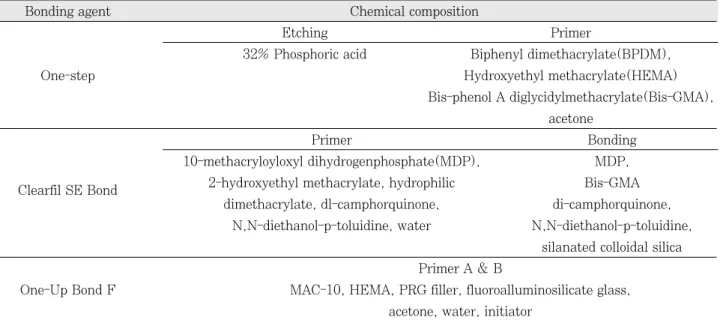
Bonding materials used were One-step� (Bisco., Inc., Schaumburg, Illinois, USA), Clearfil SE Bond� (Kuraray Co., Ltd., Osaka, Japan), and One-up Bond F� (Tokuyama Co., Ltd., Shibuta- ku, Tokyo, Japan) (Table 2). All bonding materi- als were applied following the manufacturer’s instructions.
Hybrid composite (Clearfil AP-X, Kuraray Co., Ltd., Osaka, Japan) was packed into the Ultradent mount jig mold (Ultradent Product Inc., South Jordan, Utah, USA) and light-cured
Table 1.Experimental groups following bonding condition of enamel surface
Group Treatment Bonding agent
OS 1 No bleaching, 10 days storage in saline
OS 2 Bleaching, immediate bonding One step�
OS 3 Bleaching, delayed bonding(2week later) SE 1 No bleaching, 10 days storage in saline
SE 2 Bleaching, immediate bonding Clearfil SE Bond�
SE 3 Bleaching, delayed bonding(2week later) OU 1 No bleaching, 10 days storage in saline
OU 2 Bleaching, immediate bonding One-up Bond F�
OU 3 Bleaching, delayed bonding(2week later)
Bleaching: apply Opalescence�10%, 6 hours per day for 10 days
Table 2.Chemical ingredients of the bonding agents used in this study
Bonding agent Chemical composition
Etching Primer
32% Phosphoric acid Biphenyl dimethacrylate(BPDM),
One-step Hydroxyethyl methacrylate(HEMA)
Bis-phenol A diglycidylmethacrylate(Bis-GMA), acetone
Primer Bonding
10-methacryloyloxyl dihydrogenphosphate(MDP), MDP, Clearfil SE Bond 2-hydroxyethyl methacrylate, hydrophilic Bis-GMA
dimethacrylate, dl-camphorquinone, di-camphorquinone, N,N-diethanol-p-toluidine, water N,N-diethanol-p-toluidine,
silanated colloidal silica Primer A & B
One-Up Bond F MAC-10, HEMA, PRG filler, fluoroalluminosilicate glass, acetone, water, initiator
for 40 seconds. After polymerization, the align- ment tube and mold were removed and the speci- mens were placed in 37℃ distilled water for 24 hours.
Control and immediate bonding groups were tested in shear mode using a chisel-shaped rod in an Instron testing machine (Type 4202, Instron Corp., Canton, Massachusettes, USA) at a cross- head speed of 1 mm/minute. After two-week stor- age, the groups of delayed bonding specimens were bonded and tested in the same mode.
The data for each group were subjected to one- way ANOVA followed by Tukey’s test at p<0.05 to make comparisons among the groups.
Ⅲ. RESULTS
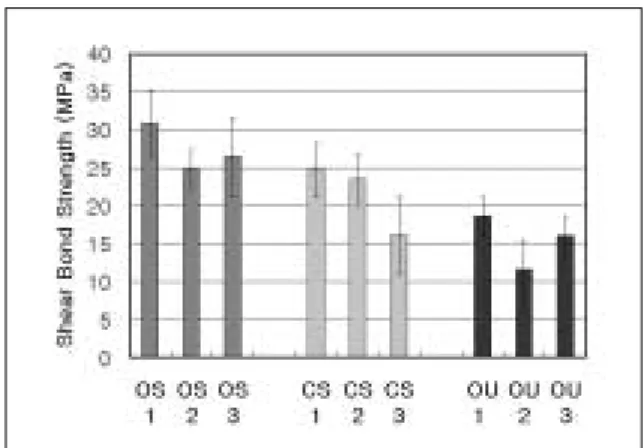
The results of the shear bond strength tests to bleached enamel are shown in table 3 and Fig.1.
In One-step� and One-up Bond F� groups, the immediate bonding group showed lower bond strength than control and delayed groups.
In Clearfil SE Bond� group, there were no sta- tistical difference of shear bond strength in imme- diate bonding group compared to control group, but the bond strength of delayed group was lower than the others.
Among bonding agents, One-up Bond F�showed significantly lower bond strength than One-step� and Clearfil SE Bond�.
Ⅳ. DISCUSSION
Although prerestorative carbamide peroxide bleaching is gaining popularity as a more conserv- ative and economical method of improving the esthetics, its detrimental effect on the bond strength to composite has been suggested. Some authors have reported a severe decrease in the average bond strength of composite to bleached enamel compared with unbleached enamel2-6,10).
The exact mechanism of the decreased bond strength after bleaching is not certain, but there were some speculated reasons. One of the reason is that changes in enamel structures resulting from the loss of mineral content, or increased porosity as manifested by an “over-etched”
appearance with loss of prismatic form10).
However, Dishman et al.11) argued that the quality of composite bond is compromised through a decreased number of resin tags present, sug- gesting that there may be some kind of polymer- ization inhibition taking place. Kalili et al.12)pro- posed that such inhibition could result from bleaching agents that cause oxygen to penetrate and concentrate on the surface of enamel, thus inhibiting the cure of some resin tags.
Perdigao et al13) reported that vital bleaching Table 3. Shear bond strength of resin composite to
bleached enamel
Group n Shear bond strength Tukey test
OS 1 11 30.8±4.4 A
OS 2 11 24.8±2.6 B
OS 3 11 26.5±5.1 AB
CS 1 11 24.7±3.6 B
CS 2 11 23.5±3.4 BC
CS 3 11 16.2±5.2 D
OU 1 10 18.6±2.6 CD
OU 2 10 11.6±3.9 E
OU 3 11 16.1±2.4 DE
∙Means with different letters are significantly different at p<0.05.
∙OS: One-step�, CS: Clearfil SE Bond�, OU: One-up Bond F�
Fig. 1. Shear bond strength of resin composite to ble- ached enamel surface.
with a commercial 10 % carbamide peroxide gel did not change the oxygen concentration in the surface of bleached enamel. And they found that carbamide peroxide bleached enamel showed rela- tively lower concentration of Ca and P.
To recover the bond strength, some authors have advised of delays in bonding one or more weeks after bleaching because the reduction of composite bond strength to freshly bleached enamel has been transient3,14,15). Similarly, removal of the superficial layer, pretreatment of bleached enamel with alcohol, and use of adhe- sives containing organic solvents have been also suggested to result in complete reversal of the reduced enamel bonds16-18).
Recently used bonding agents can be divided in two groups by their surface conditioning method.
One is conventional total etching system and the other is self-etching system.
Although self-etching primers had lower acidity than conventional etchants, they showed compara- ble shear bond strengths to conventional types19-21). They explain the reason that the length of resin tags has been shown to contribute little to the bond strength of resin to enamel and bonding is mainly attributable to the ability of the resin to penetrate between the enamel crystallites and rods. If the resin monomers adequately penetrate into the superficially etched surface, that is enough to obtain proper bond strength20).
In control groups, following the results of this study, the conventional acid etching system showed higher bond strength than the self-etch- ing systems and the One-up Bond F�, all-in-one type bonding system, was the lowest.
In the immediate bond strength of OS 2 and CS 2 was comparable but OU 2 group was much low- er than the other groups. This can be explained that the lower acidity (higher pH) of self-etching primer. In total etching system, the depletion of calcium from enamel surface could reduce bond strength22,23), but in self-etching system calcium removal from the tooth surface was not detrimen- tal.
The latter system may less influence on the hardness of already weakened enamel structure.
In case of using self-etching primer after bleach- ing, there may be no need to delay bonding steps.
In the delayed bonding groups, the bond strength of OS 3 and OU 3 were recovered to the control group level, but CS 3 was different. We have not known the reason of these results, and more study may be need to reveal those reasons.
In case of One-up Bond F�, there were signifi- cantly lower shear bond strength in all test groups than two groups. So it may be used cau- tiously.
Ⅴ. CONCLUSION
The objective of this study is to compare (1) the effect of type of bonding agents; conventional and self-etching adhesive systems and (2) immediate and delayed bonding of hybrid composite resin on the 10 % carbamide peroxide bleached enamel.
68 extracted, noncarious human molars were used in this study. With enamel surface facing up, sectioned teeth were embedded in auto-poly- merizing acrylic resin. The teeth were randomly divided into nine groups of 11 specimen each.
Bleaching material, Opalescence� with 10% of carbamide peroxide gel was used. Control groups were not bleached and after 10-day storage, those were tested. Experimental groups were exposed to one daily application of bleaching gel for six hours during 10 consecutive days. Used bonding materi- als were One-step�, Clearfil SE Bond�, One-up Bond F�. All bonding materials were applied per manufacturer’s instructions. The immediate bonding groups were bonded the composite right after the final bleaching procedure and delayed groups were immersed in saline and bonded com- posite. 24 hours after bonding shear bond strength were measured by Instron testing machine at a crosshead speed of 1 mm/minute.
The data for each group were subjected to One- way ANOVA followed by Tukey’s test at p<0.05 to make comparisons among the groups
The results are :
In One-step� groups, the immediate bonding group showed lower bond strength than control and delayed groups.
In Clearfil SE Bond�groups, there were no sta- tistical difference of shear bond strength between the control and immediate groups, but delayed group showed lower bond strength.
In One-up Bond F�groups, the immediate bond- ing group showed lower bond strength than con- trol and delayed groups. Among bonding agents, One-up Bond F showed significantly lower bond strength than One-step and Clearfil SE Bond.
REFERENCE
1. Haywood VB, Houck VM, Haymann HO. Nightguard vital bleaching: effects of various solution on enamel surface texture and color. Quintessence Int 20:825- 829, 1991.
2. Stokes AN, Hood JA, Dhariwal D, Patel K. Effect of peroxide bleaches on resin-enamel bonds. Quintessence Int 23:769-771, 1992.
3. Titley KC, Torneck CD, Ruse ND, Krmec D. Adhesion of a resin composite to bleached and unbleached human enamel. J Endod 19:112-115, 1993.
4. Garcia-Godoy F, Dodge WW, Donohue M. Composite resin bond strength after enamel bleaching. Oper Dent 18:144-147, 1992.
5. Torneck CD, Titley KC, Smith DC, Adibfar A. Effect of water leaching on the adhesion of composite resin to bleached and unbleached bovine enamel. J Endod 17:156-160, 1991.
6. Spyrides GM, Perdigao J, Pagani C, Araujo MA, Spyrides SM. Effect of whitening agents on dentin bonding. J Esthet Dent 12:264-270, 2000.
7. Pashley D, Sano H. Adhesion testing of dentin bonding agents. Dent Mater 11:117-125, 1995.
8. Miller RA : Laboratory and clinical evaluation of a self-etching primer. J Clin Orthod 35:42-45, 2001.
9. Perdigao J, Eriksson S, Rosa BT, Lopes M, Gomes G.
Effect of calcium removal on dentin bond strengths.
Quintessence Int 32:142-146, 2001.
10. Ben-Amar A, Liberman R, Gorfil C, Bernstein Y. Effect of mouthguard bleaching on enamel surface. Am J Dent 8:29-32, 1995.
11. Dishman MV, Covoy DA, Baughan LW. The effects of peroxide bleaching on composite to enamel bond strength. Dent Mater 10:33-36, 1994.
12. Kalili T, Caputo AA, Mito R, Sperbeck G, Matyas J.
Adhesion of a resin composite to bleached and unbleached human enamel. Pract Periodontics Aesthet Dent 3:22-24, 1991.
13. Perdigao J, Francci C, Swift EJ Jr. Ultra-morphologi- cal study of the interaction of dental adhesives with carbamide peroxide-bleached enamel. Am J Dent 11:291-301, 1998.
14. McGuckin RS, Thurmond BA, Osovitz S. Enamel shear bond strengths after vital bleaching. Am J Dent 5:216- 222, 1992.
15. Miles PG, Pontier JP, Bahiraei D. The effect of car- bamide peroxide bleach on the tensile bond strength of ceramic brackets: An in vitro study. Am J Orthod Dentofac Orthop 106:371-375, 1994.
16. Cvitko E, Denehy GE, Swift EJ. Bond strength of com- posite resin to enamel bleached with carbamide perox- ide. J Esthet Dent 13:100-102, 1991.
17. Barghi N, Godwin JM. Reducing the adverse effect of bleaching on composite-enamel bond. J Esthet Dent 6:157-161, 1994.
18. Sung EC, Chan SM, Mito R, Caputo AA. Effect of car- bamide peroxide bleaching on the shear bond strength of composite to dental bonding agent enhanced enamel, J Prosthet Dent 82:595-599, 1999.
19. Torii Y, Itou K, Hikasa R, Iwata S, Nishitani Y.
Enamel tensile bond strength and morphology of resin- enamel interface created by acid etching system with or without moisture and self-etching priming system. J Oral Rehabil 29:528-533, 2002.
20. Shimada Y, Senawongse P, Harnirattisai C, Burrow MF, Nakaoki Y, Tagami J. Bond strength of two adhe- sive systems to primary and permanent enamel.Oper Dent 27:403-409, 2002.
21. Hayakawa T, Nemoto K. Efficacy of self-etching primers in the adhesion of 4-META/MMA-TBB resin cement to enamel.J Adhes Dent 4:105-113, 2002.
22. Panighi M, G’Sell C. Influence of calcium concentra- tion on the dentin wettability by an adhesives. J Biomed Mater Res 26:1081-1089, 1992.
23. Swift EJ, Hammel SA, Perdigao J, Wefel JS.
Prevention of root surface caries using a dentin adhe- sive. J Am Dent 125:571-576, 1994.