• 검색 결과가 없습니다.

Comparison of between Upper Thoracic Manipulation and Cervical Stability Training on Range of Motion and Neck Disability in Patients with Chronic Mechanical Neck Pain

N/A
N/A
Protected

Academic year: 2021

Share "Comparison of between Upper Thoracic Manipulation and Cervical Stability Training on Range of Motion and Neck Disability in Patients with Chronic Mechanical Neck Pain"

Copied!
8
0
0

로드 중.... (전체 텍스트 보기)

전체 글

(1)

Research Article Open Access

Physical Activities and Health-related Quality of Life of Individuals Post Stroke

Young-eun Choi, PT, PhD⋅Ji-hye Kim, PT, PhD 1†

1)

Department Rehabilitation, Rapha Rehabilitation Center

1 Department of Physical Therapy, Gangdong College

Received: April 8, 2015 / Revised: April 16, 2015 / Accepted: May 6, 2015

ⓒ 2015 J Korean Soc Phys Med

| Abstract |

PURPOSE: The purpose of this study is to examine the relationship between the physical activities of individuals post-stroke and their HRQL, as well as to determine whether their functional abilities contribute to their amounts of physical activity.

METHODS: The study’s subjects included 90 individuals post-stroke. Their amounts of physical activity were measured using the International Physical Activity Question- naire (IPAQ), and their HRQL was measured using the Medical Outcomes Study 36-Item Short-form Health Survey (SF-36). In addition, the functional abilities of the subjects were measured. For the measures of physical activities and the HRQL, Pearson’s correlation coefficients were used to identify the strengths of the associations between the measures. A hierarchical linear regression model was used to determine whether physical activities had independent impacts on the HRQL.

RESULTS: This study found that the physical activities performed by the subjects affected the SF-36 physical component score (PCS) (12%). However, the physical activities and the SF-36 mental component score (MCS) showed no statistically significant relationship, whereas functional abilities and physical activities had a statistically

†Corresponding Author : [email protected]

significant relationship (r = .57~.86, p<.001).

CONCLUSION: The present study identified a correlation between physical activity and the PCS. Therefore, individuals post-stroke should be encouraged to carry out more physical activities, including more frequent walking activities.

Key Words: Stroke, Physical activity, Health-related quality of life, Functional ability

Ⅰ. Introduction

In Korea, about 500,000 individuals suffer from strokes, which is the leading cause of death as a single disease

(American Heart Association Statistics Committee and

Stroke Statistics Subcommittee, 2013). In particular, elderly

people exhibit a high incidence of stroke. Therefore, this

disease is emerging as an important medical issue in Korea,

and it is showing the trend of population aging. According

to the International Classification of Functioning, Disability,

and Health (ICF) of the World Health Organization (WHO),

problems caused by stroke can be explained by three main

dimensions: body function and structure, activity, and

participation(Roth and Harvey, 2000). In the dimension

of body function and structure, a stroke causes primary

neurological impairments, such as hemiplegia, spasticity,

and aphasia. Activity limitations are referred to as a

(2)

disability and the ability to perform daily functions, such as dressing, bathing, and walking, is reduced(Gresham et al., 1997).

Individuals post-stroke place a high priority on recovering their functional abilities to carry out everyday activities and their abilities to walk independently(Muren et al., 2008). While over 60% of individuals post-stroke recover independent walking, a stroke is accompanied by changes in gait patterns and declines in walking speeds and total distances walked(Pang et al., 2005; Patterson et al., 2007).

Individuals post-stroke with medium or moderate severity have about 40% lower levels of cardiovascular and functional capacities than healthy individuals(Courbon et al., 2006; Michael et al., 2005). This reduction will inevitably influence the psychological functions of individuals post-stroke and their well-being in daily life.

The health-related quality of life (HRQL) refers to self-reported measures. It is not confined to the concept of physical, social, and emotional health, but it includes multiple dimensions(Harper and Power, 1998). The HRQL measures are potentially related to patients more deeply than the measurements of impairment or disability. They are also an important post-stroke index outcome that enables a broader description of the disease and its outcomes(Moon et al., 2004; Sturm et al., 2002).

A study reported that healthy older adults who participated in moderate-intensity regular physical activities showed an overall higher level of HRQL than healthy older adults who engaged in fewer physical activities(Rejeski and Mihalko, 2001). The physical activities of older individuals with chronic conditions and arthritis were found to have positive impacts on their HRQL(Abell et al., 2005;

Sawatzky et al., 2007). Some studies reported that quality of life declines after a stroke, and disabilities, handicaps, neurological impairments, and functional capacity have correlations with HRQL(Patel et al., 2006). Moreover, the participation of individuals post-stroke in physical activities resulted in the reduced recurrence of strokes and improved

quality of life(Carod-Artal, 2006; Greenlund et al., 2002;

Sacco et al., 1998). Unlike age, the level of physical activities is a potentially modifiable factor. However, few studies have dealt with the correlation between the HRQL of individuals post-stroke and variable physical activities.

In this regard, the purpose of this study is to investigate the relationship between the physical activities of individuals post-stroke and their HRQL, as well as to determine whether their functional abilities contribute to their amounts of physical activity.

Ⅱ. Methods

1. Study subjects

The subjects of this study included 90 stroke patients who listened to explanations about the study and agreed to participate. The inclusion criteria were those who had a stroke at least six months ago, lived in a local community, were capable of walking independently with or without a walking aid, and had intact cognition with 24 points or higher on the mental state examination (MMSE). The exclusion criteria were those who could not carry out basic activities of daily living due to any additional neurological and/or orthopedic deficits. General characteristics of the subjects are shown in Table 1.

2. Measurement

Physical activities were measured using the Korean

version of the International Physical Activity Questionnaire

(IPAQ) short form. The IPAQ includes questions regarding

activities performed during the week prior to the survey,

and it assesses the frequency and duration of three types

of physical activities: walking (moving from a place to

another place for leisure, pleasure, or exercises); moderate

physical activities without walking (light weightlifting,

light cycling at normal speeds, light aerobic workouts, other

activities that moderately increase breathing or heart rates),

(3)

Table 1. General characteristics of subjects (N=90)

Age (yrs) 64.92±12.06

Weight (kg) 61.66±9.47

Height (m) 1.61±0.08

BMI (kg/m

2

) 23.41±2.20

Sex

Male 39 (43.3)

Female 51 (56.7)

On set (month) 23.99±13.54

Stroke type

Hemorrhage 28 (31.1)

Infarction 62 (68.9)

Paretic side

Left 49 (54.4)

Right 41 (45.6)

Values are number (%) or mean±standard deviation, BMI:

Body Mass Index

and vigorous physical activities (heavy weightlifting, running, aerobic workouts, rapid cycling, or other activities that significantly increase breathing or heart rates). The data obtained from the questionnaire for the three types of physical activities were added to measure the total time and amount of physical activities per week. Total daily physical activities were estimated using the metabolic equivalent task (MET) value according to each type of physical activity (1 MET=resting energy expenditure). The daily average MET score was expressed based on the scoring protocol of the official IPAQ. Vigorous-intensity activities, moderate activities, and walking were assumed based on 8, 4, and 3.3 METs, respectively (www.ipaq.ki.se).

The HRQL was evaluated using the MOS SF-36, which consists of 36 items as a self-report questionnaire. It is measured as eight domains of functioning, and two summary scores (physical component score: PCS, mental component score: MCS) are yielded. The PCS consists of four domains: physical function, role physical, bodily pain, and general health. The MCS also consists of four domains:

vitality, social functioning, role-emotion, and mental health.

A higher score indicates a corresponding higher level of HRQL perceived. A study reported that the SF-36 satisfied reliability and validity in individuals post-stroke(Buck et al., 2002).

Functional ability was identified using the following assessments. The Chedoke–McMaster Stroke Assessment (CMSA) was employed to confirm the presence and severity of motor impairments in the leg and foot. Fourteen points is the largest value, and a higher value indicates a corresponding lower level of motor impairment in the lower extremity. This assessment has good concurrent validity with the Fugl–Meyer assessment of sensorimotor recovery and it had a moderate correlation with activities of daily living(Gowland et al., 1993; Valach et al., 2003).

The Functional Independence Measure (FIM) measures the level of activities of daily living with a disability. Its 18 items are rated on a seven-point scale along a continuum ranging from 1 (total assistance) to 7 (complete independence).

This study used only locomotion scores related to ambulation(Granger et al., 1986). The Berg Balance Scale (BBS) was used to evaluate the subjects’ abilities to maintain balance while performing 14 functional tasks. The maximum score is 56 points and a higher score indicates a corresponding level of improvement in balance function.

The BBS is a psychometrically sound measure for assessing the balance of individuals post-stroke. The test-retest reliability and the intrarater reliability are ICC=.98 and ICC=.97, respectively(Blum and Korner- Bitensky, 2008).

3. Data analysis

The collected data were analyzed using PASW 18.0.

Descriptive statistics was employed to explain the study

population. For the measures of physical activities and the

HRQL, Pearson’s correlation coefficients were used to

identify the strengths of the associations between the

measures. A hierarchical linear regression model was used

to determine whether physical activities had independent

(4)

Table 2. Measures of the HRQL, physical activity and functional ability (N=90)

Variables Mean±S.D

HRQL (SF-36)

Physical functioning (range, 0-100) 42.28±19.50

Role-physical (range, 0-100) 53.89±12.93

Bodily pain (range, 0-100) 61.41±25.03

General health (range, 0-100) 45.26±12.81

Vitality (range, 0-100) 59.72±17.52

Social functioning (range, 0-100) 53.88±13.97

Role emotional (range, 0-100) 40.74±20.46

Mental health (range, 0-100) 50.13±15.18

PCS (range, 0-100) 42.09±8.61

MCS (range, 0-100) 46.51±6.00

Physical activity (IPAQ)

Total physical activity (MET-min/week) 4136.92±1128.93

Functional ability

Berg balance scale (range, 0-56) 36.52±9.40

CMSA (leg and foot impairment range, 2-14) 10.44±1.71

FIM (locomotion range, 2-14) 11.17±1.10

Values are mean±standard deviation, PCS: Physical Component Score, MCS: Mental Component Score, MET: Metabolic Equivalent Task (1 MET=resting energy expenditure), CMSA: Chedoke-McMaster Stroke Assessment (leg and foot impairment scores 14 points=no lower extremity motor impairment), FIM: Functional Independence Measure (locomotion includes walking or wheelchair propulsion and stair climbing)

impacts on the HRQL. First, the level of motor impairment in the lower extremity was controlled by entering the CMSA leg and foot impairment scores in the regression model.

The levels of physical activities were then entered into the regression model. Next, this study checked whether physical activities was a variable with independent impacts on the HRQL while the level of motor impairment in the lower extremity was controlled, and then, the level of significant increase in the modified R 2 (R 2 change) was reviewed. The statistical significance level was set at 0.05.

Ⅲ. Results

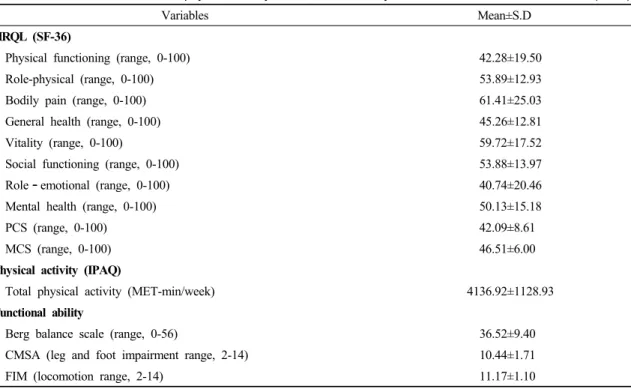
The values resulting from measuring the HRQL, physical activities, and functional abilities of the subjects

are presented in Table 2.

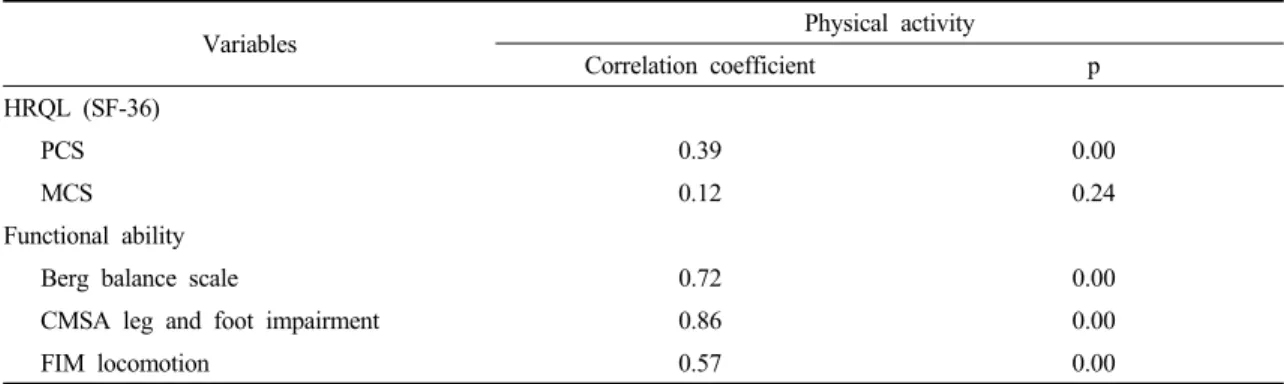
While physical activities performed for the one-week

period showed a statistically significant correlation with

the SF-36 PCS (r=.39, p<.01), they revealed no correlation

with the SF-36 MCS (r=.12, p=.24). The physical activities

had a statistically significant correlation with functional

abilities (r=.57~.86, p<.001) (Table 3). A hierarchical linear

regression analysis was conducted to confirm the effects

of the physical activities of individuals post-stroke on their

HRQL, and the results are shown in Table 4. The SF-36

MCS had no correlation with the physical activities. In

addition, as the general characteristics of the subjects were

not correlated with the physical activities in the SF-36,

they were not entered into the regression model. First, the

CMSA leg and foot scores were entered to control the

level of motor impairment in the lower extremity. The total

(5)

Table 3. Correlation analysis of the amount of physical activity with HRQL and functional ability (N=90)

Variables Physical activity

Correlation coefficient p

HRQL (SF-36)

PCS 0.39 0.00

MCS 0.12 0.24

Functional ability

Berg balance scale 0.72 0.00

CMSA leg and foot impairment 0.86 0.00

FIM locomotion 0.57 0.00

PCS: Physical Component Score, MCS: Mental Component Score, CMSA: Chedoke-McMaster Stroke Assessment, FIM: Functional Independence Measure

Table 4. The influence of physical activity on physical component score of the SF-36 in individuals post stroke (N=90) Physical component score of SF-36

R

2

R

2

change Unstandardised B Standardised p

Step 1 0.27 0.27 0.01

CMSA leg and foot 1.30 (0.49) 0.27 0.01

Step 2 0.39 0.12 0.00

CMSA leg and foot 1.19 (0.61) 0.24 0.02

Physical activity 2.87 (0.00) 0.36 0.01

CMSA: Chedoke-McMaster Stroke Assessment

variance accounted for by the SF-36 PCS was 27.3%. When the physical activities were added, the value of the R 2 change resulted in 12% and the model was improved at a statistically significant level (p=.001). The total variance accounted for by the final model was 39.3%.

Ⅳ. Discussion

This study aimed to identify whether the physical activities of individuals with chronic stroke who resided in local communities influence their HRQL, as well as to assess the relationship between functional and physical abilities. Physical activities performed by the subjects for the one-week period were found to influence the SF-36 PCS (12%). The level of physical activities evaluated by

the IPAQ (4136.92±1128.93 METs-min/week) was lower

than the equivalent for healthy adults (4543±2743 METs-

min/week)(Moore et al., 2013). This was a lower level

even when compared with previous studies that evaluated

the physical activities of 25 individuals with a stroke

(4665±13309 METs-min/week), 209 older adults with

chronic conditions (4620±3276 METs-min/week), and 45

individuals with neurologic and orthopedic conditions

(6510±4452 METs-min/week) using self-report measures

(Liu-Ambrose et al., 2010; Moore et al., 2013; van der

Ploeg et al., 2007). The US Center for Disease Control

and the American College of Sports Medicine guidelines

recommended that individuals should engage in 30 minutes

or more of moderate-intensity physical activity on a daily

basis (equivalent to approximately 1,400 kcal/week), while

the US Surgeon General's 1996 report classified moderate

(6)

physical activity as more than 1,000 kcal/week(Pate et al., 1995; Sawatzky et al., 2007). In fact, most of the stroke patients in local communities do not meet the standard for physical activity at 1,000 kcal/week(US Department of Health and Human Services, 1996).

Strokes are known to influence the HRQL of individuals with conditions due to the sequelae of a stroke(Mayo et al., 2002). The present study also supports this point as proven by previous studies. The SF-36 PCS and MCS scores of stroke patients were lower than those of normal individuals. The SF-36 scores of individuals who experienced a stroke at least one year ago were lowered when their neurological impairment was more severe(Franceschini et al., 2010). Improvements to the HRQL are known as a health benefit from physical activities. Physical activities promote mobility by improving muscle strength and postural balance. Maintaining capacity for independent mobility contributes to a general sense of health and well-being. As a result, it can increase HRQL(Gordon et al., 2004). All functional ability measures have correlations with physical activities. This indicates a greater balance of functions, and reduced motor impairment can enable leisure and recreational activities. The FIM does not provide any specific information about the quality or competency of walking and has a significant ceiling effect for independent ambulators(Patterson et al., 2008). The almost half of the IPAQ items involve walking.

Ⅴ. Conclusion

Improvements to quality of life after a stroke have become the most important goal in rehabilitation and community reintegration. While some factors influencing quality of life are not modifiable (e.g., age), other factors might involve more difficulty in modifying after a stroke (e.g., severity of neurological impairment). In addition, some factors often cannot be improved easily, particularly

during the chronic stage. The present study identified a correlation between physical activity and the PCS.

Therefore, individuals post-stroke should be encouraged to carry out more physical activities, including more frequent walking activities.

Reference

Abell JE, Hootman JM, Zack MM, et al. Physical Activity and Health Related Quality of Life among People with Arthritis. J Epidemiol Community Health.

2005;59(5):380-5.

American Heart Association Statistics Committee and Stroke Statistics Subcommittee. Heart disease and stroke statistics-2013 update: a report from the American Heart Association. Circulation. 2013;127(1):e6-e245.

Blum L, Korner-Bitensky N. Usefulness of the Berg Balance Scale in stroke rehabilitation: a systematic review.

Phys Ther. 2008;88(5):559-66.

Buck D, Jacoby A, Massey A, et al. Evaluation of Measures Used to Assess Quality of Life after Stroke. Stroke.

2002;31(8):2004-10.

Carod-Artal FJ. Post-stroke depression(I): Epidemiology, diagnostic criteria and risk factors. Rev Neurol.

2006;42(3):169-75.

Gordon NF, Gulanick M, Costa F, et al. Physical activity and exercise recommendations for stroke survivors:

an American Heart Association scientific statement from the Council on Clinical Cardiology, Subcom- mittee on Exercise, Cardiac Rehabilitation, and Prevention; the Council on Cardiovascular Nursing;

the Council on Nutrition, Physical Activity, and Metabolism; and the Stroke Council. Circulation.

2004;109(16):2031-41.

Courbon A, Calmels P, Roche F, et al. Relationship Between

Maximal Exercise Capacity and Walking Capacity

in Adult Hemiplegic Stroke Patients. Am J Phys Med

(7)

Rehabil. 2006;85(5):436-42.

Franceschini M, La Porta F, Agosti M, et al. Is Health-Related Quality of Life of Stroke Patients Influenced by Neurological Impairments at One Year after Stroke?.

Eur J Phys Rehabil Med. 2010;46(3):389-99.

Gowland C, Stratford P, Ward M, et al. Measuring physical impairment and disability with the Chedoke-McMaster Stroke Assessment. Stroke. 1993;24(1):58-63.

Granger CV, Hamilton BB, Keith RA, et al. Advances in functional assessment for medical rehabilitation. Top Geriatr Rehabil. 1986;1(3):59-74.

Greenlund KJ, Giles WH, Keenan NL, et al. Physician Advice, Patient Actions, and Health-Related Quality of Life in Secondary Prevention of Stroke through Diet and Exercise. Stroke. 2002;33(2):565-70.

Gresham GE, Duncan PW, Stason WB. Post-Stroke Rehabilitation.

Maryland. US Department of Health and Human Services. 1997.

Harper A, Power M. Development of the World Health Organization WHOQOL-BREF quality of life assessment. Psychol Med. 1998;28(3):551-8.

Liu-Ambrose TY, Ashe MC, Marra C. Independent and inverse association of healthcare utilisation with physical activity in older adults with multiple chronic conditions.

Br J Sports Med. 2010;44(14):1024-8.

Mayo NE, Wood-Dauphinee S, Cote R, et al. Activity, participation, and quality of life 6 months poststroke.

Arch Phys Med Rehabil. 2002;83(8):1035-42.

Michael KM, Allen JK, Macko RF. Reduced ambulatory activity after stroke: the role of balance, gait, and cardiovascular fitness. Arch Phys Med Rehabil.

2005;86(8):1552-6.

Moon YS, Kim SJ, Kim HC, et al. Correlates of quality of life after stroke. J Neurol Sci. 2004;224(1-2):37-41.

Moore SA, Hallsworth K, Plötz T, et al. Physical Activity, Sedentary Behaviour and Metabolic Control following Stoke: a cross-sectional and longitudinal study. PLoS One. 2013;8(1):e55263.

Muren MA, Hutler M, Hooper J. Functional capacity and health-related quality of life in individuals post stroke.

Top Stroke Rehabil. 2008;15(1):51-8.

Pang MY, Eng JJ, Dawson AS. Relationship Between Ambulatory Capacity and Cardiorespiratory Fitness in Chronic Stroke: influence of stroke-specific impairments. Chest. 2005;127(2):495-501.

Pate RR, Pratt M, Blair SN, et al. Physical activity and public health. A recommendation from the Centers for Disease Control and Prevention and the American College of Sports Medicine. JAMA. 1995;273(5):

402-7.

Patel MD, Tilling K, Lawrence E, et al. Relationships between Long-Term Stroke Disability, Handicap and Health- Related Quality of Life. Age Ageing. 2006;35(3):273-9.

Patterson KK, Parafianowiez I, Danells CJ, et al. Gait asymmetry in the community ambulating stroke survivors. Arch Phys Med Rehabil. 2008;89(2):304-10.

Patterson SL, Forrester LW, Rodgers MM, et al. Determinants of walking function after stroke: differences by deficit severity. Arch Phys Med Rehabil. 2007;88(1):115-9.

Rejeski WJ, Mihalko SL. Physical Activity is Related to Quality of Life in Oder Adults. J Gerontol Biol A Sci Med Sci. 2001;56(2):23-35.

Roth EJ, Harvey RL. Physical Medicine and Rehabilitation(2 nd ed). Philadelphia. WB Sauders. 2000.

Sacco RL, Gan R, Boden-Albala B, et al. Leisure-time physical activity and ischemic stroke risk: the Northern Manhattan Stroke Study. Stroke. 1998;29(2):380-7.

Sawatzky R, Liu-Ambrose T, Miller WC, et al. Physical Activity as Mediator of the Impact of Chronic Conditions on Quality of Life in Older Adults. Health Qual Life Outcomes. 2007;5(1):68-78.

Sturm JW, Osborne RH, Dewey HM, et al. Brief comprehensive quality of life assessment after stroke: the assessment of quality of life instrument in the north East melbourne stroke incidence study (NEMESIS). Stroke.

2002;33(12):2888-94.

(8)

US Department of Health and Human Services. Physical activity and health: a report of the surgeon general. Atlanta.

US Department of Health and Human Services. 1996.

Valach L, Signer S, Hartmeier A, et al. Chedoke-McMaster stroke assessment and modified Barthel Index self-assessment in patients with vascular brain damage. Int J Rehabil Res. 2003;26(2):93-9.

van der Ploeg HP, Streppel KR, van der Beek AJ, et al. The Physical Activity Scale for Individuals with Physical Disabilities: test-retest reliability and comparison with an accelerometer. J Phys Act Health. 2007;4(1):

96-100.

수치

Table  1.  General  characteristics  of  subjects        (N=90) Age  (yrs) 64.92±12.06 Weight  (kg) 61.66±9.47 Height  (m)   1.61±0.08 BMI  (kg/m 2 ) 23.41±2.20 Sex Male 39  (43.3) Female 51  (56.7) On  set  (month) 23.99±13.54 Stroke  type Hemorrhage 28
Table  2.  Measures  of  the  HRQL,  physical  activity  and  functional  ability                                                                    (N=90)
Table  3.  Correlation  analysis  of  the  amount  of  physical  activity  with  HRQL  and  functional  ability                      (N=90)

참조

관련 문서

The purpose of this study was to analyze the relations between the leader-member exchange relationship, job satisfaction, and organizational citizenship behavior of sports

The purpose of this study is to verify whether The mediating effects of planned happenstance skills on the relationship between perceived social support

The purpose of this study is to analyze the interest and self-confidence of middle school students in learning English grammar and to examine the

Objective: The purpose of this study was to investigate the relationship between the awareness of death and the ethical attitude to Do-Not-Resuscitate (DNR) among some

The purpose of this study is to analyze the relationship between dance performances, which is a part of social contribution activities of local governments,

Purpose: The aim of this study is to identify the relationship between knowledge and awareness of radiation department students and their intent in

The purpose of this study is to examine the relationship among marketing mix factors, motivation for watching, relationship quality, and consumption

The purpose of this research is to confirm whether voluntary early morning physical exercise effects on the emotional and behavioral development of