A GIS-based Analysis of Spatial Patterns of Individual Accessibility: A Critical Examination of Spatial Accessibility
Measures
Hyun-Mi Kim*
GIS를 이용한 접근성의 공간적 패턴 분석:
공간적 접근성 측정방법에 대한 비판적 검토
김현미*
Abstract:The purpose of this study is to critically examine conventional spatial measures of individual accessibility, which are based on the notion of spatial proximity, the single reference location, and the unlinked travel model. Using space-time accessibility measures with the travel-activity diary data set of Portland Metro, US, three expectations from spatial measures on spatial patterns of individual accessibility were empirically examined: (1) does individual accessibility decrease with an increase of distance from the CBD?; (2) does the spatial pattern of accessibility resemble that of urban opportunity density pattern?; and (3) are spatial patterns of individual accessibility of different socio- demographic population groups basically similar as people in the same area share the same geographic characteristics regardless of gender, race, age, and so on? First of all, the results showed that spatial variations in individual accessibility were not directly determined by spatial proximity and opportunity density as suggested by previous accessibility measures. The spatial pattern of individual accessibility was dramatically different from that of urban opportunity density. High peaks of accessibility level were found far away from the CBD and regional centers. This finding might be associated with the importance of multi-reference locations and linked travels in shaping accessibility in reality. Furthermore, this study found that spatial patterns of accessibility clearly differ between men and women.
These findings suggest that access requires more than proximity, and that the interaction between person-specific space-time constraints and the consequential availability of urban opportunities in space-time renders different accessibility experiences to people even in the same region, which would be one of the key ingredients missing from conventional spatial measures of accessibility.
Key Words : Individual Accessibility, Spatial accessibility measures, Space-time accessibility measures, Spatial proximity, GIS
요약:본 연구는 시간지리학 개념을 도입한 새로운 접근성 개념을 통해 공간적 근접성과 단일한 이동 행태를 전제하는 기존의 방법 을 비판적으로 검토해보고자 한다. 이를 위해, 미국 Portland Metro 지역의 개인통행자료를 이용해 시공간적 접근성의 공간적 패턴 과 근접성의 관계를 비교·분석하였다. 시간지리학의 시공간 프리즘 개념에 기반한 시공간적 접근성은 근접성 외에도 시공간 제약 에 따른 다양한 이동성을 고려한 대안적 방법으로 최근 새롭게 주목 받고 있다. 기존 방법은 접근성이 도시의 기능 중심성과 유사한 공간패턴을 보일 것으로 예상하지만, 연구결과는 접근성이 근접성보다는 개인의 시공간적 속성에 더 많은 영향을 받는다는 사실을
* Lecturer, Department of Geography Education, Seoul National University, [email protected]
1. Introduction
Accessibility has been given much attention by a wide range of research and policy areas, such as geography, urban transportation, marketing, and urban planning and policy, for various analytical and evaluative purposes. Despite its long history, however, most researchers have not agreed upon any definitions or measurements of accessibility. As a consequence, various versions of accessibility measures have been defined and operationalized, depending on the research topics. Examples of relatively widely used definitions of accessibility are: the connectivity of places (Taaffe et al., 1996), the nearness to places (Ingram, 1971); the nearness to activities (Wachs and Kumagai, 1973; Breheny, 1978), the potentials of opportunities for interaction (Hansen, 1959; Vickerman, 1974; Pooler, 1987), and the ease of participating in activities (Burns, 1979; Lenntorp, 1976) -- (for extensive reviews for accessibility measures, see Pirie, 1979; Jones, 1981; Pooler, 1987; Handy and Niemeier, 1997;
Kwan et al., 2003). On the other hand, classifying accessibility into place accessibility and individual accessibility is another way of defining accessibility. While place accessibility is about accessibility of place, individual accessibility is about accessibility of a person or a group of people. Place accessibility concerns how easily a
place can reach other places. Individual accessibility can be defined as the ease with which urban opportunities (employment, shopping, etc.) can be reached by an individual (refer to the work of Kwan and Weber (2003) for the review of individual accessibility studies).
Two distinct approaches in measuring individual access to urban opportunities are spatial measures and space-time measures. The most widely used conventional approaches, such as gravity measures and cumulative-opportunity measures, are considered as ‘spatial’accessibility measures because they are based solely on the notion of locational proximity. Despite the relative ease of implementation and resulting popularity, however, these measures are not quite suitable for evaluating individual accessibility due to their inherent characteristics (Kwan, 1998). Their limitations include (a) dependence on zonal and disaggregated analysis;
(b) a lack of consideration of the attributes of people and the importance of the temporal dimension; and (c) a lack of understanding of complex activity-travel behavior, such as interdependence between activity locations, and multipurpose/stop travel behaviors (Kwan, 1999b). Particularly, such spatial measures are likely to be gender-blind. That is, spatial measures have been criticized as inadequate for 보여준다. 접근성은 CBD나 도시기회의 고밀도지역을 멀리 벗어난 지역에서 오히려 높게 나타났으며, 같은 지리적 특성을 공유하는 동일 지역이라 할지라도 성별에 따라 다르게 드러났다. 이는 접근성이 거주지 뿐만 아니라 다른 공간적 축들(직장, 자녀의 탁아시설 등)을 중심으로도 형성되며, 이에 따라 집에서 멀리 떨어진 곳의 도시기회들이 집 주변의 도시기회들보다 개인의 접근성에 더 큰 기 여를 할 수 있다는 점을 시사한다.
주요어 : 접근성, 공간적 접근성 측정방법, 시공간적 접근성 측정방법, 공간적 근접성, GIS
understanding the access experience of individuals and masking the existence, or the level, of gender difference in access to urban opportunities. Conventional measures based on spatial proximity alone do not allow room for incorporating situational complexities of the activity-travel behavior and space-time constraints women face every day, and therefore cannot reveal how, and to what extent, individuals (women) are disadvantaged. While conventional measures only consider a transport element and the spatial availability of opportunity, space-time measures highlight the importance of temporal factors as well (Burns, 1979).
Space-time accessibility measures have attracted attention recently as an alternative approach to measuring individual access to opportunities, along with the use of GIS geocomputational capabilities. This type of measure, based on Hagerstrand’s (1970) time- geographic framework and the concept of
“space-time prism”, evaluates accessibility in terms of an individual’s ability to reach activity locations given the person’s daily activity program and spatio-temporal constraints (Lenntorp, 1976; Burns, 1979; Villoria, 1989;
Kwan, 1998, 1999a; Weber, 2003; Weber and Kwan, 2002, 2003; Kim and Kwan, 2003). These space-time accessibility measures explicitly take into account the fact that individual accessibility depends not only “on where activity sites are located vis-à-vis the person’s home and the transportation network, but also on when such sites are open and when and how much time the person has for making trips”and participating in activities at the places (Hanson, 1995).
In this light, the purpose of this paper is to empirically examine that conventional spatial
measures are not suitable for capturing lived experiences of accessibility of people. More specifically, this study attempts to critically examine the importance of spatial proximity on individual accessibility and the appropriateness of the single reference location (particularly, home-to-home travel) assumption -- two key ingredients of conventional accessibility measures. To achieve this goal, the spatial relationship between urban opportunity density and individual accessibility, and the gender difference in spatial patterns of accessibility were analyzed, with the use of the travel-activity diary data set in Portland Metro, US and the results of a GIS-based geocomputation to calculate space- time accessibility in the ArcView environment.
2. Measures of Individual Accessibility
1) Conventional spatial measures of accessibility
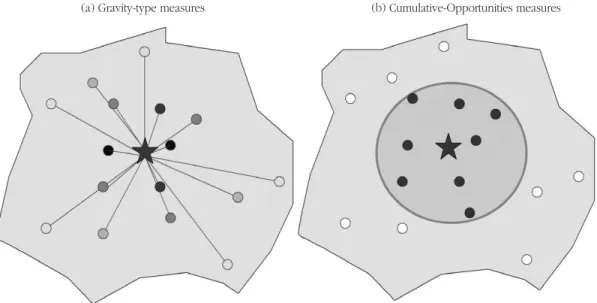
Conventional accessibility measures describe locations which could be reached by a given travel mode. The most commonly used indicators of accessibility are of two kinds: opportunities weighted by an impedance (a decreasing function of travel cost or time) and isochronic definition (number of opportunities reached within a given travel time). The former accessibility measures are known as gravity- based measures, and the latter are cumulative opportunities measures.
The gravity-based measures are the most common measures of accessibility proposed by Hansen (1959), and are based on spatial
interaction framework. As shown in the equation below, this type of measure weights opportunities by impedance, generally a decreasing function of travel time or travel cost.
Ai= Oj`f(Cij)
where Ai=Accessibility from zone (or a place of resi- dence) i to the considered type of opportu-
nities
where Oj=Opportunities in zone (or any destination point) j (employment places, shops, etc)
where Cij=Travel time, distance, or cost from i to j
where f(Cij)=Impedance function (negative expon- ential, power, or modified Gaussian functions are most often used)
The cumulative opportunities measures evaluate accessibility in terms of the number of opportunities reached within a specified travel time (or distance, x) from the origin of interest and, thus, give some sense of the range of choice available. They can be seen as a specific form of
the gravity-based measure, with an impedance function equal to 1 for travel time less than x, and 0 beyond x. They are called isochronic indices, as a measure of ‘equivalent attraction,’
which does not discount measures of op portunity over distance (Wachs and Kumagai, 1973). Figure 1 shows how urban opportunities within the urban area are considered in measuring accessibility by gravity-type measures and cumulative-opportunity measures.
2) Limitations of conventional measures
Even with the popularity and computational simplicity of such conventional measures for individual accessibility (Hansen, 1959; Ingram, 1971; Vickerman, 1974), these types of measures have been criticized for their inherent problems in both a conceptual and operational sense (Breheny, 1978; Pirie, 1979; Handy and Niemeier, 1997).
First, even though accessibility levels are highly sensitive to the choice of parameter values on Çn
j=1
Figure 1. Two types of conventional spatial measures of individual accessibility (a) Gravity-type measures (b) Cumulative-Opportunities measures
the travel-impedance term or a cutoff distance limit, these values cannot be innately determined in spatial measures (Breheny, 1978; Handy and Niemeier, 1997). Furthermore, such a predetermined parameter in the case of cumulative-opportunities measures tends to be applied universally without the consideration of possible differences among population groups in different situations and with different mobility.
Second, the aggregate nature of most of the gravity measures limits its usefulness.
Conventional measures, due to their analysis unit as zone, have been criticized with respect to their strong association with the Modifiable Areal Unit Problem (MAUP) and the Ecological Fallacy problem. Zone-based conventional measures are severely affected by the size and the shape of zones and by aggregation level (Davidson, 1977;
Pirie, 1979; Bach, 1981), and are also associated with the self-potential problem (accessibility of a zone to itself) (Pooler, 1987; Frost and Spence, 1995). In addition, zone-based conventional measures essentially assume that all individuals within a zone face the same set of opportunities and, as a result, ascribe the same level of accessibility to different individuals in the same zone (Ben-Akiva and Lerman, 1979; Vickerman, 1974; Pirie, 1979). Zonal measures overlook the fact that individuals within any zone differ in their access to transport modes and therefore in their ability to reach activity sites (Pirie, 1979;
Kwan, 1998, 1999a; Hanson and Swab, 1987).
Although the MAUP or the ecological fallacy problem might be reduced if a disaggregated approach is used, conventional accessibility measures, however, still have problems as individual accessibility measures because of their lack of the recognition of the temporal constraints and their failure to grasp complex
travel behavior (Recker et al., 1986a, 1986b).
Third, little recognition of the importance of temporal aspects in shaping accessibility has been found in these conventional accessibility measures (Kwan, 1998, 1999a, 1999b). Two types of temporal dimensions that should be considered for individual accessibility measures are overlooked in conventional measures:
temporal aspects of environment (activities and transport) and of individual circumstances. While conventional measures are just interested in the locations of opportunities, in reality, however, most activity opportunities are not always available since they have their own opening hours and closing hours. And, public transportation systems such as buses, trains, or rails have specific timetables and cannot be accessed during certain periods of time (such as late night to early morning). In addition, temporal dimensions of personal condition are also neglected in the conventional accessibility measures. Accessibility is not just a function of the travel environment and the spatial distribution of opportunities, but also the ability of individuals to use the opportunities based on their activity schedule associated with certain amount of temporal constraints. Such activity- related contextual effects cannot be captured by conventional accessibility measures (Kwan, 1998).
Fourth, with the single reference assumption, the conventional measures cannot grasp complex travel behavior (Kwan, 1999b; Hanson, 1995). As conventional measures see accessibility as locational proximity of opportunities with respect to a single reference location such as home or workplace, they assume all potential trips start from that single point. Accessibility measures based solely on travel impedances from a single
point are too limited, because a considerable number of trips are, in fact, not home-based. It is also because many locational decisions are based on proximity to non-home activities. As Richardson and Young (1982) pointed out, the failure to understand the effect of linked-trip or trip-chaining behavior in conventional accessibility measures would result in considerable under-estimation of accessibility to activities located at non-central urban areas.
Spatial proximity between an origin and intermediate facilities and between the intermediate facilities and a destination plays a significant role in determining the level of accessibility of an individual. Especially, in the case of women with young children, for example, access to jobs not only depends on where the jobs are, but also on the location of child care facilities, which makes some job locations are more feasible than others even when the distances from home are the same (Palm and Pred, 1974; Kwan, 1999b; Pickup, 1984, 1985, 1989; England, 1996).
Finally, ignoring the role of space-time constraints in determining individual accessibility makes conventional accessibility measures problematic (Kwan, 1999a). People have certain types of obligatory activities in their everyday lives and thus face some degree of spatial- temporal constraints, which limits when, where and how long they can travel. Therefore, individual accessibility is determined not only by how many opportunities are located nearby, but also by how many opportunities are within reach given space-time constraints and adaptive capacity (Kwan, 1999b; England, 1996). The extent to which spatial-temporal fixity plays an important role in determining accessibility may vary among different subgroups of people.
According to Pickup (1985), conventional spatial measures of accessibility are not that suitable for the analysis of women’s access to urban opportunities like jobs because women’s activity choices have additional time constraints because of their gender role (heavy household-associated activities and child care activities), and because such gender-role-related space-time constraints are more important than travel mobility or costs in determining women’s job locations (Tivers, 1985; Turner and Niemeier, 1997; Turner and Grieco, 2000; Kondo and Kitamura, 1987; Kwan, 1999a, 1999b).
3) Space-time measures of accessibility
In contrast to conventional measures which focus only on spatial components, space-time accessibility reflects three components (spatial, temporal, and transportation) of accessibility altogether. Additionally, the attractiveness of the space-time approach in measuring individual accessibility stems basically from its better ability to cover a multiplicity of factors in the formulation, and largely from its sensitivity to person-specific situations, which reveals gender differences in levels of access to urban opportunities caused by the differential limiting effects of various factors. In so doing, space-time accessibility has been shown as a promising measure of individuals’ access to urban opportunities, through a series of comparative and empirical studies (Villoria, 1989; Kwan, 1998, 1999a, 1999b; Weber, 2003; Weber and Kwan, 2002).
The space-time accessibility measures evaluate the level of space-time autonomy (or space-time feasibility) by examining the space-time prism determined by locations of activities (or distances
between relevant locations), total amount of time available for travel and activity participation, and travel velocities (Hagerstand, 1970; Burns, 1979;
Villoria, 1989). Figure 2 illustrates how space- time paths, space-time prisms, potential path
areas (PPAs), and feasible opportunity sets are formed and inter-related. The space-time prism determines the feasible set of locations for travel and activity participation in a bound expanse of space and a limited interval of time. People are Figure 2. A hypothetical diagram of daily space-time prisms and PPAs
confined in certain spatial boundaries for travel and activity due to their limited mobility and daily activity schedules with space-time fixities.
The space-time prism of people who have a slower travel mode, more space-time constraints and therefore less time for flexible activities is expected to be much smaller than those who have faster travel mode, less space-time constraints and, therefore, more time. The potential path area (PPA) is the projection of three-dimensional space-time prism onto two- dimensional planar space. The PPA delimits the purely spatial extent or area within which the individual can travel.
Lenntorp (1976) and Burns (1979) originally proposed the operational formulations of space- time accessibility measures by using the space- time prism as a key for an operational measure of accessibility. As the space-time accessibility measures, the volume of the space-time prism, and the area delimited by the potential path area (PPA) were initially proposed by Lenntorp (1976). Later, Burns (1979) included transport network geometry, non-uniform travel speed, and a combination of different travel modes on the accessibility measures. Following Hagerstrand’s (1970) conceptualization of travel/activity patterns as space-time paths, temporal aspects, and complexities of activity/travel behavior (such as linked and interdependent trips) are taken into account in the space-time accessibility measure.
Most past attempts to operationalize the space- time prism used mathematical and geometric methods based on the Euclidean distance between fixed activities (Villoria, 1989; Newsome et al, 1998; Nishii and Kondo, 1992). The PPA
derived by such a geometric method takes a shape of an ellipse, which is simple but far from being a realistic representation of urban space as a potential path area of individuals. The assumption of a constant and uniform travel speed throughout the urban environment, the ignorance of movement confined by the geometry of the transport network, and the lack of understanding of uneven distribution of opportunities even within a PPA make such a geometric space-time measures unrealistic.
Recently, GIS capabilities help to tackle problems associated with geometric methods. Instead of uniform and constant speed-based, and Euclidean distance-based PPA, Miller (1991) proposed an operational method for deriving the network-based space-time prism constructs, using GIS procedures based on point-to-point travel distances on the network. By using different network-based space-time accessibility measures, Kwan (1998) and Weber and Kwan (2002, 2003), Kim and Kwan (2003) implemented the GIS procedures empirically with real world data, and conducted disaggregated (not aggregate-zonal) analyses of individual accessibility based on point-to-point travels.
When deriving network-based space-time prisms and resulting potential path areas, these boundaries take irregular shapes instead of the form of clear-cut ellipsoids as shown in Figure 2.
3. Data and Methodology
1) Study area and data
The study area for this study is Portland Metro, US, as shown in Figure 3. The CBD of Portland
city, the largest city in this area, is also the center of Portland Metro. Several regional centers are found around suburban municipalities, mostly near highways or freeways. To measure individual accessibility, geographic data sets and activity-travel diary data sets1) of Portland Metro (conducted in 1994 and 1995) were used. The commercial and industrial parcels were used as urban opportunities. The transport network data set was modified to include one-way streets, turn prohibitions, and segment-specific, time-specific, and location-specific travel velocities for more accurate travel time estimation which is very crucial in measuring space-time accessibility. A total of 1713 persons (939 men and 774 women), who were employed and used cars for travels, were selected. The spatial pattern of their home locations is demonstrated in Figure 4. Among their 10,567 activities a day, 6725 fixed (obligatory) activities were identified for later accessibility calculation.
2) Measuring space-time accessibility
Space-time measures of individual accessibility are based on the time geographic framework and particularly space-time prism constructs. Space- time prisms can be basically made when travel times between each pair of consecutive two fixed activities are smaller than the time budget between the departure time at origin and the arrival time at destination. In addition, this study considers the possibility that activity participation time budget beyond travel times between a pair of fixed activities can be further reduced due to temporal mismatch by limited opening hours of urban opportunities even within a space-time prism. This study is based on Kim and Kwan (2003)’s GIS-based geocomputational algorithm since it explicitly takes into account such role of temporal dimension in determining individual accessibility. As a result, a total of 2416 space- time prisms are constructed and each individual’
s accessibility was measured. Accessibility values of each individual (WareaDur) were derived based on the size and possible activity duration of each feasible urban opportunity within space- time prisms a day. That is, after the possible Figure 3. Study Area: Portland Metro, US
activity duration of each urban opportunity multiplied by the weighted area of the opportunity within a prism was all summed up, values for all space-time prisms of an individual for a particular day were summed up, and the resulting value represented the individual’s daily accessibility level.
4. Results and Discussion
The purpose of this paper is basically to examine the limitations of conventional spatial accessibility measures through showing the spatial relationships between urban forms and individual accessibility. In so doing, this paper will critically examine the effect of spatial proximity to urban opportunities or distance to the CBD or urban centers in shaping spatial
variations of individual accessibility within the city.
Spatial measures consider spatial proximity to urban centers as a key property in determining individual accessibility. If so, the location of an individual’s residence becomes a crucial in relation to CBD or regional centers: Individual accessibility is expected to decline with distance from the CBD under the monocentric model, and from regional centers under the polycentric model. Therefore, under such assumption, the higher accessibility is expected when the closer to the CBD the person’s home is, or the more urban opportunities are near the person’s home.
In addition, as spatial measures see individual accessibility is determined by the location of residence within the city, all the house members within the same household would get the same level of accessibility if the transport mode is the Figure 4. Home locations of 1713 persons
same and thus so is mobility ( travel speeds).
Three expectations on individual accessibility, derived from underlying logics of conventional spatial measures, were tested. First, individual accessibility should decline with the distance from the CBD which is the major urban center and usually a location of distance minimization to rest of the urban area. Second, the spatial pattern of individual accessibility should generally resemble the urban opportunity density pattern. And third, as people within the same household or in the same area get the same level of accessibility due to the same local environment (distance and land use), spatial patterns of individual accessibility between women and men should also be the same when transport mode is controlled. The examination on the first two expectations is conducted in next section, which is followed by the comparison of spatial patterns of individual accessibility of
women and men.
1) Individual accessibility in relation to spatial proximity to the CBD, and opportunity density
This section examines individual accessibility in relation to spatial proximity to urban centers and urban opportunity density. Figure 5 shows 5- minute interval distance rings from the CBD as travel times are more meaningful and realistic measure of distance or proximity. Due to varying travel speeds by different street types, each distance ring is not perfectly concentric in shape.
Most of regional urban centers are located within the 15-20 minutes distance ring from the CBD, and some are within the 30-35 minutes distance ring. In such proximity circumstances, according to the assumptions of spatial measures, individual accessibility would decrease with the increase of
Figure 5. Distance from the CBD(in minutes)
distance from the CBD, resembling the time- distance ring patterns. Furthermore, individual
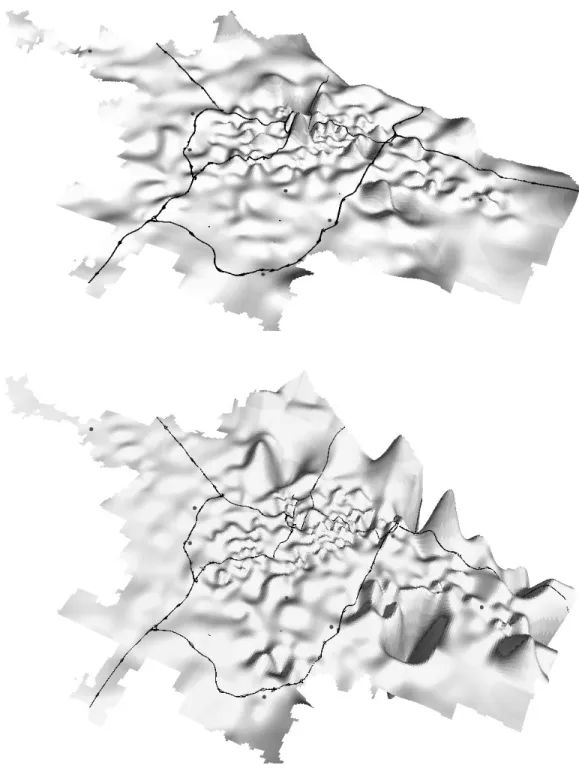
accessibility is expected to be relatively higher in areas near the CBD and regional centers(that is, Figure 6. Spatial patterns of individual accessibility (top) and urban opportunity density(bottom)
0-5 minutes, 15-20 minutes, and 30-35 minutes ring areas). Or, simply, the spatial pattern of individual accessibility would be similar to that of urban opportunity density.
Figure 6 shows the spatial patterns of individual accessibility (top) and urban opportunity density in Portland Metro. In order to visualize spatial variations in individual accessibility, ArcView 3D analyst functions were used with the accessibility value of WareaDur, creating a 3-dimensional continuous surface of accessibility. Values of the WareaDur acc- essibility measure were interpolated from points of individuals’home locations. The surface height basically reflects the level of accessibility of people residing in particular locations, rather than that of fixed places.
The spatial pattern of individual accessibility reveals that individual accessibility does not vary directly along with distance from the CBD and/or urban regional centers. And it is also clearly shown that it is not directly determined by the spatial pattern of urban opportunities. In other words, unlike the expectation of conventional accessibility measures, the spatial pattern of accessibility does not show any simple and clear relationship with the high concentrations of urban opportunities close to downtown Portland.
Neither downtown areas nor major regional centers are the significant places for people with high accessibility. Even some areas close to downtown Portland inside the loop show low accessibility levels. What is interesting from the spatial pattern of accessibility is that even more accessibility peaks as well as troughs are found at relatively peripheral areas rather than central areas. Additionally, such patterns do not show a noticeable association with the spatial pattern of urban opportunities. The result of this study
supports the findings of previous space-time accessibility research on the relationship between accessibility and proximity (Kwan, 1998; Weber and Kwan 2002; Weber 2003) and thus provides another empirical evidence of more limited effect of distance or neighborhood urban opportunity density in predicting spatial variations of individual accessibility within the urban area, compared to what has been expected by the spatial measures.
The fact that the accessibility pattern is not directly determined by the geographic environment- more specifically, geographic location of an individual’s home within a city or the level of urban opportunities within residential areas - indicates that people’s daily travel/activi- ty characteristics based on his/her own space- time constraints also considerably influence the accessibility pattern. Conventional accessibility measures are based on single reference location (especially, home) and assume that origin and destination of travels are the same. In this way, spatial measures expect that individual accessibility is a function of spatial proximity to the major urban opportunities like the CBD from the location of home becomes.
However, the role of such single-reference location and/or home-to-home travel in constructing space-time prisms and in turn individual accessibility values is found to be much less than expected, regardless gender.
Table 1 shows the composition of individual accessibility values by type of travel and locations where space-time prisms are made. It clearly shows that conventional accessibility measures, based on a single reference location and unlinked trip assumptions, are problematic to evaluate individual accessibility. Two-reference
location-based accessibility values predominantly contribute to the overall accessibility level of people (81.7% on average), whereas accessibility values based on a single-reference location only count 18% for the total population.
Home has been considered as a single reference point for conventional measures. When the importance of home is examined, the results suggest that such an assumption would render accessibility values measured by previous methods seriously unreliable. For example, home is strikingly the least influential location of origin in shaping the level of individual accessibility (14.8%). Accessibility values contributed by home-to-home trips, which conventional measures usually assume to be a typical trip pattern with a typical reference location, are just 9.1% of the total, whereas other travel and locational situations (e.g. work-to-work, work-to- home, daycare-to-home, work-to-daycare, etc.) count more than 90%. Yet, urban opportunities considerably far away from home could contribute more to the accessibility level than those close to home, since people’s accessibilit- ies are mostly affected by various meaningful nodes other than home, and is based on the strong tendency of linked-trips where the origin
and destination are not the same. These findings suggest that accessibility research should explicitly recognize the importance of various locations and situations on individual accessibility.
2) Gender differences in spatial patterns of individual accessibility
This section examines the remaining expectation addressed earlier - women and men who reside the same geographic area (in terms of the position within the city or neighborhood land use characteristics) would get the same individual accessibility level. If so, spatial patterns of individual accessibility of women and men should be similar.
However, the gender difference in spatial patterns of individual accessibility is clearly visible, as shown in Figure 7. High peaks of accessibility levels are scattered around the urban area in the case of women, whereas both high peaks and deep troughs are only found remote areas from the CBD (especially northern and eastern peripheral areas) for men. Such a distinctive difference in spatial variations of individual accessibility between women and men indicates that accessibility is not simply governed by the geographic location, proximity, or local Table 1. Composition of accessibility values by type of travel/location
Percentage of accessibility values
TOTAL Gender
Men Women
Number of reference points 100% 100% 100%
Single 18.3% 16.9% 20.3%
Two 81.7% 83.1% 79.7%
Travel Type 100% 100% 100%
Home as origin 14.8% 15.2% 14.3%
(Home-to-Home Travel) (9.1 %) (8.2 %) (10.4 %)
geographic properties; rather, it is affected by person-specific mobility and space-time feasibility to reach urban opportunities, given the
individual’s daily activity-travel schedule stemmed from personal, social, cultural norms, expectations, and so on.
Figure 7. Spatial patterns of individual accessibility: women(top) and men(bottom)
5. Summary and Conclusions
Using space-time accessibility measures, this study showed that the contribution of spatial proximity and local urban opportunity density in determining individual accessibility levels was in fact very minimal compared to what conventional spatial measures have expected. It should not be treated that the concept of individual accessibility is synonymous with that of spatial proximity. Spatial variations in individual accessibility are not directly determined by spatial proximity and opportunity density as suggested by previous accessibility measures. Furthermore, another expectation by spatial measures on travel behaviors which delimits individual accessibility - the single reference location and home-to-home unlinked travel - might render results by the spatial measures unrealistic and thus unreliable. This study clearly shows that such a particular type of travel and reference location does not play so much significantly role as expected by spatial measures in contributing an individual’s daily accessibility. In addition, this study showed that people living in the same area could have dramatically different accessibility levels. It implies that spatial variations in individual accessibility are more likely a function of individual characteristics (i.e. activity-travel schedules and situations), rather than a function of the residence location and land use characteristics around them.
So far, a significant number of studies have stressed the importance of multi-stop and multi- purpose trips in everyday life experiences of individuals (Burnett and Thrift, 1979), and, therefore, pointed out one of the critical weak points of previous measures, as they cannot
capture such behavioral characteristics in their formulation. However, no study has empirically examined and stressed the importance of the incorporation of such complex travel possibilities into the accessibility measure, and further possible gender differences in travel/activity situations in which the levels of accessibility are primarily determined. Previous individual accessibility studies have focused on the level of accessibility, but have not paid attention to the location/travel/activity contexts in which accessibility occurs. Therefore, this finding would be where this study can contribute to a body of accessibility research. In addition, time- geographic research has been conducted by Korean geographers in a quite narrow range:
most analyses have focused on exploring and visualizing activity-travel patterns based on space-time paths (Kim, 1997; Park, 2002; Park et al., 2005), but not accessibility utilizing the concept of space-time prisms. Therefore, this line of study could expand the scope of research based on time geography and furthermore suggests additional directions of linking GIS and spatial analysis in general, and linking time geography and accessibility analysis, particularly.
The research scope of this study is limited to the spatial examination on the limitations of conventional accessibility measures which are based on the notion of spatial proximity, the single reference location, and unlinked travel behaviors. This line of reserch needs to go beyond the identification of differences. Future research which can provide a deeper and more sophisticated understanding on underlying processes which makes individual accessibility becomes not simply a function of spatial proximity, and makes women and men encounter different accessibility experiences is in
need.
Notes
1) The activity-travel data sets include in-home activities as well as out-of-home activities which last longer than 30 minutes, and also include personal and household characteristics, and vehicle information.
References
Bach, L., 1981, The problem of aggregation and distance for analyses of accessibility and access opportunity in location-allocation models, Environment and Planning A, 13(8), 955-978.
Ben-Akiva, M., and Lerman, S.R., 1979, Disaggregate travel and mobility-choice models and measures of accessibility, in Hensher, D.A., and Stopher, P.R.(eds.), Behavioural Travel Modelling, Croom Helm. London, 654-679.
Breheny, M.J., 1978, The measurement of spatial opportunity in strategic planning, Regional Studies, 12, 463-479.
Burns, L. D., 1979, Transportation, Temporal, and Spatial Components of Accessibility, Lexington Books, Lexington.
Davidson, K.B., 1977, Accessibility in transport/land-use modeling and assessment, Environment and Planning A, 9, 1401-1416.
England, K., 1996, Mothers, wives, workers: the everyday lives of working mothers, in England, K.(ed.), Who Will Mind the Baby?, Routledge, London, 109-122.
Frost, M.E., and Spence, N.A., 1995, The rediscovery of accessibility and economic potential: The critical issue of self-potential, Environment and Planning A, 27(11), 1833-1848.
Hagerstrand, T., 1970, What about people in regional science?, Papers of the Regional Science
Association,24, 7-21.
Handy, S.L., and Niemeier, D.A., 1997, Measuring accessibility: An exploration of issues and alternatives, Environment And Planning A, 29(7), 1175-1194.
Hansen, W.G., 1959, How accessibility shapes land use, Journal of the American Planning Institute, 25, 73-76.
Hanson, S., 1995, Getting there: Urban transportation in context, in Hanson, S.(ed.), The Geography of Urban Transportation, 2nd edition, Guild-ford, New York, 3-25.
Ingram, D.R., 1971, The concept of accessibility: a search for an operational form, Regional studies, 5, 101-107.
Jones, S.R., 1981, Accessibility measures: a literature review, TRRL Laboratory Report 967, Transport and Road Research Laboratory.
Kim, H. M., and Kwan, M. P., 2003, Space-time accessibility measures: a geocomputational algorithm with a focus on the feasible opportunity set and possible activity duration, Journal of Geographical Systems, 5(1), 71-91.
Kim, S. M., 1997, A study on individual characteristics and daily activity of housewives in Kwangju city, Journal of the Korean Geographical Society, 39(2), 217-228.
Kondo, K., and Kitamura, R., 1987, Time-space constraints and the formation of trip chains, Regional Science and Urban Economics, 17(1), 49-65.
Kwan, M.P., 1998, Space-time and integral measures of individual accessibility: A comparative analysis using a point-based framework, Geographical Analysis, 30(3), 191-216.
Kwan, M.P., 1999a, Gender and individual access to urban opportunities: A study using space-time measures, Professional Geographer, 51(2), 210- 227.
Kwan, M.P., 1999b, Gender, the home-work link, and space-time patterns of non-employment activities, Economic Geography, 75(4), 370-394.
Kwan, M.P., Murray, A.T., O’Kelly, M., and Tiefelsdorf,
M., 2003, Recent Advances in Accessibility Research: Representation, Methodology and Applications, Journal of Geographical Systems, 5(1), 129-138.
Kwan, M.P., and Weber, J., 2003, Individual accessibility revisited: Implications for geographical analysis in the twenty-first century, Geographical Analysis, 35(4), 341-353.
Lenntorp, Bo, 1976, Paths in Space-Time Environments:
A Time-Geographic Study of Movement Possibilities of Individuals, Lund Series of Geography Series B Human Geography, No.44, The Royal University of Lund, Sweden.
Miller, H.J., 1991, Modelling Accessibility Using Space- Time Prism Concepts within Geographic Information Systems, International Journal of Geographical Information Systems, 5(3), 287- 301.
Newsome, T.H., Walcott, W.A., and Smith, P.D., 1998, Urban activity spaces: Illustrations and application of a conceptual model for integrating the time and space dimensions, Transportation, 25(4), 357-377.
Nishii, K., and Kondo, K., 1992, Trip linkages of urban railway commuters under time-space con straints: some empirical observations, Transpo- rtation Research B, 26, 33-44.
Palm, R. and Pred, A., 1974, A Time-Geographic Perspective on Problems of Inequality for Women, Working Paper No.236, University of California, Berkley, Institute of Urban and Regional Development, Berkeley, CA.
Park, K. H., Ahn, J. S., and Lee, Y. W., 2005, Geovisualization Environment for Spatio - temporal Trajectory of Personal Activity, Journal of the Korean Geographical Society, 40(3), 310- 320.
Park, S. H., 2002, The spatio-temporal characteristics of primary school children’s daily life activities, Journal of the Korean Association of Regional Geographers, 8(4), 492-512.
Pickup, L., 1984, Women’s gender-role and its influence on their travel behaviour, Built Environment,
10, 61-68.
Pickup, L., 1985, Women's travel need in a period of rising female employent, in Ansen, G.R.M., Nijkamp, P., and Ruijgrok, C.J.(eds.), Transportation and Mobility in an Era of Transition, North Holland, Amsterdam, 97-113.
Pickup, L., 1989, Women's travel requirements:
employment, with domestic constraints, in Grieco, M., Pickup, L., and Whipp, R.(eds.), Gender, Transport, and Employment: the Impact of Travel Constraints, Avebury, Aldershot, 199- 221.
Pooler, J., 1987, Measuring geographical accessibility: a review of current approaches and problems in the use of population potentials, Geoforum, 18(3), 269-289.
Recker, W.W., McNally, M.G., and Root, G.S., 1986a, A Model of complex travel behavior: Part I- Theoretical development, Transportation Research Part A-Policy and Practice, 20(4), 307- 318.
Recker, W.W., McNally, M.G., and Root, G.S., 1986b, A Model of complex travel behavior: Part II-an operational model, Transportation Research Part A-Policy and Practice, 20(4), 319-330.
Richardson, A.J., and Young, W., 1982, A measure of linked-trip accessibility, Transportation Planning and Technologies, 7, 73-82.
Taaffe, E.J., and Gauthier, H.L., and O’Kelly, M., 1996, Geography of Transportation,: Prentice Hall, Englewood Cliffs.
Tivers, J., 1985, Women Attached: The Daily Lives of Women with Young Children, Croom Helm, London.
Turner, T., and Niemeier D., 1997, Travel to work and household responsibility: new evidence, Transportation, 24(4), 397-419.
Turner, J., and Grieco, M., 2000, Gender and time poverty: the neglected social policy implications of gendered time, transport and travel, Time &
Society, 9(1), 129-136.
Vickerman, R.W., 1974, Accessibilty, attraction, and potential: a review of some concepts and their
use in determining mobility, Environment and Planning A, 6, 675-691.
Villoria, O.G., 1989, An Operational Measure of Individual Accessibility for Use in the Study of Travel-Activity Patterns, Ph.D. Dissertation, The Ohio State University.
Wachs, M., and Kumagai, T.G., 1973, Physical accessibility as a social indicator, Socio- Economic Planning Science, 7, 437-456.
Weber, J., 2003, Individual accessibility and distance from major employment centers: an examination using Space-time measures, Journal of Geographical Systems, 5, 51-70.
Weber, J. and Kwan, M.P., 2002, Bringing time back in:
a study on the influence of travel time variations and facility opening hours on individual accessibility, Professional Geographer, 54(2), 226-240.
Weber, J. and Kwan, M.P., 2003, Evaluating the effects of geographic contexts on individual accessibility: A multilevel approach, Urban Geography, 24(8), 647-671.
Correspondence: Hyun-Mi Kim, Department of Geography Education, Seoul National University, San56-1, Shillim-Dong, Kwanak-Gu, Seoul, 151-742, Korea (e-mail: [email protected])
교신:김현미, 151-742 서울시 관악구 신림동 산56-1 서울대 학교 지리교육과 (이메일: [email protected])
Received December 12, 2005 Accepted December 20, 2005