The Impact of Perfectionism and Academic Resilience on Subjective Well-being among Korean Undergraduate Students
Ko, Eun1) · Kim, Hye Young2) · Kang, Hee Sun1)
1)Associate Professor, Department of Nursing, College of Life Science and Natural Resources, Sunchon National University, Suncheon
2)Professor, College of Nursing ․ Research Institute of Nursing Science, Jeonbuk National University, Jeonju, Korea
Purpose: This study aimed to investigate the correlation among perfectionism, academic resilience and subjective well-being in order to identify factors that affect subjective well-being in Korean undergraduate students. Methods: This study is a descriptive study. This study was performed on 245 students currently studying in a national university in S city.
A structured questionnaire was used to collect data regarding the multidimensional perfectionism scale, the academic resilience scale, and the subjective well-being scale. Collected data were analyzed using descriptive statistics, Pearson's correlation coefficient and stepwise linear multiple regression with SPSS 25.0 for Windows. Results: Participants’ scores for self-oriented perfectionism (SOP), other-oriented perfectionism (OOP), and socially prescribed perfectionism (SPP), academic resilience and subjective well-being were 64.64±12.78, 53.62±8.90, 56.98±8.96, 92.60±19.55, and 82.93±9.72, respectively. SPP showed a negative correlation with subjective well-being (r=- .27, p<.001), while academic resilience showed a positive correlation with subjective well-being (r=.20, p=.001). Satisfaction with school life, SPP, and academic resilience were identified as factors influencing subjective well-being and explained about 22% of the variance in subjective well-being. Conclusion: This study suggests that we need to identify various factors influencing subjective well-being and accordingly develop nursing interventions to improve undergraduate students’ subjective well-being.
Key Words: Perfectionism; Resilience, psychological; Subjective health; Universities; Students
Corresponding author: Kim, Hye Young
College of Nursing, Jeonbuk National University, 567 Baekje-daero, Deokjin-gu, Jeonju 54896, Korea.
Tel: +82-63-270-4618, Fax: +82-63-270-33127, E-mail: [email protected] Received: Nov 4, 2019 / Revised: Feb 10, 2020 / Accepted: Feb 10, 2020
INTRODUCTION
Korean undergraduate students have difficulties such as financial burdens related to tuition and living expenses, pressure for purposeless qualification boosting, identity crisis, difficulty in forming bonds due to lack of emotional buffer zone. In addition, the number of Korean under- graduate students suffering from depression due to aca- demic and employment stress increased by 22% compared to 2017 (University News Network, 2018). Recently, as the interest in and subjective judgement on the quality of life of an individual is increasing, various terms, such as subjective quality of life, life satisfaction, happiness, and subjective well-being are being used (Diener et al., 2017). Higher sub- jective well-being means high levels of positive emotions, such as life satisfaction, happiness and pleasure, and low levels of negative emotions, such as depression and anxi- ety (Jeong, 2019). Korean undergraduate students are re- ported to have significantly lower subjective well-being than American undergraduate students (Koo & Suh, 2015).
Perfectionism has a multidimensional attributes. Self-ori- ented perfectionism establishes high standards for oneself and strictly evaluates and criticizes oneself according to them, while other-oriented perfectionism establishes high standards for others who are important to oneself and strictly evaluates them. In socially-prescribed perfection- ism, high standards are imposed and evaluated by others and people think they will be rejected if they fail to meet their standard (Hewitt, Flett, Turnbull-Donovan, & Mikail, 1991). Many of previous studies reported positive and negative aspects, and functional and dysfunctional as- pects of these perfectionism. Perfectionism is related with maladaptive emotion by raising depression and anxiety level and increasing stress (Im & Shim, 2015). In contrast, perfectionism improves the individual’s self-es- teem and self-efficacy (Chun & Song, 2012; Ma & Kim, 2015) and psychological well-being, life satisfaction, and positive affect in their life (Hill, Huelsman, & Araujo, 2010). Also, Perfectionism shows excellent ability in per- formance. It is related to hope of success, motivation for
school, school achievement, and academic performance in students (Stoeber & Rambow, 2007).
Resilience is a dynamic process that exerts positive adaptive capacity in various stressful situations (Fergus &
Zimmerman, 2005), leading to positive psychological well-being and increasing it psychological well-being by mediating negative emotions such as depression and an- ger (Windle, Bennett, & Noyes, 2011). Resilience is divided into ego resilience, family resilience, and academic resil- ience because it is necessary to identify resilience within various social relationships such as family and school (Kim, 2016). Previous studies that confirmed the resilience of undergraduate students had a limitation that they mainly deal with ego resilience aspects such as individual traits and characteristics alone (Kilbert et al., 2014). For un- dergraduate students, it is important to identify academic resilience that takes into account the environmental con- text surrounding them, rather than ego resilience that re- flects the individual’s traits (Kim, 2016). In recent years, in- terest in academic resilience of undergraduate students has increased, but there are not many previous studies and there is no consistent result. Academic resilience shows weakly positive correlation with subjective happiness of undergraduate students (Park & Kwon, 2018), and aca- demic resilience of nursing students is an influencing fac- tor of psychological well-being (Jin & Kim, 2017). Howev- er, there is a lack of study that confirms the relationship among perfectionism, academic resilience and subjective well-being in undergraduate students.
Therefore, this study is designed to investigate the ef- fects of perfectionism and academic resilience on sub- jective well-being of undergraduate students. The specific objectives to achieve our study's goal are as follows: 1) to measure the degree of perfectionism, academic resilience and subjective well-being of the individual subjects; 2) to examine differences in subjective well-being by the gen- eral characteristics of the subjects; 3) to test correlations among perfectionism, academic resilience and subjective well-being; and 4) to find out factors that affect the sub- jective well-being of the subjects. Furthermore, this study aims to provide basic data for development of interven- tion programs to promote subjective well-being of under- graduate students.
METHODS
1. DesignThis study is a descriptive research study to investigate the effect of perfectionism and academic resilience on the
subjective well-being in Korean undergraduate students.
2. Participants
This survey was carried out in one National University located in S city. The participants of this study is 245 stu- dents who are currently studying in Liberal Arts and Culture Center of the university and voluntarily showed interest in participating in the study.
To determine the sample size, G*power 3.1.9, a stat- istical power calculation program based on Cohen’s sam- pling formula was used. As a result of calculating with a two-tailed significant level of .05 for multiple regression analysis, an effect size=.12, and a statistical power=.95, number of predictors=13, and the minimum sample size was 233. A total of 255 questionnaires were distributed in consideration of the dropout rate of 10% of the subjects, and 248 questionnaires were returned (response rate 97.3
%). Of these, 245 parts were used for the final analysis, ex- cept for 3 with insufficient responses, to ensure a sufficient number of samples.
3. Measurements 1) Perfectionism
Perfectionism was measured using Korean version (Han, 1993) modified version of Multidimensional Perfection- ism Scale (MPS) developed by Hewitt et al.(1991). This tool has been verified for its validity. This scale consisted of total of 45 items that are sub-divided into 3 categories, such as 15 items on self-oriented perfectionism (SOP), 15 items on other-oriented perfectionism (OOP), and 15 items on so- cially prescribed perfectionism (SPP). Each item was meas- ured with Likert’s 7-point scale, ranging from ‘strongly disagree’ being 1 point to ‘strongly agree’ being 7 points.
Higher score meant higher tendency of perfectionism.
The reliability of the tool at the time of development was Cronbach’s=.85, that of Korean version of MPS was Cronbach’s=.91, and that of this study was Cronbach’s=
.89, 73, and 75 for SOP, OOP, and SPP, respectively.
2) Academic resilience
Academic resilience was measured by using academic resilience tool developed by Kim (2008). Before adapting this tool, usage of this tool has been approved by the de- veloper via email. This tool consisted of total of 29 items, which were 5 items on learning control, 5 items on friend support, 6 items on self-control, 5 items on positive atti- tude, 4 items on task responsibility and 4 items on parent support. Each item was measured with Likert's 5-point
scale, ranging from ‘strongly disagree’ getting 1 point to
‘strongly agree’ 5 points. The higher the score is the higher the academic resilience. The reliability of the tool at the time of development was Cronbach’s=.75 and that of this study was Cronbach’s=.94.
3) Subjective well-being
Subjective well-being was measured by using a tool de- veloped by Bak and Hong (2004). Before adapting this tool, usage of this tool has been approved by the developer via email. This tool consisted of 30 items, where 7 items were on positive emotional well-being, 4 items on neg- ative emotional well-being, 6 items on positive affect well-being, 8 items on negative affect well-being and 5 items on interpersonal relation well-being. Each category measured positive and negative status. Each item was mea- sured with Likert’s 4-point scale, ranging from ‘strongly disagree’ being 1 point to ‘strongly agree’ being 4 points.
The 4 items on negative emotional well-being and 8 items on negative affect well-being were statistically analyzed by inversion. The higher the score is the higher the sub- jective well-being. The reliability of the tool at the time of development was Cronbach’s=.74 and that of this study was Cronbach’s=.89.
4. Data Collection and Ethical Consideration
This paper was conducted after the ethical approval by the institutional review board at S University (IRB No.
1014173-201805-HR-013-02). Data were collected from stu- dents who were currently enrolled and voluntarily showed interest in study participation. Data collection was con- ducted from July to September in 2018. The researchers ex- plained the purpose of the study to charge of Liberal Arts and Culture Center at the university, and posted a notice for recruiting the subjects on the Liberal Arts classroom’s bulletin board located at each college. The subjects of this study were university students who voluntarily stated their intention to participate in the study. Before giving out questionnaire, the purpose and the necessity of the study, confidentiality and privacy protection, and usage of collected data as only for research purposes were ex- plained to all participants. Furthermore, the participants have been fully informed on the fact that there will be no disadvantages for not participating in the study, and that the participation can be withdrawn at any time without any disadvantages on the participant's side. After full ex- planation, the participants were informed of the purpose of the study, signed a written agreement form, and were asked to fill out a self-report questionnaire.
The questionnaire was filled out by participants in a comfortable setting. The participant sealed completed questionnaire and put it in the collection box located in the liberal arts classrooms. The questionnaire took about 15 minutes to complete for each participant.
5. Data Analysis
The collected data were analyzed using SPSS/WIN 25.0 (SPSS Inc., Chicago, IL, USA) program. Participants' gen- eral characteristics, perfectionism, academic resilience and subjective well-being were analysed by finding their fre- quencies, percentages, means, standard deviations, rang- es, minimum and maximum values, skewness, and kurto- sis. Differences in subjective well-being levels according to participants’ general characteristics were analyzed using the independent t-test, one-way ANOVA, and post hoc Scheffé test. The relationship among the variables were calculated using Pearson correlation coefficient, while the factors that affect subjective well-being were analyzed us- ing stepwise linear multiple regression. As for the sig- nificance level of the tests, it was proved to be significant (p<.05).
RESULTS
1. General Characteristics of the Participants
The participants’ mean age was 21.41±1.95 (range: 19
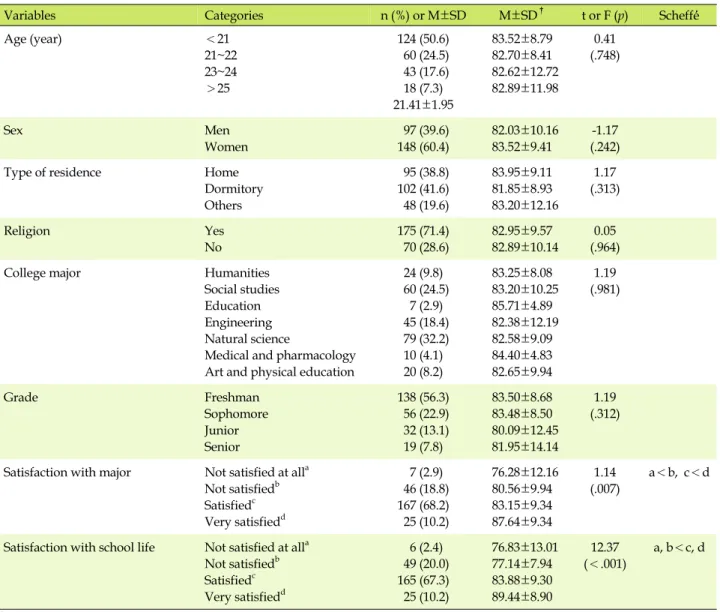
~31); with 97 (39.6%) men and 148 women (60.4%); 102 (41.6%) lived in dormitory; 175 (71.4%) had a religion. In terms of the school years, 138 (56.3%) was in their 1st year and 56 (22.9%) was in 2nd year. In terms of the partic- ipants’ college majors, 79 (32.2%) was from college of nat- ural science, 60 (24.5%) was from college of social studies, 45 (18.4%) was from college of engineering, and 24 (9.8%) was college belonged to college of humanities. And 192 (78.4%) of participants reported that their major is either
“satisfied” or “very satisfied”. Further, 190 (77.5%) of par- ticipants reported about their school life being either
“satisfied” or “very satisfied”(Table 1).
2. Degree of Perfectionism, Academic Resilience and Subjective Well-being of the Participants
The participants’ average total score for SOP was 64.64
±12.78 points; 53.62±8.90 for OOP; 56.98±8.96 for SPP.
The average total score for academic resilience were 92.60
±19.55. The average total score for subjective well- being was 82.93±9.72. The skewness and kurtosis of the varia-
Table 1. Differences in Subjective Well-being by General Characteristics (N=245)
Variables Categories n (%) or M±SD M±SD† t or F (p) Scheffé́́
Age (year) <21
21~22 23~24
>25
124 (50.6) 60 (24.5) 43 (17.6) 18 (7.3) 21.41±1.95
83.52±8.79 82.70±8.41 82.62±12.72 82.89±11.98
0.41 (.748)
Sex Men
Women
97 (39.6) 148 (60.4)
82.03±10.16 83.52±9.41
-1.17 (.242)
Type of residence Home
Dormitory Others
95 (38.8) 102 (41.6) 48 (19.6)
83.95±9.11 81.85±8.93 83.20±12.16
1.17 (.313)
Religion Yes
No
175 (71.4) 70 (28.6)
82.95±9.57 82.89±10.14
0.05 (.964)
College major Humanities
Social studies Education Engineering Natural science
Medical and pharmacology Art and physical education
24 (9.8) 60 (24.5)
7 (2.9) 45 (18.4) 79 (32.2) 10 (4.1) 20 (8.2)
83.25±8.08 83.20±10.25
85.71±4.89 82.38±12.19
82.58±9.09 84.40±4.83 82.65±9.94
1.19 (.981)
Grade Freshman
Sophomore Junior Senior
138 (56.3) 56 (22.9) 32 (13.1) 19 (7.8)
83.50±8.68 83.48±8.50 80.09±12.45 81.95±14.14
1.19 (.312)
Satisfaction with major Not satisfied at alla Not satisfiedb Satisfiedc Very satisfiedd
7 (2.9) 46 (18.8) 167 (68.2) 25 (10.2)
76.28±12.16 80.56±9.94 83.15±9.34 87.64±9.34
1.14 (.007)
a<b, c<d
Satisfaction with school life Not satisfied at alla Not satisfiedb Satisfiedc Very satisfiedd
6 (2.4) 49 (20.0) 165 (67.3) 25 (10.2)
76.83±13.01 77.14±7.94 83.88±9.30 89.44±8.90
12.37 (<.001)
a, b<c, d
†Analysis of differences in subjective well-being by general characteristics.
bles did not digress widely from the assumption of normal distribution, as their absolute values were within the ±1 range (Table 2).
3. Subjective Well-being according to General Character- istics of the Participants
Analysis of differences in subjective well-being based on general characteristics showed no significant difference by age (F=0.41, p=.748), gender (t=-1.17, p=.242), type of residence (F=1.17, p=.313), religion (t=0.05, p=.964), col- lege major (F=1.19, p=.981), or school year (F=1.19, p=.312) (Table 1).
Meanwhile, analysis of subjective well-being based on general characteristics did show significant differences re- garding participants’ satisfaction with major (F=1.14, p=.007)
and satisfaction with school life (F=12.37, p<.001) (Table 1).
4. Relationship between the Variables of the Participants Subjective well-being had a weak negative relation with SPP (r=-.27, p<.001), but was not statistically significant with SOP (r=-.01, p=.877) and OOP (r=-.09, p=.152). Sub- jective well-being had a weak positive relation with each of the subscale and total score of academic resilience with statistical significance. In other words, subjective well-be- ing was negatively correlated with academic control (r=
.14, p=.035), friend’s support (r=.17, p=.009), self-control (r=.14, p=.030), positive attitude (r=.23, p<.001), task re- sponsibility (r=.16, p=.011), parent’s support (r=.15, p=
.016), and total score (r=.20, p<.001)(Table 3).
Table 2. Degree of Perfectionism, Academic Resilience and Subjective Well-being (N=245)
Variable M±SD Min Max Possible range Skewness Kurtosis
Perfectionism SOP OOP SPP
64.64±12.78 53.62±8.90 56.98±8.96
27.00 29.00 34.00
98.00 79.00 89.00
15~105 15~105 15~105
0.12 -0.16 0.12
0.17 -0.04 0.40 Academic resilience
Academic control Friend's support Self-control Positive attitude Task responsibility Parent's support
92.60±19.55 15.53±3.83 16.12±4.37 19.54±5.25 15.90±3.86 12.91±3.34 12.61±3.58
45.00 7.00 6.00 6.00 6.00 4.00 4.00
143.00 25.00 25.00 30.00 25.00 20.00 20.00
29~145 5~25 5~25 6~30 5~25 4~20 4~20
-0.18 0.07 -0.10 -0.20 -0.06 -0.33 -0.09
-0.25 -0.24 -0.65 -0.57 -0.25 -0.49 -0.55 Subjective WB
Positive emotional WB Negative emotional WB Positive efficacy WB Negative efficacy WB Interrelationship WB
82.93±9.72 20.59±3.45 9.11±1.99 16.56±2.72 21.07±3.54 15.59±2.48
52.00 10.00 4.00 6.00 11.00 7.00
113.00 28.00 15.00 24.00 31.00 20.00
30~120 7~28 4~16 6~24 8~32 5~20
-0.01 0.03 0.07 -0.06 0.01 -0.34
0.41 0.03 0.15 0.49 0.15 0.29 SOP=Self-oriented perfectionism; OOP=Other-oriented perfectionism; SPP=Socially prescribed perfectionism; WB=Well-being.
Table 3. Correlation of Perfectionism, Academic Resilience and Subjective Well-being (N=245)
Variables
Perfectionism Academic resilience
SOP OOP SPP Academic
control
Friend's support
Self- control
Positive attitude
Task responsibility
Parent's
support Total
r (p) r (p) r (p) r (p) r (p) r (p) r (p) r (p) r (p) r (p)
Subjective well-being
-.01 (.877)
-.09 (.152)
-.27 (<.001)
.14 (.035)
.17 (.009)
.14 (.030)
.23 (<.001)
.16 (.011)
.15 (.016)
.20 (<.001) SOP=Self-oriented perfectionism; OOP=Other-oriented perfectionism; SPP=Socially prescribed perfectionism.
5. Factors affecting Subjective Well-being of the Partici- pants
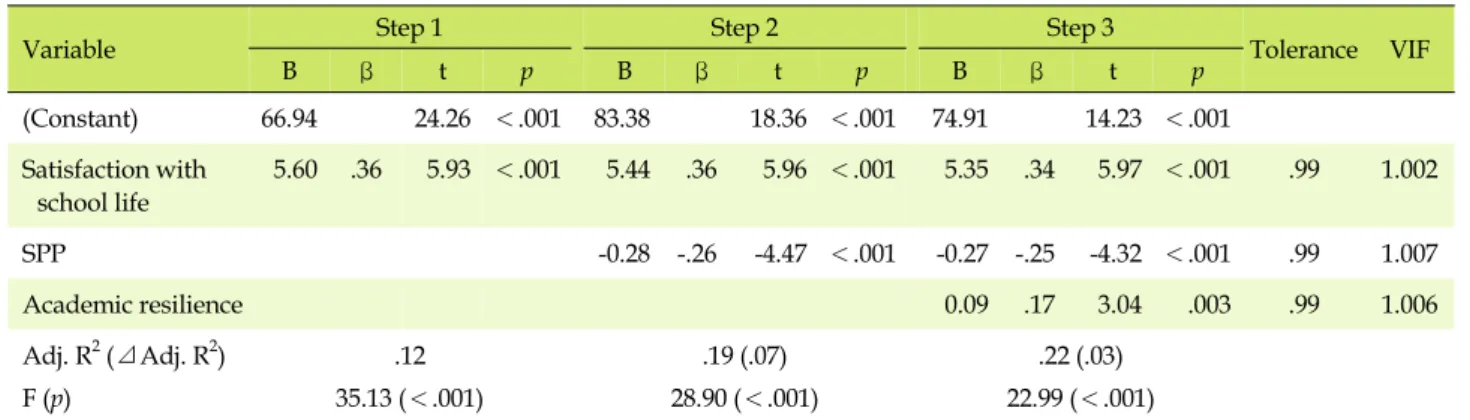
Stepwise linear multiple regression was performed by SSP, academic resilience and general characteristics that were significantly associated with subjective well-being as the independent variables to identify the factors that can affect the subjective well-being of the participants.
In order to test the assumption of linear regression anal- ysis, normality and multicollinearity among all variables were checked. To check for multicollinearity among the independent variables for the multiple regression analy- sis, variation inflation factors (VIF) were calculated, with the range of the VIFs between the variables being de- termined as 1.002 ~1.007; VIF values under 10 indicated an absence of multicollinearity. The Durbin-Watson statistic was 2.04, indicating that the error terms were independent from each other, without any autocorrelation. So it is suffi- cient to satisfy the assumption for multiple regression analysis.
The stepwise linear multiple regression analysis showed that the participants’ satisfaction with school life (β=.34, p<.001), SSP (β=-.25, p<.001) and academic resilience (β= .17, p=.003) explained approximately 22% of subjective well-being (F=22.99, p<.001) (Table 4).
The scattering of the standardized residuals and the uniformity of the residuals through the P-P plot and the normality were examined. As a result of verifying the sin- gular value, the standardized residual was less than the absolute value of 3, and it was confirmed that there was no singular value because the range of Cook’s distance did not exceed the absolute value of 1.
DISCUSSION
This study was performed to investigate the relation- ship among perfectionism, academic resilience and sub- jective well-being, and to identify the factors that affect subjective well-being. In this study’ results, SPP and aca- demic resilience was influencing factors that affect sub-
Table 4. Factors Affecting Subjective Well-being (N=245)
Variable Step 1 Step 2 Step 3
Tolerance VIF
B β t p B β t p B β t p
(Constant) 66.94 24.26 <.001 83.38 18.36 <.001 74.91 14.23 <.001
Satisfaction with school life
5.60 .36 5.93 <.001 5.44 .36 5.96 <.001 5.35 .34 5.97 <.001 .99 1.002
SPP -0.28 -.26 -4.47 <.001 -0.27 -.25 -4.32 <.001 .99 1.007
Academic resilience 0.09 .17 3.04 .003 .99 1.006
Adj. R2(⊿Adj. R2) .12 .19 (.07) .22 (.03)
F (p) 35.13 (<.001) 28.90 (<.001) 22.99 (<.001)
SPP=Socially prescribed perfectionism; VIF=Variance inflation factors.
jective well-being.
The SOP, OOP, and SPP of undergraduate students was 64.64 (mean score 4.31), 53.62 (mean score 3.57), and 56.98 (mean score 3.80). The perfectionism in this study was low compared with the results of previous studies (Kilbert et al., 2014; Moon, 2012). Perfectionism of nursing students showed that SOP was 4.89 and SPP was 4.27 (Noh, 2017), and OOP of female college students was 61.17 (Moon, 2012). SOP for undergraduate students was 4.63, and SPP for undergraduate was 4.05 (Ma & Kim, 2015). Perfection- ism can be developed by realistic external situations ex- posed to the individual (Han, 1993). Therefore, students' learning environment and required attitude will be differ- ent according to the characteristics of each major field. As the grade increases, the degree of exposure to major study increases, so the difference may become more obvious.
Other previous studies were targeted to students of specif- ic majors (Kilbert et al., 2014; Noh, 2017), but in this study, students of various majors participated as subjects, and students in first and second grades accounted for most of the subjects. For this reason, the results of this study were different from the previous studies. So, in the environ- mental factors, it is necessary to confirm the difference in perfectionism perceived by the subject according to the characteristics of each major’s curriculum. We need to conduct longitudinal research to find out how one’s per- fectionism changes along time.
On the other hand, the SOP was the highest among the three types of perfectionism in this study. SOP values the importance of being perfect in dealing with or setting goals (Hewitt et al., 1991), which is a reflection of the pos- itive aspects of college students in this study who set goals and do their best to achieve their goals. This supports the study result that SOP is higher than SPP in undergraduate students with medicine-related majors (Chun & Song, 2012). Considering the various characteristics of the par-
ticipants, we need to compare the degree of SPP, OPP, and SPP, and to study how to reinforce their adaptive and func- tional aspects.
The academic resilience in the participants of this study was 92.60 (mean score 3.19). This was higher than Park and Kwon’s (2018) finding that the academic resilience of college students, measured by the same instrument, ranged from 62.~73.0 points. On the other hand, it was lower than the studies that reported the academic resilience of nurs- ing students, which are 3.77 (Noh, 2017), 3.66 (Jin & Kim, 2017), and 3.39 (Shin, 2016) respectively. Academic resil- ience decreases with lower satisfaction with the major (Jin
& Kim, 2017), and students with high academic resilience have high motivation to study and are positive in college life (Park & Lee, 2015). Academic resilience also has an ef- fect on controlling the relationship between academic stress and burnout (Lee, 2014) but didn’t have moderating effect between academic stress and depression in nursing students (Shin, 2016). Academic resilience can be influ- enced by various factors such as college life, major, and learning method, but these factors are not controlled, and the results of the study seem to be different. Therefore, it is necessary to fully consider these various characteristics of the research subjects when examining the academic resil- ience of university students. In addition, since academic resilience is a positive factor in adaptation to college life, it is necessary to pay attention to academic resilience and prepare various strategies to increase it.
The subjective well-being in the participants of this study was 82.93 (mean score 2.76), which was similar to the study results where psychological well-being of the nursing students was 2.73, although they used different measurement tools (Jin & Kim, 2017). Jeong (2019) meas- ured the subjective well-being of college students with positive and negative emotions, with 2.65 points and 2.25 points, respectively, which showed lower affirmations
than adult learners. Koo and Suh (2015) found that Korean college students had lower subjective well-being than American college students. As there are differences in mea- surement tools by each studies, direct comparisons are difficult. However, Korean university students experience a lot of negative emotions while experiencing anxiety and uncertainty about the future (Jeong, 2019), and the unhap- piness due to increasing youth unemployment. It seems that subjective well-being is not expected to be high in this threatening situation. Also, there was a significant differ- ences regarding participants’ satisfaction with major and satisfaction with school life. This supports the study that undergraduate students are more satisfied with their overall life and experience positive emotions when their school life is satisfactory (Kim & Lee, 2013). People with high subjective well-being are known to have more pos- itive moods or emotions in their daily lives and to have good problem-solving ability and social relationships (Lee, 2013). Therefore, it is necessary to pay more attention to the subjective well-being, which can provide a healthier and positive perspective for the college students who choose and prepare their own careers, by encouraging their efforts, for example.
The subjective well-being of the participants had neg- ative relation with perfectionism, while it had positive re- lation with academic resilience. This supports a study that showed SPP and subjective well-being were negatively re- lated with significance (Kim & Lee, 2013), and another study that showed a positive correlation between academ- ic resilience and happiness of college students (Park &
Kwon, 2018). Satisfaction with school life, SPP, and aca- demic resilience were identified as factors influencing sub- jective well-being and explained about 22.3% of the vari- ance in subjective well-being. The results of this study par- tially supported the results of SOP and SPP significantly predicting subjective well-being (Jin & Seo, 2014). In the case of nursing students, academic achievement and sat- isfaction with major had an effect on subjective well-being (Jun, Cha, & Lee, 2015). SPP is a property that others are considered to have high standards and rigorously eval- uate themselves according to those standards, with fear that they might be rejected if they do not meet them (Hewitt et al., 1991). It is known to make one experience more negative emotions, such as depression, anxiety, low self-esteem, and fear of negative feedback (Kilbert et al., 2014; Smith, Saklofske, & Yan, 2015). On the other hand, in the present study, SOP was not identified as an influenc- ing factor of subjective well-being. If the SOP is high, uni- versity students may experience stress due to the differ- ence between their reality and their goals, but they may
feel that they can solve this stress if they perceive that they have enough support (Cho & Lim, 2018). In addition, Cho and Lim (2018) reported that university students experi- enced less test anxiety, even with higher SOPs, but with higher academic self-efficacy. Therefore, researchers should identify the causal relationship between academic resil- ience when identifying perfectionism and subjective well- being. And also, variable such as social support perceived by university students need to be considered as an influ- encing factor of subjective well-being.
Based on the results of this study, it is necessary to focus on academic resilience and SPP of undergraduate students and develop a plan to increase the academic resilience and moderate SPP when planning nursing intervention for the promotion of subjective well-being of undergraduate stu- dents. Further studies would need to expand the partic- ipants and identify perfectionism, academic resilience and subjective well-being by reflecting the various psychoso- cial and environmental characteristics. In addition, we pro- pose a longitudinal study that identifies and tracks the change of these variables from 1st year through 4th year, and a study that develops and applies the intervention program that can facilitate subjective well-being in the un- dergraduate students.
A limitation of this study was a cross-sectional survey to investigate perfectionism, academic resilience and sub- jective well-being in participants. And in this study, data were collected by convenience sampling in one university located S city in South Korea, so it should be taken care- fully not to expand the interpretation of the results.
CONCLUSION
The purpose of this study was to examine the degree of perfectionism, academic resilience, and subjective well- being of college students, and to examine the relationships among these variables to provide basic data to enhance their subjective well-being. As a result, university students’
satisfaction with college life, SPP and academic resilience were found to be factors influencing their subjective well- being. Therefore, when planning an intervention program to increase the subjective well-being of college students, a strategy to enhance university life satisfaction and acade- mic resilience is needed, and to strengthen the positive as- pects of perfectionism by adjusting the SPP is also recom- mended.
Based on the results of this study, we propose a repeated study that considers various demographic variables and expands the subjects. We propose a study to identify the causal relationships among SOP, OOP, SPP and subjective
well-being, and suggest an interventional study that can contribute to enhancing the subjective well-being of col- lege students.
REFERENCES
Bak, B. G., & Hong, S. P. (2004). Development and validation of a subjective well-being scale. The Korean Journal of Educational Psychology, 18(3), 159-175.
Cho, B. Y., & Lim, Y. J. (2018). The moderating effects of academic self-efficacy and perceived emotional support on the rela- tionship between self-oriented perfectionism and test anxi- ety of university students. Korean Journal of Youth Studies, 25(8), 159-179.
https://doi.org/10.21509/kjys.2018.08.25.8.159
Chun, K. H., & Song, Y. M. (2012). The effects of achievement goal orientation and perfectionism on self-efficacy and achieve- ment of medical students. Korean Journal of Educational Re- search, 50(4), 107-132.
Diener, E., Heintzelman, S. J., Kushlev, K., Tay, L., Wirtz, D., Lutes, L. D., et al. (2017). Findings all psychologists should know from the new science on subjective well-being. Canadian Psy- chology, 58(2), 87-104.
https://doi.org/10.1037/cap0000063
Fergus, S., & Zimmerman, M. A. (2005). Adolescent resilience: A framework for understanding healthy development in the face of risk. Annual Review of Public Health, 26, 399-419.
https://doi.org/10.1146/annurev.publhealth.26.021304.144 357
Han, K. Y. (1993). On multidimentional perfectionism-concept, assess- ment, and it's relation with maladjustment. Unpublished doc- toral dissertation, Korea University, Seoul.
Hewitt, P. L., Flett, G. L., Turnbull-Donovan, W., & Mikail, S. F.
(1991). The multidimensional perfectionism scale: Reliability, validity, and psychometric properties in psychiatric samples.
Psychological Assessment: A Journal of Consulting and Clinical Psychology, 3, 464-468.
https://doi.org/10.1037/1040-3590.3.3.464
Hill, R. W., Huelsman, T. J., & Araujo, G. (2010). Perfectionistic concerns suppress associations between perfectionistic striv- ings and positive life outcomes. Personality and Individual Dif- ferences, 48(5), 584-589.
https://doi.org/10.1016/j.paid.2009.12.011
Im, K. H., & Shim, E. J. (2015). The relationship between malad- aptive perfectionism and fatigue: The mediating role of de- pression and anxiety. The Korean Journal of Health Psychology, 20, 139-159.
Jeong, E. (2019). Effects of grit and everyday creativity on sub- jective well-being for adult learners and college students.
Journal of Learner-Centered Curriculum and Instruction, 19(16),
163-192. https://doi.org/10.22251/jlcci.2019.19.16.163 Jin, J. I., & Kim, N. C. (2017). Grit, academic resilience, and psycho-
logical well-being in nursing students. The Journal of Korean Academic Society of Nursing Education, 23(2), 175-183.
https://doi.org/10.5977/jkasne.2017.23.2.175
Jin, S. Y., & Seo, S. G. (2014). The effects of dimension and do- main-specific perfectionism on the happiness. The Korean Journal of Counseling and Psychotherapy, 26(2), 297-315.
Jun, W. H., Cha, K. S., & Lee, K. L. (2015). Factors affecting sub- jective well-being in nursing students. The Journal of Korean Academic Society of Nursing Education, 21(2), 276-284.
https://doi.org/10.5977/jkasne.2015.21.2.276
Kilbert, J., Lamis, D. A., Collins, W., Bryant Smalley, K., Warren, J.
C., Yancey, C. T., et al. (2014). Resilience mediates the rela- tions between perfectionism and college student distress.
Journal of Counseling & Development, 92, 75-92.
https://doi.org/10.1002/j.1556-6676.2014.00132.x
Kim, H. J. (2016). A study on post-traumtic growth by the media- ting effect of academic resilience. Studies on Life and Cultures, 40, 167-214.
Kim, J. Y., & Lee, D. G. (2013). The mediating effects of self-accept- ance and self-concept clarity on the relationship between so- cially-prescribed perfectionism and subjective well-being in college students. Korea Journal of Counseling, 14(1), 63-82.
Kim, N. R. (2008). A study on the development and validity of the scale of academic resilience. Unpublished master's thesis. Sungshin Women's University, Seoul.
Koo, J., & Suh, E. (2015). Why Korean university students are less happy that U.S. counterparts? The role of relative extrinsic value orientation, social support and social comparison. Ko- rean Journal of Social and Personality Psycholog, 29(4), 63-83.
https://doi.org/10.21193/kjspp.2015.29.4.004
Lee, J. A. (2013). A structural model of subjective well-being and social cognitive variables in college students. The Journal of Vocational Education Research, 32(3), 97-116.
Lee, Y. M. (2014). A moderating effect of academic resilience on the relationship between academic stress and academic burnout.
The Korean Association for Thinking Development, 10(4), 79-101.
Ma, Y. Y., & Kim, H. L. (2015). The relationships between perfec- tionism and subjective well-being in university students- Focused on the self-efficacy and perceived social support mediator effect-. Youth Facilities and Environment, 13(4), 87-99.
Moon, S. H. (2012, October). Perfectionism of female college students and perimenstrual symptom. Paper presented at the meeting of the Korean Society of Nursing Science, Seoul, Korea.
Noh, G. O. (2017). The effect of perfectionism and academic resili- ence on the level of students' satisfaction with nursing major.
The Journal of Korean Academic Society of Nursing Education, 23(2), 205-213. https://doi.org/10.5977/jkasne.2017.23.2.205 Park, H. J., & Lee, J. (2015). Longitudinal analysis of academically
resilient students' characteristics during high school and college. Journal of Educational Evaluation, 28(2), 289-311.
Park, J. W., & Kwon, M. J. (2018). The convergence effect of aca- demic resilience, social support, and happiness on SNS ad- diction tendency of university students. Journal of the Korean Convergence Society, 9(4), 453-460.
https://doi.org/10.15207/JKCS.2018.9.4.453
Shin, S. H. (2016). The effect of academic stress and the moderating effects of academic resilience on nursing students' depres- sion. The Journal of Korean Academic Society of Nursing Educa- tion, 22(1), 14-24.
https://doi.org/10.5977/jkasne.2016.22.1.14
Smith, M. M., Saklofske, D. H., & Yan, G. (2015). Perfectionism, trait emotional intelligence, and psychological outcomes.
Personality and Individual Differences, 85, 155-158.
https://doi.org/10.1016/j.paid.2015.05.010
Stoeber, J., & Rambow, A. (2007). Perfectionism in adolescent school students: Relations with motivation, achievement, and well-being. Personality and Individual Differences, 42(7), 1379-1389. https://doi.org/10.1037/e538922013-207 University News Network. (2018, April 4). College student depres-
sion and suicide rate increase. Retrieved May 10, 2018, from http://news.unn.net/news/articleView.html?idxno=187725 Windle, G., Bennett, K. M., & Noyes, J. (2011). A methodological
review of resilience measurement scales. Health and Quality of Life Outcomes, 9, 8-26.
https://doi.org/10.1186/1477-7525-9-8