• 검색 결과가 없습니다.

Hybrid Technique to Correct Cerebral Malperfusion Following Repair of a Type A Aortic Dissection

N/A
N/A
Protected

Academic year: 2021

Share "Hybrid Technique to Correct Cerebral Malperfusion Following Repair of a Type A Aortic Dissection"

Copied!
4
0
0

로드 중.... (전체 텍스트 보기)

전체 글

(1)

Korean J Thorac Cardiovasc Surg 2014;47:163-166 □ Case Report □ http://dx.doi.org/10.5090/kjtcs.2014.47.2.163 ISSN: 2233-601X (Print) ISSN: 2093-6516 (Online)

− 163 −

1

Department of Thoracic and Cardiovascular Surgery,

2

Division of Cardiology, Departments of Internal Medicine, and

3

Department of Anesthesiology and Pain Medicine, Medical Research Institute, Pusan National University Hospital, Pusan National University School of Medicine

Received: August 5, 2013, Revised: October 10, 2013, Accepted: October 11, 2013

Corresponding author: Seunghwan Song, Department of Thoracic and Cardiovascular Surgery, Medical Research Institute, Pusan National University Hospital, Pusan National University School of Medicine, 179 Gudeok-ro, Seo-gu, Busan 602-739, Korea (Tel) 82-51-240-7267 (Fax) 82-51-243-9389 (E-mail) [email protected]

C

The Korean Society for Thoracic and Cardiovascular Surgery. 2014. All right reserved.

CC
This is an open access article distributed under the terms of the Creative Commons Attribution Non-Commercial License (http://creative- commons.org/licenses/by-nc/3.0) which permits unrestricted non-commercial use, distribution, and reproduction in any medium, provided the original work is properly cited.

Hybrid Technique to Correct Cerebral Malperfusion Following Repair of a Type A Aortic Dissection

Seon Hee Kim, M.D.

1

, Seunghwan Song, M.D.

1

, Sang-pil Kim, M.D.

1

, Jonggeun Lee, M.D.

1

, Han Cheol Lee, M.D.

2

, Eun Soo Kim, M.D.

3

A 49-year-old man with drowsy mentality was diagnosed with acute type A aortic dissection; he underwent an emergency operation. When selective antegrade cerebral perfusion was initiated, the right regional cerebral oxygen saturation (rSO

2

) decreased as compared to the left one. Adequate blood flow was perfused through the branch of the artificial graft, after distal anastomosis, but the right rSO

2

did not recover. Angiography revealed another intimal tear on the right common carotid artery. A stent was then inserted. The right rSO

2

promptly increased to the same level as that of the left one. The patient was discharged without any neurologic complications.

Key words: 1. Aortic dissection 2. Cerebral angiography 3. Stents

CASE REPORT

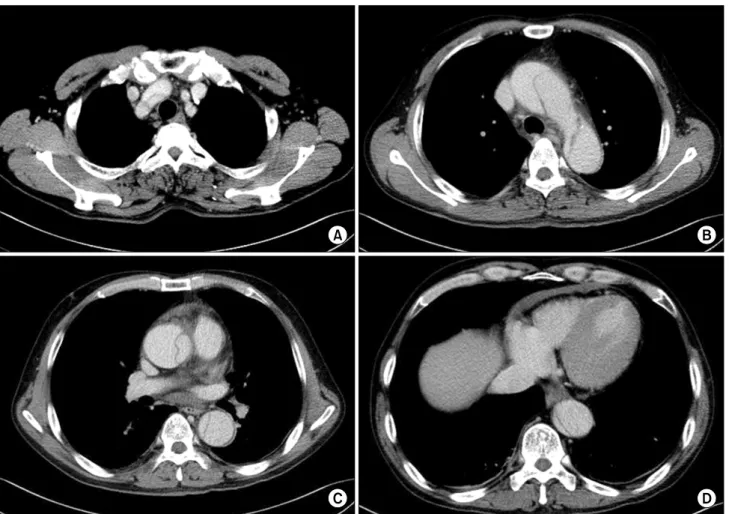
A 49-year-old man was admitted to Pusan National University Hospital with complaints of squeezing chest pain and drowsy mentality. His systolic blood pressure was 70 mmHg, and his heart rate was 120 bpm. Computed tomog- raphy revealed acute type A aortic dissection (ATAAD) that involved the aortic arch and the descending thoracic aorta (Fig. 1). An emergency operation was performed. Regional cerebral oxygen saturation (rSO

2

) was monitored upon arrival at the operation room, and it was maintained during surgery using an Invos system (Somanetics, Troy, MI, USA) (Fig. 2).

The arterial perfusion line was placed on the right subclavian artery that appeared to be visually normal. After initiating cardiopulmonary bypass (CPB), adequate blood flow was ob-

tained, and the patient’s vital signs stabilized. After aortic cross clamping, the ascending aorta and the aortic valve were observed through aortotomy. An intimal tear was located in the ascending aorta, and the coaptation of the aortic valve was good. When the blood temperature fell to 27

o

C, the aort- ic cross clamp was released. Ascending and hemiarch re- placement was planned because the visible arch and the de- scending aorta were intact. Selective antegrade cerebral perfu- sion (SACP) was initiated through all three arch vessels. The proximal innominate artery was clamped, and perfusion cathe- ters were inserted into the left carotid and left subclavian arteries. The cerebral blood flow rate was maintained at ap- proximately 600 mL/min. Then, the right rSO

2

decreased abruptly, and it did not recover as compared to the left one.

Despite declamping and rechecking the inside of the in-

(2)

Seon Hee Kim, et al

− 164 −

Fig. 1. Preoperative computed tomography revealed aortic dissection involving (A) the innominate artery, (B) aortic arch, and (C) ascending and descending thoracic aorta. (D) Pericardial hemorrhage was shown at the level of diaphragm.

Fig. 2. The serial changes of right and left regional cerebral oxy- gen saturation are presented. rSO

2,

regional cerebral oxygen satu- ration; CPB, cardiopulmonary bypass; SACP, selective antegrade cerebral perfusion.

nominate artery, we found no luminal problem. As dynamic carotid artery obstruction was suspected, the operation was continued because such obstructions usually resolve after operation. Although the distal aortic anastomosis was com- pleted and an adequate amount of blood flow to the branch of artificial graft was restarted, the right rSO

2

did not increase. Diagnostic angiography was planned for blood flow assessment. We transferred the patient to the catheterization laboratory for angiography immediately after the operation.

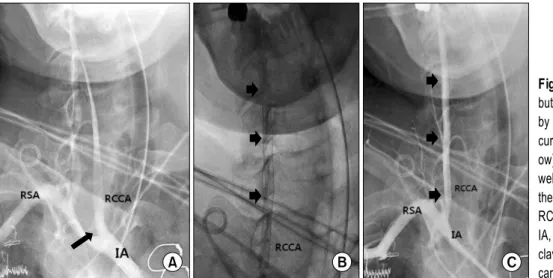
Another intimal tear on the proximal right common carotid artery, which was obstructing the blood flow, was identified using angiography. A 12×80 mm SMART Control Nitinol Stent System (Cordis Co., Bridgewater, NJ, USA) was in- serted into the right common carotid artery (Fig. 3). The right rSO

2

promptly recovered to the same level as the left one.

The total bypass time, aortic cross clamp time, and selective

(3)

Hybrid Technique for Malperfusion ATAAD

− 165 −

Fig. 3. (A) A patent IA and RSA but obstructed RCCA were revealed by angiography. An intimal tear oc- curred at the IA bifurcation site (arr- ow). (B) An angiograph revealed a well-deployed stent graft (arrow) in the RCCA. (C) Flow recovered in the RCCA (arrows) after stent insertion.

IA, innominate artery; RSA, right sub- clavian artery; RCCA, right common carotid artery.

antegrade cerebral perfusion time were 227, 191, and 85 mi- nutes, respectively. The patient was extubated on postoper- ative day 2 and discharged on postoperative day 13 without neurologic deficit.

DISCUSSION

Despite advances in surgical techniques, the mortality rates of ATAAD have remained high in patients with brain malperfusion. Occlusion of the aortic arch vessels, which is propagated from the dissected aorta, commonly leads to neu- rological deficit [1]. The main factor causing malperfusion is the dynamic obstruction of the false lumen or hypotension itself. In most cases, this can be relieved by restoring suffi- cient true luminal blood flow via surgery.

In the present case, we described a patient who had ATAAD and a right carotid artery tear. The patient was treat- ed via stent placement at the time of the surgery, using a hy- brid technique. There are three important points to understand from this case.

First, whenever the patient’s condition is acceptable, evalu- ations of the aortic arch vessels are essential for selecting the arterial approach for cardiopulmonary bypass in ATAAD in- volving the aortic arch. A previous study elucidated when the malperfusion occurs: 1) pre-surgery malperfusion, 2) malper- fusion at the institution of cardiopulmonary bypass, 3) mal- perfusion occurring after aortic cross clamping, and 4) mal- perfusion postdistal aortic anastomotic construction [2]. Clam-

ping the innominate artery for SACP may have caused in- juries such as intimal tear and dissection, resulting in a re- duction of carotid blood flow. This speculation is consistent with the fact that rSO

2

dramatically decreased when SACP was initiated. Malperfusion, at the beginning of CPB, can be generated not only by retrograde perfusion via the femoral ar- tery but also by antegrade perfusion via the subclavian artery.

Therefore, precise radiographic evaluation should be per- formed to ensure adequate cerebral blood flow. If rSO

2

drops at the time of CPB initiation, surgeons should promptly change the arterial cannulation site.

Second, rSO

2

monitoring is a very reliable method to de- tect brain malperfusion. In addition, it is important to initiate monitoring before anesthetic induction to detect problems by observing serial saturation changes. Near-infrared spectro- scopy (NIRS) provides continuous rSO

2

monitoring and is a simple noninvasive method for monitoring cerebral perfusion.

NIRS-guided SACP allows a safe approach to aortic arch sur- gery, and a unilateral progressive discrepancy in rSO

2

in- dicates the occurrence of brain malperfusion. It is recom- mended that additional perfusion should be addressed imme- diately, when major hemispheric discrepancies appear [2,3].

In our case, rSO

2

did not recover at the end of the surgery.

Thus, we immediately performed confirmatory angiography.

Third, if rSO

2

drops without any apparent anatomic or pro-

cedural reason, diagnostic angiography, as a hybrid technique,

is strongly recommended. As for the discrepancy in rSO

2

in

our case, even though aortic replacement was completed, we

(4)

Seon Hee Kim, et al

− 166 − ascertained the luminal integrity of the innominate artery and suspected insufficient brain perfusion due to dissection or re-dissection of the carotid artery. Angiography is needed to confirm the status of the carotid artery lumen. In our case, we found a tear on the right common carotid artery and ach- ieved rSO

2

recovery through prompt carotid stent placement.

After an open arterial stenosis, sufficient brain perfusion was restored, and no postoperative neurological symptoms devel- oped. There are several published experiences with acute car- otid revascularization in ATAAD cases involving the aortic arch vessels. In these cases, carotid stent placement was per- formed to recanalize the artery or seal an intimal flap, and a high success rate was achieved [4,5].

In summary, in ATAAD patients with decreased mentality, preoperative evaluation of the aortic arch vessels, continuous monitoring of rSO

2

, and the use of a hybrid technique that involves confirmatory angiography for detected problems will reduce neurologic complications from brain malperfusion. In addition, if a hybrid operation room is available, surgeons can save additional time in finding and fixing vascular complica- tions

CONFLICT OF INTEREST

No potential conflict of interest relevant to this article was

reported.

ACKNOWLEDGMENTS

This work was supported by clinical research grant from Pusan National University Hospital 2013.

REFERENCES

1. Tanaka H, Okada K, Yamashita T, Morimoto Y, Kawanishi Y, Okita Y. Surgical results of acute aortic dissection com- plicated with cerebral malperfusion. Ann Thorac Surg 2005;

80:72-6.

2. Harrington DK, Ranasinghe AM, Shah A, Oelofse T, Bonser RS. Recommendations for haemodynamic and neurological monitoring in repair of acute type a aortic dissection. Anest- hesiol Res Pract 2011;2011:949034.

3. Harrer M, Waldenberger FR, Weiss G, et al. Aortic arch surgery using bilateral antegrade selective cerebral perfusion in combination with near-infrared spectroscopy. Eur J Cardi- othorac Surg 2010;38:561-7.

4. Lentini S, Tancredi F, Benedetto F, Gaeta R. Type A aortic dissection involving the carotid arteries: carotid stenting during open aortic arch surgery. Interact Cardiovasc Thorac Surg 2009;8:157-9.

5. Roseborough GS, Murphy KP, Barker PB, Sussman M.

Correction of symptomatic cerebral malperfusion due to acute

type I aortic dissection by transcarotid stenting of the in-

nominate and carotid arteries. J Vasc Surg 2006;44:1091-6.

수치

Fig. 1. Preoperative computed tomography revealed aortic dissection involving (A) the innominate artery, (B) aortic arch, and (C) ascending  and descending thoracic aorta
Fig. 3. (A) A patent IA and RSA  but obstructed RCCA were revealed  by angiography. An intimal tear  oc-curred at the IA bifurcation site  (arr-ow)

참조

관련 문서

Advisor: prof. We will look into a criterion of definition and type of condition the base of a existing theory. Expression called condition is defined

This expression is used when the content of the following clause is a condition or method to achieve the situation of the first clause.. 갈비가 타지 않게끔

[r]

이하선의 실질 속에서 하악경의 후내측에서 나와 하악지의 내측면을 따라 앞으로 간다. (귀밑샘 부위에서 갈라져 나와

with the experimental C versus t data. If the fit is unsatisfactory, another rate equation is guessed and tested. Integral method is especially useful for fitting simple

Smed-prep , encoding a TALE class homeodomain, is described as the first gene necessary for correct anterior fate and patterning during

The “Asset Allocation” portfolio assumes the following weights: 25% in the S&P 500, 10% in the Russell 2000, 15% in the MSCI EAFE, 5% in the MSCI EME, 25% in the

1 John Owen, Justification by Faith Alone, in The Works of John Owen, ed. John Bolt, trans. Scott Clark, "Do This and Live: Christ's Active Obedience as the