• 검색 결과가 없습니다.

The Prognosis According to Patterns of Mediastinal Lymph Node Metastasis in Pathologic Stage IIIA/N2 Non-Small Cell Lung Cancer

N/A
N/A
Protected

Academic year: 2021

Share "The Prognosis According to Patterns of Mediastinal Lymph Node Metastasis in Pathologic Stage IIIA/N2 Non-Small Cell Lung Cancer"

Copied!
7
0
0

로드 중.... (전체 텍스트 보기)

전체 글

(1)

http://dx.doi.org/10.5090/kjtcs.2014.47.1.13 ISSN: 2233-601X (Print) ISSN: 2093-6516 (Online)

Department of Thoracic and Cardiovascular Surgery, Chonnam National University Hwasun Hospital, Chonnam National University Medical School

Received: July 1, 2013, Revised: August 31, 2013, Accepted: September 17, 2013

Corresponding author: Kook Joo Na, Department of Thoracic and Cardiovascular Surgery, Chonnam National University Hwasun Hospital, Chonnam National University Medical School, 322 Seoyang-ro, Hwasun 519-763, Korea

(Tel) 82-61-379-7664 (Fax) 82-61-379-7665 (E-mail) [email protected]

C

The Korean Society for Thoracic and Cardiovascular Surgery. 2014. All right reserved.

CC

This is an open access article distributed under the terms of the Creative Commons Attribution Non-Commercial License (http://creative- commons.org/licenses/by-nc/3.0) which permits unrestricted non-commercial use, distribution, and reproduction in any medium, provided the original work is properly cited.

The Prognosis According to Patterns of Mediastinal Lymph Node Metastasis in Pathologic Stage IIIA/N2

Non-Small Cell Lung Cancer

Do Wan Kim, M.D., Ju Sik Yun, M.D., Sang Yun Song, M.D., Kook Joo Na, M.D.

Background: The aim of this study is to evaluate prognostic factors for survival in pathologic stage IIIA/N2 non-small-cell lung cancer (NSCLC), to identify the prognostic significance of the metastatic patterns of mediastinal lymph nodes (MLNs) relating to survival and to recurrence and metastasis. Methods: A total of 129 patients who underwent radical resection for pathologic stage IIIA-N2 NSCLC from July 1998 to April 2011 were retrospectively reviewed. The end points of this study were rates of loco-regional recurrence and distant metastasis, and survival.

Results: The overall 5-year survival rate was 47.4%. A univariate analysis showed that age, pathologic T stage, and adjuvant chemotherapy were significant prognostic factors, while in multivariate analysis, pathologic T stage and adjuvant chemotherapy were significant prognostic factors. The metastasis rate was higher in patients with multi- station N2 involvement and with more than 3 positive MLNs. Further, non-regional MLN metastasis was associated with a higher loco-regional recurrence rate. Conclusion: Pathologic T stage and adjuvant chemotherapy were in- dependent prognostic factors for long-term survival in pathologic stage IIIA/N2 NSCLC. The recurrence and the metastasis rate were affected by the metastatic patterns of MLNs. These results may be helpful for planning post- operative therapeutic strategies and predicting outcomes.

Key words: 1. Carcinoma, non-small cell, lung 2. Mediastinal lymph nodes 3. Neoplasm metastasis 4. Lung surgery

INTRODUCTION

In pathologic stage IIIA/N2 non-small-cell lung cancer (NSCLC), the reported 5-year survival rate ranges from 25%

to 50% and many prognostic factors have been reported [1,2].

In the classification of mediastinal lymph node (MLN) meta- stasis as IIIA/N2, various subgroups may be recognized [3].

Previous studies have reported that the prognosis may be af-

fected by these subgroups. According to the National

Comprehensive Cancer Network (NCCN) guidelines, com-

pletely resected NSCLC refers to negative highest mediastinal

lymph node metastasis [4]. According to the recom-

mendations of the American College of Chest Physicians

(ACCP) for patients with pathologic stage IIIA/N2 disease af-

ter resection, adjuvant chemotherapy is recommended in pa-

tients who have good performance status, and adjuvant radia-

(2)

tion therapy should be considered after chemotherapy to re- duce local recurrence [5]. In the our study, the incidences of local recurrence and distant metastasis were investigated in patients diagnosed with postoperative pathologic stage IIIA/N2 NSCLC, and factors affecting the overall survival based on the presence of MLN metastases were examined. In addition, the appropriate treatment modality for patients with a highest MLN metastasis was assessed.

METHODS

A total of 129 cases involving patients who underwent rad- ical resection for p-stage IIIA-N2 NSCLC from July 1998 to April 2011 at Chonnam National University Hospital under a single surgical team were retrospectively reviewed. For all of the patients, a resection greater than lobectomy, and a com- plete systemic lymph node dissection or sampling were performed. According to NCCN recommendations for R0 re- sections, adjuvant chemotherapy was administered. Additio- nally, for an R1 resection or according to the surgeon’s opin- ion, adjuvant radiation therapy was added after considering the patient’s general condition. To identify local recurrences and distant metastases after surgery, routine blood tests, bone scans, and chest computed tomography (CT) scans were per- formed every 6 months in the initial 5 years and repeated an- nually thereafter. Starting in 2004, positron emission tomog- raphy/CT was performed in the case of abnormal findings of other imaging studies or of the patient’s need. The definition of local recurrence in lung cancer varies [6]. In the present study, we limited the definition of local recurrences only to the metastasis in the ipsilateral thorax, which also includes MLNs. Age, sex, stage-associated factors, histologic features, and adjuvant therapy were investigated. We considered che- motherapy, radiation therapy, and combined (chemoradiation) therapy to be the adjuvant therapies. The classification and the name of the lymph nodes were based on the TNM stag- ing system of Mountain and Dresler [7]. The presence of the highest MLN metastasis, the number of positive N2 stations, the number of pathologically positive lymph nodes, the pres- ence of skip N2 metastasis, and regional metastasis following surgery were analyzed separately. The highest MLN was de- fined as one of the resected MLNs located closest to the

head; skip N2 metastasis was defined as an MLN metastasis without N1 nodal metastasis. Further, regional lymph node metastasis was defined as the involvement of lymph node levels 1 to 4 in the right upper lobe, levels 1 to 6 in the left upper lobe, and levels 7 to 9 in both lower lobes, based on the lymph node map published by the International Association for the Study of Lung Cancer (IASLC) [8]. The overall survival rate, local recurrence, and distant metastasis were investigated as the end point for evaluating the prognosis. The follow-up period lasted from the date of sur- gery to death or the last date of follow-up. The follow-up pe- riod was 0 to 157 months (mean, 40.4±31.3 months), with a median follow-up period of 32 months. To conduct frequency comparisons between the two groups, chi-square test and Fisher’s exact test were used. An analysis of survival was carried out using the Kaplan-Meier method. A univariate analysis was performed using the log-rank test, and a multi- variate analysis was carried out using Cox’s proportional haz- ards model. A p-value of <0.05 was considered to be stat- istically significant.

RESULTS

The clinical characteristics of the patients are shown in

Table 1. The mean age of the patients was 62.1 years (range,

35 to 83 years), and 88 of the patients (68%) were male. The

distribution of MLN metastasis is presented in Table 2. Two

hospital deaths (1.6%) occurred; pneumonia was the cause of

death in both cases. The overall survival rates for the patients

were as follows: 1 year, 80.6%; 3 years, 57.0%; and 5 years,

47.4%. During the follow-up period, 36 patients had a local

recurrence, a distant metastasis was identified in 64 cases,

and both recurrence and metastasis occurred in 14 cases. The

most common local recurrence site was the MLNs in 18 cas-

es, the ipsilateral lung in 15 cases, and the bronchial stump

in 6 cases. The brain was the most common site of distant

metastasis (26 cases), followed by the contralateral lung (15

cases), and bone (11 cases). A univariate survival analysis

was performed (Tables 1, 2). Sex, location of tumor, the

presence or absence of pneumonectomy, and histological dif-

ferentiation or classification did not differ significantly be-

tween the groups. The 5-year survival rate was 51.1% for pa-

(3)

Table 1. Patient demographics and comparison of survival accord- ing to clinical characteristics

Variable No. of patients

Median survival time (mo)

5-year survival

(%)

p-value

Gender Male Female Age (yr) <70 ≥70 Tumor site Left Right Operation type Pneumonectomy Non-pneumonectomy Histology

ADC/others SQC/others Differentiation Well-differentiated Others

T stage T1 T2–3

Adjuvant therapy Chemotherapy Others

88 41

109 20

44 85

22 107

68/61 36/93

42 62

31 98

69 55

58 44

61 25

41 58

NR 47

69/32 29/58

NR 64

NR 32

NR 29

49.0 42.9

51.1 18.9

44.8 48.6

54.5 45.2

53.9/40.9 49.9/39.9

55.1 55.1

65.7 41.5

62.3 34.6

0.803

0.034

0.407

0.589

0.181 0.254 0.274

0.012

0.004

NR, not reported; ADC, adenocarcinoma; SQC, squamous cell carcinoma.

Table 2. LN status and survival according to LN invasion status Variable No. of

patients

Median survival time (mo)

5-year survival

(%)

p-value

Highest MLN status Positive

Negative N2 station no.

Single Multiple Involved N2 no.

<3 ≥3

Distribution of MLN Skip N2

No-skip N2

Regional N2 metastases Regional

Non-regional Clinical N factor N0–1

N2

52 77

74 55

78 51

45 84

82 38

74 53

44 57

61 44

58 44

47 57

57 41

42 61

45.8 48.2

50.9 42.9

48.8 45.5

43.4 49.5

50.2 44.4

43.4 51.9

0.877

0.453

0.642

0.474

0.868

0.985

LN, lymph node; MLN, mediastinal lymph node.

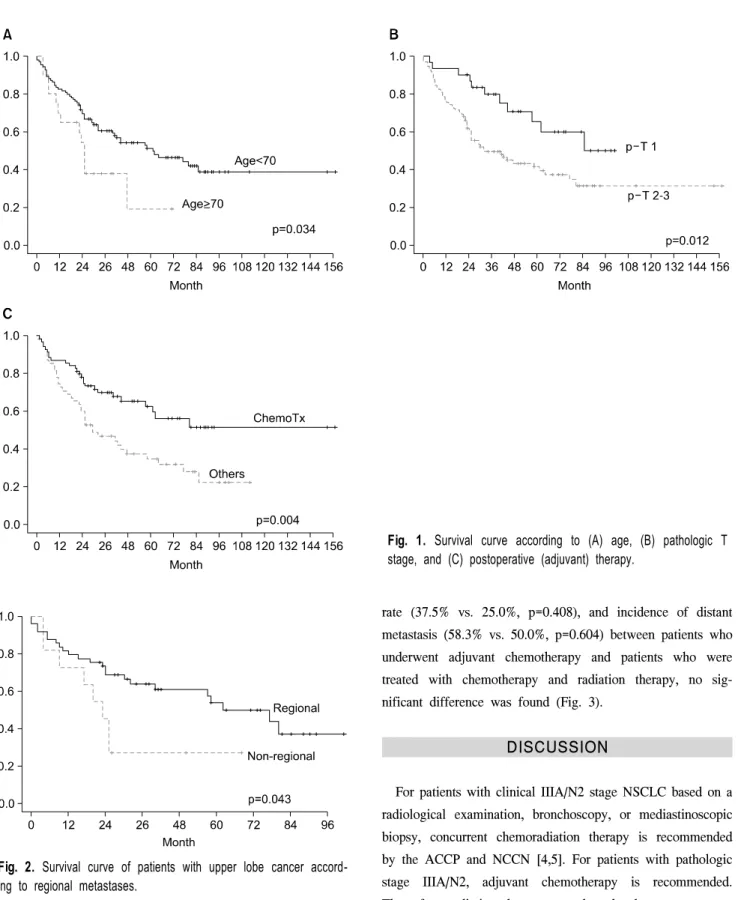
tients aged <70 years and 18.9% for those aged >70 years (p=0.034) (Fig. 1A). With respect to the pathological T stage, since only a few patients (n=18) with T3 stage were in- cluded, we combined the patients with T2 stage and T3 stage into a single high risk group and analyzed them together. The 5-year survival rate in group T1 was 65.7% as compared to 41.5% in group T2–3 (p=0.012) (Fig. 1B). Sixty-nine patients were treated by chemotherapy, and 55 patients were treated by radiotherapy or combined therapy. Five patients were not treated with adjuvant therapy due to the patients’ refusal or poor general condition. We analyzed these patients by divid- ing them into two groups: a group that was treated by only chemotherapy (n=69) and a group that underwent a treatment other than chemotherapy (n=55). The five-year survival rate among patients who received adjuvant chemotherapy after

surgery was 62.3%; that for patients who received another treatment was 34.6% (p=0.004) (Fig. 1C). With respect to the patterns of MLN metastasis, in all cases, there was no sig- nificant difference in survival. However, among the patients with upper lobe cancer, the 5-year survival rate was sig- nificantly higher in patients with regional metastasis (53.9%

vs. 27.3%, p=0.043) (Fig. 2). In a multivariate analysis,

pathologic T stage and adjuvant chemotherapy were sig-

nificant prognostic factors for survival (Table 3). The in-

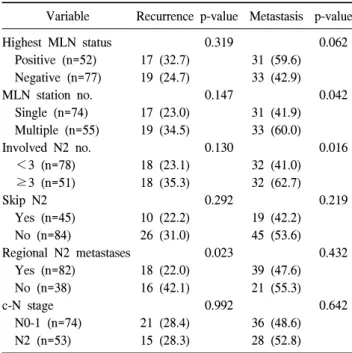
cidences of local recurrence and distant metastasis were dif-

ferent according to the pattern of lymph node metastasis

(Table 4). Distant metastasis was more likely in cases involv-

ing multiple MLN stations (p=0.042) or three or more pos-

itive MLNs (p=0.016). Additionally, the non-regional lymph

node metastasis group showed a higher frequency of local re-

currence than the regional lymph node metastasis group

(p=0.023). The highest MLN was identified in 52 patients

and was targeted for additional analysis. Twenty-four patients

were treated only with chemotherapy, and 17 patients were

treated with combined therapy. In a comparison of the 5-year

survival rate (67.7% vs. 47.2%, p=0.300), local recurrence

(4)

Fig. 1. Survival curve according to (A) age, (B) pathologic T stage, and (C) postoperative (adjuvant) therapy.

Fig. 2. Survival curve of patients with upper lobe cancer accord- ing to regional metastases.

rate (37.5% vs. 25.0%, p=0.408), and incidence of distant metastasis (58.3% vs. 50.0%, p=0.604) between patients who underwent adjuvant chemotherapy and patients who were treated with chemotherapy and radiation therapy, no sig- nificant difference was found (Fig. 3).

DISCUSSION

For patients with clinical IIIA/N2 stage NSCLC based on a radiological examination, bronchoscopy, or mediastinoscopic biopsy, concurrent chemoradiation therapy is recommended by the ACCP and NCCN [4,5]. For patients with pathologic stage IIIA/N2, adjuvant chemotherapy is recommended.

Thereafter, radiation therapy to reduce local recurrence may

be considered. These guidelines have been made subject to

resection, and NCCN recommendations for complete resection

(5)

Table 3. Independent factors affecting survival using a Cox pro- portional hazard model

Variable Hazard

ratio

95%

confidence interval

p-value

p-T stage (T1/T2–3)

Adjuvant therapy (ChemoTx/others) 0.492 0.513

0.255–0.948 0.308–0.854

0.034 0.010

Fig. 3. Survival curve of patients with positive highest mediastinal lymph node according to (postoperative) adjuvant treatment (chemotherapy or combined therapy).

Table 4. Recurrence and metastasis rate according to the sub-classifications of N2 metastasis

Variable Recurrence p-value Metastasis p-value Highest MLN status

Positive (n=52) Negative (n=77) MLN station no.

Single (n=74) Multiple (n=55) Involved N2 no.

<3 (n=78) ≥3 (n=51) Skip N2 Yes (n=45) No (n=84)

Regional N2 metastases Yes (n=82)

No (n=38) c-N stage N0-1 (n=74) N2 (n=53)

17 (32.7) 19 (24.7)

17 (23.0) 19 (34.5)

18 (23.1) 18 (35.3)

10 (22.2) 26 (31.0)

18 (22.0) 16 (42.1)

21 (28.4) 15 (28.3)

0.319

0.147

0.130

0.292

0.023

0.992

31 (59.6) 33 (42.9)

31 (41.9) 33 (60.0)

32 (41.0) 32 (62.7)

19 (42.2) 45 (53.6)

39 (47.6) 21 (55.3)

36 (48.6) 28 (52.8)

0.062

0.042

0.016

0.219

0.432

0.642

Values are presented as number (%).

MLN, mediastinal lymph node.

in the surgical treatment of NSCLC are associated with the following criteria: 1) negative resection margins, 2) systematic lymph node sampling or complete resection, 3) negative ex- tracapsular invasion of lymph node, and 4) negative highest mediastinal lymph node. The appropriate treatment plan for patients with stage IIIA/N2NSCLC is controversial. The 5-year survival rate is reported to be 25% to 50%, and tumor location, histology, T stage, and distribution of metastatic lymph nodes have all been reported to be important prog- nostic factors [1-3]. In recent years, the size of the media- stinal lymph nodes (3 cm) has come to play an important role in determining whether surgery should be considered [9,10]. One of the reasons for such a variety of results of

stage IIIA/N2 is that the MLNs may be present in various subgroups.

Many studies have investigated the pattern of MLN meta- stasis and reported prognostic factors as the number of MLN stations involved, the presence of a skip metastasis, and meta- stasis to the highest MLN. Misthos et al. [11] reported that among 302 patients with pathologic stage IIIA/N2 disease, 66% showed multiple stations of MLN metastases; in the multivariate analysis, the only factor associated with a good prognosis was the presence of one-station MLN metastasis.

This was explained by the facts that the risk of non-regional or skip metastasis is relatively low in case of one-station in- volvement and there is little likelihood of systemic extension.

Skip metastasis has been reported in stage IIIA/N2 disease at a frequency of 17% to 41% [12]. Prenzel et al. [13] com- pared the 5-year survival rates between patients of the skip N2 group and those of the control group, and found a sig- nificantly better prognosis among those in the skip N2 group (41% vs. 14%, respectively). There are two distinct pathways of MLN metastasis (directly to the MLNs and through an N1 lymph node). Usually, a better prognosis of skip metastasis was explained by single pathway invasion [14].

It should be noted that the definition of the highest MLNs

has varied in previous reports. They have often been defined

as the lymph nodes above the horizontal plane of the left

brachiocephalic vein [7]; moreover, lymph node level 4 on

the left side and lymph node level 1/2 on the right side may

(6)

be defined for them [15]. However, they are most commonly defined as one of the resected MLNs located closest to the head. In a study by Sakao et al. [16], patients without meta- stasis to the highest MLN had a 3-year survival rate of 52%, while those with metastasis to the highest MLN had a 3-year survival rate of 21% (p<0.001). Involvement of the highest MLN is a poor prognostic factor, irrespective of the number of involved MLN stations, clinical N stage, or pathologic T stage. Nakagiri et al. [17] found significant differences in the survival rate according to various patterns of MLN meta- stasis, including pathologic T factor, clinical N factor, meta- stasis of the highest MLNs, and skip N2 metastasis. An addi- tional analysis of the recurrence status revealed that there were significant differences among the disease-free survival rates according to the metastasis of the highest MLNs, skip N2 metastasis, and the number of metastatic node stations.

Based on these results, they emphasized that the sub-classi- fication of lymph node metastasis is required for predicting the prognosis in patients with pathologic stage IIIA/N2.

Contrary to the viewpoints presented in these studies, Lacasse et al. [18] asserted that the highest MLN involve- ment had no effect on prognosis, and the IASLC reported no significant difference in survival rates according to the sub- types of MLN metastasis [19]. Our study also did not show any significant difference in the overall survival rate, brought about by the pattern of MLN metastasis. In the multivariate analysis, pathologic T stage and adjuvant chemotherapy were shown to be significant prognostic factors for survival. The 5-year survival rate was significantly higher among those pa- tients who received adjuvant chemotherapy (62.3%).

However, there was no difference between the chemotherapy group and the chemotherapy plus radiation therapy group.

Patients with the involvement of multiple stations of MLNs and three or more positive lymph nodes had a significantly higher incidence of distant metastasis. Further, patients with non-regional lymph node metastases showed a higher in- cidence of local recurrence. Asamura et al. [20] observed dif- ferent patterns of MLN metastasis according to the location of the primary tumor in the lungs (right upper lobe, levels 3 and 4; left upper lobe, level 5; both lower lobes, level 7), and similar results were obtained in our study. In general, pa- tients with a non-regional metastasis had relatively poor

outcomes. We assumed that patients with a non-regional metastasis had a higher recurrence rate; this was corroborated with the results of the present study.

There was no significant difference in the 5-year survival rate, local recurrence rate, or incidence of distant metastasis between the chemotherapy group and the chemotherapy plus radiation therapy group among patients with metastasis of the highest MLN. Thus, we carefully suggest that the use of radi- ation therapy to prevent recurrence in patients with the high- est MLN metastasis be reconsidered. However, this result has a limitation in that we considered a smaller number of pa- tients undergoing radiation therapy than other studies. Further prospective studies are required to confirm the above- mentioned result.

The present study has some limitations. Firstly, this was a retrospective analysis of medical records. Secondly, because of the relatively long study period, the homogeneity of the group decreased and the treatment paradigms of stage IIIA/N2 NSCLC may have changed. Additionally, we used a multivariate analysis and the overall survival rate of up to 70 years; however, the result does not reflect disease-specific and disease-free survival rates. Hence, a well-designed, pro- spective analysis is required.

In conclusion, pathologic T stage and adjuvant chemo- therapy were independent prognostic factors for long-term survival in patients with pathologic stage IIIA/N2 NSCLC.

There were no differences in the survival rate according to the patterns of MLN metastasis. Although adjuvant chemo- therapy was a prognostic factor, there was no significant dif- ference in the survival rate between the chemotherapy group and the chemotherapy plus radiation therapy group, even among patients with the highest MLN metastasis. The re- currence and the metastasis rate were affected by the meta- static patterns of the MLNs (non-regional metastasis for re- currence, and multi-station and positive MLNs ≥3 for meta- stasis). These results may be helpful in formulating post- operative therapeutic strategies and predicting their outcomes.

CONFLICT OF INTEREST

No potential conflict of interest relevant to this article was

reported.

(7)

REFERENCES

1. Inoue M, Sawabata N, Takeda S, Ohta M, Ohno Y, Maeda H. Results of surgical intervention for p-stage IIIA (N2) non-small cell lung cancer: acceptable prognosis predicted by complete resection in patients with single N2 disease with primary tumor in the upper lobe. J Thorac Cardiovasc Surg 2004;127:1100-6.

2. Saito M, Kato H. Prognostic factors in patients with patho- logical and N2 non-small cell lung cancer. Ann Thorac Cardiovasc Surg 2008;14:1-2.

3. Kim DJ, Kim KD, Kim CY, Chung KY. Nodal station as a prognostic factor in resected stage IIIA N2 non-small cell lung cancer. Korean J Thorac Cardiovasc Surg 2003;36:

489-96.

4. National Comprehensive Cancer Network. National Compre- hensive Cancer Network (NCCN) guidelines [Internet]. Fort Washington (PA): National Comprehensive Cancer Network;

2013 [cited 2013 Mar 1]. Available from: http://www.nccn.

org/index.asp.

5. Alberts WM; American College of Chest Physicians.

Diagnosis and management of lung cancer executive sum- mary: ACCP evidence-based clinical practice guidelines (2nd Edition). Chest 2007;132(3 Suppl):1S-19S.

6. Varlotto JM, Recht A, Flickinger JC, Medford-Davis LN, Dyer AM, DeCamp MM. Varying recurrence rates and risk factors associated with different definitions of local re- currence in patients with surgically resected, stage I non- small cell lung cancer. Cancer 2010;116:2390-400.

7. Mountain CF, Dresler CM. Regional lymph node classi- fication for lung cancer staging. Chest 1997;111:1718-23.

8. Rusch VW, Asamura H, Watanabe H, et al. The IASLC lung cancer staging project: a proposal for a new international lymph node map in the forthcoming seventh edition of the TNM classification for lung cancer. J Thorac Oncol 2009;4:568-77.

9. Cerfolio RJ, Bryant AS. Survival of patients with un- suspected N2 (stage IIIA) nonsmall-cell lung cancer. Ann Thorac Surg 2008;86:362-6.

10. Andre F, Grunenwald D, Pignon JP, et al. Survival of pa- tients with resected N2 non-small-cell lung cancer: evidence for a subclassification and implications. J Clin Oncol

2000;18:2981-9.

11. Misthos P, Sepsas E, Kokotsakis J, Skottis I, Lioulias A.

The significance of one-station N2 disease in the prognosis of patients with nonsmall-cell lung cancer. Ann Thorac Surg 2008;86:1626-30.

12. Bonner JA, Garces YI, Sawyer TE, et al. Frequency of non- contiguous lymph node involvement in patients with resect- able nonsmall cell lung carcinoma. Cancer 1999;86:1159-64.

13. Prenzel KL, Monig SP, Sinning JM, et al. Role of skip metastasis to mediastinal lymph nodes in non-small cell lung cancer. J Surg Oncol 2003;82:256-60.

14. Riquet M, Hidden G, Debesse B. Direct lymphatic drainage of lung segments to the mediastinal nodes. An anatomic study on 260 adults. J Thorac Cardiovasc Surg 1989;97:

623-32.

15. Zheng H, Hu XF, Jiang GN, et al. Define relative in- complete resection by highest mediastinal lymph node meta- stasis for non-small cell lung cancers: rationale based on prognosis analysis. Lung Cancer 2011;72:348-54.

16. Sakao Y, Miyamoto H, Yamazaki A, et al. Prognostic sig- nificance of metastasis to the highest mediastinal lymph node in nonsmall cell lung cancer. Ann Thorac Surg 2006;81:

292-7.

17. Nakagiri T, Sawabata N, Funaki S, et al. Validation of pN2 sub-classifications in patients with pathological stage IIIA N2 non-small cell lung cancer. Interact Cardiovasc Thorac Surg 2011;12:733-8.

18. Lacasse Y, Bucher HC, Wong E, et al. “Incomplete re- section” in non-small cell lung cancer: need for a new definition. Canadian Lung Oncology Group. Ann Thorac Surg 1998;65:220-6.

19. Rusch VW, Crowley J, Giroux DJ, et al. The IASLC Lung Cancer Staging Project: proposals for the revision of the N descriptors in the forthcoming seventh edition of the TNM classification for lung cancer. J Thorac Oncol 2007;2:

603-12.

20. Asamura H, Nakayama H, Kondo H, Tsuchiya R, Naruke T.

Lobe-specific extent of systematic lymph node dissection for

non-small cell lung carcinomas according to a retrospective

study of metastasis and prognosis. J Thorac Cardiovasc Surg

1999;117:1102-11.

수치

Table 1. Patient demographics and comparison of survival accord- accord-ing to clinical characteristics
Fig. 1. Survival curve according to (A) age, (B) pathologic T  stage, and (C) postoperative (adjuvant) therapy.
Table 4. Recurrence and metastasis rate according to the  sub-classifications of N2 metastasis

참조

관련 문서

Degree Centrality The counts of how many connections a node has Popularity or influence of a node (e.g., word, person) in the network Betweenness Centrality The extent to which

Kameoka, “Sentinel lymph node biopsy for breast cancer patients using fluorescence navigation with indocyanine green,” World Journal of Surgical Oncology, Vol..

Relationship between lymph node metastasis and lymphatic invasion, diagnosed by immunohistochemical staining and H&E staining in gastric

 Rule #1: Express currents in terms of node voltages: Count the number of unknown node voltages and the required number of KCL equations to solve..  Rule #2: If a node

3.4 The estimating stage of relative coordinates : (d) coordinates transfer based on estimated reference node (e) Get the azimuth of mobile node (f) Get.. the final

Bone is a common site of distant metastasis in prostate cancer. Association of bone and metastatic cancer cells are important in this site-specific manifestation

1 John Owen, Justification by Faith Alone, in The Works of John Owen, ed. John Bolt, trans. Scott Clark, "Do This and Live: Christ's Active Obedience as the

Preoperative evaluation of pelvic lateral lymph node of patients with lower rectal cancer: comparison study of MR imaging and CT in 53 patients?.