大 韓 不 妊 學 會 誌 : 第 32 卷 第 4 號 2005 Kor. J. Fertil. Steril., Vol. 32, No. 4, 2005, 12
높은 기저 난포자극호르몬 수치를 가지는 환자와 고령 환자의 체외수정시술을 위한 과배란 유도에서 GnRH Antagonist 다회투여법과 GnRH Agonist 장기요법의
효용성에 대한 연구
포천중문 의과대학교 산부인과학교실, 차병원 여성의학연구소
1김지연·김낙근·윤태기·차선희·김유신·원형재 조정현·차수경
1·정미경
1·최동희
Comparison of IVF-ET Outcomes between GnRH Antagonist Multiple Dose Protocol and GnRH Agonist Long Protocol in Patients with
High Basal FSH Level or Advanced Age
JY Kim, NK Kim, TK Yoon, SH Cha, YS Kim, HJ Won, JH Cho, SK Cha
1, MK Chung
1, DH Choi
Department of Obstetrics and Gynecology, Pochon CHA University, College of Medicine, Seoul, Korea,
1Fertility Center of CHA General Hospital
Objectives: To compare the efficacy of GnRH antagonist multiple dose protocol (MDP) with that of GnRH agonist long protocol (LP) in controlled ovarian hyperstimulation for in vitro fertilization in patients with high basal FSH (follicle stimulating hormone) level or old age, a retrospective analysis was done.
Methods: Two hundred ninety four infertile women (328 cycles) who were older than 41 years of age or had elevated basal FSH level (> 8.5 mIU/mL) were enrolled in this study. The patients had undergone IVF-ET after controlled ovarian hyperstimulation using GnRH antagonist multiple dose protocol (n=108, 118 cycles) or GnRH agonist long protocol (n=186, 210 cycles). The main outcome measurements were cycle cancellation rate, consumption of gonadotropins, the number of follicles recruited and total oocytes retrieved. The number of fertilized oocytes and transferred embryos, the clinical pregnancy rates, and the implantation rates were also reviewed. And enrolled patients were divided into three groups according to their age and basal FSH levels; Group A - those who were older than 41 years of age, Group B - those with elevated basal FSH level (> 8.5 mIU/mL) and Group C - those who were older than 41 years of age and with elevated basal FSH level (> 8.5 mIU/mL). Poor responders were classified as patients who had less than 4 retrieved oocytes, or those with E
2level <
500 pg/mL on the day of hCG injection or those who required more than 45 ampules of exogenous gonadotropin for stimulation.
Results: The cancellation rate was lower in the GnRH antagonist group than in GnRH agonist group,
주관책임자: 최동희, 우) 463-828 경기도 성남시 분당구 야탑동 351번지, 포천중문의과대학교 분당차병원 Tel: (031) 780-5200, Fax: (031) 780-5881, e-mail: [email protected]
but not statistically significant (6.8% vs. 9.5%, p=NS). The amount of used gonadotropins was significantly lower in GnRH antagonist group than in agonist group (34.8±11.3 ampules vs. 44.1±13.4 ampules, p<0.001). The number of follicles > 14 mm in diameter was significantly higher in agonist group than in antagonist group (6.7±4.6 vs. 5.0±3.4, p<0.01). But, there were no significant differences in clinical pregnancy rate (24.5% in antagonist group vs. 27.4% in agonist group, p=NS) and implantation rate (11.4% in antagonist group vs. 12.0% in agonist group, p=NS) between two groups. Mean number of retrieved oocytes was significantly higher in GnRH agonist LP group than in GnRH antagonist MDP group (5.4±3.5 vs. 6.6±5.0, p<0.0001). But, the number of mature and fertilized oocytes, and the number of good quality (grade I and II) and transferred embryos were not different between two groups.
In each group A, B, and C, the rate of poor response did not differ according to stimulation protocols.
Conclusions: In conclusion, for infertile women expected poor ovarian response such as who are old age or has elevated basal FSH level, a protocol including a controlled ovarian hyperstimulation using GnRH antagonist appears at least as effective as that using a GnRH agonist, and may offer the advantage of reducing gonadotropin consumption and treatment period. However, much work remains to be done in optimizing the GnRH antagonist protocols and individualizing these to different cycle characteristics.
Key Words: GnRH antagonist, GnRH agonist, Advanced age, Elevated basal FSH level
최근 여성들의 결혼과 임신 연령이 증가면서 고 령으로 인한 생식력의 감소 때문에 불임클리닉을 찾는 환자수가 늘어나고 있다. 따라서 고령 여성에 서 배란유도제에 대한 반응을 예측하여 적절한 과 배란 유도 방법을 확립하는 것이 불임 환자의 치 료에 있어서 더욱 중요해지고 있다.
GnRH agonist는 1982년 Fleming 등에 의해 처음 배란유도에 사용된 이후
1체외수정을 위한 과배란 유도에 효과적으로 사용되어 왔다. GnRH agonist의 작용기전은, 투여 직후 flare effect를 보인 후 뇌하 수체의 GnRH 수용체의 탈감작을 일으켜 혈중 성 선자극호르몬과 성 호르몬 수치를 감소시키는 것 인데 , 이런 기전을 이용하여 GnRH 장기요법, 단기 요법 , 초단기요법 등 다양한 배란 유도 방법이 개발 되어 체외수정을 위한 과배란 유도에 이용되고 있 다 . 특히 GnRH agonist 장기요법은 조기 LH 급증 을 효과적으로 예방하고 회수되는 난자 수를 증가 시킴으로써 체외수정을 위한 가장 효율적인 과배란 유도 방법으로 자리 잡게 되었다.
2그러나 GnRH agonist에 의한 뇌하수체의 과잉 억제가 일어나 과 배란 유도를 위한 외인성 성선자극호르몬의 투여량 이 증가되고 따라서 비용 및 치료 기간이 증가하는 문제점이 있다.
3GnRH antagonist는 1990년대부터 임상에서 사용
되고 있으며 agonist에 비해 LH, FSH 억제 효과가 즉시 나타나므로 후기 난포기에 투여하여 조기 LH 급증을 예방할 수 있다. 따라서 GnRH agonist 대신 antagonist를 저반응군 환자에 사용하면, 초기 난포 기에 GnRH agonist에 의한 억제를 피할 수 있고 초 기의 내인성 성선자극호르몬을 이용할 수 있다는 장점이 있다. 또한 최근에 인간의 난소에서 GnRH 수용체가 발견됨으로써 GnRH agonist가 난소에 직 접적인 억제를 일으켜 이러한 기전이 특히 저반응 군 환자들에게서 중요하게 작용할 수 있을 것이라 고 추정되고 있어 저반응군 환자의 과배란 유도에 GnRH antagonist의 사용이 증가되고 있는 추세이 다 .
4,5과배란 유도를 이용한 체외수정시술 주기에서 저
반응을 보이는 환자는 9~24%로 보고되고 있다.
6그런데 실제 저반응은 배란유도제를 투여하고 난
후에 발견되는 경우가 많고 현재 배란 유도에 대
한 난소 반응을 정확하게 예측할 수 있는 검사가
없어 저반응군 환자를 찾아낼 수 있는 선별검사법
(screening test)이 확립되어 있지 않은 실정이다. 난
소 기능 (또는 ovarian reserve)을 알아보기 위한 여
러 가지 검사법 중, 월경 주기 제 2일 또는 3일에
측정된 기저 난포자극호르몬 수치는 가장 주된 선
별검사법으로 간주되고 있는데, 이 또한 연구자마
다 저반응군에서 증가된 기저 난포자극호르몬 수 치를 7 mIU/mL 이상에서 15 mIU/mL 이상까지 다 양하게 보고하고 있어 통일된 기준 값이 존재하지 않는다 .
6국내에서는 김 등 (1995년)이 월경 주기 제 2일 또는 3일에 측정된 혈중 기저 FSH 농도가 난소 반응의 예측인자로 유용하며, 그 기준치는 8.5 mIU/mL가 적절하다고 보고한 바 있다.
7그 외 41 세 이상의 나이도 저반응군의 예측인자의 하나로 생각되며 , 이는 recruitment 가능한 난포 수의 감소 와 난자 질의 저하 때문으로 생각되고 있다.
6본 연구는 저반응이 예측되는 높은 기저 난포자 극호르몬 수치 (>8.5 mIU/mL)을 보이는 환자와 41 세 이상 고령 환자의 체외수정시술에서 GnRH anta- gonist 다회투여법과 GnRH agonist 장기요법을 사 용하였을 때 과배란 유도에 대한 난소 반응을 알아 보고 체외수정 결과를 비교해 보고자 하였다.
연구 대상 및 방법
1. 연구 대상
본 연구는 2002년 9월부터 2003년 9월까지 포천 중문의과대학 차병원 불임센터에 불임을 주소로 내원하여 체외수정시술을 시행 받은 환자 중 기저 난포자극호르몬 수치가 8.5 mIU/mL 를 초과하거나 41세 이상인 환자를 대상으로 하였으며, GnRH anta- gonist 다회투여법이나 GnRH agonist 장기요법을 사용하여 체외수정시술을 받은 환자 총 294명의 328 주기를 후향적으로 조사하였다.
2. 과배란 유도 및 체외수정-배아이식 GnRH antagonist 다회투여법은 월경 주기 3일째 부터 외인성 FSH와 hMG를 매일 300~450 IU을 투 여하기 시작하였고 우성 난포의 평균 직경이 14 mm 에 도달하면 GnRH antagonist인 Cetrorelix (Cetrotide
®, Serono, Germany) 0.25 mg을 피하 주사하기 시작하 여 hCG 투여 일까지 매일 주사하였다. GnRH ago- nist 장기요법은 이전 월경 주기의 중기 황체기부터 GnRH agonist인 buserelin acetate (Suprefact
®, Han Dok/Aventis Pharma) 0.3 mg을 매일 피하로 주사하 고 월경이 시작되면 3일째부터 0.15 mg으로 감량 투여하면서 FSH (Puregon
®, Organon Korea; GONAL-
F
®, Serono Korea) 혹은 hMG (IVF-M
®, LG life Sci- ences) 300~450 IU를 매일 근육 주사하기 시작하였 다 (Figure 1). GnRH antagonist와 agonist 군에서 모 두 3~4일 간 외인성 FSH와 hMG 투여 후 혈중 E
2와 질식 초음파를 통해 난포 성장을 관찰하면서 FSH와 hMG 투여량을 개인별로 조절하였다.
평균 직경이 18 mm 이상인 난포가 2개 이상 초 음파로 관찰되면 hCG (Profasi
®, Serono) 10,000 IU를 근육 주사하였고 36시간 후 질식 초음파를 이용하 여 난자를 회수하였다. 회수된 난자는 10% synthetic serum substitute (Irvine Scientific Co., Santa Ana, CA)가 첨가된 preimplantation I 배양액에서 4~6시간 배양 한 후 1~2 × 10
5/ml의 정자농도가 되게 난자가 있 는 배양접시에 주입하거나 정자직접주입술을 시행 하여 수정을 유도하였다. 16~20시간 후 전핵 (pro- nucleus) 형성 유무로 수정을 확인한 후 2일 간 더 배양하여 4~8세포기에 자궁 내로 이식하였다. 임신 여부의 확인은 배아이식 12일 후 혈중 hCG를 측 정하여 10 mIU/mL 이상이면 일주일 후 질식 초음 파를 시행하고 태낭이 보이는 경우를 임상적 임신 으로 판정하였다.
3. 결과의 관찰 및 통계 검정
대상 환자에서 주기 취소율, 사용된 고나도트로 핀의 양, 회수된 난자와 성숙 난자의 개수, 수정된 난자와 이식된 배아의 개수, 등급이 우수한 배아 (Grade I, II) 수를 조사하였고 임신율과 착상율을 확인하였다. 배아의 등급은 할구의 크기가 균일하 고 세포질 내에 세포 파편이 없는 것을 grade I, 할 구의 크기가 균일하고 세포질 내에 세포 파편이 10% 미만인 것은 grade II, 세포 파편은 없으나 할 구의 크기가 균일하지 않은 것을 grade III, 할구의 크기가 균일하지 않고 세포질 내에 세포 파편이 10% 이상인 것은 grade IV, 할구가 거의 없고 세포 질 내에 세포 파편이 50% 이상인 것을 grade V라 고 하였다.
8등급이 우수한 배아 (Grade I, II)를 선 별하여 자궁 내 이식하였고 이식에 사용되지 않는 여분의 배아는 동결 보존시켰다.
또한 대상 환자를 나이와 기저 난포자극호르몬
수치에 따라서 세 군으로 나누어 각 군에서 과배란
유도에 대한 저반응 비율을 살펴보았다. A군은 나
이 41세 이상인 환자, B군은 기저 난포자극호르몬 수치가 8.5 mIU/mL를 초과하는 환자, C군은 41세 이상이면서 동시에 기저 난포자극호르몬 수치가 8.5 mIU/mL를 초과하는 환자로 나누었다. 과배란 유도 후 저반응의 정의는 채취된 난자의 수가 4개 미만이거나 hCG 투여 일의 E
2가 500 pg/mL 미만 이거나 사용된 고나도트로핀의 양이 45앰플 이상 인 경우로 하였다.
각각의 결과는 평균 ± 표준편차로 기술하였고, 통 계적인 분석에 있어서 평균값의 비교를 위해 Stu- dent's t-test, 분율의 비교를 위하여 χ
2-test와 Fisher's exact test를 사용하였으며, p 값이 0.05 미만인 경우
에 통계학적으로 유의하다고 판정하였다.
결 과
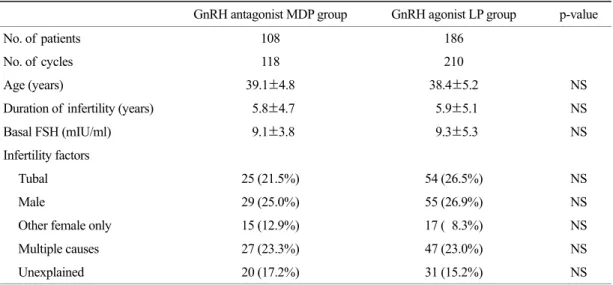
GnRH antagonist 다회투여법을 사용한 군 108명, GnRH agonist 장기요법을 사용한 군 186명이었다.
대상 환자의 평균 연령은 GnRH antagonist 군이
39.1±4.8세, GnRH agonist 군이 38.4±5.2세로 두 군
간에 유의한 차이는 없었다 (p=NS). 불임 기간 및
체외수정시술의 적응증도 두 군 간에 유의한 차
이는 없었다. 기저 난포자극호르몬 수치는 GnRH
antagonist 다회투여법을 사용한 군이 9.1 mIU/mL,
Figure 1. GnRH antagonist multiple dose protocol (MDP) and GnRH agonist long protocol, MCD; Menstrual Cycle Day.GnRH agonist 장기요법을 사용한 군이 9.3 mIU/mL 로 역시 두 군 간에 유의한 차이가 없었다 (Table 1).
GnRH antagonist 다회투여법을 사용한 군은 118 주기 중 8주기에서, GnRH agonist 장기요법을 사용 한 군은 210주기 중 20주기에서 시술이 취소되어
GnRH antagonist 다회투여법을 사용한 군이 낮은 주기 취소율을 보였으나 통계적인 차이는 없었다 (6.8% vs. 9.5%, p=NS). 주기 취소의 원인은 조기 배 란에 의한 것이 각각 2건 (2.7% vs. 0.9%, p=NS)이 고 , 저 난소 반응에 의한 것이 각각 6건과 18건
Table 2. Comparison of results of controlled ovarian hyperstimulation and pregnancy outcome between GnRH anta-
gonist MDP group and GnRH agonist LP group
GnRH antagonist
MDP group GnRH agonist
LP group p-value
Cancellation rate (%) 8 (6.8) 20 (9.5) NS
Premature ovulation (%) 2 (1.7%) 2 (0.9%) NS
Insufficient ovarian response (%) 6 (5.1%) 18 (8.6%) NS No. of FSH/hMG ampules 34.8±11.3 44.1±13.4 <0.001 Duration of gonadotropin administration (days) 8.7±1.5 10.8±2.1 <0.001 No. of follicles ≥ 14 mm on the day of hCG 5.0±3.4 6.7±4.6 <0.01
No. of oocytes 5.4±3.5 6.6±5.0 <0.0001
No. of mature oocytes 3.9±2.7 5.0±3.2 NS
No. of fertilized oocytes 4.1±2.0 5.0±2.9 NS
No. of grade I,II embryos 1.5±0.6 1.6±0.8 NS
No. of transferred embryos 2.7±1.0 3.0±1.1 NS
Clinical pregnancy/ transfer (%) 27/110 (24.5) 52/190 (27.4) NS Implantation rate (%) 33/290 (11.4) 65/541 (12.0) NS Values are means ± SD, NS; not significant
Table 1. Clinical characteristics of the patients
GnRH antagonist MDP group GnRH agonist LP group p-value
No. of patients 108 186
No. of cycles 118 210
Age (years) 39.1±4.8 38.4±5.2 NS
Duration of infertility (years) 5.8±4.7 5.9±5.1 NS
Basal FSH (mIU/ml) 9.1±3.8 9.3±5.3 NS
Infertility factors
Tubal 25 (21.5%) 54 (26.5%) NS
Male 29 (25.0%) 55 (26.9%) NS
Other female only 15 (12.9%) 17 ( 8.3%) NS
Multiple causes 27 (23.3%) 47 (23.0%) NS
Unexplained 20 (17.2%) 31 (15.2%) NS
Values are means ± SD, NS; not significant, MDP; multiple dose protocol, LP; long protocol
(5.1% vs. 8.6%, p=NS)으로 두 군 간에 유의한 차이 는 없었다.
사용된 외인성 고나도트로핀 용량은 GnRH anta- gonist 다회투여법을 사용한 군은 34.8±11.3 앰플, GnRH agonist 장기요법을 사용한 군은 44.1±13.4 앰 플로 antagonist 군에서 agonist 군에 비해 유의하게 낮은 결과를 보였다 (p<0.001). 고나도트로핀 투여 기간도 GnRH antagonist 다회투여법을 사용한 군이 8.7±1.5일, GnRH agonist 장기요법을 사용한 군이 10.8±2.1일로 GnRH antagonist 다회투여법을 사용 한 군에서 유의하게 짧은 기간을 보였다 (p<0.001).
HCG 투여 일에 관찰된 직경 14 mm 이상의 난포 개수는 GnRH antagonist 다회투여법을 사용한 군이 5.0±3.4개, GnRH agonist 장기요법을 사용한 군이 6.7±4.6개로 GnRH agonist 장기요법을 사용한 군에 서 유의하게 높았다 (p<0.01). 그러나 배아이식 주 기당 임신률은 GnRH antagonist 다회투여군 (24.5%) 과 GnRH agonist 장기요법이군 (27.4%) 사이에 통 계적으로 유의한 차이를 보이지 않았고, 착상율도 각각 11.4%와 12.0%로 양 군 간에 유의한 차이가 없었다 (Table 2).
양 군 간의 과배란 유도 결과를 비교해 보면, 각 군에서 채취된 난자의 평균 개수는 GnRH antago- nist 다회투여법을 사용한 군이 5.4±3.5개, GnRH
agonist 장기요법을 사용한 군이 6.6±5.0개로 GnRH agonist 장기요법을 사용한 군이 유의하게 많았다 (p<0.0001). 성숙 난자 수 (3.9±2.7 vs. 5.0±3.2)와 수 정된 난자 수 (4.1±2.0 vs. 5.0±2.9)도 GnRH agonist 장기요법을 사용한 군이 antagonist 다회투여군에 비 해 많은 경향을 보였으나, 통계적으로 유의한 차이 는 없었다 (p=NS). 등급이 우수한 배아 수 (1.5±0.6 vs. 1.6±0.8)와 이식된 배아 수 (2.7±1.0 vs. 3.0±1.1) 도 양 군 간에 차이를 보이지 않았다 (Table 2).
두 군에서의 나이와 기저 난포자극호르몬 수치에 따른 저반응군의 비율을 비교해 보면, A군의 경우 GnRH antagonist 다회투여법을 사용한 군이 54.7%, GnRH agonist 장기요법을 사용한 군이 48.1%, B군 의 경우 GnRH antagonist 다회투여법을 사용한 군 이 50.7%, GnRH agonist 장기요법을 사용한 군이 44% 환자에서 저반응을 나타내었으나 antagonist와 agonist 군 간에 통계적으로 유의한 차이는 없었다.
41세 이상이면서 동시에 기저 난포자극호르몬 수치 가 8.5 mIU/mL를 초과하는 C군의 경우는 antagonist 와 agonist 두 군에서 공히 78.9%와 70%의 비교적 높은 저반응율를 나타내었으나 역시 두 군 간에 유의한 차이는 없었다 (Figure 2).
Figure 2. Poor response rate according to age and FSH level in GnRH antagonist MDP group and GnRH agonist LP