ORAL CONTRACEPTIVE PILL PRETREATMENT IN OVARIAN STIMULATION WITH GnRH ANTAGONISTS FOR IN VITRO FERTILIZATION: A COMPARATIVE STUDY
Youn-Sil Choo, MD, Ae-Ra Han, MD, Seung-Heon Yang, MD, Na-Young Sung, MD, Sun-Hwa Cha, MD, Hye-Ok Kim, MD, Chan-Woo Park, MD, In-Ok Song, MD, Mi-Kyoung Koong, MD, In-Soo Kang, MD, Kwang-Moon Yang, MD
Division of Reproductive Endocrinology and Infertility, Department of Obstetrics and Gynecology, Cheil General Hospital and Women’s Healthcare Center, Kwandong University College of Medicine, Seoul, Korea
Objective
To evaluate whether oral contraceptive pill (OCP) pretreatments in gonadotropin-releasing hormone (GnRH) antagonist ovarian stimulation protocols takes positive effects on in vitro fertilization (IVF) outcomes in respect to retrieved oocyte number, oocyte maturation rate, fertilization rate, good quality embryo rate, cycle cancellation rate, pregnancy rate and clinical abortion rate.
Methods
A total of 194 cycles using GnRH antagonist protocol was performed at infertility clinic of our institute from September 1st, 2009 to February 28th, 2010. The medical records of GnRH antagonist protocols for IVF with or without OCP pretreatment in our IVF unit were retrospectively analyzed. We compared the IVF outcomes between OCP pretreated (n=41) and no pretreatment group (n=153).
Results
In cycles with OCP pretreated group, the total used dosage of gonadotropin (3019.38±1379.00 IU) were higher than that of no pretreatment group (2551.52 ± 1157.05 IU, P = 0.054). The duration of ovarian stimulation in OCP pretreated group (11.5 ± 2.0) was signifi cantly longer than that of control group (9.5 ± 1.9, P = 0.000). The number of gained total embryo (2.8±0.9 vs. 2.5±1.0, P = 0.055) and fertilization rate (77.2% vs. 65.5%, P = 0.017) were significantly higher in OCP pretreated group. There is no
signifi cant difference in pregnancy rate between two groups (39.4% vs. 30.0%, P = 0.304).
Conclusion
OCP pretreatment before GnRH antagonist protocol for IVF appears not to have reliable benefi t in terms of IVF outcomes. Well- controlled and large-scaled studies are needed.
Keywords: Gonadotropin-releasing hormone antagonist; Oral contraceptive pill pretreatment; Ovarian stimulation; In vitro fertilization
Received: 2011. 5.15. Revised: 2011. 8.16. Accepted: 2011. 8.22.
Corresponding author: Kwang-Moon Yang, MD Division of Reproductive Endocrinology and Infertility,
Department of Obstetrics and Gynecology, Cheil General Hospital and Women’s Healthcare Center, Kwandong University College of Medicine, 1-19 Mukjeong-dong, Jung-gu, Seoul 100-380, Korea Tel: +82-2-2000-4728 Fax: +82-2-2000-7790
E-mail: [email protected]
Th is is an Open Access article distributed under the terms of the Creative Commons Attribution Non-Commercial License (http://creativecommons.org/licenses/
by-nc/3.0/) which permits unrestricted non-commercial use, distribution, and reproduction in any medium, provided the original work is properly cited.
Copyright © 2011. Korean Society of Obstetrics and Gynecology
Gonadotropin-releasing hormone (GnRH) antagonists have been widely used after its first introduction in assisted reproductive technologies to prevent a premature luteinization [1]. GnRH an- tagonist protocols are preferred for poor responders because of shorter duration and use of lower amount of gonadotropins for ovarian stimulation as compared with traditional GnRH long ago- nist protocols [2]. However, it induces insuffi cient synchronization of follicular development and lack of fl exibility in the starting day of ovarian stimulation, which is less likely in GnRH agonist long protocols [3]. For getting over these limitations, several pretreat- ments have been applied [4-7]. Among them, oral contraceptive
http://dx.doi.org/10.5468/KJOG.2011.54.10.599 pISSN 2233-5188 · eISSN 2233-5196
pills (OCP) pretreatment has been reported to induce higher numbers of oocytes retrieved compared to no pretreatment group in GnRH antagonist cycles [8]. However, OCP pretreated GnRH an- tagonist cycles presented longer duration and needed more larger amount of gonadotropin for stimulation than no pretreatment cycles [8,9].
In this study, we aimed to evaluate the effect of OCP pretreatment in in vitro fertilization (IVF) cycles using GnRH antagonists by com- parison between OCP-pretreated and non-treated groups.
Materials and Methods
A total of 421 cycles of GnRH antagonist protocol were performed at infertility clinic of our institute from September 1
st, 2009 to Feb- ruary 28
th, 2010. After exclusion of cycles with male factor infertil- ity, of having uterine anomalies, and cycles for pre-implantation diagnosis, 194 GnRH antagonist cycles were included in this study. Among them, 41 cycles used OCP pretreatment in previous menstrual cycle before starting GnRH antagonist protocol for IVF (OCP pretreated group). In contrary, 153 cycles used no medicine before GnRH antagonist protocol for IVF (no pretreatment group).
We reviewed the medical records of each group and compared basal characteristics of the cycles and IVF outcomes between two groups.
In OCP pretreated group, daily OCP (Myvlar
®, Bayer Schering Pharma AG, Berlin, Germany) was applied from 3
rdday of previous menstrual cycle. About 3-4 days after OCP discontinuation, the ovarian stimulation was done with gonadotropin as usual as ex- tensively described. Briefl y, the patients underwent pituitary down- regulation with daily GnRH antagonist (Orgalutran
®, Schering- Plough, Whitehouse station, NJ, USA or Cetrotide
®, Merck-Serono, Geneva, Switzerland) from mid or late follicular period of this cycle applied when dominant follicle reached to 12 or 13 mm. When two or more follicles reached 18 mm in diameter 5,000-10,000 IU of hCG (Ovidrel
®, Merck Serono, Bari, Italy) was administered.
Trans-vaginal ultrasound guided oocyte pick-up (OPU) was per- formed 34-36 hours later and then, maturity and quality of re- trieved oocytes was evaluated.
According to the quality and number of sperm, conventional in- semination or microinjection (intracytoplasmic sperm injection, ICSI) was carried out 4-6 hours later. After 3-5 days of in vitro culture, less than 4 selected embryos were transferred to uterus.
For the purpose of luteal support, daily intramuscular injection of progesterone (Progesterone
®, Watson Pharmaceuticals Inc., Mor-
ristown, NJ, USA) was started at the time of OPU day up to fi rst inspection of pregnancy. In case of successful pregnancy, luteal support was continued to 7
thto 8
thgestational weeks.
The IVF outcomes such as retrieved oocyte number, oocyte matu- ration rate, fertilization rate, good quality embryo rate, cycle cancellation rate, pregnancy rate and clinical abortion rate were compared between OCP pretreated and no pretreatment group.
Statistical analysis was performed using SPSS ver. 16.0 (SPSS Inc., Chicago, IL, USA). Each variable was presented as mean ± stan- dard deviation. Student’s t -test and Chi-square test were used wherever appropriate. P-value of < 0.05 was considered statisti- cally signifi cant.
Results
The mean age and body mass index in OCP pretreated and non- pretreated groups were similar (35.8 ± 3.1 vs. 36.8 ± 3.5 years and 21.1 ± 2.4 kg/m
2vs. 20.5 ± 1.9 kg/m
2). The basal follicle stimulat- ing hormone (FSH) level (9.89 ± 4.0 IU/mL vs. 10.5 ± 2.1 IU/mL) was also similar between two groups. The primary infertility rate tended to be higher in OCP pretreated group (65.9% vs. 55.6%) but not statistically significant. The mean duration of infertility was longer in control group (52.4 ± 40.2 months vs. 49.7 ± 33.3 months) but not statistically signifi cant (Table 1).
Mean amount of gonadotropins for controlled ovarian stimulation in OCP pretreated group was higher than that of control group.
The mean duration of ovarian stimulation in OCP pretreated group was signifi cantly longer than that of no pretreatment group.
The mean number of retrieved oocytes was similar between two groups. The good quality embryo rate and oocyte maturation rate tended to be higher in OCP pretreated group but were not statisti- cally signifi cant. The number of gained total embryo was higher in OCP pretreated group with borderline signifi cance (P = 0.055).
Fertilization rate was also higher in OCP pretreated group. The im- plantation and pregnancy rate were similar between two groups.
The clinical abortion rate was also showed no significant differ- ence between two groups. The cycle cancellation rate tended to higher in OCP pretreated group than OCP non-treated group but not statistically different.
Discussion
The retrieval of good quality oocyte is very important factor to
achieve pregnancy in infertile women, especially older women who are barely gettable many oocytes with one cycle of controlled ovarian hyperstimulation (COH). To gain good quality embryo, growth of finely matured oocyte is firstly needed. To get more matured oocytes, the synchronized growing of follicles is one of important factor.
During COH, most of the early antral follicles are required to grow coordinately in response to exogenous gonadotropins thus accom- plishing simultaneous functional and morphological maturation.
Marked discrepancies of follicular size at the end of COH may be counterproductive since they imply that a substantial fraction of FSH-sensitive follicles fail to undergo satisfactory maturation. This phenomenon potentially reduces the number of viable oocytes and embryos and the probability of conception. Selection of good
embryos for transfer depends on embryo cohort size: implications for the `mild ovarian stimulation’ debate [10]. The number of em- bryos available for transfer predicts successful pregnancy outcome in women over 39 years with normal ovarian hormonal reserve testing [11]. During the last year, we took notice of unusually low maturation rate of oocytes, especially in GnRH antagonist cycles.
Primarily, we thought it derived from rapidly rising age of patients which reached 36 years old averagely. And then we assumed that the less competent oocyte is caused by asynchronous follicular de- velopment and a limited number of dominant follicles due to ovar- ian stimulation without pituitary suppression in GnRH antagonist protocols.
Asynchronous multi-follicular growth during COH may be a direct consequence of size heterogeneities of early antral follicles dur-
Table 1. Comparison of baseline characteristics and ART outcomesOCP pretreated group (n = 41)
No pretreatment group
(n = 153) P-value
Age of female (yr) 35.8 ± 3.1 36.8 ± 3.5 NS
Age of husband (yr) 36.9 ± 4.0 38.3 ± 4.0 0.039
BMI (kg/m2) 21.1 ± 2.4 20.5 ± 1.9 NS
Basal serum FSH (mIU/mL) 9.9 ± 4.0 10.5 ± 2.1 NS
Primary infertility (%) 65.9 55.6 NS
Duration of infertility (mon.) 49.7 ± 33.3 52.4 ± 40.2 NS
Dosage of gonadotropin (IU) 3019.4 ± 1379.0 2551.5 ± 1157.1 0.054
Duration of COH (day) 11.5 ± 2.1 9.5 ± 1.9 0.000a
E2 on hCG day (pg/mL) 1170.8 ± 1267.3 1086.0 ± 877.5 NS
EM thickness on hCG day (mm) 10.4 ± 2.6 10.0 ± 2.4 NS
Number of retrieved oocyte 7.2 ± 5.1 7.0 ± 5.2 NS
Number of matured oocyte 5.6 ± 4.3 5.1 ± 4.1 NS
Oocyte maturation rate (%) 81.1 75.1 NS
Number of total gained embryo 2.8 ± 0.9 2.5 ± 1.0 0.055
Good quality embryo rate (%) 26.8 19.1 NS
Number of transferred embryo 2.6 ± 0.9 2.3 ± 1.0 NS
Implantation rate (%) 10.6 10.5 NS
Fertilization rate (%) 77.2 ± 0.2 65.5 ± 0.3 0.017a
ICSI rate (%) 75.8 83.1 NS
Cycle cancellation rate (%) 19.5 14.5 0.468
Pregnancy rate/embryo transfer (%) 39.4 30.0 0.304
Clinical abortion rate (%) 41.7 42.1 1.000
Values are presented as mean ± standard deviation.
ART, assisted reproductive technology; OCP, oral contraceptive pill; NS, not statistically signifi cant; BMI, body mass index; FSH, follicle stimulating hor- mone; COH, controlled ovarian hyperstimulation; E2, estradiol;EM, endometrial thickness; hCG, human chorionic gonadotropin; ICSI, intracytoplasmic sperm injection.
aStatistically signifi cant (P-value < 0.05).
ing the early follicular phase [12]. Luteal estradiol administration strengthens the relationship between day 3 FSH and inhibin B levels and ovarian follicular status [13]. Some follicles are able to respond to lower FSH levels than others by their intrinsic sensi- tivity to FSH, and, start their development during the late luteal phase [14]. Since larger follicles are more FSH responsive than are smaller follicles, exogenous gonadotrophin administration is likely to intensify further size discrepancies of growing follicles during COH [15]. Follicular development begins during the luteal phase of the human menstrual cycle. Hence, COH protocols such as mid- luteal long protocol, suppression of luteal FSH secretion could prevent untimely and uncoordinated development of FSH-sensitive follicles during the luteal-follicular transition and faster follicular growth synchronization during COH can be obtained [16].
However, this luteal suppression of FSH is cannot achieve in GnRH antagonist COH protocols. Therefore, marked follicular size dis- crepancies would be occurred in GnRH antagonist COH cycles. In previous study, OCP pretreatment in GnRH antagonist cycles in low responders resulted in improving ovarian response by intrinsic gonadotropins before COH [17]. Based on that result, we tried to apply OCP pretreatment in GnRH antagonist IVF cycles bearing in mind their insuffi cient action of follicular synchronization.
In our study, the baseline characteristics of IVF cycles and out- comes between both groups were comparable regardless of age.
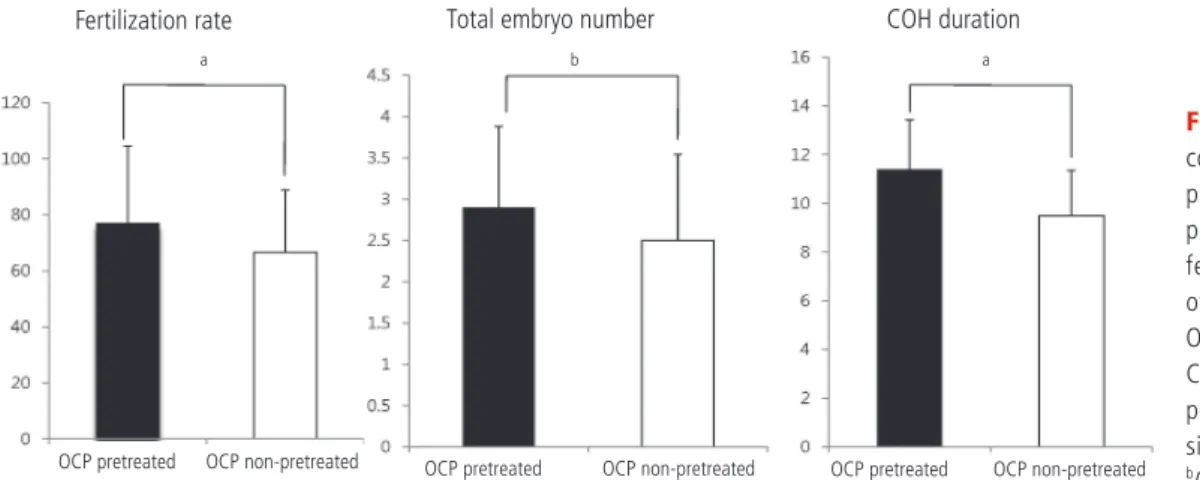
In OCP pretreated group, as shown in Fig. 1, it presented improve- ment of fertilization rate and gained more number of fertilized embryo than that of OCP non-treated group even if longer dura- tion and larger used dose of gonadotropin for ovarian stimulation.
According to previous meta-analysis regarding OCP pretreatment in GnRH antagonist cycles [18], OCP pretreatment was associated with an increased gonadotropin consumption and increased dura- tion of stimulation without improvement of ongoing pregnancy
rate. There were many other studies which concerned to OCP pre- treatment and IVF outcomes in GnRH antagonist cycles. Among them, Kolibianakis et al. [19], reported that OCP pretreated GnRH antagonist COH cycles have no significant benefit in ongoing pregnancy rates and moreover results in a significantly higher early pregnancy loss of compared to non-OCP cycles. In another systemic review and meta-analysis analyzed by Griesinger et al.
[20], OCP pretreatment in GnRH antagonist for COH have no significant benefit in increasing ongoing pregnancy rates. Those results were in accordance with our current data. A recent study focused on compromised group like as low responders [21]. The study showed higher number of retrieved and matured oocytes, and fertilized oocytes in OCP pretreatment group in low respond- ers which was defi ned as elevated basal FSH level (>8.5 mIU/mL), and/or antral follicle count <5. In the present study, the number of gained embryo and oocyte fertilization rate were higher in cycles of OCP pretreatment.
Old age and high basal FSH level are predictors of poor responder in controlled ovarian stimulation for IVF. However, these two parameters do not always show consistent result, and moreover basal FSH level is variable by each cycle. The other study focused on women’s age which divided into young (less than 36 years old) and old group (over 36 years old); they reported that OCP pre- treatment in GnRH antagonist cycles just results in increased use of gonadotropin and increased time of stimulation without any benefi t, regardless of age [22].
In summary, OCP pretreatment for women in GnRH antagonist protocol is a valid option in terms of better fertilization rate and higher number of fertilized embryos. The oocyte maturation rate appears to improve by OCP pretreatment. But, it also has a weak point in respect to longer stimulation duration and increased gonadotropin consumption. The OCP pretreated cycle had no ad-
Fig. 1. Histogram of IVF out- comes of GnRH antagonist protocol with or without OCP pretreatment. IVF, in vitro fertilization; GnRH, gonad- otropin-releasing hormone;
OCP, oral contraceptive pill;
COH, controlled ovarian hy- perstimulation. aStatistically significant (P -value < 0.05).
bP-value = 0.055.
Fertilization rate Total embryo number COH duration
OCP pretreated OCP non-pretreated OCP pretreated OCP non-pretreated OCP pretreated OCP non-pretreated a
a b
vantages in respect to pregnancy rate, cycle cancellation rate, and clinical abortion rates.
In conclusion, OCP pretreatment before GnRH antagonist protocol for IVF seems to have no reliable benefit in respect to final IVF outcomes. Our present study have a some different features from other previous studies because we focused on new aspects of the effects, such as maturation and fertilization rate in OCP pretreat- ment in GnRH antagonist protocols although it was retrospective small. Well controlled, large scaled studies are needed to support ineffectiveness of OCP pretreatment before starting GnRH antago- nist ovarian stimulation protocol for IVF.
References
1. Martinez-Salazar J, Cerrillo M, Quea G, Pacheco A, Garcia- Velasco JA. GnRH antagonist ganirelix prevents premature luteinization in IUI cycles: rationale for its use. Reprod Biomed Online 2009;19:156-61.
2. Berin I, Stein DE, Keltz MD. A comparison of gonadotropin- releasing hormone (GnRH) antagonist and GnRH agonist fl are protocols for poor responders undergoing in vitro fertilization.
Fertil Steril 2010;93:360-3.
3. Depalo R, Lorusso F, Palmisano M, Bassi E, Totaro I, Vacca M, et al. Follicular growth and oocyte maturation in GnRH agonist and antagonist protocols for in vitro fertilisation and embryo transfer. Gynecol Endocrinol 2009;25:328-34.
4. Orvieto R, Rabinson J, Meltzer S, Zohav E, Anteby E, Homburg R. Substituting HCG with GnRH agonist to trigger final fol- licular maturation: a retrospective comparison of three dif- ferent ovarian stimulation protocols. Reprod Biomed Online 2006;13:198-201.
5. Nogueira D, Friedler S, Schachter M, Raziel A, Ron-El R, Smitz J.
Oocyte maturity and preimplantation development in relation to follicle diameter in gonadotropin-releasing hormone ago- nist or antagonist treatments. Fertil Steril 2006;85:578-83.
6. Fanchin R, Schonäuer LM, Cunha-Filho JS, Méndez Lozano DH, Frydman R. Coordination of antral follicle growth: basis for innovative concepts of controlled ovarian hyperstimulation.
Semin Reprod Med 2005;23:354-62.
7. Fanchin R, Méndez Lozano DH, Schonäuer LM, Cunha-Filho JS, Frydman R. Hormonal manipulations in the luteal phase to coordinate subsequent antral follicle growth during ovarian stimulation. Reprod Biomed Online 2005;10:721-8.
8. Oehninger S. Ovulation induction in IVF. Minerva Ginecol
2011;63:137-56.
9. Arslan M, Bocca S, Mirkin S, Barroso G, Stadtmauer L, Oehnin- ger S. Controlled ovarian hyperstimulation protocols for in vitro fertilization: two decades of experience after the birth of Elizabeth Carr. Fertil Steril 2005;84:555-69.
10. Devreker F, Pogonici E, De Maertelaer V, Revelard P, Van den Bergh M, Englert Y. Selection of good embryos for transfer de- pends on embryo cohort size: implications for the ‘mild ovar- ian stimulation’ debate. Hum Reprod 1999;14:3002-8.
11. Opsahl MS, Blauer KL, Black SH, Lincoln SR, Thorsell L, Sherins RJ. The number of embryos available for transfer predicts suc- cessful pregnancy outcome in women over 39 years with nor- mal ovarian hormonal reserve testing. J Assist Reprod Genet 2001;18:551-6.
12. Fanchin R, Cunha-Filho JS, Schonäuer LM, Kadoch IJ, Cohen- Bacri P, Frydman R. Coordination of early antral follicles by luteal estradiol administration provides a basis for alternative controlled ovarian hyperstimulation regimens. Fertil Steril 2003;79:316-21.
13. Fanchin R, Cunha-Filho JS, Schonäuer LM, Righini C, de Ziegler D, Frydman R. Luteal estradiol administration strengthens the relationship between day 3 follicle-stimulating hormone and inhibin B levels and ovarian follicular status. Fertil Steril 2003;79:585-9.
14. Klein NA, Battaglia DE, Fujimoto VY, Davis GS, Bremner WJ, Soules MR. Reproductive aging: accelerated ovarian follicular development associated with a monotropic follicle-stimulating hormone rise in normal older women. J Clin Endocrinol Metab 1996;81:1038-45.
15. McNatty KP, Hillier SG, van den Boogaard AM, Trimbos- Kemper TC, Reichert LE Jr, van Hall EV. Follicular development during the luteal phase of the human menstrual cycle. J Clin Endocrinol Metab 1983;56:1022-31.
16. Fanchin R, Salomon L, Castelo-Branco A, Olivennes F, Frydman N, Frydman R. Luteal estradiol pre-treatment coordinates fol- licular growth during controlled ovarian hyperstimulation with GnRH antagonists. Hum Reprod 2003;18:2698-703.
17. Kim CH, Jeon GH, Cheon YP, Jeon I, Kim SH, Chae HD, et al.
Comparison of GnRH antagonist protocol with or without oral contraceptive pill pretreatment and GnRH agonist low-dose long protocol in low responders undergoing IVF/intracytoplas- mic sperm injection. Fertil Steril 2009;92:1758-60.
18. Bodri D, Sunkara SK, Coomarasamy A. Gonadotropin-releasing
hormone agonists versus antagonists for controlled ovarian
hyperstimulation in oocyte donors: a systematic review and
meta-analysis. Fertil Steril 2011;95:164-9.
19. Kolibianakis EM, Papanikolaou EG, Camus M, Tournaye H, Van Steirteghem AC, Devroey P. Effect of oral contraceptive pill pretreatment on ongoing pregnancy rates in patients stimu- lated with GnRH antagonists and recombinant FSH for IVF. A randomized controlled trial. Hum Reprod 2006;21:352-7.
20. Griesinger G, Venetis CA, Marx T, Diedrich K, Tarlatzis BC, Kolibianakis EM. Oral contraceptive pill pretreatment in ovar- ian stimulation with GnRH antagonists for IVF: a systematic
review and meta-analysis. Fertil Steril 2008;90:1055-63.
21. Franco JG Jr, Baruffi RL, Mauri AL, Petersen CG, Felipe V, Cor- nicelli J, et al. GnRH agonist versus GnRH antagonist in poor ovarian responders: a meta-analysis. Reprod Biomed Online 2006;13:618-27.
22. Griesinger G, Kolibianakis EM, Venetis C, Diedrich K, Tarlatzis B. Oral contraceptive pretreatment signifi cantly reduces ongo- ing pregnancy likelihood in gonadotropin-releasing hormone antagonist cycles: an updated meta-analysis. Fertil Steril
생식샘자극호르몬 분비호르몬 길항제를 이용한 난소자극 투여법에서의 경구복합피임제의 전처지: 비교 연구
관동대학교 의과대학 제일병원 산부인과
추연실, 한애라, 양승헌, 성나영, 차선화, 김혜옥, 박찬우, 송인옥, 궁미경, 강인수, 양광문
목적
생식샘자극호르몬 분비호르몬 길항제를 이용한 난소자극 투여법에서 경구복합피임제의 전처치가 체외수정시술의 결과에 미치는 효과에 대해 평가해 보고자 하였다.
연구방법
2009년 9월 1일에서 2010년 2월 28일까지 본원 불임센터에서 체외수정시술을 위해 총 194회의 생식샘자극호르몬 분비호르몬 길항제 요법을 시행한 환자 중 경구복합피임제를 전처치한 경우와 그렇지 않은 경우의 체외수정 및 배아이식술의 진료 기록을 찾아 후향적으로 분석하였다.
결과
경구복합피임제 전처치군의 경우 사용된 생식샘자극호르몬의 사용량이 전처치하지 않은 군보다 많았다(3019.38±1379.00 vs.
2551.52 ± 1157.05 IU, P = 0.054). 난소 자극 시작부터 난소 채취를 위한 마지막 생식샘자극호르몬의 투여일까지 기간 또한 경구복합피 임제 전처치 군(11.5 ± 2.0)에서 전처치하지 않은 않은 군(9.5 ± 1.9)에 비해 통계학적으로 의미 있게 길었다(P = 0.000). 배아 총 획득 갯 수(2.8 ± 0.9 vs. 2.5 ± 1.0, P = 0.055) 및 난자수정률(77.2% vs. 65.5%, P = 0.017) 또한 경구복합피임제 전처치 군에서 처치 하지 않은 군 에 비해 통계학적으로 의미 있게 높았다. 한편, 임신율에 있어서는 두 그룹 간에 통계학적으로 유의한 차이가 없었다(39.4% vs. 30.0%;
P = 0.0304).
결론
체외수정시술을 위한 생식샘자극호르몬 분비호르몬 길항제 사용 시 경구복합피임제를 전처치 하였을 때, 그렇지 않은 군에 비해 최종적인 체외수정시술의 결과적인 측면에서 현저한 장점은 없는 것으로 보인다. 하지만 좀 더 명확한 결론을 도출하기 위해서는 더 많은 연구군을 포함한 전향적인 연구가 필요할 것으로 생각된다.
중심단어: 생식샘자극호르몬 분비호르몬 길항제, 경구복합피임제 전처치, 난소자극투여법, 체외수정시술