大 韓 不 妊 學 會 誌 : 第 29 卷 第 4 號 2 002 Kor. J. Fertil. Steril., Vol. 29, No. 4, 2002, 12
다낭성 난소증후군의 과배란유도시 GnRH Antagonist (Cetrorelix)를 병합한 Minimal Stimulation Protocol의
임상적 유용성에 관한 연구
중앙대학교 의과대학 산부인과학교실
박 성 대・이 상 훈
A Study for Clinical Efficacy of GnRH Antagonist (Cetrorelix) Minimal Stimulation Protocol in Assisted Reproductive Techniques for Polycystic Ovaian Syndrome
Sung Dae Park, Sang Hoon Lee
Department of Obstetrics and Gynecology, College of Medicine, Chung-Ang University, Seoul, Korea
Objective : The aim of this study was to evaluate the outcomes of the GnRH antagonist (Cetrotide) minimal stimulation protocol comparing with GnRH agonist combined long step down stimulation protocol in PCOS patients.
Materials and Method: From Apr 2001 to May 2002, 22 patients (22 cycles) were performed in controlled ovarian hyperstimulation using by GnRH antagonist and GnRH agonist for PCOS patients.
GnRH antagonist (Cetrotide) combined minimal stimulation protocol was administered in 10 patients (10 cycles, Study Group) and GnRH agonist long step down stimulation protocol was administered in 12 patients (12 cycles, Control Group). We compared the pregnancy rate/cycle, total FSH (A)/cycle, Retrieved oocyte/cycle, the incidence of ovarian hyperstimulation syndrome, multiple pregnancy rate between the two groups. Student-t test were used to determine statistical significance. Statistical significance was defined as p<0.05.
Results: Group of GnRH antagonist (Cetrorelix) minimal stimulation protocol produced fewer oocytes (6.4 versus 16.3 oocytes/cycle) using a lower dose of FSH (22.2 versus 36.1 Ample/cycle) and none developed OHSS and multiple pregnancy. Although the trends were in favour of the GnRH antagonist (Cetrorelix) protocol, the differences did not reach statistical significance. This was probably due to small sample size.
Conclusion: The use of GnRH antagonist reduce the risk of ovarian hyperstimulation and multiple pregnancy. We suggest that GnRH antagonist might be alternative controlled ovarian hyperstimulation method, especially in PCOS patients who will be ovarian high response.
Key Words: GnRH antagonist, Ovarian hyperstimulation syndrome, Multiple pregnancy, PCOS
주관책임자: 박성대, 우) 100-272 서울특별시 중구 필동 2가 82-1, 중앙대학교부속 필동병원 산부인과학교실 Tel: (02) 2260-2187, Fax: (02) 6263-2187, e-mail: [email protected]
보조생식술 (Assisted Reproductive Technology, ART) 을 위한 난소의 과배란유도 (Controlled Ovarian Hy- perstimulation)는 임신율의 향상과 합병증을 감소시 키기 위한 방법으로 발전하였다.
초창기의 체외수정시술은 자연배란주기 혹은 단 독 외인성 성선자극호르몬 또는 Clomiphene citrate을 이용한 과배란유도 방법을 시행하였다. 이러한 방법 들은 간편하기는 하지만 조기에 발생하는 LH surge 로 인한 주기취소율 등의 문제가 있다.1 이는 과배 란유도시 과도하게 증가된 혈중 Estradiol 농도에 의 한 양성 되먹이기 기전으로 난포가 완전히 성숙하기 이전에 뇌하수체에서 LH의 생성 분비가 증가하기 때문이다. Porter2 등 (1984)은 이러한 문제점을 해결 하기 위한 과배란유도 방법으로 GnRH agonist를 병 합하였다. GnRH agonist의 투여시 초기에는 뇌하수 체에 존재하는 GnRH 수용체에 결합으로 gonadotro- pin의 급격히 분비가 일어나지만 점차 GnRH 수용 체에 대한 down-regulation 기전, gonadotrophic cell의 탈감작 기전 등에 의하여 medical hypophysectomy 상 태를 이루어진다. 이러한 기전에 의해 외부에서 투 여하는 성선자극호르몬만에 의한 효율적인 과배란 유도를 시행할 수 있게 되었다. 또한 조기 LH surge 를 효과적으로 예방함으로써 난자 채취율, 임신율 등이 증가되었다.
GnRH agonist 병합한 과배란유도에서도 여러 문 제점들이 제기되었는데 이들 중 특히 난소과자극증 후군 (ovarian hyperstimulation syndrome, OHSS)과 다 태임신 등은 체외수정시술을 받는 환자에게 경제적, 심리적, 신체적 손실을 야기시켰다. Albrecht3 등은 (1996) 체외수정시술에 있어서 다태임신은 건강한 아이를 낳을 기회마저 상실시킴으로 실직적 임신 성공으로 볼 수 없다고 보고하였다.
최근 임상 이용에 소개된 GnRH antagonist는 뇌하 수체의 GnRH 수용체에 경쟁적 억제제로 작용하여 gonadotropin의 분비를 즉각적으로 차단한다.4 이러 한 GnRH antagonist의 사용으로 그 동안 단독 외인 성 성선자극호르몬 또는 Clomiphene citrate을 이용한 과배란유도 방법의 문제점으로 제시되었던 조기 LH surge를 예방할 수 있게 되었으며 GnRH agonist의 사용시 문제점이었던 난소과자극증후군 및 다태임 신 등의 부작용을 줄일 수 있게 되었다. Olivennes5
등은 (1994) 기존의 단독 성선자극호르몬 배란유도 방법에 GnRH antagonist (Cetrorelix)를 일회 피하주 사하여 조기 LH surge를 예방할 수 있으며, 임신율 의 감소는 없으며 배란 조절을 더욱 유동적으로 시 행할 수 있다고 보고하였으며 이를 난소과자극을 통한 통상적인 과배란유도와 대조되는 minimal sti- mulation protocol로 소개하였다.
특히 과배란유도의 고반응군인 다낭성 난소증후 군 (Polycystic ovarian syndrome) 환자군은 저반응군 에 비해서 난소과자극증후군 및 다태임신 등의 부 작용이 높게 나타나므로 보조생식술의 과배란유도 방법에 대한 많은 연구가 이루어져 왔다.7 Craft8 등 은 (1999) 다낭성 난소증후군 환자에게 GnRH anta- gonist를 병합한 과배란유도 방법을 시행하여 난소 과자극증후군과 다태임신의 발생을 줄이는 등 체외 수정시술의 간편화와 비용을 절감하는 장점이 있다 고 보고하였다.
이에 본 교실에서는 다낭성 난소증후군 환자를 대상으로 GnRH antagonist (Cetrorelix) single injection 을 통한 과배란유도와 GnRH agonist를 병합한 step- down low-dose FSH protocol을 비교하여 임상적 효 용성을 알아보고자 본 연구를 시행하였다.
연구 대상 및 방법
1. 환자의 선택
2001년 4월부터 2002년 5월까지 중앙대학교 의과 대학 산부인과 불임클리닉에서 체외수정시술을 시 행받은 환자 중 World Healt h Organization (WHO) 2 classificat ion에 따라 진단된 PCOS 환자를 대상으로 하여 GnRH antagonist군은 minimal stimulation proto- col을 이용한 10명 (10주기), GnRH agonist군은 step- down low-dose FSH protocol을 이용한 12명 (12주기) 을 대상으로 하였다.
2. 연구 방법 1) 과배란유도 방법
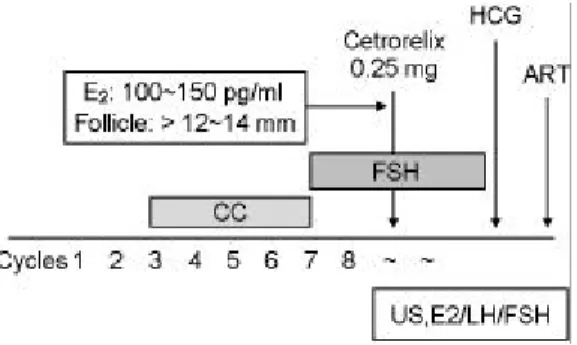
(1) GnRH antagonist group (Figure 1) 생리 3일째부터 5일간 매일 clomiphene citrat e (Cl- omiphene, 한국파마) 100 mg을 경구로 월경주기 8일 째까지 투여하였고, 월경주기 6일째부터 pFSH (Me-
trodine HP, Serono International, Germany) 2 ample을 5~6일간 투여하였다. 생리 8일째부터 초음파 검사 및 Estradiol의 농도를 측정하였으며 Estradiol 농도가 100~150 pg/ml이며 우위난포 직경이 12~14 mm이면 cetrorelix (Cetrotide, Serono International, Germany) 0.25 mg을 단일 피하주사 하였다. 우성난포의 직경이 18 mm 이상이거나, 평균 직경이 14 mm 이상인 난포 가 2개 이상인 경우에 hCG 10,000 I.U (Choriomon, IBSA, Swizerland)를 근육주사 하였으며 투여일 아침 에 혈중 Estradiol, LH, FSH를 측정하였다.
(2) GnRH agonist group (Figure 2) 생리 2일째부터 leuprolide acetate (Lucrin, Abott, France, 2 ml/ample)을 매일 피하고 0.2 cc (1.4 mg) 씩 주사하고, 생리 2일 3일째 2일간 pFSH 3앰플 (225 IU) 씩 근주하였다. 이전 주기에 과배란 양상이나 고반응을 보였던 환자는 처음 시작 용량을 낮추어 2앰플 (150 IU)로 시작하였다. 이후에는 pFSH 1앰 플 (75 IU)을 계속 주사하였다. 그러나 난포의 성숙 이 활성화 되지 않으면 7일 후 pFSH 150 IU를 주사 한다.
2) 난자 채취
최종 난포성숙을 유도하기 위해 hCG 주사 36시간 후에 질식초음파를 이용해 난포에서 난자를 채취하 였다. 난자를 포함하고 있는 난포액은 2 ml Dulbe- ccos phosphate buffered saline (D-PBS; GIBCO libora- tory)를 포함하고 있는 난포액 수집용기에 흡입 후 난포액과 D-PBS 용액이 들어있는 혼합액을 배양접 시에 옮겨 담아 해부현미경으로 난자의 존재 여부를 확인하고, 또한 도립현미경으로 난자의 형태 및 성 숙 정도를 확인하였다. 채취된 난자는 성숙 정도에
따라 SSS가 첨가된 P-1 배양액이 들어있는 수정 배 양접시로 각기 다르게 옮긴 다음 수정시까지 37℃, 5% CO2가 공급되는 배양기에서 배양하였다.
3) 정자의 준비 및 수정
난자 채취 후 수음으로 남편의 정액을 sterile spe- cimen container (Baxter, USA)에 무균적으로 받아 실 온에서 20분 정도 방치하여 액화시킨 후 정자의 농 도와 운동성을 WHO 기준에 따라 측정하였다. 정자 처리는 2차례의 원심분리와 swim-up 방법을 사용하 였다. 즉, Isolat e kit의 상층용액과 하층용액을 각각 1.5 ml 씩 15 ml conical tube에 넣어 두 층을 만들고 윗부분에 액화된 정액을 올려 놓은 후 300 rpm에서 20분간 원심분리한 후 정자괴를 제외한 상층액을 제거하였다. 남은 정자괴에 1 ml의 배양액을 조심 스럽게 추가하여 CO2 배양기에서 1시간 정도 정자 를 swim-up시켰다. 운동성 정자를 포함하고 있는 상 층액만을 모아 다시 한번 정자의 수와 운동성을 측 정한 후, 추가 배양이 끝난 난자와 수정시키는데, 이때 수정 배양액 내 정자의 농도는 5×10⁵/ml이 되 도록 조절하였다. 수정 16~18시간 후에 수정 여부 를 확인한 후 새로운 P-1 배양액으로 옮겨 추가 배 양하였다.
4) 배아의 관찰 및 배아의 자궁강내 이식 정상적으로 수정된 배아에서 난할을 관찰하였으 며, 이때 할구의 균등성, 할구 파편의 포함 정도에 따라 배아의 형태학적 등급을 평가하였다. 난자 채 취 후 2일 또는 3일에 양질의 배아만을 골라 'norfolk intrauterine catheter' 이식도관을 이용하여 환자의 자 궁강내로 이식하였다.
Figure 1. GnRH antagonist combined stimulation protocol (minimal stimulation protocol).
Figure 2. GnRH agonist combined step-down low- dose FSH protocol.
5) 임신의 확인
체외수정시술 후 임신 여부는 배아 이식 후 12일 째에 혈청 ?-hCG 농도를 측정하여 10 mIU/ml 이상 이면 임신으로 판정하였다. ?-hCG의 측정을 hCG- beta-kit 을 이용한 방사면역 측정법을 사용하였다. 이 측정의 민감도는 3 mIU/ml이며 interassay variance와 intraassay variance와 intraassay variance는 각각 6.0%, 3.1%이다.
6) 결과 분석
통계적인 분석은 Student's t-test와 Fisher exact test 에 의해 시행되었고, p값이 0.05 미만인 경우에 통계 학적으로 유의한 차이가 있는 것으로 판정하였다.
결 과
1. 임상적인 특성의 비교
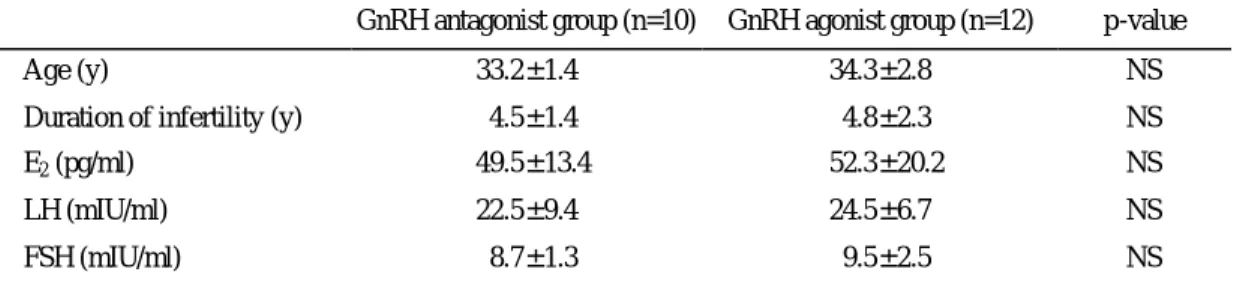
GnRH antagonist군은 minimal stimulation protocol을 이용한 10명 (10주기), GnRH agonist군은 step -down low-dose FSH protocol을 이용한 12명 (12주기)을 대 상으로 하였다. GnRH antagonist군의 평균 연령은 33.2±1.4세, 평균 불임기간은 4.5±1.4년이었다. Gn RH agonist군은 34.3±2.8세, 평균 불임기간은 4.8±
2.3년으로 2군간에 통계적 유의한 차이가 없었다
(Table 1).
2. 혈중 호르몬 농도의 비교
생리 2~3일째의 GnRH antagonist군과 GnRH ago- nist군 사이의 혈중 E2 농도 (pg/ml)와 혈중 LH 농도 (mlU/ml), 혈중 FSH 농도 (mlU/ml)는 2군간에 차이 가 없었다 (Table 1). hCG 투여 날의 혈중 E2 농도는 GnRH antagonist군에서는 2845±125 (pg/ml), GnRH agonist군은 6424±234 (pg/ml)으로 GnRH antagonist 군이 GnRH agonist군에 비해 유의하게 낮았다 (p<
0.01). FSH의 혈중 농도는 GnRH antagonist군이 16.5
±3.4 (mlU/ml), GnRH agonist군이 17.4±4.7 (mlU/ml) 로 두 군 사이에 유의한 차이가 없었다 (Table 2).
3. 과배란 특성과 임상 결과의 비교
치료 주기당 pFSH 사용량 (앰플/주기)은 GnRH antagonist군에서는 22.2앰플, GnRH agonist군은 36.1 앰플로 GnRH agonist군에서의 사용량이 GnRH anta- gonist군의 사용량에 비해 유의하게 많았다 (p<0.05).
과배란 유도기간은 GnRH antagonist군이 13.2±2.8일, GnRH agonist군은 15.8±1.7일로 두 군 사이의 차이 가 없었다.
Table 1. Characteristics and basal hormone profile of women undergoing controlled ovarian hyperstimulaion GnRH antagonist group (n=10) GnRH agonist group (n=12) p-value
Age (y) 33.2±1.4 34.3±2.8 NS
Duration of infertility (y) 4.5±1.4 4.8±2.3 NS
E2 (pg/ml) 49.5±13.4 52.3±20.2 NS
LH (mIU/ml) 22.5±9.4 24.5±6.7 NS
FSH (mIU/ml) 8.7±1.3 9.5±2.5 NS
E2 : Estradiol, LH : Lutenizing hormone, FSH : Follicle stimulation hormone, NS : Not significant
Table 2. Hormone profile of women undergoing controlled ovarian hyperstimulaion at hCG day GnRH antagonist group (n=10) GnRH agonist group (n=12) p-value
E2 (pg/ml) 2845±125 6424±234 < 0.01
LH (mIU/ml) 20.4±2.6 19.5±1.4 NS
FSH (mIU/ml) 16.5±3.4 17.4±2.7 NS
E2 : Estradiol, LH : Lutenizing hormone, FSH : Follicle stimulation hormone, NS : Not significant
4. 임상 결과의 비교
채취된 난자의 수는 GnRH antagonist군이 6.4개, GnRH agonist군이 16.3개로 GnRH antagonist군이 Gn RH agonist군에 비해 유의하게 적었다 (p<0.01). 임 신율은 GnRH antagonist군이 20.0% (2/10주기), Gn RH agonist군이 25% (3/12주기)의 결과를 나타냈다.
난소 과배란 증후군 (OHSS)은 GnRH antagonist군에 서는 발생하지 않았으며 GnRH agonist군에서 2 case 에서 발생하였다. 유산율은 GnRH agonist군에서 3 예의 임신 중 1예 (33.3%)에서 유산하였다. 다태임 신은 GnRH antagonist군에서는 발생하지 않았으며 GnRH agonist군의 한 예에서 twin pregnancy 가 발생 하였다 (Table 3).
고 찰
초기에 보조생식술에 있어 과배란유도 방법은 단 독 외인성 성선자극호르몬 또는 Clomiphene citrat e (CC)을 이용한 방법을 이용하여 만족할만한 임신 율을 보여 광범위하게 사용되었다. 그러나 이 과배 란유도의 주요 단점인 조기 LH surge로 인한 높은 주기취소율은 불임 환자에게 있어 사회적, 신체적, 정신적 부담으로 작용하였다. LH surge를 효과적으 로 통제하기 위해 GnRH agonist를 병합한 과배란유 도 방법이 시도되었으며 현재 대부분의 임상에서 사 용하고 있다.9 이를 통한 난자의 과다 채취는 수정
률과 임신율의 증가를 보였으며 유산율을 낮추고 출생률의 증가를 가져왔다.10 그러나 단독 외인성 성선자극호르몬만을 이용한 과배란유도와 GnRH agonist 병합 과배란유도를 비교한 European study11 의 보고에 따르면 GnRH agonist 병합 과배란유도는 주기당 임신율, 주기취소율 등에서 우위한 결과를 보여주었지만 실제로 이중맹검을 시행하지 않음으 로 인해 단독 외인성 성선자극호르몬만을 이용한 과배란유도 방법을 사용한 집단에 대한 편견의 발 생으로 배란유도의 성공률이 낮아진 점과 GnRH agonist 병합 과배란유도를 사용한 집단에서의 다태 임신과 난소과자극증후군 등의 합병증의 증가와 이 로 인한 경제적, 신체적 손실을 배제하였다고 보고 하였다. 특히 난소과자극증후군은 배란유도에 있어 서 흔한 합병증으로 발생률은 주기당 6%에 이르며 중증 난소과자극증후군은 2%의 빈도로 발생한다.12
이러한 시점에 제 3세대 GnRH antagonist인 Ce- trorelix와 Ganirelix이 소개되었다. 이전의 제 2세대 GnRH antagonist에 비해 히스타민 유리를 통한 알 러지 반응과 아나필락틱양 반응이 나타나지 않으며 수용성의 증가로 약물 효능의 증가를 가져왔다.4 과 배란유도를 받는 환자에 있어서 GnRH agonist는 초 기에 gonadotropin의 분비를 일으키며, 완전한 뇌하 수체 탈감작을 일으키는 데에는 2~3주가 소요된다.
이에 반해 GnRH antagonist는 GnRH 수용체에 경쟁 적 억제제로 작용하여 gonadotropin의 즉각적인 억 제가 가능하며 투약 중단 후에 뇌하수체 기능의 빠 Table 3. Outcome of cycles on minimal stimulation protocol as compared to that of previous cycles on GnRH-a long
stimulation step down protocol in polycystic ovarian syndrome (PCOS) patients
GnRH antagonist group (n=10) GnRH agonist group (n=12) p-value
Cancellation None None -
Duration of stimulation (y) 13.2±2.8 15.8±1.7 < 0.05
Total FSH (ample)/cycle 22.2 36.1 < 0.05
Retrieved oocyte/cycle 6.4 16.3 < 0.01
OHSS None 2 -
Clinical pregnancy/cycle 20% (2/10) 25% (3/12) -
Abortion None 1/3 -
Multiple pregnancy None 1/3 (twin) -
FSH : Follicle stimulation hormone, OHSS : ovarian hyperstimulation syndrome
른 회복을 보여 투약법의 간편화를 가능하게 해 주 었다. 또한 gonadotrop in 사용량의 감소를 가져왔으 며, LH surge를 유발시키기 위해 human chorionic gonadotrophin 대신에 GnRH agonist를 사용할 수 있 게 되었다. 더욱이 이러한 GnRH antagonist를 병합 한 과배란유도 방법의 장점들은 난소과자극증후군 의 발생을 예방한다고 생각되었다.13~15
다낭성 난소증후군은 배란장애를 유발하는 대표 적 내분비 질환으로 알려져 있다. 다낭성 난소증후 군은 시상하부, 뇌하수체, 난소, 그리고 부신 등의 내분비 기관들의 지속적인 불균형의 순환으로 인하 여 희발월경, 조모증, 여성불임 등의 증상을 유발하 게 되는, 특징적 병리조직학적 진단적 기준이 없는 다면성의 임상적 실체로 생각된다. 이 질환의 병태 생리에 관한 일차적 기전에 대하여서는 아직 여러 가지 논란이 많은데 한가지 결함으로는 설명하기 힘들며 여러 원인이 복합적으로 작용하여 발생하는 일련의 순환적인 장애로 여겨진다.16,17 또한 이 질환 의 내분비학적 특징으로는 성선자극호르몬의 이상 분비, 여성호르몬의 무주기적 분비 및 남성호르몬 의 과잉 분비 등 세가지로 요약되나 이들의 기전 역시 명확하지 않은 실정이다.18,19
기존의 다낭성 난소증후군 환자의 치료 목적은 내분비학적인 변화로 발생되는 여러 합병증을 교정 하는 데에 있으며, 이를 위해 불임을 동반한 환자의 치료에는 일차적인 배란유도제로 CC가 쓰이며 이 외에도 hMG, hMG, pure-FSH, 그리고 GnRH-agonist 등이 사용되고 있다. 이중 CC가 불임여성의 배란 유도에 많이 사용되어 왔는데 50~100 mg의 용량으 로 75~80%에서 배란이 발생하였고 이는 비교적 경 제적이며 성공률이 높은 일차적인 배란유도제로 보 고되고 있다.20 그러나 CC에 저항성을 보이는 무배 란 여성들에게 다양한 약제들을 단독 혹은 병용 투 여해 왔으나 다태임신이나 난소과자극증후군 등의 위험한 합병증 발생률이 높아지는 등 그 효과에 있 어 한계를 보여왔다. 특히 난소과자극증후군은 과 배란유도시 발생할 수 있는 가장 심각한 부작용 중 하나로서 때로는 치명적인 합병증을 유발할 수도 있으며 다낭성 난소증후군 환자들에서 과배란유도 를 위하여 hMG나 FSH와 같은 성선자극호르몬을 사용하는 경우에는 난소과자극증후군의 발생 위험
성은 더욱 높은 것으로 알려져 있다.21 정확한 발생 기전은 규명되지 않았지만 난포기 후반의 FSH의 축 적과22 ovarian-renin-angiotensin system이 관계23가 있 을 것이라는 가정이 있다. 이러한 높은 발생률의 난 소과자극증후군을 줄이기 위해 냉동보존 (cryopre- servation)24, LH surge의 유발을 위해 hCG 대신 Gn RH agonist 사용25, hCG 사용 전에 menotropin 투약 의 중단시기의 조절26, 난자흡인 후 albumin 투여27 등과 같은 노력이 있었지만 효과적이지 못하였다.
따라서 이들에서의 과배란유도시 난소과자극증후군 의 발생은 해당 시술주기에서 임신을 포기하는 방 법 이외에는 아직 어떠한 방법도 뚜렷한 효과가 입 증되지 못한 실정이다. 더욱이 현재까지 제시되어 온 대부분의 방법들은 배란유도 과정에서 성선자 극호르몬의 용량을 조절하거나 이미 과다한 난포 의 성장이 이루어진 이후에 대책을 강구하는 형태 였다.
이에 본 불임클리닉에서는 다낭성 난소증후군 환 자를 대상으로 과배란유도시 GnRH antagonist를 병 합한 minimal stimulation protocol과 GnRH agonist를 병합한 step-down low-dose FSH protocol를 비교 연구 하였다. 본 연구 결과에 따르면 난소과자극증후군이 GnRH agonist group에서만 12주기 중 2 case에서 발 생하여 이를 통해 GnRH antagonist를 병합한 배란유 도가 난소과자극증후군의 발생률이 높은 다낭성 난 소증후군 환자에게 있어서 안전하게 사용될 수 있 음을 나타낸다. Albano 등11은 난소과자극증후군이 Cetrorelix를 사용한 군 (2/181=1.1%)에서 Buserelin을 사용한 군 (5/77=6.5%)에 비해 적은 빈도로 나타났 다고 보고하였다 (p=0.03). Borm 등28도 Ganirelix를 사용한 군 (11/463=2.4%)이 Buserelin을 사용한 군 (14/238=5.9%)에 비해 2배 정도 낮은 발생률을 나 타낸다고 보고하였다. Albano 등10은 이러한 난소과 자극증후군 발생률의 감소는 GnRH antagonist 사용 시 gonadotropin의 사용량이 감소하기 때문이라고 설 명하였고 또한 Olivennes5 등도 저용량의 gonadotro- phin을 사용할 경우 난소과자극증후군의 발생 가능 성을 줄일 수 있다고 보고하였다. 본 연구에서도 치 료 주기당 pFSH 사용량 (ample/cycle)은 GnRH anta- gonist group에서는 22.2 ample/cycle, GnRH agonist group은 36.1 ample/cycle로 GnRH antagonist group의
사용량이 유의하게 감소되었다는 결과 (p<0.05)로 위의 설명을 뒷받침한다. 또한 Egbase 등과13 Ulug 등의14 보고에 따르면 Estradiol의 혈중치가 3000 pg/
ml 이하이며 우위난포 직경이 15 mm 이하일 때 gonadotrophin 투약을 중단할 경우 난소과자극증후 군의 발생빈도가 감소하며 이를 통해 Estradiol과 난 소과자극증후군의 연관성을 설명하였다. 본 연구에 서 생리 2~3일째 시행한 두 집단 사이의 혈중 Es- tradiol 농도 (pg/ml)와 혈중 LH 농도 (mlU/ml), 혈중 FSH 농도 (mlU/ml)는 두 군간에 차이가 없었으나 hCG 투여 날의 혈중 Estradiol 농도 (pg/ml)는 GnRH antagoist group에서는 2845±125 pg/ml, GnRH agonist group은 6424±234 pg/ml으로 GnRH antagonist group 이 유의하게 낮음 (p<0.01)이 증명되어 GnRH anta- gonist를 병합한 과배란유도가 난소과자극증후군 발 생률에 유익한 영향을 준다고 판단된다.
다낭성 난소증후군 환자 중 과배란유도를 받는 여성에서 난포기 후반에 GnRH antagonist의 사용으 로 투약법상 투약기간의 단축, 단순화 및 생명 위협 적 질환인 난소과자극증후군 및 다태임신의 감소 가능성을 제시하여 이에 대한 더 많은 환자를 대상 으로 장기적인 연구가 필요할 것으로 사료된다.
참 고 문 헌
1. Tummon IS, Daniel SAJ, Kaplan BR, Nisker JA, Yuzpe AA. Randomized, prospective comparison of luteal leuprolide acetate and gonadotropins versus clomiphene citrate and gonadotropins in 408 first cycles of in vitro fertilizatin. Fertil Steril 1992; 58:
563-8.
2. Poter RN, Smith W, Craft IL. Induction of ovulation for in vitro fertilization using buserelin and gona- dotropins. Lancet II 1984; 1284-5.
3. Albrecht JL, Tomich PG. The maternal and neonatal outcome of triple gestations. American Journal of Obstetrics and Gynecology 1996; 174: 1551-6.
4. Judith AF Huirne, Cornelis B Lambalk. Gonado- tropin-releasing-hormone-receptor antagonists. The Lancet 2001; 358: 1793-803.
5. Olivennes F, Fanchin R, Bouchard P, et al. The
single or dual administration of the gonadotrophin- releasing hormone antagonist Cetrorelix is an in vitro fertilization-embryo transfer programme. Fertil Steril 1994; 62: 468-76.
6. Albano C, Riethmuller-Winzen H, Smitz J, Van Steirteghem A, Camus M, Devroey P. Comparison of different doses of gonadotropin-releasing hor- mone antagonist Cetrorelix during controlled ova- rian hyperstimulation. Fertil Steril 1997; 67; 5: 917- 22.
7. Smitz J, Camus M, Devroey P. Incidence of severe ovarian hyperstimulation syndrome after GnRH ago- nist/HMG superovulation for in vitro fertilization.
Hum Reprod 1990; 5: 933-40.
8. Graft I, Gorgy A, Jennifer H, Menon D, Podsiadly B. Will GnRH antagonists provide new hope for patients considered 'difficult responders' to GnRH agonist protocols? 1999; 12(22): 2959-62.
9. Andreyko JL, Marshall LA, Dumesic DA, Jaffe RB. Therapeutic uses of gonadotropin-releasing hor- mone analogs. Obstet Gynecol Surv 1987; 42: 1-21.
10. Albano C, Platteau P, Devroey P. Gonadotropin releasing hormone antagonist: how good is the new hope? Curr Opin Obstet Gynecol 2001; 13: 257-62.
11. Albano C, Felberbaum R, Smitz J, et al. On behalf of the European Cetrorelix Study Group. Ovarian stimulation with HMG: results of a prospective ran- domized phase III European study comparing the luteinizing hormone-releasing hormone (LHRH)- antagonist cetrorelix and the LHRH-agonist busere- lin. Hum Reprod 2000; 3: 526-31.
12. Elchalal U, Schenken JG. The pathophysiology of ovarian hyperstimulation syndrome - views and ideas. Hum Reprod 1997; 12: 1129-37.
13. Egbase PE, Sharhan M, Grudzinskas J. 'Early co- asting' in patients with polycystic ovarian syndrome is consistent with good clinical outcome. Hum Re- prod 2002; 17: 1212-6.
14. Ulug U, Bahceci M, Erden H, Shalev E, Ben- Shlomo I. The significance of coasting duration during ovarian stimulation for conception in assi-
sted fertilization cycles. Hum Reprod 2002; 17(2):
310-3.
15. Demetrios M, Michael MA, Selwyn PO, Susan ML, Joseph FM, Spyros NP. Gonadotropin-releasing hormone antagonist versus agonist administration in women undergoing controlled ovarian hyperstimu- lation: Cycle performance and in vitro steroidoge- nesis of granulosa-lutein cells. American Journal of Obstetrics and Gynecology 1995; 172(5): 1518-25.
16. Hoff JD, Lasley BL, Yen SSC. The functional relationship between priming and releasing actions of luteinizing hormone-releasing hormone. J Clin Endocrinol Metab 1979; 49: 8-15.
17. Yen SSC. The polycystic ovarian disease. Clin En- docrinol (Oxford) 1980; 12: 177-207.
18. Yen SSC, Jaffe RB. Reproduction. Endocrinology 3rd Ed, Philadelpia, WB Saunders 1991; 593-7.
19. Falcone T, Bourque J, Granger L, Hemmings R, Miron P. Polycystic ovary syndrome. Current Ro- blems Obset Gynecol Fertil 1993; 16: 72-89.
20. Gysler MG, March CM, Mishell DR, Gailey EJ. A decade's experience with an individualized clomi- phene treatment regimen including its effect on the postcoital test. Fertil Steril 1982; 37: 161-7.
21. Chung-hoon Kim, Hee-done C, Eun-hee K, Hyung- sik C, Byund-moon K, Yoon-seok C. The effects of somatostatin analogue on ovarian response to ovu- lation induction in patients with polycystic ovarian syndrome. 대한산부회지 1999; 42(3): 496-503.
22. Ben-Rafael Z, Strauss JF III, Mastroianni L Jr, Flickinger GL. Differences in ovarian stimulation in
human menopausal gonadotropin treated woman may be related to follicle-stimulating hormone ac- cumulation. Fertil Steril 1986; 46: 586-92.
23. Navot D, Margalioth EJ, Laufer N, Birkenfeld A, Relou A, Rosler A, et al. Direct correlation between plasma renin activity and severity of the ovarian hyperstimulation syndrome. Fertil Steril 1987; 48:
57-61.
24. Wu TCJ, Gelety TH, Jih MH, Fournet N, Buyalos RP. Successful management of predicted severe ovarian hyperstimulation syndrome with gonado- tropin-releasing hormone agonist. J Assist Reprod Genet 1992; 622-4.
25. Itskovitz J, Boldes R, Levron J, Erlik Y, Kahana L, Brandes JM. Induction of preovulatory luteinizing hormone surge and prevention of ovarian hypersti- mulation syndrome by gonadotropin-releasing hor- mone agonist. Fertil Steril 1991; 56: 213-20.
26. Urman B, Pride SM, Yuen BH. Management of overstimulated gonadotrophin cycles with a con- trolled drift period. Hum Reprod 1992; 7: 918-22.
27. Hall JE. Gonadotropin-releasing hormone antago- nists: Effects on the ovarian follicle and corpus luteum. Clin Obstet Gynecol 1993; 36: 744-52.
28. Borm G, Mannaerts B. The European Orgalutran Study Group. Treatment with the gonadotrophin- releasing hormone antagonist ganirelix in women undergoing ovarian stimulation with recombinant follicle stimulating hormone is effective, safe and convenient: results of a controlled, randomiz ed, mul- ticentre trial. Hum Reprod 2000; 15: 1490-8.