• 검색 결과가 없습니다.

Primary Intrapulmonary Thymoma Presenting as a Solitary Pulmonary Nodule

N/A
N/A
Protected

Academic year: 2021

Share "Primary Intrapulmonary Thymoma Presenting as a Solitary Pulmonary Nodule"

Copied!
5
0
0

로드 중.... (전체 텍스트 보기)

전체 글

(1)

ISSN: 2233-601X (Print) ISSN: 2093-6516 (Online)

Received: February 19, 2016, Revised: April 24, 2016, Accepted: April 26, 2016, Published online: February 5, 2017

Corresponding author: In Kyu Park, Department of Thoracic and Cardiovascular Surgery, Seoul National University Hospital, Seoul National University College of Medicine, 101 Daehak-ro, Jongno-gu, Seoul 03080, Korea

(Tel) 82-2-2072-2342 (Fax) 82-2-764-3664 (E-mail) [email protected]

© The Korean Society for Thoracic and Cardiovascular Surgery. 2017. All right reserved.

This is an open access article distributed under the terms of the Creative Commons Attribution Non-Commercial License (http://creativecommons.org/

licenses/by-nc/4.0) which permits unrestricted non-commercial use, distribution, and reproduction in any medium, provided the original work is properly cited.

Primary Intrapulmonary Thymoma Presenting as a Solitary Pulmonary Nodule

Woohyun Jung, M.D., Chang Hyun Kang, M.D., Young Tae Kim, M.D., In Kyu Park, M.D.

Department of Thoracic and Cardiovascular Surgery, Seoul National University Hospital, Seoul National University College of Medicine

Primary intrapulmonary thymoma (PIT) is a very rare lesion of uncertain pathogenesis. PIT should be con- sidered when the histopathological appearance of a lung tumor shows features that are uncommon but sim- ilar to those of a thymoma. In this case report, we discuss the case of a 5 9-year-old female with a solitary pulmonary nodule that was confirmed to be PIT on the basis of pathological tests. Treatment with complete resection showed good results.

Key words: 1. Thymoma

2. Solitary pulmonary nodule 3. Diagnosis

4. Histology

Case report

Primary intrapulmonary thymoma (PIT) was first reported by McBurney in 1951. PIT displays the characteristic histological features of a thymoma, with the additional characteristic of being surrounded by lung or visceral pleura without evidence of a thymic lesion in the anterosuperior mediastinum [1]. Due to its rarity, variety, unclear natural course, and non- specific features on diagnostic imaging, a formal diag- nosis can be made only based on a pathological examination. Therefore, surgical resection should be considered for an exact diagnosis, unlike is the case for mediastinal thymomas. Herein, we report the case of a patient who was initially suspected to have lung cancer on the basis of a bronchoscopic biopsy but was later diagnosed with PIT after surgery followed by a pathological examination. Written informed con- sent was obtained from the patient for the pub-

lication of this case report and all accompanying images.

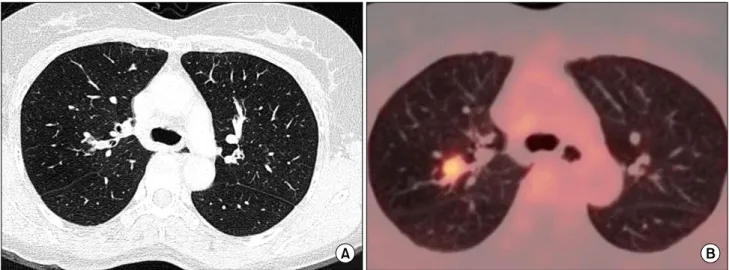
A 59-year-old asymptomatic female with a history of partial thyroidectomy for papillary thyroid cancer visited for the evaluation of pulmonary nodules ob- served in a low-dose chest computed tomography (CT) scan. There was a 1.1-cm nodule in the right upper lobe (RUL) and a 5-mm small ground glass nodule in the left upper lobe. The 1.1-cm RUL nodule was suspected to be primary lung cancer, and a con- trast CT scan was performed. In the contrast CT scan, the RUL nodule was observed as a 1.5-cm fin- ger-shaped lesion with a smooth margin in the sub- segmental bronchus of the posterior segment. It had an expansile appearance and showed mild homoge- neous enhancement (Fig. 1A). In positron emission tomography (PET) with 18-F fluorodeoxyglucose (FDG), the maximum standardized uptake value (SUV

max

) of the RUL endobronchial nodule was 4.1 (Fig. 1B).

https://doi.org/10.5090/kjtcs.2017.50.1.54

(2)

Fig. 1. (A) A chest CT scan showed a nodule obstructing the posterior bronchus in the RUL. (B) A positron emission tomography-CT scan, the standardized uptake value of the RUL nodule was 4.1, and it was presumed to be an endobronchial malignancy. CT, computed to- mography; RUL, right upper lobe.

Lung cancer was strongly suspected from the find- ings of the radiological studies, and fiber-optic bron- choscopy was performed to confirm the tissue diagnosis.

The bronchoscopy revealed a smooth surface mass obstructing a subsegmental bronchus of the posterior segment (Fig. 2A). No malignant cells were observed in bronchial washing cytology. However, spindle cell proliferation with moderate cellularity, mild nuclear pleomorphism, and mitosis over 10 per high-power field were identified in the biopsy specimen. The clinical diagnosis was cT1aN0M0 primary lung cancer of the salivary gland type or a spindle cell tumor showing epithelial differentiation; subsequently, thor- acoscopic RUL lobectomy and mediastinal lymph node dissection were performed.

In the macroscopic examination, the white-to-gray tumor measuring 1.4 cm×1.0 cm×0.8 cm showed no evidence of hemorrhage or necrosis. It was well cir- cumscribed and confined to the lung parenchyma. A microscopic evaluation showed a relatively fascicular spindle cell pattern with round-to-oval nuclei (Fig.

2B). Immunohistochemical studies revealed diffuse immunoreactivity for pan cytokeratin, cytokeratin 5/6, p40, and p63 (Fig. 2C). It was also focally pos- itive for CD117 and CD5 (Fig. 2D), but negative for vimentin, S-100 protein, thyroid transcription fac- tor-1, napsin A, and smooth muscle actin. According to the World Health Organization (WHO) classi- fication, these histopathological findings are consistent with type A thymoma. Further, all mediastinal lymph

nodes were free of tumor cells.

Discussion

PIT is a rare disease, and thus far, only 37 cases of this condition have been reported. According to the epidemiological data reported by Myers et al. [1]

in 2007, almost all patients were diagnosed in- cidentally without any symptoms. Autoimmune para- neoplastic syndromes, such as myasthenia gravis or Good syndrome, can be accompanied and are asso- ciated with a poor prognosis. The patients ranged in age from 14 to 79 years. Masses were located in the right lung in approximately 65% and in the left lung in approximately 35% of the patients. The size of the masses ranged from 9 to 129 mm in diameter. On the basis of the WHO classification, there were 7 cas- es of type A, 8 of type AB, 6 of type B1, 5 of type B2, and 7 of type B3 thymoma.

The pathogenesis of PIT is still unclear. It has been suggested that PIT involves thymomas with an ectopic location [2], tumors arising from an un- committed germinative cell [3], and migration of a mediastinal thymoma into the lung. Since the theory of ectopic location is considered to have the most support, PIT has been classified as a tumor of an ec- topic origin in the recently revised WHO histological classification of lung tumors [4].

The radiological findings of PIT are non-specific. In

CT, most PITs present as well-circumscribed hetero-

(3)

Fig. 2. (A) A smooth surface nodule obstructing the posterior bronchus in the right upper lobe was observed during bronchoscopy. (B) A hematoxylin and eosin ×300 stain showed a fascicular spindle cell pattern with round-to-oval nuclei. (C) Immunohistochemical stain for p63 shows diffuse expression (×400). (D) Immunohistochemical stain for CD5 shows weak expression (×400).

geneous masses that are not diagnostic. In the pres- ent case, the nodule was a cylindrical lesion with a smooth margin and showed a homogeneous enhance- ment pattern on the CT. The homogeneous enhance- ment pattern in this case may have been related to the small size of the lesion. A thymoma can show an increased FDG uptake in PET, as in the case of lung cancer, and the amount of the FDG uptake has been reported to have a correlation with the WHO subtype [5]. However, PET is non-specific with respect to the differential diagnosis of PIT because it is not possible to make a histological diagnosis by using SUV

max

. The FDG uptake in the present case was not high, and the nodule was presumed to be a low-grade malignancy.

However, it was not possible to suspect PIT until a pathological diagnosis was performed using a surgical

specimen.

PIT has the same characteristic histological fea- tures as a mediastinal thymoma. Most PITs are diag- nosed postoperatively on the basis of the histopatho- logical features of the surgically obtained specimens.

A cytologic diagnosis based on a biopsy with a

small amount of the thymoma tissue is extremely

challenging. This is in part attributed to the fact that

epithelial cells are difficult to recognize in lym-

phoid-rich aspirate smears and there is an inherent

sampling error in a tumor that frequently displays

heterogeneous histopathology [6]. Moreover, invasion

into an adjacent tissue is difficult to identify in biop-

sy samples. Therefore, most cases, including ours, are

typically clinically diagnosed as primary lung cancer

and staged accordingly before surgery.

(4)

In the fourth edition of the WHO classification, the diagnostic criteria of thymomas have been revised to include histological features using hematoxylin and eosin-stained specimens, which are justified as obli- gatory criteria [7]. Optional criteria and immunohisto- chemical features for the diagnosis are also in- troduced in order to reduce previous ambiguities, im- prove the unsatisfactory reproducibility of the WHO classification, and help to classify thymomas with ambiguous histology. Immunohistochemical markers such as cytokeratin 19 /20, p20, p63, p40, and TdT are routinely used for this purpose.

After a pathological examination of the surgical specimen, we confirmed it to be type A thymoma be- cause of its well-circumscribed and spindle-shaped epithelial cell-rich appearance with relatively low mi- totic activity and minimal atypia in comparison with its histological findings. Further, in the immunohis- tochemical study of our case, the surgical specimen was positive for AE1/3, indicating the epithelial kera- tin origin of the tumor. We assumed it to be the epi- thelium of the salivary gland or a lung-origin malig- nancy because of the positive result of the cytoker- atin (AE1/3) staining of the biopsy specimen, which is also strongly associated with spindle-shaped epi- thelial-cell neoplasms, such as type A thymoma.

Moreover, the positive result for p40 staining, which is a p53 marker that is positive in 9 7% of thymo- mas, supported this result. Additionally, p63, another maker of the spindle-shaped epithelial cells of thy- moma, was positive in our case. The antigen CD20 reveals the existence of focal micronodular areas with a lymphoid stroma and is helpful in the diag- nosis of type A thymoma. However, 50% of type A thymomas show a negative result for CD20, and our result was also negative [8]. CD117, a marker for ep- ithelial cells in thymic carcinoma, was focally positive. The fourth edition of the WHO classification states that tumors should be diagnosed on the basis of hematoxylin and eosin staining; thus, we con- cluded that our case was type A thymoma, although some immunohistochemical studies did not follow the usual pattern of type A thymoma.

PIT should be staged according to the lung cancer staging system because PIT is classified as a malig- nant tumor of the lung according to the WHO histo- logical classification. The Masaoka staging system, which is based on the extent of invasion into media-

stinal structures [9], is not appropriate for the stag- ing of PIT, because PIT exists inside of a lung, and not in the mediastinum, and has an identical anatom- ical condition to that of lung cancer. Further, nodal involvement was described in several cases, which shared an anatomy similar to that of primary lung cancer.

Surgical resection, lobectomy, and systematic lymph node dissection should be the treatment of choice in the case of PIT. A significantly better survival rate was reported in patients who underwent surgical treatment than in those who were conservatively treated in a systematic review by Veynovich et al.

[10]. They suggested that adjuvant radiation therapy be considered in cases of incomplete resection or ex- pansion of the tumor tissue beyond a circumscribed capsule. However, the effect of radiotherapy on the overall survival rate is unclear.

In particular, the need for lymph node dissection has not been adequately discussed because of the rarity of PIT. As previously mentioned, Terashima et al. [11] reported a case of PIT with lymphatic spread;

the sites of nodal metastases were similar to those of primary lung cancer. They argued that systematic mediastinal lymph node dissection according to the lymph node map for primary lung cancer be consid- ered for better staging and most likely, better prognosis.

In our case, video-assisted thoracic surgery lobec- tomy and mediastinal lymph node dissection were performed, and no adjuvant therapy was conducted subsequently, because the mass was confirmed to be type A thymoma without invasion.

In conclusion, PIT is a very rare lesion with un- certain pathogenesis. PIT should be included in the differential diagnosis when the pathology of a lung tumor shows uncommon features. An immunohis- tochemical examination should be performed for an exact diagnosis. Complete resection should be ach- ieved surgically. Since the natural history of the dis- ease has not yet been fully elucidated, regular long-term follow-ups should be performed in accord- ance with primary lung cancer.

Conflict of interest

No potential conflict of interest relevant to this ar-

ticle was reported.

(5)

References

1. Myers PO, Kritikos N, Bongiovanni M, et al. Primary intra- pulmonary thymoma: a systematic review. Eur J Surg Oncol 2007;33:1137-41.

2. Gilmour JR. Some developmental abnormalities of the thymus and parathyroids. J Pathol Bacteriol 1941;52:213-8.

3. Marchevsky AM. Lung tumors derived from ectopic tissues.

Semin Diagn Pathol 1995;12:172-84.

4. Travis WD, Brambilla E, Nicholson AG, et al. The 2015 World Health Organization classification of lung tumors:

impact of genetic, clinical and radiologic advances since the 2004 classification. J Thorac Oncol 2015;10:1243-60.

5. Marom EM. Imaging thymoma. J Thorac Oncol 2010;5(10 Suppl 4):S296-303.

6. Chhieng DC, Rose D, Ludwig ME, Zakowski MF. Cytology of thymomas: emphasis on morphology and correlation with histologic subtypes. Cancer 2000;90:24-32.

7. Marx A, Chan JK, Coindre JM, et al. The 2015 World Health Organization classification of tumors of the thymus: con- tinuity and changes. J Thorac Oncol 2015;10:1383-95.

8. Alexiev BA, Drachenberg CB, Burke AP. Thymomas: a cyto- logical and immunohistochemical study, with emphasis on lymphoid and neuroendocrine markers. Diagn Pathol 2007;2:13.

9. Masaoka A, Monden Y, Nakahara K, Tanioka T. Follow-up study of thymomas with special reference to their clinical stages. Cancer 1981;48:2485-92.

10. Veynovich B, Masetti P, Kaplan PD, Jasnosz KM, Yousem SA, Landreneau RJ. Primary pulmonary thymoma. Ann Thorac Surg 1997;64:1471-3.

11. Terashima H, Saitoh M, Yokoyama S, Nishiyama S,

Hirayama K, Waga T. A case of primary intrapulmonary

thymoma: its entity and the problem of lymph node

dissection. Kyobu Geka 2000;53:369-74.

수치

Fig. 1. (A) A chest CT scan showed a nodule obstructing the posterior bronchus in the RUL

참조

관련 문서

We experienced a case of concurrent diagnosis of primary small cell lung cancer and pulmonary metastasis of uterine malignant mixed Müllerian tumor MMMT.. The patient was a