• 검색 결과가 없습니다.

Primary Intrapulmonary Thymoma Appearing as a Solitary Pulmonary Nodule: The “Master of Disguise” of Lung Tumors?: Case Report

N/A
N/A
Protected

Academic year: 2021

Share "Primary Intrapulmonary Thymoma Appearing as a Solitary Pulmonary Nodule: The “Master of Disguise” of Lung Tumors?: Case Report"

Copied!
4
0
0

로드 중.... (전체 텍스트 보기)

전체 글

(1)

412 http://www.jchestsurg.org

JCS

Journal of Chest Surgery

Case Report

Primary Intrapulmonary Thymoma Appearing as a Solitary Pulmonary Nodule: The “Master of Disguise” of Lung Tumors?:

Case Report

Athanasios Krassas, M.D., FECTS. 1 , Ioannis Diamantis, M.D. 1 , Ioannis Karampinis, M.Sc. 1 , Stefani Vgenopoulou, M.D. 2 , Panagiotis Misthos, M.D., Ph.D. 1

Departments of

1

Thoracic Surgery and

2

Pathology, Sismanogleio General Hospital, Athens, Greece

ARTICLE INFO

Received September 21, 2020 Revised October 20, 2020 Accepted November 9, 2020 Corresponding author Athanasios Krassas Tel 30-2132058255 Fax 30-2132058255

E-mail [email protected] ORCID

https://orcid.org/0000-0001-5873-5008

Primary intrapulmonary thymomas (PITs) are defined as thymomas arising in intrapul- monary locations, without an associated mediastinal component. They are rare lesions, the diagnosis of which can be very difficult. We present a case of PIT in an asymptomatic 74-year-old woman in whom pulmonary nodules were found on pulmonary angiography performed for an episode of pulmonary embolism. She underwent wedge resection and the pathology report revealed a PIT. We also summarize this patient’s clinicopathological features and discuss the diagnosis, pathogenesis, and treatment of PIT.

Keywords: Thymoma, Pulmonary nodule, Multiple, Diagnosis, Histology, Case report

Copyright © 2021, The Korean Society for Thoracic and Cardiovascular Surgery

This is an Open Access article distributed under the terms of the Creative Commons Attribution Non-Commercial License (http://creativecommons.org/licenses/

by-nc/4.0) which permits unrestricted non-commercial use, distribution, and reproduction in any medium, provided the original work is properly cited.

Case report

Thymomas originate from thymic epithelial cells, and their incidence is 0.15/100,000 [1]. The vast majority of thy- momas occur in the antero-superior mediastinum, but ec- topic thymic tissue can be found in the neck, the trachea, the thyroid and parathyroid gland, the pericardium, the heart, the pleura, and the lung. McBurney et al. [2] were the first to report a case of PIT in 1951. Primary intrapul- monary thymomas (PITs) are very rare, and fewer than 50 cases have been reported in the literature. They are defined as tumors with the histopathological characteristics of thy- momas, located either as subpleural lesions or surrounded by pulmonary parenchyma without evidence of a lesion in the antero-superior mediastinum. We report a case of PIT in a 74-year-old woman in whom pulmonary nodules were found incidentally.

A 74-year-old woman was admitted to our department due to multiple bilateral pulmonary nodules, which were found incidentally during pulmonary angiography per- formed for an episode of pulmonary embolism 5 years ago.

They were located in the lingula (2 lesions) and in the right upper lobe (2 lesions, measuring 6 mm). According to her

treating pulmonologist, she was followed up for the nod- ules, and on repeated chest computed tomography (CT) scans, a lingular lesion increased in size (from 9 to 25 mm) during this period, while the other nodules remained sta- ble. She did not present with symptoms of myasthenia gra- vis or Good syndrome. The mediastinum was normal. She underwent 18-fluorodeoxyglucose positron emission to- mography (18FDG-PET)-CT scanning, which showed mild uptake of the lingular nodule (maximum standardized up- take value [SUV

max

]=3.4) without mediastinal involvement.

The other sub-centimetric nodules were negative on PET- CT (Fig. 1). She underwent wedge resection of the lingular lesion and the lesion in the left upper lobe. The frozen sec- tions of both nodules were negative for malignancy. A macroscopic examination showed a well-circumscribed, encapsulated solid tumor measuring 2 cm in diameter (Fig.

2). A microscopic examination revealed a cellular neoplas- tic population of bland ovoid to spindled epithelioid cells with rare, scattered CD1a

+

immature T lymphocytes. The epithelioid neoplastic cells, following immunohistochemi- cal investigation, stained positive for cytokeratin (CK AE1/

AE3) and p63 and negative for CK7, TTF-1, synaptophysin, chromogranin, CD56, CD117, CD34, CD20, CD5, smooth

https://doi.org/10.5090/jcs.20.116

pISSN: 2765-1606 eISSN: 2765-1614

J Chest Surg. 2021;54(5):412-415

(2)

413

Athanasios Krassas, et al. Primary Intrapulmonary Thymoma

http://www.jchestsurg.org

JCS

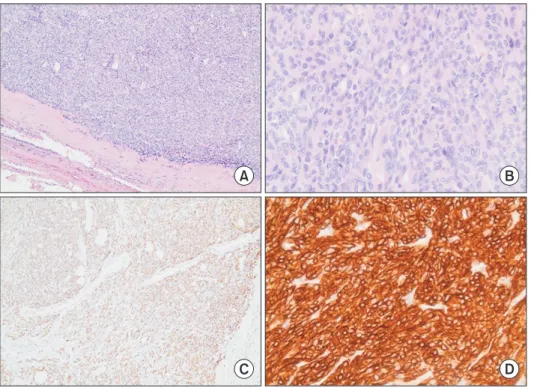
muscle actin, desmin, caldesmon, estrogen receptor, pro- gesterone receptor, vimentin, and CD99. The differential diagnosis, based on the microscopic characteristics of the tumor cells, included intrapulmonary thymoma, solitary fibrous tumor, and carcinoid tumor (Fig. 3).

The macroscopic, microscopic, and immunohistochemi- cal findings led to the diagnosis of intrapulmonary thymo- ma, type A. The left upper lobe nodule was a granuloma.

The patient’s postoperative course was uneventful, and she was discharged home on the seventh postoperative day.

Based on an oncologic consultation, no adjuvant treatment was administered due to the absence of invasion. It was also decided to monitor the other nodules for potential re- section in case of growth. The patient provided written in- formed consent for the publication of her clinical details and images.

Discussion

PIT is a rare intrapulmonary tumor, of which fewer than 50 cases have been reported in the literature. PITs are de- fined as tumors of thymic origin with the characteristic histological features of thymoma, situated below the vis- ceral pleura or completely surrounded by lung parenchy- ma, without a mediastinal component. The first case was reported by McBurney et al. [2] in 1951. They can be soli- tary or multiple and they affect both sexes. They usually occur after the fifth decade of life, with a mean age of 57 years. PITs are usually asymptomatic and they are inciden- tally found on CT scans performed for other reasons. They produce symptoms when they grow large enough to com- press or invade neighboring anatomical structures such as the bronchi, parietal pleura, and bronchial arteries, thereby producing pain, cough, bronchial obstruction, and hemop- tysis. In addition, they can be associated with paraneoplas- tic syndromes (in the same way as mediastinal thymomas).

The most common of these are myasthenia gravis and Good syndrome.

The pathogenesis of PIT is unknown. The most probable scenario accounting for PIT is that of embryologic rem-

Fig. 1. (A–D) 18-fluorodeoxyglucose positron emission tomography–com- puted tomography showing a lin- gular nodule measuring 25 mm in diameter with mild hypermetabo- lism (maximum standardized uptake value=3.4).

A B

C D

Fig. 2. Specimen of wedge resection of the lingula with a periph-

eral, well-circumscribed, encapsulated solid tumor 2 cm in di-

ameter.

(3)

414

https://doi.org/10.5090/jcs.20.116

http://www.jchestsurg.org

JCS

nants. Normally, the thymus develops from a ventral sac- culation of the third pharyngeal pouch, and to a minor ex- tent the fourth pharyngeal pouch, in the sixth week of gestation. During the eighth week, the thymic primordia enlarge towards their lower poles, forming 2 epithelial bars that fuse in the midline, moving caudally to reach the de- finitive position in the antero-superior mediastinum [3].

During the descent, the tail portion breaks in small frag- ments that normally disappear. Occasionally, some rem- nants may persist, producing ectopic thymic tissue and thymomas (located in the neck, thyroid and parathyroid glands, the pleura and the trachea) [4]. Another hypothesis is that PIT arises from stem cells. These cells can differen- tiate along a variety of lines, thereby producing ectopic mature tissues in the lung parenchyma (thyroid, pancreatic adrenal tissue, etc.). Finally, Fukayama et al. [5] suggested that PIT is the result of a monodermal teratoma.

PIT appears on CT as a well-circumscribed, heteroge- neous mass [6]. Our patient also presented with a cylindri- cal mass with smooth borders. The radiological differential diagnosis of PIT includes low-grade malignant tumor, metastatic lung tumor, hamartoma, sclerosing hemangio- ma, lipoma, and angiolipoma. PET-CT can be used for the preoperative workup, as for all solitary pulmonary nodules.

The degree of 18FDG uptake seems to be related with the histologic subtype of the World Health Organization clas- sification of epithelial tumors. Ishibashi et al. [7] men-

tioned that PIT shows mild or no hypermetabolism of 18FDG. In our case, the SUV

max

was 3.4.

Preoperative histologic determination is difficult, and most PITs are diagnosed postoperatively. The diagnosis of PITs is particularly challenging on both biopsy specimens and intraoperative frozen sections, so PIT can be misdiag- nosed. To differentiate a PIT from another intrathoracic tumor, the pathologist must rely on immunohistochemical staining combined with the gross and microscopic patterns of the tumor and the patient’s clinical history. Macroscopi- cally, the examination shows a well-circumscribed and en- capsulated nodule within the pulmonary parenchyma.

PITs usually do not involve the visceral pleura. As with mediastinal thymomas, extension beyond the capsule sug- gests invasiveness, implying a poor prognosis.

Due to the scarcity of available data due to the small number of reported cases, it is difficult to define the opti- mal treatment strategy of PIT, and radical resection re- mains the treatment of choice [3]. Depending on the size and the location of the lesion, the extent of resection rang- es from wedge resection to pneumonectomy according to the largest review to date, authored by Myers et al. [4]. In case of incomplete resection, adjuvant radiotherapy should be considered. This treatment strategy is based in several retrospective studies of incompletely resected mediastinal thymomas. These studies showed reduced local relapse af- ter radiotherapy. The follow-up period must be relatively

Fig. 3. (A) Cellular intrapulmonary thymoma surrounded by a thick fi- brous capsule (H&E, ×100). (B) Neo- plastic epithelioid cells with ovoid spindle cell morphology and lack- ing significant nuclear atypia (H&E,

×400). (C) Immunohistochemical st- aining with p63 antibody showed strong nuclear positivity of the neo- plastic cells for this marker (immu- nohistochemical stain, ×100). (D) St- rong cytoplasmic positivity of the tu mor cells for broad spectrum kera- tin CKAE1/AE3 (immunohistochemi- cal stain, ×200).

A B

C D

(4)

415

Athanasios Krassas, et al. Primary Intrapulmonary Thymoma

http://www.jchestsurg.org

JCS

long, given the substantial risk of recurrence.

In conclusion, PITs are exceedingly rare lesions. Their pathogenesis is currently not clearly understood. Complete resection appears sufficient in non-malignant tumors. In patients who undergo incomplete resection, adjuvant ra- diotherapy should be considered. Long-term follow-up is warranted because of the risk of late local relapse.

Conflict of interest

No potential conflict of interest relevant to this article was reported.

ORCID

Athanasios Krassas: https://orcid.org/0000-0001-5873-5008 Ioannis Diamantis: https://orcid.org/0000-0003-3207-5165 Ioannis Karampinis: https://orcid.org/0000-0003-4363-7047 Stefani Vgenopoulou: https://orcid.org/0000-0002-1454-8814 Panagiotis Misthos: https://orcid.org/0000-0003-2963-1503

References

1. Engels EA, Pfeiffer RM. Malignant thymoma in the United States:

demographic patterns in incidence and associations with subsequent malignancies. Int J Cancer 2003;105:546-51.

2. McBurney RP, Clagett OT, McDonald JR. Primary intrapulmonary neoplasm (thymoma?) associated with myasthenia gravis: report of case. Proc Staff Meet Mayo Clin 1951;26:345-53.

3. Moran CA, Suster S, Fishback NF, Koss MN. Primary intrapulmo- nary thymoma: a clinicopathologic and immunohistochemical study of eight cases. Am J Surg Pathol 1995;19:304-12.

4. Myers PO, Kritikos N, Bongiovanni M, et al. Primary intrapulmo- nary thymoma: a systematic review. Eur J Surg Oncol 2007;33:1137- 41.

5. Fukayama M, Maeda Y, Funata N, et al. Pulmonary and pleural thy- moma: diagnostic application of lymphocyte markers to the thymo- ma of unusual site. Am J Clin Pathol 1988;89:617-21.

6. Jung W, Kang CH, Kim YT, Park IK. Primary intrapulmonary thy- moma presenting as a solitary pulmonary nodule. Korean J Thorac Cardiovasc Surg 2017;50:54-8.

7. Ishibashi F, Moriya Y, Tamura H, Matsui Y, Iizasa T. Differential di- agnosis of primary intrapulmonary thymoma: a report of two cases.

Surg Case Rep 2015;1:56.

수치

Fig. 3. (A) Cellular intrapulmonary  thymoma surrounded by a thick  fi-brous capsule (H&E, ×100)

참조

관련 문서

Percutaneous polymethylmethacrylate vertebroplasty in the treatment of osteoporotic vertebral body compression fractures: technical aspects. Pulmonary embolism caused

§ Due to the late start of construction and frequent design changes during construction, the completion of the project has been one year delayed. of the project has been

As a result of comparing the number of treatments per person by treatment behavior, the fluoride application during the preventive dental operation period was significantly

Therefore, as a recovery method during exercise, it is more effective for recovery of exercise fatigue and prevention of body acidification due to high

As a result of the systematic strength training for six sports climbing speed athletes, there were positive changes due to the improvement of

- For gas-phase reactions, the volumetric flow rate most often changes during the course of the reaction due to a often changes during the course of the reaction due to a change

As a basic study, we developed convoy navigation system which is configured that if a master ship sends its GPS data to a slave ship via wireless LAN

Accordingly, the researcher reinterpreted a 600-year-old MyeongsimBogam text into a modern one, and tried to select texts which are expected to have the effect